
Table of Contents
As filed with the Securities and Exchange Commission on April 27, 2026
Registration No. 333-294989
UNITED STATES
SECURITIES AND EXCHANGE COMMISSION
WASHINGTON, D.C. 20549
AMENDMENT NO. 1
TO
FORM S-1
REGISTRATION STATEMENT
UNDER
THE SECURITIES ACT OF 1933
HEMAB THERAPEUTICS HOLDINGS, INC.
(Exact name of registrant as specified in its charter)
| Delaware | 2836 | 41-4241952 | ||
| (State or other jurisdiction of incorporation or organization) |
(Primary Standard Industrial Classification Code Number) |
(I.R.S. Employer Identification Number) |
101 Main Street, Suite 1220
Cambridge, MA 02142
(617) 553-3952
(Address, including zip code, and telephone number, including area code, of registrant’s principal executive offices)
Benny Sørensen, M.D., Ph.D.
President and Chief Executive Officer
Hemab Therapeutics Holdings, Inc.
101 Main Street, Suite 1220
Cambridge, MA 02142
(617) 553-3952
(Name, address, including zip code, and telephone number, including area code, of agent for service)
Copies to:
| Cynthia T. Mazareas, Esq. Scott N. Lunin, Esq. Wilmer Cutler Pickering Hale and Dorr LLP 60 State Street Boston, Massachusetts 02109 (617) 526-6000 |
Benjamin K. Marsh, Esq. Kristopher D. Brown, Esq. Justin S. Platt, Esq. Goodwin Procter LLP The New York Times Building 620 Eighth Avenue New York, NY 10018 (212) 813-8800 |
Approximate date of commencement of proposed sale to the public: As soon as practicable after this registration statement is declared effective.
If any of the securities being registered on this Form are to be offered on a delayed or continuous basis pursuant to Rule 415 under the Securities Act of 1933, check the following box. ☐
If this Form is filed to register additional securities for an offering pursuant to Rule 462(b) under the Securities Act, please check the following box and list the Securities Act registration statement number of the earlier effective registration statement for the same offering. ☐
If this Form is a post-effective amendment filed pursuant to Rule 462(c) under the Securities Act, check the following box and list the Securities Act registration statement number of the earlier effective registration statement for the same offering. ☐
If this Form is a post-effective amendment filed pursuant to Rule 462(d) under the Securities Act, check the following box and list the Securities Act registration statement number of the earlier effective registration statement for the same offering. ☐
Indicate by check mark whether the registrant is a large accelerated filer, an accelerated filer, a non-accelerated filer, a smaller reporting company or an emerging growth company. See the definitions of “large accelerated filer,” “accelerated filer,” “smaller reporting company” and “emerging growth company” in Rule 12b-2 of the Exchange Act.
| Large accelerated filer | ☐ | Accelerated filer | ☐ | |||
| Non-accelerated filer | ☒ | Smaller reporting company | ☒ | |||
| Emerging growth company | ☒ | |||||
If an emerging growth company, indicate by check mark if the registrant has elected not to use the extended transition period for complying with any new or revised financial accounting standards provided pursuant to Section 7(a)(2)(B) of the Securities Act. ☐
The Registrant hereby amends this registration statement on such date or dates as may be necessary to delay its effective date until the Registrant shall file a further amendment which specifically states that this registration statement shall thereafter become effective in accordance with Section 8(a) of the Securities Act of 1933, as amended, or until the registration statement shall become effective on such date as the Securities and Exchange Commission, acting pursuant to said Section 8(a), may determine.
Table of Contents
The information in this prospectus is not complete and may be changed. We may not sell these securities until the registration statement filed with the Securities and Exchange Commission is effective. This prospectus is not an offer to sell these securities, and we are not soliciting offers to buy these securities in any state or other jurisdiction where the offer or sale is not permitted.
SUBJECT TO COMPLETION, DATED APRIL 27, 2026
PRELIMINARY PROSPECTUS
11,764,706 Shares

Common Stock
This is the initial public offering of shares of common stock of Hemab Therapeutics Holdings, Inc. We are offering 11,764,706 shares of our common stock.
Prior to this offering, there has been no public market for our common stock. It is currently estimated that the initial public offering price per share will be between $16.00 and $18.00. We have applied to list our common stock on the Nasdaq Global Select Market under the symbol “COAG.” We believe that upon the completion of this offering, we will meet the standards for listing on Nasdaq, and the completion of this offering is contingent upon such listing.
We are an “emerging growth company” and a “smaller reporting company” as defined under the U.S. federal securities laws, and, as such, have elected to comply with certain reduced reporting requirements in this prospectus. See the section titled “Prospectus Summary—Implications of Being an Emerging Growth Company and a Smaller Reporting Company.”
See the section titled “Risk Factors” beginning on page 13 to read about factors that you should consider before deciding to invest in shares of our common stock.
| Per Share | Total | |||||||
| Initial public offering price |
$ | $ | ||||||
| Underwriting discounts and commissions(1) |
$ | $ | ||||||
| Proceeds, before expenses, to us |
$ | $ | ||||||
| (1) | See the section titled “Underwriting” for additional information regarding compensation payable to the underwriters. |
We have granted the underwriters the option to purchase up to an additional 1,764,706 shares of common stock from us, at the initial public offering price, less the underwriting discounts and commissions.
The underwriters expect to deliver the shares of common stock on or about , 2026.
Neither the Securities and Exchange Commission nor any state securities commission has approved or disapproved of these securities or determined if this prospectus is truthful or complete. Any representation to the contrary is a criminal offense.
Joint Book-Running Managers
| Goldman Sachs & Co. LLC | Jefferies | Evercore ISI |
Lead Manager
Wedbush PacGrow
, 2026
Table of Contents
| PAGE | ||||
| i | ||||
| 1 | ||||
| 13 | ||||
| Cautionary Note Regarding Forward-Looking Statements and Industry Data |
106 | |||
| 108 | ||||
| 110 | ||||
| 111 | ||||
| 112 | ||||
| 114 | ||||
| Management’s Discussion and Analysis of Financial Condition and Results of Operations |
117 | |||
| 136 | ||||
| 195 | ||||
| 203 | ||||
| 221 | ||||
| 226 | ||||
| 230 | ||||
| 236 | ||||
| Material U.S. Federal Income Tax Considerations for Non-U.S. Holders of Common Stock |
239 | |||
| 243 | ||||
| 252 | ||||
| 253 | ||||
| 254 | ||||
| F-1 | ||||
Neither we nor the underwriters have authorized anyone to provide you any information or make any representations other than those contained in this prospectus or in any free writing prospectuses prepared by or on behalf of us or to which we have referred you. We and the underwriters take no responsibility for, and can provide no assurance as to the reliability of, any other information that others may give you. We and the underwriters are not making an offer to sell these securities in any jurisdiction where the offer or sale is not permitted. You should assume that the information appearing in this prospectus or in any applicable free writing prospectus is current only as of its date, regardless of its time of delivery or any sale of shares of our common stock. Our business, financial condition, results of operations and prospects may have changed since that date.
For investors outside of the United States: we have not, and the underwriters have not, done anything that would permit this offering or possession or distribution of this prospectus in any jurisdiction where action for that purpose is required, other than the United States. Persons outside of the United States who come into possession of this prospectus must inform themselves about, and observe any restrictions relating to, the offering of the shares of our common stock and the distribution of this prospectus outside of the United States.
All trademarks, trade names and service marks appearing in this prospectus are the property of their respective owners. Solely for convenience, the trademarks and trade names in this prospectus may be referred to without the ® and ™ symbols, but such references should not be construed as any indicator that their respective owners will not assert their rights thereto.
Table of Contents
We previously operated as Hemab ApS, a private limited company organized under the laws of the Kingdom of Denmark. For purposes of this offering, we formed Hemab Therapeutics Holdings, Inc., a Delaware corporation, which is the registrant whose name appears on the cover of the registration statement of which this prospectus is a part. In March 2026, we completed a corporate reorganization pursuant to which the shareholders of Hemab ApS exchanged their shares in Hemab ApS for the same number, class and series of newly issued shares in the newly incorporated Delaware company, Hemab Therapeutics Holdings, Inc. and, as a result, Hemab ApS became a wholly owned subsidiary of Hemab Therapeutics Holdings, Inc. Additionally, promptly following the corporate reorganization, Hemab ApS transferred its shares of Hemab Therapeutics Inc., a Delaware corporation and wholly-owned subsidiary of Hemab ApS, to Hemab Therapeutics Holdings, Inc. in exchange for the issuance of a promissory note and, as a result, Hemab Therapeutics Inc. became a wholly owned subsidiary of Hemab Therapeutics Holdings, Inc. Hemab Therapeutics Holdings, Inc. had nominal assets and liabilities and did not conduct any operations prior to the corporate reorganization other than its incorporation. We refer to this reorganization transaction throughout this prospectus as the “corporate reorganization.” See the section of the prospectus titled “Corporate Reorganization” for further details.
Unless otherwise indicated or the context otherwise requires, all references in this prospectus to the terms “Hemab ApS,” “Hemab Therapeutics Holdings, Inc.,” “the company,” “we,” “us” and “our” refer to (1) Hemab ApS and its wholly owned U.S. subsidiary, Hemab Therapeutics Inc., prior to the completion of our corporate reorganization and (2) Hemab Therapeutics Holdings, Inc. and its wholly-owned subsidiaries, Hemab ApS and Hemab Therapeutics Inc., after the completion of the corporate reorganization.
References in this prospectus to “ordinary shares” and “preference shares” refer to the historic share capital of Hemab ApS prior to the completion of the corporate reorganization. All references to “common stock” and “preferred stock” refer to the capital structure of Hemab Therapeutics Holdings, Inc. following completion of the corporate reorganization.
Unless otherwise indicated, all references to “$” or “dollars” in this prospectus refer to U.S. dollars. References to “DKK” in this prospectus refer to Danish kroner. The rate of exchange on December 31, 2025, as reported by the U.S. Treasury for the conversion of U.S. dollars to DKK was $1.00 equals DKK 6.3550. Numerical figures presented in this prospectus have been subject to rounding adjustments.
Unless otherwise indicated, the historical financial and operating information presented in this prospectus as of and for the years ended December 31, 2024 and 2025 is that of Hemab ApS. Upon consummation of the corporate reorganization, the historical consolidated financial statements of Hemab ApS became the historical consolidated financial statements of Hemab Therapeutics Holdings, Inc., the entity whose shares are being sold in this offering.
Shares of common stock of Hemab Therapeutics Holdings, Inc. are being offered by the prospectus included in this registration statement.
i
Table of Contents
This summary highlights information contained elsewhere in this prospectus and does not contain all of the information that you should consider in making your investment decision. Before investing in our common stock, you should carefully read this entire prospectus, including our consolidated financial statements and the related notes thereto and the information set forth in the sections titled “Risk Factors” and “Management’s Discussion and Analysis of Financial Condition and Results of Operations.”
Overview
We are a clinical-stage biotechnology company developing therapies that reimagine the treatment of blood coagulation disorders to sustain life and human resilience. Our mission is to build the leading coagulation company by discovering, developing, and commercializing innovative therapies for the millions of patients worldwide suffering from serious bleeding and thrombotic diseases. Coagulation disorders encompass a broad and heterogeneous group of conditions, and many patients experience significant life-long disease burden due to either a lack of available prophylactic therapies or limitations associated with existing treatment approaches.
Our lead asset, sutacimig (HMB-001), is a bispecific antibody currently in Phase 1/2 clinical development for the prophylactic treatment of Glanzmann thrombasthenia and Phase 2 clinical development for the prophylactic treatment of Factor VII deficiency. Our second clinical-stage asset, HMB-002, is a monovalent antibody in Phase 1/2 clinical development for the subcutaneous prophylactic treatment of Von Willebrand Disease. We are also advancing multiple preclinical and discovery-stage assets.
We estimate that there are approximately an aggregate of 10,000 patients with Glanzmann thrombasthenia and Factor VII deficiency and an aggregate of 120,000 patients with Von Willebrand Disease in the geographies where we intend to commercialize our assets, including the United States, the European Union, Japan, the Gulf Cooperation Council countries and other select regions. With greater disease burden awareness, potential regulatory approvals of new prophylactic options and expanding global reach of these options, we believe the overall number of addressable patients for our clinical-stage assets, and preclinical and discovery stage programs could be greater than we currently estimate.
We aim to establish the industry’s leading coagulation franchise through the execution of our “Hemab 2x3 by 2030” strategic roadmap, which is designed to build a franchise consisting of 2 commercial medicines, 2 new late-stage clinical programs, and 2 new early-stage clinical programs by 2030. We have not yet initiated pivotal trials for any of our product candidates, and due to the novel and unproven nature of our programs, their current stage of development and the lack of approved prophylactic therapies to inform endpoint selection and trial design, we may not be able to achieve our strategic goals on the timeline we expect or at all.
Our Franchise
We are building a franchise designed to address select coagulation disorders where we believe advances in biology, drug modality, and care delivery have the potential to meaningfully improve disease management. We design our assets to address critical gaps in the treatment of coagulation disorders. Based on our plans to commence a Phase 3 clinical trial of sutacimig in Glanzmann thrombasthenia, report data from our Phase 2 clinical trial of sutacimig in Factor VII deficiency and commence clinical development of one of our preclinical assets, we anticipate multiple potentially
1
Table of Contents
value-driving clinical data events in 2026, 2027 and beyond. The following table summarizes our assets and our target indications, as well as the status of development and anticipated clinical data events. We maintain all global economic development and commercialization rights to the assets in our franchise.
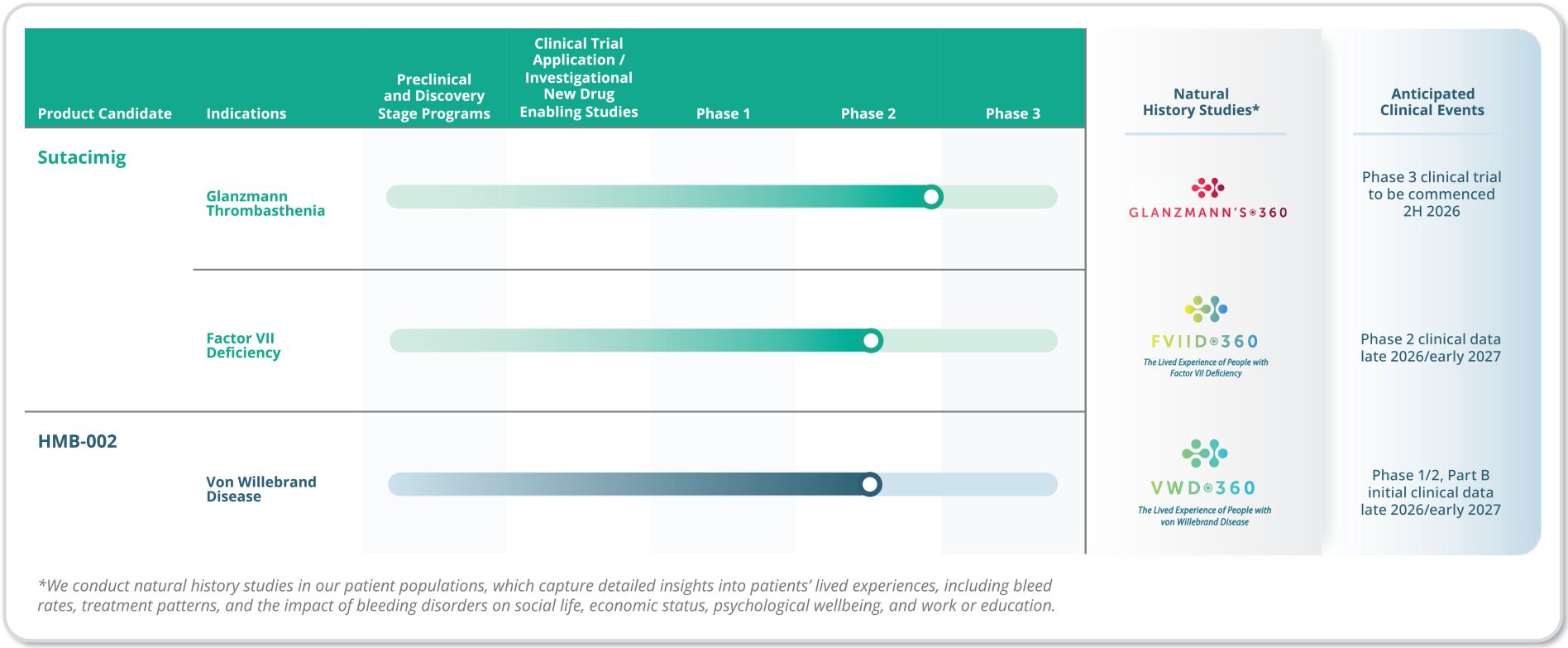
Our lead asset, sutacimig, is a bispecific antibody, which we are currently evaluating in a Phase 1/2 clinical trial for the prophylactic treatment of Glanzmann thrombasthenia and in a Phase 2 clinical trial for the prophylactic treatment of Factor VII deficiency. Glanzmann thrombasthenia and Factor VII deficiency are both congenital, severe, chronic bleeding disorders for which there are no approved subcutaneous prophylactic therapies. Patients with Glanzmann thrombasthenia and Factor VII deficiency suffer from what can be a devastating combination of life-threatening acute hemorrhages and relentless chronic bleeding that profoundly impact patients’ physical health, mental health, and quality of life. Both disorders also carry additional risks for female patients, including heavy menstrual bleeding and potentially life-threatening post-partum hemorrhage.
In our Phase 1/2 clinical trial of sutacimig in patients with Glanzmann thrombasthenia, we have completed the Part A (single ascending dose) and Part B (three-month multiple ascending dose) portions of the trial, and the Part C (long-term extension up to 24 months) portion is currently ongoing. The data from Part A of the trial established proof-of-mechanism. In Part B, the reduction in mean annualized treated bleed rate, or ATBR, for patients treated with sutacimig ranged from 19% to 87%, indicating clinical activity at all regimens tested. Sutacimig also achieved a 100% reduction in mean high-intensity ATBR during the Part B treatment period. In addition, 92% of patients in Part B who had at least one bleed event during the six week prospective run-in period experienced a reduction in ATBR and over 50% of those patients experienced a 50% or greater reduction in ATBR. Based on the clinical data observed as of the data cutoff date of October 14, 2025, we expect to commence a Phase 3 clinical trial of sutacimig in Glanzmann thrombasthenia in the second half of 2026.
We are also conducting a Phase 2 clinical trial that aims to establish proof-of-concept by demonstrating sutacimig’s ability to increase Factor VII levels for patients with Factor VII deficiency. We anticipate reporting clinical data from our Phase 2 trial in late 2026 or early 2027.
Beyond these two initial indications, we believe sutacimig’s mechanism of action has potential applicability across multiple other inherited and acquired bleeding conditions characterized by platelet dysfunction, and other causes of impaired hemostasis where platelet activation occurs at bleeding
2
Table of Contents
sites. We believe this represents a significant opportunity for potential label expansion if sutacimig receives regulatory approval for Glanzmann thrombasthenia or Factor VII deficiency.
Our second clinical-stage asset, HMB-002, is a monovalent antibody, which we are developing for the subcutaneous prophylactic treatment of Von Willebrand Disease. HMB-002 is designed to address the underlying biological drivers of Von Willebrand Disease by increasing endogenous levels of von Willebrand factor, or VWF, and Factor VIII, a blood coagulation protein. Von Willebrand Disease is the most common inherited bleeding disorder and results from a reduced quantity or function of VWF, a plasma protein essential for normal hemostasis. Von Willebrand Disease is characterized by life-threatening hemorrhagic events and chronic mucocutaneous bleeding episodes that combine to harm patients’ physical health, mental well-being, and quality of life. Despite the availability of approved treatments, many patients continue to experience recurrent bleeding and substantial treatment burden, as the approved therapies either require frequent intravenous administration or do not address the underlying biology of the disease. Beyond this initial indication, we believe HMB-002’s intended mechanism of action has potential applicability across other bleeding conditions associated with low VWF levels.
We are currently conducting a Phase 1/2 clinical trial of HMB-002 for Von Willebrand Disease, which we refer to as Velora Pioneer. Velora Pioneer employs an adaptive dose-escalation design with two parts (Part A and Part B). In Part A, we are evaluating the safety, tolerability, pharmacokinetics, and pharmacodynamics of single ascending doses of HMB-002. In Part B, participants transition from Part A into multiple-dose cohorts. As of the data cutoff date of September 2, 2025 for Velora Pioneer, we have completed treatment of two cohorts of patients in Part A at dose levels of 20 mg and 50 mg and are currently evaluating patients in an ongoing 150 mg cohort. In the 20 mg and 50 mg cohorts, VWF and Factor VIII levels increased over 1.5-fold from baseline in a dose-dependent manner. In addition, in the 20 mg cohort, HMB-002 corrected prolonged activated partial thromboplastin time and improved thrombin generation assays, resulting in enhanced overall coagulation activity for patients. Furthermore, a sustained VWF multimer distribution was observed, suggesting that HMB-002 did not impact the protein structure of VWF. We expect to report initial data from Part B of Velora Pioneer in late 2026 or early 2027.
In addition to sutacimig and HMB-002, we are advancing multiple preclinical and discovery-stage assets. The first of our preclinical assets is expected to enter clinical development in the second half of 2026, subject to regulatory submission and clearance.
Our Strategy and Approach
We are guided by our “All Patients Matter” philosophy and by the conviction that individuals living with serious bleeding disorders should not have to live with inadequate treatment options. Our mission is to deliver therapeutics that provide meaningful clinical benefit and enable patients to live full lives that are not defined or limited by their diseases. We aim to establish the industry’s leading coagulation franchise through the execution of our “Hemab 2x3 by 2030” strategic roadmap, which is designed to build a franchise consisting of 2 commercial medicines, 2 new late-stage clinical programs, and 2 new early-stage clinical programs by 2030. We have not yet initiated pivotal trials for any of our product candidates, and due to the novel and unproven nature of our programs, their current stage of development and the lack of approved prophylactic therapies to inform endpoint selection and trial design, we may not be able to achieve our strategic goals on the timeline we expect or at all.
The following core pillars underpin our strategy and guide our approach to reimagining the treatment of coagulation disorders.
| • | We deploy a fundamentally patient-centric approach to drug development, beginning with listening, understanding, and collaboration. |
3
Table of Contents
| • | We leverage our deep domain expertise to identify optimal therapeutic targets and match them to the most appropriate validated drug technology platforms. |
| • | We apply a flexible approach to clinical trial design, to maximize development outcomes and efficiency by leveraging our patient-driven insights. |
| • | We are building the foundations of an efficient and scalable commercial franchise. |
| • | We bring an exceptional depth of experience across the entire value chain of drug discovery, development and commercialization. |
Our Team and History
We have assembled a leadership team and board of directors with deep experience in coagulation medicine and building life sciences companies. Members of our board of directors and leadership and scientific teams have been directly involved in the discovery, development, regulatory approval, or commercialization of an extensive number of drugs approved for hemophilia, Von Willebrand Disease, and other coagulation disorders, including ADYNOVATE, VONVENDI, QFITLIA, ELOCTATE, ALPROLIX, REFIXIA, NOVOEIGHT, ESPEROCT and ANGIOMAX. This collective expertise positions us to efficiently navigate the scientific, regulatory, and commercial complexities inherent in developing therapies for coagulation disorders.
Since inception, we have raised approximately $346.0 million from investors, including Access Biotechnology, Avoro Capital Advisors, Deep Track Capital, HealthCap, Novo Holdings, RA Capital Management, SMALLCAP World Fund and Sofinnova. Prospective investors should not rely on the investment decisions of our existing investors, as these investors may have different risk tolerances and in certain cases received their shares in prior private financings at prices lower than the price offered to the public in this offering.
Summary of Risks Associated with Our Business
Our business is subject to a number of risks of which you should be aware before making an investment decision. These risks are discussed more fully in the “Risk Factors” section of this prospectus. These risks include, but are not limited to, the following:
| • | We have incurred significant losses since our inception and have no products approved for sale. We expect to incur significant losses for the foreseeable future and may never achieve or maintain profitability. |
| • | We have never generated revenue from product sales and may never achieve or maintain profitability. |
| • | We are heavily dependent on the success of sutacimig and HMB-002, which are our only clinical-stage product candidates. |
| • | We will need substantial additional funding. If we are unable to raise capital on acceptable terms when needed, or at all, we could be forced to delay, reduce or eliminate our product development programs or commercialization efforts. |
| • | Our limited operating history may make it difficult for you to evaluate the success of our business to date and to assess our future viability. |
| • | We are early in our clinical development efforts. If we are unable to successfully complete clinical development, obtain marketing approval for, and ultimately commercialize our product candidates, or experience significant delays in doing so, our business will be materially harmed. |
4
Table of Contents
| • | Clinical drug development involves a lengthy and expensive process, with an uncertain outcome. We will be required to incur substantial costs and may experience delays in completing, or ultimately be unable to complete, the development and commercialization of any product candidates. |
| • | The outcome of preclinical studies and earlier-stage clinical trials may not be predictive of the success of later-stage clinical trials. |
| • | Serious adverse events of thrombosis have been identified in the development of sutacimig, and if additional serious adverse events or unacceptable side effects are identified during the development of our product candidates and any other product candidates we may develop, we may need to abandon or limit our development of those product candidates. |
| • | If we engage in future acquisitions, this may increase our capital requirements, dilute our stockholders, cause us to incur debt or assume contingent liabilities, and subject us to other risks. |
| • | Even if any product candidate receives marketing approval, it may fail to achieve the degree of market acceptance by physicians, patients, third-party payors and others in the medical community necessary for commercial success. |
| • | We face substantial competition, which may result in others discovering, developing or commercializing products before or more successfully than we do. |
| • | We rely, and expect to continue to rely, on third parties to conduct our clinical trials, and those third parties may not perform satisfactorily, including failing to meet deadlines for the completion of such trials, which may harm our business. |
| • | We contract with third parties for the manufacture of our product candidates, plan to contract with third parties for any other product candidates we may develop for preclinical and clinical testing and expect to continue to do so for commercialization. This reliance on third parties entails risks, including that such third parties may not be able to comply with applicable regulatory requirements. Any performance failure on the part of our existing or future manufacturers could delay clinical development or marketing approval. |
| • | We may enter into collaborations with third parties for the development or commercialization of product candidates. If our collaborations are not successful, we may not be able to capitalize on the market potential of these product candidates and our business could be adversely affected. |
| • | If we fail to comply with our obligations under our existing license agreements with Novo Nordisk A/S and Genmab A/S, or under any future intellectual property licenses, or otherwise experience disruptions to our business relationships with our current or any future licensors, we could lose intellectual property rights that are important to our business. |
| • | If we are unable to obtain, maintain, enforce, defend and otherwise protect the intellectual property relating to our technology and product candidates, and if the scope of the intellectual property protection obtained is not sufficiently broad, our competitors or other third parties could develop and commercialize technology and products similar or identical to ours, and our ability to successfully develop and commercialize our technology and product candidates may be adversely affected. |
| • | Even if we complete the necessary preclinical studies and clinical trials, the marketing approval process is expensive, time-consuming and uncertain and may prevent us from obtaining approvals for the commercialization of some or all of our product candidates. As a result, we cannot predict when or if, and in which territories, we will obtain marketing approval to commercialize a product candidate. |
5
Table of Contents
| • | We have identified material weaknesses in our internal control over financial reporting. If we are unable to remedy our material weaknesses, or if we fail to establish and maintain an effective system of internal control over financial reporting, we may be unable to produce timely and accurate financial statements or prevent fraud, which could adversely impact our business and our stock price. |
| • | An active trading market for our common stock may not develop. |
Our Corporate Information
We were incorporated under the laws of the State of Delaware on February 12, 2026 under the name Hemab Therapeutics Holdings, Inc. We previously operated as Hemab ApS, a private limited company organized under the laws of the Kingdom of Denmark.
In March 2026, we completed a corporate reorganization, pursuant to which the shareholders of Hemab ApS exchanged their shares in Hemab ApS for the same number, class and series of newly issued shares in Hemab Therapeutics Holdings, Inc. and, as a result, Hemab ApS became a wholly owned subsidiary of Hemab Therapeutics Holdings, Inc. Additionally, promptly following the corporate reorganization, Hemab ApS transferred its shares of Hemab Therapeutics Inc., a Delaware corporation and wholly-owned subsidiary of Hemab ApS, to Hemab Therapeutics Holdings, Inc. in exchange for the issuance of a promissory note and, as a result, Hemab Therapeutics Inc. became a wholly owned subsidiary of Hemab Therapeutics Holdings, Inc. Hemab Therapeutics Holdings, Inc. had nominal assets and liabilities and did not conduct any operations prior to the corporate reorganization other than its incorporation.
Our principal executive offices are located at 101 Main Street, Suite 1220, Cambridge, MA 02142, and our telephone number is (617) 553-3952. We also maintain operations in Copenhagen, Denmark. Our website address is www.hemab.com. The information contained on, or that can be accessed through, our website is not incorporated by reference into this prospectus and you should not consider any such information to be a part of this prospectus. We have included our website address in this prospectus solely as an inactive textual reference.
Implications of Being an Emerging Growth Company and a Smaller Reporting Company
We are an “emerging growth company” as defined in the Jumpstart Our Business Startups Act of 2012, or the JOBS Act. As a result, we are able to take advantage of certain reduced reporting requirements that are otherwise applicable to public companies, including delaying auditor attestation of internal control over financial reporting, providing only two years of audited financial statements and related management’s discussion and analysis of financial condition and results of operations and reduced executive compensation disclosures.
We may remain an emerging growth company until the end of the fiscal year in which the fifth anniversary of this offering occurs. However, if certain events occur prior to the end of such period, including if we become a “large accelerated filer” under rules of the Securities and Exchange Commission, or the SEC, our annual gross revenue exceeds $1.235 billion, or we issue more than $1 billion of non-convertible debt in any three-year period, we will cease to be an emerging growth company prior to the end of such period.
We have elected to take advantage of certain of the reduced disclosure obligations in the registration statement of which this prospectus is a part and may elect to take advantage of other reduced reporting requirements in future filings. In particular, we have provided only two years of audited financial statements and have not included all of the executive compensation-related
6
Table of Contents
information that would be required if we were not an emerging growth company. As a result, the information that we provide to our stockholders may be different than what you might receive from other public reporting companies in which you hold equity interests. In addition, the JOBS Act provides that an emerging growth company can take advantage of an extended transition period for complying with new or revised accounting standards. We have elected not to “opt out” of such extended transition period, which means that when a standard is issued or revised and it has different application dates for public or private companies, we can adopt the new or revised standard at the time private companies adopt the new or revised standard and may do so until such time that we either (1) irrevocably elect to “opt out” of such extended transition period or (2) no longer qualify as an emerging growth company.
We are also a “smaller reporting company” as defined in the Securities Exchange Act of 1934, as amended, or the Exchange Act. We may continue to be a smaller reporting company even after we are no longer an emerging growth company. We may take advantage of certain of the scaled disclosures available to smaller reporting companies until the fiscal year following the determination that (1) our common stock held by non-affiliates is $250 million or more, measured on the last business day of our second fiscal quarter, or (2) our annual revenues are $100 million or more, during the most recently completed fiscal year and our common stock held by non-affiliates is $700 million or more, measured on the last business day of our second fiscal quarter.
7
Table of Contents
THE OFFERING
Common stock offered by us
| 11,764,706 shares. |
| Option to purchase additional shares of common stock |
We have granted the underwriters an option for a period of 30 days to purchase up to 1,764,706 additional shares of our common stock at the initial public offering price, less the underwriting discounts and commissions. |
| Common stock to be outstanding immediately following this offering |
39,207,616 shares (or 40,972,322 shares if the underwriters exercise their option to purchase additional shares of common stock in full). |
| Use of proceeds |
We estimate that the net proceeds to us from this offering will be approximately $180.3 million (or approximately $208.2 million if the underwriters exercise their option to purchase additional shares in full), based on an assumed initial public offering price of $17.00 per share, the midpoint of the price range set forth on the cover page of this prospectus, after deducting estimated underwriting discounts and commissions and estimated offering expenses payable by us. |
| We intend to use the net proceeds to us from this offering, together with our existing cash, cash equivalents, and marketable securities, to fund clinical development of sutacimig for the treatment of Glanzmann thrombasthenia and Factor VII deficiency and HMB-002 for the treatment of Von Willebrand Disease; additional discovery, preclinical, and clinical activities for current and future programs; and the remainder for working capital and other general corporate purposes. See “Use of Proceeds.” |
| Risk factors |
You should read the “Risk Factors” section of this prospectus for a discussion of factors to consider carefully before deciding to invest in our common stock. |
| Proposed Nasdaq Global Select Market symbol |
“COAG” |
The number of shares of our common stock to be outstanding immediately following this offering is based on 27,442,910 shares of our common stock outstanding as of March 31, 2026, after giving
8
Table of Contents
effect to the automatic conversion of 1,204,405 shares of our preferred stock into an aggregate of 26,496,910 shares of common stock upon the completion of this offering.
The number of shares of our common stock to be outstanding immediately following this offering excludes:
| • | 4,372,742 shares of common stock issuable upon exercise of warrants outstanding as of March 31, 2026 with a weighted-average exercise price of $5.84 per share; |
| • | 4,180,000 shares of our common stock that will become available for future issuance under our 2026 Equity Incentive Plan, or the 2026 Plan, which will become effective immediately prior to the effectiveness of the registration statement of which this prospectus is a part, as well as any automatic increases in the number of shares of common stock reserved for future issuance under the 2026 Plan, of which we have granted stock options to purchase an aggregate of 306,900 shares of common stock, at an exercise price per share equal to the initial public offering price, effective upon the pricing of this offering; and |
| • | 418,000 shares of our common stock that will become available for future issuance under our 2026 Employee Stock Purchase Plan, or the 2026 ESPP, which will become effective immediately prior to the effectiveness of the registration statement of which this prospectus is a part, as well as any automatic increases in the number of shares of common stock reserved for future issuance under the 2026 ESPP. |
Unless otherwise indicated, all information in this prospectus reflects and assumes:
| • | the consummation of the transactions described under the section titled “Corporate Reorganization”; |
| • | no issuance or exercise of outstanding warrants as described above; |
| • | no exercise by the underwriters of their option to purchase additional shares of our common stock; |
| • | the automatic conversion of all outstanding shares of our preferred stock into an aggregate of 26,496,910 shares of our common stock upon the completion of this offering; and |
| • | a 22-for-one stock split of our common stock, and a proportionate adjustment in the ratio at which our preferred stock is convertible into our common stock, that became effective on April 24, 2026; and |
| • | the filing and effectiveness of our restated certificate of incorporation and the adoption of our amended and restated bylaws immediately prior to the completion of this offering. |
9
Table of Contents
SUMMARY CONSOLIDATED FINANCIAL DATA
The following tables set forth our summary consolidated financial data for the years ended December 31, 2024 and 2025. We have derived the summary statement of operations and comprehensive loss data for the years ended December 31, 2024 and 2025 and the balance sheet data from our consolidated financial statements included elsewhere in this prospectus. Our consolidated financial statements have been prepared in accordance with U.S. generally accepted accounting principles, or GAAP. Our historical results are not necessarily indicative of the results that may be expected for any period in the future. You should read the following summary financial data together with the “Management’s Discussion and Analysis of Financial Condition and Results of Operations” section of this prospectus and our consolidated financial statements and the related notes included elsewhere in this prospectus. The summary consolidated financial data included in this section are not intended to replace the consolidated financial statements and are qualified in their entirety by our consolidated financial statements and the related notes included elsewhere in this prospectus.
| Year Ended December 31, | ||||||||
| 2024 | 2025 | |||||||
| (in thousands, except share and per share data) |
||||||||
| Statements of Operations and Comprehensive Loss Data: |
||||||||
| Operating Expenses: |
||||||||
| Research and development |
$ | 41,412 | $ | 59,632 | ||||
| General and administrative |
8,971 | 10,487 | ||||||
|
|
|
|
|
|||||
| Total operating expenses |
50,383 | 70,119 | ||||||
|
|
|
|
|
|||||
| Loss from operations |
(50,383 | ) | (70,119 | ) | ||||
| Other income (expense), net: |
||||||||
| Interest income |
3,740 | 1,974 | ||||||
| Other income (expense), net |
(1,879 | ) | 4,005 | |||||
|
|
|
|
|
|||||
| Total other income (expense), net |
1,861 | 5,979 | ||||||
|
|
|
|
|
|||||
| Loss before income tax (expense) benefit |
(48,522 | ) | (64,140 | ) | ||||
| Income tax (expense) benefit |
(185 | ) | 227 | |||||
|
|
|
|
|
|||||
| Net loss |
$ | (48,707 | ) | $ | (63,913 | ) | ||
|
|
|
|
|
|||||
| Net loss per share, basic and diluted(1) |
$ | (51.49 | ) | $ | (67.56 | ) | ||
|
|
|
|
|
|||||
| Weighted-average shares outstanding, basic and diluted(1) |
946,000 | 946,000 | ||||||
|
|
|
|
|
|||||
| Other comprehensive income (loss): |
||||||||
| Net unrealized (loss) gain on available-for-sale securities |
(1,333 | ) | 540 | |||||
|
|
|
|
|
|||||
| Total other comprehensive income (loss) |
(1,333 | ) | 540 | |||||
|
|
|
|
|
|||||
| Total comprehensive loss |
$ | (50,040 | ) | $ | (63,373 | ) | ||
|
|
|
|
|
|||||
| Pro forma net loss per share, basic and diluted (Unaudited)(2) |
$ | (2.33 | ) | |||||
|
|
|
|||||||
| Pro forma weighted-average shares outstanding, basic and diluted (Unaudited)(2) |
27,442,910 | |||||||
|
|
|
|||||||
| (1) | See Note 2 and Note 14 to our consolidated financial statements included elsewhere in this prospectus for an explanation of the calculations of our net loss per share, basic and diluted, and the weighted-average number of shares used in the computation of per-share amounts. |
10
Table of Contents
| (2) | The unaudited pro forma net loss per share, basic and diluted, for the year ended December 31, 2025 has been prepared to give effect to (1) the corporate reorganization, as if the corporate reorganization had occurred on the first day of the period presented, including the exchange by existing shareholders of their shares in Hemab ApS for the same number, classes and series of newly issued shares in Hemab Therapeutics Holdings, Inc. and the assumption and conversion of each outstanding warrant to subscribe for the purchase of ordinary shares of Hemab ApS into a warrant to purchase the same number of shares of our common stock, and (2) the automatic conversion of all outstanding shares of convertible preferred stock into shares of common stock, which conversion will occur upon the completion of this offering, as if such conversion had occurred on the first day of the period presented. |
| As of December 31, 2025 | ||||||||||||
| Actual | Pro Forma(1) |
Pro Forma As Adjusted(2) |
||||||||||
| (Unaudited) | (Unaudited) | |||||||||||
| (in thousands, except for share data) | ||||||||||||
| Balance Sheet Data: |
||||||||||||
| Cash, cash equivalents and marketable securities |
$ | 185,485 | $ | 185,485 | $ | 365,735 | ||||||
| Working capital(3) |
181,874 | 181,874 | 362,124 | |||||||||
| Total assets |
194,783 | 194,783 | 375,033 | |||||||||
| Total liabilities |
11,250 | 11,250 | 11,250 | |||||||||
| Convertible preference shares |
360,168 | — | — | |||||||||
| Additional paid-in capital |
4,916 | 365,213 | 545,462 | |||||||||
| Accumulated deficit |
(181,858 | ) | (181,858 | ) | (181,858 | ) | ||||||
| Total stockholders’ (deficit) equity |
(176,635 | ) | 183,533 | 363,783 | ||||||||
| (1) | The pro forma consolidated balance sheet data gives effect to (1) the corporate reorganization, as if the corporate reorganization had occurred as of December 31, 2025, including the exchange by existing shareholders of their shares in Hemab ApS for the same number, classes and series of newly issued shares in Hemab Therapeutics Holdings, Inc. and the assumption and conversion of each outstanding warrant to subscribe for the purchase of ordinary shares of Hemab ApS into a warrant to purchase the same number of shares of our common stock, (2) the automatic conversion of all outstanding shares of convertible preferred stock into shares of common stock, which conversion will occur upon the completion of this offering, and (3) the filing and effectiveness of our amended and restated certificate of incorporation, which will occur immediately prior to the effectiveness of the registration statement of which this prospectus forms a part. |
| (2) | The pro forma as adjusted balance sheet data give effect to (i) the pro forma adjustments set forth in footnote (1) above and (ii) the issuance and sale of 11,764,706 shares of our common stock in this offering at an assumed initial public offering price of $17.00 per share, the midpoint of the price range set forth on the cover page of this prospectus, after deducting the estimated underwriting discounts and commissions and estimated offering expenses payable by us. |
| (3) | We define working capital as current assets less current liabilities. See our consolidated financial statements and the related notes included elsewhere in this prospectus for further details regarding our current assets and current liabilities. |
The pro forma as adjusted information discussed above is illustrative only and will change based on the actual initial public offering price and other terms of this offering determined at pricing. Each $1.00 increase (decrease) in the assumed initial public offering price of $17.00 per share, the midpoint of the price range set forth on the cover page of this prospectus, would increase (decrease) our pro forma as adjusted amount of each of our cash, cash equivalents, and marketable securities, working capital, total assets and total stockholders’ (deficit) equity by approximately $10.9 million, assuming that the number of shares offered by us, as set forth on the cover page of this prospectus, remains the
11
Table of Contents
same and after deducting estimated underwriting discounts and commissions and estimated offering expenses payable by us. We may also increase (decrease) the number of shares we are offering. A 1.0 million share increase (decrease) in the number of shares offered by us, as set forth on the cover page of this prospectus, would increase (decrease) the pro forma adjusted amount of each of our cash, cash equivalents, and marketable securities, working capital, total assets and total stockholders’ (deficit) equity by approximately $15.8 million, assuming the assumed initial public offering price per share remains the same, and after deducting estimated underwriting discounts and commissions and estimated offering expenses payable by us.
12
Table of Contents
Investing in our common stock involves a high degree of risk. You should carefully consider the risks and uncertainties described below together with all of the other information contained in this prospectus, including our consolidated financial statements and the related notes appearing at the end of this prospectus, before deciding to invest in our common stock. The risks described below are not the only risks facing our company. The occurrence of any of the following risks, or of additional risks and uncertainties not presently known to us or that we currently believe to be immaterial, could cause our business, prospects, operating results and financial condition to suffer materially. In such an event, the trading price of our common stock could decline, and you might lose all or part of your investment.
Risks Related to Our Financial Position, Need for Additional Capital and Limited Operating History
We are a clinical-stage biopharmaceutical company, have no products approved for sale and have incurred significant losses since our inception. We expect to incur significant losses for the foreseeable future and may never achieve or maintain profitability.
We are a clinical-stage biopharmaceutical company with a limited operating history. Since our inception, we have devoted substantially all of our financial resources and efforts to research and development, including clinical trials and preclinical studies of our product candidates, sutacimig and HMB-002, and have incurred significant operating losses. Our net losses were $48.7 million and $63.9 million for the years ended December 31, 2024 and 2025, respectively. As of December 31, 2025, we had an accumulated deficit of $181.9 million. We have no approved products, and we have not generated any revenue from product sales. We have financed our operations primarily through private placements of convertible preference shares, including our Series C financing, which we completed in October 2025, for aggregate gross proceeds of $156.9 million, and issuances of convertible debt. We are still continuing to research and develop our product candidates, and we have not yet completed the development of any of our product candidates. We expect to continue to incur significant operating expenses and net losses for the foreseeable future. Our operating expenses and net losses may fluctuate significantly from quarter to quarter and year to year. Accordingly, you should not rely upon the results of any particular quarterly or annual period as indications of future operating performance. Because of the numerous risks and uncertainties associated with developing pharmaceutical products, we are unable to predict the extent of any future losses or when we will become profitable, if at all. Even if we become profitable, we may not be able to sustain or increase our profitability on a quarterly or annual basis.
We anticipate that our expenses will increase substantially, if and as, we:
| • | continue to advance the clinical development of our product candidates, including our ongoing Phase 1/2 clinical trial of sutacimig in patients with Glanzmann thrombasthenia, our ongoing Phase 2 clinical trial of sutacimig in patients with Factor VII deficiency, and our ongoing Phase 1/2 clinical trial of HMB-002 in patients with Von Willebrand Disease, as well as any other product candidates that we may develop; |
| • | advance our clinical-stage product candidates into later-stage clinical trials, including our planned Phase 3 clinical trial of sutacimig in patients with Glanzmann thrombasthenia, which will be required in order to seek marketing approval of our product candidates, and which we expect will be substantially more expensive than our earlier-stage clinical trials; |
| • | continue to advance our research and preclinical activities and seek to discover and develop additional product candidates; |
| • | establish and scale-up manufacturing processes and capabilities, or arrange for a third party to do so on our behalf, to support our clinical trials of our product candidates and commercialization of any of our product candidates for which we obtain marketing approval; |
13
Table of Contents
| • | seek regulatory and marketing approvals for any of our product candidates that successfully complete clinical trials; |
| • | ultimately establish a sales, marketing, medical affairs and distribution infrastructure to commercialize any products for which we may obtain marketing approval; |
| • | continue to develop, maintain, expand and protect our intellectual property portfolio (including intellectual property obtained through license agreements) and provide reimbursement of third-party expenses related to our patent portfolio; |
| • | acquire or in-license products, product candidates or technologies; |
| • | establish or maintain collaborations; |
| • | maintain, expand, enforce, defend and protect our intellectual property; |
| • | hire additional clinical, medical, regulatory, quality control, manufacturing and other scientific and technical personnel; |
| • | add operational, financial, clinical, quality and management information systems and personnel, including personnel to support our product development and planned future commercialization efforts of our product candidates and our operations as a public company; |
| • | incur additional audit, legal, regulatory, tax and other expenses with being a public company; and |
| • | make any milestone, royalty, or other payments to Novo Nordisk A/S, or Novo Nordisk, under our license agreement with Novo Nordisk, or the Novo Nordisk Agreement, and to Genmab A/S, or Genmab, under our license agreement with Genmab, or the Genmab Agreement, and under any additional future collaboration or license agreements that we may enter into. |
In addition, our expenses will further increase if, among other things:
| • | we are required by the U.S. Food and Drug Administration, or the FDA, the European Medicines Agency, or the EMA, or other regulatory authorities to perform clinical trials or preclinical studies that are in addition to, or different than, those expected; |
| • | there are any delays in completing our clinical trials or preclinical studies or the development of any of our product candidates; or |
| • | there are any third-party challenges to our intellectual property or we need to defend against any intellectual property-related claim. |
Even if we obtain marketing approval for, and are successful in commercializing, one or more of our product candidates, we expect to incur substantial additional research and development and other expenditures to develop and market additional product candidates and/or to expand the approved indications of any marketed product. We may encounter unforeseen expenses, difficulties, complications, delays and other unknown factors that may adversely affect our business. The size of our future net losses will depend, in part, on the rate of future growth of our expenses and our ability to generate revenue.
We have never generated revenue from product sales and may never achieve or maintain profitability.
We expect that it will be several years before we have a product candidate ready for commercialization, if ever. To become and remain profitable, we must succeed in developing, obtaining the necessary marketing approvals and eventually commercializing, a product or products that
14
Table of Contents
generate significant revenue. The ability to achieve this success will require us to be effective in a range of challenging activities, including completing preclinical testing and clinical trials of our product candidates and any other product candidates we may identify and pursue, obtaining marketing approval for these product candidates and manufacturing, marketing and selling any products for which we may obtain marketing approval. We may never succeed in these activities and, even if we do, may never generate revenues that are significant enough to achieve profitability. Because of the numerous risks and uncertainties associated with biopharmaceutical product development, we are unable to accurately predict the timing or amount of increased expenses or when, or if, we will be able to generate revenue or achieve profitability. Even if we do achieve profitability, we may not be able to sustain or increase profitability on a quarterly or annual basis. Our failure to become and remain profitable may have an adverse effect on the value of our company and could impair our ability to raise capital, expand our business, maintain our research and development efforts, diversify our product candidates, achieve our strategic objectives or even continue our operations. A decline in the value of our company could also cause you to lose all or part of your investment.
Even if we are able to generate revenue from the sale of any approved products, we may not become profitable and may need to obtain additional funding to continue operations. Our revenue will be dependent, in part, upon the size of the markets in the territories for which we gain marketing approval, the accepted price for the product, the ability to obtain coverage and reimbursement, and whether we own the commercial rights for that territory. If the number of our addressable patients is not as significant as we estimate, the indication approved by regulatory authorities is narrower than we expect, or the treatment population is narrowed by competition, physician choice or treatment guidelines, we may not generate significant revenue from sales of such products, even if approved.
We will need substantial additional funding. If we are unable to raise capital on acceptable terms when needed, or at all, we could be forced to delay, reduce or eliminate our product development programs or commercialization efforts.
Our operations have consumed substantial amounts of cash since inception. Identifying potential product candidates and conducting preclinical testing and clinical trials is a time-consuming, expensive and uncertain process that takes years to complete, and we may never generate the necessary data or results required to obtain regulatory approvals and achieve product sales. We expect to devote substantial financial resources to our ongoing and planned activities, particularly as we commence our planned Phase 3 clinical trial of sutacimig in patients with Glanzmann thrombasthenia and continue our ongoing Phase 1/2 clinical trial of sutacimig in patients with Glanzmann thrombasthenia, Phase 2 clinical trial of sutacimig in patients with Factor VII deficiency and Phase 1/2 trial of HMB-002 in patients with Von Willebrand Disease, continue research and development and initiate additional clinical trials of, and seek marketing approval for, these and other product candidates. We expect our expenses to increase substantially in connection with our ongoing and planned activities, particularly as we advance our preclinical activities and clinical trials of and potentially seek marketing approval for our product candidates and other product candidates we may identify, and if and as we expand our research and development and scale-up and manufacture our product candidates for our current and future indications. We will be required to incur substantial costs and may experience delays in completing, or ultimately be unable to complete, the development and commercialization of any product candidates.
In addition, if we obtain marketing approval for our product candidates and any other product candidates we may identify and pursue, we expect to incur significant commercialization expenses related to product manufacturing, sales, marketing and distribution. Furthermore, upon the completion of this offering, we expect to incur additional costs associated with operating as a public company. Accordingly, we will need to obtain substantial additional funding to support our continuing operations and pursue our growth strategy.
15
Table of Contents
Identifying potential product candidates and conducting preclinical testing and clinical trials is a time-consuming, expensive and uncertain process that takes years to complete, and we may never generate the necessary data or results required to obtain marketing approval and achieve product sales. In addition, any product candidates, if approved, may not achieve commercial success. We will not generate commercial revenues, if any, unless and until we, alone or with partners, can achieve sales of products, which we do not anticipate will occur for many years, if at all.
As of December 31, 2025, we had cash, cash equivalents and marketable securities of $185.5 million. We believe that our existing cash, cash equivalents and marketable securities, together with the anticipated net proceeds from this offering, will enable us to fund our operating expenses and capital expenditure requirements into the second half of 2028. However, we have based this estimate on assumptions that may prove to be wrong, and our operating plan may change as a result of many factors currently unknown to us. As a result, we could deplete our capital resources sooner than we currently expect and could be forced to seek additional funding sooner than planned. We would be required to obtain substantial additional funding in order to initiate and conduct registrational and other clinical trials for our product candidates.
We currently do not have a credit facility or any committed sources of capital. If we are unable to raise capital or obtain adequate funds when needed or on acceptable terms, we may be forced to delay, limit, reduce or terminate our research and development programs or any future commercialization efforts or grant rights to develop and market product candidates that we would otherwise prefer to develop and market ourselves.
Our future capital requirements will depend on many factors, including:
| • | the scope, progress, costs and results of our current and future preclinical studies and clinical trials for our product candidates; |
| • | the number of clinical trials required for regulatory approval of our current or future product candidates; |
| • | whether we partner our programs with collaborators for later-stage clinical development or commercialization; |
| • | the number and development requirements of any other product candidates we may identify and develop; |
| • | the costs, timing and outcome of regulatory review of our product candidates and any other product candidates we may identify and develop; |
| • | the costs of obtaining clinical and commercial supplies of our product candidates and any other product candidates we may identify and develop; |
| • | our ability to successfully commercialize our product candidates and any other product candidates we may identify and develop; |
| • | the manufacturing, selling and marketing costs associated with our product candidates and any other product candidates we may identify and develop, including the cost and timing of establishing sales and marketing capabilities; |
| • | the scope, progress, costs and results of any post-marketing studies that could be required by regulatory authorities; |
| • | the amount and timing of sales and other revenues from our product candidates and any other product candidates we may identify and develop, including the sales price and the availability of coverage and adequate third-party reimbursement; |
16
Table of Contents
| • | the time and cost necessary to respond to technological and market developments; |
| • | the extent to which we may acquire or in-license other product candidates and technologies; |
| • | our ability to establish and maintain strategic collaborations, licensing or other arrangements and the financial terms of such arrangements; |
| • | milestone payments and other collaboration-based payments, if any; |
| • | our ability to attract, hire and retain qualified personnel; |
| • | our ability to establish a commercially viable pricing structure and obtain approval for coverage and adequate reimbursement from third-party and government payors; |
| • | the effect of macroeconomic trends including inflation, foreign exchange rate, interest rates and tariffs; and |
| • | the costs and timing of preparing, filing and prosecuting patent applications, maintaining, enforcing and protecting our intellectual property and proprietary rights and defending any intellectual property-related claims. |
Any additional fundraising efforts may divert our management from their day-to-day activities, which may adversely affect our ability to develop and commercialize any product candidates. Additionally, volatility in the financial markets and general economic conditions may be a significant obstacle to raising the required funds. We cannot be certain that adequate additional financing will be available to us on acceptable terms, or at all. In addition, we may seek additional capital due to favorable market conditions or strategic considerations, even if we believe we have sufficient funds for our current or future operating plans. If adequate funds are not available to us on a timely basis or on terms acceptable to us, we may be required to delay, limit, reduce or terminate preclinical studies, clinical trials or other development activities for one or more product candidates or discovery stage programs or delay, limit, reduce or terminate our establishment of sales and marketing capabilities or other activities that may be necessary to commercialize any product candidates.
Raising additional capital may cause dilution to our stockholders, including purchasers of our common stock in this offering, restrict our operations or require us to relinquish rights to our technologies or product candidates.
Until such time, if ever, as we can generate substantial product revenues, we expect to finance our cash needs through a combination of equity offerings, debt financings, royalty financings, collaborations, strategic alliances and marketing, distribution or licensing arrangements. We do not have any source of committed capital or external funds. To the extent that we raise additional capital through the sale of equity or convertible debt securities, your ownership interest will be diluted, and the terms of these securities may include liquidation or other preferences that adversely affect your rights as a stockholder. Debt financing and preferred equity financing, if available, may involve agreements that include covenants limiting or restricting our ability to take specific actions, such as incurring additional debt, selling or licensing our assets, making capital expenditures, declaring dividends or encumbering our assets to secure future indebtedness.
If we raise additional funds through partnerships, collaborations, strategic alliances or marketing, distribution or licensing arrangements with third parties, we may have to relinquish valuable rights to our technologies, future revenue streams, research programs or product candidates or grant licenses on terms that may not be favorable to us. If we are unable to raise additional funds when needed or on terms acceptable to us, we may be required to delay, limit, reduce or terminate our product development or future commercialization efforts or grant rights to develop and market product candidates that we would otherwise prefer to develop and market ourselves.
17
Table of Contents
Our limited operating history may make it difficult for you to evaluate the success of our business to date and to assess our future viability.
We commenced operations in 2020 and are a clinical-stage biotechnology company. Our operations to date have been limited to organizing and staffing our company, business planning, raising capital, securing intellectual property rights, in-licensing technology, discovering product candidates, undertaking preclinical studies and conducting clinical trials. While we are in the process of conducting Phase 1/2 and Phase 2 trials, we have not yet initiated or completed a Phase 3 clinical trial of any product candidate. We have not yet demonstrated our ability to successfully develop any product candidate, obtain marketing approvals, manufacture a commercial-scale product or arrange for a third party to do so on our behalf, or conduct sales and marketing activities necessary for successful product commercialization. Therefore, we cannot be certain that our ongoing preclinical studies and clinical trials will be completed on time or that our planned preclinical studies and clinical trials will begin or be completed on time, if at all. Further, biopharmaceutical product development is a highly speculative undertaking and involves a substantial degree of risk. You should consider our prospects in light of the costs, uncertainties, delays, and difficulties frequently encountered by companies in clinical development, especially clinical-stage biopharmaceutical companies such as ours. Any predictions you make about our future success or viability may not be as accurate as they could be if we had a longer operating history or a history of successfully developing and commercializing products.
In addition, as our business grows, we may encounter unforeseen expenses, difficulties, restrictions, complications, delays and other known and unknown factors. We will need to transition at some point from a company with a research and development focus to a company capable of supporting commercial activities. We may not be successful in such a transition.
We expect our financial condition and operating results to fluctuate significantly from quarter to quarter and year to year due to a variety of factors, many of which are beyond our control. Accordingly, you should not rely upon the results of any quarterly or annual periods as indications of future operating performance.
Our future ability to use our net operating losses and research and development tax credit carryforwards to offset future taxable income may be subject to certain limitations.
As of December 31, 2025, we had $170.9 million of net operating losses, or NOLs. Our anticipated activities are also expected to result in future significant NOLs in Denmark and the United States resulting in additional deferred tax assets. Utilization of most deferred tax assets is dependent on generating sufficient future taxable income in the appropriate jurisdiction and/or entity. We have recorded a full valuation allowance on our net deferred tax assets as of December 31, 2025, based on all available evidence, it is considered more likely than not that all the recorded deferred tax assets will not be realized in a future period. Additionally, most of our deferred tax assets are determined by reference to applicable corporate income tax rates in Denmark. Accordingly, in the event of a reduction of any such corporate income tax rates, the carrying value of certain of our deferred tax assets would decrease.
Moreover, our ability to use our NOLs and other deferred tax assets to offset future taxable income in Denmark and the United States may be limited if we experience an ownership change. For Danish income tax purposes, an ownership change will generally occur when one, or several shareholders together, at once or successively, acquire shares representing more than 50% of the share capital or voting power. Although such an ownership change entails no reduction of the amount of NOLs to be carried forward, the utilization is restricted to exclude offsetting against positive net capital income (e.g. income from interest, dividend and royalty) on NOLs incurred in a previous income year, where the ownership has changed by more than by 50% (under section 12D of the Danish
18
Table of Contents
Corporate Tax Act). In the United States, in general, under Section 382 of the Internal Revenue Code of 1986, as amended, and corresponding provisions of state law, a corporation that undergoes an “ownership change,” generally defined as a greater than 50 percentage point change (by value) in its equity ownership by certain stockholders over a three-year period, is subject to limitations on its ability to utilize its pre-change NOLs and research and development tax credit carryforwards to offset future taxable income. We have not conducted a study to assess whether any such ownership changes have occurred. We may have experienced such ownership changes in the past and may experience such ownership changes in the future as a result of this offering and/or subsequent changes in our stock ownership (which may be outside our control). As a result, if, and to the extent that, we earn net taxable income, our ability to use our pre-change NOLs and research and development tax credit carryforwards to offset such taxable income may be subject to limitations.
There is also a risk that due to regulatory changes, such as suspensions on the use of NOLs, or other unforeseen reasons, our existing NOLs could expire or otherwise become unavailable to offset future income tax liabilities. Additionally, in the United States, state NOLs generated in one state cannot be used to offset income generated in another state. For these reasons, even if we attain profitability, we may be unable to use a material portion of our NOLs and other tax attributes.
The tax authorities in the jurisdictions in which we operate may challenge our transfer pricing procedures.
We are a multinational business that has operations in Denmark and other tax jurisdictions, and the tax laws of those jurisdictions generally require that royalty and other payments between affiliated companies in different jurisdictions be the same as those between unrelated companies dealing at arm’s length, and that such prices are supported by contemporaneous documentation. While we believe that we operate in compliance with applicable transfer pricing laws and intend to continue to do so, our transfer pricing procedures are not binding on applicable tax authorities. If tax authorities in any of these jurisdictions were to successfully challenge our transfer prices as not reflecting arm’s length transactions, they could require us to adjust our transfer prices and thereby reallocate our income or deductions to reflect these revised transfer prices, which could result in a higher overall tax liability to us and possibly interest and penalties.
Additionally, tax authorities in the jurisdictions in which we operate may challenge our treatment of our corporate reorganization. No assets (either physical or intangible) were transferred from Denmark to the United States pursuant to our corporate reorganization, nor were any existing business functions or units operating from Denmark transferred from Hemab ApS to Hemab Therapeutics Holdings, Inc. as part of our corporate reorganization to form part of our U.S. operations. Accordingly, we have not treated and do not intend to treat our corporate reorganization as a deemed sale of all or part of our business by Hemab ApS to Hemab Therapeutics Holdings, Inc. If Danish tax authorities were to disagree with our position and treat our corporate reorganization or any of our activities thereafter as a deemed sale, in whole or in part, of intellectual property rights and/or other assets owned by Hemab ApS to Hemab Therapeutics Holdings, Inc., we could be subject to a Danish tax, the current rate of which is 22%, on the gain realized calculated as the difference between the fair market value and the tax value of the assets, at the time of the deemed sale of the assets from Denmark as determined by the Danish tax authorities.
Finally, the nature of our operations can produce conflicting claims from tax authorities in different countries as to the profits to be taxed in the individual countries. The jurisdictions in which we operate have double tax treaties with other jurisdictions, which provide a framework for mitigating the impact of double taxation on our revenues and capital gains. However, mechanisms developed to resolve such conflicting claims are largely untested, can be expected to be very lengthy, and do not always contain a mandatory dispute resolution clause. In recent years, tax authorities around the world have increased their scrutiny of company tax filings and have become more rigid in exercising any discretion they may have.
19
Table of Contents
In general, tax reform efforts, including with respect to transfer pricing, will require us to continually assess our organizational structure and could lead to an increased risk of international tax disputes, an increase in our effective tax rate and an adverse effect on our financial condition.
Risks Related to the Discovery, Development and Commercialization of Our Product Candidates
We are heavily dependent on the success of sutacimig and HMB-002, which are our only clinical-stage product candidates.
We currently have no products that are approved for commercial sale and may never be able to develop marketable products. We expect that a substantial portion of our efforts and expenditures over the next several years will be devoted to sutacimig and HMB-002, which are currently our only clinical-stage product candidates. Accordingly, our business currently depends heavily on the successful development, marketing approval and commercialization of these product candidates. We cannot be certain that sutacimig or HMB-002 will receive marketing approval, be approved for the indications that we may seek or be successfully commercialized even if we receive marketing approvals. If we were required to discontinue development of sutacimig or HMB-002, or if any of these product candidates do not receive marketing approvals or fail to achieve significant market acceptance, we would be delayed by many years in our ability to achieve profitability, if ever, and may not be able to generate sufficient revenue to continue our business.
If we are unable to successfully complete clinical development, obtain marketing approval for, and ultimately commercialize our product candidates, or experience significant delays in doing so, our business will be materially harmed.
To date, we have invested a majority of our efforts and financial resources in the preclinical and clinical development of our product candidates, including our ongoing Phase 1/2 clinical trial of sutacimig in patients Glanzmann thrombasthenia, Phase 2 clinical trial of sutacimig in patients with Factor VII deficiency and our ongoing Phase 1/2 clinical trial of HMB-002 in patients with Von Willebrand Disease. We have not yet initiated a Phase 3 trial of any product candidate. Our future success is heavily dependent on our ability to successfully develop, obtain marketing approval for and ultimately commercialize our product candidates. We cannot be certain that our product candidates will be successful in clinical trials or receive marketing approval.
The success of our product candidates will depend on several factors, including the following:
| • | successfully completing clinical trials; |
| • | acceptance by the FDA or other regulatory agencies of regulatory filings for our product candidates; |
| • | expanding and maintaining a workforce of experienced scientists and others to continue to develop our product candidates; |
| • | obtaining and maintaining intellectual property protection and regulatory exclusivity for our product candidates; |
| • | making arrangements with third-party manufacturers for, or establishing, commercial manufacturing capabilities; |
| • | establishing sales, marketing and distribution capabilities and successfully launching commercial sales, if and when approved, whether alone or in collaboration with others; |
| • | acceptance of the products, if and when approved, by patients, the medical community and third-party payors; |
20
Table of Contents
| • | further chemistry, manufacturing and controls, manufacturing or development and optimization of the formulation and presentation of our product candidates; |
| • | effectively competing or successfully being administered with other approved therapies; |
| • | obtaining and maintaining coverage, adequate pricing and adequate reimbursement from third-party payors, including government payors; |
| • | patients’ willingness to pay out of pocket for our products in the absence of coverage and/or adequate reimbursement from third-party payors; |
| • | maintaining, enforcing, defending and protecting our rights in our intellectual property portfolio; |
| • | not infringing, misappropriating or otherwise violating others’ intellectual property or proprietary rights; and |
| • | maintaining a continued acceptable safety and tolerability profile following receipt of any marketing approvals. |
Although we are planning to conduct a multinational, multicenter, Phase 3, single-arm, open-label clinical trial evaluating sutacimig as a prophylactic therapy in adults with Glanzmann thrombasthenia, the FDA may determine that a randomized controlled clinical trial is necessary to support filing and approval of our Biologics License Application, or BLA. We intend to schedule a Type D meeting with the FDA in the coming months to obtain the FDA’s feedback on, and seek alignment regarding, our proposed Phase 3 trial design. A Type D meeting is intended to facilitate focused discussion on a limited number of specific issues, but there can be no assurance that the FDA will agree with our proposed approach. If the FDA requires us to conduct a randomized controlled Phase 3 clinical trial, we could incur additional costs and delays, to the extent any such trial is more complex, time-consuming and/or expensive to design, initiate and complete. A randomized trial may require a larger number of patients, longer enrollment and follow-up periods, and additional clinical sites, which could delay the timing of any regulatory submission and potential approval. In addition, the use of a control arm may introduce ethical, operational and recruitment challenges, particularly if patients or investigators are reluctant to participate in a study where treatment assignment is randomized. There is also a risk that a randomized trial could fail to meet its primary or secondary endpoints, even if a single-arm study might have demonstrated favorable results, which could materially and adversely affect our ability to obtain regulatory review and approval and commercialize our product candidate.
Many of these factors are beyond our control, including clinical outcomes, the regulatory review process, potential threats to our intellectual property rights and the manufacturing, marketing and sales efforts of any future collaborators. If we are unable to develop, receive marketing approval for and successfully commercialize our product candidates, or if we experience delays as a result of any of these factors or otherwise, we may need to spend significant additional time and resources to identify other product candidates, advance them through preclinical and clinical development, and apply for marketing approvals, which would adversely affect our business, prospects, financial condition and results of operations.
Clinical drug development involves a lengthy and expensive process, with an uncertain outcome. We will be required to incur substantial costs and may experience delays in completing, or ultimately be unable to complete, the development and commercialization of any product candidates.
The risk of failure for our product candidates and any other product candidates we may develop is high. It is impossible to predict when or if our product candidates and any other product candidates we may develop will prove effective or safe in humans or will receive marketing approval. The time required to obtain approval from the FDA, EMA or other comparable foreign regulatory authorities is unpredictable but typically takes many years following the commencement of clinical trials and
21
Table of Contents
depends upon numerous factors, including the substantial discretion of regulatory authorities. Before obtaining marketing approval from regulatory authorities for the sale of any product candidate, we must complete preclinical development and then conduct extensive clinical trials to demonstrate the safety and efficacy of such product candidate in humans. We have not yet initiated a pivotal clinical trial for any of our product candidates. Clinical trials may fail to demonstrate that our current or future product candidates are safe for humans and effective for indicated uses. Even if initial clinical trials in any of our product candidates we may develop are successful, these product candidates may fail to show the desired safety and efficacy in later stages of clinical development despite having successfully advanced through preclinical studies and initial clinical trials. There is a high failure rate for drugs proceeding through clinical trials. A number of companies in the pharmaceutical and biotechnology industries have suffered significant setbacks in later-stage clinical trials even after achieving promising results in earlier-stage clinical trials.
Furthermore, clinical trials for blood disorders present unique challenges:
| • | The small patient populations in the indications we are pursuing, such as Glanzmann thrombasthenia and Factor VII deficiency (which we estimate to be approximately 10,000 patients in the aggregate in the geographies where we intend to commercialize sutacimig, including the United States, the European Union, Japan, the Gulf Cooperation Council, or GCC, countries and other select regions), may make it challenging to enroll a sufficient number of patients in our clinical trials. |
| • | The variability in bleeding phenotypes and disease severity in these conditions can make it difficult to demonstrate statistical significance in clinical endpoints. |
| • | The lack of validated biomarkers and endpoints in blood disorders requires us to develop novel endpoints, which may not be accepted by regulatory authorities. |
| • | Patients with coagulation disorders may be geographically dispersed, requiring multi-national clinical trials with associated regulatory complexity. |
| • | Recruitment of patients for our clinical trials may be slower than anticipated due to the low prevalence of these conditions, competition for patients from other clinical trials and the burden of our clinical trials on patients, including due to the duration of our clinical trials, the need for a higher degree of oversight by principal investigators, and the requirement of patient adherence to strict electronic bleed diary protocol requirements. |
| • | The potential that rare and severe side effects of our product candidates may be uncovered in the later stages of clinical development due to accelerated development, which could result in disruptions and delays or a need for increased sample sizes for our clinical trials. |
| • | As with most procoagulant drugs, our product candidates have the potential for adverse effects, including thrombotic events, which can occur at any active dose level due to sporadic or patient-specific factors that are hard to identify. |
| • | The patient populations in coagulation disorders are not as accustomed to participation in clinical trials, as in other indications, which may impact the ability to recruit and maintain patients in our clinical trials. |
Even if the clinical trials are successful, changes in marketing approval policies during the development period, changes in or the enactment or promulgation of additional statutes, regulations or guidance or changes in regulatory review for each submitted product application may cause delays in the approval or rejection of an application.
22
Table of Contents
Before we can commence clinical trials for a product candidate, we must complete extensive preclinical testing and studies that support investigational new drug applications, or INDs, and other regulatory filings in the United States, marketing applications in the European Union and other applications and filings in other jurisdictions. We cannot be certain of the timely completion or outcome of preclinical testing and studies and cannot predict if the FDA or other regulatory agencies will accept any proposed clinical programs or if the outcome of any preclinical testing and studies will ultimately support the further development of any product candidates. As a result, we cannot be sure that we will be able to submit INDs or similar applications for any preclinical programs on the timelines we expect, if at all, and we cannot be sure that submission of INDs or similar applications will result in the FDA or other regulatory authorities allowing clinical trials to begin. Furthermore, product candidates are subject to continued preclinical safety studies, which may be conducted concurrently with clinical testing. The outcomes of these safety studies may delay the launch of, or enrollment in, future clinical trials and could impact our ability to continue to conduct our clinical trials.
Clinical testing is expensive and is difficult to design and implement, can take many years to complete, and is uncertain as to outcome. We cannot guarantee that any of our clinical trials will be conducted as planned or completed on schedule, or at all. A failure of one or more clinical trials can occur at any stage of testing, which may result from a multitude of factors, including, but not limited to, flaws in study design, dose selection issues, placebo effects, patient enrollment criteria and failure to demonstrate favorable safety or efficacy traits.
Preclinical and clinical data are often susceptible to varying interpretations and analyses, and many companies that have believed their product candidates performed satisfactorily in preclinical studies and clinical trials have nonetheless failed to obtain marketing approval of their products. Furthermore, the failure of any of our product candidates to demonstrate safety and efficacy in any clinical trial could negatively impact the perception of our other product candidates and/or cause the FDA, EMA or other regulatory authorities to require additional testing before approving any of our product candidates.
We may incur unexpected costs or experience delays in completing, or ultimately be unable to complete, the development and commercialization of our product candidates.
We may experience numerous unforeseen events during, or as a result of, clinical trials that could delay or prevent our ability to receive marketing approval or commercialize our product candidates and any other product candidates we may develop, including:
| • | regulators or institutional review boards, or IRBs, or independent ethics committees may not authorize us or our investigators to commence a clinical trial or conduct a clinical trial at a prospective trial site; |
| • | we may experience delays in reaching, or fail to reach, agreement on acceptable clinical trial contracts or clinical trial protocols with prospective trial sites; |
| • | regulators may decide that longer follow-up data are needed before they will consider our marketing applications, which would delay our ability to obtain marketing approval; |
| • | regulators may decide the design of our clinical trials is flawed, for example, if our trial protocol does not evaluate treatment effects in trial subjects for a sufficient length of time; |
| • | clinical trials of our product candidates and any other product candidates we may develop may produce negative or inconclusive results, and we may decide, or regulators may require us, to conduct additional clinical trials or abandon product development programs; |
| • | we may be unable to establish clinical endpoints that applicable regulatory authorities would consider clinically meaningful, or, if we seek accelerated approval, biomarker efficacy endpoints that applicable regulatory authorities would consider likely to predict clinical benefit; |
23
Table of Contents
| • | preclinical testing may produce results based on which we may decide, or regulators may require us, to conduct additional preclinical studies before we proceed with certain clinical trials, limit the scope of our clinical trials, halt ongoing clinical trials or abandon product development programs; |
| • | the number of patients required for clinical trials of our product candidates and any other product candidates we may develop may be larger than we anticipate, enrollment in these clinical trials may be slower than we anticipate, or participants may drop out of these clinical trials at a higher rate than we anticipate; |
| • | our third-party contractors may fail to comply with regulatory requirements or meet their contractual obligations to us in a timely manner, or at all; |
| • | we may decide, or regulators or IRBs may require us, to suspend or terminate clinical trials of our product candidates and any other product candidates we may develop for various reasons, including non-compliance with regulatory requirements or a finding that the participants are being exposed to unacceptable health risks; |
| • | regulators may require us to perform additional or unanticipated clinical trials to obtain approval or we may be subject to additional post-marketing testing requirements to maintain marketing approval; |
| • | regulators may revise the requirements for approving our product candidates and any other product candidates we may develop, or such requirements may not be as we anticipate; |
| • | the cost of clinical trials of our product candidates and any other product candidates we may develop may be greater than we anticipate; |
| • | the supply or quality of our product candidates and any other product candidates we may develop or other materials necessary to conduct clinical trials of such product candidates may be insufficient or inadequate; |
| • | our product candidates and any other product candidates we may develop may have undesirable side effects or other unexpected characteristics, causing us or our investigators, regulators or IRBs or ethics committees to suspend or terminate the trials; and |
| • | regulators may withdraw their approval of a product or impose restrictions on its distribution, such as in the form of a risk evaluation and mitigation strategy, or REMS. |
We could encounter delays if a clinical trial is suspended or terminated by us, by the IRBs of the institutions in which such trials are conducted or their ethics committees, by the data review committee or data safety monitoring board for such trial or by the FDA, EMA or other foreign regulatory authorities. Such authorities may suspend or terminate a clinical trial due to a number of factors, including failure to conduct the clinical trial in accordance with regulatory requirements or our clinical protocols, inspection of the clinical trial operations or trial site by the FDA, EMA or other foreign regulatory authorities resulting in the imposition of a clinical hold, unforeseen safety issues or adverse side effects, including those relating to the class of products to which our product candidates belong.
If we are required to conduct additional clinical trials or other testing of our product candidates beyond those that we currently contemplate, if we are unable to successfully complete clinical trials or other testing of our product candidates or any other product candidates we may develop, if the results of these trials or tests are not positive or are only modestly positive, or if there are safety concerns, we may:
| • | be delayed in obtaining marketing approval for any product candidates; |
| • | not obtain marketing approval at all; |
24
Table of Contents
| • | obtain approval for indications or patient populations that are not as broad as intended or desired; |
| • | obtain approval with labeling or a REMS that includes significant use or distribution restrictions or safety warnings; |
| • | be subject to additional post-marketing testing requirements; or |
| • | have the product removed from the market after obtaining marketing approval. |
Our product development costs will also increase if we experience delays in preclinical studies or clinical trials or in obtaining marketing approvals. We do not know whether any of our preclinical studies or clinical trials will begin as planned, will need to be restructured or will be completed on schedule, or at all. We may also determine to change the design or protocol of one or more of our clinical trials, including to add additional patients or arms, which could result in increased costs and expenses and/or delays. Significant preclinical study or clinical trial delays also could shorten any periods during which we may have the exclusive right to commercialize any product candidates or allow our competitors to bring products to market before we do and impair our ability to successfully commercialize any product candidates and may harm our business and results of operations.
The outcome of preclinical studies and earlier-stage clinical trials may not be predictive of the success of later-stage clinical trials.
The outcome of preclinical testing and earlier-stage clinical trials may not be predictive of the success of later-stage clinical trials. Our product candidates and any other product candidates we may develop may fail to show the desired safety, potency and purity in clinical development despite positive results in preclinical studies or having successfully advanced through initial clinical trials. For example, we are currently planning our Phase 3 clinical trial of sutacimig in patients with Glanzmann thrombasthenia, based off the positive results of our Phase 1/2 dose-finding study in patients with Glanzmann thrombasthenia. However, we cannot provide assurances that the evidence of activity we observed in our Phase 1/2 trial of sutacimig will translate to our planned Phase 3 clinical trial. Additionally, any positive results generated in our ongoing and planned clinical trials do not ensure that we will achieve similar results in later-stage clinical trials of these product candidates, and we cannot provide assurances that we will be able to seek or obtain marketing approval for any of our product candidates even if our clinical trials are successful.
Many companies in the pharmaceutical and biotechnology industries have suffered significant setbacks in late-stage clinical trials after achieving promising results in preclinical testing and earlier-stage clinical trials, and we cannot be certain that we will not face similar setbacks. In addition, while the animal models used in preclinical studies are designed to be representative of disease states in humans, these preclinical models may not be able to accurately predict the way a product candidate will affect patients in clinical trials. Moreover, preclinical and clinical data are often susceptible to varying interpretations and analyses, and many companies that have believed their product candidates performed satisfactorily in preclinical studies and clinical trials have nonetheless failed to obtain marketing approval of their products. Furthermore, the failure of any product candidate to demonstrate safety, potency and purity in any clinical trial could negatively impact the perception of any other product candidates we may developing at the time and/or cause the FDA or other regulatory authorities to require additional testing before approving any other product candidates.
Interim, top-line and preliminary results from our clinical trials that we announce or publish from time to time may change as more patient data become available and are subject to audit and verification procedures, which could result in material changes in the final data.
From time to time, we may publish or report interim, top-line or preliminary results from our clinical trials. For example, we plan to report data for our Phase 2 clinical trial of sutacimig in Factor VII
25
Table of Contents
deficiency in late 2026 or early 2027, and data from our Phase 1/2 clinical trial of HMB-002 in patients with Von Willebrand Disease in late 2026 or early 2027. Interim results from clinical trials that we may complete are subject to the risk that one or more of the clinical outcomes may materially change as patient enrollment continues and more patient data become available. Preliminary, interim or top-line results also remain subject to audit and verification procedures that may result in the final data being materially different from the preliminary or interim data we previously published. As a result, interim, top-line and preliminary data should be viewed with caution until the final data are available. Adverse differences between preliminary or interim data and final data could be material and could significantly harm our reputation and business prospects and may cause the trading price of our common stock to fluctuate significantly.
As an organization, we have never conducted pivotal clinical trials, and we may be unable to do so for our product candidates or any other product candidates we may develop.
We will need to successfully complete pivotal clinical trials in order to obtain the approval of the FDA, the EMA, or other regulatory agencies to market our product candidates or any future product candidate. Carrying out later-stage clinical trials is a complicated process. As an organization, we have not previously conducted any pivotal clinical trials. In order to do so, we will need to significantly expand our clinical development and regulatory capabilities. In addition, we may be unable to recruit and train qualified personnel. Consequently, we may be unable to successfully and efficiently execute and complete necessary clinical trials in a way that leads to approval of our product candidates or future product candidates. We may require more time and incur greater costs than our competitors and may not succeed in obtaining marketing approvals of product candidates that we develop.
Due to the complexity, expense, scale and size of clinical trials, we may have to find one or more collaborators to conduct such a trial, and there can be no assurance that we would be able to do so. Even if we are able to find a collaborator, we may have to relinquish valuable rights to our technologies, future revenue streams, research programs or product candidates or grant licenses on terms that may not be favorable to us. See “—Risks Related to Our Dependence on Third Parties—We may enter into collaborations with third parties for the development or commercialization of product candidates. If our collaborations are not successful, we may not be able to capitalize on the market potential of these product candidates and our business could be adversely affected.” Failure to commence or complete, or delays in, our planned clinical trials, could prevent us from or delay us in commercializing our product candidates.
If we do not achieve our projected development and commercialization goals in the timeframes we announce and expect, the development and commercialization of our product candidates may be delayed, and our business and results of operations may be harmed.
For planning purposes, we sometimes estimate the timing of the accomplishment of various scientific, clinical, regulatory and other product development objectives. These milestones may include our expectations regarding the commencement or completion of scientific studies and clinical trials, the submission of regulatory filings or commercialization objectives. From time to time, we may publicly announce the expected timing of some of these milestones, such as the completion of an ongoing clinical trial, the initiation of other clinical programs, receipt of marketing approval or a commercial launch of a product. The achievement of many of these milestones may be outside of our control. All of these milestones are based on a variety of assumptions which, if not realized as expected, may cause the timing of achievement of the milestones to vary considerably from our estimates, including:
| • | our available capital resources or capital constraints we experience; |
| • | the rate of progress, costs and results of our clinical trials and research and development activities, including the extent of scheduling conflicts with participating clinicians and collaborators; |
26
Table of Contents
| • | our ability to identify and enroll patients who meet clinical trial eligibility criteria; |
| • | our receipt of approvals by the FDA, EMA, and other comparable regulatory authorities and the timing thereof; |
| • | other actions, decisions or rules issued by regulators; |
| • | our ability to access sufficient, reliable and affordable supplies of materials used to manufacture our product candidates; |
| • | the efforts of our collaborators with respect to the commercialization of our product candidates; and |
| • | the securing of, costs related to, and timing issues associated with, product manufacturing as well as sales and marketing activities. |
If we fail to achieve announced milestones in the timeframes we expect, the development and commercialization of our product candidates may be delayed, and our business and results of operations may be harmed.
If we experience delays or difficulties in the enrollment of patients in clinical trials, our receipt of necessary marketing approvals could be delayed or prevented.
Identifying and qualifying patients to participate in clinical trials for our product candidates and any other product candidates we may develop is critical to our success. Successful and timely completion of clinical trials will require that we enroll a sufficient number of patients, as required by the FDA, EMA or similar regulatory authorities in other jurisdictions, who remain in the trial until its conclusion. Additionally, the prevalence of patients in our target indications is estimated to be low, and we estimate that there are approximately an aggregate of 10,000 patients with Glanzmann thrombasthenia and Factor VII deficiency and an aggregate of 120,000 patients with Von Willebrand Disease in the geographies where we intend to commercialize, including the United States, the European Union, Japan, the GCC countries and other select regions. We may not be able to identify, recruit, and enroll a sufficient number of patients to complete our clinical trials of our product candidates because of the perceived risks and benefits of our product candidates, the availability of competing therapies and clinical trials, the proximity and availability of clinical trial sites for prospective subjects and the subject referral practices of physicians, among other factors. Patient enrollment is affected by a variety of other factors, including:
| • | the prevalence and severity of the disease under investigation; |
| • | the eligibility and the discontinuation criteria for the trial in question; |
| • | the perceived risks and benefits of the product candidate under trial; |
| • | the requirements of the trial protocols; |
| • | the availability of existing commercially available treatments for the targeted indications; |
| • | the ability to recruit clinical trial investigators with the appropriate competencies and experience; |
| • | efforts to facilitate timely enrollment in clinical trials; |
| • | the patient referral practices of physicians; |
| • | the ability to monitor patients adequately during and after treatment; |
| • | the proximity and availability of clinical trial sites for prospective patients; |
27
Table of Contents
| • | the conduct of clinical trials by competitors for product candidates that treat the targeted indications; |
| • | the ability to identify specific patient populations for biomarker-defined trial cohort(s); and |
| • | the cost to, or lack of adequate compensation for, prospective patients. |
Our inability to locate and enroll a sufficient number of patients for our clinical trials would result in significant delays, could require us to abandon one or more clinical trials altogether and could delay or prevent our receipt of necessary marketing approvals, any of which would have an adverse effect on our business, financial condition, results of operations and prospects. Enrollment delays in our clinical trials may result in increased development costs for our product candidates and any other product candidates we may develop, which would cause the value of our company to decline and limit our ability to obtain additional financing.
Even if we are able to enroll a sufficient number of patients for our future clinical trials, we may have difficulty maintaining patients in our clinical trials, including that patients may drop out of our clinical trials. If we have difficulty enrolling or maintaining a sufficient number of patients to conduct our clinical trials, we may need to delay, limit or terminate clinical trials, any of which would harm our business, financial condition, results of operations and prospects.
Changes in methods of product candidate manufacturing or formulation may result in additional costs or delay.
As product candidates proceed through preclinical studies to late-stage clinical trials towards potential approval and commercialization, it is common that various aspects of the development program, such as manufacturing methods and formulation, are altered over the course of development in an effort to optimize processes and results. Such changes carry the risk that they will not achieve these intended objectives. Any of these changes could cause our product candidates to perform differently and affect the results of planned clinical trials or other future clinical trials conducted with the materials manufactured using altered processes. Such changes may also require additional testing, FDA notification or FDA approval. This could delay completion of clinical trials, require the conduct of bridging clinical trials or the repetition of one or more clinical trials, increase clinical trial costs, delay approval of our product candidates and jeopardize our ability to commence sales and generate revenue.
Serious adverse events of thrombosis have been identified in the development of sutacimig, and if additional serious adverse events or unacceptable side effects are identified during the development of our product candidates and any other product candidates we may develop, we may need to abandon or limit our development of those product candidates.
Clinical trials by their nature utilize a sample of the potential patient population. With a limited number of patients and limited duration of exposure, rare and severe side effects of our product candidates may only be uncovered with a significantly larger number of patients exposed to the product candidate. For example, our Phase 1/2 clinical trial of sutacimig for the treatment of Glanzmann thrombasthenia has included only 34 patients.
In addition, as we continue to evaluate our product candidates, rare and severe side effects of our product candidates may be uncovered in the later stages of our current and future clinical development. For example, in our Phase 1/2 clinical trial of sutacimig in Glanzmann thrombasthenia, several patients have experienced events of thrombosis. In particular, one patient experienced a grade 2 proximal deep vein thrombotic event at the highest exposure level (0.9 mg/kg) and one patient at the 0.3 mg/kg dose level (whose dose had been reduced from 0.6 mg/kg) experienced grade 2 subsegmental pulmonary embolism. These events were reported to the FDA on an expedited reporting basis as an event of a type
28
Table of Contents
referred to as a Suspected Unexpected Serious Adverse Reaction (SUSAR). While we expect to select a lower dose than 0.6 mg/kg for purposes of our planned Phase 3 clinical trial, thrombotic events have been reported at the 0.3 mg/kg dose level, and there is no guarantee that thrombotic events or other serious adverse events will not occur even at lower doses. In addition, sutacimig’s mechanism of action inherently carries the risk of thrombotic complications if the drug achieves excessive systemic exposure or if patients have concurrent prothrombotic conditions or other risk factors. HMB-002’s intended mechanism of increasing von Willebrand factor, or VWF, and Factor VIII levels could also increase thrombotic risk, particularly in patients with concurrent conditions that increase VWF levels, such as pregnancy, acute illness, or hormonal contraception use, or result in other adverse events.
Furthermore, many product candidates that initially showed promise in early-stage testing have later been found to cause side effects that prevented their further development. If our product candidates and any other product candidates we may develop are associated with undesirable side effects in clinical trials or have characteristics that are unexpected in clinical trials or preclinical testing, we may need to abandon their development or limit development to more narrow uses or subpopulations in which the side effects or other characteristics are less prevalent, less severe or more acceptable from a risk-benefit perspective. In biopharmaceutical development, many compounds that initially show promise in early-stage or clinical testing are later found to cause side effects that delay or prevent further development of the compound.
Additionally, if results of our clinical trials reveal unacceptable side effects, we, the FDA or the IRBs at the institutions in which our studies are conducted could suspend or terminate our clinical trials, or the FDA or comparable foreign regulatory authorities could order us to cease clinical trials or deny approval of our product candidates and any other product candidates we may develop for any or all targeted indications. Furthermore, we expect that our clinical trial protocol for our planned Phase 3 trial may require us to pause or stop enrollment in the trial if one or more thrombotic events occur in order to assess whether it is safe to proceed with further enrollment and dosing. Any such event could cause significant delays in the execution and completion of the trial, or lead to discontinuation altogether. Treatment-related side effects could also affect patient recruitment or the ability of enrolled patients to complete any of our clinical trials. In addition, these side effects may not be appropriately recognized or managed by the treating medical staff. We may need to train medical personnel using our product candidates to understand the side effect profiles for our clinical trials and upon any commercialization of any of our product candidates. Inadequate training in recognizing or managing the potential side effects of our product candidates could result in harm to patients that are administered our product candidates. Any of these occurrences may adversely affect our business, financial condition and prospects significantly.
If any product candidate receives marketing approval and we, or others, later discover that the drug is less effective than previously believed or causes undesirable side effects that were not previously identified, our ability to market the drug could be compromised.
We conduct, and intend to conduct in the future, clinical trials of product candidates in carefully defined subsets of patients who have agreed to enter into clinical trials. Consequently, it is possible that our clinical trials may indicate an apparent positive effect of a product candidate that is greater than the actual positive effect, if any, or alternatively fail to identify undesirable side effects. If any product candidate receives marketing approval, and we, or others, later discover that it is less effective than previously believed, or causes undesirable side effects, a number of potentially significant negative consequences could result, including:
| • | withdrawal or limitation by regulatory authorities of approvals of such product; |
| • | seizure of the product by regulatory authorities; |
| • | recall of the product; |
| • | restrictions on the marketing of the product or the manufacturing process for any component thereof; |
29
Table of Contents
| • | requirement by regulatory authorities of additional warnings on the label, such as a “black box” warning or contraindication; |
| • | requirement that we implement a REMS or create a medication guide outlining the risks of such side effects for distribution to patients; |
| • | commitment to expensive post-marketing studies as a prerequisite of approval by regulatory authorities of such product; |
| • | the product may become less competitive; |
| • | initiation of regulatory investigations and government enforcement actions; |
| • | initiation of legal action against us to hold us liable for harm caused to patients; and |
| • | harm to our reputation and resulting harm to physician or patient acceptance of our products. |
Any of these events could prevent us from achieving or maintaining market acceptance of a particular product candidate, if approved, and could significantly harm our business, financial condition, and results of operations.
Some data for our product candidates comes from clinical trials conducted outside the United States or European Union. The FDA, EMA, or other comparable regulatory authorities, may not accept data from trials conducted in such locations, which could subject us to additional delays and expense.
We may conduct one or more of our clinical trials with one or more trial sites that are located outside the United States or European Union. The acceptance of data from clinical trials conducted outside the United States or another jurisdiction by the FDA may be subject to certain conditions or may not be accepted at all. Similarly, the EMA, and other equivalent foreign regulatory authorities may not accept data from trials conducted outside their jurisdiction. For example, we are currently conducting our ongoing Phase 2 clinical trial of sutacimig in patients with Factor VII deficiency at sites in the United Kingdom, and our ongoing Phase 1/2 trial of HMB-002 in patients with Von Willebrand Disease at sites in United Kingdom, Australia, and the United States. We plan to conduct our Phase 3 clinical trial of sutacimig in patients with Glanzmann thrombasthenia in the United States, Europe and potentially other jurisdictions. In cases where data from clinical trials outside of the United States are intended to serve as the basis for marketing approval in the United States, acceptance of these data is subject to conditions imposed by the FDA. For example, the clinical trial must be well designed and conducted and be performed by qualified investigators in accordance with ethical principles. The FDA must be able to validate the data from the trial through an onsite inspection, if necessary. The trial population must also adequately represent the U.S. population, and the data must be applicable to the U.S. population and U.S. medical practice in ways that the FDA deems clinically meaningful. In addition, while these clinical trials are subject to the applicable local laws, whether the FDA accepts the data will depend on its determination that the trials also complied with all applicable U.S. laws and regulations. Additionally, recent policy proposals in the United States, if enacted in the future, may make acceptance by the FDA or inclusion in a marketing application of non-U.S. data more difficult or costly. There can be no assurance that the FDA will accept data from trials conducted outside of the United States. If the FDA does not accept the data from any trial that we conduct outside the United States, it would likely result in the need for additional trials, which would be costly and time-consuming and could delay or permanently halt our development of the applicable product candidates.
30
Table of Contents
We may not be successful in our efforts to identify or discover additional product candidates and may fail to capitalize on programs or product candidates that may present a greater commercial opportunity or for which there is a greater likelihood of success.
If we do not successfully develop and eventually commercialize products, we will not generate product revenue in future periods, resulting in significant harm to our financial position and adversely affecting our share price. Research programs to identify new product candidates require substantial technical, financial and human resources.
Although our product candidates are currently in clinical development, we may fail to identify other potential product candidates for clinical development. Our focus on blood coagulation disorders limits our opportunities to a specific therapeutic area. If there are fewer than anticipated viable product targets in this area, or if competitors develop superior products for these indications, our business may suffer.
Additionally, because we have limited resources, we may forego or delay pursuit of opportunities with certain programs or product candidates or for indications that later prove to have greater commercial potential. For example, we currently intend to focus our capital resources primarily on the development of our product candidates. We have prioritized the development of sutacimig for Glanzmann thrombasthenia and Factor VII deficiency, which are both blood disorders with small patient populations, instead of potentially expanding into larger platelet disorder indications, which may have larger markets and potentially greater commercial returns. The development of our product candidates may ultimately prove to be unsuccessful or less successful than another potential product candidate in our pipeline that we might have chosen to pursue on a more aggressive basis with our capital resources. If we do not accurately evaluate the commercial potential for a particular product candidate, we may relinquish valuable rights to that product candidate through strategic collaborations, licensing or other arrangements in cases in which it would have been more advantageous for us to retain sole development and commercialization rights to such product candidate. Alternatively, we may allocate internal resources to a product candidate in a therapeutic area in which it would have been more advantageous to enter into a partnering arrangement.
If we engage in future acquisitions, this may increase our capital requirements, dilute our stockholders, cause us to incur debt or assume contingent liabilities, and subject us to other risks.
From time to time, we evaluate various acquisition opportunities, including licensing or acquiring complementary products, product candidates, intellectual property rights, technologies or businesses. Any potential acquisition may entail numerous risks, including:
| • | increased operating expenses and cash requirements; |
| • | the assumption of additional indebtedness or contingent liabilities; |
| • | the issuance of our equity securities; |
| • | assimilation of operations, intellectual property, products and product candidates of an acquired company, including difficulties associated with integrating new personnel; |
| • | the diversion of our management’s attention from our existing programs and initiatives in pursuing such a strategic merger or acquisition; |
| • | retention of key employees, the loss of key personnel and uncertainties in our ability to maintain key business relationships; |
| • | risks and uncertainties associated with the other party to such a transaction, including the prospects of that party and their existing products, product candidates and marketing approvals; and |
31
Table of Contents
| • | our inability to generate revenue from acquired product candidates or products sufficient to meet our objectives in undertaking the acquisition or even to offset the associated acquisition and maintenance costs. |
We do not know if we will be able to identify acquisitions or strategic relationships we deem suitable, whether we will be able to successfully complete any such transactions on favorable terms, if at all, or whether we will be able to successfully integrate any acquired business, product or technology into our business or retain any key personnel or suppliers. Our ability to successfully grow through strategic transactions depends upon our ability to identify, negotiate, complete and integrate suitable target businesses, technologies or products and to obtain any necessary financing. These efforts could be expensive and time-consuming and may disrupt our ongoing business and prevent management from focusing on our operations.
To finance any acquisitions, investments or strategic alliances, we may choose to issue shares of our common stock as consideration, which could dilute the ownership of our stockholders. If the price of our common stock is low or volatile, we may be unable to consummate any acquisitions, investments or strategic alliances using our common stock as consideration. Additional funds may not be available on terms that are favorable to us, or at all.
Even if any product candidate receives marketing approval, it may fail to achieve the degree of market acceptance by physicians, patients, third-party payors and others in the medical community necessary for commercial success.
If any product candidate receives marketing approval, it may nonetheless fail to gain sufficient market acceptance by physicians, patients, third-party payors and others in the medical community. Sales of medical products depend in part on the willingness of physicians to prescribe the treatment, which is likely to be based on a determination by these physicians that the products are safe, therapeutically effective and cost-effective. In addition, the inclusion or exclusion of products from treatment guidelines established by various physician groups and the viewpoints of influential physicians can affect the willingness of other physicians to prescribe the treatment. We cannot predict whether physicians, physicians’ organizations, hospitals, other healthcare providers, government agencies or private insurers will determine that our product is safe, therapeutically effective and cost-effective as compared with competing treatments. Efforts to educate the medical community and third-party payors on the benefits of our product candidates and any other product candidates we may develop may require significant resources, including management time and financial resources, and may not be successful. If our product candidates and any other product candidates we may develop do not achieve an adequate level of acceptance, we may not generate significant product revenues and we may not become profitable. The degree of market acceptance of our product candidates and any other product candidates we may develop, if approved for commercial sale, will depend on a number of factors, including:
| • | the efficacy, safety and potential advantages of our product candidates compared to the advantages and relative risks of alternative treatments; |
| • | the effectiveness of sales and marketing efforts; |
| • | the cost of treatment in relation to alternative treatments, including any similar generic or biosimilar treatments; |
| • | whether the product is designated under physician treatment guidelines as a first-, second- or third-line therapy; |
| • | limitations or warnings, including distribution or use restrictions contained in the product’s approved labeling; |
32
Table of Contents
| • | the clinical indications for which the product is approved; |
| • | the convenience and ease of administration compared to alternative treatments; |
| • | the willingness of the target patient population to try new therapies and to continue treatment over time and of physicians to prescribe these therapies; |
| • | the strength of marketing and distribution support; |
| • | the timing of market introduction of competitive products; |
| • | the availability of third-party coverage and adequate reimbursement, and patients’ willingness to pay out of pocket for required co-payments or in the absence of third-party coverage or adequate reimbursement; |
| • | the prevalence and severity of any side effects; |
| • | any restrictions on the use of our products, if approved, together with other medications; and |
| • | any failure by one or more of our product candidates that obtains regulatory approval to achieve market acceptance or commercial success would adversely affect our business prospects. |
If the market opportunities for any product candidates we develop are smaller than we believe they are, our revenue may be adversely affected, and our business may suffer.
We focus our research and product development on treatments for bleeding disorders. Given the small number of patients who have certain of the diseases that we are targeting, it is critical to our ability to grow and become profitable that we continue to successfully identify patients with these diseases. Our projections of both the number of people who have these diseases, as well as the subset of people with these diseases who have the potential to benefit from treatment with any product candidates we may develop, are based on our beliefs and estimates. These estimates have been derived from a variety of sources, including scientific literature, surveys of clinics, patient foundations or market research, and “360” natural history studies that we conducted, and may prove to be incorrect or contain errors. New studies may change the estimated incidence or prevalence of these diseases. The number of patients may turn out to be lower than expected. The effort to identify patients with diseases we seek to treat is in early stages, and we cannot accurately predict the number of patients for whom treatment might be possible. Additionally, the potentially addressable patient population for each of our product candidates may be limited or may not be amenable to treatment with our product candidates, and new patients may become increasingly difficult to identify or gain access to, which would adversely affect our results of operations and our business. Further, even if we obtain significant market share for our product candidates, because the potential target populations are very small, we may never achieve profitability despite obtaining such significant market share. Additionally, if the actual market for any product candidates we may develop is smaller than we estimate, our revenues, if any, may be limited and it may be more difficult for us to achieve or maintain profitability.
Even with high penetration rates and premium pricing typical of orphan drugs, the revenue potential for sutacimig for the treatment of Glanzmann thrombasthenia and Factor VII deficiency may be limited due to the small patient populations. The pricing and reimbursement of any product candidates we may develop, if approved, is uncertain, and it may not be adequate to support commercial infrastructure. If we are unable to obtain adequate levels of pricing or reimbursement, our ability to successfully market and sell product candidates will be adversely affected.
If we are unable to establish sales, marketing and distribution capabilities or enter into sales, marketing and distribution agreements with third parties, we may not be successful in commercializing any product candidates if and when they are approved.
We do not have a sales or marketing infrastructure and have no experience in the sale, marketing or distribution of pharmaceutical products. To achieve commercial success for any product for which
33
Table of Contents
we have obtained marketing approval, we will need to establish a sales, marketing and distribution organization, either ourselves or through collaborations or other arrangements with third parties.
In the future, we expect to build a sales and marketing infrastructure to market our product candidates and any other product candidates we may develop in the United States, Europe and potentially other jurisdictions, if and when approved by the respective regulatory authority.
There are risks involved with establishing our own sales, marketing and distribution capabilities. For example, recruiting and training a sales force is expensive and time-consuming and could delay any product launch. If the commercial launch of a product candidate for which we recruit a sales force and establish marketing capabilities is delayed or does not occur for any reason, we would have prematurely or unnecessarily incurred these commercialization expenses. These efforts may be costly, and our investment would be lost if we cannot retain or reposition our sales and marketing personnel.
Factors that may inhibit our efforts to commercialize our products on our own include:
| • | our inability to recruit, train and retain adequate numbers of effective sales, marketing, coverage or reimbursement, customer service, medical affairs and other support personnel; |
| • | the inability of sales personnel to educate adequate numbers of physicians on the benefits of any future products; |
| • | the inability of reimbursement professionals to negotiate arrangements for formulary access, reimbursement and other acceptance by payors; |
| • | the inability to price our products at a sufficient price point to ensure an adequate and attractive level of profitability; |
| • | restricted or closed distribution channels that make it difficult to distribute our products to segments of the patient population; |
| • | the lack of complementary products to be offered by sales personnel, which may put us at a competitive disadvantage relative to companies with more extensive product lines; and |
| • | unforeseen costs and expenses associated with creating an independent sales and marketing organization. |
If we are unable to establish our own sales, marketing and distribution capabilities and we enter into arrangements with third parties to perform these services, our product revenues and our profitability, if any, are likely to be lower than if we were to market, sell and distribute any products that we develop ourselves. In addition, we may not be successful in entering into arrangements with third parties to sell, market and distribute any product candidates or may be unable to do so on terms that are acceptable to us. We likely will have little control over such third parties, and any of them may fail to devote the necessary resources and attention to sell and market our products effectively. If we do not establish sales, marketing and distribution capabilities successfully, either on our own or in collaboration with third parties, we will not be successful in commercializing any product candidates.
We face substantial competition, which may result in others discovering, developing or commercializing products before or more successfully than we do.
The development and commercialization of new drug products is highly competitive. We face competition with respect to our product candidates, and will face competition with respect to any product candidates that we may seek to develop or commercialize in the future, from major pharmaceutical companies, specialty pharmaceutical companies and biotechnology companies worldwide. There are a number of large pharmaceutical and biotechnology companies that currently
34
Table of Contents
market and sell products or are pursuing the development of products for the treatment of the same disease indications we are pursuing. Some of these competitive products and therapies are based on scientific approaches that are the same as or similar to our approach, and others are based on entirely different approaches. Potential competitors also include academic institutions, government agencies and other public and private research organizations that conduct research, seek patent protection and establish collaborative arrangements for research, development, manufacturing and commercialization. Any product candidates that we successfully develop and commercialize will compete with existing products and new products that may become available in the future.
There are currently no subcutaneous prophylactic therapies for Glanzmann thrombasthenia or Factor VII deficiency that are in development or approved. However, companies could develop new therapies or repurpose existing therapies for Glanzmann thrombasthenia or Factor VII deficiency, such as emicizumab (Hemlibra), which was developed for hemophilia A, but could potentially be studied in other bleeding disorders, potentially including our target indications.
For Von Willebrand Disease, the competitive landscape includes currently available therapies and products in development. The current standard of care includes desmopressin and VWF replacement products, including both plasma-derived products (Humate-P, Wilate, Alphanate) and recombinant VWF (Vonvendi). These products have established positions in the market and physician familiarity. In addition, Star Therapeutics Inc. is currently developing VGA-039, an investigational monoclonal antibody that inhibits protein S, which is currently in Phase 3 clinical development for Von Willebrand Disease.
Our commercial opportunity could be reduced or eliminated if our competitors develop and commercialize products that are safer, more effective, have fewer or less severe side effects, are more convenient or are less expensive than any products that we may develop. Our competitors also may obtain FDA or other marketing approval for their products more rapidly than we may obtain approval for ours, which could result in our competitors establishing a strong market position before we are able to enter the market. In addition, our ability to compete may be affected in many cases by insurers or other third-party payors seeking to encourage the use of generic and/or biosimilar products. If any product candidates achieve marketing approval, we expect that they would be priced at a significant premium over competitive generic or biosimilar products.
Many of the companies against which we are competing or against which we may compete in the future have significantly greater financial resources and expertise in research and development, manufacturing, preclinical testing, conducting clinical trials, obtaining marketing approvals and marketing approved products than we do. If we successfully obtain approval for any product candidate, we will face competition based on many different factors, including the safety, tolerability and effectiveness of our products, the ease with which our products can be administered, the timing and scope of regulatory approvals for these products, the availability and cost of manufacturing, marketing and sales capabilities, price, reimbursement coverage and patent position. Competing products could present superior treatment alternatives, including by being more effective, tolerable or convenient, safer, less expensive or marketed and sold more effectively than any products we may develop. Competing products may render any product candidates we develop obsolete or noncompetitive before we recover the expense of developing and commercializing our product candidates. If we are unable to compete effectively, our opportunity to generate revenue from the sale of our products we may develop, if approved, could be adversely affected.
Mergers and acquisitions in the pharmaceutical, biopharmaceutical and biotechnology industries may result in even more resources being concentrated among a smaller number of our competitors. Smaller and other early-stage companies may also prove to be significant competitors, particularly through collaborative arrangements with large and established companies. These third parties
35
Table of Contents
compete with us in recruiting and retaining qualified scientific and management personnel, establishing clinical trial sites and patient registration for clinical trials, as well as in acquiring technologies complementary to, or necessary for, our programs.
Even if we are able to commercialize any product candidates, the products may become subject to unfavorable pricing regulations, third-party coverage or reimbursement practices or healthcare reform initiatives, which could harm our business.
The regulations that govern marketing approvals, pricing, coverage and reimbursement for new drug products vary widely from country to country. Current and future legislation may significantly change the approval requirements in ways that could involve additional costs and cause delays in obtaining approvals. Some countries require approval of the sale price of a drug before it can be marketed. In many countries, the pricing review period begins after marketing or product licensing approval is granted. In some foreign markets, prescription pharmaceutical pricing remains subject to continuing governmental control even after initial approval is granted. As a result, we might obtain marketing approval for a product in a particular country but then be subject to price regulations that delay our commercial launch of the product, possibly for lengthy time periods, and negatively impact the revenues we are able to generate from the sale of the product in that country. Adverse pricing limitations may hinder our ability to recoup our investment in one or more product candidates, even if any product candidates obtain marketing approval.
Our ability to commercialize any product candidates successfully will depend in part on the extent to which coverage and adequate reimbursement for these products and related treatments will be available from government health administration authorities, private health insurers and other organizations. Government authorities and other third- party payors, such as private health insurers and health maintenance organizations, decide which medications they will pay for and establish reimbursement levels. A primary trend in the U.S. healthcare industry and elsewhere is cost containment. Government authorities and other third-party payors have attempted to control costs by limiting coverage and the amount of reimbursement for particular medications. Increasingly, third-party payors are requiring that drug companies provide them with predetermined discounts from list prices and are challenging the prices charged for medical products. Coverage and reimbursement may not be available for any product that we commercialize and, even if these are available, the level of reimbursement may not be satisfactory. Reimbursement may affect the demand for, or the price of, any product candidate for which we obtain marketing approval. Obtaining and maintaining adequate reimbursement for our products may be difficult. There can be no assurance that any product candidates, even if they are approved for sale in the United States, Europe or in other jurisdictions, will be considered medically reasonable and necessary for a specific indication or cost-effective by third-party payors. We may be required to conduct expensive pharmacoeconomic studies to justify coverage and reimbursement or the level of reimbursement relative to other therapies. If coverage and adequate reimbursement are not available, we may not be able to successfully commercialize any product candidate for which we obtain marketing approval.
There may be significant delays in obtaining coverage and reimbursement for newly approved drugs, and coverage may be more limited than the purposes for which the drug is approved by the FDA, European Commission or similar regulatory authorities in other jurisdictions. Moreover, eligibility for coverage and reimbursement does not imply that a drug will be paid for in all cases or at a rate that covers our costs, including research, development, manufacture, sale and distribution expenses. Interim reimbursement levels for new drugs, if applicable, may also not be sufficient to cover our costs and may not be made permanent. Reimbursement rates may vary according to the use of the drug and the clinical setting in which it is used, may be based on reimbursement levels already set for lower cost drugs and may be incorporated into existing payments for other services. Net prices for drugs may be reduced by mandatory discounts or rebates required by government healthcare programs or private
36
Table of Contents
payors and by any future relaxation of laws that presently restrict imports of drugs from countries where they may be sold at lower prices than in the United States. Further, no uniform policy for coverage and reimbursement exists in the United States. Third-party payors often rely upon Medicare coverage policy and payment limitations in setting their own reimbursement policies, but also have their own methods and processes apart from Medicare determinations. As a result, obtaining and maintaining coverage and adequate reimbursement is often time-consuming and costly. Our inability to promptly obtain coverage and adequate reimbursement rates from both government-funded and private payors for any approved products that we develop could have a material adverse effect on our operating results, our ability to raise capital needed to commercialize products and our overall financial condition.
Our future growth depends, in part, on our ability to penetrate markets outside the United States and the European Union, where we would be subject to additional regulatory burdens and other risks and uncertainties that, if they materialize, could harm our business.
Our future profitability will depend, in part, on our ability to commercialize our product candidates and any other product candidates we may develop in markets outside of the United States and the European Union. We are not permitted to market or promote any product candidate before we receive regulatory approval from applicable regulatory authorities in foreign markets, and we may never receive such regulatory approvals for any product candidates. If we commercialize our product candidates and any other product candidates we may develop in foreign markets, we will be subject to additional risks and uncertainties, including:
| • | economic weakness, including inflation, or political instability in particular economies and markets; |
| • | the burden of complying with complex and changing foreign regulatory, tax, accounting and legal requirements, many of which vary between countries; |
| • | different medical practices and customs in foreign countries affecting acceptance in the marketplace; |
| • | tariffs and trade barriers, as well as other governmental controls and trade restrictions; |
| • | other trade protection measures, import or export licensing requirements or other restrictive actions by governments in the jurisdictions in which we operate or plan to operate; |
| • | longer accounts receivable collection times; |
| • | longer lead times for shipping; |
| • | compliance with tax, employment, immigration and labor laws for employees living or traveling abroad; |
| • | workforce uncertainty in countries where labor unrest is common; |
| • | language barriers for technical training; |
| • | reduced protection of intellectual property rights in some foreign countries, and related prevalence of generic alternatives to therapeutics; |
| • | foreign currency exchange rate fluctuations and currency controls; |
| • | differing foreign reimbursement landscapes; |
| • | uncertain and potentially inadequate reimbursement of our products; and |
| • | the interpretation of contractual provisions governed by foreign laws in the event of a contract dispute. |
If risks related to any of these uncertainties materialize, it could have a material adverse effect on our business.
37
Table of Contents
Clinical trial and product liability lawsuits against us could divert our resources, could cause us to incur substantial liabilities and could limit commercialization of any products that we may develop.
We face an inherent risk of clinical trial and product liability exposure related to the testing of our product candidates and any other product candidates we may develop in clinical trials, and we will face an even greater risk if we commercially sell any products that we may develop. While we currently have no products that have been approved for commercial sale, the current and future use of product candidates by us in clinical trials, and the sale of any approved products in the future, may expose us to liability claims. These claims might be made by patients that use the product, healthcare providers, pharmaceutical companies or others selling such products. If we cannot successfully defend ourselves against claims that our product candidates and any other product candidates or products we may develop caused injuries, we will incur substantial liabilities. Even a successful defense would require significant financial and management resources. Regardless of merit or eventual outcome, liability claims may result in:
| • | decreased demand for our product candidates and any other product candidates or products that we may develop; |
| • | injury to our reputation and significant negative media attention; |
| • | withdrawal of clinical trial participants; |
| • | significant costs to defend any related litigation; |
| • | substantial monetary awards to trial participants or patients; |
| • | loss of revenue; |
| • | reduced resources of our management to pursue our business strategy; and |
| • | the inability to commercialize any products that we may develop. |
Although we currently hold clinical trial liability insurance coverage in amounts we believe to be adequate, the coverage limits may be inadequate to cover all liabilities we may incur, and we may need to increase our insurance coverage as we expand our clinical trials or if we commence commercialization of any product candidates. Insurance coverage is increasingly expensive. We may not be able to maintain insurance coverage at a reasonable cost or in an amount adequate to satisfy any liability that may arise. If a successful clinical trial or product liability claim or series of claims is brought against us for uninsured liabilities or in excess of insured liabilities, our assets may not be sufficient to cover such claims and our business operations could be impaired.
If any product candidate receives marketing approval, we will be required to report to regulatory authorities if the product causes or contributes to adverse medical events, and any failure to do so would result in sanctions that would materially harm our business.
If we are successful in commercializing any product candidate, the FDA and foreign regulatory authorities would require that we report certain information about adverse medical events if those products may have caused or contributed to those adverse events. The timing of our obligation to report would be triggered by the date we become aware of the adverse event as well as the nature of the event. We may fail to report adverse events within the prescribed timeframe. If we fail to comply with such reporting obligations, the FDA or a foreign regulatory authority could take action, including criminal prosecution, the imposition of civil monetary penalties, seizure of our products or delay in approval or clearance of future products.
38
Table of Contents
Risks Related to Our Dependence on Third Parties
We rely, and expect to continue to rely, on third parties to conduct our clinical trials, and those third parties may not perform satisfactorily, including failing to meet deadlines for the completion of such trials, which may harm our business.
We currently rely on third-party clinical research organizations, or CROs, to conduct our planned and ongoing clinical trials. We do not plan to independently conduct clinical trials of our product candidates. We expect to continue to rely on third parties, such as CROs, clinical data management organizations, medical institutions and clinical investigators, to conduct our clinical trials.
These third parties are not our employees, and except for remedies available to us under our agreements with such third parties, we have limited ability to control the amount or timing of resources that any such third party will devote to our preclinical studies or our clinical trials. The third parties we rely on for these services may also have relationships with other entities, some of which may be our competitors, for whom they may also be conducting clinical trials or other drug development activities, which could affect their performance on our behalf. Some of these third parties may terminate their engagements with us at any time. We also have to negotiate budgets and contracts with CROs and clinical trial sites and we may not be able to do so on favorable terms, which may result in delays to our development timelines and increased costs. If we need to enter into alternative arrangements with, or replace or add any such third parties, it would involve substantial cost and require extensive management time and focus, or involve a transition period, and may delay our drug development activities, as well as materially impact our ability to meet our desired clinical development timelines.
In addition, while our reliance on these third parties for research and development activities will reduce our control over these activities, it will not relieve us of our responsibilities. For example, we will remain responsible for ensuring that each of our clinical trials is conducted in accordance with the general investigational plan and protocols for the trial. Moreover, the FDA requires us to comply with standards, commonly referred to as good clinical practices, or GCPs, for conducting, recording and reporting the results of clinical trials to assure that data and reported results are credible and accurate and that the rights, integrity and confidentiality of trial participants are protected. Our failure or the failure of third parties to comply with the applicable protocol, legal and regulatory requirements and scientific standards can result in rejection of our clinical trial data or other sanctions. Additionally, if we or our third-party contractors fail to comply with applicable GCPs, the clinical data generated in our clinical trials may be deemed unreliable and the FDA may require us to perform additional clinical trials before approving our product candidates, which would delay the regulatory approval process. We cannot be certain that, upon inspection, the FDA will determine that any of our clinical trials comply with GCPs. We also are required to register ongoing clinical trials and post the results of completed clinical trials on a government-sponsored database, ClinicalTrials.gov, within specified timeframes. Failure to do so can result in fines, adverse publicity and civil and criminal sanctions.
We also rely on other third parties to store and distribute drug supplies for our clinical trials. Any performance failure on the part of our distributors could delay clinical development or regulatory approval of our product candidates or commercialization of any resulting products, producing additional losses and depriving us of potential product revenue.
If these third parties do not successfully carry out their contractual duties, meet expected deadlines or conduct our clinical trials in accordance with regulatory requirements or our stated protocols, we will not be able to obtain, or may be delayed in obtaining, marketing approvals for any product candidates and will not be able to, or may be delayed in our efforts to, successfully develop and commercialize any product candidates.
39
Table of Contents
Manufacturing biologics is complex, and we may experience manufacturing problems that result in delays in our development or future commercialization programs.
The manufacturing of biologics is complex and difficult and we, or our CMOs, may experience production issues or interruptions for sutacimig, HMB-002 or any other product candidate we may develop, including raw material or starting material variability in terms of quality, cell line viability, productivity or stability issues, shortages of any kind, shipping, distribution, storage and supply chain failures, growth media contamination, equipment malfunctions, operator errors, facility contamination, labor problems, natural disasters, disruption in utility services, terrorist activities, or acts of god that are beyond our control or the control of our third party manufacturers.
Given the nature of biologics manufacturing, there is a risk of contamination during manufacturing. Any contamination could materially harm our or our third party manufacturers’ ability to produce sutacimig, HMB-002 or any other product candidate we may develop on schedule and could harm our results of operations and cause reputational damage. Some of the raw materials that we require in our manufacturing process are derived from biologic sources. Such raw materials may be difficult to procure and may be subject to contamination or recall.
Problems with the manufacturing process, even minor deviations from the normal process, could result in product defects or manufacturing failures that result in lot failures, product recalls, product liability claims, insufficient inventory or potentially delay progression of our preclinical or clinical development of sutacimig, HMB-002 and any other product candidate we may develop. If we successfully develop sutacimig, HMB-002 and any other product candidate, we may encounter problems achieving adequate quantities and quality that meet FDA, EMA or other comparable applicable foreign standards or specifications with consistent and acceptable production yields and costs. The ability to scale our manufacturing through manufacturers of drug substance for our product candidates and for finished drug product and maintain the manufacturing process at the same levels of quality and efficiency is yet to be tested. If we or our third party manufacturers are unable to scale our manufacturing at the same levels of quality and efficiency, we may not be able to supply the required number of doses for clinical trials or commercial supply. A material shortage, contamination or manufacturing failure in the manufacture of sutacimig, HMB-002 and any other product candidate we may develop or other adverse impact or disruption in the commercial manufacturing or the production of clinical material could materially harm our development timelines and our business, financial condition, results of operations and prospects.
We contract with third parties for the manufacture of our product candidates, plan to contract with third parties for any other product candidates we may develop for preclinical and clinical testing and expect to continue to do so for commercialization. This reliance on third parties entails risks, including that such third parties may not be able to comply with applicable regulatory requirements. Any performance failure on the part of our existing or future manufacturers could delay clinical development or marketing approval.
We do not have any manufacturing facilities. We currently rely on a small number of manufacturers of drug substance for our product candidates and for finished drug product, and we expect to continue to rely on third parties to manufacture clinical supplies of our product candidates and any other product candidates we may develop and commercial supplies of our products, if and when approved for marketing by applicable regulatory authorities, as well as for packaging, sterilization, storage, distribution and other production logistics.
Reliance on third-party manufacturers may expose us to different risks than if we were to manufacture product candidates ourselves. If these third parties do not successfully carry out their contractual duties, meet expected deadlines or manufacture any product candidates in accordance with
40
Table of Contents
regulatory requirements, if there are disagreements between us and such parties or if such parties are unable to expand capacities to support commercialization of any product candidates for which we obtain marketing approval, we may not be able to fulfill, or may be delayed in producing sufficient product candidates to meet, our supply requirements. These facilities may also be affected by natural disasters, such as floods or fire, or geopolitical developments, or such facilities could face manufacturing issues, such as contamination or regulatory concerns following a regulatory inspection of such facility. In such instances, we may need to locate an appropriate replacement third-party facility and establish a contractual relationship, which may not be readily available or on acceptable terms, which would cause additional delay and increased expense, and may have a material adverse effect on our business.
Third-party manufacturers may not be able to comply with current good manufacturing practices, or cGMP, regulations or similar regulatory requirements outside of the United States. Our failure, or the failure of our third- party manufacturers, to comply with applicable regulations could result in sanctions being imposed on us, including clinical holds, fines, injunctions, civil penalties, delays, suspension or withdrawal of approvals, license revocation, seizures or recalls of product candidates or products, operating restrictions and criminal prosecutions, any of which could significantly and adversely affect supplies of our products.
Our product candidates and any other product candidates or products that we may develop may compete with other product candidates and products for access to manufacturing facilities. There are a limited number of manufacturers that operate under cGMP regulations and that might be capable of manufacturing for us.
We or our third-party manufacturers may also encounter shortages in the raw materials or drug substance necessary to produce our product candidates and any other product candidates we may develop in the quantities needed for our clinical trials or, if our product candidates and any other product candidates we may develop are approved, in sufficient quantities for commercialization or to meet an increase in demand, as a result of capacity constraints or delays or disruptions in the market for the raw materials or drug substance, including shortages caused by the purchase of such raw materials or drug substance by our competitors or others. Even if raw materials or drug substance are available, we may be unable to obtain sufficient quantities at an acceptable cost or quality. The failure of us or our third-party manufacturers to obtain the raw materials or drug substance necessary to manufacture sufficient quantities of our product candidates and any other product candidates we may develop could delay, prevent or impair our development efforts and may have a material adverse effect on our business.
Any performance failure on the part of our existing or future manufacturers could delay clinical development or marketing approval. We do not have long-term supply agreements in place for drug product or drug substance for our product candidates. If any of our future contract manufacturers cannot perform as agreed, or decline to continue to supply us, we may be required to replace such manufacturers. Although we believe that there are several potential alternative manufacturers who could manufacture our product candidates and any other product candidates we may develop, we may incur added costs and delays in identifying and qualifying any such replacement.
Our current and anticipated future dependence upon others for the manufacture of our product candidates and any other product candidates or products we may develop may adversely affect our future profit margins and our ability to commercialize any products that receive marketing approval on a timely and competitive basis.
41
Table of Contents
We may from time to time be dependent on single-source suppliers for some of the components and materials used in the product candidates we may develop.
We may from time to time depend on single-source suppliers for some of the components and materials used in any product candidate we may develop. We cannot ensure that these suppliers or service providers will remain in business, have sufficient capacity or supply to meet our needs or that they will not be purchased by one of our competitors or another company that is not interested in continuing to work with us. Our use of single-source suppliers of raw materials, components, key processes and finished goods could expose us to several risks, including disruptions in supply, price increases or late deliveries. There are, in general, relatively few alternative sources of supply for substitute components. These vendors may be unable or unwilling to meet our future demands for our clinical trials or commercial sale. Establishing additional or replacement suppliers for these components, materials and processes could take a substantial amount of time and it may be difficult to establish replacement suppliers who meet regulatory requirements. Any disruption in supply from any single-source supplier or service provider could lead to supply delays or interruptions which would damage our business, financial condition, results of operations and prospects.
If we have to switch to a replacement supplier, the manufacture and delivery of any product candidates we may develop could be interrupted for an extended period, which could adversely affect our business. Establishing additional or replacement suppliers, if required, may not be accomplished quickly. If we are able to find a replacement supplier, the replacement supplier would need to be qualified and may require additional regulatory authority approval, which could result in further delay. While we seek to maintain adequate inventory of the single source components and materials used in our products, any interruption or delay in the supply of components or materials, or our inability to obtain components or materials from alternate sources at acceptable prices in a timely manner, could impair our ability to meet the demand for our investigational medicines.
We may enter into collaborations with third parties for the development or commercialization of product candidates. If our collaborations are not successful, we may not be able to capitalize on the market potential of these product candidates and our business could be adversely affected.
We may utilize collaboration, distribution and other marketing arrangements with third parties to develop our product candidates or any future product candidates of ours or to commercialize any product for which we obtain marketing approval. Our likely collaborators for any sales, marketing, distribution, development, licensing or broader collaboration arrangements include large and mid-size pharmaceutical companies, regional and national pharmaceutical companies and biotechnology companies. We are not currently party to any such arrangement.
We face significant competition in seeking appropriate collaborators, and a number of more established companies may also be pursuing strategies to license or acquire third-party intellectual property rights that we consider attractive. These established companies may have a competitive advantage over us due to their size, financial resources and greater clinical development and commercialization capabilities. In addition, companies that perceive us to be a competitor may be unwilling to assign or license rights to us. Whether we reach a definitive agreement for a collaboration will depend, among other things, upon our assessment of the collaborator’s resources and expertise, the terms and conditions of the proposed collaboration and the proposed collaborator’s evaluation of a number of factors. Those factors may include the design or results of clinical trials, the likelihood of approval by regulatory authorities, the potential market for the subject product candidate, the costs and complexities of manufacturing and delivering such product candidate to patients, the potential of competing products, the existence of uncertainty with respect to our ownership of technology, which can exist if there is a challenge to such ownership without regard to the merits of the challenge, and
42
Table of Contents
industry and market conditions generally. The collaborator may also consider alternative product candidates or technologies for similar indications that may be available to collaborate on and whether such a collaboration could be more attractive than the one with us for our product candidate. Collaborations are complex and time-consuming to negotiate and document. In addition, there have been a significant number of recent business combinations among large pharmaceutical and biotechnology companies that have resulted in a reduced number of potential future collaborators. As a result, we may not be able to negotiate collaborations on a timely basis, on acceptable terms, or at all.
If we are unable to reach agreements with suitable collaborators on a timely basis, on acceptable terms or at all, we may have to curtail the development of a product candidate, reduce or delay its development program or one or more of our other development programs, delay its potential commercialization or reduce the scope of any sales or marketing activities, or increase our expenditures and undertake development or commercialization activities at our own expense. If we elect to fund and undertake development or commercialization activities on our own, we may need to obtain additional expertise and additional capital, which may not be available to us on acceptable terms or at all. If we fail to enter into collaborations and do not have sufficient funds or expertise to undertake the necessary development and commercialization activities, we may not be able to further develop any product candidates or bring them to market.
If we are able to enter into collaborations with any third parties in the future, we will likely have limited control over the amount and timing of resources that any future collaborators of ours dedicate to the development or commercialization of our product candidates and any future product candidates of ours. Our ability to generate revenues from these arrangements will depend on any future collaborators of ours abilities and efforts to successfully perform the functions assigned to them in these arrangements. We cannot be certain that, following a collaboration, license or strategic transaction, we will achieve an economic benefit that justifies such transaction.
Collaborations that we enter into may not be successful, and any success will depend heavily on the efforts and activities of such collaborators. Collaborations pose a number of risks, including the following:
| • | collaborators have significant discretion in determining the amount and timing of efforts and resources that they will apply to these collaborations; |
| • | collaborators may not perform their obligations as expected; |
| • | collaborators may not pursue development of our product candidates and any future product candidates of ours or may elect not to continue or renew development programs based on results of clinical trials or other studies, changes in the collaborators’ strategic focus or available funding, or external factors, such as an acquisition, that divert resources or create competing priorities; |
| • | collaborators may delay clinical trials, provide insufficient funding for a clinical trial program, stop a clinical trial or abandon a product candidate, repeat or conduct new clinical trials or require a new formulation of a product candidate for clinical testing; |
| • | we may not have access to, or may be restricted from disclosing, certain information regarding product candidates being developed or commercialized under a collaboration and, consequently, may have limited ability to inform our stockholders about the status of such product candidates; |
| • | collaborators could independently develop, or develop with third parties, products that compete directly or indirectly with any product candidates and products if the collaborators believe that the competitive products are more likely to be successfully developed or can be commercialized under terms that are more economically attractive than ours; |
43
Table of Contents
| • | product candidates discovered in collaboration with us may be viewed by any future collaborators of ours as competitive with their own product candidates or products, which may cause collaborators to cease to devote resources to the commercialization of any product candidates; |
| • | a collaborator may fail to comply with applicable regulatory requirements regarding the development, manufacture, distribution or marketing of a product candidate or product; |
| • | a collaborator with marketing and distribution rights to one or more of any product candidates that achieves marketing approval may not commit sufficient resources to the marketing and distribution of such product or products; |
| • | disagreements with collaborators, including disagreements over intellectual property or proprietary rights, contract interpretation or the preferred course of development, might cause delays or terminations of the research, development or commercialization of product candidates, might lead to additional responsibilities for us with respect to product candidates, or might result in litigation or arbitration, any of which would be time-consuming and expensive; |
| • | collaborators may not properly obtain, maintain, enforce, defend or protect our intellectual property or proprietary rights or may use our proprietary information in such a way as to potentially lead to disputes or legal proceedings that could jeopardize or invalidate our intellectual property or proprietary information or expose us to potential litigation; |
| • | disputes may arise with respect to the ownership of intellectual property developed pursuant to our collaborations; |
| • | collaborators may infringe, misappropriate or otherwise violate the intellectual property or proprietary rights of third parties, which may expose us to litigation and potential liability; |
| • | we may be required to invest resources and attention into collaborations, which could distract from other business objectives; and |
| • | collaborations may be terminated by the collaborator (including for convenience), and, if terminated, we could be required to raise additional capital to pursue further development or commercialization of the applicable product candidates. |
Collaboration agreements may not lead to development or commercialization of product candidates in the most efficient manner, or at all. If any collaborations that we enter into do not result in the successful development and commercialization of products or if one of our future collaborators terminates its agreement with us, we may not receive any future research funding or milestone or royalty payments under the collaboration. If we do not receive the funding we expect under these agreements, our development of any product candidates could be delayed and we may need additional resources to develop any product candidates. All of the risks relating to product development, marketing approval and commercialization described in this prospectus also apply to the activities of any future collaborators of ours.
Additionally, subject to its contractual obligations to us, if a collaborator of ours is involved in a business combination, the collaborator might deemphasize or terminate the development or commercialization of any product candidate licensed to it by us. If any future collaborators of ours terminates its agreement with us, we may find it more difficult to attract new collaborators and our perception in the business and financial communities could be adversely affected.
We may be subject to claims that our employees, consultants or independent contractors have wrongfully used or disclosed confidential information or trade secrets of third parties.
We employ individuals who were previously employed at other biotechnology or biopharmaceutical companies. Although we try to ensure that our employees, consultants and advisors
44
Table of Contents
do not use the proprietary information, trade secrets or know-how of others in their work for us, we may be subject to claims that we or our employees, consultants or independent contractors have inadvertently or otherwise used or disclosed confidential information of our employees’ former employers or other third parties. Litigation may be necessary to defend against these claims. There is no guarantee of success in defending these claims, and even if we are successful, litigation could result in substantial cost and be a distraction to our management and other employees.
Risks Related to Our Intellectual Property
If we fail to comply with our obligations under our existing license agreements with Novo Nordisk and Genmab, or under any future intellectual property licenses, or otherwise experience disruptions to our business relationships with our current or any future licensors, we could lose intellectual property rights that are important to our business.
We are party to existing license agreements with each of Novo Nordisk and Genmab with respect to sutacimig. Termination of either of these agreements or a reduction or elimination of our licensed rights could lead to the loss of our ability to develop and commercialize sutacimig. Under the Novo Nordisk Agreement, we have been granted an exclusive (even as to Novo Nordisk), worldwide and sublicensable license under specified patent rights, and a non-exclusive, worldwide and sublicensable license under specified know-how, to research, develop, make, have made, use, offer for sale, sell, import, export or otherwise exploit, or transfer possession of or title in, products containing bispecific IgG antibodies targeting TLT-1 and Factor VII, including sutacimig, for the treatment of bleeding conditions, including hemophilia. Under the Genmab Agreement, we have been granted an exclusive (even as to Genmab and its affiliates), worldwide and sublicensable license under platform technology patent rights and know-how relating to Genmab’s proprietary DuoBody® platform to research, develop, make, have made, use, manufacture, import, export and commercialize products containing bispecific IgG antibodies targeting TLT-1 and Factor VII, including sutacimig, for the treatment of bleeding conditions, including hemophilia. For further information regarding our license agreements with Novo Nordisk and Genmab see “Business—License Agreements.”
We may enter into additional license agreements in the future. Our future license agreements may not provide us with exclusive rights to use the licensed intellectual property and technology or may not provide us with exclusive rights to use such intellectual property and technology in all relevant fields of use and in all territories in which we may wish to develop or commercialize our product candidates and technology in the future. Additionally, future agreements may impose various development, diligence, commercialization and other obligations on us and require us to meet development timelines, or to exercise commercially reasonable efforts to develop and commercialize licensed products, in order to maintain the licenses.
Our license agreements with Novo Nordisk and Genmab impose, and we expect that future licenses may impose, specified diligence, milestone payments, royalties and other obligations on us. Furthermore, Novo Nordisk and Genmab each has the right to terminate their respective license agreement if we materially breach such agreement and fail to cure such breach within a specified period or in the event of insolvency. In spite of our best efforts, our current or any future licensors might conclude that we have materially breached our license agreements and might therefore terminate the license agreements, thereby removing our ability to develop and commercialize product candidates and technology covered by these license agreements. As a result, we may be required to cease our development and commercialization of our product candidates and use of our proprietary technologies covered by the patent rights owned by such licensors. If these in-licenses are terminated, or if the in-licensed intellectual property fails to provide the intended exclusivity, competitors may have the freedom to seek regulatory approval of, and to market, products identical to ours. This could have a material adverse effect on our competitive position, business, financial condition, results of operations, and prospects.
45
Table of Contents
Disputes may arise regarding intellectual property subject to a licensing agreement, including:
| • | the scope of rights granted under the license agreement and other interpretation-related issues; |
| • | the extent to which our technology and processes infringe on intellectual property of the licensor that is not subject to the licensing agreement; |
| • | the sublicensing of patent and other rights under our collaborative development relationships; |
| • | our diligence obligations under the license agreement and what activities satisfy those diligence obligations; |
| • | the inventorship and ownership of inventions and know-how resulting from the joint creation or use of intellectual property by our current or future licensors, and us and our partners; and |
| • | the priority of invention of patented technology. |
In addition, license agreements are complex, and certain provisions in such agreements may be susceptible to multiple interpretations. The resolution of any contract interpretation disagreement that may arise could narrow what we believe to be the scope of our rights to the relevant intellectual property or technology, or increase what we believe to be our financial or other obligations under the relevant agreement, either of which could have a material adverse effect on our business, financial condition, results of operations and prospects. Moreover, if disputes over intellectual property that we have licensed prevent or impair our ability to maintain our current licensing arrangements on commercially acceptable terms, we may be unable to successfully develop and commercialize the affected technology and product candidates, which could have a material adverse effect on our business, financial conditions, results of operations and prospects.
If we are unable to obtain licenses from third parties on commercially reasonable terms or fail to comply with our obligations under such agreements, our business could be harmed.
We currently have rights to intellectual property, through licenses from third parties, to identify and develop certain product candidates, and we may enter into additional licenses in the future as we expand our product candidate pipeline. Although we have succeeded in licensing intellectual property from third-party licensors, including Genmab and Novo Nordisk, in the past, we cannot assure our stockholders that we will be able to in-license or acquire the rights to any potential product candidates from third parties on acceptable terms or at all.
In addition, our license agreements may provide that our fields of use exclude particular fields. If we determine that rights to such fields are necessary to commercialize our product candidates or maintain our competitive advantage, we may need to obtain additional license rights in order to continue developing, manufacturing or marketing our product candidates. In addition, we may seek to obtain additional licenses from our licensors and, in connection with obtaining such licenses, we may agree to amend our existing licenses in a manner that may be more favorable to the licensors, including by agreeing to terms that could enable third parties (potentially including our competitors) to receive licenses to a portion of the intellectual property that is subject to our existing licenses.
Various third parties practice in competitive areas and may have issued patents or patent applications that will issue as patents in the future, which could impede or preclude our ability to commercialize our product candidates. For any third-party patents that could be relevant to our product candidates, we rely in part on the “safe harbor” or research exemption under 35 U.S.C. § 271(e)(1), which exempts activities related to pursuing FDA approval for a drug product from patent infringement. However, while U.S. patent law provides such a “safe harbor” to our clinical product candidates under this provision, that exemption may expire when a BLA is submitted. Given the uncertainty of clinical
46
Table of Contents
trials, we cannot be certain of the timing of their completion and it is possible that we may submit a BLA for one of our future product candidates at a time when one or more relevant third-party patents is in force. It may therefore be necessary for us to use the patented or proprietary intellectual property of third parties to commercialize our products, in which case we would be required to obtain a license from these third parties. If we are unable to license such intellectual property, or if we are forced to license such intellectual property on unfavorable terms, our business could be materially harmed. If we are unable to obtain a necessary license, we may be unable to develop or commercialize the affected product candidates, which could materially harm our business and the third parties owning such intellectual property rights could seek either an injunction prohibiting our sales or an obligation on our part to pay royalties and/or other forms of compensation. Even if we are able to obtain a license, it may be non-exclusive, thereby giving our competitors access to the same intellectual property licensed to us.
Additionally, we may collaborate with academic institutions to accelerate our preclinical research or development under written agreements with these institutions. In certain cases, these institutions provide us with an option to negotiate a license to any of the institution’s rights in intellectual property resulting from the collaboration. Even if we hold such an option, we may be unable to negotiate a license from the institution within the specified timeframe or under terms that are acceptable to us. If we are unable to do so, the institution may offer the intellectual property rights to others, potentially blocking our ability to pursue our program.
In addition, the licensing or acquisition of third-party intellectual property rights is a highly competitive area, and a number of more established companies are also pursuing strategies to license or acquire third-party intellectual property rights that we may consider attractive or necessary. These established companies may have a competitive advantage over us due to their size, capital resources and greater clinical development and commercialization capabilities. In addition, companies that perceive us to be a competitor may be unwilling to assign or license rights to us. We also may be unable to license or acquire third party intellectual property rights on terms that would allow us to make an appropriate return on our investment or at all. If we are unable to successfully obtain rights to required third party intellectual property rights or maintain the existing intellectual property rights we have, we may have to abandon development of the applicable product candidate, which could have a material adverse effect on our business, financial condition, results of operations and prospects.
If we are unable to obtain rights to required third-party intellectual property rights or maintain the existing intellectual property rights we have, we may be required to expend significant time and resources to redesign our product candidates, or the methods for manufacturing them or to develop or license replacement intellectual property, all of which may not be feasible on a technical or commercial basis. If we are unable to do so, we may be unable to develop or commercialize the affected product candidates, which could harm our business, financial condition, results of operations, and prospects significantly.
Additionally, if we fail to comply with our obligations under license agreements, our counterparties may have the right to terminate these agreements, in which event we might not be able to develop, manufacture or market, or may be forced to cease developing, manufacturing or marketing, any product that is covered by these agreements or may face other penalties under such agreements. Such an occurrence could materially adversely affect the value of the product candidate being developed under any such agreement. Termination of these agreements or reduction or elimination of our rights under these agreements, or current and future restrictions on our ability to freely assign or sublicense our rights under such agreements when it is in the interest of our business to do so, may result in our having to negotiate new or reinstated agreements with less favorable terms, cause us to lose our rights under these agreements, including our rights to important intellectual property or impede, or delay or prohibit the further development or commercialization of one or more potential product candidates that rely on such agreements.
47
Table of Contents
If we are unable to obtain, maintain, enforce, defend and otherwise protect the intellectual property relating to our technology and product candidates, and if the scope of the intellectual property protection obtained is not sufficiently broad, our competitors or other third parties could develop and commercialize technology and products similar or identical to ours, and our ability to successfully develop and commercialize our technology and product candidates may be adversely affected.
Our success depends in large part on our ability to obtain and maintain protection of the intellectual property we may own solely and jointly with others or may license from others, particularly patents with respect to any proprietary technology and product candidates we develop. We seek to protect our proprietary position by filing patent applications in the United States, Europe and other jurisdictions in which we plan to market any products, if approved, related to our product candidates and any other product candidates we may develop that are important to our business and by in-licensing intellectual property related to our technologies and product candidates. If we, or our licensors, are unable to obtain or maintain patent protection with respect to any proprietary technology or product candidates, our business, financial condition, results of operations and prospects could be materially harmed.
The patent prosecution process is expensive, time-consuming and complex, and we may not be able to file, prosecute, maintain, defend or license all necessary or desirable patent applications at a reasonable cost or in a timely manner. It is also possible that we will fail to identify patentable aspects of our research and development output before it is too late to obtain patent protection. Therefore, these in-licensed patents and applications may not be prepared, filed, prosecuted, maintained, defended and enforced in a manner consistent with the best interests of our business.
The patent position of pharmaceutical and biotechnology companies generally is highly uncertain, involves complex legal and factual questions and has in recent years been the subject of much litigation. With respect to both owned and in-licensed patent rights, we cannot predict whether the patent applications we and our licensors are currently pursuing will issue as patents in any particular jurisdiction or whether the claims of any issued patents will provide sufficient protection from competitors. Further, we may not be aware of all third-party intellectual property rights potentially relating to our product candidates and any other product candidates we may develop. In addition, publications of discoveries in the scientific literature often lag behind the actual discoveries, and patent applications are typically not published until 18 months after filing of the priority application, or in some cases not published at all. Therefore, neither we nor our licensors can know with certainty whether either we or our licensors were the first to make the inventions claimed in the patents and patent applications we own or in-license now or in the future, or that either we or our licensors were the first to file for patent protection of such inventions. As a result, the issuance, scope, validity, enforceability and commercial value of our owned and in-licensed patent rights are highly uncertain. Moreover, our owned and in-licensed pending and future patent applications may not result in patents being issued that protect our technology and product candidates, in whole or in part, or that effectively prevent others from commercializing competitive technologies and products. Changes in either the patent laws or interpretation of the patent laws in the United States, the European Union and other countries may diminish the value of our patents and our ability to obtain, protect, maintain, defend and enforce our patent rights, narrow the scope of our patent protection and, more generally, could affect the value of, or narrow the scope of, our patent rights.
As of March 31, 2026, we own, co-own, or hold exclusive license rights to approximately 11 issued patents and 71 pending patent applications related to our product candidates. In order to continue to pursue protection based on provisional patent applications, we will need to file Patent Cooperation Treaty applications, non-U.S. applications and/or U.S. non-provisional patent applications prior to applicable deadlines. Even then, as highlighted above, patents may never issue from our patent applications, or the scope of any patent may not be sufficient to provide a competitive advantage. With respect to sutacimig,
48
Table of Contents
our foundational composition of matter patent application was filed in April 2020 (and claims priority to April 2019) with an expected expiration in April 2040, potentially extending to 2045 with patent term extension. The foundational sutacimig composition of matter patent family is exclusively licensed to us from Novo Nordisk. For HMB-002, our initial composition of matter patent application was filed in February 2023 (and claims priority to February 2022) with an expected expiration in February 2043. We solely own the initial HMB-002 composition of matter patent family. A second composition of matter patent application covering HMB-002 was filed in August 2024 (and claims priority to August 2023), with an expected expiration in August 2044. We also solely own the second HMB-002 composition of matter patent family.
Moreover, we or our licensors may be subject to a third-party preissuance submission of prior art to the United States Patent and Trademark Office, or USPTO, or become involved in opposition, derivation, revocation, re-examination, inter partes review, post-grant review, interference or other similar proceedings challenging our patent rights or the patent rights of others. An adverse determination in any such submission, proceeding or litigation could reduce the scope of, or invalidate, our patent rights, allow third parties to commercialize technology and product candidates that are identical or similar to ours and compete directly with us, without payment to us, or result in our inability to manufacture or commercialize drugs without infringing third-party patent rights. If the breadth or strength of protection provided by our patents and patent applications is threatened, it could dissuade companies from collaborating with us to license, develop or commercialize current or future product candidates.
Additionally, the coverage claimed in a patent application can be significantly reduced before the patent is issued, and its scope can be reinterpreted after issuance, including as a result of challenges brought in patent offices or court proceedings. Even if our owned and in-licensed patent applications issue as patents, they may not issue in a form that will provide us with any meaningful protection, prevent competitors from competing with us or otherwise provide us with any competitive advantage. The issuance of a patent is not conclusive as to its inventorship, scope, validity or enforceability, and our owned and in-licensed patents may be challenged in the courts or patent offices in the United States, the European Union and other jurisdictions. Such challenges may result in loss of exclusivity or freedom to operate, or in patent claims being narrowed, invalidated or held unenforceable, in whole or in part, which could limit our ability to stop others from using or commercializing similar or identical technology and products, or limit the duration of the patent protection of our technology and product candidates. Such proceedings also may result in substantial cost and require significant time from our management and employees, even if the eventual outcome is favorable to us. Given the amount of time required for the development, testing and regulatory review of new product candidates, patents protecting such candidates might expire before or shortly after such candidates are commercialized. Moreover, some of our owned and in-licensed patents and patent applications may in the future be, and certain of our current patent applications are, co-owned with third parties. If we are unable to obtain an exclusive license to any such third-party co-owners’ interest in such patents or patent applications, we may need the cooperation of any such co-owners of our patents in order to enforce such patents against third parties, and such cooperation may not be provided to us. Furthermore, our competitors may be able to circumvent our owned or in-licensed patents by developing similar or alternative technologies or products in a non-infringing manner. As a result, our owned and in-licensed patent portfolio may not provide us with sufficient rights to exclude others from using or commercializing technology and products similar or identical to any of our technology and product candidates.
Patent terms may be inadequate to protect our competitive position on any product candidates for an adequate amount of time.
Patents have a limited lifespan. In the United States, if all maintenance fees are timely paid, the natural expiration of a patent is generally 20 years from its earliest U.S. non-provisional filing date. The
49
Table of Contents
patent term of a U.S. patent may be lengthened by patent term adjustment, which compensates a patentee for administrative delays by the USPTO in granting a patent, or may be shortened if a patent is terminally disclaimed over an earlier-filed patent.
Notwithstanding these and other extensions that may be available, the life of a patent, and the protection it affords, is limited. Even if patents covering any product candidates are obtained, once the patent life has expired, we may be open to competition from competitive products, including generics or biosimilars. Given the amount of time required for the development, testing and regulatory review of new product candidates, patents protecting such candidates might expire before or shortly after such candidates are commercialized. As a result, our owned and licensed patent portfolio may not provide us with sufficient rights to exclude others from commercializing products similar or identical to ours. Given the expected expiration date of these patents, and the fact that safe harbor protections in many jurisdictions permit third parties to engage in development, including clinical trials, prior to patent expiry, these patents may not provide us with a meaningful competitive advantage.
If we are unable to obtain licenses from third parties on commercially reasonable terms, or fail to comply with our obligations under such agreements, our business could be harmed.
It may be necessary for us to use the patented or proprietary technology of one or more third parties to develop or commercialize our current and future product candidates, in which case we would be required to obtain a license from these third parties.
If we are unable to license such technology, or if we are forced to license such technology on unfavorable terms, our business could be materially harmed. If we are unable to obtain a necessary license, or to otherwise acquire the relevant intellectual property rights, we may be unable to develop or commercialize the affected product candidates, or such development and commercialization may be delayed, which could materially harm our business. In addition, the third parties owning such intellectual property rights could seek either an injunction prohibiting our sales or an obligation on our part to pay royalties and/or other forms of compensation. Even if we are able to obtain a license, it may be non-exclusive, thereby giving our competitors access to the same technologies licensed to us.
If we are unable to obtain rights to required third-party intellectual property rights or maintain the existing intellectual property rights we have, we may be required to expend significant time and resources to redesign our technology, product candidates, or the methods for manufacturing them or to develop or license replacement technology, all of which may not be feasible on a technical or commercial basis. If we are unable to do so, we may be unable to develop or commercialize the affected technology and product candidates, which could materially harm our business, financial condition, results of operations and prospects significantly.
Additionally, if we fail to comply with our obligations under our current and future license agreements, our counterparties may have the right to terminate these agreements, in which event we might not be able to develop, manufacture or market, or may be forced to cease developing, manufacturing or marketing, any product that is covered by these agreements or may face other penalties under such agreements. Such an occurrence could materially adversely affect the value of the product candidate being developed under any such agreement. Termination of these agreements or reduction or elimination of our rights under these agreements, or restrictions on our ability to freely assign or sublicense our rights under such agreements when it is in the interest of our business to do so, may result in our having to negotiate new or reinstated agreements with less favorable terms, cause us to lose our rights under these agreements, including our rights to important intellectual property or technology or impede, or delay or prohibit the further development or commercialization of one or more product candidates that rely on such agreements.
50
Table of Contents
We may not have the right to control the prosecution, maintenance, enforcement or defense of patents and patent applications that we license from third parties. In such cases, we would be reliant on the licensor to take any necessary actions. We cannot be certain that such licensor would act with our best interests in mind, or in compliance with applicable laws and regulations, or that their actions would result in valid and enforceable patents. For example, it is possible that a licensor’s actions in enforcing and/or defending a patent licensed by use may be less vigorous than had we conducted them ourselves. Any of the foregoing could have a material adverse effect on our business, financial condition, results of operations and prospects.
If we do not obtain patent term extensions in the United States under the Hatch-Waxman Act and in non-U.S. countries under similar legislation, thereby potentially limiting the term of our marketing exclusivity for any product candidates we may develop, our business may be materially harmed.
In the United States, the patent term of a patent that covers an FDA-approved drug may be eligible for limited patent term extension, which permits patent term restoration as compensation for the patent term lost during the FDA regulatory review process. The Drug Price Competition and Patent Term Restoration Act of 1984, also known as the Hatch-Waxman Act, permits a patent term extension of up to five years beyond the expiration of the patent. The length of the patent term extension is related to the length of time the drug is under regulatory review. Patent extension cannot extend the remaining term of a patent beyond a total of 14 years from the date of product approval, and only one patent applicable to an approved drug may be extended and only those claims covering the approved drug, a method for using it, or a method for manufacturing it may be extended. Similar provisions are available in the European Union and certain other non-U.S. jurisdictions to extend the term of a patent that covers an approved drug. While, in the future, if and when any product candidates receive FDA approval or equivalent approvals in foreign jurisdictions, if available, we expect to apply for patent term extensions on patents covering those product candidates, there is no guarantee that the applicable authorities will agree with our assessment of whether such extensions should be granted, and even if granted, the length of such extensions. We may not be granted patent term extensions either in the United States or in any non-U.S. country because of, for example, failing to exercise due diligence during the testing phase or regulatory review process, failing to apply within applicable deadlines, failing to apply prior to expiration of relevant patents or otherwise failing to satisfy applicable requirements. In addition, to the extent we wish to pursue patent term extension based on a patent that we in-license from a third party, we would need the cooperation of that third party. Moreover, the term of extension, as well as the scope of patent protection during any such extension, afforded by the governmental authority could be less than we request. If we are unable to obtain any patent term extension or the term of any such extension is less than we request, our competitors may obtain approval of competing products earlier than if such extension was granted as requested by us, and our business, financial condition, results of operations and prospects could be materially harmed.
It is possible that we will not obtain patent term extension under the Hatch-Waxman Act for a U.S. patent covering any of any product candidates that we may identify even where that patent is eligible for patent term extension, or if we obtain such an extension, it may be for a shorter period than we had sought. Further, for our licensed patents, we may not have the right to control prosecution, including filing with the USPTO a petition for patent term extension under the Hatch-Waxman Act. Thus, if one of our licensed patents is eligible for patent term extension under the Hatch-Waxman Act, we may not be able to control whether a petition to obtain a patent term extension is filed, or obtained, from the USPTO.
Also, there are detailed rules and requirements regarding the patents that may be submitted to the FDA for listing in the Approved Drug Products with Therapeutic Equivalence Evaluations, or the Orange Book. We may be unable to obtain patents covering any product candidates that contain one or more claims that satisfy the requirements for listing in the Orange Book. Even if we submit a patent
51
Table of Contents
for listing in the Orange Book, the FDA may decline to list the patent, or a manufacturer of generic drugs may challenge the listing. If a product candidate is approved and a patent covering that product candidate is not listed in the Orange Book, a manufacturer of generic drugs would not have to provide advance notice to us of any abbreviated new drug application, or ANDA, filed with the FDA to obtain permission to sell a generic version of such product candidate.
Changes to patent laws in the United States and other jurisdictions could diminish the value of patents in general, thereby impairing our ability to protect our products.
Changes in either the patent laws or interpretation of patent laws in the United States, including patent reform legislation such as the Leahy-Smith America Invents Act, or the Leahy-Smith Act, could increase the uncertainties and costs surrounding the prosecution of our owned and in-licensed patent applications and the maintenance, enforcement or defense of our owned and in-licensed issued patents. The Leahy-Smith Act includes a number of significant changes to U.S. patent law. These changes include provisions that affect the way patent applications are prosecuted, redefine prior art, provide more efficient and cost-effective avenues for competitors to challenge the validity of patents, and enable third-party submission of prior art to the USPTO during patent prosecution and additional procedures to attack the validity of a patent at USPTO-administered post-grant proceedings, including post-grant review, inter partes review, and derivation proceedings. Assuming that other requirements for patentability are met, prior to March 2013, in the United States, the first to invent the claimed invention was entitled to the patent, while outside the United States, the first to file a patent application was entitled to the patent. After March 2013, under the Leahy-Smith Act, the United States transitioned to a first-to-file system in which, assuming that the other statutory requirements for patentability are met, the first inventor to file a patent application will be entitled to the patent on an invention regardless of whether a third party was the first to invent the claimed invention. As such, the Leahy-Smith Act and its implementation could increase the uncertainties and costs surrounding the prosecution of our patent applications and the enforcement or defense of our issued patents, all of which could have a material adverse effect on our business, financial condition, results of operations and prospects.
In addition, the patent positions of companies in the development and commercialization of biologics and pharmaceuticals are particularly uncertain. Recent U.S. Supreme Court rulings have narrowed the scope of patent protection available in certain circumstances and weakened the rights of patent owners in certain situations. This combination of events has created uncertainty with respect to the validity and enforceability of patents once obtained. Depending on future actions by Congress, the federal courts, and the USPTO, the laws and regulations governing patents could change in unpredictable ways that could have a material adverse effect on our patent rights and our ability to protect, defend and enforce our patent rights in the future.
Further, a new court system recently became operational in the European Union. The Unified Patent Court, or UPC, began accepting patent cases on June 1, 2023. The UPC is a common patent court with jurisdiction over patent infringement and revocation proceedings effective for multiple European Union member states. The broad geographic reach of the UPC could enable third parties to seek revocation of any of our European patents in a single proceeding at the UPC rather than through multiple proceedings in each of the individual European Union member states in which the European patent is validated. Under the UPC, a successful revocation proceeding for a European Patent under the UPC would result in loss of patent protection in those European Union countries. Accordingly, a single proceeding under the UPC could result in the partial or complete loss of patent protection in numerous European Union countries. Such a loss of patent protection could have a material adverse impact on our business and our ability to commercialize our technology and product candidates and, resultantly, on our business, financial condition, prospects and results of operations. Moreover, the controlling laws and regulations of the UPC will develop over time and we cannot predict what the outcomes of cases tried before the UPC will be. The case law of the UPC may adversely affect our ability to enforce or defend the
52
Table of Contents
validity of our European patents. Patent owners have the option to opt-out their European Patents from the jurisdiction of the UPC, defaulting to pre-UPC enforcement mechanisms. We have decided to opt out certain European patents and patent applications from the UPC. However, if certain formalities and requirements are not met, our European patents and patent applications could be subject to the jurisdiction of the UPC. We cannot be certain that our European patents and patent applications will avoid falling under the jurisdiction of the UPC, if we decide to opt out of the UPC.
We and our licensors, and any future licensors, may become involved in lawsuits to protect or enforce our patent or other intellectual property rights, which could be expensive, time-consuming and unsuccessful, and which may result in our patents being found invalid or unenforceable.
Competitors and other third parties may infringe, misappropriate or otherwise violate our or our current and future licensors’ issued patents or other intellectual property. As a result, we or any current or future licensors may need to file infringement, misappropriation or other intellectual property related claims, which can be expensive and time- consuming. Any claims we assert against perceived infringers could provoke such parties to assert counterclaims against us alleging that we infringe, misappropriate or otherwise violate their intellectual property. In addition, in a patent infringement proceeding, such parties could counterclaim that the patents we or our licensors have asserted are invalid or unenforceable. In patent litigation in the United States, defendant counterclaims alleging invalidity or unenforceability are commonplace. Grounds for a validity challenge could be an alleged failure to meet any of several statutory requirements, including lack of novelty, obviousness, or non-enablement. Grounds for an unenforceability assertion could be an allegation that someone connected with prosecution of the patent withheld relevant information from the USPTO, or made a misleading statement, during prosecution. Third parties may institute such claims before administrative bodies in the United States or abroad, even outside the context of litigation. Such mechanisms include re-examination, post-grant review, inter partes review, interference proceedings, derivation proceedings, and equivalent proceedings in non-U.S. jurisdictions (e.g., opposition proceedings). The outcome following legal assertions of invalidity and unenforceability is unpredictable, and the outcome of any intellectual property litigation is subject to uncertainties that cannot be adequately quantified in advance, including the demeanor and credibility of witnesses and the identity of any adverse party. This is especially true in intellectual property cases that may turn on the testimony of experts as to technical facts upon which experts may reasonably disagree.
An adverse result in any such proceeding could put one or more of our owned or in-licensed patents at risk of being invalidated or interpreted narrowly and could put any of our owned or in-licensed patent applications at risk of not yielding an issued patent. A court may also refuse to stop the third party from using the technology at issue in a proceeding on the grounds that our owned or in-licensed patents do not cover such technology. Furthermore, because of the substantial amount of discovery required in connection with intellectual property litigation, there is a risk that some of our confidential information or trade secrets could be compromised by disclosure during this type of litigation. Any of the foregoing could allow such third parties to develop and commercialize competing technologies and products and have a material adverse impact on our business, financial condition, results of operations and prospects.
Interference or derivation proceedings provoked by third parties, or brought by us or by our licensors, or declared by the USPTO may be necessary to determine the priority of inventions with respect to our patents or patent applications. An unfavorable outcome in such proceedings could require us to cease using the related technology or to attempt to license rights to it from the prevailing party. Our business could be harmed if the prevailing party does not offer us a license on commercially reasonable terms or at all, or if a non-exclusive license is offered and our competitors gain access to the same technology. Our defense of litigation or interference or derivation proceedings may fail and, even if successful, may result in substantial costs and distract our management and other employees.
53
Table of Contents
In addition, the uncertainties associated with litigation could have a material adverse effect on our ability to raise the funds necessary to continue our clinical trials, continue our research programs, license necessary technology from third parties, or enter into development partnerships that would help us bring any product candidates to market.
Third parties may initiate legal proceedings alleging that we are infringing, misappropriating or otherwise violating their intellectual property rights, the outcome of which would be uncertain and could have a material adverse effect on the success of our business.
Our commercial success depends upon our ability and the ability of any future collaborators of ours to develop, manufacture, market and sell any product candidates we may develop and use our proprietary technologies without infringing, misappropriating or otherwise violating the intellectual property and proprietary rights of third parties. There is considerable patent and other intellectual property litigation in the pharmaceutical and biotechnology industries. We may become party to, or threatened with, adversarial proceedings or litigation regarding intellectual property rights with respect to our technology and product candidates, including interference proceedings, post-grant review, inter partes review, and derivation proceedings before the USPTO and similar proceedings in non-U.S. jurisdictions, such as oppositions before the European Patent Office. Numerous U.S. and non-U.S. issued patents and pending patent applications, which are owned by third parties, exist in the fields in which we are pursuing product candidates. As the biotechnology and pharmaceutical industries expand and more patents are issued, the risk increases that our technologies or product candidates that we may identify may be subject to claims of infringement of the patent rights of third parties.
The legal threshold for initiating litigation or contested proceedings is low, so that even lawsuits or proceedings with a low probability of success might be initiated and require significant resources to defend. Litigation and contested proceedings can also be expensive and time-consuming, and our adversaries in these proceedings may have the ability to dedicate substantially greater resources to prosecuting these legal actions than we can. The risks of being involved in such litigation and proceedings may increase if and as any product candidates near commercialization and as we gain the greater visibility associated with being a public company. Third parties may assert infringement claims against us based on existing patents or patents that may be granted in the future, regardless of merit. We may not be aware of all such intellectual property rights potentially relating to our technology and product candidates and their uses, or we may incorrectly conclude that third-party intellectual property is invalid or that our activities and product candidates do not infringe such intellectual property. Thus, we do not know with certainty that our technology and product candidates, or our development and commercialization thereof, do not and will not infringe, misappropriate or otherwise violate any third party’s intellectual property.
Third parties may assert that we are employing their proprietary technology without authorization. There may be third-party patents or patent applications with claims to materials, formulations or methods, such as methods of manufacture or methods for treatment, related to the discovery, use or manufacture of the product candidates that we may identify or related to our technologies. Because patent applications can take many years to issue, there may be currently pending patent applications which may later result in issued patents that the product candidates that we may identify may infringe. In addition, third parties may obtain patents in the future and claim that use of our technologies infringes upon these patents. Moreover, as noted above, there may be existing patents that we are not aware of or that we have incorrectly concluded are invalid or not infringed by our activities. If any third-party patents were held by a court of competent jurisdiction to cover, for example, the manufacturing process of the product candidates that we may identify, any molecules formed during the manufacturing process or any final product itself, the holders of any such patents may be able to block our ability to commercialize such product candidate unless we obtained a license under the applicable patents, or until such patents expire.
54
Table of Contents
Parties making claims against us may obtain injunctive or other equitable relief, which could effectively block our ability to further develop and commercialize the product candidates that we may identify. Defense of these claims, regardless of their merit, would involve substantial litigation expense and would be a substantial diversion of employee resources from our business. In the event of a successful claim of infringement against us, we may have to pay substantial damages, including treble damages and attorneys’ fees for willful infringement, pay royalties, redesign our infringing products, be forced to indemnify our customers or collaborators or obtain one or more licenses from third parties, which may be impossible or require substantial time and monetary expenditure.
We may choose to take a license or, if we are found to infringe, misappropriate or otherwise violate a third party’s intellectual property rights, we could also be required to obtain a license from such third party to continue developing, manufacturing and marketing our technology and product candidates. However, we may not be able to obtain any required license on commercially reasonable terms or at all. Even if we were able to obtain a license, it could be non-exclusive, thereby giving our competitors and other third parties access to the same technologies licensed to us and could require us to make substantial licensing and royalty payments. We could be forced, including by court order, to cease developing, manufacturing and commercializing the infringing technology or product. A finding of infringement could prevent us from commercializing any product candidates or force us to cease some of our business operations, which could materially harm our business. In addition, we may be forced to redesign any product candidates, seek new marketing approvals and indemnify third parties pursuant to contractual agreements. Claims that we have misappropriated the confidential information or trade secrets of third parties could have a similar material adverse effect on our business, financial condition, results of operations and prospects.
Intellectual property litigation or other legal proceedings relating to intellectual property could cause us to spend substantial resources and distract our personnel from their normal responsibilities.
Litigation or other legal proceedings relating to intellectual property claims, with or without merit, are unpredictable and generally expensive and time-consuming. Even if resolved in our favor, litigation or other legal proceedings relating to intellectual property claims may cause us to incur significant expenses and could distract our technical and management personnel from their normal responsibilities. In addition, there could be public announcements of the results of hearings, motions or other interim proceedings or developments and if securities analysts or investors perceive these results to be negative, it could have a substantial adverse effect on the price of our common stock. Such litigation or proceedings could substantially increase our operating losses and reduce the resources available for development activities or any future sales, marketing or distribution activities. We may not have sufficient financial or other resources to conduct such litigation or proceedings adequately. Some of our competitors may be able to sustain the costs of such litigation or proceedings more effectively than we can because of their greater financial resources and may also have an advantage in such proceedings due to their more mature and developed intellectual property portfolios. Uncertainties resulting from the initiation and continuation of intellectual property litigation or other proceedings could compromise our ability to compete in the marketplace.
Obtaining and maintaining patent protection depends on compliance with various procedural, document submission, fee payment and other requirements imposed by governmental patent agencies, and our patent protection could be reduced or eliminated for non-compliance with these requirements.
Periodic maintenance, renewal and annuity fees and various other government fees on any issued patent and pending patent application must be paid to the USPTO and non-U.S. patent agencies in several stages or annually over the lifetime of our owned and in-licensed patents and
55
Table of Contents
patent applications. The USPTO and various non-U.S. patent agencies also require compliance with a number of procedural, documentary and other similar provisions during the patent application process. With respect to our patents, we rely on an annuity service, outside firms and outside counsel to remind us of the due dates and to make payment after we instruct them to do so. While an inadvertent lapse can in many cases be cured by payment of a late fee or by other means in accordance with the applicable rules, there are situations in which non-compliance can result in abandonment or lapse of the patent or patent application, resulting in partial or complete loss of patent rights in the relevant jurisdiction. Non-compliance events that could result in abandonment or lapse of a patent or patent application include failure to respond to official actions within prescribed time limits, non-payment of fees and failure to properly legalize and submit formal documents. In such an event, potential competitors might be able to enter the market with similar or identical products or technology. If we or our current or future licensors fail to maintain the patents and patent applications covering any product candidates, it may have a material adverse effect on our business, financial condition, results of operations and prospects.
We may not be able to protect our intellectual property and proprietary rights throughout the world.
Filing, prosecuting and defending patents on product candidates in all countries throughout the world would be prohibitively expensive, and the laws of non-U.S. countries may not protect our rights to the same extent as the laws of the United States. In addition, the laws of some non-U.S. countries do not protect intellectual property rights to the same extent as federal and state laws in the United States, and even where such protection is nominally available, judicial and governmental enforcement of such intellectual property rights may be lacking. Consequently, we may not be able to prevent third parties from practicing our inventions in all countries outside the United States, or from selling or importing products made using our inventions in and into the United States or other jurisdictions. Competitors may use our technologies in jurisdictions where we have not obtained patent protection to develop their own products and, further, may export otherwise infringing products to territories where we have patent protection or licenses but enforcement is not as strong as that in the United States. These products may compete with our products, and our patents or other intellectual property rights may not be effective or sufficient to prevent them from competing.
Many companies have encountered significant problems in protecting and defending intellectual property rights in non-U.S. jurisdictions. The legal systems of certain countries do not favor the enforcement of patents, trade secrets, and other intellectual property rights, particularly those relating to biotechnology products, which could make it difficult for us to stop the infringement of our patents or marketing of competing products in violation of our intellectual property and proprietary rights generally. In addition, certain jurisdictions do not protect to the same extent or at all inventions that constitute new methods of treatment. Proceedings to enforce our intellectual property and proprietary rights in non-U.S. jurisdictions could result in substantial costs and divert our efforts and attention from other aspects of our business, could put our patents at risk of being invalidated or interpreted narrowly, could put our patent applications at risk of not issuing, and could provoke third parties to assert claims against us. We may not prevail in any lawsuits that we initiate, and the damages or other remedies awarded, if any, may not be commercially meaningful. Accordingly, our efforts to enforce our intellectual property and proprietary rights around the world may be inadequate to obtain a significant commercial advantage from the intellectual property that we develop or license. Many countries have compulsory licensing laws under which a patent owner may be compelled to grant licenses to third parties. In addition, many countries limit the enforceability of patents against government agencies or government contractors. In these countries, the patent owner may have limited remedies, which could materially diminish the value of such patent. If we or any of our current or future licensors are forced to grant a license to third parties with respect to any patents relevant to our business, our competitive
56
Table of Contents
position may be impaired, and our business, financial condition, results of operations and prospects may be adversely affected.
We may be subject to claims challenging the inventorship or ownership of our patents and other intellectual property.
We or our licensors may be subject to claims that former employees, collaborators or other third parties have an interest in our owned or in-licensed patents, trade secrets or other intellectual property as an inventor or co-inventor. For example, we or our licensors may have inventorship disputes arise from conflicting obligations of employees, consultants or others who are involved in developing any product candidates. Litigation may be necessary to defend against these and other claims challenging inventorship or our or our licensors’ ownership of our owned or in-licensed patents, trade secrets or other intellectual property. If we or our licensors fail in defending any such claims, in addition to paying monetary damages, we may lose valuable intellectual property rights, such as exclusive ownership of, or right to use, intellectual property that is important to any product candidates. Even if we are successful in defending against such claims, litigation could result in substantial costs and be a distraction to management and other employees. Any of the foregoing could have a material adverse effect on our business, financial condition, results of operations and prospects.
We may be subject to claims by third parties asserting that our employees, consultants or contractors have wrongfully used or disclosed confidential information of third parties, or we have wrongfully used or disclosed alleged trade secrets of their current or former employers or claims asserting we have misappropriated their intellectual property, or claiming ownership of what we regard as our own intellectual property.
Certain of our employees, consultants and contractors were previously employed at universities or other pharmaceutical or biotechnology companies, including our competitors or potential competitors. Although we try to ensure that our employees, consultants and contractors do not use the proprietary information or know-how of others in their work for us, we may be subject to claims that these individuals or we have used or disclosed intellectual property, including trade secrets or other proprietary information, of any such individual’s current or former employer. Litigation may be necessary to defend against these claims.
In addition, while it is our policy to require that our employees, consultants and contractors who may be involved in the development of intellectual property to execute agreements assigning such intellectual property to us, we may be unsuccessful in executing such an agreement with each party who in fact develops intellectual property that we regard as our own. In addition, even when we obtain agreements assigning intellectual property to us, such intellectual property assignment agreements may not be self-executing or may be breached, and we may be forced to bring claims against third parties, or defend claims they may bring against us, to determine the ownership of what we regard as our intellectual property. Furthermore, individuals executing agreements with us may have preexisting or competing obligations to a third party, such as an academic institution, and thus an agreement with us may be ineffective in perfecting ownership of inventions developed by that individual. Such claims could have a material adverse effect on our business, financial conditions, results of operations and prospects.
In addition, we or our licensors may in the future be subject to claims by former employees, consultants or other third parties asserting an ownership right in our owned or licensed patents or patent applications. An adverse determination in any such claim or proceeding may result in loss of exclusivity or freedom to operate or in patent claims being narrowed, invalidated or held unenforceable, in whole or in part, which could limit our ability to stop others from using or commercializing similar technology and product candidates. Such challenges may also result in our inability to develop,
57
Table of Contents
manufacture or commercialize technology and product candidates infringing third-party patent rights. Any of the foregoing could have a material adverse effect on our business, financial condition, results of operations and prospects.
If we fail in prosecuting or defending any such claims, in addition to paying monetary damages, we may lose valuable intellectual property rights or personnel, which could have a material adverse effect on our competitive business position and prospects. Such intellectual property rights could be awarded to a third party, and we could be required to obtain a license from such third party to commercialize our technology or products, which license may not be available on commercially reasonable terms, or at all, or such license may be non-exclusive. Even if we are successful in prosecuting or defending against such claims, litigation could result in substantial costs and be a distraction to our management and employees.
If we are unable to protect the confidentiality of our proprietary information, our business and competitive position may be harmed.
In addition to seeking patents for any product candidates, we also rely on confidentiality agreements to protect our unpatented know-how, technology and other proprietary information, to maintain our competitive position. We seek to protect our proprietary technology, in part, by entering into non-disclosure and confidentiality agreements with parties who have access to them, such as our employees, corporate collaborators, outside scientific collaborators, CROs, contract manufacturers, consultants, advisors and other third parties. We also enter into confidentiality and invention or patent assignment agreements with our employees and consultants, but we cannot guarantee that we have entered into such agreements with each party that may have or has had access to our proprietary technology. Despite these efforts, any of these parties may breach the agreements and disclose our proprietary information and we may not be able to obtain adequate remedies for such breaches. We may also rely on trade secrets to maintain our competitive position. Detecting the disclosure or misappropriation of a trade secret and enforcing a claim that a party illegally disclosed or misappropriated a trade secret is difficult, expensive and time-consuming, and the outcome is unpredictable. In addition, some courts inside and outside of the United States are less willing or unwilling to protect trade secrets. If any of our trade secrets were to be lawfully obtained or independently developed by a competitor or other third party, we would have no right to prevent them, or those to whom they communicate it, from using that technology or information to compete with us. If any of our trade secrets were to be disclosed to or independently developed by a competitor or other third party, our competitive position may be materially and adversely harmed.
If our trademarks and trade names are not adequately protected, then we may not be able to build name recognition in our markets of interest.
Our future trademark applications in the United States and in foreign jurisdictions may not be allowed or may subsequently be opposed. Once filed and registered, our trademarks or trade names may be challenged, infringed, circumvented or declared generic or determined to be infringing on other marks. As a means to enforce our trademark rights and prevent infringement, we may be required to file trademark claims against third parties or initiate trademark opposition proceedings. This can be expensive and time-consuming. We may not be able to protect our rights to these trademarks and trade names, which we need to build name recognition among potential partners or customers in our markets of interest. At times, competitors may adopt trade names or trademarks similar to ours, thereby impeding our ability to build brand identity and possibly leading to market confusion. In addition, there could be potential trade name or trademark infringement claims brought by owners of other registered trademarks or trademarks that incorporate variations of our registered or unregistered trademarks or trade names. Over the long term, if we are unable to establish name recognition based on our trademarks and trade names, then we may not be able to compete effectively and our business
58
Table of Contents
may be adversely affected. Our efforts to enforce or protect our proprietary rights related to trademarks, trade secrets, domain names, copyrights or other intellectual property may be ineffective and could result in substantial costs and diversion of resources. Any of the foregoing could have a material adverse effect on our business, financial condition, results of operations and prospects.
Intellectual property rights do not necessarily address all potential threats.
The degree of future protection afforded by our intellectual property rights is uncertain because intellectual property rights have limitations and may not adequately protect our business or permit us to maintain our competitive advantage. For example:
| • | others may be able to make product candidates that are similar to ours but that are not covered by the claims of the patents that we own or license; |
| • | we, or our licensors or current or future collaborators, might not have been the first to make the inventions covered by the issued patent or pending patent applications that we own or license; |
| • | we, or our licensors or current or future collaborators, might not have been the first to file patent applications covering certain of our or their inventions; |
| • | others may independently develop similar or alternative technologies or duplicate our technologies without infringing our owned or in-licensed intellectual property rights; |
| • | others may circumvent our regulatory exclusivities, such as by pursuing approval of a competitive product via the traditional approval pathway based on their own clinical data, rather than relying on the abbreviated pathway provided for biosimilar or generic applicants; |
| • | it is possible that our owned and in-licensed pending patent applications or those we may own or in-license in the future will not lead to issued patents; |
| • | issued patents that we hold rights to now or in the future may be held invalid or unenforceable, including as a result of legal challenges by our competitors; |
| • | our competitors might conduct research and development activities in countries where we do not have patent rights, or in countries where research and development safe harbor laws exist, and then use the information learned from such activities to develop competitive products for sale in our major commercial markets; |
| • | we may need to initiate litigation or administrative proceedings to enforce and/or defend our patent rights which will be costly and time consuming regardless of outcome; |
| • | the patents of third parties or pending or future applications of third parties, if issued, may have an adverse effect on our business; |
| • | we cannot ensure that any of our patents, or any of our pending patent applications, if issued, or those of our licensors, will include claims having a scope sufficient to protect any product candidates; |
| • | we cannot ensure that any patents issued to us or our current or future licensors will provide a basis for an exclusive market for our commercially viable product candidates or will provide us with any competitive advantages; |
| • | we cannot ensure that our commercial activities or product candidates will not infringe upon the patents of others; |
| • | we cannot ensure that we will be able to successfully commercialize any product candidates on a substantial scale, if approved, before the relevant patents that we own or license expire; |
| • | we may not develop additional proprietary technologies that are patentable; |
59
Table of Contents
| • | the patents of others may harm our business; and |
| • | we may choose not to file a patent in order to maintain certain technology as trade secrets or know-how, and a third party may subsequently file a patent application covering such technology. |
Should any of these events occur, they could have a material adverse effect on our business, financial condition, results of operations and prospects.
Risks Related to Marketing Approval of Our Product Candidates and Other Legal Compliance Matters
Even if we complete the necessary preclinical studies and clinical trials, the marketing approval process is expensive, time-consuming and uncertain and may prevent us from obtaining approvals for the commercialization of some or all of our product candidates. As a result, we cannot predict when or if, and in which territories, we will obtain marketing approval to commercialize a product candidate.
The research, testing, manufacturing, labeling, approval, selling, marketing, promotion and distribution of products are subject to extensive regulation by the FDA, EMA and comparable regulatory authorities in other jurisdictions. We are not permitted to market our product candidates in the United States, the European Union or in other jurisdictions until we receive approval of a BLA from the FDA or marketing approval from the European Union or other applicable regulatory authorities. Our product candidates are in various stages of development and are subject to the risks of failure inherent in development. We have not submitted an application for or received marketing approval for any of our product candidates in the United States, the European Union or in any other jurisdiction. Additionally, we have no experience as a company in filing and supporting the applications necessary to gain marketing approvals and expect to rely on third-party CROs to assist us in this process.
The process of obtaining marketing approvals, both in the United States, the European Union and in other jurisdictions, is lengthy, expensive and uncertain. It may take many years, if approval is obtained at all, and can vary substantially based upon a variety of factors, including the type, complexity and novelty of the product candidates involved. Securing marketing approval requires the submission of extensive preclinical and clinical data and supporting information, including manufacturing information, to regulatory authorities for each therapeutic indication to establish the product candidate’s safety, potency and purity. The FDA or other regulatory authorities may determine that our product candidates are not safe, potent or pure, only moderately effective or have undesirable or unintended side effects, toxicities or other characteristics that preclude our obtaining marketing approval or prevent or limit commercial use.
Moreover, principal investigators for our clinical trials may serve as scientific advisors or consultants to us and receive compensation in connection with such services. Under certain circumstances, we may be required to report some of these relationships to the FDA or comparable foreign regulatory authorities. The FDA or a comparable foreign regulatory authority may conclude that a financial relationship between us and a principal investigator has created a conflict of interest or otherwise affected interpretation of the clinical trial. The FDA or comparable foreign regulatory authority may therefore question the integrity of the data generated at the applicable clinical trial site and the utility of the clinical trial itself may be jeopardized. This could result in a delay in approval, or rejection, of our marketing applications by the FDA or comparable foreign regulatory authority, as applicable, and may ultimately lead to the denial of marketing approval of one or more of our product candidates.
Further, under the Pediatric Research Equity Act of 2003, or PREA, a BLA or supplement thereto must contain data that are adequate to assess the safety, potency and purity of the product for the
60
Table of Contents
claimed indications in all relevant pediatric subpopulations and to support dosing and administration for each pediatric subpopulation for which the product is safe, potent or pure, unless granted a deferral or waiver. A deferral may be granted for several reasons, including a finding that the product or therapeutic candidate is ready for approval for use in adults before pediatric trials are complete or that additional data needs to be collected before the pediatric trials begin. The applicable legislation in the European Union also requires sponsors to either conduct clinical trials in a pediatric population in accordance with a Pediatric Investigation Plan approved by the Pediatric Committee of the EMA or to obtain a waiver or deferral from the conduct of these studies by this Pediatric Committee. For any of our product candidates for which we are seeking marketing approval in the United States or the European Union, we cannot guarantee that we will be able to obtain a waiver or alternatively complete any required studies and other requirements in a timely manner, or at all, which could result in associated reputational harm and subject us to enforcement action.
In addition, changes in marketing approval policies during the development period, changes in or the enactment or promulgation of additional statutes, regulations or guidance or changes in regulatory review for each submitted product application, may cause delays in the approval or rejection of an application. For example, in December 2022, with the passage of the Food and Drug Omnibus Reform Act, or FDORA, Congress required sponsors to develop and submit a diversity action plan, or DAP, for each Phase 3 clinical trial or any other “pivotal study” of a new drug product. These plans are meant to encourage the enrollment of more diverse patient populations in late-stage clinical trials of FDA-regulated products. In June 2024, as mandated by FDORA, the FDA issued draft guidance outlining the general requirements for DAPs. Unlike most guidance documents issued by the FDA, the DAP guidance, when finalized, will have the force of law because FDORA specifically dictates that the form and manner for submission of DAPs are specified in FDA guidance.
On January 27, 2025, in response to an Executive Order issued by President Trump on January 21, 2025, relating to Diversity, Equity and Inclusion programs, the FDA removed the draft DAP guidance from its website. That action, along with similar actions by the Trump Administration to remove many other healthcare webpages, is currently the subject of ongoing litigation. In late July 2025, pursuant to a court order, the FDA restored the draft DAP guidance to its website with a statement that “information on this page may be modified and/or removed in the future subject to the terms of the court’s order and implemented consistent with applicable law.” Accordingly, in light of these ongoing actions, there is considerable uncertainty surrounding the draft DAP guidance and how the FDA will consider diversity action plans in connection with its review of BLAs.
Further, in January 2022, the new Clinical Trials Regulation (EU) No 536/2014, or CTR, became effective in the European Union and replaced the prior Clinical Trials Directive 2001/20/EC. This regulation aims at simplifying and streamlining the authorization, conduct and transparency of clinical trials in the European Union. Under the coordinated procedure for the approval of clinical trials, the sponsor of a clinical trial to be conducted in more than one European Union member state is only required to submit a single application for approval by each applicable European Union member state. The submission will be made through the Clinical Trials Information System, a clinical trials portal overseen by the EMA and available to clinical trial sponsors, competent authorities of the European Union member states and the public. While the CTR has been in place for several years, and applied to all clinical studies in the European Union as of January 31, 2025, we will need to carefully navigate our compliance with the CTR to ensure that it does not delay our ability to commence and conduct clinical studies in the European Union.
In addition, the FDA may determine that we must provide additional evidence and data before approving a BLA for any of our product candidates. For example, the novel nature of our product candidates may create further challenges in obtaining regulatory approval. That may be because: sutacimig is a bispecific antibody with a novel mechanism targeting Factor VII to activated platelets via TLT-1, which has not been previously exploited therapeutically, and regulatory authorities may have
61
Table of Contents
limited experience reviewing similar mechanisms and may require additional data to support approval; our product candidates target bleeding disorders where traditional clinical trial designs and endpoints used in more common bleeding disorders (such as hemophilia A and B) may not be fully applicable or validated; for Glanzmann thrombasthenia and Factor VII deficiency, there are no approved prophylactic therapies, so we cannot rely on precedent for endpoint selection, trial design, or benefit-risk assessment; and for Von Willebrand Disease, we will need to demonstrate that increasing endogenous VWF and Factor VIII levels translates to clinically meaningful bleeding reduction, which may require longer-term trials with bleed rate endpoints.
The FDA reviews an application to determine whether there is “substantial evidence” to support a finding of effectiveness for the proposed product for its intended use(s). The FDA has interpreted this evidentiary standard to generally require two adequate and well-controlled clinical trials to establish effectiveness of a new product. Under certain circumstances, however, the FDA has indicated that a single trial with certain characteristics and additional information may satisfy this standard. The FDA issued draft guidance in September 2023 that outlines considerations for relying on confirmatory evidence in lieu of a second clinical trial to demonstrate efficacy. The FDA has not yet finalized such guidance but, in February 2026, the Commissioner of the FDA and the Director of the FDA’s Center for Biologics Evaluation and Research published an editorial in the New England Journal of Medicine in which they declared that, in most cases, the new default requirement for FDA approval of a new product will be one robust pivotal clinical trial plus confirmatory evidence, rather than two pivotal clinical trials. In determining whether to rely on one trial, the FDA will focus on the single trial’s quality, including magnitude of effect, appropriateness of control arms, endpoint selection, statistical power, blinding, handling of missing data, biological plausibility and alignment with intermediate biomarkers. While the FDA has long had authority to approve new products in this manner and, in recent years, has exercised that authority with respect to certain types of products, the publication declares that this will be the new official default standard for most new products. This approach will reportedly be implemented as the FDA places a greater emphasis on collecting robust post-marketing data on all pharmaceutical products. At this point, it is unclear how this new policy will be implemented by the FDA and how, if at all, it will affect our clinical development programs. Moreover, although we are planning to conduct a multinational, multicenter, Phase 3, single-arm, open-label clinical trial evaluating sutacimig as a prophylactic therapy in adults with Glanzmann thrombasthenia, the FDA may determine that a randomized controlled clinical trial is necessary to support filing and approval of our BLA. We intend to schedule a Type D meeting with the FDA in the coming months to obtain the FDA’s feedback on, and seek alignment regarding, our proposed Phase 3 trial design. A Type D meeting is intended to facilitate focused discussion on a limited number of specific issues, but there can be no assurance that the FDA will agree with our proposed approach. Our failure to timely agree with the FDA on the design of our planned Phase 3 clinical trial may lead to delays in its initiation and completion.
Regulatory authorities have substantial discretion in the approval process and varying interpretations of the data obtained from preclinical and clinical testing could delay, limit or prevent marketing approval of a product candidate. Any marketing approval we ultimately obtain may be limited or subject to restrictions or post-approval commitments that render the approved product not commercially viable. Regulatory authorities may approve any of our product candidates for fewer or more limited indications than we request, may not approve the price we intend to charge for our products, may grant approval contingent on the performance of costly post-marketing clinical trials or may approve a product candidate with a label that does not include the labeling claims necessary or desirable for the successful commercialization of that product candidate. Any of the foregoing scenarios could materially harm the commercial prospects for our product candidates.
We could also be adversely affected by several significant administrative law cases decided by the U.S. Supreme Court in 2024. In Loper Bright Enterprises v. Raimondo, for example, the court overruled Chevron U.S.A., Inc. v. Natural Resources Defense Council, Inc., which for 40 years required federal courts to defer to permissible agency interpretations of statutes that are silent or ambiguous on
62
Table of Contents
a particular topic. The U.S. Supreme Court stripped federal agencies of this presumptive deference and held that courts must exercise their independent judgment when deciding whether an agency such as the FDA acted within its statutory authority under the Administrative Procedure Act, or APA. Additionally, in Corner Post, Inc. v. Board of Governors of the Federal Reserve System, the U.S. Supreme Court held that actions to challenge a federal regulation under the APA can be initiated within six years of the date of injury to the plaintiff, rather than the date the rule is finalized. The decision appears to give prospective plaintiffs a personal statute of limitations to challenge longstanding agency regulations. Another decision, Securities and Exchange Commission v. Jarkesy, overturned regulatory agencies’ ability to impose civil penalties in administrative proceedings. These decisions could introduce additional uncertainty into the regulatory process and may result in additional legal challenges to actions taken by federal regulatory agencies, including the FDA and the Center for Medicare & Medicaid Services, or CMS, on which we rely. In addition to potential changes to regulations as a result of legal challenges, these decisions may result in increased regulatory uncertainty and delays and other impacts, any of which could adversely impact our business and operations.
Finally, our ability to develop and market new drug products may be impacted if litigation challenging the FDA’s approval of another company’s drug product continues. In April 2023, the U.S. District Court for the Northern District of Texas invalidated the approval by the FDA of mifepristone, a drug product which was originally approved in 2000 and whose distribution is governed by various measures adopted under a REMS. The Court of Appeals for the Fifth Circuit declined to order the removal of mifepristone from the market but did hold that plaintiffs were likely to prevail in their claim that changes allowing for expanded access of mifepristone, which the FDA authorized in 2016 and 2021, were arbitrary and capricious. In June 2024, the U.S. Supreme Court reversed that decision after unanimously finding that the plaintiffs did not have standing to bring this legal action against the FDA. On October 11, 2024, the Attorneys General of three states filed an amended complaint in the district court in Texas challenging the FDA’s actions. On January 16, 2025, the district court in Texas agreed to allow these states to file an amended complaint and continue to pursue this challenge. Thereafter, on September 30, 2025, the district court in Texas declined to dismiss the case and, instead, transferred it to the federal district court in the Eastern District of Missouri. Depending on the outcome of this litigation, our ability to develop new product candidates and to maintain approval of any then-existing drug products could be at risk and could be delayed, undermined or subject to protracted litigation.
Failure to obtain marketing approval in the European Union or other jurisdictions outside the United States would prevent our product candidates from being marketed in those jurisdictions. Any approval we may be granted for our product candidates in the United States would not ensure approval of our product candidates in the European Union or any other jurisdictions and any of our product candidates that may be approved for marketing in the European Union or another jurisdiction will be subject to risks associated with operation in such jurisdiction.
We intend to market our current product candidates, if approved, in the European Union and other markets outside of the United States either directly or through collaborations. In order to market and sell our products in the European Union and other non-U.S. jurisdictions, we must obtain separate marketing approvals and comply with numerous and varying regulatory requirements. The approval procedure varies among countries and can involve additional testing. The time required to obtain approval may differ substantially from that required to obtain FDA approval. The marketing approval process outside the United States generally includes all of the risks associated with obtaining FDA approval. We may not obtain approvals from the European Union and regulatory authorities outside the United States on a timely basis, if at all. Approval by the FDA does not ensure approval by regulatory authorities in other countries or jurisdictions, and approval by one regulatory authority outside the United States does not ensure approval by regulatory authorities in other countries or jurisdictions or
63
Table of Contents
by the FDA. We may file for marketing approvals but not receive necessary approvals to commercialize our product candidates in any market.
In many countries outside the United States, a product candidate must also be approved for reimbursement before it can be sold in that country. In some cases, the price that we intend to charge for our products, if approved, is also subject to approval. Obtaining non-U.S. marketing approvals and compliance with non-U.S. regulatory requirements could result in significant delays, difficulties and costs for us and could delay or prevent the introduction of our product candidates in certain countries. In addition, if we fail to obtain the non-U.S. approvals required to market our product candidates outside the United States or if we fail to comply with applicable non-U.S. regulatory requirements, our target markets will be reduced and our ability to realize the full market potential of our product candidates will be harmed and our business, financial condition, results of operations and prospects may be adversely affected.
Additionally, we could face heightened risks with respect to obtaining marketing authorization in the United Kingdom as a result of the withdrawal of the United Kingdom from the European Union, commonly referred to as Brexit. The United Kingdom is no longer part of the European Single Market and EU Customs Union. As of January 1, 2025, the Medicines and Healthcare products Regulatory Agency, or MHRA, is responsible for approving all medicinal products destined for the U.K. market (i.e., Great Britain and Northern Ireland). On April 28, 2025, the U.K. Parliament adopted amendments to improve and strengthen the United Kingdom’s clinical trials regulatory regime, which will take effect on April 28, 2026. Since the United Kingdom left the European Union prior to the date on which the EU Clinical Trials Regulation (Regulation EU No 536/2014) took effect, the U.K. legal framework (which was based upon the now-repealed EU Clinical Trials Directive (2001/20/EC)) did not benefit from the same revisions as occurred in the European Union. In anticipation of these new requirements, on October 1, 2025, the MHRA updated its guidance for clinical trials to address, among other things, research transparency requirements for clinical trials, the approvals process, the Research Ethics Committee review of clinical trials, simplified arrangements for consent in clinical trials and pharmacovigilance. We will need to ensure that we comply with the new U.K. regulatory regime for any clinical trials we conduct in the United Kingdom, which could add time and expense to our conduct of such trials.
At the same time, the United Kingdom has introduced a new international recognition procedure, or IRP, which is intended to facilitate approval of pharmaceutical products in the United Kingdom. The IRP is open to applicants that have already received an authorization for the same product from one of the MHRA’s specified Reference Regulators, or RRs. The RRs notably include the EMA and regulators in the European Union/European Economic Area, or EEA, member states for approvals in the European Union centralized procedure and mutual recognition procedure as well as the FDA (for product approvals granted in the United States). However, the IRP does not guarantee that a marketing authorization will be granted in the United Kingdom for all products with an approval from the EMA, and the MHRA retains the authority to reject applications if the evidence provided is considered insufficiently robust. Any delay in obtaining, or an inability to obtain, any marketing approvals may force us or any of our future collaborators to restrict or delay efforts to seek regulatory approval in the United Kingdom for our product candidates, which could significantly and materially harm our business.
In addition, the EU pharmaceutical legislation is currently undergoing a complete review process, in the context of the Pharmaceutical Strategy for Europe initiative, launched by the European Commission in November 2020. The European Commission’s proposal for revision of several legislative instruments related to medicinal products, which may reduce the duration of regulatory data protection and exclusivity periods for orphan drugs, and revise the eligibility for expedited pathways in addition to other changes, was published on April 26, 2023. On June 4, 2025, after almost two years of negotiations among the European Union member states, the Council of the European Union adopted
64
Table of Contents
its position on the proposed overhaul of the EU general pharmaceutical legislative framework, which is known as the new Pharma Package. On December 11, 2025, the European Parliament and European Council reached a provisional political agreement on the legislation. The revisions may have a significant impact on the pharmaceutical industry and our business. The new Pharma Package would, among other things, set a baseline period of eight years of data exclusivity and one year of market exclusivity with possible extensions for new indications up to a maximum of 11 years total. The new framework is expected to be adopted by mid-2026 and there will likely be a transition period of 24 months, with the changes taking effect in mid-2028.
We expect that we will be subject to additional risks in commercializing any of our product candidates that receive marketing approval outside the United States, including tariffs, trade barriers and regulatory requirements; economic weakness, including inflation or political instability in particular foreign economies and markets; compliance with tax, employment, immigration and labor laws for employees living or traveling abroad; foreign currency fluctuations, which could result in increased operating expenses and reduced revenue, and other obligations incident to doing business in another country; and workforce uncertainty in countries where labor unrest is more common than in the United States.
Any marketing approval to market our products will be limited by indication. If we fail to comply or are found to be in violation of FDA regulations restricting the promotion of our products for unapproved uses, we could be subject to criminal penalties, substantial fines or other sanctions and damage awards.
The regulations relating to the promotion of products for unapproved uses are complex and subject to substantial interpretation by the FDA, EMA, MHRA and other government agencies. In September 2021, the FDA published final regulations which describe the types of evidence that the FDA will consider in determining the intended use of a drug product. Moreover, with the passage of the Pre-Approval Information Exchange Act in December 2022, sponsors of products that have not been approved may proactively communicate to payors certain information about products in development to help expedite patient access upon product approval. Physicians may nevertheless prescribe our products off-label to their patients in a manner that is inconsistent with the approved label. The use of our product candidates for indications other than those approved by the FDA may not effectively treat such conditions. Any such off-label use of our product candidates could harm our reputation in the marketplace among physicians and patients. There may also be increased risk of injury to patients if physicians attempt to use our product candidates for these uses for which they are not approved, which could lead to product liability suits that might require significant financial and management resources and that could harm our reputation.
In January 2025, the FDA published final guidance outlining its policies governing the distribution of scientific information to healthcare providers about unapproved uses of approved products. The final guidance calls for such communications to be truthful, non-misleading and scientifically sound and to include all information necessary for healthcare providers to interpret the strengths and weaknesses and validity and utility of the information about the unapproved use of the approved product. Notwithstanding these programs, the FDA or other government agencies may allege or find that our practices constitute prohibited promotion of our products for unapproved uses. We also cannot be sure that our employees will comply with company policies and applicable regulations regarding the promotion of products for unapproved uses.
In addition, companies may also communicate information that is consistent with the prescribing information and may proactively speak to payors, formulary committees, and similar entities regarding healthcare economic information data for an unapproved drug or unapproved uses of an approved drug. We may engage in these discussions and communicate with healthcare providers, payors and
65
Table of Contents
other constituencies in compliance with all applicable laws, regulatory guidance and industry best practices. We will need to carefully navigate the FDA’s various regulations, guidance and policies, along with recently enacted legislation, to ensure compliance with restrictions governing promotion of our products.
In recent years, a significant number of pharmaceutical and biotechnology companies have been the target of inquiries and investigations by various federal and state regulatory, investigative, prosecutorial and administrative entities in connection with the promotion of products for unapproved uses and other sales practices, including the Department of Justice and various U.S. Attorneys’ Offices, the Office of Inspector General of the Department of Health and Human Services, the FDA, the Federal Trade Commission, or the FTC, and various state Attorneys General offices. These investigations have alleged violations of various federal and state laws and regulations, including claims asserting antitrust violations, violations of the Federal Food, Drug and Cosmetic Act, or FDCA, the False Claims Act, the Prescription Drug Marketing Act and anti-kickback laws and other alleged violations in connection with the promotion of products for unapproved uses, pricing and Medicare and/or Medicaid reimbursement. Many of these investigations originate as “qui tam” actions under the False Claims Act. Under the False Claims Act, any individual can bring a claim on behalf of the government alleging that a person or entity has presented a false claim or caused a false claim to be submitted to the government for payment. The person bringing a qui tam suit is entitled to a share of any recovery or settlement. Qui tam suits, also commonly referred to as “whistleblower suits,” are often brought by current or former employees. In a qui tam suit, the government must decide whether to intervene and prosecute the case. If it declines, the individual may pursue the case alone.
For example, in September 2025, President Trump issued a Memorandum directing the U.S. Department of Health and Human Services, or HHS, to “ensure transparency and accuracy in direct-to-consumer prescription drug advertising, including by increasing the amount of information regarding any risks associated with the use of any such prescription drug required to be provided in prescription drug advertisements.” To that end, the FDA announced that it is initiating a rulemaking process “to eliminate the ‘adequate provision’ loophole that allows pharmaceutical advertisements to hide safety information by placing it in another format or location.” In this context, the FDA declared that it will no longer tolerate what it characterized as “deceptive practices” in prescription drug advertising and that the FDA would “aggressively deploy” its available enforcement tools, with “heightened scrutiny” of fair balance and disclosures in social media promotions. The FDA also issued a generic “notice letter” directing companies to “remove any noncompliant advertising and bring all promotional communications into compliance.” The FDA has subsequently increased its enforcement scrutiny over prescription drug advertising, particularly direct-to-consumer product promotion and advertising. If the FDA finds any of our promotional communications or advertising to be violative, we may receive an untitled or warning letter, requests for corrective advertising, or fines, amongst other enforcement tools available to the FDA.
If the FDA or any other governmental agency initiates an enforcement action against us or if we are the subject of a qui tam suit and it is determined that we violated prohibitions relating to the promotion of products for unapproved uses, we could be subject to substantial civil or criminal fines or damage awards and other sanctions such as consent decrees and corporate integrity agreements pursuant to which our activities would be subject to ongoing scrutiny and monitoring to ensure compliance with applicable laws and regulations. Any such fines, awards or other sanctions would have an adverse effect on our revenue, business, financial prospects and reputation.
Any product for which we obtain marketing approval in the future could be subject to post-marketing restrictions or withdrawal from the market, and we may be subject to substantial
66
Table of Contents
penalties if we fail to comply with regulatory requirements or if we experience unanticipated problems with any such product following approval.
Any product for which we obtain marketing approval, as well as the manufacturing processes, post-approval studies and measures, labeling, advertising and promotional activities for such product, among other things, will be subject to ongoing requirements of and review by the FDA and other regulatory authorities. These requirements include submissions of safety and other post-marketing information and reports, registration and listing requirements, requirements relating to manufacturing, quality control, quality assurance and corresponding maintenance of records and documents, requirements regarding the distribution of samples to physicians and recordkeeping. Manufacturers of approved products and their facilities are subject to continual review and periodic and unannounced inspections by the FDA and other regulatory authorities for compliance with cGMP regulations and standards. Even if marketing approval of a product is granted, the approval may be subject to limitations on the indicated uses for which the product may be marketed or to the conditions of approval, including the requirement to implement a REMS.
The FDA may also impose requirements for costly post-marketing studies or clinical trials and surveillance to monitor the safety or efficacy of a product. The FDA and other agencies, including the Department of Justice, closely regulate and monitor the post-approval marketing and promotion of products to ensure that they are manufactured, marketed and distributed only for the approved indications and in accordance with the provisions of the approved labeling. The FDA imposes stringent restrictions on manufacturers’ communications regarding off-label use and if we market any product for an indication that is not approved, we may be subject to warnings or enforcement action for off-label marketing. Violation of the FDCA and other statutes, including the False Claims Act, relating to the promotion and advertising of prescription drugs may lead to investigations or allegations of violations of federal and state healthcare fraud and abuse laws and state consumer protection laws.
In addition, later discovery of previously unknown adverse events or other problems with any product for which we may obtain marketing approval and its manufacturers or manufacturing processes or failure to comply with regulatory requirements, may yield various results, including:
| • | restrictions on such product, manufacturers or manufacturing processes; |
| • | restrictions on the labeling or marketing of the product; |
| • | restrictions on product distribution or use; |
| • | requirements to conduct post-marketing studies or clinical trials; |
| • | warning letters or untitled letters; |
| • | withdrawal of the product from the market; |
| • | refusal to approve pending applications or supplements to approved applications that we submit; |
| • | recall of the product; |
| • | restrictions on coverage by third-party payors; |
| • | fines, restitution or disgorgement of profits or revenues; |
| • | suspension or withdrawal of marketing approvals; |
| • | refusal to permit the import or export of the product; |
| • | product seizure; or |
| • | injunctions or the imposition of civil or criminal penalties. |
67
Table of Contents
Similar restrictions apply to the authorization and post-authorization supervision of our products in the European Union. The holder of a marketing authorization is required to comply with a range of requirements applicable to the manufacturing, marketing, promotion and sale of medicinal products. These include: compliance with the European Union’s stringent pharmacovigilance or safety reporting rules, which can impose post-authorization studies and additional monitoring obligations; the manufacturing of authorized medicinal products, for which a separate manufacturer’s license is mandatory; and the marketing and promotion of authorized drugs, which are strictly regulated in the European Union and are also subject to European Union member state laws. The failure to comply with these and other EU requirements can also lead to significant penalties and sanctions.
Accordingly, assuming we, or any future collaborators of ours, receive marketing approval for one or more of our product candidates, we, and any future collaborators of ours, and our and their contract manufacturers will continue to expend time, money and effort in all areas of regulatory compliance, including manufacturing, production, product surveillance and quality control. If we, and any future collaborators of ours, are not able to comply with post-approval regulatory requirements, our or any future collaborators of ours ability to market any future products could be limited, which could adversely affect our ability to achieve or sustain profitability. Further, the cost of compliance with post-approval regulations may have a negative effect on our operating results and financial condition.
If approved, our product candidates that are licensed and regulated as biologics may face competition from biosimilars approved through an abbreviated regulatory pathway.
The Biologics Price Competition and Innovation Act of 2009, or the BPCIA, was enacted as part of the Patient Protection and Affordable Care Act, as amended by the Health Care and Education Affordability Reconciliation Amendment, or ACA, to establish an abbreviated pathway for the approval of biosimilar and interchangeable biological products. The regulatory pathway establishes legal authority for the FDA to review and approve biosimilar biologics, including the possible designation of a biosimilar as “interchangeable” based on its similarity to an approved biologic.
Under the BPCIA, a reference biological product is granted 12 years of data exclusivity from the time of first licensure of the product, and the FDA will not accept an application for a biosimilar or interchangeable product based on the reference biological product until four years after the date of first licensure of the reference product. In addition, the licensure of a biosimilar product may not be made effective by the FDA until 12 years from the date on which the reference product was first licensed. During this 12-year period of exclusivity, another company may still develop and receive licensure of a competing biologic, so long as its BLA does not rely on the reference product, sponsor’s data or submit the application as a biosimilar application.
We believe that any of the product candidates we develop as a biological product under a BLA should qualify for the 12-year period of exclusivity. However, there is a risk that this exclusivity could be shortened due to U.S. congressional action or otherwise, or that the FDA will not consider our product candidates to be reference products for competing products, potentially creating the opportunity for biosimilar competition sooner than anticipated. Further, the FDA may revise the standards governing the approval of biosimilars so as to bring such products to the market more quickly. For example, in October 2025, the FDA issued draft guidance which proposes to eliminate the need for sponsors of biosimilar products to conduct comparative human clinical efficacy studies in many circumstances, allowing them to rely instead on analytical testing to assess product differences from a reference product.
Moreover, the extent to which a biosimilar, once approved, will be substituted for any one of the reference products in a way that is similar to traditional generic substitution for non-biological products will depend on a number of marketplace and regulatory factors that are still developing. There have been recent government proposals to reduce the 12-year reference product exclusivity period, but
68
Table of Contents
none has been enacted to date. At the same time, since passage of the BPCIA, many states have passed laws or amendments to laws, which address pharmacy practices involving biosimilar products. The approval of a biosimilar to our product candidates would have a material adverse impact on our business due to increased competition and pricing pressure.
We have sought and received Fast Track designation, Breakthrough Therapy designation and ILAP designation in the United Kingdom and may in the future seek additional designations for our product candidates, including but not limited to Priority Review designation in the United States, and PRIority Medicines, or PRIME, Designation in the European Union, but we might not receive such designations, and even if we do, such designations may not lead to a faster development or regulatory review or approval process.
We have received and may in the future seek certain designations for one or more of our product candidates that could expedite review and approval by the FDA. A Breakthrough Therapy product is defined as a product that is intended, alone or in combination with one or more other products, to treat a serious condition, and preliminary clinical evidence indicates that the product may demonstrate substantial improvement over existing therapies on one or more clinically significant endpoints, such as substantial treatment effects observed early in clinical development. For products that have been designated as Breakthrough Therapies, interaction and communication between the FDA and the sponsor of the trial can help to identify the most efficient path for clinical development while minimizing the number of patients placed in ineffective control regimens.
The FDA may also designate a product for Fast Track review if it is intended, whether alone or in combination with one or more other products, for the treatment of a serious or life-threatening disease or condition, and it demonstrates the potential to address unmet medical needs for such a disease or condition. For Fast Track products, sponsors may have greater interactions with the FDA, and the FDA may initiate review of sections of a Fast Track product’s application before the application is complete. This rolling review may be available if the FDA determines, after preliminary evaluation of clinical data submitted by the sponsor, that a Fast Track product may be effective.
We have received Fast Track and Breakthrough Therapy designations for sutacimig for the treatment of Glanzmann thrombasthenia and may seek Fast Track and Breakthrough Therapy designations for sutacimig in other indications or for other of our product candidates, but such designation may not lead to a faster development or regulatory review and approval process or increase the likelihood that such product candidate will receive regulatory approval.
We may also seek a Priority Review designation for one or more of our product candidates. If the FDA determines that a product candidate is intended to treat a serious condition and, if approved, offers a significant improvement in safety or effectiveness, the FDA may designate the product candidate for priority review. Significant improvement may be illustrated by evidence of increased effectiveness in the treatment of a condition, elimination or substantial reduction of a treatment-limiting product reaction, documented enhancement of patient compliance that may lead to improvement in serious outcomes, and evidence of safety and effectiveness in a new subpopulation. A Priority Review designation means that the goal for the FDA to review an application is six months, rather than the standard review period of ten months.
These designations are within the discretion of the FDA. Accordingly, even if we believe that one of our product candidates meets the criteria for these designations, the FDA may disagree and instead determine not to make such designation. Further, even if we receive a designation, the receipt of such designation for a product candidate may not result in a faster development or regulatory review or approval process compared to products considered for approval under conventional FDA procedures and does not assure ultimate approval by the FDA. In addition, even if one or more of our product candidates qualifies for these designations, the FDA may later decide that the product candidates no longer meet the conditions for qualification or decide that the time period for FDA review or approval will not be shortened.
69
Table of Contents
In September 2025, the FDA introduced a framework intended to streamline the approval of new therapies for ultrarare diseases. The Rare Disease Evidence Principles framework is intended to allow sponsors to rely on a single-arm trial in support of approval of biologics that treat rare diseases with very small patient populations and where the disease is linked to a known genetic defect and characterized by progressive functional deterioration leading to disability or death in a short period of time. The targeted diseases should also lack adequate alternative therapies.
In the European Union, we may seek PRIME designation for our product candidates in the future. PRIME is a voluntary program aimed at enhancing the EMA’s role to reinforce scientific and regulatory support in order to optimize development and enable accelerated assessment of new medicines that are of major public health interest with the potential to address unmet medical needs. The program focuses on medicines that target conditions for which there exists no satisfactory method of treatment in the European Union or, if such a method exists, the medicine offers a major therapeutic advantage over existing treatments. PRIME is limited to medicines under development and not authorized in the European Union, where the applicant intends to apply for an initial marketing authorization application through the centralized procedure. To be accepted for PRIME, a product candidate must meet the eligibility criteria in respect of its major public health interest and therapeutic innovation based on information that is capable of substantiating the claims.
The benefits of a PRIME designation include the appointment of a Committee for Medicinal Products for Human Use, or CHMP, rapporteur to provide continued support and help to build knowledge ahead of a marketing authorization application, early dialogue and scientific advice at key development milestones, and the potential to qualify products for accelerated review, meaning reduction in the review time for an opinion on approvability to be issued earlier in the application process. PRIME enables an applicant to request parallel EMA scientific advice and health technology assessment advice to facilitate timely market access. Even if we receive PRIME designation for any of our product candidates, the designation may not result in a materially faster development process, review or approval compared to conventional EMA procedures. Further, obtaining PRIME designation does not assure or increase the likelihood of the European Commission’s grant of a marketing authorization.
In the United Kingdom, sutacimig has received innovative licensing and access pathway, or ILAP. designation from the MHRA for the treatment of Glanzmann thrombasthenia. The ILAP is open to sponsors of potentially transformative medicines or drug-device combination products that address unmet medical needs. It supports products with evidence of safe use in humans but before confirmatory trials have started. It is designed to reduce the end-to-end timeline for research and development, regulatory approval and timely adoption of new technologies to benefit patients and the healthcare system in the United Kingdom. To these ends, the ILAP comprises an Innovation Passport designation, a Target Development profile and a toolkit to support all stages of the design, development and approval process. As with expedited review and approval programs in other jurisdictions, the designation of sutacimig under the ILAP does not guarantee approval of this candidate product in the United Kingdom by the MHRA. Further, we will need to carefully navigate the requirements of the ILAP to ensure that we benefit from this accelerated pathway to approval.
We have received orphan drug designation for sutacimig for the treatment of Glanzmann thrombasthenia, but we may be unable to maintain this designation or realize the benefits associated with orphan drug designation, including exclusivity.
We sought and obtained orphan drug designation for sutacimig from the FDA and the EMA for the treatment of Glanzmann thrombasthenia, however, we may not be able to maintain these designations. We also may seek orphan drug designation for sutacimig in other specific orphan indications, or for HMB-002 or any future product candidates, but we may never receive such
70
Table of Contents
designations. Under the Orphan Drug Act, the FDA may designate a product as an orphan drug if it is a drug intended to treat a rare disease or condition. A similar regulatory scheme governs orphan designation by the European Commission, following a recommendation from the EMA’s Committee for Orphan Medicinal Products in the European Union.
Generally, if a product candidate with an orphan drug designation subsequently receives the first marketing approval for the indication for which it has such designation, the product is entitled to a period of marketing exclusivity, which precludes the FDA or EMA from approving another marketing authorization application for the same product (or a similar medicinal product in the European Union) for the same approved use indication for that time period, subject to limited exceptions. The applicable period is seven years in the United States and ten years in the European Union. The exclusivity period in the European Union can be reduced to six years if a product no longer meets the criteria for orphan drug designation, including if the product is sufficiently profitable so that market exclusivity is no longer justified.
In order for the FDA to grant orphan drug exclusivity, the FDA must find that the product is indicated for the treatment of a condition or disease with a patient population of fewer than 200,000 individuals annually in the United States. The FDA may conclude that the condition or disease for which we seek orphan drug exclusivity does not meet this standard. Even if orphan drug exclusivity is obtained for a product, that exclusivity may not effectively protect the product from competition because different products can be approved for the same approved use or indication. In addition, even after an orphan drug is approved, the FDA can subsequently approve the same product for the same condition if the FDA concludes that the later product is clinically superior in that it is shown to be safer, more effective or makes a major contribution to patient care. Orphan drug exclusivity may also be lost if the FDA or EMA determines that the request for designation was materially defective or if the manufacturer is unable to assure sufficient quantity of the product to meet the needs of the patients with the rare disease or condition.
The FDA and Congress may further reevaluate and revise the Orphan Drug Act and its regulations and policies. For example, in September 2021, the Court of Appeals for the 11th Circuit held that, for the purpose of determining the scope of orphan drug exclusivity, the term “same disease or condition” means the designated “rare disease or condition” and not the “indication or use” for which the product is approved. Subsequently, in another case, a federal district court in Washington, D.C. followed the reasoning of the 11th Circuit decision, and that decision was appealed to the U.S. Court of Appeals for the D.C. Circuit. On February 3, 2026, the Consolidated Appropriations Act of 2026 was enacted into law. It overruled these court decisions and codified the FDA’s longstanding interpretation of the scope of orphan drug exclusivity to apply to “the same drug for the same approved use or indication within such [designated] rare disease or condition.” This change, which applies retroactively, expressly authorizes the FDA to approve multiple versions of the same orphan drug for different sub-indications and subpopulations, such as adult and pediatric patients or multiple variations of the same disease that are caused by different genetic variants.
We do not know if, when, or how the FDA or Congress may change the orphan drug regulations and policies in the future, and it is uncertain how any changes might affect our business. Depending on what changes the FDA may make to its orphan drug regulations and policies, our business could be adversely impacted.
In addition, obtaining orphan drug designation in the European Union requires demonstrating that there exists no satisfactory method of diagnosis, prevention or treatment of the condition in question that has been authorized in the European Union or, if such method exists, the medicinal product will be of significant benefit to those affected by that condition. There is no assurance that we would be able to meet that standard for sutacimig in indications other than Glanzmann thrombasthenia or for any of our
71
Table of Contents
product candidates. Further, orphan drug designation for a product candidate in the European Union cannot be maintained at the time of a marketing authorization application without a showing, to the satisfaction of the EU regulatory authorities, that the product candidate is of significant benefit to patients over available commercial products for the indication in the European Union and any additional products that are ahead of our product candidate in clinical development for the indication.
Disruptions at the FDA and other government agencies from funding cuts, personnel losses, regulatory reform, government shutdowns and other developments could hinder our ability to obtain guidance from the FDA regarding our clinical development programs and develop and secure approval of our product candidates in a timely manner, which would negatively impact our business.
The FDA and comparable regulatory agencies in foreign jurisdictions, such as the EMA and CHMP, play a critical role in the development of our product candidates by providing guidance on our clinical development programs and reviewing and approving our regulatory submissions, including INDs, requests for special designations and marketing applications. If these oversight and review activities are disrupted or delayed, then correspondingly our ability to develop and secure timely approval of our product candidates could be impacted in a negative manner.
For example, the loss of FDA leadership and personnel could lead to disruptions and delays in FDA guidance, review and potential approval of our product candidates. In November 2025, a Congressional Continuing Resolution ended the government shutdown, which began on October 1, 2025, providing full-year funding of the FDA for the 2026 federal fiscal year of approximately $7 billion with a slight increase in user fees for drug and device companies.
While the FDA’s review of marketing applications and other activities for new drugs and biologics is largely funded through the user fee program established under the Prescription Drug User Fee Act, or PDUFA, it remains unclear how the FDA’s 2025 reduction in force and budget cuts will impact this program and the ability of the FDA to provide guidance and review our product candidates in a timely manner. For example, while the FDA’s 2025 reduction in force did not reportedly specifically target FDA reviewers, many operations, administrative and policy staff that help support such reviews were affected and those losses could lead to delays in PDUFA reviews and related activities. There has been at least one report in which the FDA failed to meet a PDUFA goal date for approval of an NDA or BLA due to heavy workload and limited resources.
There is also substantial uncertainty as to how regulatory reform measures being implemented by the Trump Administration across the government will impact the FDA and other federal agencies with jurisdiction over our activities. For example, since taking office, the President has issued a number of executive orders that could have a significant impact on the manner in which the FDA conducts its operations and engages in regulatory and oversight activities. These include E.O. 14192, “Unleashing Prosperity Through Deregulation,” January 31, 2025; E.O. 14212, “Establishing the President’s Make America Healthy Again Commission,” February 13, 2025; and E.O. 14219, “Ensuring Lawful Governance and Implementing the President’s ‘Department of Government Efficiency” Deregulatory Initiative,” February 21, 2025. If these or other orders or executive actions impose constraints on the FDA’s ability to engage in oversight and implementation activities in the normal course, our business may be negatively impacted.
Similarly, actions by the U.S. government have significantly disrupted the operations of U.S. government agencies such as the National Institutes of Health, National Science Foundation, Centers for Disease Control and Prevention, and the FDA, which have traditionally provided funding for basic research, research and development, and clinical testing. These U.S. government actions have included, among other things, suspending, terminating and withholding of disbursements of funds
72
Table of Contents
owed under ongoing contracts, grants, and other financial assistance agreements; declining to continue multi-year research projects for additional annual budget periods; canceling or delaying solicitations for new contract, grant and other financial assistance awards; canceling or delaying proposal evaluation processes and issuance of such new awards; substantially reducing federal agency staff responsible for managing contract and financial assistance programs; eliminating agency information and resources for facilitating research activity; delaying or terminating federal agency procedures for authorizing international transactions; initiating aggressive enforcement actions that may disrupt the operations of major research universities that are significant contributors to life sciences research in the United States, and threatening access to federal agency contracts and other funding awards based on companies’ otherwise lawful corporate policies and choice of counsel. These U.S. government actions could, directly or indirectly, significantly disrupt, delay, prevent, or increase the costs of our research and product commercialization programs, including our ability to develop new product candidates, conduct clinical trials, implement research collaborations with other companies or institutions, and obtain approvals to market and sell new products.
In addition, government funding of the SEC and other government agencies on which our operations may rely, including those that fund research and development activities, is subject to the political process, which is inherently fluid and unpredictable. For example, over the last several years, the U.S. government has shut down several times and certain regulatory agencies, such as the FDA and the SEC, have had to furlough critical FDA, SEC and other government employees and stop critical activities. If a prolonged government shutdown occurs, it could significantly impact the ability of the FDA to timely review and process our regulatory submissions and could impact our ability to access the public markets and obtain necessary capital in order to properly capitalize and continue our operations.
For example, the federal government shut down on October 1, 2025, and reopened on November 13, 2025. At the outset of that shutdown, the FDA issued a public notice stating that FDA operations would continue to the extent permitted by law, such as activities necessary to address imminent threats to the safety of human life and activities funded by carryover user fee funds. The FDA declared that, during the shutdown period, it does not have legal authority to accept user fees assessed for fiscal year 2026 until a fiscal year 2026 appropriation or Continuing Resolution for the FDA is enacted. As a result, during the government shutdown, the FDA did not accept any regulatory submissions for fiscal year 2026 that require a fee payment.
At the same time, disruptions at the FDA and other government agencies may result from public health events similar to the COVID-19 pandemic. For example, during the pandemic, a number of companies announced receipt of complete response letters due to the FDA’s inability to complete required inspections for their applications. In the event of a similar public health emergency in the future, the FDA may not be able to continue its current pace and review timelines could be extended. Regulatory authorities outside the United States facing similar circumstances may adopt similar restrictions or other policy measures in response to a similar public health emergency and may also experience delays in their regulatory activities.
Accordingly, if any of the foregoing developments and others impact the ability of the FDA to provide us with guidance regarding our clinical development programs or delay the FDA’s review and processing of our regulatory submissions, including INDs and BLAs, our business would be negatively impacted. Further, any future government shutdown could impact our ability to access the public markets and obtain necessary capital in order to properly capitalize and continue our operations.
73
Table of Contents
Accelerated approval by the FDA, even if granted for any of our current or future product candidates, may not lead to a faster development or regulatory review or approval process and it does not increase the likelihood that our product candidates will receive marketing approval.
In the future, we may seek approval of our product candidates using the FDA’s accelerated approval pathway. A product candidate may be eligible for accelerated approval if it treats a serious or life-threatening condition, generally provides a meaningful advantage over available therapies, and demonstrates an effect on a surrogate endpoint that is reasonably likely to predict clinical benefit. The FDA or other applicable regulatory agency makes the determination regarding whether a surrogate endpoint is reasonably likely to predict long-term clinical benefit.
Prior to seeking such accelerated approval, we will seek feedback from the FDA and otherwise evaluate our ability to seek and receive such accelerated approval. As a condition of approval, the FDA requires that a sponsor of a product receiving accelerated approval perform an adequate and well-controlled post-marketing confirmatory clinical trial or trials. These confirmatory trials must be completed with due diligence and we may be required to evaluate different or additional endpoints in these post-marketing confirmatory trials. These confirmatory trials may require enrollment of more patients than we currently anticipate and will result in additional costs, which may be greater than the estimated costs we currently anticipate. In addition, the FDA currently requires as a condition for accelerated approval preapproval of promotional materials, which could adversely impact the timing of the commercial launch of the product.
There can be no assurance that the FDA will agree with any proposed surrogate endpoints or that we will decide to pursue or submit an NDA for accelerated approval or any other form of expedited development, review or approval for any of our current or future product candidates. Similarly, there can be no assurance that, after feedback from FDA, we will continue to pursue or apply for accelerated approval or any other form of expedited development, review or approval, even if we initially decide to do so. Furthermore, if we decide to submit an application for accelerated approval or under another expedited regulatory designation, there can be no assurance that such submission or application will be accepted or that any expedited review or approval will be granted on a timely basis, or at all.
The FDA may withdraw approval of a product candidate approved under the accelerated approval pathway if, for example, the trial required to verify the predicted clinical benefit of our product candidate fails to verify such benefit or does not demonstrate sufficient clinical benefit to justify the risks associated with the drug. The FDA may also withdraw approval if other evidence demonstrates that our product candidate is not shown to be safe or effective under the conditions of use, we fail to conduct any required post approval trial of our product candidate with due diligence or we disseminate false or misleading promotional materials relating to our product candidate. A failure to obtain accelerated approval or any other form of expedited development, review or approval for our product candidates, or withdrawal of a product candidate, would result in a longer time period for commercialization of such product candidate, could increase the cost of development of such product candidate and could harm our competitive position in the marketplace.
Further, there can be no assurance that we will satisfy all FDA requirements, including new provisions, that govern accelerated approval. For example, with the passage of FDORA in December 2022, Congress modified certain provisions governing accelerated approval of products. Specifically, the legislation authorized the FDA to require a sponsor to have its confirmatory clinical trial underway before accelerated approval is awarded and to submit progress reports on its post-approval studies to FDA every six months until the study is completed. Moreover, FDORA established expedited procedures authorizing FDA to withdraw an accelerated approval if certain conditions are met, including where a required confirmatory study fails to verify and describe the predicted clinical benefit or where evidence demonstrates the product is not shown to be safe or effective under the conditions
74
Table of Contents
of use. The FDA may also use such procedures to withdraw an accelerated approval if a sponsor fails to conduct any required post-approval study of the product with due diligence, including with respect to “conditions specified by the Secretary.” The new procedures include the provision of due notice and an explanation for a proposed withdrawal, and opportunities for a meeting with the Commissioner of the FDA or the designee of the Commissioner of the FDA and a written appeal, among other things. We will need to fully comply with these and other requirements in connection with the development and approval of any product candidate that qualifies for accelerated approval.
In March 2023, the FDA issued draft guidance that outlines its views and approach to accelerated approval. The FDA indicated that the accelerated approval pathway is commonly used for approval of oncology drugs due to the serious and life-threatening nature of cancer. Although single-arm trials have been commonly used to support accelerated approval, a randomized controlled trial is the preferred approach as it provides a more robust efficacy and safety assessment and allows for direct comparisons to an available therapy. To that end, the FDA outlined considerations for designing, conducting, and analyzing data for trials intended to support accelerated approvals of oncology therapeutics. Subsequently, in December 2024 and January 2025, the FDA issued additional draft guidances relating to accelerated approval. These guidances describe the FDA’s views on what it means to conduct a confirmatory trial with due diligence and how the FDA plans to interpret whether such a study needs to be underway at the time of approval. While these guidances are currently only in draft form and will ultimately not be legally binding even when finalized, sponsors typically observe the FDA’s guidance closely to ensure that their investigational products qualify for accelerated approval.
In the European Union, a conditional marketing authorization may be granted for certain medicines on less comprehensive clinical data than normally required, where the benefit of immediate availability of the medicine outweighs the risk inherent in the fact that additional data are still required. A conditional marketing authorization is subject to conditions to be fulfilled for generating missing data or ensuring increased safety measures. A conditional marketing authorization is valid for one year and has to be renewed annually until fulfillment of all relevant conditions. Once the applicable pending studies are provided, a conditional marketing authorization can be converted to a standard marketing authorization. However, if the conditions are not fulfilled within the timeframe set by the EMA, the marketing authorization will cease to be renewed.
Our activities, including our interactions with healthcare providers, third party payors, patients and government officials, are, and will continue to be, subject to extensive regulation involving healthcare, anti-corruption, data privacy and security and consumer protection laws. Failure to comply with applicable laws could result in substantial penalties, contractual damages, reputational harm, diminished revenues and curtailment or restructuring of our operations.
Our activities may now or in the future be directly or indirectly subject to various federal and state laws related to healthcare, anti-corruption, data privacy and security consumer protection. If we obtain FDA approval for any of our product candidates and begin commercializing those products in the United States, our potential exposure under such laws will increase significantly, and our costs associated with compliance with such laws are also likely to increase. These laws include, but are not limited to:
| • | federal false claims, false statements and civil monetary penalties laws prohibiting, among other things, any person from knowingly presenting, or causing to be presented, a false claim for payment of government funds or knowingly making, or causing to be made, a false statement to get a false claim paid; |
| • | the federal anti-kickback law, which prohibits, among other things, persons from offering, soliciting, receiving or providing any remuneration, directly or indirectly, to induce, either the referral of an individual for, or the purchasing or ordering of a good or service, for which payment may be made under federal healthcare programs such as Medicare and Medicaid; |
75
Table of Contents
| • | the federal anti-kickback prohibition known as Eliminating Kickbacks in Recovery Act, enacted in 2018, which prohibits certain payments related to referrals of patients to certain providers (recovery homes, clinical treatment facilities and laboratories) and applies to services reimbursed by private health plans as well as government healthcare programs; |
| • | the federal law known as Health Insurance Portability and Accountability Act of 1996, or HIPAA, which, in addition to privacy protections to healthcare providers and other entities, prohibits executing a scheme to defraud any healthcare benefit program (which may include private health plans) or making false statements relating to healthcare matters; |
| • | the FDCA, which among other things, strictly regulates drug marketing, prohibits manufacturers from marketing such products for off-label use and regulates the distribution of samples; |
| • | federal laws that require pharmaceutical manufacturers to report certain calculated product prices to the government or provide certain discounts or rebates to government authorities or private entities, often as a condition of reimbursement under government healthcare programs; |
| • | the so-called “federal sunshine” law, which requires pharmaceutical and medical device companies to monitor and report certain financial interactions with teaching hospitals, physicians and certain non-physician practitioners to the federal government for re-disclosure to the public; |
| • | the privacy, security and breach provisions of HIPAA, which impose obligations on certain “covered entities” (healthcare providers, health plans and healthcare clearinghouses) and certain of their “business associate” contractors with respect to safeguarding the privacy, security and transmission of individually identifiable health information; |
| • | federal and state laws and regulations, including state security breach notification laws, state comprehensive privacy laws, state health information privacy laws, and federal and state consumer protection laws, govern the collection, use, disclosure and protection of health-related and other personal information; |
| • | federal consumer protection and unfair competition laws, which broadly regulate marketplace activities and activities that potentially harm consumers; |
| • | the Foreign Corrupt Practices Act, or FCPA, a United States law which regulates certain financial relationships with foreign government officials (which could include, for example, certain medical professionals); and |
| • | state law analogues of each of the above federal laws, such as anti-kickback and false claims laws which may apply to items or services reimbursed by any third-party payor, including private health plans, state privacy laws, state consumer protection laws, and state laws regulating interactions between pharmaceutical manufacturers and healthcare providers, requiring disclosure of such financial interactions or mandating adoption of certain compliance standards, many of which differ from each other in significant ways and often are not preempted by federal laws, thus complicating compliance efforts. |
Companies that violate these laws can be subject to civil and criminal fines and penalties for each violation, plus up to three times the remuneration involved, imprisonment, and exclusion from government healthcare programs. Further, lack of knowledge (anti-kickback laws, HIPAA) or lack of intent (false claims laws) may not be valid defenses to violating such laws.
In addition, the marketing approval and commercialization of any of our product candidates in the European Union and other jurisdictions outside the United States will also likely subject us to foreign equivalents of the healthcare laws mentioned above, among other foreign laws. Efforts to ensure that our business arrangements will comply with applicable healthcare laws may involve substantial costs.
76
Table of Contents
It is possible that governmental and enforcement authorities will conclude that our business practices may not comply with current or future statutes, regulations or case law interpreting applicable fraud and abuse or other healthcare laws and regulations. If our operations are found to be in violation of any of the laws described above or any other governmental regulations that apply to us, we may be subject to penalties, including, without limitation, civil, criminal and administrative penalties, damages, monetary fines, disgorgement, possible exclusion from participation in Medicare, Medicaid and other federal healthcare programs, contractual damages, reputational harm, diminished profits and future earnings and curtailment or restructuring of our operations.
Current and future legislation may increase the difficulty and cost for us to obtain reimbursement for our product candidates.
In the United States and some foreign jurisdictions, there have been and continue to be a number of legislative and regulatory changes and proposed changes regarding the healthcare system that could, among other things, prevent or delay marketing approval of our product candidates, restrict or regulate post-approval activities and affect our ability to profitably sell any products for which we obtain marketing approval. We expect that current laws, as well as other healthcare reform measures that may be adopted in the future, may result in more rigorous coverage criteria and additional downward pressure on the price that we may receive for any approved products. If reimbursement of our products is unavailable or limited in scope, our business could be materially harmed.
The ACA was enacted in March 2010, and other legislative changes have been proposed and adopted since its enactment. In August 2011, the Budget Control Act of 2011, among other things, created measures for spending reductions by Congress. A Joint Select Committee on Deficit Reduction, tasked with recommending a targeted deficit reduction of at least $1.2 trillion for the years 2013 through 2021, was unable to reach required goals, thereby triggering the legislation’s automatic reduction to several government programs. These changes included aggregate reductions to Medicare payments to providers of up to 2% per fiscal year, which went into effect in April 2013 and will remain in effect through 2031 under the Coronavirus Aid, Relief, and Economic Security Act, or the CARES Act.
The American Taxpayer Relief Act of 2012, among other things, reduced Medicare payments to several providers and increased the statute of limitations period for the government to recover overpayments to providers from three to five years. These laws may result in additional reductions in Medicare and other healthcare funding and otherwise affect the prices we may obtain for any of our products or product candidates for which we may obtain marketing approval or the frequency with which any such product is prescribed or used.
Since enactment of the ACA, there have been and continue to be numerous legal challenges and U.S. congressional actions to repeal and replace provisions of the law. For example, with enactment of the Tax Cuts and Jobs Act, or the Tax Act, in 2017, Congress repealed the “individual mandate.” The repeal of this provision, which requires most Americans to carry a minimal level of health insurance, became effective in 2019. On June 17, 2021, the U.S. Supreme Court dismissed a challenge to the ACA brought by several states without specifically ruling on the constitutionality of the ACA. Litigation and legislation over the ACA are likely to continue, with unpredictable and uncertain results.
In the European Union, on December 13, 2021, Regulation (EU) 2021/2282 on Health Technology Assessment, or HTA, amending Directive 2011/24/EU, was adopted. While the Regulation entered into force in January 2022, it only began to apply from January 2025 onwards and has a phased implementation depending on the concerned products. The Regulation intends to boost cooperation among European Union member states in assessing health technologies, including new medicinal products as well as certain high-risk medical devices, and provide the basis for cooperation
77
Table of Contents
at the EU level for joint clinical assessments in these areas. It permits European Union member states to use common HTA tools, methodologies, and procedures across the European Union, working together in four main areas, including joint clinical assessment of the innovative health technologies with the highest potential impact for patients, joint scientific consultations whereby developers can seek advice from HTA authorities, identification of emerging health technologies to identify promising technologies early, and continuing voluntary cooperation in other areas. Individual European Union member states will continue to be responsible for assessing non-clinical (e.g., economic, social, ethical) aspects of health technology and making decisions on pricing and reimbursement.
We expect that these healthcare reforms, as well as other healthcare reform measures that may be adopted in the future, may result in additional reductions in Medicare and other healthcare funding, more rigorous coverage criteria, new payment methodologies and additional downward pressure on the price that we receive for any approved product and/or the level of reimbursement physicians receive for administering any approved product we might bring to market. Reductions in reimbursement levels may negatively impact the prices we receive or the frequency with which our products are prescribed or administered. Any reduction in reimbursement from Medicare or other government programs may result in a similar reduction in payments from private payors. Accordingly, such reforms, if enacted, could have an adverse effect on anticipated revenue from product candidates that we may successfully develop and for which we may obtain marketing approval and may affect our overall financial condition and ability to develop or commercialize product candidates.
The prices of prescription pharmaceuticals in the United States and foreign jurisdictions are subject to considerable legislative and executive actions and could impact the prices we obtain for our products, if and when licensed.
The prices of prescription pharmaceuticals have also been the subject of considerable discussion in the United States. There have been U.S. congressional inquiries, as well as proposed and enacted state and federal legislation designed to, among other things, bring more transparency to pharmaceutical pricing, review the relationship between pricing and manufacturer patient programs, and reduce the costs of pharmaceuticals under Medicare and Medicaid.
For example, in October 2020, HHS and the FDA published a final rule allowing states and other entities to develop a Section 804 Importation Program, or SIP, to import certain prescription drugs from Canada into the United States. That regulation was challenged in a lawsuit by the Pharmaceutical Research and Manufacturers of America, or PhRMA, but the case was dismissed by a federal district court in February 2023 after the court found that PhRMA did not have standing to sue HHS. Several states have passed laws allowing for the importation of drugs from Canada. On January 5, 2024, the FDA approved Florida’s plan for Canadian drug importation. That state now has authority to import certain drugs from Canada for a period of two years once certain conditions are met. Florida will first need to submit a pre-import request for each drug selected for importation, which must be approved by the FDA. The state will also need to relabel the drugs and perform quality testing of the products to meet FDA standards. On May 21, 2025, the FDA announced that it would offer individual states the opportunity to submit a draft proposal for pre-review and meet with the FDA to obtain initial feedback from FDA prior to formally submitting their SIP proposals. The intent of these meetings is to assist states in developing their proposals by further clarifying requirements, enhancing the quality of proposals submitted to the FDA and ultimately shortening the review timeline.
In August 2022, the Inflation Reduction Act, or IRA, was signed into law by President Biden. The legislation has implications for Medicare Part D, which is a program available to individuals who are entitled to Medicare Part A or enrolled in Medicare Part B to give them the option of paying a monthly premium for outpatient prescription drug coverage. Among other things, the IRA requires manufacturers of certain drugs to engage in price negotiations with Medicare (beginning in 2026), with
78
Table of Contents
prices that can be negotiated subject to a cap, and replaces the Part D coverage gap discount program with a new discounting program (beginning in 2025). In addition, the IRA established inflation rebate programs under Medicare Part B and Part D. These programs require manufacturers to pay rebates to Medicare if they raise their prices for certain Part B and Part D drugs faster than the rate of inflation. On December 9, 2024, with issuance of its 2025 Physician Fee Schedule final regulation, CMS finalized its rules governing the IRA inflation rebate programs. The IRA permits the Secretary of HHS to implement many of these provisions through guidance, as opposed to regulation, for the initial years.
Further, the IRA subjects drug manufacturers to civil monetary penalties and a potential excise tax for failing to comply with the legislation by offering a price that is not equal to or less than the negotiated “maximum fair price” under the law or for taking price increases that exceed inflation. The legislation also requires manufacturers to pay rebates for drugs in Medicare Part D whose price increases exceed inflation. The law also capped Medicare out-of-pocket drug costs at an estimated $4,000 a year in 2024 and at $2,000 a year in 2025 and onwards. In addition, the IRA potentially raises legal risks with respect to individuals participating in a Medicare Part D prescription drug plan who may experience a gap in coverage if they required coverage above their initial annual coverage limit before they reached the higher threshold, or “catastrophic period” of the plan. Individuals requiring services exceeding the initial annual coverage limit and below the catastrophic period, must pay 100% of the cost of their prescriptions until they reach the catastrophic period. Among other things, the IRA contains many provisions aimed at reducing this financial burden on individuals by reducing the co-insurance and co-payment costs, expanding eligibility for lower income subsidy plans, and price caps on annual out-of-pocket expenses, each of which could have potential pricing and reporting implications. Accordingly, while it is currently unclear how the IRA will be effectuated, we cannot predict with certainty what impact any federal or state health reforms will have on us, but such changes could impose new or more stringent regulatory requirements on our activities or result in reduced reimbursement for our products, any of which could adversely affect our business, results of operations and financial condition.
Specifically, with respect to price negotiations, Congress authorized Medicare to negotiate lower prices for certain costly single-source drug products that do not have competing generics or biosimilars and are reimbursed under Medicare Part B and Part D. CMS may negotiate prices for ten high-cost drugs paid for by Medicare Part D starting in 2026, followed by 15 additional Medicare Part D drugs in 2027, 15 additional Medicare Part B or Part D drugs in 2028, and 20 additional Medicare Part B or Part D drugs per year in 2029 and beyond. This provision applies to drug products that have been approved for at least nine years. Drugs that have been approved for a single rare disease or condition were originally categorically excluded from price negotiation. With the passage of the One Big Beautiful Bill Act, or OBBBA, on July 3, 2025, which was signed into law on July 4, 2025, Congress extended this exemption to drugs with multiple orphan drug designations. Nonetheless, since CMS may establish a maximum price for these products in price negotiations, we would be fully at risk of government action if our products are the subject of Medicare price negotiations. Moreover, given the risk that could be the case, these provisions of the IRA may also further heighten the risk that we would not be able to achieve the expected return on any of our product candidates, if approved, or the full value of our patents protecting any such approved drug products if prices are set after any such approved products have been on the market for nine years.
The first cycle of negotiations for the Medicare Drug Price Negotiation Program commenced in the summer of 2023 with the negotiated prices for ten selected drug products becoming effective on January 1, 2026. The second cycle of negotiations with participating drug companies occurred during 2025, and the negotiated prices for this second set of 15 drugs will become effective on January 1, 2027. On January 27, 2026, CMS published the list of 15 drugs selected for the third cycle of negotiations. These negotiated prices will become effective on January 1, 2028.
79
Table of Contents
On June 6, 2023, Merck & Co. filed a lawsuit against HHS and CMS asserting that, among other things, the IRA’s Drug Price Negotiation Program for Medicare constitutes an uncompensated taking in violation of the Fifth Amendment of the U.S. Constitution. Subsequently, a number of other parties also filed lawsuits in various courts with similar constitutional claims. HHS has generally won the substantive disputes in these cases or succeeded in getting claims dismissed for lack of standing or on the merits. For example, on May 8, 2025, the U.S. Court of Appeals for the Third Circuit rejected AstraZeneca L.P.’s challenge to the Medicare price negotiation program, finding that the program did not violate the company’s due process rights under the U.S. Constitution. Litigation involving these and other provisions of the IRA will continue with unpredictable and uncertain results.
We expect that litigation involving these and other provisions of the IRA will continue, with unpredictable and uncertain results. Accordingly, while it is currently unclear how the IRA will be effectuated, we cannot predict with certainty what impact any federal or state health reforms will have on us, but such changes could impose new or more stringent regulatory requirements on our activities or result in reduced reimbursement for our products, if approved, any of which could adversely affect our business, results of operations and financial condition.
In addition, the Trump Administration has taken a number of actions to reduce the costs of pharmaceutical products. For example, on April 15, 2025, President Trump issued an Executive Order which directs HHS to take steps to reduce the prices of pharmaceutical products. Such measures include streamlining the state drug importation program and modifying provisions of the 340B program. Further, on May 12, 2025, President Trump issued an additional Executive Order calling on pharmaceutical manufacturers to voluntarily reduce the prices of medicines in the United States. The Executive Order provides that if such actions do not lower the costs of pharmaceuticals, the Secretary of HHS would pursue other actions, including proposing a rulemaking that imposes most-favored nation, or MFN, pricing in the United States. Thereafter, on July 31, 2025, President Trump issued letters to 17 pharmaceutical companies reiterating the requirements of the May 12, 2025 Executive Order and demanding that such companies extend MFN pricing to Medicaid patients, guarantee MFN pricing for newly-launched drug products, return increased revenues abroad to American patients and provide for direct purchasing at MFN pricing. Since that time, virtually all of these pharmaceutical companies have entered into agreements with the Trump Administration to provide for lower prices on certain pharmaceuticals. On February 5, 2026, President Trump launched TrumpRx.gov, a website that directs individuals to pharmaceutical manufacturer websites that are offering price discounts based on the administration’s pricing agreements with pharmaceutical manufacturers.
On December 23, 2025, CMS, through its Center for Medicare and Medicaid Innovation, proposed two five-year pilot programs to implement a “reference pricing” regime for drugs paid for under Medicare for 25% of covered beneficiaries. The programs are referred to as the Global Benchmark for Efficient Drug Pricing Model for Medicare Part B drugs, referred to as GLOBE, and the Guarding U.S. Medicare Against Rising Drug Costs for Medicare Part D drugs, referred to as GUARD. Under the proposed pilot programs, a manufacturer would owe rebates to Medicare if prices for their drugs exceeded the prices paid by other economically comparable reference countries, defined in the proposed regulations as Organisation for Economic Co-operation and Development countries with a gross domestic product of $400 billion and a per capita gross domestic product that is at least 60% of the U.S. per capita gross domestic product (an initial list of 19 reference countries is included in the proposed rule). The pilot programs are proposed to go into effect beginning October 1, 2026.
At the state level, individual states are increasingly aggressive in passing legislation and implementing regulations designed to control pharmaceutical and biological product pricing, including price or patient reimbursement constraints, discounts, restrictions on certain product access and marketing cost disclosure and transparency measures, and, in some cases, designed to encourage importation from other countries and bulk purchasing. This is increasingly true with respect to products
80
Table of Contents
approved pursuant to the accelerated approval pathway. States, including through their Medicaid programs and regulatory agencies, as well as other payers are developing strategies and implementing significant coverage barriers, or refusing to cover these products outright, arguing that accelerated approval products have insufficient or limited evidence despite meeting the FDA’s standards for accelerated approval. Certain states are also pursuing cost containment efforts through Prescription Drug Affordability Boards, or PDABs, and similar entities. While many PDABs have been granted authority to promote drug price transparency and reporting, some states have granted PDABs more expansive authority, including to set Upper Payment Limits, or UPLs, on select, high price drugs. The adoption and implementation of UPLs may put downward pressure on drug prices and impact our company’s future revenues. In addition, regional healthcare organizations and individual hospitals are increasingly using bidding procedures to determine what pharmaceutical products and which suppliers will be included in their prescription drug and other healthcare programs. These measures could reduce the ultimate demand for our products, if approved, or put pressure on our product pricing.
We expect that additional state and federal healthcare reform measures will be adopted in the future, any of which could limit the amounts that federal and state governments will pay for healthcare products and services, which could result in reduced demand for our product candidates or additional pricing pressures. This is increasingly true with respect to products approved pursuant to the accelerated approval pathway. State Medicaid programs and other payers are developing strategies and implementing significant coverage barriers, or refusing to cover these products outright, arguing that accelerated approval drugs have insufficient or limited evidence despite meeting the FDA’s standards for accelerated approval.
In the European Union, similar political, economic and regulatory developments may affect our ability to profitably commercialize our product candidates, if approved. In markets outside of the United States and the European Union, reimbursement and healthcare payment systems vary significantly by country and many countries have instituted price ceilings on specific products and therapies. In many countries, including those of the European Union, the pricing of prescription pharmaceuticals is subject to governmental control and access. In these countries, pricing negotiations with governmental authorities can take considerable time after the receipt of marketing approval for a product. To obtain reimbursement or pricing approval in some countries, we or any future collaborators of ours may be required to conduct a clinical trial that compares the cost-effectiveness of our product to other available therapies. If reimbursement of our products is unavailable or limited in scope or amount or if pricing is set at unsatisfactory levels, our business could be materially harmed.
We are subject to stringent privacy laws, information security laws, regulations, policies and contractual obligations related to data privacy and security, and a failure to comply with such requirements could subject us to significant fines and penalties, which may have a material adverse effect on our business, financial condition or results of operations.
We are subject to data privacy and protection laws and regulations that apply to the collection, transmission, storage, use, disclosure and other processing of sensitive, confidential and personally identifying information, which among other things, impose certain requirements relating to the privacy, security and transmission of such information, including comprehensive regulatory systems in the United States, European Union and United Kingdom. The legislative and regulatory landscape for privacy and data protection continues to evolve in jurisdictions worldwide, and there has been an increasing focus on privacy and data protection issues with the potential to affect our business. Failure to comply with any of these laws and regulations could result in enforcement action against us, including fines, imprisonment of company officials and public censure, claims for damages by affected individuals, damage to our reputation and loss of goodwill, any of which could have a material adverse effect on our business, financial condition, results of operations or prospects.
81
Table of Contents
There are numerous U.S. federal and state laws and regulations related to the privacy and security of personal information. At the federal level, regulations promulgated pursuant to HIPAA establish privacy and security standards that limit the use and disclosure of individually identifiable health information, or protected health information, and require the implementation of administrative, physical and technological safeguards to protect the privacy of protected health information and ensure the confidentiality, integrity and availability of electronic protected health information. Determining whether protected health information has been handled in compliance with applicable privacy standards and our contractual obligations can be complex and may be subject to changing interpretation. These obligations may be applicable to some or all of our business activities now or in the future.
If we are unable to properly protect the privacy and security of protected health information, we could be found to have breached our contracts. Further, if we fail to comply with applicable privacy laws, including applicable HIPAA privacy and security standards, we could face civil and criminal penalties. HHS enforcement activity under HIPAA can result in financial liability and reputational harm, and responses to such enforcement activity can consume significant internal resources. In addition, state attorneys general are authorized to bring civil actions seeking either injunctions or damages in response to violations that threaten the privacy or security of the personal information of state residents, including pursuant to the state privacy laws discussed below. We cannot be sure how these regulations will be interpreted, enforced or applied to our operations. In addition to the risks associated with enforcement activities and potential contractual liabilities, our ongoing efforts to comply with evolving laws and regulations at the federal and state level may be costly and require ongoing modifications to our policies, procedures and systems.
We make public statements about our use, collection, disclosure and other processing of personal information through our privacy policies and information provided on our website. Although we endeavor to comply with our public statements and documentation, we may at times fail to do so or be alleged to have failed to do so. The publication of our privacy policies and other statements that provide promises and assurances about data privacy and security can subject us to potential government or legal action if they are found to be deceptive, unfair or misrepresentative of our actual practices.
In addition to potential enforcement by HHS, we are also potentially subject to privacy enforcement from the FTC. The FTC has been particularly focused on the unpermitted processing of health and genetic data through its recent enforcement actions and is expanding the types of privacy violations that it interprets to be “unfair” under Section 5 of the Federal Trade Commission Act of 1914, as well as the types of activities it views to trigger the Health Breach Notification Rule (which the FTC also has the authority to enforce). We will need to account for the FTC’s evolving rules and guidance for proper privacy and data security practices in order to mitigate our risk for a potential enforcement action, which may be costly. If we are subject to a potential FTC enforcement action, we may be subject to a settlement order that requires us to adhere to very specific privacy and security practices (depending on the nature of the alleged violations). If we violate any consent order that we reach with the FTC, we may be subject to additional fines and compliance requirements.
There are also increased restrictions at the federal level relating to transferring sensitive data outside of the United States to certain foreign countries. For example, the Department of Justice’s January 8, 2025, rule on “Preventing Access to U.S. Sensitive Personal Data and Government-Related Data by Countries of Concern or Covered Persons,” prohibits data brokerage transactions involving certain sensitive personal data categories, including health data, genetic data, and biospecimens, to countries of concern, including China. The regulations also restrict certain investment agreements, employment agreements and vendor agreements involving such data and countries of concern, absent specified cybersecurity controls. Actual or alleged violations of these regulations may be punishable by
82
Table of Contents
criminal and/or civil sanctions and may result in exclusion from participation in federal and state programs.
Numerous states have also created comprehensive privacy laws which govern the processing of personal information. For example, the California Consumer Privacy Act, or the CCPA, took effect on January 1, 2020 and imposed many requirements on businesses that process the personal information of California residents. Many of the CCPA’s requirements are similar to those found in the EU General Data Protection Regulation, or the EU GDPR, which is further described below, including requiring businesses to provide notice to data subjects regarding the information collected about them and how such information is used and shared, and providing data subjects the right to request access to such personal information and, in certain cases, request the erasure of such personal information. The CCPA also affords California residents the right to opt out of “sales” of their personal information. The CCPA contains significant penalties for companies that violate its requirements. The California Privacy Rights Act, or the CPRA, went into effect on January 1, 2023 and significantly expanded the CCPA to incorporate additional EU GDPR-like provisions including requiring that the use, retention and sharing of personal information of California residents be reasonably necessary and proportionate to the purposes of collection or processing, granting additional protections for sensitive personal information, and requiring greater disclosures related to notice to residents regarding retention of information. The CPRA also created an enforcement agency—the California Privacy Protection Agency—the sole responsibility of which is to enforce the CPRA and other California privacy laws, which will further increase compliance risk. The provisions in the CPRA may apply to some of our business activities.
In addition to California, a number of other states have passed similarly comprehensive privacy laws. Like the CCPA, these laws create obligations related to the processing of personal information, as well as special obligations for the processing of “sensitive” data (which includes health data in some cases). Some of the provisions of these laws may apply to our business activities. There are also states that are specifically regulating specific categories of personal information, such as health information that may affect our business. For example, the State of Washington recently passed a health privacy law that will regulate the collection and sharing of health information, and the law also has a private right of action, which further increases the relevant compliance risk. Additionally, a small number of states, such as Illinois and Texas, have enacted laws that specifically target the collection and use of biometric information. These laws may impact our business activities, including our identification of research subjects, relationships with business partners and ultimately the marketing and distribution of our products.
Additionally, laws in all 50 states require businesses to provide notice to customers whose personal information has been disclosed as a result of a data breach. These laws are not consistent, and compliance in the event of a widespread data breach is difficult and may be costly. Moreover, states have been frequently amending existing laws, requiring attention to changing regulatory requirements. We also may be contractually required to notify affected individuals or other counterparties of a cybersecurity incident, data breach, or other compromise. Although we may have contractual protections with our vendors, any actual or perceived security breach, incident, or compromise could harm our reputation and brand, expose us to potential liability or require us to expend significant resources on data security and in responding to any such actual or perceived cybersecurity incident, data breach, or other compromise. Any contractual protections we may have from our vendors may not be sufficient to adequately protect us from any such liabilities and losses, and we may be unable to enforce any such contractual protections. In addition to government regulation, privacy advocates and industry groups have and may in the future propose self-regulatory standards from time to time. These and other industry standards may legally or contractually apply to us, or we may elect to comply.
Plaintiffs’ lawyers are also increasingly using privacy-related statutes at both the state and federal level to bring lawsuits against companies for their data-related practices. In particular, there have been
83
Table of Contents
a significant number of cases filed against companies for their use of pixels and other web trackers. These cases often allege violations of the California Invasion of Privacy Act and other state laws regulating wiretapping, as well as the federal Video Privacy Protection Act. The rise in these types of lawsuits creates potential risk for our business.
Similar to the laws in the United States, there are significant and evolving privacy and data security laws that apply in Europe and other countries. The collection, use, disclosure, transfer or other processing of personal data, including personal health data, regarding individuals who are located in the EEA and the United Kingdom and the processing of personal data that takes place in the EEA and the United Kingdom, is regulated by the EU GDPR with respect to the EEA, and the U.K. General Data Protection Regulation, or U.K. GDPR, with respect to the United Kingdom, and collectively with the EU GDPR referred to as the “GDPR” in this report unless specified otherwise. The GDPR applies to all organizations processing or holding personal data of EEA and/or U.K. data subjects (regardless of the organization’s location) as well as to organizations outside these jurisdictions that offer goods or services in the EEA and United Kingdom, or that monitor the behavior of EEA and/or U.K. data subjects. The GDPR imposes extensive obligations on companies that process personal data, including requirements relating to lawful bases for processing, transparency, consent where required, security safeguards, data processing agreements, data subject rights, breach notification, record-keeping, data protection impact assessments and, in some cases, appointment of a data protection officer. It also restricts transfers of personal data outside the EEA and United Kingdom (including to the United States). Breaches can result in significant penalties (up to €20 million / £17.5 million or 4% of global annual turnover, whichever is higher), and data subjects have rights to lodge complaints and seek compensation.
The GDPR imposes strict rules on the transfer of personal data out of the EEA/United Kingdom to countries not regarded by the European Commission and the U.K. government as providing adequate protection, or third countries, including the United States. These transfers are prohibited unless an appropriate safeguard specified by data protection laws is implemented, such as the Standard Contractual Clauses, or SCCs, approved by the European Commission, or a derogation applies. Transfers made pursuant to the SCCs need to be assessed on a case-by-case basis to ensure the law in the recipient country provides “essentially equivalent” protections to safeguard the transferred data. If the standard is not met, businesses will be required to adopt supplementary measures. Further, the European Union and United States have adopted its adequacy decision for the EU-U.S. Data Privacy Framework, or the Framework, which entered into force on July 11, 2023. This Framework provides that the protection of personal data transferred between the European Union and the United States is comparable to that offered in the European Union. This provides a further avenue to ensuring transfers to the United States are carried out in line with the GDPR. The United Kingdom is not subject to the European Commission’s SCCs but the U.K. Information Commissioner’s Office has published the United Kingdom’s own transfer mechanisms for personal data originating from the United Kingdom (the International Data Transfer Agreement and International Data Transfer Addendum, or, each, an IDTA), which have been in force since March 21, 2022. The IDTA requires the same case-by-case risk assessment of the transfer. In addition, there has been an extension to the Framework to cover U.K. transfers to the United States. The Framework could be challenged like its predecessor frameworks. The international transfer obligations under the EEA and U.K. data protection regimes will require significant effort and cost, and may result in us needing to make strategic considerations around where EEA/U.K. personal data is located and which service providers we can utilize for the processing of EEA/U.K. personal data, particularly as the enforcement around GDPR international transfer compliance obligations is currently unclear. The above transfer requirements and other future developments regarding the flow of data across borders could increase the cost and complexity of delivering our services in some markets and may lead to governmental enforcement actions, litigation, fines, and penalties or adverse publicity, which could adversely affect our business and financial position.
84
Table of Contents
Although the United Kingdom is regarded as a third country under the EU GDPR, the European Commission has now issued a decision recognizing the United Kingdom as providing adequate protection under the EU GDPR and, therefore, transfers of personal data originating in the European Union to the United Kingdom remain unrestricted. In December 2025, the European Commission adopted a decision to extend the validity of the U.K. adequacy decision for six years until December 2031, determining that the United Kingdom continues to offer a level of data protection that is “essentially equivalent” to the EU standards. This follows the United Kingdom’s adoption of the Data (Use and Access) Act 2025 on June 19, 2025. Like the EU GDPR, the U.K. GDPR restricts personal data transfers outside the United Kingdom to countries not regarded by the United Kingdom as providing adequate protection. The U.K. government has confirmed that personal data transfers from the United Kingdom to the EEA remain free flowing. The respective provisions and enforcement of the EU GDPR and U.K. GDPR may further diverge in the future and create additional regulatory challenges and uncertainties. This lack of clarity on future U.K. laws and regulations and their interaction with EU laws and regulations could add legal risk, complexity and cost to our handling of personal data and our privacy and data security compliance programs and could require us to implement different compliance measures for the United Kingdom and the EEA.
Beyond GDPR, there are privacy and data security laws in a growing number of countries around the world. While many loosely follow GDPR as a model, other laws contain different or conflicting provisions. These laws will impact our ability to conduct our business activities, including both our clinical trials and the sale and distribution of commercial products, if approved, through increased compliance costs, costs associated with contracting and potential enforcement actions.
While we continue to address the implications of the recent changes to data privacy regulations, data privacy remains an evolving landscape at both the domestic and international level, with new regulations coming into effect and continued legal challenges, and our efforts to comply with such evolving data protection laws, rules and regulations may be unsuccessful. These laws are not consistent, and compliance in the event of a widespread data breach is costly and time-consuming. It is possible that these laws may be interpreted and applied in a manner that is inconsistent with our practices, which could adversely affect our business. We must devote significant resources to understanding and complying with this changing landscape. Failure by us or our third-party vendors to comply with federal, state and international laws regarding privacy and security of personal information could expose us to the risk of enforcement actions taken by data protection authorities and can carry with it the potential for significant fines and penalties under such laws if we are found to be non-compliant. Even if we are not determined to have violated these laws, rules or regulations, government investigations into these issues typically require the expenditure of significant resources and generate negative publicity, which could harm our business, financial condition, results of operations or prospects.
Laws and regulations governing international operations may preclude us from developing, manufacturing and selling certain products outside of the United States and require us to develop and implement costly compliance programs.
We have operations in Denmark and are required to dedicate additional resources to comply with U.S. laws regarding international operations and the laws and regulations in Denmark and any additional jurisdiction in which we operate.
The FCPA prohibits any U.S. individual or business from paying, offering or authorizing payment or offering of anything of value, directly or indirectly, to any foreign official, political party or candidate for the purpose of influencing any act or decision of the foreign entity in order to assist the individual or business in obtaining or retaining business. The FCPA also obligates companies whose securities are listed in the United States to comply with certain accounting provisions requiring the company to
85
Table of Contents
maintain books and records that accurately and fairly reflect all transactions of the company, including international subsidiaries and to devise and maintain an adequate system of internal accounting controls for international operations.
Compliance with the FCPA is expensive and difficult, particularly in countries in which corruption is a recognized problem. In addition, the FCPA presents particular challenges in the pharmaceutical industry because in many countries, hospitals are operated by the government and doctors and other hospital employees are considered foreign officials. Certain payments to hospitals in connection with clinical trials and other work have been deemed to be improper payments to government officials and have led to FCPA enforcement actions.
Various laws, regulations and executive orders also restrict the use and dissemination outside of the United States or the sharing with certain non-U.S. nationals, of information classified for national security purposes, as well as certain products and technical data relating to those products. Further, the provision of benefits or advantages to physicians to induce or encourage the prescription, recommendation, endorsement, purchase, supply, order or use of medicinal products is prohibited in the European Union. The provision of benefits or advantages to physicians is also governed by the national anti-bribery laws of European Union member states, such as the U.K. Bribery Act 2010. Infringement of these laws could result in substantial fines and imprisonment. Payments made to physicians in certain European Union member states must be publicly disclosed. Moreover, agreements with physicians often must be the subject of prior notification and approval by the physician’s employer, his or her competent professional organization and/or the regulatory authorities of the individual European Union member states. These requirements are provided in the national laws, industry codes or professional codes of conduct applicable in the European Union member states. Failure to comply with these requirements could result in reputational risk, public reprimands, administrative penalties, fines or imprisonment.
If we expand our international presence beyond Denmark, it will require us to dedicate additional resources to comply with these laws and these laws may preclude us from developing, manufacturing or selling certain products and product candidates outside of the United States, which could limit our growth potential and increase our development costs. The creation, implementation and maintenance of international business practices compliance programs may be necessary and costly, and such programs are difficult to enforce, particularly where reliance on third parties is required. The failure to comply with laws governing international business practices may result in substantial civil and criminal penalties and suspension or debarment from government contracting. The SEC also may suspend or bar issuers from trading securities on U.S. exchanges for violations of the FCPA’s accounting provisions.
We and our third-party contract manufacturers must comply with environmental, health and safety laws and regulations, and failure to comply with these laws and regulations could expose us to significant costs or liabilities.
We and our third-party manufacturers are subject to numerous environmental, health and safety laws and regulations, including those governing laboratory procedures and the use, generation, manufacture, distribution, storage, handling, treatment, remediation and disposal of hazardous materials and wastes. Hazardous chemicals, including flammable and biological materials, are involved in certain aspects of our business, and we cannot eliminate the risk of injury or contamination from the use, generation, manufacture, distribution, storage, handling, treatment or disposal of hazardous materials and wastes. In the event of contamination or injury, or failure to comply with environmental, health and safety laws and regulations, we could be held liable for any resulting damages and any such liability could exceed our assets and resources. We could also incur significant costs associated with civil or criminal fines and penalties for failure to comply with such laws and regulations. Although we maintain workers’ compensation insurance to cover us for costs and expenses we may incur due to injuries to our employees resulting from the use of hazardous materials, this insurance may not provide adequate
86
Table of Contents
coverage against potential liabilities. We do not maintain insurance for environmental liability or toxic tort claims that may be asserted against us in connection with our storage or disposal of biological, hazardous or radioactive materials.
Environmental, health and safety laws and regulations are becoming increasingly more stringent. We may incur substantial costs in order to comply with current or future environmental, health and safety laws and regulations. These current or future laws and regulations may impair our research, development or production efforts. Our failure to comply with these laws and regulations also may result in substantial fines, penalties or other sanctions or business disruption, any of which could have a material adverse effect on our business, financial condition, results of operations, and prospects.
Further, with respect to the operations of our third-party contract manufacturers, it is possible that if they fail to operate in compliance with applicable environmental, health and safety laws and regulations or properly dispose of wastes associated with our products, we could be held liable for any resulting damages, suffer reputational harm or experience a disruption in the manufacture and supply of our product candidates or products.
Our employees, consultants and business partners may engage in misconduct or other improper activities, including noncompliance with regulatory standards and requirements and insider trading.
We are exposed to the risk of fraud or other misconduct by our employees, consultants and business partners. Misconduct by these parties could include intentional failures to comply with FDA regulations, to provide accurate information to the FDA, to comply with manufacturing standards we have established, to comply with federal and state healthcare fraud and abuse laws and regulations, to comply with state and federal securities laws, to report financial information or data accurately or to disclose unauthorized activities to us. In particular, sales, marketing and business arrangements in the healthcare industry are subject to extensive laws and regulations intended to prevent fraud, kickbacks, self-dealing and other abusive practices. These laws and regulations may restrict or prohibit a wide range of pricing, discounting, marketing and promotion, sales commission, customer incentive programs and other business arrangements. Such misconduct could also involve the improper use of information obtained in the course of clinical trials or interactions with the FDA or other regulatory authorities, which could result in regulatory sanctions and serious harm to our reputation. We are also exposed to risks in connection with any insider trading violations by employees or others affiliated with us. It is not always possible to identify and deter employee misconduct, and the precautions we take to detect and prevent this activity may not be effective in controlling unknown or unmanaged risks or losses or in protecting us from governmental investigations or other actions or lawsuits stemming from a failure to be in compliance with such laws or regulations. Additionally, we are subject to the risk that a person could allege such fraud or other misconduct, even if none occurred. If any such actions are instituted against us, and we are not successful in defending ourselves or asserting our rights, those actions could have a significant impact on our business, including the imposition of civil, criminal and administrative penalties, damages, monetary fines, disgorgement, possible exclusion from participation in Medicare, Medicaid and other federal healthcare programs, contractual damages, reputational harm, diminished profits and future earnings and curtailment or restructuring of our operations, any of which could adversely affect our ability to operate our business and our results of operations.
Changes in and uncertainty surrounding U.S. and international trade policies, particularly with respect to China, may adversely impact our business and operating results.
In the spring of 2025, the U.S. government initiated a series of tariff-related actions against U.S. trading partners. On April 2, 2025, an Executive Order announced a “baseline” reciprocal tariff of 10% on all U.S. trading partners effective April 5, 2025, and higher individualized reciprocal tariffs on 57 countries (with certain product exemptions for pharmaceutical-related products, among others).
87
Table of Contents
Previously, the U.S. government had imposed a 25% tariff on Canada and Mexico for goods not covered by the United States-Mexico-Canada Agreement, and tariffs due to drug trafficking equaling 20% on imports from China. In response, several countries threatened retaliatory measures, including Canada and China, which then imposed retaliatory tariffs. Prior to when the country-specific reciprocal tariffs were scheduled to take effect, the U.S. delayed the effective date of such tariffs for all countries except China to August 1, 2025. Later, the United States and China reached a framework agreement that ultimately resulted in the suspension of the higher reciprocal tariffs on China until November 10, 2025. Shortly before that expiration date, the United States and China reached a one-year agreement with an expiration of November 10, 2026, that includes the continued suspension of the heightened reciprocal tariffs on China and delayed enforcement of new U.S. export rules targeting affiliates of blacklisted firms.
Since the April 2025 reciprocal tariffs announcement, the European Union, Japan, South Korea, Switzerland and the United Kingdom, among others, have reached deals with the United States that include reduced tariff rates to varying levels and other measures. On July 31, 2025, the Trump Administration issued an Executive Order detailing new reciprocal tariff rates for individual countries that took effect on August 7, 2025. The deals with the European Union, Japan, South Korea, Switzerland (and Liechtenstein), the United Kingdom and others cap pharmaceutical tariffs at 15%. In addition, an agreement with Malaysia provides a zero percent tariff exemption for pharmaceutical products that are not patented in the United States and are used in pharmaceutical applications and an agreement with Switzerland and Lichenstein caps tariffs on pharmaceuticals imported from those two countries at 15%. Finally, an agreement with Taiwan concluded on January 15, 2026 eliminates tariffs on generic pharmaceuticals and their active ingredients imported from Taiwan.
The reciprocal tariffs and the fentanyl tariffs were imposed pursuant to the International Emergency Economic Powers Act, or the IEEPA. These tariffs were found to be unconstitutional by multiple federal courts in the spring and summer of 2025. On February 20, 2026, the U.S. Supreme Court held that the IEEPA does not authorize the U.S. President to impose tariffs, invalidating both the reciprocal tariffs and the drug trafficking tariffs. Shortly thereafter, President Trump issued a new Executive Order revoking the IEEPA tariffs and Customs and Border Protection ceased collecting the tariffs on February 24, 2026. At the same time, however, the Trump Administration imposed a new 10% global tariff under Section 122 of the Trade Act of 1974, effective February 24, 2026. Pursuant to the statute, absent an extension by Congress, these tariffs will expire in 150 days on July 24, 2026. For those countries that have concluded trade deals with the United States, the tariff rates agreed to, including with regard to pharmaceuticals and pharmaceutical ingredients, have now reverted to 10% until July 24, 2026. Like the IEEPA tariffs, pharmaceuticals and pharmaceutical ingredients are exempt from the Section 122 tariffs along with a list of other products. The Trump Administration has announced that it also plans to initiate new investigations on “most major trading partners” under Section 301 of the same act, which will likely lead to additional tariffs.
Neither the U.S. Supreme Court’s decision nor the Executive Order revoking the IEEPA tariffs addressed refunds, leaving the issue to renewed proceedings before the U.S. Court of International Trade, where importers may need to pursue administrative remedies and/or litigation amid continued uncertainty. Sustained uncertainty about, or the further escalation of, trade and political tensions between the United States and China could result in a disadvantageous research and manufacturing environment in China, particularly for U.S.-based companies, including retaliatory restrictions that hinder or potentially inhibit our ability to rely on CMOs and other service providers that operate in China.
Separately, in April 2025, the Department of Commerce announced an investigation under Section 232 of the Trade Expansion Act of 1962, or Section 232, into imports of pharmaceuticals and pharmaceutical ingredients, including finished products, medical countermeasures, critical inputs such
88
Table of Contents
as active pharmaceutical ingredients, and key starting materials, and derivative products of those items. On September 25, 2025, via a post on Truth Social, President Trump announced that, beginning October 1, 2025, all branded or patented drugs imported in the United States would face a 100% tariff. At the same time, President Trump indicated that these tariffs could be avoided by building pharmaceutical manufacturing facilities in the United States. Thereafter, President Trump delayed the October 1, 2025 effective date of the tariffs on branded or patented pharmaceutical products announcing that the Trump Administration had now “begun preparing” tariffs on manufacturers that do not build in the United States or enter into a most-favored-nation drug pricing agreement with the Trump Administration. A host of other U.S. tariff actions remain possible, including additional 25% tariffs on products from countries that do certain business with Iran or Cuba.
On April 2, 2026, President Trump issued a proclamation invoking Section 232 to impose tariffs on imports of certain patented pharmaceuticals, biologics, and associated ingredients into the United States, or the Proclamation. The Proclamation affects pharmaceutical manufacturers, importers, and supply chain participants. Specifically, beginning September 29, 2026, tariffs ranging from 10% to 100% will apply to pharmaceutical articles that are subject to a valid, unexpired U.S. patent and are listed either in the Orange Book or are listed in the FDA’s Lists of Licensed Biological Products, or the Purple Book. These tariffs apply to active pharmaceutical ingredients and key starting materials for such articles. Certain categories of products are exempt from these tariffs, including generic pharmaceuticals and biosimilars; U.S.-origin pharmaceutical products, active pharmaceutical ingredients and key starting materials; products classified in certain 10-digit tariff codes, listed in Annex IV of the Proclamation; drugs and associated ingredients for all approved indications that are designated as orphan pursuant to the Orphan Drug Act; drugs for certain specific uses, including nuclear medicines; plasma-derived therapies; fertility treatments; cell and gene therapies; antibody drug conjugates; medical countermeasures related to chemical, biological, radiological, and nuclear threats; animal health; and other specialty pharmaceutical products to be later identified by the Secretary of Commerce; and goods that qualify as “prototypes to be used exclusively for development, testing, product evaluation, or quality control purposes,” may be excluded from the additional tariffs.
As a result of changes in tariffs that have been announced and/or implemented, and the underlying uncertainty currently surrounding international trade, we could experience a negative impact to our costs of materials and production processes, and supply chain disruptions and delays as a result of any new tariff policies or trade restrictions. If we are unable to obtain necessary raw materials or product components in sufficient quantity and in a timely manner due to disruptions in the global supply chain caused by macroeconomic events and conditions, the development, testing and clinical trials of our product candidates may be delayed or infeasible, and regulatory approval or commercial launch of any resulting product may be delayed or not obtained, which could significantly harm our business. We cannot yet predict the effect of the recently imposed U.S. tariffs on imports, or the extent to which other countries will impose quotas, duties, tariffs, taxes or other similar restrictions upon imports or exports in the future, nor can we predict future trade policy or the terms of any renegotiated trade agreements and their impact on our business.
Further, some of our manufacturers and suppliers are located in China. Trade tensions and conflicts between the United States and China have been escalated in recent years and, as such, we are exposed to the possibility of product supply disruption and increased costs and expenses in the event of changes to the laws, rules, regulations and policies of the governments of the United States or China, or due to geopolitical unrest and unstable economic conditions. Certain Chinese biotechnology companies may become subject to trade restrictions, sanctions, other regulatory requirements or proposed legislation by the U.S. government, which could restrict or even prohibit our ability to work with such entities, thereby potentially disrupting their supply of material to us. For example, in February 2024, U.S. lawmakers called for investigations into and the imposition of possible economic sanctions against Chinese biotechnology companies WuXi AppTec and WuXi Biologics, or collectively WuXi, over alleged ties to the Chinese military.
89
Table of Contents
Subsequently, in December 2025, as part of the Fiscal Year 2026 National Defense Authorization Act, President Trump signed into law the BIOSECURE Act. Under the BIOSECURE Act, U.S. government agencies cannot (1) buy or obtain biotechnology equipment or services provided by biotechnology companies of concern, or BCCs, (2) enter into, extend, or renew a contract with any entity using biotechnology equipment or services provided by a BCC to perform a government contract, or (3) expend, loan or grant funds for biotechnology equipment or services provided by a BCC, whether directly or through a loan or grant recipient. The BIOSECURE Act does not name specific companies as BCCs but treats any company on the Department of Defense 1260H list of “Chinese military companies” as a BCC. On December 18, 2025, the Chairs of multiple Senate and House committees, including the House Select Committee on China, sent a letter to the Department of Defense recommending that WuXi be added to the 1260H list, which would make it a BCC. The 1260H list was updated by the Department of Defense in January 2024 and January 2025. On February 13, 2026, the Department published an updated list, which included WuXi, but then abruptly withdrew the list. The implications of this action remain unclear.
Risks Related to Employee Matters and Managing Growth
Our future success depends on our ability to retain key executives and to attract, retain and motivate qualified personnel.
We are highly dependent on the research and development, clinical, regulatory, and business development expertise of Benny Sørensen, M.D., Ph.D., our president and chief executive officer, as well as the other principal members of our management, scientific and clinical teams. Although we have entered into employment agreements with our executive officers, each of them may terminate their employment with us at any time. We do not maintain “key person” insurance for any of our executives or other employees. This lack of insurance means that we may not have adequate compensation for the loss of the services of these individuals. Recruiting and retaining qualified scientific, clinical, manufacturing, accounting, legal and sales and marketing personnel will also be critical to our success.
The loss of the services of our executive officers or other key employees could impede the achievement of our research, development and commercialization objectives and seriously harm our ability to successfully implement our business strategy. Furthermore, replacing executive officers and key employees may be difficult and may take an extended period of time because of the limited number of individuals in our industry with the breadth of skills and experience required to successfully develop, gain marketing approval of and commercialize products. Competition to hire from this limited pool is intense, and we may be unable to hire, train, retain or motivate these key personnel on acceptable terms given the competition among numerous pharmaceutical and biotechnology companies for similar personnel. We also experience competition for the hiring of scientific and clinical personnel from universities and research institutions.
In addition, we rely on consultants and advisors, including scientific and clinical advisors, to assist us in formulating our research and development and commercialization strategy. Our consultants and advisors may be employed by employers other than us and may have commitments under consulting or advisory contracts with other entities that may limit their availability to us. Our success as a public company also depends on implementing and maintaining internal controls and the accuracy and timeliness of our financial reporting. If we are unable to continue to attract and retain high quality personnel, our ability to pursue our growth strategy will be limited.
90
Table of Contents
We expect to expand our development and regulatory capabilities and potentially implement sales, marketing and distribution capabilities, and as a result, we may encounter difficulties in managing our growth, which could disrupt our operations.
We expect to experience significant growth in the number of our employees and the scope of our operations, particularly in the areas of drug development, clinical, regulatory affairs, manufacturing and quality control and, if any product candidate receives marketing approval, sales, marketing and distribution. To manage our anticipated future growth, we must continue to implement and improve our managerial, operational and financial systems, expand our facilities and continue to recruit and train additional qualified personnel. Due to our limited financial resources and the limited experience of our management team in managing a company with such anticipated growth, we may not be able to effectively manage the expansion of our operations or recruit and train additional qualified personnel. The expansion of our operations may lead to significant costs and may divert our management and business development resources. Any inability to manage growth could delay the execution of our business plans or disrupt our operations.
Future acquisitions or strategic alliances could disrupt our business and harm our financial condition and results of operations.
We may acquire additional businesses, technologies or assets, form strategic alliances or create joint ventures with third parties that we believe will complement or augment our existing business. If we acquire businesses with promising markets or technologies, those markets or technologies may not achieve the outcomes that we expect. Acquiring new product candidates is inherently risky, and there can be no assurance that any acquired product candidates would prove to be successful. In addition, we may not be able to realize the benefit of acquiring such businesses if we are unable to successfully integrate them with our existing operations and company culture. We may encounter numerous difficulties in developing, manufacturing and marketing any new products or product candidates resulting from a strategic alliance or acquisition that may delay or prevent us from realizing their expected benefits or enhancing our business. We cannot assure our stockholders that, following any such acquisition, we will achieve the expected synergies to justify the transaction. The risks we face in connection with acquisitions include:
| • | diversion of management time and focus from operating our business to addressing acquisition integration challenges; |
| • | coordination of research and development efforts; |
| • | retention of key employees from the acquired company; |
| • | changes in relationships with collaborators as a result of product acquisitions or strategic positioning resulting from the acquisition; |
| • | cultural challenges associated with integrating employees from the acquired company into our organization; |
| • | the need to implement or improve controls, procedures and policies at a business that prior to the acquisition may have lacked sufficiently effective controls, procedures and policies; |
| • | liability for activities of the acquired company before the acquisition, including intellectual property infringement claims, violation of laws, commercial disputes, tax liabilities and other known liabilities unanticipated write-offs or charges; and |
| • | litigation or other claims in connection with the acquired company, including claims from terminated employees, customers, former stockholders or other third parties. |
91
Table of Contents
The internal information technology systems, or those of any future collaborators of ours, vendors or other contractors or consultants, on which we depend have in the past and may in the future fail or suffer cybersecurity incidents, data breaches, loss of data and other disruptions, which could result in a material disruption of our product development programs, compromise sensitive information related to our business or prevent us from accessing critical information, trigger contractual and legal obligations, potentially exposing us to liability, reputational harm or otherwise adversely affect our business and financial results.
We are dependent upon information technology systems, infrastructure and data to operate our business. In the ordinary course of business, we collect, store and transmit confidential information, including but not limited to intellectual property, proprietary business information and personal information.
Despite the implementation of security measures, our internal information technology systems and those of any collaborators, vendors, contractors or consultants are vulnerable to breakdowns, damage or interruption from computer viruses, computer hackers, malicious code, ransomware, malware, malicious conduct or error by employees or other users, theft or misuse, denial-of-service attacks, sophisticated nation-state and nation-state-supported actors, unauthorized access, natural disasters, terrorism, wars or other armed conflict, telecommunication and electrical failures or other compromise. There could also be an increase in cybersecurity attacks generally as a result of ongoing military conflicts and the resulting sanctions imposed by the United States and European governments, together with any additional future sanctions or other actions by them.
Cyberattacks are increasing in their frequency, sophistication and intensity, and have become increasingly difficult to detect. Cyberattacks could include the deployment of harmful malware, ransomware, business email compromises, denial-of-service attacks, unauthorized access to or deletion of files, social engineering (including phishing attacks) and other means to affect service reliability and threaten the confidentiality, integrity and availability of information. Cyberattacks also could include phishing attempts or e-mail fraud to cause payments or information to be transmitted to an unintended recipient. These attacks and activity are also being facilitated or enhanced by evolving technologies, including artificial intelligence. We may not be able to anticipate all types of security threats, and we may not be able to implement preventive measures effective against all such security threats. The techniques used by cyber criminals change frequently, may not be recognized until launched, and can originate from a wide variety of sources, including outside groups such as external service providers, organized crime affiliates, terrorist organizations or hostile foreign governments or agencies.
Like other companies in our industry, we, and our third-party vendors, have experienced threats and cybersecurity incidents relating to our information systems and infrastructure. We cannot guarantee that the measures we have taken to date, and actions we may take in the future, will be sufficient to prevent any future system failures, cyberattacks, accidents or cybersecurity incidents or data breaches with respect to our information technology systems, or the information technology systems of our vendors, collaborators or other contractors or consultants.
To the extent we or our vendors, collaborators or other contractors or consultants experience a material system failure, accident, cyberattack or security breach, it could result in a material disruption of our development programs and our business operations, whether due to a loss of our trade secrets or other proprietary or confidential information or other disruptions. For example, the loss of clinical trial data from our ongoing or planned clinical trials could result in delays in our marketing approval efforts and significantly increase our costs to recover or reproduce the data. If we do not allocate and effectively manage the resources necessary to build and sustain the proper technology and cybersecurity infrastructure, we could suffer significant business disruption (and may suffer such disruption notwithstanding the building and sustaining of such infrastructure), including transaction errors, supply chain or manufacturing interruptions, processing inefficiencies, data loss or the loss of or damage to intellectual property or other proprietary information.
92
Table of Contents
To the extent that any disruption, cybersecurity incident or data breach were to result in a loss of, or damage to, our or our vendors’, collaborators’ or other contractors’ or consultants’ data or applications, or inappropriate disclosure of confidential or proprietary information, we could incur liability, including litigation exposure, penalties and fines, we could become the subject of regulatory action or investigation, our competitive position and reputation could be harmed and the further development and commercialization of our product candidates could be delayed. As a result of such an event, we may also be in breach of our contractual obligations. Due to applicable laws, rules, regulations and standards or contractual obligations, we may be held responsible for any system failure or security incident attributed to our third-party vendors as they relate to the information we share with them.
Furthermore, any such event that leads to unauthorized access, use, or disclosure of personal information, including personal information regarding our customers or employees, could harm our reputation, compel us to comply with federal and/or state breach notification laws and foreign law equivalents, subject us to mandatory corrective action, and otherwise subject us to liability under laws and regulations that protect the privacy and security of personal information, which could result in significant legal and financial exposure and reputational damage. Any of the above could have a material adverse effect on our business, financial condition, results of operations or prospects.
The financial exposure from the events referenced above could either not be insured against or not be fully covered through any insurance that we maintain and could have a material adverse effect on our business, financial condition, results of operations or prospects. In addition, we cannot be sure that our existing insurance coverage will continue to be available on acceptable terms or that our insurers will not deny coverage as to any future claim. There can be no assurance that the limitations of liability in our contracts would be enforceable or adequate or would otherwise protect us from liabilities or damages as a result of the events referenced above.
While we do not currently use artificial intelligence, or AI, in a manner that is central to our operations, we may decide to do so, which may cause us to expend material resources in the future. Our current use of AI is limited, but we are still exposed to the inherent risks of the use of AI. The risks and challenges associated with the use of AI, whether in the more limited manner that we currently do so or the manner that we may do so in the future, include security and other risks to our confidential information, proprietary information and personal information, any of which may result in reputational harm and liability, “hallucinations” or other errors, and biases, among other potential adverse effects to our business.
We may use and integrate AI into our business processes both in our own development and implementation of AI and through the adoption of commercially available tools. The rapid evolution of AI will require the application of significant resources to design, develop, test and maintain such systems to help ensure that AI is implemented in accordance with applicable law and regulation and in a socially responsible manner and to minimize any real or perceived unintended harmful impact. Engaging appropriate resources (including computing power) to properly develop such technologies may require substantial expense and it may require substantial time to develop a properly functioning AI system, including because expertise in the use of AI for drug discovery or other life sciences applications is rare, and we may be unable to successfully integrate AI tools into our business or to do so efficiently. We may also need to license data from third-party sources or develop data internally, each of which may take substantial time and require substantial expense. If we enable or offer solutions that draw controversy due to perceived or actual negative societal impact, we may experience brand or reputational harm, competitive harm or legal liability.
Whether with our current, limited use of AI or a future, more fundamental use of AI, we are exposed to the risk related to the use and integration of AI. Use of this technology could pose cybersecurity, data
93
Table of Contents
privacy, IT, intellectual property, regulatory, legal, operational, competitive, reputational and other risks and challenges that could affect our business. Specifically, risks related to accuracy, bias, AI hallucinations, discrimination, harmful content, misinformation, fraud, scams, targeted attacks (including model poisoning or data poisoning), surveillance, data leakage, inequality, environmental harms, and other harms may flow from our development, use, or deployment of AI technologies.
No assurance can be provided that the use of AI will enhance our business or assist our business in becoming more efficient or profitable. The use of AI can give rise to intellectual property risks, including compromises to our proprietary intellectual property and risks of infringement or misappropriation of third party intellectual property, each of which may result in time-consuming and costly litigation and could require us to purchase a costly license or cease use of any material created using AI (and any intellectual property derived from such material). In addition, there is currently significant uncertainty around the extent to which we would be able to claim ownership in, or otherwise protect using intellectual property or similar proprietary rights, any inventions or other materials, which we develop through the use of AI. As a result, we could have no remedy if third parties reused those same materials, or similar materials also generated by AI. In addition, the use of AI by any of our personnel or our third-party providers could include the input of proprietary or confidential information (including material non-public information) into any AI systems, resulting in such proprietary or confidential information becoming part of a dataset that is accessible by other third-party AI users. Not all providers of AI tools may offer an option to opt-out of usage of such inputs or prompts to further train the tools, and, even where we do opt-out, we cannot guarantee that the opt-out will be fully effective.
AI is generally highly reliant on the collection and analysis of large amounts of data. The data we may use to train AI models may be inaccurate, such as if we do not generate the data in an accurate manner, we license third-party data that is inaccurate, or we use a third-party AI system trained on data that is inaccurate. As a result of this potential inaccuracy, we may have analyses, recommendations or other outputs that are deficient, inaccurate, incomplete, overbroad, or biased, which may in turn adversely affect our business, financial condition and results of operations. Another data-related risk of the use of AI, even if the underlying data is accurate, is that AI may be subject to data herding and interconnectedness (i.e., multiple market participants utilizing the same data to generate the same or similar results), and if those results are important to our business, that may adversely impact our financial or operational condition.
Additionally, we may see increasing government and supranational regulation and ethical concerns related to AI use which may also significantly increase the burden and cost of research, development and compliance in this area. For example, the European Union began implementing the Artificial Intelligence Act, or the AI Act, on August 1, 2024, with a significant part of the law scheduled to come into effect in August 2026. As currently enacted, the AI Act, which may be amended as part of the EU’s Digital Omnibus, imposes significant obligations on providers and deployers of high-risk artificial intelligence systems, and encourages providers and deployers of artificial intelligence systems to account for EU ethical principles in their development and use of these systems. The scope of requirements depends on judicial interpretations and forthcoming legislative amendments, and non-compliance can lead to significant fines.
In the United States, the AI regulatory environment is complex and uncertain. Over the past year, states have advanced, and in some cases passed, dozens of laws focusing on AI governance and regulation, including on deployment of AI in healthcare settings. At the federal level, the Trump Administration has endorsed a federal moratorium on the enforcement of state AI laws, including through a December 11, 2025, Executive Order on “Ensuring a National Policy Framework for Artificial Intelligence.” So far, these efforts have not been successful at curtailing state action on AI regulation, contributing to a complicated legislative patchwork, which may be litigated in state and federal courts. If
94
Table of Contents
we develop or use AI systems that are governed by the these laws or regulations, we will need to meet higher standards of data quality, transparency, and human oversight, and we would need to adhere to specific and potentially burdensome and costly ethical, accountability, and administrative requirements. Because of the interest in AI by many governmental authorities, there may be additional laws or regulations that limit our ability to use AI or apply novel liability frameworks to the use of AI, and these risks may cause adverse effects to our business, operations or financial condition.
We may collaborate with third parties, or source work from vendors, that use AI, with or without our knowledge that those third parties or vendors are using AI. As a result, we may face the risks associated with the use of AI without knowingly using AI. Bad actors around the world also use increasingly sophisticated methods, including the use of AI, to engage in illegal activities involving the theft and misuse of personal information, confidential information and intellectual property. In addition, the use of generative AI models in our internal or third-party systems may create new attack surfaces or methods for adversaries, which could impact us and our vendors. Any of these effects could damage our reputation, result in the loss of valuable property and information, cause us to breach applicable laws and regulations, and adversely impact our business.
We may be exposed to significant foreign exchange risk.
Our consolidated financial statements are presented in U.S. dollars. We have operations in Denmark, and we incur portions of our expenses, and may in the future derive revenues, in a variety of currencies. As a result, we are exposed to foreign currency exchange risk as our results of operations and cash flows are subject to fluctuations in foreign currency exchange rates. Fluctuations in currency exchange rates have had, and will continue to have, an impact on our results as expressed in U.S. dollars. We currently do not engage in hedging transactions to protect against uncertainty in future exchange rates between particular foreign currencies and the U.S. dollar. We cannot predict the impact of foreign currency fluctuations, and foreign currency fluctuations in the future may adversely affect our financial condition, results of operations and cash flows.
Risks Related to this Offering, Ownership of Our Common Stock and Operating as a Public Company
An active trading market for our common stock may not develop.
Prior to this offering, there has not been a public market for our common stock. The initial public offering price for our common stock will be determined through negotiations with the underwriters. Although we have applied to list our common stock on the Nasdaq Global Select Market, an active trading market for our shares may never develop or be sustained following this offering. If an active market for our common stock does not develop, it may be difficult for you to sell shares you purchase in this offering without depressing the market price for the shares or at all.
We may not be able to satisfy listing requirements of Nasdaq or obtain or maintain a listing of our common stock on Nasdaq.
If our common stock is listed on Nasdaq, we must meet certain financial and liquidity criteria to maintain such listing. If we violate Nasdaq’s listing requirements, our common stock may be delisted. If we fail to meet any of Nasdaq’s listing standards, our common stock may be delisted. In addition, our board of directors may determine that the cost of maintaining our listing on a national securities exchange outweighs the benefits of such listing. A delisting of our common stock from Nasdaq may materially impair our stockholders’ ability to buy and sell our common stock and could have an adverse effect on the market price of, and the efficiency of the trading market for, our common stock. The delisting of our common stock could significantly impair our ability to raise capital and the value of your investment.
95
Table of Contents
If you purchase shares of common stock in this offering, you will suffer immediate dilution of your investment.
The initial public offering price of our common stock will be substantially higher than the pro forma as adjusted net tangible book value per share of our common stock after this offering. Therefore, if you purchase shares of our common stock in this offering, you will pay a price per share that substantially exceeds our pro forma as adjusted net tangible book value per share after this offering. Based on an assumed initial public offering price of $17.00 per share, the midpoint of the price range set forth on the cover page of this prospectus, you will experience immediate dilution of $7.72 per share. To the extent outstanding warrants or options are exercised, you will incur further dilution.
The price of our common stock may be volatile and fluctuate substantially, which could result in substantial losses for purchasers of our common stock in this offering.
Our stock price is likely to be volatile. The stock market in general and the market for smaller biotechnology companies in particular have experienced extreme volatility that has often been unrelated to the operating performance of particular companies. As a result of this volatility, you may not be able to sell your common stock at or above the initial public offering price. The market price for our common stock may be influenced by many factors, including:
| • | results of or developments in preclinical studies and clinical trials of our product candidates and any other product candidates we may develop or those of our competitors or potential collaborators; |
| • | the results of our preclinical studies and clinical trials of our competitors; |
| • | our success in commercializing any product candidates, if and when approved; |
| • | developments with respect to competitive products; |
| • | regulatory or legal developments in the United States and other countries; |
| • | announcements by us or our competitors of significant acquisitions, in-licensing arrangements, strategic partnerships, joint ventures or collaborations; |
| • | developments or disputes concerning patent applications, issued patents or other intellectual property or proprietary rights; |
| • | the recruitment or departure of key personnel; |
| • | the level of expenses related to our development efforts with respect to our product candidates and any future product candidates we may develop; |
| • | the results of our efforts to discover, develop, acquire or in-license products, product candidates, technologies or data referencing rights, and the costs of commercializing any products we are able to successfully develop; |
| • | actual or anticipated changes in estimates as to financial results, development timelines or recommendations by securities analysts; |
| • | announcements or expectations of additional financing efforts; |
| • | variations in our financial results or the financial results of companies that are perceived to be similar to us; |
| • | sales of common stock by us, our executive officers, directors or principal stockholders, or others; |
| • | changes in the structure of healthcare payment systems; |
| • | market conditions in the pharmaceutical and biotechnology sectors; |
| • | general economic, industry and market conditions; and |
| • | the other factors described in this “Risk Factors” section. |
96
Table of Contents
In the past, following periods of volatility in the market price of a company’s securities, securities class-action litigation has often been instituted against that company. Any lawsuit to which we are a party, with or without merit, may result in an unfavorable judgment. We also may decide to settle lawsuits on unfavorable terms. Any such negative outcome could result in payments of substantial damages or fines, damage to our reputation or adverse changes to our offerings or business practices. Such litigation may also cause us to incur other substantial costs to defend such claims and divert management’s attention and resources.
After this offering, our executive officers, directors and principal stockholders, if they choose to act together, will continue to have the ability to control all matters submitted to stockholders for approval.
Upon the completion of this offering, based on the number of shares outstanding as of March 31, 2026, and giving effect to the issuance of 11,764,706 shares of our common stock in this offering, assuming no exercise by the underwriters of their option to purchase additional shares of our common stock and the automatic conversion of all outstanding shares of our preferred stock into an aggregate of 26,496,910 shares of our common stock upon the closing of this offering our executive officers and directors and our stockholders who owned more than 5% of our outstanding common stock before this offering will, in the aggregate, beneficially own shares representing approximately 62.4% of our capital stock (excluding any shares purchased in this offering). As a result, if these stockholders were to choose to act together, they would be able to control all matters submitted to our stockholders for approval, as well as our management and affairs. For example, these persons, if they choose to act together, would control the election of directors and approval of any merger, consolidation or sale of all or substantially all of our assets.
This concentration of ownership control may:
| • | delay, defer or prevent a change in control; |
| • | entrench our management and board of directors; or |
| • | delay or prevent a merger, consolidation, takeover or other business combination involving us that other stockholders may desire. |
We have broad discretion in the use of the net proceeds from this offering and may not use them effectively.
Our management will have broad discretion in the application of the net proceeds from this offering and could spend the proceeds in ways that do not improve our results of operations or enhance the value of our common stock. The failure by our management to apply these funds effectively could result in financial losses that could cause the price of our common stock to decline and delay the development of our product candidates and any other product candidates we may develop. Pending their use, we may invest the net proceeds from this offering in a manner that does not produce income or that loses value.
Because we do not anticipate paying any cash dividends on our capital stock in the foreseeable future, capital appreciation, if any, will be your sole source of gain.
We have never declared or paid cash dividends on our capital stock. We currently intend to retain all of our future earnings, if any, to finance the growth and development of our business. As a result, capital appreciation, if any, of our common stock will be your sole source of gain for the foreseeable future. There is no guarantee that our common stock will appreciate or even maintain the price at which our stockholders purchase it.
97
Table of Contents
A significant portion of our total outstanding shares are eligible to be sold into the market in the near future, which could cause the market price of our common stock to drop significantly, even if our business is doing well.
Sales of a substantial number of shares of our common stock in the public market, or the perception in the market that the holders of a large number of shares intend to sell shares, could reduce the market price of our common stock. After this offering, we will have 39,207,616 shares of common stock outstanding based on the number of shares outstanding as of March 31, 2026, and after giving effect to the issuance of 11,764,706 shares of our common stock in this offering, assuming no exercise by the underwriters of their option to purchase additional shares of our common stock and the automatic conversion of all outstanding shares of our preferred stock into common stock upon the closing of this offering. This includes the shares that we are selling in this offering, which may be resold in the public market immediately without restriction, unless purchased by our affiliates. The remaining shares are currently restricted as a result of securities laws or lock-up agreements but will become eligible to be sold at various times after the offering as described in the section of this prospectus titled “Shares Eligible for Future Sale.” The representatives of the underwriters may release some or all of the shares of common stock subject to lock-up agreements at any time and without notice, which would allow for earlier sales of shares in the public market.
In addition, certain of our executive officers, directors and stockholders affiliated with our directors may enter into Rule 10b5-1 plans providing for sales of shares of our common stock from time to time. Under a Rule 10b5-1 plan, a broker executes trades pursuant to parameters established by the executive officer, director or affiliated stockholder when entering into the plan, without further direction from the executive officer, director or affiliated stockholder. A Rule 10b5-1 plan may be amended or terminated in some circumstances. Our executive officers, directors and stockholders affiliated with our directors also may buy or sell shares outside of a Rule 10b5-1 plan when they are not in possession of material, nonpublic information.
Moreover, beginning 180 days after the completion of this offering, holders of an aggregate of 27,442,910 shares of our common stock will have rights, subject to specified conditions, to require us to file registration statements covering their shares or to include their shares in registration statements that we may file for ourselves or other stockholders. We also intend to register all shares of common stock that we may issue under our equity compensation plans. Once we register these shares, they can be freely sold in the public market upon issuance, subject to the lock-up agreements described in the “Underwriting” section of this prospectus.
We are an “emerging growth company” and a “smaller reporting company,” and the reduced disclosure requirements applicable to emerging growth companies and smaller reporting companies may make our common stock less attractive to investors.
We are an “emerging growth company,” or EGC, as defined in the Jumpstart Our Business Startups Act of 2012, or the JOBS Act. We may remain an EGC until the end of the fiscal year in which the fifth anniversary of this offering occurs, although if the market value of our common stock that is held by non-affiliates exceeds $700.0 million as of any June 30 before that time or if we have annual gross revenues of $1.235 billion or more in any fiscal year, we would cease to be an EGC as of December 31 of the applicable year. We also would cease to be an EGC if we issue more than $1.0 billion of non-convertible debt over a three-year period. For so long as we remain an EGC, we are permitted and intend to rely on exemptions from certain disclosure requirements that are applicable to other public companies that are not EGCs. These exemptions include:
| • | being permitted to provide only two years of audited financial statements in this prospectus, in addition to any required unaudited interim financial statements, with correspondingly reduced “Management’s Discussion and Analysis of Financial Condition and Results of Operations” disclosure; |
98
Table of Contents
| • | not being required to comply with the auditor attestation requirements in the assessment of our internal control over financial reporting; |
| • | reduced disclosure obligations regarding executive compensation; and |
| • | exemptions from the requirements of holding a nonbinding advisory vote on executive compensation and stockholder approval of any golden parachute payments not previously approved. |
We have taken advantage of reduced reporting obligations in this prospectus. In particular, in this prospectus, we have provided only two years of audited financial statements and have not included all of the executive compensation-related information that would be required if we were not an EGC.
We cannot predict whether investors will find our common stock less attractive if we rely on these exemptions. If some investors find our common stock less attractive as a result, there may be a less active trading market for our common stock and our stock price may be more volatile.
In addition, the JOBS Act permits an EGC to take advantage of an extended transition period to comply with new or revised accounting standards applicable to public companies until those standards would otherwise apply to private companies. We have elected not to opt out of such extended transition period, which means that when a standard is issued or revised and it has different application dates for public or private companies, we will adopt the new or revised standard at the time private companies adopt the new or revised standard and will do so until such time that we either (1) irrevocably elect to “opt out” of such extended transition period or (2) no longer qualify as an EGC.
We are also a “smaller reporting company” as defined in the Securities Exchange Act of 1934, or the Exchange Act. We may continue to be a smaller reporting company even after we are no longer an emerging growth company. We may take advantage of certain of the scaled disclosures available to smaller reporting companies and will be able to take advantage of these scaled disclosures for so long as our common stock held by non-affiliates is less than $250.0 million measured on the last business day of our second fiscal quarter, or our annual revenue is less than $100.0 million during the most recently completed fiscal year and our common stock held by non-affiliates is less than $700.0 million measured on the last business day of our second fiscal quarter.
We will incur increased costs as a result of operating as a public company, and our management will be required to devote substantial time to new compliance initiatives and corporate governance practices.
As a public company, and particularly after we are no longer an EGC or smaller reporting company, we will incur significant legal, accounting and other expenses that we did not incur as a private company. The Sarbanes-Oxley Act of 2002, or the Sarbanes-Oxley Act, the Dodd-Frank Wall Street Reform and Consumer Protection Act, the listing requirements of the Nasdaq Global Select Market and other applicable securities rules and regulations impose various requirements on public companies, including establishment and maintenance of effective disclosure and financial controls and corporate governance practices. Further, pursuant to the Dodd-Frank Wall Street Reform and Consumer Protection Act of 2010, the SEC has adopted additional rules and regulations in these areas, such as mandatory “say on pay” voting requirements that will apply to us when we cease to be an emerging growth company. Stockholder activism, the current political environment and the current high level of government intervention and regulatory reform may lead to substantial new regulations and disclosure obligations, which may lead to additional compliance costs and impact the manner in which we operate our business in ways we cannot currently anticipate. Our management and other personnel will need to devote a substantial amount of time to these compliance initiatives. Moreover, these rules and regulations will increase our legal and financial compliance costs, particularly as we
99
Table of Contents
hire additional financial and accounting employees to meet public company internal control and financial reporting requirements, and will make some activities more time-consuming and costly compared to when we were a private company. For example, we expect that these rules and regulations may make it more difficult and more expensive for us to obtain director and officer liability insurance, which in turn could make it more difficult for us to attract and retain qualified members of our board of directors.
We are evaluating these rules and regulations and cannot predict or estimate the amount of additional costs we may incur or the timing of such costs. These rules and regulations are often subject to varying interpretations, in many cases due to their lack of specificity, and, as a result, their application in practice may evolve over time as new guidance is provided by regulatory and governing bodies. This could result in continuing uncertainty regarding compliance matters and higher costs necessitated by ongoing revisions to disclosure and governance practices.
Pursuant to Section 404 of the Sarbanes-Oxley Act, or Section 404, in our second annual report due to be filed with the SEC after becoming a public company, we will be required to furnish a report by our management on our internal control over financial reporting. However, while we remain an EGC, we will not be required to include an attestation report on internal control over financial reporting issued by our independent registered public accounting firm. To achieve compliance with Section 404 within the prescribed period, we will be engaged in a process to document and evaluate our internal control over financial reporting, which is both costly and challenging. In this regard, we will need to continue to dedicate internal resources, including through hiring additional financial and accounting personnel, potentially engage outside consultants and adopt a detailed work plan to assess and document the adequacy of internal control over financial reporting, continue steps to improve control processes as appropriate, validate through testing that controls are functioning as documented and implement a continuous reporting and improvement process for internal control over financial reporting. Despite our efforts, there is a risk that we will not be able to conclude, within the prescribed timeframe or at all, that our internal control over financial reporting is effective as required by Section 404. If we are unable to conclude that our internal control over financial reporting is effective, it could result in an adverse reaction in the financial markets due to a loss of confidence in the reliability of our financial statements. Moreover, any material weakness or other deficiencies in our internal control over financial reporting may impede our ability to file timely and accurate reports with the SEC.
We have identified material weaknesses in our internal control over financial reporting. If we are unable to remedy our material weaknesses, or if we fail to establish and maintain an effective system of internal control over financial reporting, we may be unable to produce timely and accurate financial statements or prevent fraud, which could adversely impact our business and our stock price.
Prior to this offering, we were a private company and have limited accounting and financial reporting personnel and other resources with which to address our internal controls and related procedures. In connection with the audit of our consolidated financial statements for the years ended December 31, 2024 and 2025, we identified material weaknesses in our internal control over financial reporting. As defined in the standards of the Public Company Accounting Oversight Board (United States), a material weakness is a deficiency, or a combination of deficiencies, in internal control over financial reporting, such that there is a reasonable possibility that a material misstatement of our annual or interim financial statements will not be prevented or detected on a timely basis.
The material weaknesses were (1) controls around the financial statement close process were not designed or operating effectively, including as a result of an inappropriate segregation of conflicting duties and insufficient evidence of performance and review of controls, and (2) information system controls around user access, segregation of conflicting duties and change management were not designed or operating effectively.
100
Table of Contents
To remediate these material weaknesses, we have made and plan to continue to make improvements to the design and operating effectiveness of our internal controls over financial reporting, including the monitoring, oversight and evaluation of our internal controls. We also plan to allocate more internal resources to our internal controls, including by hiring additional staff, and intend to engage external advisors to provide training and to reassess and redesign processes and develop new controls as appropriate, including information technology controls covering access and change management as well as cyber risks, and assisting with the evaluation and documentation of the risk assessment, design and operating effectiveness of our internal controls over financial reporting.
We cannot assure you that the measures we have taken to date, and actions we plan to take in the future, will be sufficient to remediate the control deficiencies that led to the material weaknesses in our internal control over financial reporting or that they will prevent or avoid potential future material weaknesses. In addition, neither our management nor an independent registered public accounting firm has performed an evaluation of our internal control over financial reporting in accordance with the provisions of the Sarbanes-Oxley Act because no such evaluation has been required. Had we or our independent registered public accounting firm performed an evaluation of our internal control over financial reporting in accordance with the provisions of the Sarbanes-Oxley Act, additional material weaknesses may have been identified. If we are unable to successfully remediate our existing or any future material weaknesses in our internal control over financial reporting, or identify any additional material weaknesses in the future, or otherwise fail to maintain an effective system of internal controls, the accuracy and timing of our financial reporting may be adversely affected, we may be unable to maintain compliance with securities law requirements regarding timely filing of periodic reports in addition to applicable stock exchange listing requirements, investors may lose confidence in our financial reporting, and the market price of our common stock may decline as a result.
Our disclosure controls and procedures may not prevent or detect all errors or acts of fraud.
Upon completion of this offering, we will become subject to certain reporting requirements of the Exchange Act. Our disclosure controls and procedures are designed to reasonably assure that information required to be disclosed by us in reports we file or submit under the Exchange Act is accumulated and communicated to management, recorded, processed, summarized and reported within the time periods specified in the rules and forms of the SEC. We believe that any disclosure controls and procedures or internal controls and procedures, no matter how well conceived and operated, can provide only reasonable, not absolute, assurance that the objectives of the control system are met. These inherent limitations include the realities that judgments in decision-making can be faulty, and that breakdowns can occur because of simple error or mistake. Additionally, controls can be circumvented by the individual acts of some persons, by collusion of two or more people or by an unauthorized override of the controls. Accordingly, because of the inherent limitations in our control system, misstatements or insufficient disclosures due to error or fraud may occur and not be detected.
Provisions in our corporate charter documents and under Delaware law could make an acquisition of our company, which may be beneficial to our stockholders, more difficult and may prevent attempts by our stockholders to replace or remove our current directors and members of management.
Provisions in our certificate of incorporation and our bylaws that will become effective upon the completion of this offering may discourage, delay or prevent a merger, acquisition or other change in control of our company that stockholders may consider favorable, including transactions in which you might otherwise receive a premium for your shares. These provisions could also limit the price that investors might be willing to pay in the future for shares of our common stock, thereby depressing the market price of our common stock. In addition, because our board of directors is responsible for appointing the members of our management team, these provisions may frustrate or prevent any
101
Table of Contents
attempts by our stockholders to replace or remove our current management by making it more difficult for stockholders to replace members of our board of directors. Among other things, these provisions:
| • | establish a classified board of directors such that only one of three classes of directors is elected each year; |
| • | allow the authorized number of our directors to be changed only by resolution of our board of directors; |
| • | limit the manner in which stockholders can remove directors from our board of directors; |
| • | establish advance notice requirements for stockholder proposals that can be acted on at stockholder meetings and nominations to our board of directors; |
| • | require that stockholder actions must be effected at a duly called stockholder meeting and prohibit actions by our stockholders by written consent; |
| • | limit who may call stockholder meetings; |
| • | authorize our board of directors to issue preferred stock without stockholder approval, which could be used to institute a “poison pill” that would work to dilute the stock ownership of a potential hostile acquirer, effectively preventing acquisitions that have not been approved by our board of directors; and |
| • | require the approval of the holders of at least 75% of the votes that all our stockholders would be entitled to cast to amend or repeal specified provisions of our certificate of incorporation or bylaws that will become effective upon the completion of this offering. |
Moreover, because we are incorporated in Delaware, we are governed by the provisions of Section 203 of the Delaware General Corporation Law, or the DGCL, which prohibits a person who owns in excess of 15% of our outstanding voting stock from merging or combining with us for a period of three years after the date of the transaction in which the person acquired in excess of 15% of our outstanding voting stock, unless the merger or combination is approved in a prescribed manner.
Our certificate of incorporation designates the Court of Chancery of the State of Delaware and the federal district courts of the United States of America as the sole and exclusive forum for certain types of actions and proceedings that may be initiated by our stockholders, which could limit our stockholders’ ability to obtain a favorable judicial forum for disputes with us or our directors, officers and employees.
Our certificate of incorporation that will become effective upon the completion of this offering provides that, unless we consent in writing to the selection of an alternative forum, the Court of Chancery of the State of Delaware (or, if the Court of Chancery of the State of Delaware does not have jurisdiction, the federal district court for the District of Delaware) will be the sole and exclusive forum for any action asserting an internal corporate claim as defined in Section 115 of the DGCL.
These choice of forum provisions will not apply to suits brought to enforce a duty or liability created by the Exchange Act. Furthermore, Section 22 of the Securities Act creates concurrent jurisdiction for federal and state courts over all such Securities Act actions. Accordingly, both state and federal courts have jurisdiction to entertain such claims. To prevent having to litigate claims in multiple jurisdictions and the threat of inconsistent or contrary rulings by different courts, among other considerations, our certificate of incorporation provides that, unless we consent in writing to the selection of an alternative forum, the federal district courts of the United States of America shall, to the fullest extent permitted by law, be the sole and exclusive forum for the resolution of any claims arising under the Securities Act. While the Delaware courts have determined that such choice of forum provisions are facially valid, a stockholder may nevertheless seek to bring a claim in a venue other than those designated in the
102
Table of Contents
exclusive forum provisions. In such instance, we would expect to vigorously assert the validity and enforceability of the exclusive forum provisions of our certificate of incorporation. This may require significant additional costs associated with resolving such action in other jurisdictions and there can be no assurance that the provisions will be enforced by a court in those other jurisdictions.
These exclusive forum provisions may limit the ability of our stockholders to bring a claim in a judicial forum that such stockholders find favorable for disputes with us or our directors, officers or employees, which may discourage such lawsuits against us and our directors, officers and employees. If a court were to find either exclusive forum provision contained in our certificate of incorporation to be inapplicable or unenforceable in an action, we may incur further significant additional costs associated with resolving such action in other jurisdictions, all of which could materially adversely affect our business, financial condition and results of operations.
If securities analysts do not publish or cease publishing research or reports or publish misleading, inaccurate or unfavorable research about our business or if they publish negative evaluations of our stock, the price and trading volume of our stock could decline.
The trading market for our common stock will rely, in part, on the research and reports that industry or financial analysts publish about us or our business. We do not currently have, and may never obtain, research coverage by industry or financial analysts. If no, or few, analysts commence coverage of us, the trading price of our stock would likely decrease. Even if we do obtain analyst coverage, if one or more of the analysts covering our business downgrade their evaluations of our stock or publish inaccurate or unfavorable research about our business, or provides more favorable relative recommendations about our competitors, the price of our stock could decline. If one or more of these analysts cease to cover our stock, we could lose visibility in the market for our stock, which in turn could cause our stock price and trading volume to decline.
General Risk Factors
Unfavorable global economic conditions could adversely affect our business, financial condition, stock price, and results of operations.
The global credit and financial markets have in recent years experienced volatility and disruptions (including as a result of actual or perceived changes in interest rates, inflation and macroeconomic uncertainties), which has included severely diminished liquidity and credit availability, declines in consumer confidence, declines in economic growth, high inflation, uncertainty about economic stability, global supply chain disruptions, and increases in unemployment rates. The financial markets and the global economy may also be adversely affected by the current or anticipated impact of military conflict, terrorism, or other geopolitical events. Sanctions imposed by the United States and other countries in response to such conflicts may also continue to adversely impact the financial markets and the global economy, and any economic countermeasures by the affected countries or others could exacerbate market and economic instability. There can be no assurance that further deterioration in credit and financial markets and confidence in economic conditions will not occur. A severe or prolonged economic downturn could result in a variety of risks to our business, including a decrease in the demand for our product candidates and in our ability to raise additional capital when needed on acceptable terms, if at all.
Furthermore, any disruptions to our supply chain as a result of unfavorable global economic conditions, including due to geopolitical conflicts or public health crises, could negatively impact the timely execution of our ongoing and future clinical trials. In addition, current inflationary trends in the global economy may impact salaries and wages, costs of goods and transportation expenses, among other things, and recent and potential future disruptions in access to bank deposits or lending
103
Table of Contents
commitments due to bank failures may create market and economic instability. We cannot anticipate all of the ways in which the foregoing, and the current economic climate and financial market conditions generally, could adversely impact our business.
Changes in tax laws or in their interpretation could adversely affect our business and financial condition.
Income, sales, use or other tax laws, statutes, rules or regulations could be enacted or amended at any time, which could affect our business or financial condition, including causing potentially adverse impacts to our effective tax rate, tax liabilities and cash tax obligations. For example, the IRA was signed into law in August 2022, and the OBBBA was signed into law in July 2025. The IRA introduced new tax provisions, including a one percent excise tax imposed on certain stock repurchases by publicly traded companies. The one percent excise tax generally applies to any acquisition of stock by the publicly traded company (or certain of its affiliates) from a stockholder of the company in exchange for money or other property (other than stock of the company itself), subject to a de minimis exception. Thus, the excise tax could apply to certain transactions that are not traditional stock repurchases. The OBBBA contains numerous tax provisions that we are currently in the process of evaluating, and which may significantly affect our business or financial condition. The recent changes under the OBBBA include tax rate extensions and changes to the business interest deduction limitation, the expensing of domestic research and development expenditures (in contrast to the continued capitalization and amortization of foreign research and development expenditures), the bonus depreciation deduction rules and the international tax framework.
Regulatory guidance under the IRA, the OBBBA and additional legislation is and continues to be forthcoming, and such guidance could ultimately increase or lessen the impact of these laws on our business and financial condition. Congress may enact additional legislation, some of which could have an impact on our company. In addition, it is uncertain if and to what extent various states will conform to such legislation.
We may become involved in litigation that could divert management’s attention and harm our business, and insurance coverage may not be sufficient to cover all costs and damages.
From time to time, we may be subject to litigation claims through the ordinary course of our business operations regarding, but not limited to, securities litigation, employment matters, security of patient and employee personal data, contractual relations with collaborators and licensors and intellectual property rights. In the past, securities class action litigation has often followed certain significant business transactions, such as the sale of a company or announcement of any other strategic transaction, the announcement of negative events, such as negative results from clinical trials, or periods of volatility in the market price of a company’s securities. These events may also result in or be concurrent with investigations by the SEC. We may be exposed to such litigation or investigation even if no wrongdoing occurred. Litigation and investigations are usually expensive and divert management’s attention and resources, which could adversely affect our business and cash resources and our ability to consummate a potential strategic transaction or the ultimate value our stockholders receive in any such transaction.
Our insurance policies are expensive and only protect us from some business risks, which will leave us exposed to significant uninsured liabilities.
While we maintain commercial insurance at a level we believe is appropriate against certain risks commonly insured in the industry in which we operate, there is no guarantee that our insurer will cover costs or that we will be able to obtain the desired level of coverage on acceptable terms in the future. Some of the policies we currently maintain include property, general liability, crime insurance, workers’
104
Table of Contents
compensation, and directors’ and officers’, employment practices and fiduciary liability insurance, clinical trial insurance, transportation insurance and umbrella insurance. We do not know, however, if we will be able to maintain insurance with adequate levels of coverage. Changes in the market conditions and our business operations may necessitate the addition of new insurance policies or change of our existing insurance policies. Any significant uninsured liability may require us to pay substantial amounts, which would adversely affect our financial position and results of operations.
We also expect that operating as a U.S. public company will make it more difficult and more expensive for us to obtain director and officer liability insurance, and we may be required to accept reduced policy limits and coverage or incur substantially higher costs to obtain the same or similar coverage. As a result, it may be more difficult for us to attract and retain qualified people to serve on our board of directors, on our board committees or as executive officers. We do not know, however, if we will be able to maintain existing insurance with adequate levels of coverage.
Any significant uninsured liability may require us to pay substantial amounts, which would negatively affect our business, financial condition and results of operations.
Our operations are vulnerable to interruption by disasters, terrorist activity, pandemics and other events beyond our control, which could harm our business.
Our main facilities are located in Cambridge, Massachusetts and Copenhagen, Denmark. We have not undertaken a systematic analysis of the potential consequences to our business and financial results from a major flood, power loss, terrorist activity, pandemics or other regional or global disasters and generally do not have a recovery plan for such events. In addition, we do not carry sufficient insurance to compensate us for actual losses from interruption of our business that may occur, and any losses or damages incurred by us could harm our business. The occurrence of any of these business disruptions could seriously harm our operations and financial condition and increase our costs and expenses.
105
Table of Contents
CAUTIONARY NOTE REGARDING FORWARD-LOOKING STATEMENTS AND INDUSTRY DATA
This prospectus contains forward-looking statements that involve substantial risks and uncertainties. All statements, other than statements of historical fact, contained in this prospectus, including statements regarding our strategy, future operations, future financial position, future revenue, projected costs, prospects, plans and objectives of management, are forward-looking statements. The words “anticipate,” “believe,” “contemplate,” “continue,” “could,” “estimate,” “expect,” “intend,” “may,” “might,” “plan,” “potential,” “predict,” “project,” “should,” “target,” “will,” “would” or the negative of these words or other similar expressions are intended to identify forward-looking statements, although not all forward-looking statements contain these identifying words.
The forward-looking statements in this prospectus include, among other things, statements about:
| • | the initiation, timing, progress and results of our research and development programs and preclinical studies and clinical trials, including the timing of our planned Phase 3 clinical trial of sutacimig in patients with Glanzmann thrombasthenia; |
| • | our estimates regarding expenses, future revenue, capital requirements, need for additional financing and the period over which we believe that the net proceeds from this offering, together with our existing cash, cash equivalents, and marketable securities, will be sufficient to fund our operating expenses and capital expenditure requirements; |
| • | the timing of and our ability to complete clinical development of, submit applications for and obtain and maintain regulatory approvals for our current and future product candidates; |
| • | the potential advantages of our current and future product candidates; |
| • | our plans to develop and, if approved, subsequently commercialize any product candidates we may develop; |
| • | the rate and degree of market acceptance and clinical utility of our products, if approved; |
| • | our estimates regarding the addressable patient population and potential market opportunity for our current and future product candidates; |
| • | our commercialization, marketing and manufacturing capabilities and strategy; |
| • | our expectations regarding our ability to obtain and maintain intellectual property protection and to remain in compliance with our existing license agreements; |
| • | our ability to identify additional products, product candidates or technologies with significant commercial potential that are consistent with our commercial objectives; |
| • | our ability to attract and retain key scientific and management personnel; |
| • | our expectations regarding milestone and/or royalty payments under any of our current or future license agreements; |
| • | the impact of government laws and regulations, including any new regulatory requirements in the countries in which we operate; |
| • | our competitive position and expectations regarding developments and projections relating to our competitors and any competing therapies that are or become available; |
| • | developments relating to our competitors and our industry; |
| • | our reliance on and the performance of third parties that conduct clinical trials of our product candidates and manufacture our product candidates; |
| • | our ability to identify, establish and maintain collaborations or obtain additional funding; |
| • | general economic, industry and market conditions, including rising interest rates, inflation and tariffs; |
106
Table of Contents
| • | our expectations regarding the time during which we will be an emerging growth company under the JOBS Act or a smaller reporting company; and |
| • | our anticipated use of our existing cash, cash equivalents, and marketable securities and the proceeds from this offering. |
We may not actually achieve the plans, intentions, or expectations disclosed in our forward-looking statements, and you should not place undue reliance on our forward-looking statements. Actual results or events could differ materially from the plans, intentions, and expectations disclosed in the forward-looking statements we make. We have included important factors in the cautionary statements included in this prospectus, particularly in the “Risk Factors” section, that we believe could cause actual results or events to differ materially from the forward-looking statements that we make. Moreover, we operate in a competitive and rapidly changing environment. New risks and uncertainties emerge from time to time, and it is not possible for us to predict all risks and uncertainties that could have an impact on the forward-looking statements contained in this prospectus. Our forward-looking statements do not reflect the potential impact of any future acquisitions, mergers, dispositions, collaborations, joint ventures, or investments we may make or enter into.
You should read this prospectus and the documents that we reference in this prospectus and have filed as exhibits to the registration statement of which this prospectus is a part completely and with the understanding that our actual future results may be materially different from what we expect. The forward-looking statements contained in this prospectus are made as of the date of this prospectus, and we do not assume any obligation to update any forward-looking statements, whether as a result of new information, future events or otherwise, except as required by applicable law.
In addition, statements that “we believe” and similar statements reflect our beliefs and opinions on the relevant subject. These statements are based upon information available to us as of the date of this prospectus, and while we believe such information forms a reasonable basis for such statements, such information may be limited or incomplete. Our statements should not be read to indicate that we have conducted an exhaustive inquiry into, or review of, all potentially available relevant information. These statements are inherently uncertain and investors are cautioned not to unduly rely upon these statements.
107
Table of Contents
We estimate that the net proceeds from our issuance and sale of 11,764,706 shares of our common stock in this offering will be approximately $180.3 million, or approximately $208.2 million if the underwriters exercise in full their option to purchase additional shares of our common stock, assuming an initial public offering price of $17.00 per share, the midpoint of the price range set forth on the cover page of this prospectus, and after deducting estimated underwriting discounts and commissions and estimated offering expenses payable by us.
Each $1.00 increase (decrease) in the assumed initial public offering price of $17.00 per share, the midpoint of the price range set forth on the cover page of this prospectus, would increase (decrease) the net proceeds to us from this offering by approximately $10.9 million, assuming the number of shares offered by us, as set forth on the cover page of this prospectus, remains the same, and after deducting estimated underwriting discounts and commissions and estimated offering expenses payable by us. Similarly, a 1.0 million share increase (decrease) in the number of shares offered by us, as set forth on the cover page of this prospectus, would increase (decrease) the net proceeds to us from this offering by approximately $15.8 million, assuming that the assumed initial public offering price per share remains the same, and after deducting estimated underwriting discounts and commissions and estimated offering expenses payable by us. We do not expect that a change in the initial price to the public or the number of shares by these amounts would have a material effect on uses of the proceeds from this offering, although a decrease in the initial offering price without a corresponding increase in the number of shares offered may accelerate the time at which we will need to seek additional capital.
As of December 31, 2025, we had cash, cash equivalents, and marketable securities of $185.5 million. We currently expect to use the net proceeds from this offering, together with our cash, cash equivalents, and marketable securities, as follows:
| • | approximately $120.0 million to 130.0 million to fund clinical development of sutacimig for the treatment of Glanzmann thrombasthenia and Factor VII deficiency; |
| • | approximately $60.0 million to $70.0 million to fund clinical development of HMB-002 for the treatment of Von Willebrand Disease; |
| • | approximately $25.0 million to $35.0 million for additional discovery, preclinical, and clinical activities for current and future programs; and |
| • | the remainder for working capital and other general corporate purposes. |
Our expected use of net proceeds from this offering and our existing cash, cash equivalents, and marketable securities represents our intentions based upon our current plans and business conditions, which could change in the future as our plans and business conditions evolve. The amounts and timing of our actual expenditures may vary significantly depending on numerous factors, including the scope, progress, costs and results of our research and development efforts, as well as any collaborations that we may enter into with third parties, and any unforeseen cash needs. We believe opportunities may exist from time to time to expand our current business through acquisitions of complementary companies, products or technologies. While we have no current agreements, commitments or understandings for any specific acquisitions at this time, we may also use a portion of the net proceeds for these purposes.
We expect that the net proceeds from this offering, together with our existing cash, cash equivalents, and marketable securities, will be sufficient to enable us to initiate our planned Phase 3 clinical trial of sutacimig in Glanzmann thrombasthenia, report data from our Phase 2 clinical trial of sutacimig in Factor VII deficiency, report initial clinical data from Part B of our Phase 1/2 clinical trial of
108
Table of Contents
HMB-002 for Von Willebrand Disease and commence clinical development of one of our preclinical assets. The expected net proceeds from this offering will not be sufficient for us to fund any of our product candidates through regulatory approval, and we will need to raise substantial additional capital to complete the development and commercialization of our product candidates. The specific allocation of the net proceeds from this offering and our existing cash, cash equivalents, and marketable securities to any product candidate will depend on, among other things, the results of our research and development efforts, the timing and success of our preclinical studies and clinical trials and the timing and outcome of regulatory submissions.
Based on our current plans, we believe that the anticipated net proceeds from this offering, together with our cash, cash equivalents, and marketable securities, will be sufficient to enable us to fund our operating expenses and capital expenditure requirements into the second half of 2028. We have based our estimates as to how long we expect we will be able to fund our operations on assumptions that may prove to be wrong. We could use our available capital resources sooner than we currently expect, in which case we would be required to obtain additional financing, which may not be available to us on acceptable terms, or at all. Our failure to raise capital as and when needed would have a negative impact on our financial condition and our ability to pursue our business strategy.
We will have broad discretion over how to use the net proceeds to us from this offering. Pending our use of the net proceeds from this offering, we intend to invest the net proceeds in a variety of capital preservation investments, including short-term, investment-grade, interest-bearing instruments and U.S. government securities.
109
Table of Contents
We have never declared or paid cash dividends on our capital stock. We currently intend to retain all available funds and any future earnings to fund the development and expansion of our business, and we do not anticipate paying any cash dividends in the foreseeable future. Any future determination to declare and pay dividends will be made at the discretion of our board of directors and will depend on then-existing conditions, including our results of operations, financial condition, contractual restrictions, capital requirements, business prospects, and other factors our board of directors may deem relevant.
In addition, our ability to pay cash dividends on our capital stock in the future may be limited by the terms of any future debt or preferred securities we issue or any credit facilities we enter into.
110
Table of Contents
We previously operated as Hemab ApS, a private limited company organized under the laws of the Kingdom of Denmark. For purposes of this offering, we formed Hemab Therapeutics Holdings, Inc., a Delaware corporation, which is the registrant whose name appears on the cover of the registration statement of which this prospectus is a part. In March 2026, we completed a corporate reorganization pursuant to which the shareholders of Hemab ApS exchanged their shares in Hemab ApS for the same number, class and series of newly issued shares in the newly incorporated Delaware company, Hemab Therapeutics Holdings, Inc. and, as a result, Hemab ApS became a wholly owned subsidiary of Hemab Therapeutics Holdings, Inc. Additionally, promptly following the corporate reorganization, Hemab ApS transferred its shares of Hemab Therapeutics Inc., a Delaware corporation and wholly-owned subsidiary of Hemab ApS, to Hemab Therapeutics Holdings, Inc. in exchange for the issuance of a promissory note and, as a result, Hemab Therapeutics Inc. became a wholly owned subsidiary of Hemab Therapeutics Holdings, Inc. Hemab Therapeutics Holdings, Inc. had nominal assets and liabilities and did not conduct any operations prior to the corporate reorganization other than its incorporation. Upon completion of the corporate reorganization, the historical consolidated financial statements of Hemab ApS became the historical consolidated financial statements of Hemab Therapeutics Holdings, Inc. Investors in this offering will only acquire, and this prospectus only describes the offering of, shares of the common stock of Hemab Therapeutics Holdings, Inc. We refer to this reorganization transaction throughout this prospectus as the “corporate reorganization.”
We, Hemab ApS, and the holders of all of the issued and outstanding shares of Hemab ApS entered into a share contribution and exchange agreement, pursuant to which the corporation reorganization was effected.
Exchange of Hemab ApS Ordinary Shares for Hemab Therapeutics Holdings, Inc. Common Shares
Prior to the corporate reorganization, the share capital of Hemab ApS was divided into ordinary shares, Seed Preference Shares, Series A Preference Shares, Series B Preference Shares and Series C Preference Shares. In connection with the corporation reorganization, the shareholders of Hemab ApS exchanged each of these classes of shares of Hemab ApS for the same number, class and series of common stock and preferred stock of Hemab Therapeutics Holdings, Inc. on a one-for-one basis. The newly issued shares of Hemab Therapeutics Holdings, Inc. have substantially identical rights to the exchanged shares of Hemab ApS. As a result of the exchange, Hemab Therapeutics Holdings, Inc. became the sole shareholder of Hemab ApS, and the prior shareholders of Hemab ApS solely hold shares of Hemab Therapeutics Holdings, Inc.
Assumption and Conversion of Hemab ApS Warrants for Hemab Therapeutics Holdings, Inc. Warrants
In connection with the corporate reorganization, each outstanding warrant to subscribe for the purchase of ordinary shares of Hemab ApS was assumed by Hemab Therapeutics Holdings, Inc. and converted into a warrant to purchase the same number of shares of common stock of Hemab Therapeutics Holdings, Inc. Each new warrant otherwise has and is subject to the same terms and conditions as were in effect immediately prior to the assumption and conversion, except that any warrant exercise price that had been denominated in DKK prior to the corporate reorganization was converted into an exercise price in U.S. dollars at the exchange rate as in effect at the close of business on the business day prior to the corporate reorganization. No warrants of Hemab ApS are outstanding following the assumption and conversion.
111
Table of Contents
The following table sets forth our cash, cash equivalents, and marketable securities and our capitalization as of December 31, 2025:
| • | on an actual basis; |
| • | on a pro forma basis to give effect to (1) the corporate reorganization, (2) the automatic conversion of all outstanding shares of our preferred stock into an aggregate of 26,496,910 shares of our common stock, which conversion will occur upon the completion of this offering, and (3) the filing and effectiveness of our restated certificate of incorporation immediately prior to the completion of this offering; and |
| • | on a pro forma as adjusted basis to give further effect to our issuance and sale of 11,764,706 shares of our common stock in this offering at an assumed initial public offering price of $17.00 per share, the midpoint of the estimated offering price range set forth on the cover page of this prospectus, after deducting estimated underwriting discounts and commissions and estimated offering expenses payable by us. |
The pro forma as adjusted information below is illustrative only and our capitalization following the completion of this offering will be adjusted based on the actual initial public offering price and other terms of this offering determined at pricing. You should read the information in this table together with our consolidated financial statements and the related notes appearing elsewhere in this prospectus and the “Management’s Discussion and Analysis of Financial Condition and Results of Operations” section of this prospectus.
| As of December 31, 2025 | ||||||||||||
| Actual | Pro Forma |
Pro Forma As Adjusted |
||||||||||
| (in thousands, except share and per share data) | ||||||||||||
| Cash, cash equivalents, and marketable securities |
$ | 185,485 | $ | 185,485 | $ | 365,735 | ||||||
|
|
|
|
|
|
|
|||||||
| Preference Shares: |
||||||||||||
| Convertible Seed Preference Shares, DKK 1 par value: 23,343 shares authorized, issued and outstanding, actual; no shares authorized, issued and outstanding, pro forma and pro forma as adjusted |
5,236 | — | — | |||||||||
| Convertible Series A Preference Shares, DKK 1 par value; 225,866 shares authorized, issued and outstanding, actual; no shares authorized, issued and outstanding, pro forma and pro forma as adjusted |
63,536 | — | — | |||||||||
| Convertible Series B Preference Shares, DKK 1 par value; 442,205 shares authorized, issued and outstanding, actual; no shares authorized, issued and outstanding, pro forma and pro forma as adjusted |
134,975 | — | — | |||||||||
| Convertible Series C Preference Shares, DKK 1 par value; 512,991 shares authorized, issued and outstanding, actual; no shares authorized, issued and outstanding, pro forma and pro forma as adjusted |
156,421 | — | — | |||||||||
| Shareholder’s (deficit) equity: |
||||||||||||
| Ordinary shares, DKK 1 par value; 946,000 shares authorized, issued and outstanding, actual; no shares authorized, issued and outstanding, pro forma and pro forma as adjusted |
132 | — | — | |||||||||
112
Table of Contents
| As of December 31, 2025 | ||||||||||||
| Actual | Pro Forma |
Pro Forma As Adjusted |
||||||||||
| (in thousands, except share and per share data) | ||||||||||||
| Common stock, $0.0001 par value; no shares authorized, issued and outstanding, actual; 1,446,166 shares authorized, 1,247,405 shares issued and outstanding, pro forma; 400,000,000 shares authorized, 39,207,616 shares issued and outstanding, pro forma as adjusted |
— | 3 | 4 | |||||||||
| Preferred stock, $0.0001 par value; no shares authorized, issued and outstanding, actual; 5,000,000 shares authorized, no shares issued and outstanding, pro forma and pro forma as adjusted |
— | — | — | |||||||||
| Additional paid-in capital |
4,916 | 365,213 | 545,462 | |||||||||
| Accumulated other comprehensive income |
175 | 175 | 175 | |||||||||
| Accumulated deficit |
(181,858 | ) | (181,858 | ) | (181,858 | ) | ||||||
|
|
|
|
|
|
|
|||||||
| Total stockholders’ (deficit) equity |
(176,635 | ) | 183,533 | 363,783 | ||||||||
|
|
|
|
|
|
|
|||||||
| Total capitalization |
$ | 183,533 | $ | 183,533 | $ | 363,783 | ||||||
|
|
|
|
|
|
|
|||||||
The pro forma as adjusted information in the table above is illustrative only, and our capitalization following the completion of this offering will change based on the actual initial public offering price and other terms of this offering determined at pricing. Each $1.00 increase (decrease) in the assumed initial public offering price of $17.00 per share, the midpoint of the estimated offering price range set forth on the cover page of this prospectus, would increase (decrease) the pro forma as adjusted amount of each of cash, cash equivalents, and marketable securities, total stockholders’ equity, and total capitalization by approximately $10.9 million, assuming that the number of shares offered by us, as set forth on the cover page of this prospectus, remains the same, and after deducting estimated underwriting discounts and commissions and estimated offering expenses payable by us. We may also increase (decrease) the number of shares we are offering. A 1.0 million share increase (decrease) in the number of shares offered by us, as set forth on the cover page of this prospectus, would increase (decrease) the pro forma as adjusted amount of each of cash, cash equivalents, and marketable securities, total stockholders’ equity, and total capitalization by $15.8 million, assuming the assumed initial public offering price per share remains the same, and after deducting estimated underwriting discounts and commissions and estimated offering expenses payable by us.
The table above does not include:
| • | 2,086,414 shares of common stock issuable upon exercise of warrants outstanding as of December 31, 2025 with a weighted-average exercise price of $5.67 per share, after giving effect to the corporate reorganization; |
| • | 4,180,000 shares of our common stock that will become available for future issuance under our 2026 Plan which will become effective immediately prior to the effectiveness of the registration statement of which this prospectus is a part, as well as any automatic increases in the number of shares of common stock reserved for future issuance under the 2026 Plan, of which we have granted stock options to purchase an aggregate of 306,900 shares of common stock, at an exercise price per share equal to the initial public offering price, effective upon the pricing of this offering; and |
| • | 418,000 shares of our common stock that will become available for future issuance under our 2026 ESPP, which will become effective immediately prior to the effectiveness of the registration statement of which this prospectus is a part, as well as any automatic increases in the number of shares of common stock reserved for future issuance under the 2026 ESPP. |
113
Table of Contents
If you invest in our common stock in this offering, your ownership interest will be diluted immediately to the extent of the difference between the initial public offering price per share of our common stock and the pro forma as adjusted net tangible book value per share of our common stock immediately after this offering.
The historical net tangible book value (deficit) of Hemab ApS as of December 31, 2025 was $(176.6) million, or $(186.72) per ordinary share. Historical net tangible book value (deficit) is the amount of total tangible assets less total liabilities and the carrying value of convertible preference shares, which is not included within stockholders’ (deficit) equity. Historical net tangible book value (deficit) per share represents historical net tangible book value (deficit) divided by the 946,000 ordinary shares outstanding as of December 31, 2025.
Our pro forma net tangible book value (deficit) as of December 31, 2025 was $183.5 million, or $6.69 per share of our common stock. Pro forma net tangible book value represents the amount of our total tangible assets less our total liabilities, after giving effect to (1) the corporate reorganization, (2) the automatic conversion of all outstanding shares of our preferred stock into an aggregate of 26,496,910 shares of our common stock, which conversion will occur upon the completion of this offering, and (3) the filing and effectiveness of our restated certificate of incorporation immediately prior to the completion of this offering. Pro forma net tangible book value (deficit) per share represents pro forma net tangible book value (deficit) divided by the total number of shares of common stock outstanding as of December 31, 2025, after giving effect to the pro forma adjustments described above.
After giving further effect to our issuance and sale of 11,764,706 shares of our common stock in this offering at an assumed initial public offering price of $17.00 per share, the midpoint of the price range set forth on the cover page of this prospectus, and after deducting estimated underwriting discounts and commissions and estimated offering expenses payable by us, our pro forma as adjusted net tangible book value as of December 31, 2025 would have been $363.8 million, or $9.28 per share. This represents an immediate increase in pro forma as adjusted net tangible book value per share of $2.59 to existing stockholders and an immediate dilution of $7.72 in pro forma as adjusted net tangible book value per share to new investors purchasing shares of common stock in this offering. Dilution per share to new investors is determined by subtracting pro forma as adjusted net tangible book value per share after this offering from the assumed initial public offering price per share paid by new investors. The following table illustrates this dilution on a per share basis:
| Assumed initial public offering price per share |
$ | 17.00 | ||||||
| Historical net tangible book value (deficit) per share as of December 31, 2025 |
$ | (186.72 | ) | |||||
| Increase per share attributable to the pro forma adjustments described above |
193.41 | |||||||
|
|
|
|||||||
| Pro forma net tangible book value per share as of December 31, 2025 |
6.69 | |||||||
| Increase in pro forma as adjusted net tangible book value per share attributable to new investors purchasing shares of common stock in this offering |
2.59 | |||||||
|
|
|
|||||||
| Pro forma as adjusted net tangible book value per share immediately after this offering |
9.28 | |||||||
|
|
|
|||||||
| Dilution per share to new investors purchasing shares of common stock in this offering |
$ | 7.72 | ||||||
|
|
|
114
Table of Contents
The dilution information discussed above is illustrative only and will change based on the actual initial public offering price and other terms of this offering determined at pricing. Each $1.00 increase (decrease) in the assumed initial public offering price of $17.00 per share, the midpoint of the price range set forth on the cover page of this prospectus, would increase (decrease) our pro forma as adjusted net tangible book value per share after this offering by $0.28, dilution per share to new investors purchasing shares of common stock in this offering by $0.72, assuming that the number of shares offered by us, as set forth on the cover page of this prospectus, remains the same, and after deducting estimated underwriting discounts and commissions and estimated offering expenses payable by us.
We may also increase or decrease the number of shares we are offering. A 1.0 million share increase in the number of shares offered by us, as set forth on the cover page of this prospectus, would increase our pro forma as adjusted net tangible book value per share after this offering by $0.16 and decrease the dilution per share to new investors purchasing shares of common stock in this offering by $0.16, assuming the assumed initial public offering price per share remains the same, and after deducting estimated underwriting discounts and commissions and estimated offering expenses payable by us. A 1.0 million share decrease in the number of shares offered by us, as set forth on the cover page of this prospectus, would decrease our pro forma as adjusted net tangible book value per share after this offering by $0.17 and increase the dilution per share to new investors purchasing shares of common stock in this offering by $0.17, assuming the assumed initial public offering price per share remains the same, and after deducting estimated underwriting discounts and commissions and estimated offering expenses payable by us.
If the underwriters exercise in full their option to purchase additional shares of our common stock, our pro forma as adjusted net tangible book value per share after this offering would be $9.56, representing an immediate increase in pro forma as adjusted net tangible book value per share of $2.87 to existing stockholders and immediate dilution in pro forma as adjusted net tangible book value per share of $7.44 to new investors purchasing shares of common stock in this offering, assuming an initial public offering price of $17.00 per share, the midpoint of the price range set forth on the cover page of this prospectus, and after deducting estimated underwriting discounts and commissions and estimated offering expenses payable by us.
The following table summarizes, as of December 31, 2025 on the pro forma as adjusted basis described above, the total number of shares of common stock purchased from us on an as converted to common stock basis, the total consideration paid or to be paid and the weighted average price per share paid or to be paid by existing stockholders and by new investors in this offering at the assumed initial public offering price of $17.00 per share, the midpoint of the estimated offering price range set forth on the cover page of this prospectus, before deducting estimated underwriting discounts and commissions and estimated offering expenses payable by us. As the table shows, new investors purchasing shares of common stock in this offering will pay an average price per share substantially higher than our existing stockholders paid.
| Shares Purchased | Total Consideration | Weighted Average Price Per Share |
||||||||||||||||||
| Number | Percent | Amount | Percent | |||||||||||||||||
| Existing stockholders |
27,442,910 | 70.0 | % | $ | 346,056,321 | 63.4 | % | $ | 12.61 | |||||||||||
| Investors purchasing shares of common stock in this offering |
11,764,706 | 30.0 | 200,000,000 | 36.6 | 17.00 | |||||||||||||||
|
|
|
|
|
|
|
|
|
|
|
|||||||||||
| Total |
39,207,616 | 100.0 | % | $ | 546,056,321 | 100.0 | % | |||||||||||||
|
|
|
|
|
|
|
|
|
|||||||||||||
The table above assumes no exercise of the underwriters’ option to purchase additional shares in this offering. If the underwriters exercise in full their option to purchase additional shares of our
115
Table of Contents
common stock, the number of shares of our common stock held by existing stockholders would be reduced to 67.0% of the total number of shares of our common stock outstanding after this offering, and the number of shares of common stock held by new investors purchasing shares of common stock in this offering would be increased to 33.0% of the total number of shares of our common stock outstanding after this offering.
The tables and discussion above are based on the number of shares outstanding as of December 31, 2025, and exclude:
| • | 2,086,414 shares of common stock issuable upon exercise of warrants outstanding as of December 31, 2025 with a weighted-average exercise price of $5.67 per share, after giving effect to the corporate reorganization; |
| • | 4,180,000 shares of our common stock that will become available for future issuance under our 2026 Plan which will become effective immediately prior to the effectiveness of the registration statement of which this prospectus is a part, as well as any automatic increases in the number of shares of common stock reserved for future issuance under the 2026 Plan, of which we have granted stock options to purchase an aggregate of 306,900 shares of common stock, at an exercise price per share equal to the initial public offering price, effective upon the pricing of this offering; and |
| • | 418,000 shares of our common stock that will become available for future issuance under our 2026 ESPP, which will become effective immediately prior to the effectiveness of the registration statement of which this prospectus is a part, as well as any automatic increases in the number of shares of common stock reserved for future issuance under the 2026 ESPP. |
To the extent that outstanding stock options are exercised, new stock options are issued, or we issue additional shares of common stock in the future, there will be further dilution to our stockholders, including investors purchasing shares of common stock in this offering. In addition, we may choose to raise additional capital because of market conditions or strategic considerations, even if we believe that we have sufficient funds for our current or future operating plans. If we raise additional capital through the sale of equity or convertible debt securities, the issuance of these securities could result in further dilution to our stockholders, including investors purchasing shares of common stock in this offering.
116
Table of Contents
MANAGEMENT’S DISCUSSION AND ANALYSIS OF FINANCIAL CONDITION AND
RESULTS OF OPERATIONS
You should read the following discussion and analysis of our financial condition and results of operations in conjunction with our consolidated financial statements and related notes and other financial information included elsewhere in this prospectus. This discussion and analysis and other parts of this prospectus contain forward-looking statements based upon our current plans and expectations that involve risks, uncertainties and assumptions, such as statements regarding our plans, strategies, objectives, expectations, intentions and beliefs. Our actual results and the timing of events could differ materially from those anticipated in these forward-looking statements as a result of various factors, including those set forth under “Risk Factors” and elsewhere in this prospectus. You should carefully read the “Risk Factors” section of this prospectus to gain an understanding of the important factors that could cause actual results to differ materially from our forward-looking statements. Please also see “Cautionary Note Regarding Forward-Looking Statements and Industry Data.”
Overview
We are a clinical-stage biotechnology company developing therapies that reimagine the treatment of blood coagulation disorders to sustain life and human resilience. Our mission is to build the leading coagulation company by discovering, developing, and commercializing innovative therapies for the millions of patients worldwide suffering from serious bleeding and thrombotic diseases, including Glanzmann thrombasthenia, Factor VII deficiency, Von Willebrand Disease and other conditions of abnormal bleeding, all of which can cause significant life-long burden to patients. We are building a comprehensive franchise of investigational therapeutics spanning from Phase 2 clinical development through discovery research. Our assets address critical gaps in the treatment of coagulation disorders, with multiple value-driving clinical data events anticipated in 2026, 2027 and beyond.
Our lead asset, sutacimig (HMB-001), is a bispecific antibody currently in Phase 1/2 clinical development for the prophylactic treatment of Glanzmann thrombasthenia and Phase 2 clinical development for the prophylactic treatment of Factor VII deficiency. Our second clinical-stage asset, HMB-002, is a monovalent antibody in Phase 1/2 clinical development for the subcutaneous prophylactic treatment of Von Willebrand Disease. We are also advancing multiple preclinical and discovery-stage assets.
Since our inception in 2020, we have devoted substantially all of our resources to drug discovery, the development of our lead product candidates, sutacimig and HMB-002, along with several preclinical programs focusing on coagulation disorders. In addition to our research and development efforts, our operations to date have been limited to organizing and staffing our company, business planning, raising capital, securing intellectual property rights, in-licensing technology, discovering product candidates, undertaking preclinical studies, conducting clinical trials and providing general and administrative support for these operations.
We have no approved products, and we have not generated any revenue from product sales. We have financed our operations primarily through private placements of convertible preference shares and issuance of convertible debt. Since our inception through December 31, 2025, we have received aggregate gross proceeds of approximately $346.0 million from such transactions.
We have incurred significant operating losses since inception. Our net losses were $48.7 million and $63.9 million for the years ended December 31, 2024 and 2025, respectively. As of December 31, 2025, we had an accumulated deficit of $181.9 million. We expect to continue to incur significant operating expenses and net losses for the foreseeable future.
117
Table of Contents
We anticipate that our expenses will increase substantially if and as we:
| • | continue to advance the clinical development of our product candidates, including our ongoing Phase 1/2 clinical trial of sutacimig in patients with Glanzmann thrombasthenia, our ongoing Phase 2 clinical trial of sutacimig in patients with Factor VII deficiency, and our ongoing Phase 1/2 clinical trial of HMB-002 in patients with Von Willebrand Disease, as well as any other product candidates that we may develop; |
| • | advance our clinical-stage product candidates into later-stage clinical trials, including our planned Phase 3 clinical trial of sutacimig in patients with Glanzmann thrombasthenia, which will be required in order to seek marketing approval of our product candidates, and which we expect will be substantially more expensive than our earlier-stage clinical trials; |
| • | continue to advance our research and preclinical activities and seek to discover and develop additional product candidates; |
| • | establish and scale-up manufacturing processes and capabilities, or arrange for a third party to do so on our behalf, to support our clinical trials of our product candidates and commercialization of any of our product candidates for which we obtain marketing approval; |
| • | seek regulatory and marketing approvals for any of our product candidates that successfully complete clinical trials; |
| • | ultimately establish a sales, marketing, medical affairs and distribution infrastructure to commercialize any products for which we may obtain marketing approval; |
| • | continue to develop, maintain, expand and protect our intellectual property portfolio (including intellectual property obtained through license agreements) and provide reimbursement of third-party expenses related to our patent portfolio; |
| • | acquire or in-license products, product candidates or technologies; |
| • | establish or maintain collaborations; |
| • | maintain, expand, enforce, defend and protect our intellectual property; |
| • | hire additional clinical, medical, regulatory, quality control, manufacturing and other scientific and technical personnel; |
| • | add operational, financial, clinical, quality and management information systems and personnel, including personnel to support our product development and planned future commercialization efforts of our product candidates and our operations as a public company; |
| • | incur additional audit, legal, regulatory, tax and other expenses with being a public company; and |
| • | make any milestone, royalty, or other payments to Novo Nordisk A/S, or Novo Nordisk, under our license agreement with Novo Nordisk, or the Novo Nordisk Agreement, and to Genmab A/S, or Genmab, under our license agreement with Genmab, or the Genmab Agreement, and under any additional future collaboration or license agreements that we may enter into. |
In addition, our expenses will further increase if, among other things:
| • | we are required by the U.S. Food and Drug Administration, the European Medicines Agency, or other regulatory authorities to perform clinical trials or preclinical studies that are in addition to, or different than, those expected; |
| • | there are any delays in completing our clinical trials or preclinical studies or the development of any of our product candidates; or |
| • | there are any third-party challenges to our intellectual property or we need to defend against any intellectual property-related claim. |
118
Table of Contents
We will not generate revenue from product sales unless and until we successfully complete the clinical development or future clinical development of, and obtain regulatory approval for, one or more of our current or future product candidates, which may not occur for several years, if at all. In addition, if we obtain marketing approval for our product candidates and any other product candidates we may identify and pursue, we expect to incur significant commercialization expenses related to product manufacturing, sales, marketing and distribution.
Our net losses may fluctuate significantly from period to period, depending on the timing of our current and potential future clinical trials and expenditures related to our research and developmental activities. Furthermore, upon the closing of this offering, we expect to incur additional costs associated with operating as a public company. Accordingly, we will need to obtain substantial additional funding to support our continuing operations and pursue our growth strategy. Until such a time when we can generate significant revenue from product sales, if ever, we expect to finance our operations through a combination of equity offerings, debt financings, royalty financings, collaborations, strategic alliances, and marketing, distribution or licensing arrangements. We may be unable to raise additional funds or enter into such other agreements or arrangements when needed, on favorable terms, or at all. Our failure to raise capital or enter into such agreements or arrangements as, and when needed, could have a material adverse effect on our business, results of operations and financial condition, including potentially requiring us to delay, limit, reduce or eliminate product development or future commercialization efforts, or grant rights to develop and market current or future development product candidates that we would otherwise prefer to develop and market ourselves.
As there are numerous risks and uncertainties associated with product development, we are unable to accurately predict the timing or amount of increased expenses or when or if we will be able to achieve or maintain profitability. Even if we are able to generate product sales, we may not become profitable. If we fail to become profitable or are unable to sustain profitability on a continuing basis, then we may be unable to continue our operations at planned levels and be forced to reduce or terminate our operations.
As of December 31, 2025, we had cash, cash equivalents and marketable securities of $185.5 million. We believe that our existing cash, cash equivalents and marketable securities, together with the anticipated net proceeds from this offering, will enable us to fund our operating expenses and capital expenditure requirements into the second half of 2028. For more information, see the section titled “Liquidity and Capital Resources” below.
Corporate Reorganization
On March 30, 2026, we completed a corporate reorganization pursuant to which the shareholders of Hemab ApS exchanged their shares in Hemab ApS for the same number, class and series of newly issued shares, on a one to one basis, in the newly incorporated Delaware company, Hemab Therapeutics Holdings, Inc. and, as a result, Hemab ApS became a wholly owned subsidiary of Hemab Therapeutics Holdings, Inc. The newly issued shares of Hemab Therapeutics Holdings, Inc. have substantially identical rights to the exchanged shares of Hemab ApS. As a result of the exchange, Hemab Therapeutics Holdings, Inc. became the sole shareholder of Hemab ApS, and the prior shareholders of Hemab ApS solely hold shares of Hemab Therapeutics Holdings, Inc. Hemab Therapeutics Holdings, Inc. had nominal assets and liabilities and did not conduct any operations prior to the corporate reorganization other than its incorporation. Upon completion of the corporate reorganization, the historical consolidated financial statements of Hemab ApS became the historical consolidated financial statements of Hemab Therapeutics Holdings, Inc.
In connection with the corporate reorganization, each outstanding warrant to subscribe for the purchase of ordinary shares of Hemab ApS was assumed by Hemab Therapeutics Holdings, Inc. and
119
Table of Contents
converted into a warrant to purchase the same number of shares of common stock of Hemab Therapeutics Holdings, Inc. Each new warrant otherwise has and is subject to the same terms and conditions as were in effect immediately prior to the assumption and conversion, except that any warrant exercise price that had been denominated in DKK prior to the corporate reorganization was converted into an exercise price in U.S. dollars at the exchange rate as in effect at the close of business on the business day prior to the corporate reorganization. No warrants of Hemab ApS are outstanding following the assumption and conversion.
Additionally, promptly following the corporate reorganization, on April 1, 2026, Hemab ApS transferred its shares of Hemab Therapeutics Inc., a Delaware corporation and wholly-owned subsidiary of Hemab ApS, to Hemab Therapeutics Holdings, Inc. in exchange for the issuance of a promissory note and, as a result, Hemab Therapeutics Inc. became a wholly owned subsidiary of Hemab Therapeutics Holdings, Inc.
Components of Results of Operations
Revenue
We have not generated any revenues from the sale of products to date and do not expect to generate any revenue from the sale of products until we successfully complete development and obtain regulatory approval for one or more of our product candidates, which may not occur for several years, if at all. If our development efforts for our product candidates are successful and result in regulatory approval or we successfully enter into collaboration or license agreements with third parties, we may generate revenues in the future from product sales, or payments from such collaboration or license agreements, or a combination thereof.
Operating Expenses
Our operating expenses consist of research and development expenses and general and administrative expenses.
Research and Development Expenses
Research and development expenses consist primarily of external and internal costs incurred for our research and development activities, including our product candidate discovery and development efforts. These expenses include:
| • | external costs, including expenses incurred under arrangements with third-parties, such as contract manufacturing organizations, or CMOs, contract research organizations, or CROs, providers of sponsored research, consultants and our scientific advisors; |
| • | laboratory and vendor costs related to the execution of preclinical studies and planned and ongoing clinical trials; |
| • | costs related to compliance with regulatory requirements; |
| • | direct costs of conducting internal research and development for our internal preclinical programs; |
| • | acquisition of intellectual property and related future payments should certain development and regulatory milestones be achieved; |
| • | personnel-related costs, including salaries, bonuses, benefits and equity-based compensation for employees engaged in research and development functions; |
| • | expenses incurred for the procurement of materials, laboratory supplies and non-capital equipment used in the research and development process; and |
120
Table of Contents
| • | depreciation, amortization and other direct and allocated expenses, including rent, insurance, maintenance of facilities and other operating costs, incurred as a result of our research and development activities. |
We expense research and development costs as incurred. Non-refundable advance payments that we make for goods or services to be received in the future for use in research and development activities are recorded as prepaid expenses. The prepaid amounts are expensed as the related goods are delivered or the services are performed.
We record accruals for estimated ongoing research costs and receive updated estimates of costs and amounts owed on a monthly basis from our third-party service providers. When evaluating the adequacy of the prepaid expenses and accrued liabilities, we analyze progress of the studies, including the phase or completion of events, invoices received and contracted cost estimates from its third-party service providers. Estimates are made in determining the balances at the end of any reporting period.
A significant portion of our research and development costs have been, and will continue to be, external costs. External costs, which are specific to a product candidate, are tracked on a product candidate-by-product candidate basis upon our designation of a preclinical asset as a product candidate. Because we can use certain resources across several product candidates, personnel-related expenses and indirect or shared operating costs incurred for our research and development activities are not recorded or allocated on a product candidate-by-product candidate basis.
We have historically met the requirements to receive a tax credit in Denmark of up to 5.5 million Danish Kroner, or DKK, per year for losses resulting from research and development costs of up to DKK 25 million per year. The tax credit is presented as a reduction to research and development expense in the consolidated statements of operations and comprehensive loss.
We anticipate that our research and development expenses will increase substantially for the foreseeable future in connection with our ongoing clinical trials and our planned clinical development activities. However, we cannot reasonably estimate the costs or timing of the efforts that will be necessary to complete the development of any of our product candidates due to the numerous risks and uncertainties associated with their development, including the uncertainty of:
| • | the scope, progress, costs and results of our current and future preclinical studies and clinical trials for our product candidates; |
| • | the number of clinical trials required for regulatory approval of our current or future product candidates; |
| • | whether we partner our programs with collaborators for later-stage clinical development or commercialization; |
| • | the number and development requirements of any other product candidates we may identify and develop; |
| • | the costs, timing and outcome of regulatory review of our product candidates and any other product candidates we may identify and develop; |
| • | the costs of obtaining clinical and commercial supplies of our product candidates and any other product candidates we may identify and develop; |
| • | our ability to successfully commercialize our product candidates and any other product candidates we may identify and develop; |
| • | the time and cost necessary to respond to technological and market developments; |
| • | the extent to which we may acquire or in-license other product candidates and technologies; |
121
Table of Contents
| • | our ability to establish and maintain strategic collaborations, licensing or other arrangements and the financial terms of such arrangements; |
| • | milestone payments and other collaboration-based payments, if any; |
| • | our ability to attract, hire and retain qualified personnel; and |
| • | the effect of macroeconomic trends including inflation, foreign exchange rate, interest rates and tariffs. |
Any changes in the outcome of any of these variables with respect to the development of our programs and product candidates or any future programs and product candidates that we may develop could result in a significant change in the costs and timing associated with the development of that program or product candidate. We may never succeed in achieving regulatory approval for any of our product candidates or any future product candidates that we may identify and develop.
General and Administrative Expenses
General and administrative expenses consist primarily of personnel-related costs, including salaries, bonuses, benefits and equity-based compensation expenses for employees in executive, accounting and finance, business development, human resources, legal and other administrative functions. Other significant general and administrative expenses include facility related costs including depreciation, legal fees relating to corporate and intellectual property matters and other corporate matters, professional fees for accounting, audit and tax services, consulting fees and insurance costs.
We anticipate that our general and administrative expenses will increase as we increase our headcount to support our research and development activities and the potential commercialization of our product candidates, if approved. Additionally, these increases will likely include increased costs related to the hiring of additional personnel, among other expenses. We also expect to incur increased expenses associated with being a public company, including increased costs of accounting, audit, legal, regulatory and tax-related services associated with maintaining compliance with Nasdaq listing requirements and the requirements of the Securities and Exchange Commission, or the SEC, director and officer insurance costs, and investor and public relations costs. We also expect to incur additional intellectual property-related expenses as we file patent applications to protect innovations arising from our research and development activities.
Other Income (Expense), Net
Other income (expense), net primarily consists of interest income generated from interest on cash, cash equivalents and marketable securities, realized and unrealized gains and losses on foreign currency transactions and interest expense associated with our finance lease for certain laboratory equipment.
Income Taxes
We are subject to taxation in the United States and Denmark. As of December 31, 2025, we had $170.9 million of net operating loss carryforwards that can be carried forward indefinitely according to Danish Tax Authority regulations. These loss carryforwards are available to reduce future taxable income, if any.
Deferred tax assets and liabilities are recognized for the future tax consequences attributable to differences between the financial statement carrying amounts of existing assets and liabilities and their respective tax bases, and operating losses and tax credit carry forwards. Deferred tax assets and
122
Table of Contents
liabilities are measured using enacted statutory tax rates expected to apply to taxable income in the jurisdictions and years in which those temporary differences are expected to be recovered or settled. The effect on deferred tax assets and liabilities of a change in tax rates is recognized in income in the period that includes the enactment date.
Based on the level of historical operating results and projections for the taxable income for the future, we have determined that it is more likely than not that our net deferred tax assets will not be realized. Accordingly, we have recorded a full valuation allowance to reduce our net deferred tax assets.
We recognize tax benefits from uncertain tax positions only if, based on the technical merits of the position, it is more likely than not that the tax positions will be sustained on examination by the tax authority. The tax benefits recognized in the financial statements from such positions are measured based on the largest amount that is more than 50% likely to be realized upon ultimate settlement. We recognize interest and penalties related to unrecognized tax benefits within the provision for taxes in our statements of operations and comprehensive loss.
We operate in Denmark and may be subject to audits from various tax authorities. Management’s judgment is required in determining our provision for income taxes, our deferred tax assets and liabilities, liabilities for uncertain tax positions, and any valuation allowance recorded against our net deferred tax assets. We plan to monitor the extent to which our deferred tax assets may be realized and adjust the valuation allowance accordingly.
Results of Operations
Comparison of the Years Ended December 31, 2024 and 2025
The following table summarizes our results of operations for the years presented (in thousands):
| Year Ended December 31, | Change | |||||||||||
| 2024 | 2025 | |||||||||||
| Operating expenses: |
||||||||||||
| Research and development |
$ | 41,412 | $ | 59,632 | $ | 18,220 | ||||||
| General and administrative |
8,971 | 10,487 | 1,516 | |||||||||
|
|
|
|
|
|
|
|||||||
| Total operating expenses |
50,383 | 70,119 | 19,736 | |||||||||
|
|
|
|
|
|
|
|||||||
| Loss from operations |
(50,383 | ) | (70,119 | ) | (19,736 | ) | ||||||
|
|
|
|
|
|
|
|||||||
| Other income (expense), net: |
||||||||||||
| Interest income |
3,740 | 1,974 | (1,766 | ) | ||||||||
| Other income (expense), net |
(1,879 | ) | 4,005 | 5,884 | ||||||||
|
|
|
|
|
|
|
|||||||
| Total other income (expense), net |
1,861 | 5,979 | 4,118 | |||||||||
|
|
|
|
|
|
|
|||||||
| Loss before income tax (expense) benefit |
(48,522 | ) | (64,140 | ) | (15,618 | ) | ||||||
|
|
|
|
|
|
|
|||||||
| Income tax (expense) benefit |
(185 | ) | 227 | 412 | ||||||||
|
|
|
|
|
|
|
|||||||
| Net loss |
$ | (48,707 | ) | $ | (63,913 | ) | $ | (15,206 | ) | |||
|
|
|
|
|
|
|
|||||||
123
Table of Contents
Research and Development Expenses
The following table summarizes our research and development expenses for the years presented (in thousands):
| Year Ended December 31, | ||||||||||||
| 2024 | 2025 | Change | ||||||||||
| External research and development costs by product candidate: |
||||||||||||
| sutacimig |
$ | 12,733 | $ | 22,167 | $ | 9,434 | ||||||
| HMB-002 |
15,281 | 12,582 | (2,699 | ) | ||||||||
| Other |
342 | 3,556 | 3,214 | |||||||||
| Other research and development costs: |
||||||||||||
| Personnel-related (excluding equity-based compensation) |
7,328 | 13,725 | 6,397 | |||||||||
| Equity-based compensation |
603 | 898 | 295 | |||||||||
| Discovery and other |
5,125 | 6,704 | 1,579 | |||||||||
|
|
|
|
|
|
|
|||||||
| Total research and development expense |
$ | 41,412 | $ | 59,632 | $ | 18,220 | ||||||
|
|
|
|
|
|
|
|||||||
Total research and development expenses were $41.4 million for the year ended December 31, 2024, compared to $59.6 million for the year ended December 31, 2025. The $18.2 million increase in research and development expenses for the year ended December 31, 2025 was primarily due to an increase of $9.4 million in spending on the clinical development of sutacimig and an increase of $6.4 million in personnel-related costs.
External research and development expenses related to sutacimig for the years ended December 31, 2024 and 2025 were $12.7 million and $22.1 million, respectively. The increase of $9.4 million for the year ended December 31, 2025 was primarily driven by continued clinical development of sutacimig, including increased scale-up activities and Good Manufacturing Practices batch production to support our planned Phase 3 clinical trial as well as increased CRO costs from our ongoing Phase 1/2 clinical trials of sutacimig.
External research and development expenses related to HMB-002 for the years ended December 31, 2024 and 2025 were $15.3 million and $12.6 million, respectively. The decrease of $2.7 million for the year ended December 31, 2025 was primarily driven by Chemistry, Manufacturing, and Controls, or CMC, costs and preclinical toxicology studies and costs related to submission of an investigational new drug application in 2024.
Other external research and development expenses increased by $3.2 million for the year ended December 31, 2025 compared to the year ended December 31, 2024, primarily driven by the initiation of preclinical toxicology studies and CMC activities to support investigational new drug enabling studies for a product candidate.
Personnel-related expenses and equity-based compensation increased by $6.4 million and $0.3 million in the year ended December 31, 2025, respectively, compared to the year ended December 31, 2024, primarily driven by an increase in average headcount across clinical development, CMC, and clinical operations related to the pursuit of identifying and developing product candidates.
Discovery and other costs increased by $1.6 million for the year ended December 31, 2025 compared to the year ended December 31, 2024, primarily driven by an increase in discovery activities and consultancy expense related to clinical operations, clinical research, and regulatory research.
124
Table of Contents
General and Administrative Expenses
The following table summarizes our general and administrative expenses for the years presented (in thousands):
| Year Ended December 31, | Change | |||||||||||
| 2024 | 2025 | |||||||||||
| Personnel-related (excluding equity-based compensation) |
$ | 2,690 | $ | 3,296 | $ | 606 | ||||||
| Equity-based compensation expense |
1,303 | 1,113 | (190 | ) | ||||||||
| Professional services |
2,393 | 3,124 | 731 | |||||||||
| Other |
2,585 | 2,954 | 369 | |||||||||
|
|
|
|
|
|
|
|||||||
| Total general and administrative expense |
$ | 8,971 | $ | 10,487 | $ | 1,516 | ||||||
|
|
|
|
|
|
|
|||||||
Total general and administrative expenses were $9.0 million for the year ended December 31, 2024, compared to $10.5 million for the year ended December 31, 2025. The $1.5 million increase was primarily due to an increase in personnel-related costs of $0.6 million driven by an increase in average headcount as well as an increase in professional service fees of $0.7 million. These costs were partially offset by a $0.2 million decrease in equity-based compensation expense.
Other Income (Expense), Net
Other income (expense), net for the years ended December 31, 2024 and 2025 were net income of $1.9 million and $6.0 million, respectively. The $4.1 million increase was primarily related to foreign currency gains recognized due to favorable movements between the currencies which we regularly transact in, including DKK, Euros, British Pounds and our functional currency, the U.S. dollar. This was offset by a decrease in interest income of $1.8 million due to a decrease in our cash, cash equivalents and marketable securities throughout the year prior to the closing of our Series C financing in October 2025.
Liquidity and Capital Resources
Sources of Liquidity
Since our inception, we have incurred significant operating losses. To date, we have financed our operations primarily through private placements of convertible preference shares and issuance of convertible debt. Through December 31, 2025, we have received aggregate gross proceeds of approximately $346.0 million from such transactions.
Cash Flows
The following table provides information regarding our cash flows for the years presented (in thousands):
| Year Ended December 31, | Change | |||||||||||
| 2024 | 2025 | |||||||||||
| Net cash used in operating activities |
$ | (45,592 | ) | $ | (61,475 | ) | $ | (15,883 | ) | |||
| Net cash provided by (used in) investing activities |
61,903 | (81,482 | ) | (143,385 | ) | |||||||
| Net cash (used in) provided by financing activities |
(100 | ) | 156,301 | 156,401 | ||||||||
| Effect of foreign exchange rate changes on cash and cash equivalents |
— | 223 | 223 | |||||||||
|
|
|
|
|
|
|
|||||||
| Net increase in cash and cash equivalents |
$ | 16,211 | $ | 13,567 | $ | (2,644 | ) | |||||
|
|
|
|
|
|
|
|||||||
125
Table of Contents
Operating Activities
Our cash flows from operating activities are significantly influenced by our use of cash for operating expenses and working capital requirements to support our business. We have historically experienced negative cash flows from operating activities as we invested in the research and development of our product candidates and programs, including preclinical studies, clinical trials, manufacturing and manufacturing process development. The cash used in operating activities resulted primarily from our net losses adjusted for non-cash charges, which are generally due to equity-based compensation, depreciation and amortization and non-cash lease expense, non-cash interest income, as well as changes in components of operating assets and liabilities, which are generally due to increased expenses and timing of vendor payments.
During the year ended December 31, 2024, net cash used in operating activities was $45.6 million, due to a net loss of $48.7 million, which was partially offset by changes in operating assets and liabilities that provided $1.4 million in cash and net non-cash expenses of $1.7 million.
During the year ended December 31, 2025, net cash used in operating activities was $61.5 million, due to a net loss of $63.9 million, which was partially offset by changes in operating assets and liabilities that provided $1.3 million in cash and net non-cash expenses of $1.1 million.
Investing Activities
During the year ended December 31, 2024, net cash provided by investing activities was $61.9 million, which primarily consisted of maturities of marketable securities, which were partially offset by purchases of marketable securities and property and equipment.
During the year ended December 31, 2025, net cash used in investing activities was $81.5 million, which primarily consisted of purchases of marketable securities, which were partially offset by maturities of marketable securities.
Financing Activities
During the year ended December 31, 2024, net cash used in financing activities was $0.1 million, related to principal payments on finance lease obligations.
During the year ended December 31, 2025, net cash provided by financing activities of $156.3 million, which primarily related to proceeds received from the issuance of Series C preference shares of Hemab ApS, net of issuance costs.
Funding Requirements
We expect our expenses to increase substantially in connection with our ongoing and planned activities, particularly as we commence our planned Phase 3 clinical trial of sutacimig in patients with Glanzmann thrombasthenia and continue our ongoing Phase 1/2 clinical trial of sutacimig in patients with Glanzmann thrombasthenia, Phase 2 clinical trial of sutacimig in patients with Factor VII deficiency and Phase 1/2 trial of HMB-002 in patients with Von Willebrand Disease, continue research and development and initiate additional clinical trials of, and seek marketing approval for, these and other product candidates. In addition, if we obtain marketing approval for our product candidates and any other product candidates we may identify and pursue, we expect to incur significant commercialization expenses related to product manufacturing, sales, marketing and distribution. Furthermore, upon the closing of this offering, we expect to incur additional costs associated with operating as a public company. As a result, we expect to continue to incur significant operating expenses and net losses for the foreseeable future.
126
Table of Contents
As of December 31, 2025, we had total cash, cash equivalents and marketable securities of $185.5 million. We believe that our existing cash, cash equivalents and marketable securities, together with the anticipated net proceeds from this offering, will enable us to fund our operating expenses and capital expenditure requirements into the second half of 2028. We have based this estimate on assumptions that may prove to be wrong, and we could exhaust our available capital resources sooner than we expect.
Because of the numerous risks and uncertainties associated with product development, and because the extent to which we may enter into collaborations with third-parties for the development of our product candidates is unknown, we may incorrectly estimate the timing and amounts of increased capital outlays and operating expenses associated with completing the research and development of our product candidates. Our funding requirements and timing and amount of our operating expenditures will depend on many factors. We anticipate that our expenses will increase substantially if and as we:
| • | continue to advance the clinical development of our product candidates, including our ongoing Phase 1/2 clinical trial of sutacimig in patients with Glanzmann thrombasthenia, our ongoing Phase 2 clinical trial of sutacimig in patients with Factor VII deficiency, and our ongoing Phase 1/2 clinical trial of HMB-002 in patients with Von Willebrand Disease, as well as any other product candidates that we may develop; |
| • | advance our clinical-stage product candidates into later-stage clinical trials, including our planned Phase 3 clinical trial of sutacimig in patients with Glanzmann thrombasthenia, which will be required in order to seek marketing approval of our product candidates, and which we expect will be substantially more expensive than our earlier-stage clinical trials; |
| • | continue to advance our research and preclinical activities and seek to discover and develop additional product candidates; |
| • | establish and scale-up manufacturing processes and capabilities, or arrange for a third party to do so on our behalf, to support our clinical trials of our product candidates and commercialization of any of our product candidates for which we obtain marketing approval; |
| • | seek regulatory and marketing approvals for any of our product candidates that successfully complete clinical trials; |
| • | ultimately establish a sales, marketing, medical affairs and distribution infrastructure to commercialize any products for which we may obtain marketing approval; |
| • | continue to develop, maintain, expand and protect our intellectual property portfolio (including intellectual property obtained through license agreements) and provide reimbursement of third-party expenses related to our patent portfolio; |
| • | acquire or in-license products, product candidates or technologies; |
| • | establish or maintain collaborations; |
| • | maintain, expand, enforce, defend and protect our intellectual property; |
| • | hire additional clinical, medical, regulatory, quality control, manufacturing and other scientific and technical personnel; |
| • | add operational, financial, clinical, quality and management information systems and personnel, including personnel to support our product development and planned future commercialization efforts of our product candidates and our operations as a public company; |
| • | incur additional audit, legal, regulatory, tax and other expenses with being a public company; and |
127
Table of Contents
| • | make any milestone, royalty, or other payments under the Novo Nordisk Agreement, under the Genmab Agreement, and under any additional future collaboration or license agreements that we may enter into. |
In addition, our expenses will further increase if, among other things:
| • | we are required by the U.S. Food and Drug Administration, the European Medicines Agency, or other regulatory authorities to perform clinical trials or preclinical studies that are in addition to, or different than, those expected; |
| • | there are any delays in completing our clinical trials or preclinical studies or the development of any of our product candidates; or |
| • | there are any third-party challenges to our intellectual property or we need to defend against any intellectual property-related claim. |
Identifying potential product candidates and conducting preclinical studies and clinical trials is a time consuming, expensive and uncertain process that takes years to complete, and we may never generate the necessary data or results required to obtain marketing approval and achieve product sales. In addition, our product candidates, if approved, may not achieve commercial success. Our commercial revenues, if any, will be derived from sales of products that we do not expect to be commercially available for many years, if ever. Accordingly, we will need to obtain substantial additional funds to achieve our business objectives.
Our expectation with respect to our ability to fund current planned operations is based on estimates that are subject to risks and uncertainties. Our operating plan may change as a result of many factors currently unknown to management and there can be no assurance that the current operating plan will be achieved in the time frame anticipated by us, and we may need to seek additional funds sooner than planned. If we are unable to raise this capital when needed, we may be forced to delay, limit, reduce or eliminate one or more of our research and development programs or other operations.
Adequate additional funds may not be available to us on acceptable terms, or at all. We do not have any source of committed capital or external funds. To the extent that we raise additional capital through the sale of equity or convertible debt securities, your ownership interest will be diluted, and the terms of these securities may include liquidation or other preferences that adversely affect your rights as stockholder. Additional debt financing and preferred equity financing, if available, may involve agreements that include covenants limiting or restricting our ability to take specific actions, such as incurring debt, selling or licensing our assets, making capital expenditures or declaring dividends or encumbering our assets to secure future indebtedness. If we raise additional funds through equity offerings, debt financings, royalty financings, collaborations, strategic alliances and marketing, distribution or licensing arrangements, we may have to relinquish valuable rights to our technologies, future revenue streams, research programs or development product candidates or grant licenses on terms that may not be favorable to us. If we are unable to raise additional funds when needed or on terms acceptable to us, we may be required to delay, limit, reduce or terminate our product development programs or future commercialization efforts or grant rights to develop and market product candidates that we would otherwise prefer to develop and market ourselves.
For additional information on risks associated with our substantial capital requirements, please see “Risk Factors — We will need substantial additional funding. If we are unable to raise capital on acceptable terms when needed, or at all, we could be forced to delay, reduce or eliminate our product development programs or commercialization efforts.”
128
Table of Contents
Contractual Obligations and Commitments
Purchase and Other Obligations
We enter into contracts in the normal course of business with CROs, CMOs and other third-parties for preclinical research studies, clinical trials and testing and manufacturing services. These contracts typically do not contain minimum purchase commitments and are cancellable by us upon written notice. Payments due upon cancellation generally consist of payments for services provided or expenses incurred up to the date of cancellation, including non-cancelable obligations of our service providers and, in some cases, wind-down costs. For further information regarding certain of our license agreements and amounts that could become payable in the future under those agreements, please see Note 8 in our consolidated financial statements appearing elsewhere in this prospectus.
License Agreements
Below is a summary of the key terms for certain of our license agreements. For a more detailed description of these agreements, see the section titled “Business—License Agreements.”
License Agreement with Novo Nordisk
In November 2019, we entered into a license agreement with Novo Nordisk A/S, or Novo Nordisk, pursuant to which Novo Nordisk granted us an exclusive (even as to Novo Nordisk), worldwide and sublicensable license under specified patent rights, and a non-exclusive, worldwide and sublicensable license under specified know-how, to research, develop, make, have made, use, offer for sale, sell, import, export or otherwise exploit, or transfer possession of or title in, products, or Novo Licensed Products, containing bispecific IgG antibodies targeting TLT-1 and Factor VII, including sutacimig, for the treatment of bleeding conditions, including hemophilia. We refer to this agreement as the Novo Nordisk Agreement. Under the terms of the Novo Nordisk Agreement, we have agreed to use commercially reasonable efforts to develop and commercialize a Novo Licensed Product.
We are obligated to pay to Novo Nordisk a one-time DKK 40 million milestone payment upon achievement by a Novo Licensed Product of a specified regulatory milestone event, and we are also obligated to pay Novo Nordisk tiered royalties, in the low single-digit percentages, on aggregate annual net sales of all Novo Licensed Products, on a Novo Licensed Product-by-Novo Licensed Product and country-by-country basis, until the later of the expiration of the last valid claim in the licensed patents under the Novo Nordisk Agreement covering such Novo Licensed Product in such country and ten years following the first commercial sale of such Novo Licensed Product in such country. We currently expect that all of the licensed patents under the Novo Nordisk Agreement will expire by 2040, potentially extending to 2045 with patent term extension. To date, we have not made any payments to Novo Nordisk under the Novo Nordisk Agreement. Under the Novo Nordisk Agreement, we initially granted to Novo Nordisk a right of first negotiation, following a specified clinical event and during a specified period of time, to obtain a license back from us to exploit Novo Licensed Products if we determined to engage with a third party with respect to a license of any Novo Licensed Products. However, Novo Nordisk’s right of first negotiation under the Novo Nordisk Agreement has expired.
The Novo Nordisk Agreement will continue in force until it is terminated. On expiration of each royalty term, our license becomes royalty-free, perpetual, and irrevocable with respect to the applicable Novo Licensed Product in the applicable country. Either party may terminate the Novo Nordisk Agreement for the other party’s uncured material breach or insolvency. We may terminate the Novo Nordisk Agreement for any reason upon 90 days’ written notice to Novo Nordisk. In the event that Novo Nordisk regains control of the exclusive right to exploit the Novo Licensed Product, the Novo Nordisk Agreement will automatically terminate.
129
Table of Contents
License Agreement with Genmab
In April 2020, we entered into a license agreement with Genmab A/S, or Genmab, pursuant to which Genmab granted us an exclusive (even as to Genmab and its affiliates), worldwide and sublicensable license under platform technology patent rights and know-how relating to Genmab’s proprietary DuoBody® platform to research, develop, make, have made, use, manufacture, import, export and commercialize products comprising bispecific IgG antibodies targeting TLT-1 and Factor VII, or TLT-1/Factor VII Antibody Products, including sutacimig, for the treatment of bleeding conditions, including hemophilia. Under the terms of the Genmab Agreement, we have agreed to use commercially reasonable efforts to develop, manufacture, obtain regulatory approval for and commercialize TLT-1/Factor VII Antibody Products worldwide.
Under the Genmab Agreement, we are obligated to pay Genmab a percentage of all net profit (i.e., revenue and other proceeds less specified direct costs we incur to conduct research, development, manufacture and commercialization of TLT-1/Factor VII Antibody Products) we or our affiliates receive with respect to any TLT-1/Factor VII Antibody Products, including (1) net profit from commercial sales of TLT-1/Factor VII Antibody Products and any revenue from third parties, other than Novo Nordisk, in respect of a sublicense or assignment with respect to TLT-1/Factor VII Antibody Products, including assignment fees, sublicensing fees, upfront and milestone fees, royalties and other consideration, whether in kind or cash, and (2) the net profit allocated to TLT-1/Factor VII Antibody Products that we or our affiliates receive if we undergo a change of control (other than an acquisition by Novo Nordisk). The percentage of net profit we owe with respect to each TLT-1/Factor VII Antibody Product is in the low teens from the effective date of the Genmab Agreement until the first commercial sale of such TLT-1/Factor VII Antibody Product. From and after the first commercial sale of a TLT-1/Factor VII Antibody Product, the percentage of net profit we owe with respect to such TLT-1/Factor VII Antibody Product is in the high single digits in all territories in which we commercialize such TLT-1/Factor VII Antibody Product and in the mid-teens in all territories in which a third party, other than Novo Nordisk, commercializes such TLT-1/Factor VII Antibody Product. We are obligated to pay such percentage of net profit on a country-by-country and TLT-1/Factor VII Antibody Product-by-TLT-1/Factor VII Antibody Product basis until the later of the expiration of the last-to-expire of the platform technology patent rights licensed under the Genmab Agreement covering such TLT-1/Factor VII Antibody Product in such country and twelve years following the first commercial sale of such TLT-1/Factor VII Antibody Product in such country, which we refer to as the net profit share term. Following the expiration of the last-to-expire of the platform technology patent rights licensed under the Genmab Agreement covering a given TLT-1/Factor VII Antibody Product in a given country, the percentage of net profit that we are obligated to pay with respect to sales of such TLT-1/Factor VII Antibody Product in such country will be reduced by a specified percentage for the remainder of the net profit share term for such TLT-1/Factor VII Antibody Product in such country. We currently expect that all of the platform technology patent rights licensed under the Genmab Agreement will expire by 2032, though this date may be extended if, for example, Genmab files additional patents covering its platform technology. To date, we have not made any payments to Genmab under the Genmab Agreement.
In the event we seek to sell, license or otherwise dispose of our rights to TLT-1/Factor VII Antibody Products, including through a change of control to any third party other than Novo Nordisk, we are obligated to provide Genmab the right to participate in any bidding process as a bona fide potential acquirer of such rights.
Unless earlier terminated, the Genmab Agreement will expire, on a TLT-1/Factor VII Antibody Product-by-TLT-1/Factor VII Antibody Product and country-by-country basis, upon the expiration of the last net profit share term for such TLT-1/Factor VII Antibody Product in such country. On expiration of each net profit share term, our license becomes perpetual, fully paid-up and non-exclusive with respect to the applicable TLT-1/Factor VII Antibody Product in the applicable country. Either party may
130
Table of Contents
terminate the Genmab Agreement for the other party’s uncured material breach or insolvency or in certain events of force majeure. Genmab may terminate the Genmab Agreement if we or our affiliates or sublicensees challenge any of the platform technology patent rights licensed under the Genmab Agreement. We may terminate the Genmab Agreement for any reason upon 120 days written notice to Genmab. If Novo Nordisk obtains from us the exclusive right to exploit TLT-1/Factor VII Antibody Products, including upon termination of the Novo Nordisk Agreement, then the Genmab Agreement will terminate in all territories in which Novo Nordisk obtains such exclusive rights.
Internal Control Over Financial Reporting
Internal control over financial reporting is a process designed to provide reasonable assurance regarding the reliability of financial reporting and the preparation of financial statements in accordance with GAAP. As defined in the standards of the Public Company Accounting Oversight Board (United States), a material weakness is a deficiency, or a combination of deficiencies, in internal control over financial reporting, such that there is a reasonable possibility that a material misstatement of our annual or interim financial statements will not be prevented or detected on a timely basis.
In connection with the audit of our consolidated financial statements for the years ended December 31, 2024 and 2025, we identified material weaknesses in our internal control over financial reporting. The material weaknesses were (1) controls around the financial statement close process were not designed or operating effectively, including as a result of an inappropriate segregation of conflicting duties and insufficient evidence of performance and review of controls, and (2) information system controls around user access, segregation of conflicting duties and change management were not designed or operating effectively.
To remediate these material weaknesses, we have made and plan to continue to make improvements to the design and operating effectiveness of our internal controls over financial reporting, including the monitoring, oversight and evaluation of our internal controls. We also plan to allocate more internal resources to our internal controls, including by hiring additional staff, and intend to engage external advisors to provide training and to reassess and redesign processes and develop new controls as appropriate, including information technology controls covering access and change management as well as cyber risks, and assisting with the evaluation and documentation of the risk assessment, design and operating effectiveness of our internal controls over financial reporting. See the section titled “Risk Factors—We have identified material weaknesses in our internal control over financial reporting. If we are unable to remedy our material weaknesses, or if we fail to establish and maintain an effective system of internal control over financial reporting, we may be unable to produce timely and accurate financial statements or prevent fraud, which could adversely impact our business and our stock price.”
Critical Accounting Estimates
Our management’s discussion and analysis of our financial condition and results of operations is based on our consolidated financial statements, which have been prepared in accordance with generally accepted accounting principles in the United States, or GAAP. The preparation of these consolidated financial statements requires us to make estimates and assumptions that affect the reported amounts of assets, liabilities, costs and expenses and the disclosure of contingent assets and liabilities at the date of the consolidated financial statements, as well as the reported expenses incurred during the reporting periods. Our estimates are based on our historical experience and on various other factors that we believe are reasonable under the circumstances, the results of which form the basis for making judgments about the carrying values of assets and liabilities that are not readily apparent from other sources. Actual results may differ from these estimates under different assumptions or conditions.
131
Table of Contents
While our significant accounting policies are described in more detail in Note 2 to our consolidated financial statements included elsewhere in this prospectus, we believe the following accounting policies used in the preparation of our consolidated financial statements are the most critical for fully understanding and evaluating our financial condition and results of operations.
Research and Development Expenses and Related Accruals and Prepaid Expenses
Research and development costs are expensed as incurred and include internal and external costs incurred in the development of our product candidates. These costs primarily consist of personnel costs, including equity-based compensation, expenses incurred under agreements with third-party laboratories, CROs, CMOs and other vendors, facility-related costs, supplies, and consulting costs. Research and development costs that are paid in advance of performance (if any) are capitalized as a prepaid expense and amortized over the service period as the services are provided.
As part of the process of preparing our consolidated financial statements, we are required to estimate our accrued and prepaid expenses as of each balance sheet date. We make estimates of these based on facts and circumstances known to us at that time. This process involves recording accruals and prepaids for estimated ongoing research costs and receiving updated estimates of costs and amounts owed on a monthly basis from our third-party service providers. When evaluating the adequacy of the accrued liabilities and prepaid expenses, we analyze progress of the studies, including the phase or completion of events, invoices received and contracted cost estimates from its third-party service providers.
Although we do not expect our estimates to be materially different from amounts incurred, if our estimates of the status and timing of services performed differ from the actual status and timing of services performed, it could result in us reporting accrued amounts that are overstated or understated in any particular period. To date, there have been no material differences between our estimates of such expenses and the amounts incurred.
Equity-Based Compensation
We have issued and continue to issue equity-based awards to our employees, managers, executives, and non-employees in the form of warrants. We account for equity-based compensation awards in accordance with the Financial Accounting Standards Board ASC Topic 718, Compensation—Stock Compensation.
We measure equity-based awards based on the fair value on the date of the grant using the Black-Scholes option-pricing model, or the Black-Scholes OPM, and recognize compensation expense for those awards over the requisite service period, which is generally the vesting period of the respective award. For equity-based awards with service-based vesting conditions, we recognize compensation expense using the straight-line method. For equity-based awards with performance-based vesting conditions, we recognize compensation expense using the accelerated attribution method over the requisite service period, commencing when achievement of the performance condition becomes probable. Forfeitures are recorded as they occur.
Determination of the Fair Value of Equity-Based Awards
The fair value of each warrant grant is estimated on the date of grant using the Black-Scholes OPM , which requires inputs based on the fair value of the ordinary shares of Hemab ApS and certain subjective assumptions, including (i) the expected share price volatility, (ii) the expected term of the award, (iii) the risk-free interest rate, and (iv) expected dividends. Due to the lack of a public market for the ordinary shares of Hemab ApS to date and lack of company-specific historical and implied volatility
132
Table of Contents
data, we have based our computation of expected volatility on the historical volatility of a representative group of publicly traded peer companies. We estimate the expected term of our warrants granted to employees and directors using the simplified method for awards that qualify as “plain-vanilla” warrants, whereby the expected term equals the midpoint between the vesting date and the end of the contractual term of the warrant. We utilize this method as we do not have sufficient historical exercise data to provide a reasonable basis upon which to estimate the expected term. For awards with service-based and performance-based conditions, the expected term is determined based on the expected period to vest and the contractual term. The risk-free interest rate is based on U.S. Treasury securities with a maturity date commensurate with the expected term of the associated award. The expected dividend yield is assumed to be zero as we have never paid dividends and have no current plans to pay any dividends on the ordinary shares of Hemab ApS.
As of December 31, 2025, there was approximately $3.1 million of unrecognized compensation expense related to unvested warrants which were subject to service-based vesting or performance-based vesting awards for which the performance condition had been achieved and have a remaining service condition. That cost is expected to be recognized over a weighted-average period of 2.1 years.
Determination of the Fair Value of Ordinary Shares
As there has been no public market for the ordinary shares of Hemab ApS to date, the estimated fair value of the ordinary shares of Hemab ApS has been determined by the board of directors of Hemab ApS, or the Board, with input from management, considering our most recently available third-party valuations of ordinary shares, as well as additional factors which may have changed since the date of the most recent valuation through the date of grant.
Significant changes to the key assumptions underlying the factors used could result in different fair values of ordinary shares at each valuation date.
In accordance with the guidance outlined in the American Institute of Certified Public Accountants’ Accounting and Valuation Guide, Valuation of Privately-Held-Company Equity Securities Issued as Compensation, a third-party valuation firm prepared valuations of ordinary shares of Hemab ApS, using the option-pricing method, or OPM, which used a market approach to estimate its enterprise value. The OPM treats ordinary shares and preference shares as call options on the total equity value of a company, with exercise prices based on the value thresholds at which the allocation among the various holders of a company’s securities changes. Under this method, the ordinary shares have value only if the funds available for distribution to stockholders exceed the value of the preference share liquidation preferences at the time of the liquidity event, such as a strategic sale or a merger. A discount for lack of marketability of the ordinary shares is then applied to arrive at an indication of value for the ordinary shares. These third-party valuations were performed at various dates, which resulted in valuation of the ordinary shares of Hemab ApS of $6.97 per share as of December 31, 2023, $7.67 per share as of December 31, 2024, and $6.00 per share as of October 23, 2025.
In addition to considering the results of these third-party valuations, the Board, with input from management, considered various objective and subjective factors to determine the fair value of the ordinary shares of Hemab ApS as of each grant date, including:
| • | our operating results and financial performance; |
| • | the progress of our research and development efforts, including the status of our programs, and the preclinical studies, clinical trials, and manufacturing process development for our product candidates; |
| • | the lack of an active public market for the ordinary shares or preference shares of Hemab ApS as a private company; |
133
Table of Contents
| • | the price at which Hemab ApS sold preference shares, and the rights, preferences and privileges of such preference shares relative to its ordinary shares; |
| • | our stage of development and business strategy and the material risks related to our business and industry; |
| • | the achievement of enterprise milestones, including entering into strategic alliance and license agreements; |
| • | the valuation of publicly traded companies in the life sciences and biotechnology sectors, as well as recently completed mergers and acquisitions of peer companies; |
| • | any external market conditions affecting the biotechnology industry, and trends within the biotechnology industry; |
| • | the likelihood of achieving a liquidity event, such as an IPO, or a sale of our company, given prevailing market conditions; and |
| • | the analysis of IPOs and the market performance of similar companies in the biotechnology industry. |
There are significant judgments and estimates inherent in these valuations. These judgments and estimates include assumptions regarding our future operating performance and the stage of development of our product candidates. If our Board had made different assumptions, our equity-based compensation expense and net loss could have been significantly different.
On January 22, 2026, we granted equity awards to certain of our employees with a per share exercise price of $6.00 per share. In April 2026, in connection with our close of the quarter ended March 31, 2026, we performed a retrospective fair value assessment as of January 22, 2026 and concluded that the fair value of our shares underlying the equity awards that we granted in January 2026 was $9.37 per share for accounting purposes. This reassessed value was based, in part, upon an independent third-party valuation of our ordinary shares prepared on this date on a retrospective basis. The third-party valuation utilized a hybrid method, which was a combination of an option pricing method approach with respect to one or more scenarios using a probability-weighted expected return method with an an IPO scenario and a trade sale scenario to allocate the equity value across the classes of stock.
Once a public trading market for our common stock has been established in connection with the consummation of this offering, our board of directors, or a committee thereof, will not have to estimate the fair value of our common stock in connection with our accounting for granted warrants and other awards, as the fair value of our common stock will be determined based on the quoted market price of our common stock.
Stock Option Grants in Connection with Initial Public Offering
In April 2026, our board of directors approved, subject to the pricing of this offering, grants of stock options to purchase an aggregate of 306,900 shares of common stock, at an exercise price per share equal to the initial public offering price to certain of our employees.
Emerging Growth Company and Smaller Reporting Company Status
We are an “emerging growth company” as defined in the Jumpstart Our Business Startups Act, or the JOBS Act. As a result, we are able to take advantage of certain reduced reporting requirements that are otherwise applicable to public companies, including delaying auditor attestation of internal control over financial reporting, providing only two years of audited financial statements and related management’s discussion and analysis of financial condition and results of operations and reduced executive compensation disclosures.
134
Table of Contents
We may remain an emerging growth company until the end of the fiscal year in which the fifth anniversary of this offering occurs. However, if certain events occurs prior to the end of such period, including if we become a “large accelerated filer” under SEC rules, our annual gross revenue exceeds $1.235 billion, or we issue more than $1.0 billion of non-convertible debt in any three-year period, we will cease to be an emerging growth company prior to the end of such period.
We have elected to take advantage of certain of the reduced disclosure obligations in the registration statement of which this prospectus is a part and may elect to take advantage of other reduced reporting requirements in future filings. In particular, we have provided only two years of audited financial statements and have not included all of the executive compensation related information that would be required if we were not an emerging growth company. As a result, the information that we provide to our stockholders may be different than what you might receive from other public reporting companies in which you hold equity interests. In addition, the JOBS Act provides that an “emerging growth company” can take advantage of an extended transition period for complying with new or revised accounting standards. We have elected not to “opt out” of such extended transition period, which means that when a standard is issued or revised and it has different application dates for public or private companies, we can adopt the new or revised standard at the time private companies adopt the new or revised standard and may do so until such time that we either (1) irrevocably elect to “opt out” of such extended transition period or (2) no longer qualify as an emerging growth company.
We are also a “smaller reporting company” as defined in the Securities Exchange Act of 1934. We may continue to be a smaller reporting company even after we are no longer an “emerging growth company”. We may take advantage of certain of the scaled disclosures available to smaller reporting companies and will be able to take advantage of these scaled disclosures for so long as our common stock held by non-affiliates is less than $250.0 million measured on the last business day of our second fiscal quarter, or our annual revenue is less than $100.0 million during the most recently completed fiscal year and our common stock held by non-affiliates is less than $700.0 million measured on the last business day of our second fiscal quarter.
Recently Issued Accounting Pronouncements
A description of recently issued accounting pronouncements that may potentially impact our financial position and results of operations is disclosed in Note 2 to our consolidated financial statements included elsewhere in this prospectus.
Off-Balance Sheet Arrangements
During the periods presented, we did not have, nor do we currently have, any off-balance sheet arrangements as defined under SEC rules and regulations.
Quantitative and Qualitative Disclosures About Market Risk
We are a smaller reporting company as defined by Item 10 of Regulation S-K and are not required to provide the information otherwise required under this item.
135
Table of Contents
Overview
We are a clinical-stage biotechnology company developing therapies that reimagine the treatment of blood coagulation disorders to sustain life and human resilience. Our mission is to build the leading coagulation company by discovering, developing, and commercializing innovative therapies for the millions of patients worldwide suffering from serious bleeding and thrombotic diseases, including Glanzmann thrombasthenia, Factor VII deficiency, Von Willebrand Disease and other conditions of abnormal bleeding, all of which can cause significant life-long burden to patients.
We are executing on an ambitious strategic roadmap, which we call “Hemab 2x3 by 2030,” to establish our company as the leading franchise in blood coagulation disorders. This strategy targets six major milestones by 2030: 2 commercial medicines, 2 new late-stage clinical programs, and 2 new early-stage clinical programs (2+2+2 = 6 major milestones). We believe that executing this strategy has the potential to enable us to treat the millions of people living with neglected blood coagulation conditions worldwide. We have not yet initiated pivotal trials for any of our product candidates, and due to the novel and unproven nature of our programs, their current stage of development and the lack of approved prophylactic therapies to inform endpoint selection and trial design, we may not be able to achieve our strategic goals on the timeline we expect or at all.
Our lead asset, sutacimig (HMB-001), is a bispecific antibody, which we are currently evaluating in a Phase 1/2 clinical trial for the prophylactic treatment of Glanzmann thrombasthenia and in a Phase 2 clinical trial for the prophylactic treatment of Factor VII deficiency. In our ongoing Phase 1/2 clinical trial in Glanzmann thrombasthenia, 34 patients were treated with sutacimig and amongst 31 efficacy evaluable patients, we observed a significant reduction in annualized treated bleed rate, or ATBR, and we expect to commence a Phase 3 clinical trial of sutacimig in Glanzmann thrombasthenia in the second half of 2026. In addition, we are conducting a Phase 2 clinical trial of sutacimig in Factor VII deficiency and expect to report clinical data in late 2026 or early 2027. Our second clinical-stage asset, HMB-002, is a monovalent antibody, which we are developing for the subcutaneous prophylactic treatment of Von Willebrand Disease. In Part A of our ongoing Phase 1/2 clinical trial of HMB-002, patients with Von Willebrand Disease treated with HMB-002 demonstrated an over 1.5-fold increase in von Willebrand factor and Factor VIII, with correction of coagulation parameters such as activated partial thromboplastin time, or aPTT, and thrombin generation, and we expect to report data from our ongoing Phase 1/2 clinical trial in late 2026 or early 2027. We are also advancing multiple preclinical and discovery-stage assets, the first of which is expected to enter the clinic in the second half of 2026, subject to regulatory submission and clearance.
Our Franchise
We are building a franchise designed to address select coagulation disorders where we believe advances in biology, drug modality, and care delivery have the potential to meaningfully improve disease management. We design our assets to address critical gaps in the treatment of coagulation disorders. Based on our plans to commence a Phase 3 clinical trial of sutacimig in Glanzmann thrombasthenia, report data from our Phase 2 clinical trial of sutacimig in Factor VII deficiency and commence clinical development of one of our preclinical assets, we anticipate multiple potentially value-driving clinical data events in 2026, 2027 and beyond. The following table summarizes our assets and our target indications,
136
Table of Contents
as well as the status of development and anticipated clinical data events. We maintain all global economic development and commercialization rights to the assets in our franchise.
Sutacimig for the Prophylactic Treatment of Glanzmann Thrombasthenia, Factor VII Deficiency and Other Platelet Disorders
We are developing sutacimig as a subcutaneous prophylactic treatment for patients with Glanzmann thrombasthenia and Factor VII deficiency, which are both congenital, severe, chronic bleeding disorders with no approved prophylactic therapies. Glanzmann thrombasthenia is characterized by deficient or dysfunctional glycoprotein IIb/IIIa expression on platelets, which impairs platelet-fibrinogen binding and platelet aggregation during primary hemostasis. Patients with Glanzmann thrombasthenia suffer from what can be a devastating combination of life-threatening acute hemorrhages and relentless chronic bleeding that profoundly impact patients’ physical health, mental health, and quality of life. Factor VII deficiency is characterized by reduced levels of Factor VII, a naturally circulating blood coagulation protein. Patients with clinically severe Factor VII deficiency suffer from recurrent, unpredictable, life-threatening or potentially disabling bleeding at critical sites, such as in the central nervous system, gastrointestinal tract and intra-articular locations, as well as recurrent mucocutaneous bleeds of the nose and gums. Both Glanzmann thrombasthenia and Factor VII deficiency also carry additional risks for female patients, including heavy menstrual bleeding and potentially life-threatening post-partum hemorrhage. We estimate there are approximately 10,000 patients in the aggregate with Glanzmann thrombasthenia and Factor VII deficiency in the geographies where we intend to commercialize sutacimig, including the United States, the European Union, Japan, the Gulf Cooperation Council, or GCC, countries and other select regions.
Sutacimig is a bispecific antibody engineered with high-affinity binding sites for both endogenous Factor VII and TREML1, or TLT-1, a receptor that is exclusively expressed on the surface of activated platelets. When Factor VII is converted to activated Factor VII, or Factor VIIa, it plays a critical role in initiating the coagulation cascade and generating thrombin, a key enzyme in blood coagulation.
We are currently evaluating sutacimig in two clinical trials, a Phase 1/2 clinical trial in Glanzmann thrombasthenia and a Phase 2 clinical trial in Factor VII deficiency. In our Phase 1/2 clinical trial of sutacimig in patients with Glanzmann thrombasthenia, we have completed the Part A (single ascending dose) and Part B (three-month multiple ascending dose) portions of the trial, and the Part C (long-term extension up to 24 months) portion is currently ongoing. The data from Part A of the trial established proof-of-mechanism for sutacimig in Glanzmann thrombasthenia by demonstrating an impact on pharmacodynamic markers, and in addition was generally well tolerated and demonstrated predictable
137
Table of Contents
dose-dependent pharmacokinetics, all of which supported advancement to Part B of the trial. In Part B, we evaluated several, multi-dose regimens and sutacimig was generally well tolerated. In addition, mean ATBR reduction for patients treated with sutacimig in Part B of the trial ranged from 19% to 87%, indicating clinical activity at all regimens tested. Sutacimig also achieved a 100% reduction in mean high-intensity ATBR during the Part B treatment period. In addition, 92% of patients in Part B who had at least one bleed event during the six-week prospective run-in period experienced a reduction in ATBR and over 50% of those patients experienced a 50% or greater reduction in ATBR. Overall, we believe the Part A and Part B data support sutacimig’s potential to deliver meaningful prophylactic ATBR reduction with a convenient low dose administered weekly. We expect to commence a Phase 3 clinical trial of sutacimig in Glanzmann thrombasthenia in the second half of 2026.
Our ongoing Phase 2 clinical trial of sutacimig in patients with Factor VII deficiency follows a dose-escalation design. In the trial, we are evaluating multiple dose levels, progressing from initial lower doses through higher dose cohorts and utilizing interim analyses to assess safety and pharmacodynamics. Our goal is to establish proof-of-concept by demonstrating sutacimig’s ability to increase Factor VII levels for patients with Factor VII deficiency. We anticipate reporting clinical data from our Phase 2 trial in late 2026 or early 2027.
Beyond these two initial indications, we believe sutacimig’s mechanism of action has potential applicability across multiple other inherited and acquired bleeding conditions characterized by platelet dysfunction, and other causes of impaired hemostasis where platelet activation occurs at bleeding sites. We believe this represents a significant opportunity for potential label expansion if sutacimig receives regulatory approval for Glanzmann thrombasthenia or Factor VII deficiency.
Sutacimig has received Fast Track designation from the U.S. Food and Drug Administration, or the FDA, for Glanzmann thrombasthenia, Breakthrough Therapy designation from the FDA for Glanzmann thrombasthenia, orphan drug designation from the FDA and European Medicines Agency, or EMA, for Glanzmann thrombasthenia, and innovative licensing and access pathway, or ILAP, designation from the U.K. Medicines and Healthcare products Regulatory Agency, or MHRA, for Glanzmann thrombasthenia. However, the receipt of such designations for sutacimig may not result in a faster development or regulatory review or approval process compared to product candidates considered for approval under conventional regulatory procedures and does not assure ultimate approval by the applicable regulatory authority.
HMB-002 for the Prophylactic Treatment of Von Willebrand Disease
We are developing HMB-002 as a novel subcutaneous prophylactic treatment for Von Willebrand Disease. HMB-002 is designed to address the underlying biological drivers of Von Willebrand Disease by increasing endogenous levels of von Willebrand factor, or VWF, and Factor VIII, a blood coagulation protein. Von Willebrand Disease is the most common inherited bleeding disorder and results from a reduced quantity or function of VWF, a plasma protein essential for normal hemostasis through its dual role in platelet adhesion and as a carrier protein protecting coagulation Factor VIII from premature degradation and clearance. Beyond its role in hemostasis, VWF plays an essential role in maintaining normal vascular structure, and reduced VWF levels have been associated with an increased risk of angiodysplasia — a potential contributing factor to bleeding in patients with Von Willebrand Disease. Von Willebrand Disease is characterized by life-threatening hemorrhagic events and chronic mucocutaneous bleeding episodes that combine to harm patients’ physical health, mental well-being, and quality of life. Moderate-to-severe levels of Von Willebrand Disease are estimated to affect approximately 1 in 10,000 to 1 in 5,000 individuals globally. In the United States, there are approximately 140,000 patients who have been diagnosed with Von Willebrand Disease across all severity levels, of whom more than an estimated 50,000 require treatment for bleeding events. The treatment landscape in Von Willebrand Disease is more established than for Glanzmann thrombasthenia and Factor VII deficiency, with approved therapies available for the management of
138
Table of Contents
acute bleeding episodes. However, despite the availability of approved treatments, many patients continue to experience recurrent bleeding and substantial treatment burden, as the approved therapies either require frequent intravenous administration or do not address the underlying biology of the disease. Beyond this initial indication, we believe HMB-002’s intended mechanism of action – stabilizing and extending the half-life of endogenous VWF and Factor VIII – has potential applicability across other bleeding conditions associated with low VWF levels.
HMB-002 is a monovalent antibody that selectively binds the C-terminal cystine knot, or CK, domain of the coagulation protein VWF with high affinity and is designed to target the CK domain. VWF is a large multimeric glycoprotein that serves two essential functions in hemostasis: mediating platelet adhesion to damaged vessel walls and serving as the carrier protein for Factor VIII, protecting it from premature degradation and clearance. The CK domain plays a critical regulatory role in VWF clearance from circulation. By selectively binding to the inactive CK domain, HMB-002 is designed to stabilize VWF structure, endow it with an extended half-life and thereby reduce its clearance rate and increase circulating levels of VWF. Because VWF functions as the carrier molecule for Factor VIII, increases in VWF levels lead to corresponding increases in Factor VIII levels, as Factor VIII bound to VWF is protected from degradation. This dual effect on both VWF and Factor VIII levels is particularly important because Von Willebrand Disease is fundamentally characterized by low levels of VWF, which in turn directly limits platelet adhesion and results in low levels of Factor VIII due to accelerated Factor VIII degradation in the absence of adequate VWF.
We are currently conducting a Phase 1/2 clinical trial of HMB-002 for the subcutaneous prophylactic treatment of Von Willebrand Disease, which we refer to as Velora Pioneer. Velora Pioneer employs an adaptive dose-escalation design with two parts (Part A and Part B). Part A of Velora Pioneer explores sequential dose escalation across multiple cohorts, evaluating safety, tolerability, pharmacokinetics, and pharmacodynamics of single ascending doses of HMB-002, and Part B of Velora Pioneer explores several multi-dose cohorts. In addition, we are conducting a prospective natural history study, which we refer to as Velora Discover, running in parallel with Velora Pioneer and enrolling Von Willebrand Disease patients to establish baseline disease characteristics, bleeding patterns, and quality of life measures. As of the data cutoff date of September 2, 2025, for Velora Pioneer, we have completed treatment of two cohorts of patients in Part A at dose levels of 20 mg and 50 mg and are currently evaluating patients in an ongoing 150 mg cohort. In the 20 mg and 50 mg cohorts, VWF and Factor VIII levels increased over 1.5-fold from baseline in a dose-dependent manner. In addition, in the 20 mg cohort, HMB-002 corrected prolonged aPTT and improved thrombin generation assays, resulting in enhanced overall coagulation activity for patients. Furthermore, a sustained VWF multimer distribution, a measure of protein integrity structure, was observed, suggesting that HMB-002 did not impact the protein structure of VWF. We expect to report initial data from Part B of Velora Pioneer in late 2026 or early 2027.
Preclinical and Discovery Stage Assets for Additional Coagulation Disorders
In addition to sutacimig and HMB-002, we are advancing multiple preclinical and discovery-stage assets. The first of our preclinical assets is expected to enter clinical development in the second half of 2026, subject to regulatory submission and clearance. We plan to report initial clinical data for this asset in mid-2027.
Our Strategy and Approach
We are guided by our “All Patients Matter” philosophy and by the conviction that individuals living with serious bleeding disorders should not have to live with inadequate treatment options. Our mission is to deliver therapeutics that provide meaningful clinical benefit and enable patients to live full lives that are not defined or limited by their diseases. We aim to establish the industry’s leading coagulation franchise through the execution of our “Hemab 2x3 by 2030” strategic roadmap, which is designed to build a franchise consisting of 2 commercial medicines, 2 new late-stage clinical programs, and 2 new
139
Table of Contents
early-stage clinical programs by 2030. We have not yet initiated pivotal trials for any of our product candidates, and due to the novel and unproven nature of our programs, their current stage of development and the lack of approved prophylactic therapies to inform endpoint selection and trial design, we may not be able to achieve our strategic goals on the timeline we expect or at all.
The following core pillars underpin our strategy and guide our approach to reimagining the treatment of coagulation disorders.
| • | We deploy a fundamentally patient-centric approach to drug development, beginning with listening, understanding, and collaboration. We conduct comprehensive natural history studies, which we refer to as our “360” natural history studies. These studies capture detailed insights into patients’ lived experiences, including bleed rates, treatment patterns, and the impact of bleeding disorders on social life, economic status, psychological wellbeing, and work or education. We engage patients through advisory boards and collaborate extensively with patient advocacy organizations and expert physicians and nurses. These “360” insights inform every aspect of our development strategy, from target selection to clinical trial design and commercial positioning. We believe our comprehensive approach demonstrates authentic patient-centricity that differentiates us and builds trust and credibility across the bleeding disorder community, benefiting our entire franchise. |
| • | We leverage our deep domain expertise to identify optimal therapeutic targets and match them to the most appropriate validated drug technology platforms. Our deep understanding of the underlying biology of blood coagulation enables us to match ideal pharmacological targets with the best suited technologies to deliver prophylactic therapies for our target indications. We are modality agnostic, adopting multiple validated technologies, including bispecific antibodies, monovalent antibodies, peptides and oligonucleotides, when designing our product candidates and programs. We focus on building proprietary product candidates that are optimally designed for the therapeutic target and patient experience rather than being constrained by a single platform. We believe that this approach of utilizing validated modalities and applying them to therapeutic targets with the highest scientific rationale maximizes our probability of success. |
| • | We apply a flexible approach to clinical trial design, to maximize development outcomes and efficiency by leveraging our patient-driven insights. Our approach to clinical trial design is grounded in identifying the most efficient path to establishing meaningful clinical data. Where appropriate, and subject to the underlying disease biology and current treatment paradigm, we conduct first-in-human studies directly in patient populations rather than exclusively in healthy volunteers. This provides more relevant safety data, early pharmacodynamic assessment and proof-of-mechanism, accelerated timelines, and improved capital efficiency through informed decision-making on dose selection and program advancement. In addition, we leverage the insights generated by our “360” natural history studies and our extensive engagement with physicians and patient advocacy communities to inform endpoint selection, support regulatory interactions and facilitate trial enrollment. For example, we have leveraged these insights to design a “fit-for-indication” electronic bleed diary that patients in our clinical trials utilize to record bleeding events and help ensure precision in our clinical data generation. |
| • | We are building the foundations of an efficient and scalable commercial franchise. We maintain all global economic development and commercialization rights to the assets in our franchise, and our ongoing engagement with bleeding-disorder communities provides insights into patient-care patterns and the organization of treatment networks globally. Across our indications, patients are predominantly treated within a concentrated network of specialized centers, including federally funded Hemophilia Treatment Centers and comprehensive bleeding disorder centers in the United States. The concentration of care within these sites allows for |
140
Table of Contents
| operational efficiencies in patient identification, engagement, and education, and may reduce the incremental commercial infrastructure required as potential future product candidates advance through development and, if approved, commercialization. This structure is expected to support a commercial model that we believe can be scaled efficiently as we aim to expand our franchise. |
| • | We bring an exceptional depth of experience across the entire value chain of drug discovery, development and commercialization. Members of our leadership and scientific teams have been directly involved in the discovery, development, regulatory approval, or commercialization of an extensive number of drugs approved for hemophilia, Von Willebrand Disease, and other coagulation disorders. This collective expertise positions us to efficiently navigate the scientific, regulatory, and commercial complexities inherent in developing therapies for coagulation disorders. |
Our Team and History
We have assembled a leadership team with deep experience in coagulation medicine, drug discovery and development, regulatory affairs, launching specialty pharmaceuticals and building life sciences companies.
| • | Benny Sorensen, M.D., Ph.D., our Chief Executive Officer, has more than 25 years of leadership and clinical experience in coagulation medicine. He previously held positions at Codiak Biosciences, Inc., Alnylam Pharmaceuticals, Inc., or Alnylam, and Baxter Healthcare Corporation, where he advanced the development of ADYNOVATE, VONVENDI, QFITLIA and other hematology drugs. |
| • | Catherine Madigan, M.D., our Chief Medical Officer, has more than 15 years of hematology experience, most recently at Syndax Pharmaceuticals, Inc., where she led regulatory approval efforts for REVUFORJ and NIKTIMVO. She previously held positions at Alnylam and Biogen Inc.’s Rare Disease Innovation Unit, advancing treatments including ELOCTATE, ALPROLIX and QFITLIA. |
| • | Erik Bjornson, our Vice President of Regulatory Affairs, has more than 30 years of pharmaceutical industry experience focused on rare bleeding disorders. Most recently at Galderma S.A., he has advanced multiple treatments including ADVATE, ADYNOVATE, VONVENDI, RIXUBIS and CEPROTIN. |
| • | Ananthram Murthy, Ph.D., our Chief Operating Officer, has more than 25 years of healthcare leadership experience, most recently as General Manager of Europe, Middle East and Africa for argenx SE, where he led the international commercial launch of VYVGART. |
| • | Henrik Ostergaard, Ph.D., MSc, our Scientific Vice President, has 18 years of experience in early-stage drug discovery and development, most recently as Scientific Director at Novo Nordisk A/S. He has led several drug development projects within the hemophilia space, including REFIXIA, NOVOEIGHT and ESPEROCT. Mr. Ostergaard is also a co-inventor of sutacimig. |
Our leadership team is supported by our board of directors, which is chaired by John M. Maraganore, Ph.D., founding Chief Executive Officer of Alnylam, who pioneered RNA interference therapeutics. Akshay Vaishnaw, M.D., Ph.D., also serves on our board of directors and is President of Research and Development at Scholar Rock Holding Corporation and a Venture Partner at Atlas Ventures. He was previously Chief Innovation Officer and President of Alnylam.
Since inception, we have raised approximately $346.0 million from investors, including Access Biotechnology, Avoro Capital Advisors, Deep Track Capital, HealthCap, Novo Holdings, RA Capital Management, SMALLCAP World Fund and Sofinnova. Prospective investors should not rely on the investment decisions of our existing investors, as these investors may have different risk tolerances and in certain cases received their shares in private financings at prices lower than the price offered to the public in this offering.
141
Table of Contents
Our Programs, Disease Background and Market Opportunity
Coagulation disorders encompass a broad and heterogeneous group of conditions affecting millions of people worldwide. While these conditions differ substantially in prevalence, many patients continue to experience significant disease burden and limitations associated with existing treatment approaches. Our franchise is designed to address select bleeding and thrombotic disorders where we believe advances in biology, drug modality, and care delivery have the potential to meaningfully improve disease management. Our lead clinical-stage assets, sutacimig and HMB-002, are subcutaneous prophylactic therapeutics that we believe have the potential to significantly improve the lives of patients. Sutacimig is currently in clinical development for Glanzmann thrombasthenia and Factor VII deficiency, and HMB-002 is currently in clinical development for Von Willebrand Disease.
Based on patient registries, published prevalence estimates, and our market insights we estimate that there are approximately an aggregate of 10,000 patients with Glanzmann thrombasthenia and Factor VII deficiency and an aggregate of 120,000 patients with Von Willebrand Disease in the geographies where we intend to commercialize, including the United States, the European Union, Japan, the GCC countries and other select regions. However, the emergence of prophylactic options in other diseases has changed the treatment paradigm for patients with blood coagulation disorders such as hemophilia. With greater disease burden awareness, potential regulatory approvals of new prophylactic options and expanding global reach of these options, we believe the overall number of addressable patients for our clinical-stage assets, and preclinical and discovery stage programs could be greater than we currently estimate. We also believe that there are a number of other coagulation disorders with prevalence rates that range from 5,000 patients to tens of millions of patients that are in need of new treatment options.
Sutacimig – Bispecific Antibody for the Prophylactic Treatment of Glanzmann Thrombasthenia and Factor VII Deficiency
Overview of Glanzmann Thrombasthenia
Glanzmann thrombasthenia is a congenital severe, lifelong bleeding disorder with no approved prophylactic therapies. Most patients are diagnosed before the age of two, and the disease is characterized by a devastating combination of life-threatening acute hemorrhages and chronic bleeding that profoundly impacts patients’ physical health, mental health, and quality of life.
The clinical severity of Glanzmann thrombasthenia is significant, with over 75% of patients experiencing at least one major, potentially life-threatening bleeding episode requiring blood component transfusions during their lifetime. The frequency of bleeding is similarly alarming. In our Glanzmann thrombasthenia “360” natural history study of 117 Glanzmann thrombasthenia patients and caregivers across 20 countries, patients reported an average of three bleeding events per week, with 88% experiencing at least one bleeding event within the preceding seven days and 65% requiring a bleed-related hospital visit in the prior six months.
Glanzmann thrombasthenia’s bleeding manifestations create particularly challenging circumstances for patients. The two most common bleeding sites are the nose and mouth, highly visible facial locations that can create social stigma and psychological distress. Bleeding into joints, muscles and the central nervous system can also cause serious complications. For women with Glanzmann thrombasthenia, the burden is especially severe: heavy menstrual bleeding is extremely common and more than 50% of childbirths of patients with Glanzmann thrombasthenia are complicated by potentially life-threatening postpartum hemorrhage. As a result, women with Glanzmann thrombasthenia may be counseled to avoid pregnancy.
142
Table of Contents
In addition to the impact of bleeding manifestation, Glanzmann thrombasthenia frequently leads to chronic iron deficiency anemia, which triggers a cascade of systemic effects including debilitating fatigue, cognitive impairment, compromised cardiovascular health, adverse obstetric outcomes, and further deterioration in quality of life. These adverse impacts can compound the direct effects of the bleeding disorder itself.
The psychosocial impact of Glanzmann thrombasthenia can also be challenging for patients. Patients can face unpredictable, potentially severe bleeding episodes—often in visible or stigmatized locations—that fundamentally restrict their ability to live normal lives. For example, approximately 30% of Glanzmann thrombasthenia patients meet the criteria for symptomatic depression, nearly five times the rate in the general population. Based on our “360” natural history studies, over 85% of patients reported that Glanzmann thrombasthenia has negatively affected their mood and caused emotional problems or social isolation. The practical and economic consequences for patients are similarly stark based on data collected from our “360” natural history studies: over 80% have missed work or school, over 50% face limitations in attending social events, and over 50% experience restrictions in travel. Glanzmann thrombasthenia is not merely a bleeding disorder, it is a disease that pervades most aspects of patients’ lives.
Overview of Factor VII Deficiency
Factor VII deficiency is a congenital severe bleeding disorder characterized by reduced levels of a blood coagulation protein called Factor VII. There are no subcutaneous prophylactic treatment options for Factor VII deficiency, and while the clinical manifestations of bleeding in the disorder are highly variable, they are potentially devastating. Patients with clinically severe Factor VII deficiency are usually diagnosed before two years of age and suffer from recurrent unpredictable life-threatening or potentially disabling severe bleeding at critical sites, including central nervous system, gastrointestinal tract, and intra-articular locations, as well as recurrent mucocutaneous bleeds of the nose and gums with additional risks for female patients, consisting of heavy menstrual bleeding and potentially life-threatening post-partum hemorrhage.
Unlike patients with hemophilia, who mainly experience bleeding events when their factor levels are under 1%, patients with Factor VII deficiency are 10 times more likely to have bleeding when factor levels are under 26% than those with levels above this threshold. Patients live with the risk of recurrent bleeding that ranges from mucocutaneous bleeding to life-threatening and potentially disabling events. Further, the mucocutaneous bleeds of the nose and gums are from highly visible sites, creating potential social stigma and psychological distress. As with Glanzmann thrombasthenia, recurrent, suboptimally treated bleeding events contribute to chronic iron deficiency anemia, which similarly can trigger a cascade of systemic health consequences. Despite this high-risk profile, there are no subcutaneous prophylactic treatment options available to patients.
Market Opportunity in Glanzmann Thrombasthenia and Factor VII Deficiency
Glanzmann thrombasthenia demonstrates substantial geographic variation in prevalence. Based on the available scientific literature, we estimate the prevalence of Glanzmann thrombasthenia ranges from approximately 1 in 100,000 individuals in high-prevalence regions, such as the GCC countries, to a range of approximately 1 in 250,000 to 1 in 500,000 in the United States, Europe, and Japan. In the United States, we estimate the prevalence of Glanzmann thrombasthenia at between 1 in 350,000 and 1 in 600,000, with approximately 500 to 1,000 patients in the United States. For Factor VII Deficiency, we estimate that prevalence of moderate and severe forms of Factor VII deficiency are approximately 1 in 500,000 globally.
We estimate there are approximately 10,000 patients in the aggregate with Glanzmann thrombasthenia and Factor VII deficiency in the geographies where we intend to commercialize
143
Table of Contents
sutacimig, including the United States, the European Union, Japan, the GCC countries and other select regions.
Based on our “360” natural history studies of 117 patients and caregivers with Glanzmann thrombasthenia and 100 patients and caregivers with Factor VII deficiency, and market insights, we believe patients most likely to benefit from prophylactic therapy include those with a history of recurrent bleeding episodes that require medical intervention or that impact quality of life, a history of major bleeding events or severe mucocutaneous bleeding, chronic iron deficiency anemia, or the inability to manage bleeding adequately with available on-demand treatments. While the data from our “360” natural history study suggests there are already a significant number of Glanzmann thrombasthenia and Factor VII deficiency patients who would benefit from a prophylactic blood coagulation treatment to prevent severe bleeding events, we believe the total number of Glanzmann thrombasthenia patients who would seek treatment may be greater than we currently estimate. This is based on the experience in other blood coagulation disorders, such as hemophilia, where the number of patients seeking treatment increased as convenient and effective treatment options became available and more widely adopted.
Current Treatment Landscape and Limitations in Glanzmann Thrombasthenia and Factor VII Deficiency
There are no subcutaneous prophylactic medicines approved to treat Glanzmann’s thrombasthenia or Factor VII deficiency. Patients with these disorders mainly receive reactive treatment in response to bleeding events without the ability to prevent them. This results in significant negative impact to physical health, mental health, and quality of life, along with marked healthcare system utilization. As a result, some patients with severe disease attempt off-label prophylactic regimens using recombinant Factor VIIa, typically administered intravenously several times per week. This approach requires frequent venous access, is associated with substantial treatment burden, has uncertain effectiveness in preventing bleeding over time, and has not been validated in rigorous clinical trials. In addition, the cost of such regimens can be significant. Consequently, many patients continue to rely on reactive management strategies rather than preventive treatment approaches. In addition, we are not aware of any other companies with active clinical development programs specifically targeting Glanzmann thrombasthenia or Factor VII deficiency as primary indications. Current treatment options for patients with Glanzmann thrombasthenia and Factor VII deficiency, and their limitations, are summarized below.
Platelet Transfusions (primarily for Glanzmann thrombasthenia). Platelet transfusions may temporarily provide functional platelets capable of supporting clot formation. However, repeated exposure to allogeneic platelets carries significant risks including alloimmunization, with many patients developing antibodies against platelet antigens (particularly human leukocyte antigen antibodies or anti-integrin IIbß3 antibodies in Glanzmann thrombasthenia), leading to platelet refractoriness and reduced effectiveness of subsequent transfusions. Additional limitations include the need for hospital-based intravenous administration, the potential for transfusion reactions, and residual risk of infectious disease transmission despite modern screening practices. With recurrent transfusion, 30% to 40% of patients become refractory and experience no benefit from platelet transfusion over time. Physicians often prioritize use of antifibrinolytics, which is less effective than platelet transfusion, to increase the chance that platelet transfusion will be effective if the patient has a future major life-threatening bleeding event. The lack of preventive options leaves patients to cope with less effective treatments, which may prolong bleeding events and result in more significant medical consequences.
Recombinant Factor VIIa. Recombinant Factor VIIa, or rFVIIa, is administered intravenously, often every two to three hours, until bleeding is controlled. While rFVIIa can be effective in certain settings, including as a bypassing agent for patients with Glanzmann thrombasthenia who have developed platelet antibodies and as replacement therapy for patients with Factor VII deficiency, its
144
Table of Contents
short circulating half-life of approximately two to three hours necessitates frequent repeat dosing. This often requires repeated venous access, which can be burdensome for patients and caregivers. Clinical response may be variable, particularly in Glanzmann thrombasthenia, where effectiveness can depend on residual platelet function and the use of supraphysiologic levels of Factor VIIa is associated with a potential risk of thrombotic complications. In addition, the cost of treatment is substantial, with management of a single bleeding event potentially requiring significant healthcare resources.
Bone Marrow Transplantation. Allogeneic hematopoietic stem cell transplantation, or HSCT, has been employed in rare cases of Glanzmann thrombasthenia, primarily for patients with severe, refractory bleeding or who have developed antibodies against platelet antigens rendering standard of care treatments ineffective. While HSCT can theoretically cure Glanzmann thrombasthenia by replacing defective platelet-producing cells, the procedure carries substantial risks including transplant-related mortality of 10% to 20%, graft-versus-host disease, opportunistic infections, organ toxicity from conditioning regimens, and graft failure. Given that Glanzmann thrombasthenia is not inherently fatal when managed with appropriate hemostatic support, the risk-benefit calculus of HSCT remains unfavorable for most patients. Transplantation is therefore reserved only for the most severe cases where quality of life is profoundly compromised despite maximal medical intervention, alloimmunization precludes effective treatment, or life-threatening bleeding events occur with unacceptable frequency.
Antifibrinolytic Therapy. Antifibrinolytic agents, such as tranexamic acid, are commonly used as adjunctive therapy, particularly for mucosal bleeding, including heavy menstrual bleeding. While these agents can help reduce bleeding in certain settings, they have limited efficacy and are contraindicated in the urological/upper urinary tract bleeding. Antifibrinlytic therapy may also cause neurological side effects, particular when taking high doses of tranexamic acid intravenously. In addition, patients may experience gastrointestinal intolerability and the risk of plasminogen deficiency symptoms with long-term use.
Other treatment modalities for Glanzmann thrombasthenia and Factor VII deficiency include blood component transfusion resulting from blood loss and intravenous iron supplementation to help stabilize clots and reduce bleeding.
Our Solution - Sutacimig
Sutacimig is a bispecific antibody engineered with high-affinity binding sites for both endogenous Factor VII and TLT-1, a receptor that is exclusively expressed on the surface of activated and adhered platelets at sites of vascular injury. Factor VII is a naturally circulating coagulation protein that, when converted to Factor VIIa, plays a critical role in initiating the coagulation cascade and generating thrombin, a key enzyme in blood coagulation.
As described above, high-dose rFVIIa has been administered intravenously for decades to manage acute bleeding events in patients with Glanzmann thrombasthenia and Factor VII deficiency, establishing a well-validated clinical mechanism for hemostatic control. This extensive real-world experience across thousands of patients has demonstrated that pharmacologic augmentation of thrombin generation through exogenous Factor VIIa administration effectively controls acute bleeds in these bleeding disorders, providing strong clinical precedent for Factor VIIa-based therapeutic interventions.
Sutacimig captures Factor VII from circulation with high affinity, effectively carrying it through the bloodstream, and then targets it specifically to TLT-1-expressing activated platelets that have adhered to sites of vessel lesions. By concentrating Factor VII/VIIa precisely where hemostasis is needed, sutacimig enhances local thrombin generation at bleeding sites to promote clot formation to stop bleeding events. This targeted approach represents a fundamentally different strategy from traditional Factor VIIa replacement therapy, which distributes Factor VIIa systemically rather than directing it to
145
Table of Contents
specific sites of need. The image below depicts sutacimig’s mechanism of action. As illustrated, following subcutaneous administration, one arm of sutacimig captures endogenous Factor VII and carries it through the blood stream. Once vessel damage occurs, platelets adhere to the vessel lesion site and become activated and begin to express TLT-1 on the surface. At this stage, sutacimig targets Factor VII to the surface of activated platelets via binding to TLT-1. Then, Factor VIIa on the surface of an activated platelet activates coagulation Factor X and converts prothrombin to thrombin, leading to the formation of a hemostatic plug that stops bleeding.
Mechanism of Action of Sutacimig
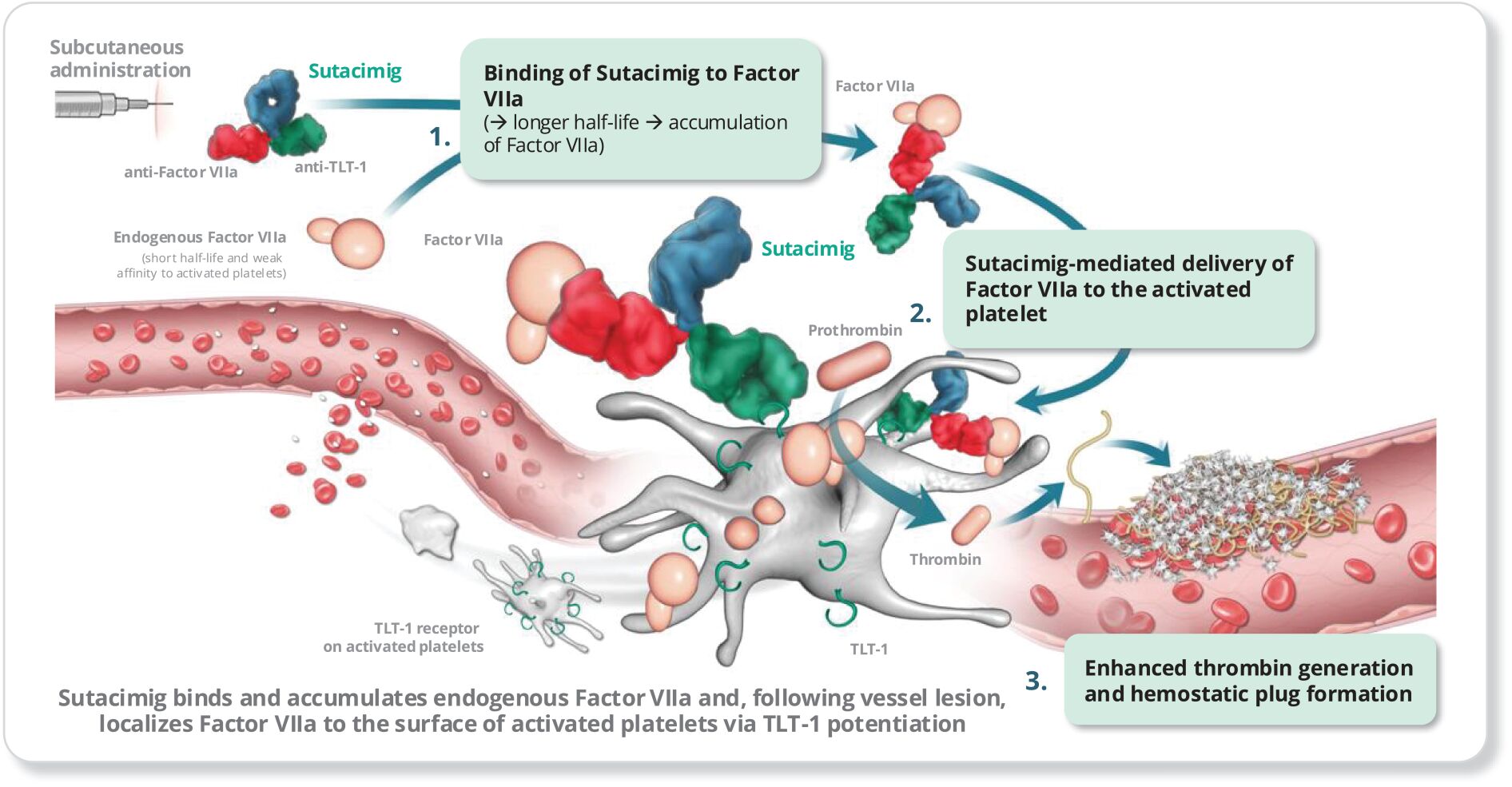
We are initially developing sutacimig as a prophylactic treatment for patients with Glanzmann thrombasthenia and Factor VII deficiency. Beyond these two initial indications, we believe sutacimig’s mechanism of action—redirecting endogenous Factor VII coagulation to sites of platelet activation marked by TLT-1 expression—has potential applicability across multiple other inherited and acquired bleeding conditions characterized by platelet dysfunction, and other causes of impaired hemostasis where platelet activation occurs at bleeding sites. We believe this represents a significant opportunity for potential label expansion if sutacimig receives regulatory approval for Glanzmann thrombasthenia or Factor VII deficiency. If approved, sutacimig could represent an important prophylactic option for patients with significant coagulation disorders.
Clinical Development of Sutacimig
We are currently evaluating sutacimig in two clinical trials, a Phase 1/2 clinical trial in Glanzmann thrombasthenia and a Phase 2 clinical trial in Factor VII deficiency. We are conducting our Phase 1/2 clinical trial at trial sites in Belgium, France, Italy, The Netherlands, the United Kingdom and the United States and our Phase 2 clinical trial at trial sites in the United Kingdom.
In our Phase 1/2 clinical trial of sutacimig in patients with Glanzmann thrombasthenia, we have completed the Part A (single ascending dose) and Part B (three-month multiple ascending dose) portions of the trial, and the Part C (long-term extension up to 24 months) portion is currently ongoing. We have dosed a total of 36 patients with Glanzmann thrombasthenia in the trial, including a total of
146
Table of Contents
seven patients in Part A and a total of 34 patients in Part B, five of whom participated in both Part A and Part B. In our Phase 2 clinical trial of sutacimig in patients with Factor VII deficiency, which we initiated in October 2025, we are evaluating the pharmacokinetics, pharmacodynamics, and preliminary safety and tolerability of single ascending doses of sutacimig in patients with Factor VII deficiency.
Phase 1/2 Clinical Trial of Sutacimig for Glanzmann Thrombasthenia
Trial Design and Demographics. In Part A, we evaluated the safety and tolerability, pharmacokinetics, and pharmacodynamics of sutacimig in patients with Glanzmann thrombasthenia across three single ascending dose cohorts, with doses of 0.2 mg/kg, 0.5 mg/kg, and 1.25 mg/kg, which were then followed by 56 days of observation. In Part A, we enrolled seven patients with Glanzmann thrombasthenia, who ranged from age 27 to 49 years, with a mean age of 38.9 years. The cohort was comprised of six female participants and one male participant, six of whom were Asian and one of whom was White.
In Part B, we evaluated the pharmacokinetic and pharmacodynamic profile and the safety and tolerability profile of sutacimig and explored clinical efficacy over three months at multiple dose levels, with the last visit of the last patient in Part B occurring in July 2025. In Part C, we are evaluating the long-term safety and tolerability profile of sutacimig and the persistence of clinical activity following up to 24 months of dosing.
In Part B, before receiving the first dose of sutacimig, all patients completed a minimum six-week prospective run-in period. During the three-month treatment period, patients received doses of sutacimig according to one of four regimens: 0.3 mg/kg, 0.6 mg/kg, or 0.9 mg/kg every two weeks, or 0.3 mg/kg weekly. Throughout the run-in and treatment periods, patients recorded bleeding events and treatments in an electronic diary, and patients were examined at the trial site and contacted by investigators regularly between visits to monitor for adverse events and ensure adherence to strict electronic diary data entry protocol requirements.
Part B and Part C – Trial Design
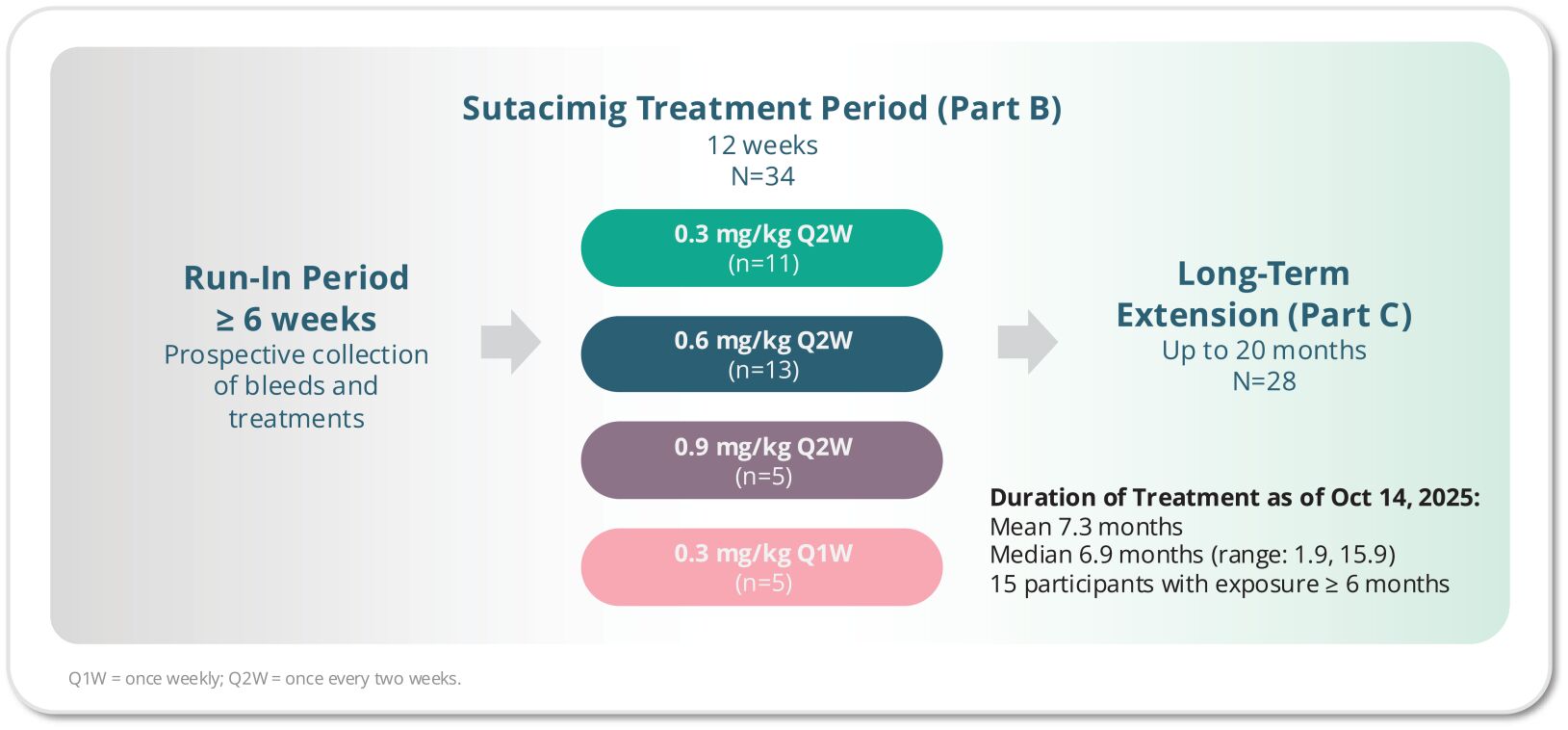
147
Table of Contents
In Part B, we enrolled 34 patients with Glanzmann thrombasthenia, who ranged from age 18 to 66 years, with a median age of 40.5 years. The cohort had 16 female participants and 18 male participants. Additional demographic information and baseline characteristics are included in the image below.
Part B – Demographics and Baseline Characteristics
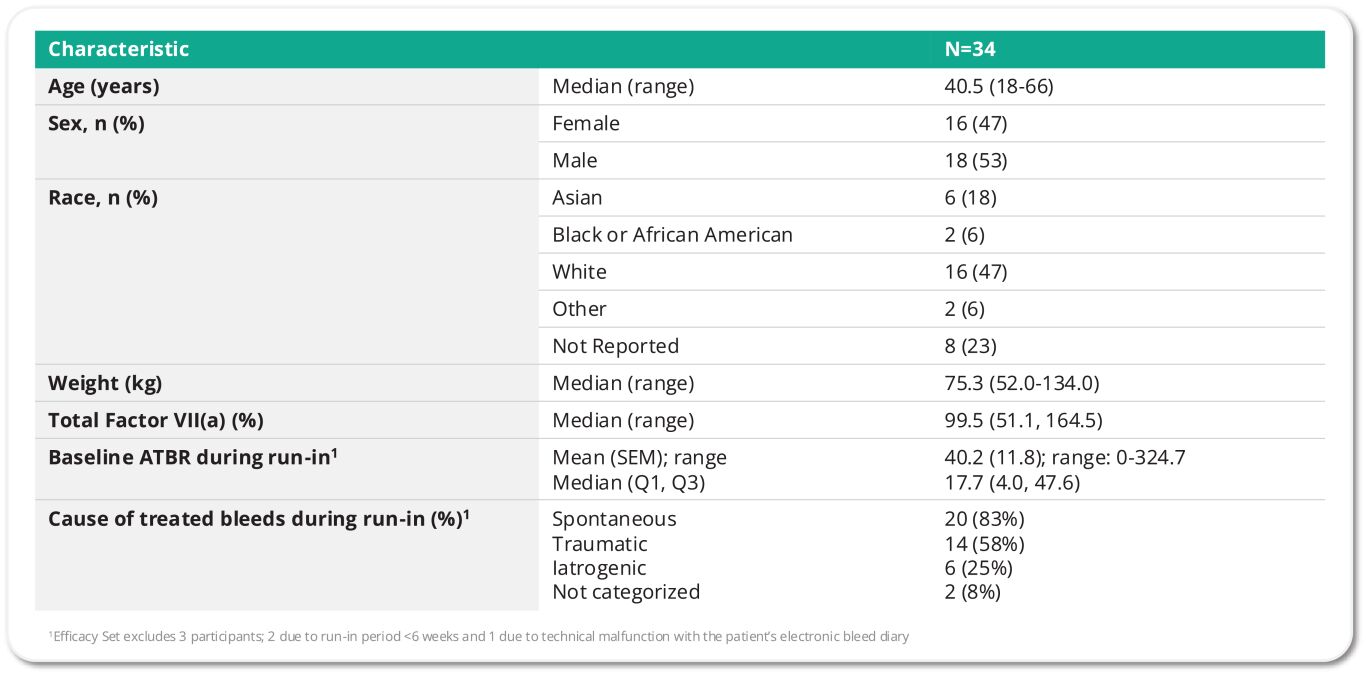
Sutacimig Phase 1/2 Clinical Efficacy Data. In our Phase 1/2 clinical trial in patients with Glanzmann thrombasthenia, sutacimig demonstrated clinical activity at all evaluated dose levels. Of the 34 patients participating in the trial, 31 patients met the protocol criteria to be analyzed for clinical activity. Three participants were excluded either due to a technical malfunction with the patient’s electronic bleed diary (one patient) or due to failure to participate in the trial for at least the protocol specified six-week minimum run-in period (two patients).
We present data below for both Part B and for the combined Part B and Part C treatment period, which reflect continuous treatment through both Parts B and C as of October 14, 2025, the data cutoff date. In Part B, 34 patients were treated with sutacimig and had a median exposure of 3.3 months (with a range of 1.9 to 3.5 months), while in the combined Part B and Part C portions, 34 patients were treated with sutacimig and had a median exposure of 6.9 months (with a range of 1.9 to 15.9 months).
ATBR was selected as the clinical efficacy endpoint for the Phase 1/2 clinical trial, analogous to the annualized bleeding rate used for regulatory approval in other bleeding disorders, such as hemophilia, and includes only bleeding events that required treatment with a prescribed medication consisting of antifibrinolytics, rFVIIa, platelet transfusion, or medical procedures. The statistical methodology used to generate and compare mean ATBR for the run-in period and treatment period was negative binomial regression with general estimating equation. This is a methodology commonly found in labels for approved drugs in bleeding disorders.
Individual patient-level data was also analyzed to determine the proportion of patients experiencing ATBR reduction, among patients with treated bleeding events in the run-in period (N=24). This was performed to understand the generalizability of the mean ATBR reduction results.
Key Clinical Efficacy Data Findings. In our Phase 1/2 clinical trial of sutacimig for Glanzmann thrombasthenia, mean ATBR reduction ranged from 19% to 87% across regimens in the treatment period, indicating clinical activity at all tested doses, with a mean 47% reduction when patients treated at all doses were combined. In three out of four tested regimens and the all-regimen analysis, the 95%
148
Table of Contents
confidence intervals around the mean ATBR excluded zero, suggesting a consistent reduction in ATBR as compared to the run-in period. Clinical activity was also consistent across bleed location and causality, whether spontaneous or traumatic.
Confidence intervals are constructed to convey the precision of an estimated effect. If a 95% confidence interval excludes zero, that suggests it is unlikely that there is no treatment effect. In this instance, the fact that the 95% confidence interval excludes zero suggests that it is unlikely that the mean ATBR during the treatment period was not lower than the mean ATBR during the run-in period. However, our Phase 1/2 clinical trial was not designed or powered to detect statistically significant differences, and statistical hypothesis testing was not prespecified. As a result, the ATBR reductions and related analyses are exploratory in nature and should not be considered statistically significant, and any observed trends relating to clinical responses or activity may not be reproduced in subsequent or pivotal clinical trials.
Based on the clinical efficacy data accrued as of the data cutoff date, we believe the 0.3 mg/kg weekly dose cohort established that a low dose weekly dosing regimen has the potential to deliver optimal exposure for prophylaxis. As depicted in the image below, the weekly 0.3 mg/kg dose achieved an 87% mean ATBR reduction (95% CI: 80-92%) in the treatment period, consistent with attainment of sustained exposure throughout the dosing interval, avoiding high peaks and low troughs in drug exposure seen in the every-other-week regimens.
Part B – Mean ATBR Reduction
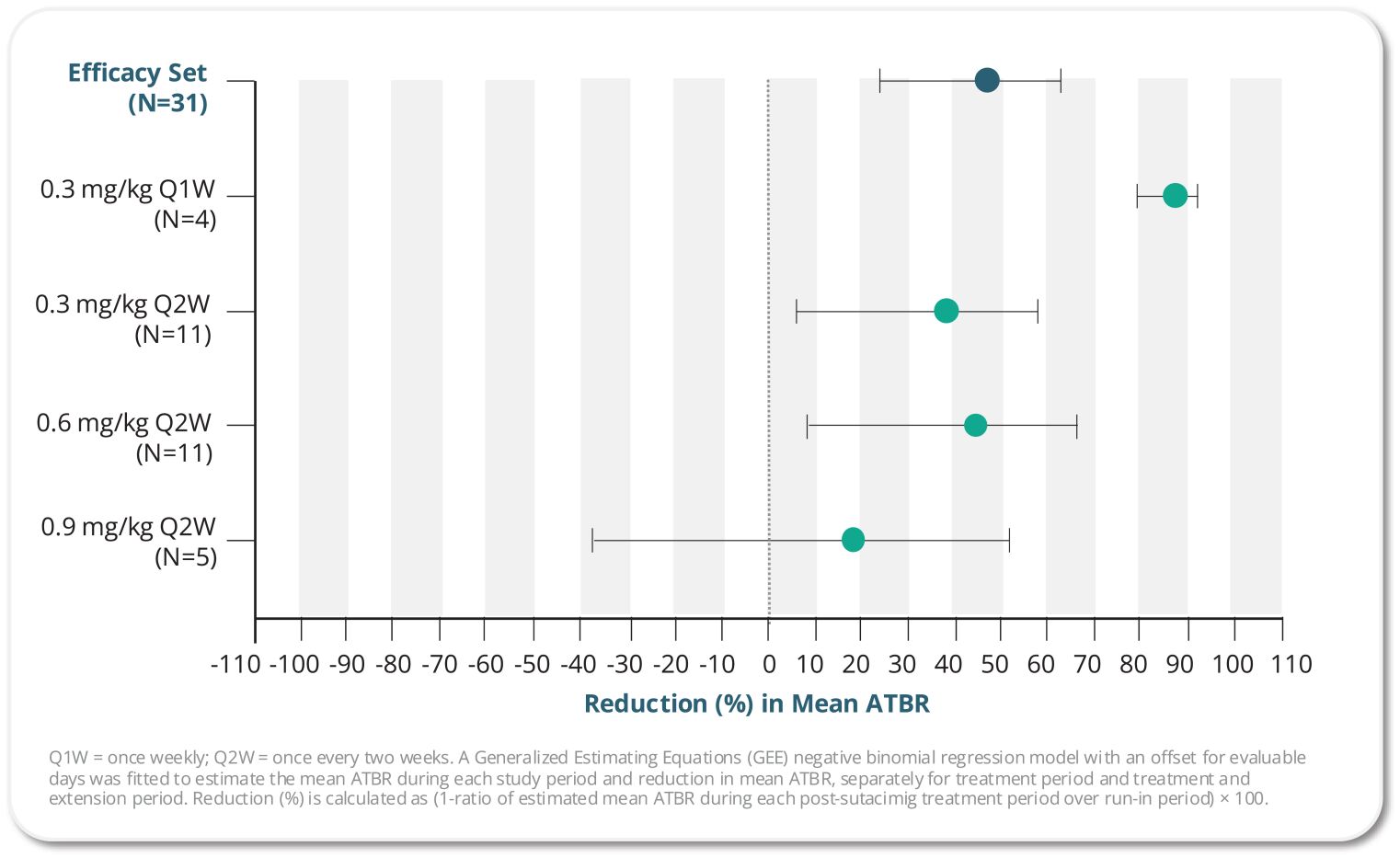
149
Table of Contents
Moreover, as depicted in the table below, the clinical activity observed in Part B of the trial persisted with extended treatment, with a mean ATBR reduction of 47% (95% CI: 75-90%).
Part B and Part B and C Combined – Mean ATBR Reduction
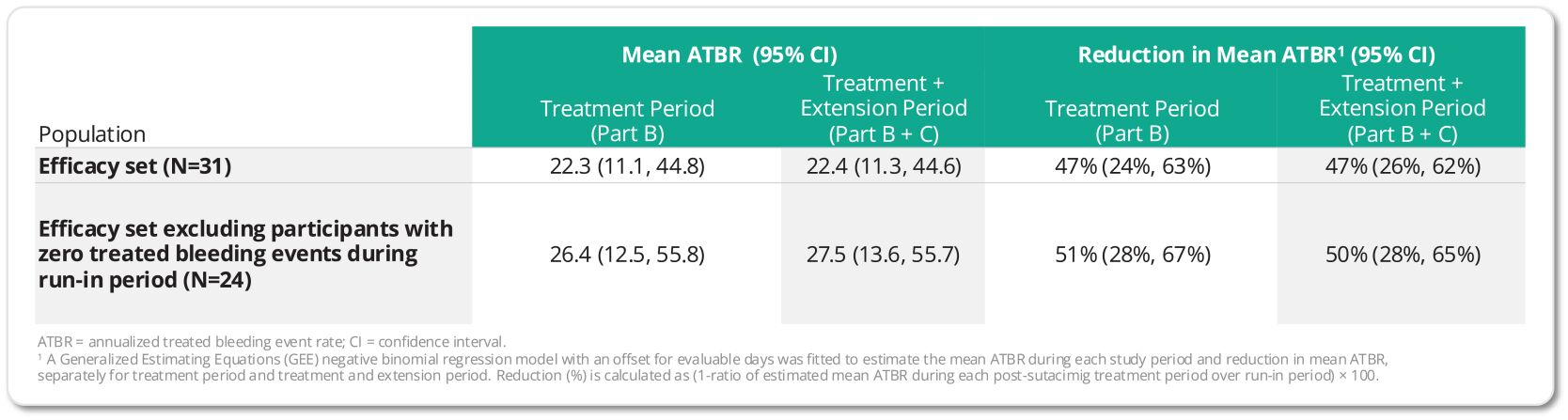
A particularly notable finding was the impact that sutacimig had on limiting the types of severe bleeding events that required high-intensity interventions with rFVIIa infusion, platelet transfusion, or medical procedures, which reflects sutacimig’s potential to meaningfully impact the most severe bleeds experienced by Glanzmann thrombasthenia patients. Fourteen patients (41%) required this treatment in the 12 months prior to receiving sutacimig. However, there was a 100% reduction in mean high-intensity ATBR during the treatment period, and a 62.4% reduction in mean high-intensity ATBR was maintained through the combined treatment and extension period.
Part B and Part B and C Combined – Mean High Intensity ATBR Reduction
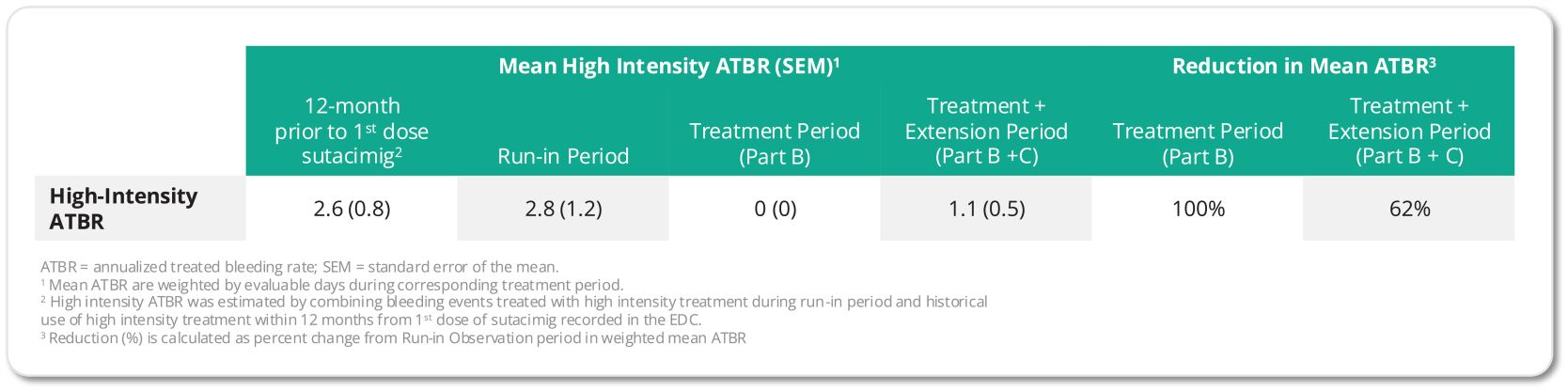
We believe these substantial rates of reduction in medically significant, potentially life-threatening bleeding events during active treatment demonstrate sutacimig’s potential to prevent even the most severe manifestations of Glanzmann thrombasthenia.
150
Table of Contents
The patient-level ATBR reductions observed in the Phase 1/2 clinical trial further support the clinical findings described above. As depicted in the image below, nearly 92% of patients who had at least one bleed event during the run-in period experienced an ATBR reduction, and over 50% of these patients experienced a 50% or higher ATBR reduction.
Part B – Patient-Level ATBR Reduction
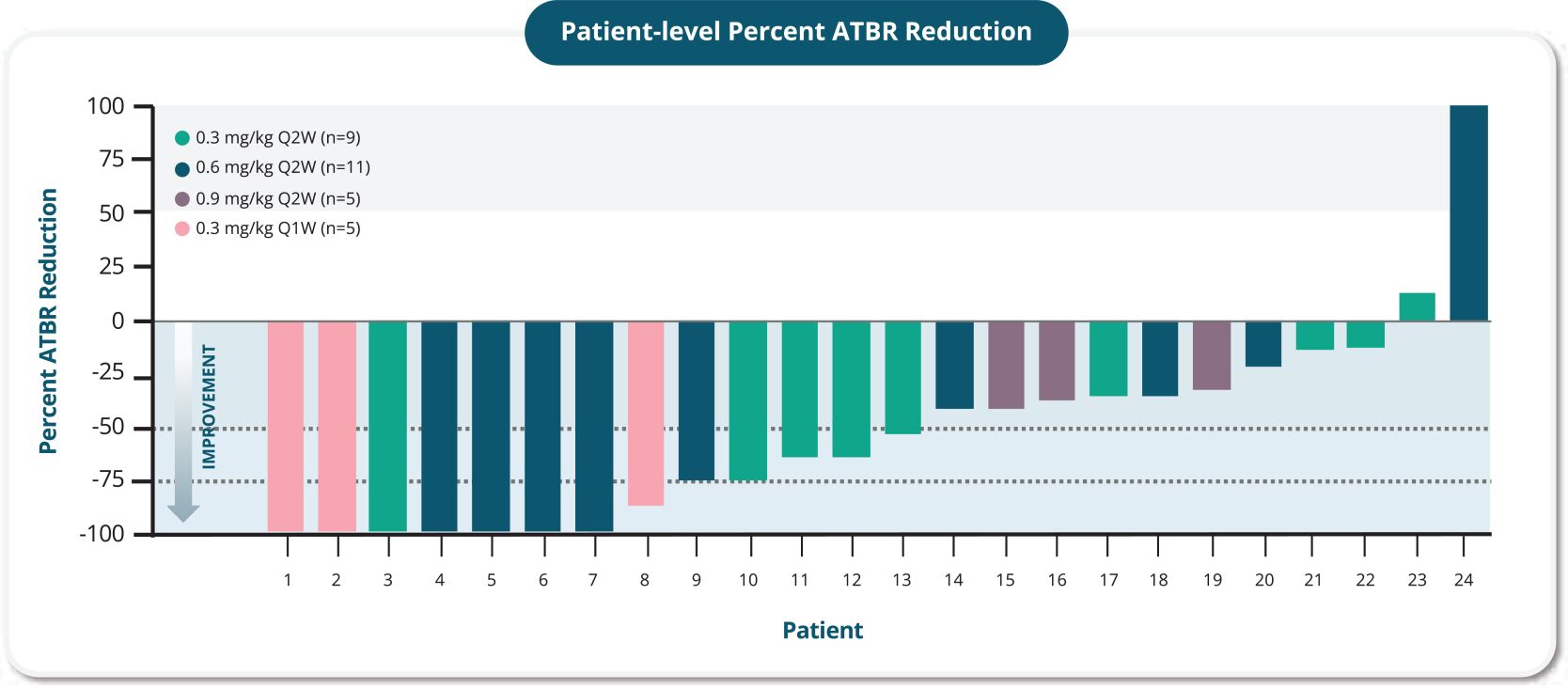
Overall, we believe this data demonstrates sutacimig’s potential to deliver meaningful prophylactic ATBR reduction with convenient weekly subcutaneous dosing.
Part A Pharmacokinetics and Pharmacodynamics. In Part A of the trial, we observed dose-dependent plasma exposure to sutacimig across all dose levels evaluated, as depicted in the image on the left below. In addition, as depicted in the image on the right below, we observed dose-dependent increases in Factor VIIa accumulation, with peak levels occurring three to seven days following dosing and higher doses achieving a longer duration of Factor VIIa elevation. Sutacimig also remained quantifiable through approximately day 42 in most participants, and in certain patients’ plasma for the entire 56 day observation period.
Part A – Pharmacokinetics and Pharmacodynamics
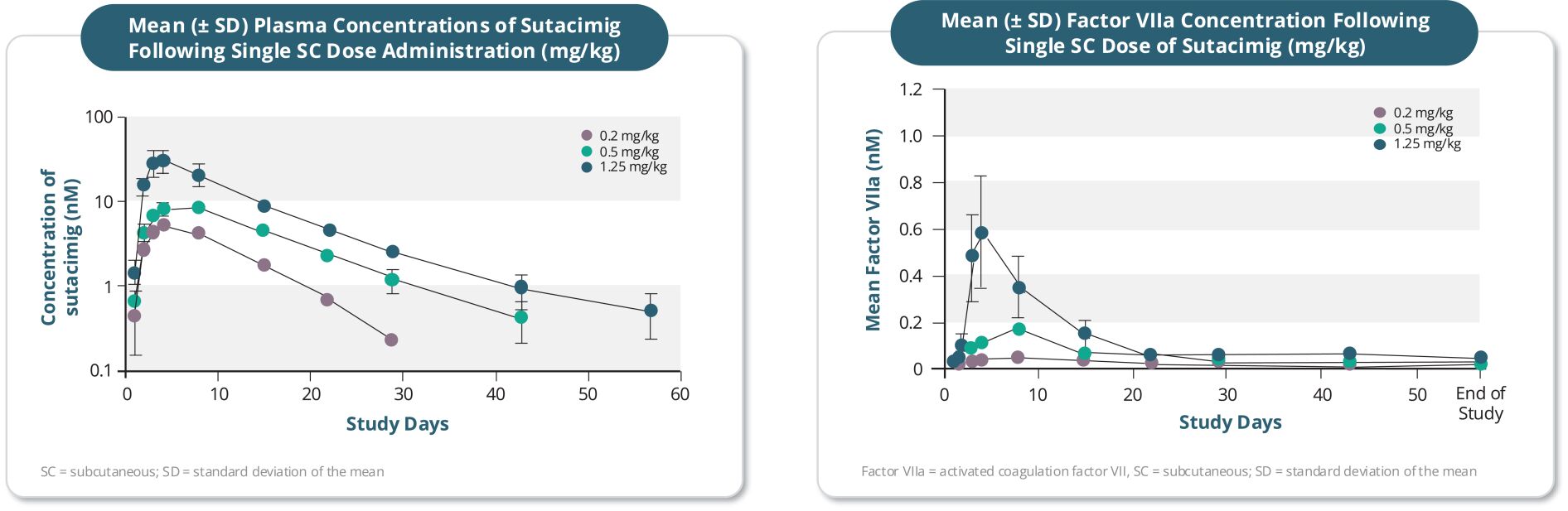
151
Table of Contents
The data from Part A of the trial established proof-of-mechanism for sutacimig in Glanzmann thrombasthenia by demonstrating an impact on pharmacodynamic. In addition, in Part A, sutacimig was generally well tolerated and demonstrated predictable dose-dependent pharmacokinetics, all of which supported advancement to Part B of the trial.
Part A Safety and Tolerability Profile. In Part A, no patients experienced dose-limiting toxicities. One serious adverse event of moderate iron deficiency anemia occurred, which was deemed unrelated to study drug and subsequently resolved. In addition, there were no adverse events of disseminated intravascular coagulation. We did detect anti-drug antibodies, or ADAs, which is an identified potential risk for sutacimig as a protein therapeutic, in four patients and two of these patients entered Part B with a positive ADA titer. However, there was no measurable impact on pharmacokinetics and pharmacodynamics, and no safety events related to immunogenicity were observed.
Part B Pharmacokinetics and Pharmacodynamics. In Part B of the trial, we observed dose proportional exposure, pharmacodynamic activity, and higher peak elevation in Factor VIIa in the 0.9 mg/kg dose cohort. The weekly dosing regimen of 0.3 mg/kg notably provided consistent exposure and Factor VIIa activity, while avoiding the high peaks and lower troughs seen in the dose levels administered every two weeks. The image below depicts the mean sutacimig plasma concentration levels observed on the left, the total Factor VIIa levels observed in the middle and the change in Factor VIIa levels compared to baseline on the right over 84 days across the four dose levels evaluated. The 0.9 mg/kg regimen administered every two weeks demonstrated higher peak Factor VIIa levels compared to other regimens, while the 0.3 mg/kg weekly regimen provided consistent exposure with minimal peak-trough fluctuation.
Part B – Pharmacokinetics and Pharmacodynamics
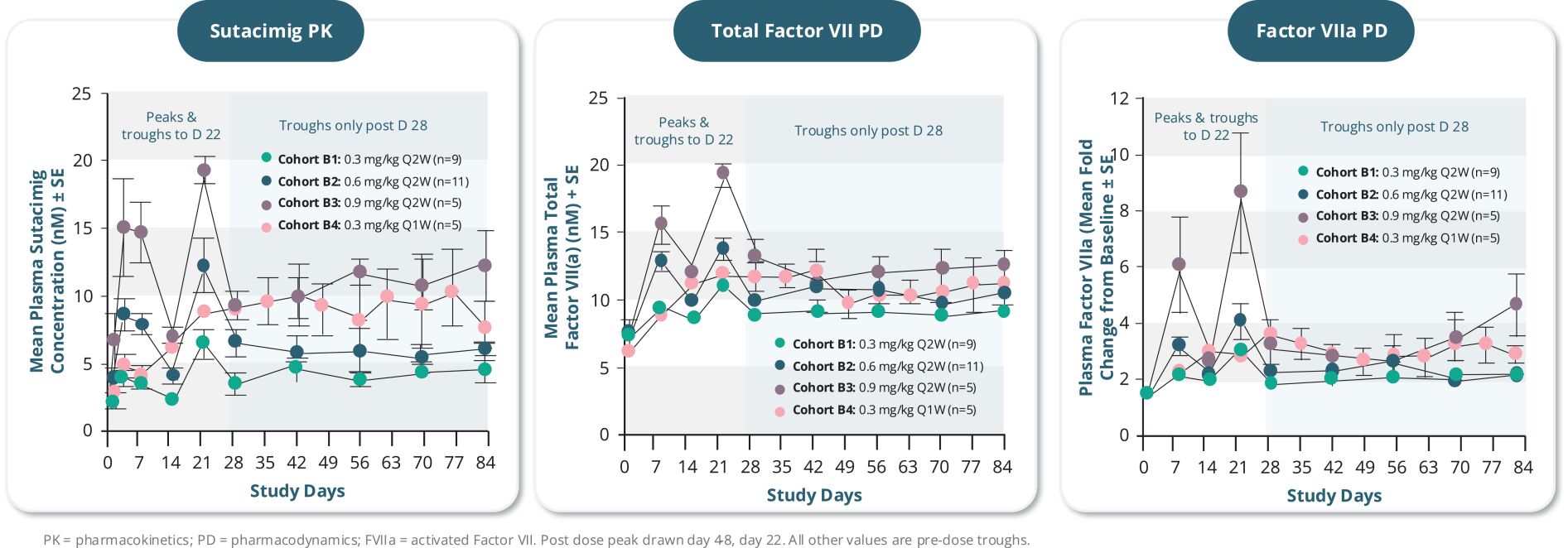
Part B and Part C Safety and Tolerability. As of the data cutoff date, 34 patients had completed Part B of the trial and 27 of those patients continued long-term dosing in Part C of the trial. Safety data is presented for all patients who received at least one dose of sutacimig and includes patients treated in Part B and Part C of the trial. In Part B and Part C of the trial, sutacimig was generally well tolerated. Of the 34 patients evaluated, 32 (94.1%) experienced at least one treatment-emergent adverse event, or TEAE, the majority of which were mild to moderate in severity. The image below summarizes the TEAEs reported in Part B and Part C of the trial.
152
Table of Contents
Summary of Part B and Part C Treatment-Emergent Adverse Events
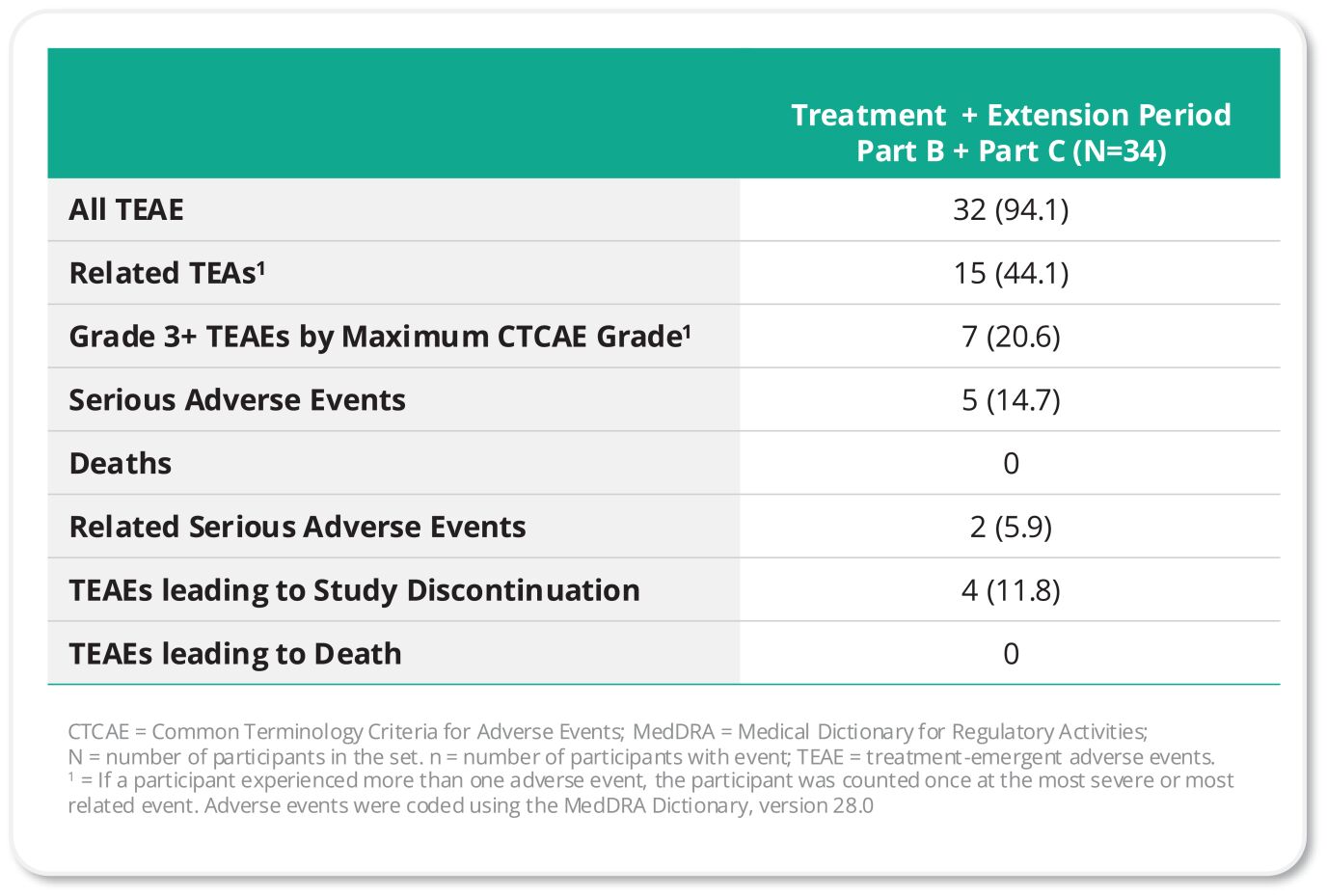
The most frequently reported TEAEs have been either nonspecific symptoms, low-grade laboratory abnormalities related to the coagulation system, or complications of the underlying disease, including headache and fibrin D-dimer increases (each 23.5%), nasopharyngitis (20.6%), and back pain (17.6%). The image below summarizes the TEAEs reported in Part B and Part C of the trial that occurred in three or more participants.
153
Table of Contents
Treatment-Emergent Adverse Events Occurring in Three or More Participants
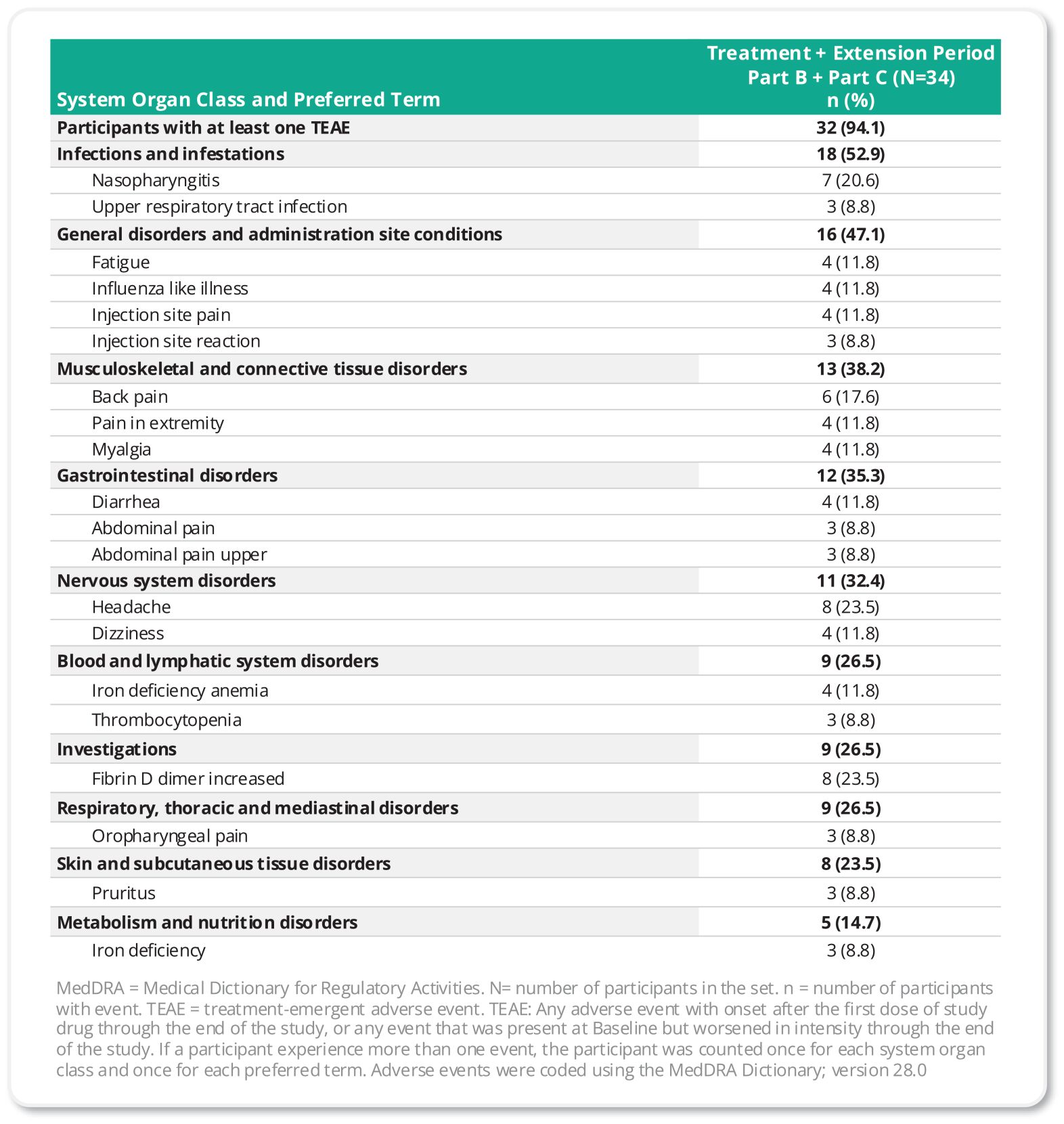
As with most approved procoagulant drugs, sutacimig carries an inherent risk of thromboembolic events. As a result, such events were monitored as adverse events of special interest, or AESI, in the trial. As of the data cutoff date, three participants had experienced thromboembolic events deemed related to sutacimig: one proximal deep vein thrombosis, or DVT, of the lower extremity, one isolated distal DVT, and one subsegmental pulmonary embolism, or SSPE. All three events were Grade 2 in severity, and the proximal DVT and SSPE were reported to the FDA on an expedited basis as Suspected Unexpected Serious Adverse Reactions (SUSARs).
As depicted in the image below, analysis of these AESI revealed an association with high dose levels of sutacimig, the presence of multiple concurrent venous thromboembolism risk factors (such as smoking, obesity, hypertension, hospitalization for acute illness, or gastrointestinal bleeding and administration of concurrent hemostatic agents), or both. We believe the proximal DVT event is the one with the highest potential medical significance due to higher risk of embolism. This is reflected in treatment guidelines that recommend a full course of anticoagulation for a proximal DVT, but offer the option to monitor patients with isolated distal or SSPE without anticoagulation. The proximal DVT event occurred in a patient with multiple DVT risk factors who was dosed at the highest dose level of
154
Table of Contents
0.9 mg/kg, which achieved mean peak levels notably higher than the other regimens evaluated. The other two AESI were thrombotic events that occurred in patients at lower dose levels with multiple (more than two) venous thromboembolism risk factors. Notably, the other 31 patients in the trial in whom no treatment-related AESIs occurred, had no more than two identified concurrent venous thromboembolism risk factors. This pattern suggests a potential relationship to elevated drug exposure with potential contribution from other venous thromboembolism risk factors. We believe this is one key principle to leverage in our planned Phase 3 clinical trial design and dose optimization, along with the finding that high exposures appear unnecessary for clinical efficacy, and weekly regimens have yielded sustained exposures.
Part B and Part C—Adverse Events of Special Interest
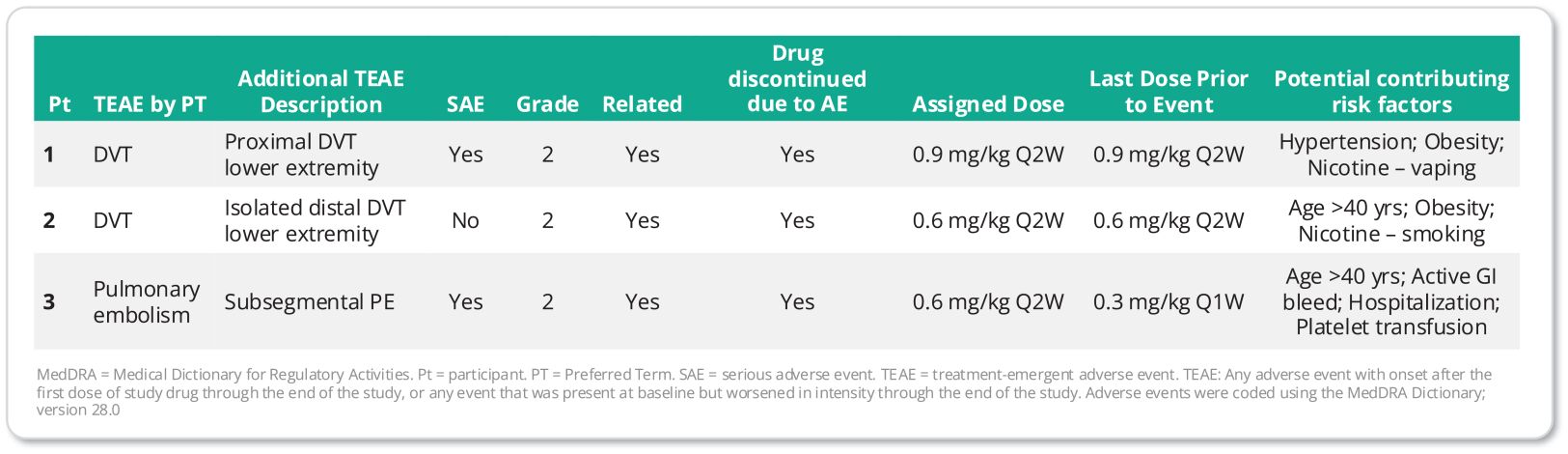
There were no instances of other protocol-defined non-bleeding AESI, such as cerebrovascular accident, acute cardiac events, peripheral arterial embolism or disseminated intravascular coagulation.
Among the five patients experiencing six serious adverse events during treatment, two events (33.3%) were deemed treatment-related – the DVT and the subsegmental pulmonary embolism described above. The remaining four serious adverse events were judged unrelated to study drug (one each of intra-abdominal hemorrhage, gastrointestinal bleeding, epistaxis, and invasive ductal carcinoma). In addition, treatment discontinuation due to adverse events occurred in four participants (11.8%), including two cases of DVT, one case of pulmonary embolism, and one case of invasive ductal breast carcinoma.
In Part B and Part C of the trial, ADAs were detected in a total of six patients, two of whom had been positive for ADAs at their last Part A assessment. In three of these six patients, the ADAs were resolved or resolving at the last assessment prior to the data cutoff date. Notably, although the assessment of ADA impact on ATBR was inconclusive given the variability of ATBR at baseline and the small sample size, these ADAs did not appear to cause Factor VII levels to drop below the lower limit of normal in patients, and there were no adverse events associated with immunogenicity reported in association with these ADA events.
We believe the data observed as of the data cutoff date supports continued clinical development of sutacimig with appropriate dose selection and patient monitoring protocols.
Phase 3 Development Plans for Glanzmann Thrombasthenia
We are planning to conduct a multinational, multicenter, Phase 3, single-arm, open-label clinical trial evaluating sutacimig as a prophylactic therapy in adults with Glanzmann thrombasthenia. However, the FDA may require a randomized controlled clinical trial to support filing and approval of our Biologics License Application, or BLA. We intend to schedule a Type D meeting with the FDA in the coming months to obtain the FDA’s feedback on, and seek alignment regarding, whether a single-arm trial will be sufficient to support filing and approval or, alternatively, whether the FDA may determine that a randomized controlled clinical trial is necessary to support filing and approval of our BLA. We anticipate initiating enrollment in the clinical trial in the second half of 2026 and, subject to discussions with
155
Table of Contents
regulators, we intend for the data generated by this trial to form the basis of our regulatory submissions for marketing approval of sutacimig as the first prophylactic treatment for Glanzmann thrombasthenia.
Preclinical Study of Sutacimig for Factor VII Deficiency
We evaluated sutacimig for Factor VII deficiency in a cynomolgus monkey model of Factor VII deficiency created through siRNA-mediated reduction of Factor VII. In the study, sutacimig demonstrated the ability to restore deficient coagulation Factor VII levels. The study employed a siRNA to reduce endogenous Factor VII to approximately 10% of normal levels, mimicking severe Factor VII deficiency. Following subcutaneous administration of sutacimig at 5.0 mg/kg, the bispecific antibody accumulated and elevated both Factor VII and Factor VIIa levels, with treated animals achieving accumulation levels approaching those observed in normal animals. We believe this preclinical proof-of-concept data supports sutacimig’s mechanism of accumulating residual Factor VII and Factor VIIa at sites of vascular injury and the potential to restore hemostatic function even for patients with severe Factor VII deficiency. The image below depicts the study design and results.
Sutacimig Demonstrated Restoration of Factor VII Levels in Non-Human Primates
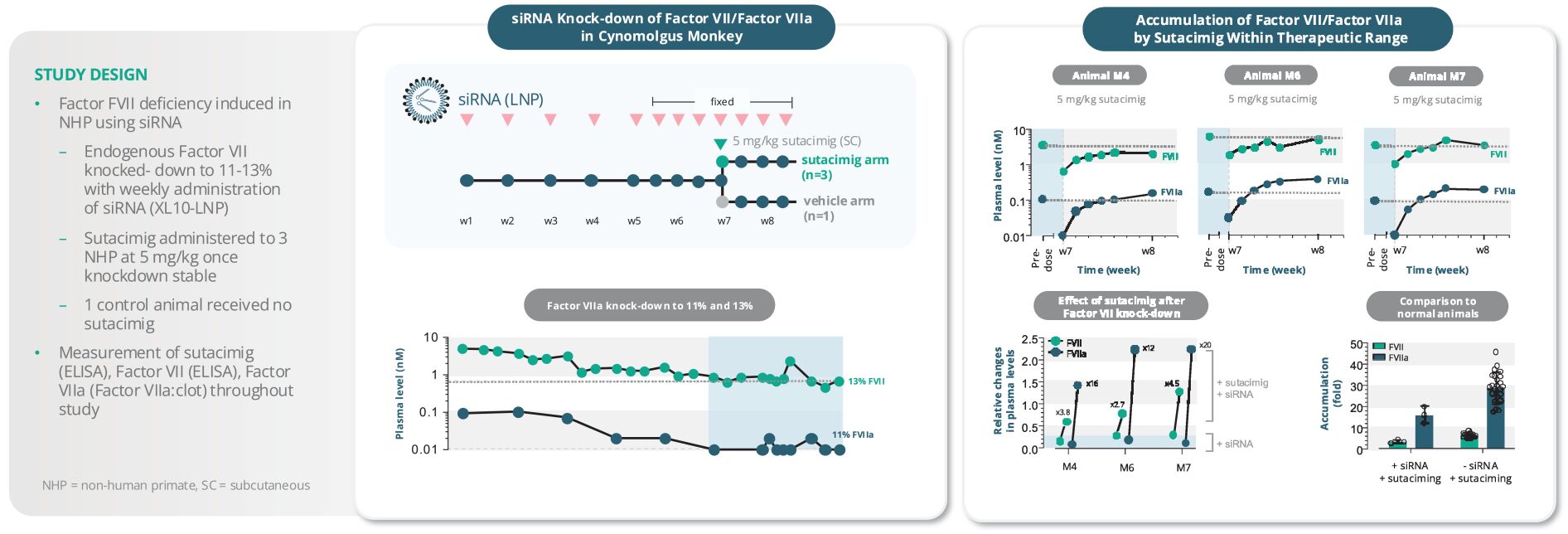
Ongoing Phase 2 Clinical Trial of Sutacimig for Severe Factor VII Deficiency
Building on the mechanistic rationale observed in our preclinical study of sutacimig in the cynomolgus monkey model, we initiated a Phase 2 single ascending dose clinical trial in patients with severe Factor VII deficiency, which includes those patients with 10% or less of normal Factor VII levels. The ongoing clinical trial follows a dose-escalation design, evaluating multiple dose levels, and progressing from initial lower doses through higher dose cohorts with planned interim analyses to assess safety and pharmacodynamics. This trial aims to establish proof-of-concept by demonstrating sutacimig’s ability to increase Factor VII levels in patients with Factor VII deficiency. The image below depicts the clinical trial design of our ongoing Phase 2 clinical trial.
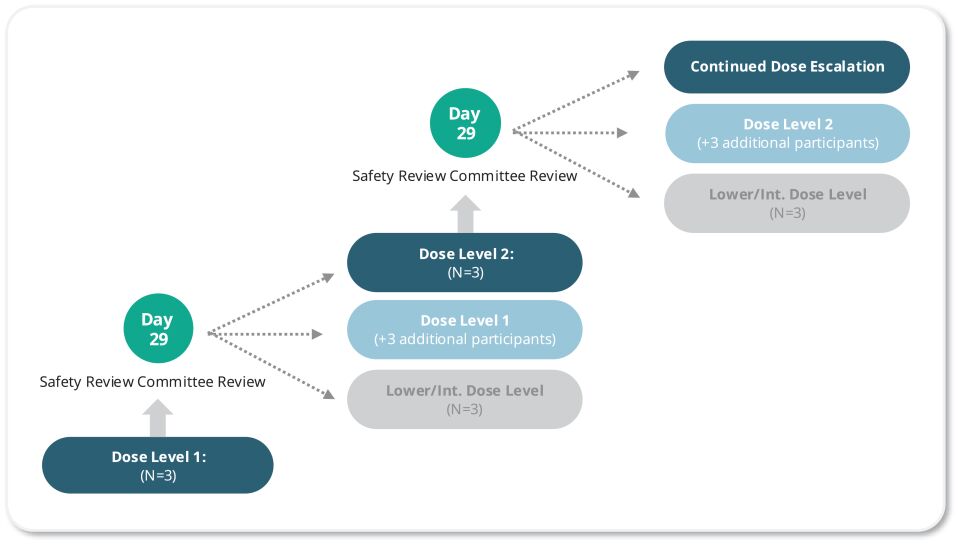
156
Table of Contents
If successful, we expect this trial would support advancement to a Phase 3 clinical trial, potentially expanding sutacimig’s utility beyond Glanzmann thrombasthenia to address additional bleeding disorders characterized by factor deficiencies.
Regulatory Status and Designations for Sutacimig
Sutacimig has received multiple regulatory designations, including Fast Track, Breakthrough Therapy, orphan drug and ILAP:
| • | FDA Fast Track Designation in Glanzmann Thrombasthenia: Potentially facilitates development and expedites review, providing more frequent FDA interactions and eligibility for priority review if criteria are met at the time of BLA submission. |
| • | Breakthrough Therapy Designation in Glanzmann Thromathenia: FDA designation provides that the FDA may take certain actions, including holding meetings with the sponsor throughout the development process; providing timely advice to the product sponsor regarding development and approval; involving more senior staff in the review process; assigning a cross-disciplinary project lead for the review team; and taking other steps to design the clinical trials in an efficient manner. Breakthrough designation may be rescinded if a product candidate no longer meets the qualifying criteria. |
| • | Orphan Drug Designations in Glanzmann Thrombasthenia: FDA designation provides the potential for seven years of market exclusivity upon approval, user fee exemption, and tax credits. The European Commission orphan medicinal product designation provides the potential for ten years of market exclusivity in the European Union, protocol assistance eligibility, and reduced regulatory fees. |
| • | UK MHRA ILAP Designation in Glanzmann Thrombasthenia: Provides the potential for enhanced regulatory support through the Innovation Passport and Target Development Profile and coordinated engagement with the National Institute for Health and Care Excellence and the Scottish Medicines Consortium to support timely patient access following marketing authorization in the United Kingdom. |
These designations may provide sutacimig with the opportunity for expedited regulatory pathways, extended market exclusivity, reduced fees, and enhanced regulatory support throughout development and commercialization. However, the receipt of such designations for sutacimig may not result in a faster development or regulatory review or approval process compared to product candidates considered for approval under conventional regulatory procedures and does not assure ultimate approval by the applicable regulatory authority.
HMB-002 – Monovalent Antibody for the Subcutaneous Prophylactic Treatment of Von Willebrand Disease
Overview of Von Willebrand Disease
Von Willebrand Disease is the most common inherited bleeding disorder. It is characterized by both life-threatening hemorrhagic events and relentless mucocutaneous bleeding episodes that combine to inflict significant harm to physical health, mental well-being, and quality of life. The age of diagnosis varies considerably. Patients with early severe bleeding manifestations are diagnosed shortly after birth, while patients with more variable bleeds may be diagnosed later in life. First described by Erik von Willebrand in 1926, Von Willebrand Disease results from reduced quantity or function of VWF, a plasma protein essential for normal hemostasis through its dual role in platelet adhesion and as a carrier protein protecting coagulation Factor VIII from degradation.
157
Table of Contents
The clinical severity of Von Willebrand Disease varies by subtype but is substantial across the disease spectrum. Von Willebrand Disease is classified into three main types:
| • | Type 1 – 70% to 80% of cases, characterized by partial quantitative VWF deficiency |
| • | Type 2 – 20% of cases, with qualitative functional defects |
| • | Type 3 – Less than 1% of cases, representing near-complete absence of functional VWF |
Patients with Von Willebrand Disease can experience potentially life-threatening bleeding events regardless of subtype. While Type 3 patients face the most severe hemorrhagic complications, even patients with Type 1 disease, which has traditionally been considered “mild”, experience a serious clinical burden, with up to 15% reporting gastrointestinal bleeding events and approximately 20% experiencing joint bleeding events.
Findings from our “360” natural history study in Von Willebrand Disease of 611 patients and caregivers highlight the substantial burden across all disease subtypes. For example, patients across subtypes experienced frequent weekly bleeding events as follows:
| • | Type 1 – 1.2 bleeds per week |
| • | Type 2 – 1.4 bleeds per week |
| • | Type 3 – 1.9 bleeds per week |
More than half of participants required hospital admission for bleeding management within the prior year, demonstrating both the severity of bleeding episodes and the failure of existing treatments to prevent clinically significant hemorrhage necessitating acute medical intervention.
The most common bleeding manifestations of Von Willebrand Disease are mucocutaneous events that can cause both physical and psychosocial harm in men and women. Women face a particularly severe burden, with 94% having experienced heavy menstrual bleeding in our “360” natural history study, which can profoundly impact quality of life, reproductive choices, and iron status. Across both genders, over 60% of patients report cutaneous and oral cavity bleeding and over 50% experienced nose bleeds, which are highly visible and socially disruptive. Patients also suffered gastrointestinal hemorrhage, hemarthrosis, and other critical bleeding events. This relentless frequency can create a constant burden pervading every aspect of patients’ lives.
Market Opportunity in Von Willebrand Disease
Moderate-to-severe Von Willebrand Disease is estimated to affect approximately 1 in 5,000 to 1 in 10,000 individuals globally. In the United States, based on published prevalence estimates and our market insights, we estimate there are approximately 140,000 patients with Von Willebrand Disease across all severity levels and types. Of these patients, between 40,000 and 50,000 patients have sought medical treatment for bleeding events based on healthcare claims analysis.
In the geographies where we intend to commercialize HMB-002, including the United States, the European Union, Japan, the GCC countries and other select regions, we estimate the diagnosed Von Willebrand Disease population includes approximately 120,000 symptomatic patients who have sought medical care across all disease types, which likely represents only a portion of the overall patient population in these markets.
Epidemiological data indicate that approximately 35% to 40% of patients with Von Willebrand Disease have concomitant anemia or iron deficiency, objective markers of ongoing bleeding that can adversely affect health and quality of life. This subset of patients represents those most likely to benefit
158
Table of Contents
from a prophylactic therapy that increases VWF and Factor VIII levels to reduce bleeding frequency. Notably, the joint evidence-based clinical practice guidelines published in 2021 by the American Society of Hematology, the International Society on Thrombosis and Haemostasis, the National Hemophilia Foundation and the World Federation of Hemophilia conditionally recommended long-term prophylaxis treatment for Von Willebrand Disease patients with a history of severe and frequent bleeds.
Current Treatment Landscape and Limitations in Von Willebrand Disease
The treatment landscape in Von Willebrand Disease is more established than in Glanzmann Thrombasthenia or Factor VII deficiency, with therapies available for management of acute bleeding episodes. Despite existing treatments, many patients continue to experience recurrent bleeding and substantial treatment burden, particularly in the context of therapies that require frequent intravenous administration or do not address the underlying biology of the disease.
Current management of Von Willebrand Disease focuses primarily on acute bleeding event management rather than prevention. Patients are typically managed using a combination of the following pharmacologic and replacement therapies depending on disease type, severity, and bleeding risk.
Desmopressin. Desmopressin, or DDAVP, is a synthetic vasopressin analog that stimulates release of VWF stored in endothelial cells and is administered intranasally or intravenously. DDAVP is effective in patients with Type 1 and Type 2 Von Willebrand Disease. However, its use is limited by tachyphylaxis, resulting in diminished response with repeated dosing, and it is ineffective in patients with Type 3 disease. As a result, DDAVP is generally used in anticipation of bleeding risk, such as prior to procedures, rather than as a continuous preventive therapy.
Antifibrinolytic Therapy. Antifibrinolytic agents, such as tranexamic acid, are commonly used as adjunctive therapy, particularly for mucosal bleeding, including heavy menstrual bleeding. While these agents can help reduce bleeding in certain settings, they do not address the underlying deficiency of VWF and are generally insufficient for controlling more severe bleeding or bleeding at non-mucosal sites. Treatment often requires multiple daily doses during bleeding episodes, which can affect adherence.
VWF Intravenous Replacement Products. Plasma-derived and recombinant VWF replacement products are approved for the treatment and prevention of bleeding in Von Willebrand Disease. These therapies are administered intravenously and have relatively short circulating half-lives, typically requiring repeated infusions. For patients receiving prophylaxis, this often involves intravenous administration two to three times per week, which can impose a significant burden related to venous access, time commitment, and interference with daily activities. In some patients, particularly children or those with difficult venous access, long-term intravenous therapy may require central venous catheters. As a result, adherence to prophylactic regimens can be challenging for many patients.
Blood Component Transfusions. Patients with severe bleeding episodes may require a transfusion of red blood cells to manage anemia resulting from blood loss and, in some cases, fresh frozen plasma to provide coagulation factors. While these interventions can be necessary to stabilize patients during acute events, they address the consequences of bleeding rather than preventing future episodes and usually require hospital-based care.
Intravenous Iron Supplementation. Chronic blood loss frequently leads to iron deficiency, necessitating repeated intravenous iron supplementation. This treatment addresses a downstream consequence of ongoing bleeding but does not reduce bleeding frequency or underlying disease activity.
159
Table of Contents
Pipeline Competition. We are aware of other therapies in clinical development for the prophylactic treatment of Von Willebrand Disease that focus on other mechanisms of action, such as monoclonal antibody inhibition of the natural anticoagulation called protein S, aiming to act as a bypassing agent.
Our Solution—HMB-002
We are developing HMB-002 as a subcutaneous prophylactic treatment for Von Willebrand Disease. HMB-002, a monovalent antibody, is designed to address the underlying biological drivers of Von Willebrand Disease by increasing endogenous levels of VWF and Factor VIII. Rather than bypassing the deficiency or providing exogenous replacement protein, HMB-002 aims to stabilize patients’ own VWF, extend its circulating half-life, and thereby increase VWF and Factor VIII levels over time.
We believe this approach offers several potential advantages:
| • | Restoration of Hemostasis by Directly Addressing the Root Cause: By increasing endogenous VWF and Factor VIII levels, HMB-002 is designed to support restoration of hemostasis rather than creating an artificial rebalancing of the coagulation system. We believe this approach has the potential to carry lower thrombotic risk than rebalancing agents that promote hemostasis by inhibiting natural anticoagulants. Preclinical studies in animal models of Von Willebrand Disease have demonstrated that an approximately 1.5-fold increases in VWF and Factor VIII levels can meaningfully improve coagulation parameters and reduce bleeding. In addition, clinical observations in patients with Von Willebrand Disease demonstrate that even modest increases in VWF and Factor VIII levels can meaningfully reduce bleeding symptoms. In our Phase 1 clinical study, HMB-002 achieved greater than 1.5-fold increases in both VWF and Factor VIII levels, along with correction of laboratory coagulation measures, such as aPTT and thrombin generation, supporting continued clinical evaluation of this approach. |
| • | Convenient Subcutaneous Administration: We are developing HMB-002 to be administered subcutaneously, with potential dosing intervals ranging from weekly to monthly, reflecting both the extended half-life of VWF achieved through stabilization and the inherent pharmacokinetic properties of an antibody therapeutic. We believe that this dosing profile could reduce the treatment burden associated with frequent intravenous infusions required for current prophylactic options. |
| • | Applicability Across Von Willebrand Disease Types: Because HMB-002 acts by reducing clearance of endogenous VWF, we believe it may potentially be applicable across multiple Von Willebrand Disease subtypes, including Type 1, Type 2, and potentially Type 3 disease in patients receiving baseline VWF replacement. |
| • | Potential for Transformative Impact: In other inherited bleeding disorders, such as hemophilia A, the introduction of subcutaneously administered prophylactic therapies has been associated with reduced treatment burden and improved disease management. We are developing HMB-002 with the goal of enabling a similar shift toward preventive care in Von Willebrand Disease by facilitating more consistent bleeding control while minimizing disruption to daily life. If our ongoing and future clinical trials are successful, we believe HMB-002 could represent an important subcutaneous prophylactic treatment option for patients with Von Willebrand Disease who require ongoing bleeding prevention. |
HMB-002 is a monovalent antibody that selectively binds the CK domain of the coagulation protein VWF with high affinity, specifically targeting this domain in its inactive conformation. VWF is a large multimeric glycoprotein that serves two essential functions in hemostasis: mediating platelet
160
Table of Contents
adhesion to damaged vessel walls and serving as the carrier protein for Factor VIII, protecting it from premature degradation and clearance. By selectively binding to the inactive CK domain, HMB-002 stabilizes VWF structure and endows it with an extended half-life, thereby reducing its clearance rate. As a result, circulating levels of VWF increase. Because VWF functions as the carrier molecule for Factor VIII, increases in VWF levels lead to corresponding increases in Factor VIII levels, as Factor VIII bound to VWF is protected from degradation. This dual effect on both VWF and Factor VIII levels is particularly important because Von Willebrand Disease is fundamentally characterized by low levels of VWF, which in turn directly limits platelet adhesion and results in low levels of Factor VIII due to accelerated Factor VIII degradation in the absence of adequate VWF.
As described above, DDAVP has been used for over 50 years as the standard of care to manage acute bleeding episodes and provide short-term hemostatic prophylaxis in patients with Type 1 and Type 2 Von Willebrand Disease. DDAVP functions by stimulating the release of endogenous VWF stored in endothelial cells, resulting in greater than 1.5-fold increases in both VWF and Factor VIII levels that persist for approximately four to six hours. The decades-long clinical experience with DDAVP demonstrates that acute elevation of VWF levels provides effective hemostatic control in Von Willebrand Disease patients and serves as important clinical validation for the therapeutic mechanism of HMB-002.
The image below depicts HMB-002’s intended mechanism of action. As illustrated, following subcutaneous administration, HMB-002 binds to circulating VWF, preventing clearance via neonatal Fc receptor-mediated rescue from vascular endothelium, leading to increased circulating VWF available for platelet adhesion and Factor VIII carrier function at sites of vascular injury.
Mechanism of Action of HMB-002
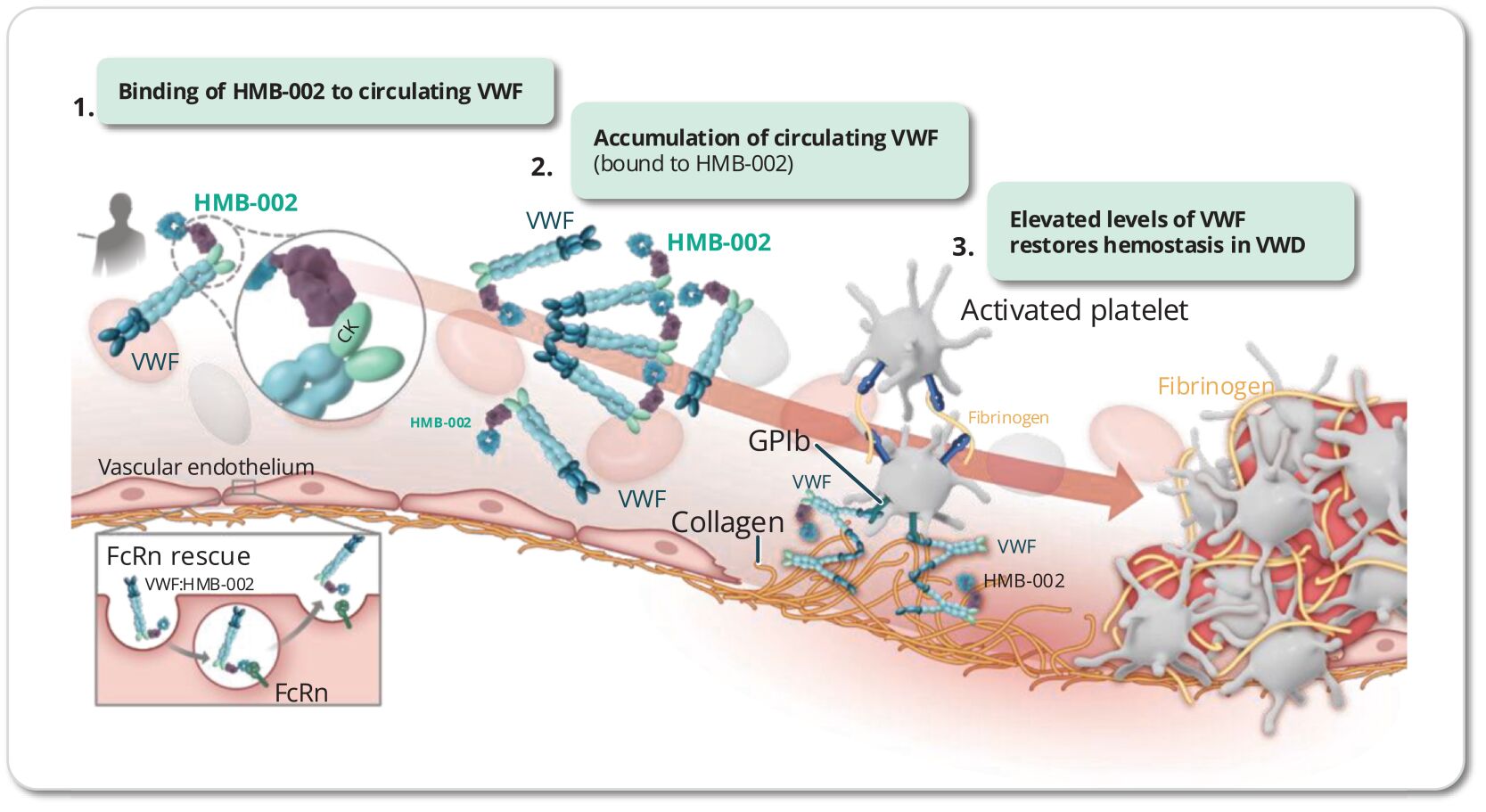
We are initially developing HMB-002 as a subcutaneous prophylactic treatment for patients with Von Willebrand Disease. Beyond this initial indication, we believe HMB-002’s intended mechanism of action – stabilizing and extending the half-life of endogenous VWF and Factor VIII – has potential applicability across other bleeding conditions associated with low VWF levels. We believe this represents a significant opportunity for potential label expansion if HMB-002 receives regulatory approval for Von Willebrand Disease. If approved, HMB-002 could represent an important subcutaneous prophylactic option for patients with significant coagulation disorders.
161
Table of Contents
Clinical Development of HMB-002
We are currently conducting a Phase 1/2 clinical trial of HMB-002 for Von Willebrand Disease, which we refer to as Velora Pioneer. This trial is supported by a prospective identification and run-in natural history study, which we refer to as Velora Discover, that has enrolled more than 80 patients as of March 31, 2026 and is generating prospectively collected data on bleeding and treatment patterns based on an electronic bleed diary. We are conducting our Phase 1/2 clinical trial at trial sites in Australia, the United Kingdom and the United States.
Phase 1/2 Clinical Trial of HMB-002 for Von Willebrand Disease
Study Design and Enrolled Patient Demographics. Velora Pioneer employs an adaptive dose-escalation design with two parts (Part A and Part B). The adaptive design allows real-time dose optimization based on emerging safety and efficacy data. Velora Discover is a prospective natural history study running in parallel with Velora Pioneer and enrolling Von Willebrand Disease patients to establish baseline disease characteristics, bleeding patterns, and quality of life measures. The purpose of Velora Discover is to provide contemporary control data and contextualize treatment effects observed in the interventional components of the trial, and the majority of patients are expected to complete Velora Discover before progressing to Part A of Velora Pioneer. In Part A of Velora Pioneer, we are evaluating the safety, tolerability, pharmacokinetics, and pharmacodynamics of single ascending doses of HMB-002. In Part B, participants transition from Part A into multiple-dose cohorts, with the first cohort in Part B (Cohort B1) receiving repeated dosing based on Part A data, with potential expansion for additional efficacy and safety assessment, and the second cohort in Part B (Cohort B2) receive a higher dose than the first Part B cohort with its own expansion cohort to further characterize the therapeutic profile. In each case, the doses administered in Part B will be informed by the safety data from Part A. The image below depicts the design of our Phase 1/2 clinical trial of HMB-002 for Von Willebrand Disease.
Phase 1/2 Clinical Trial of HMB-002 – Trial Design
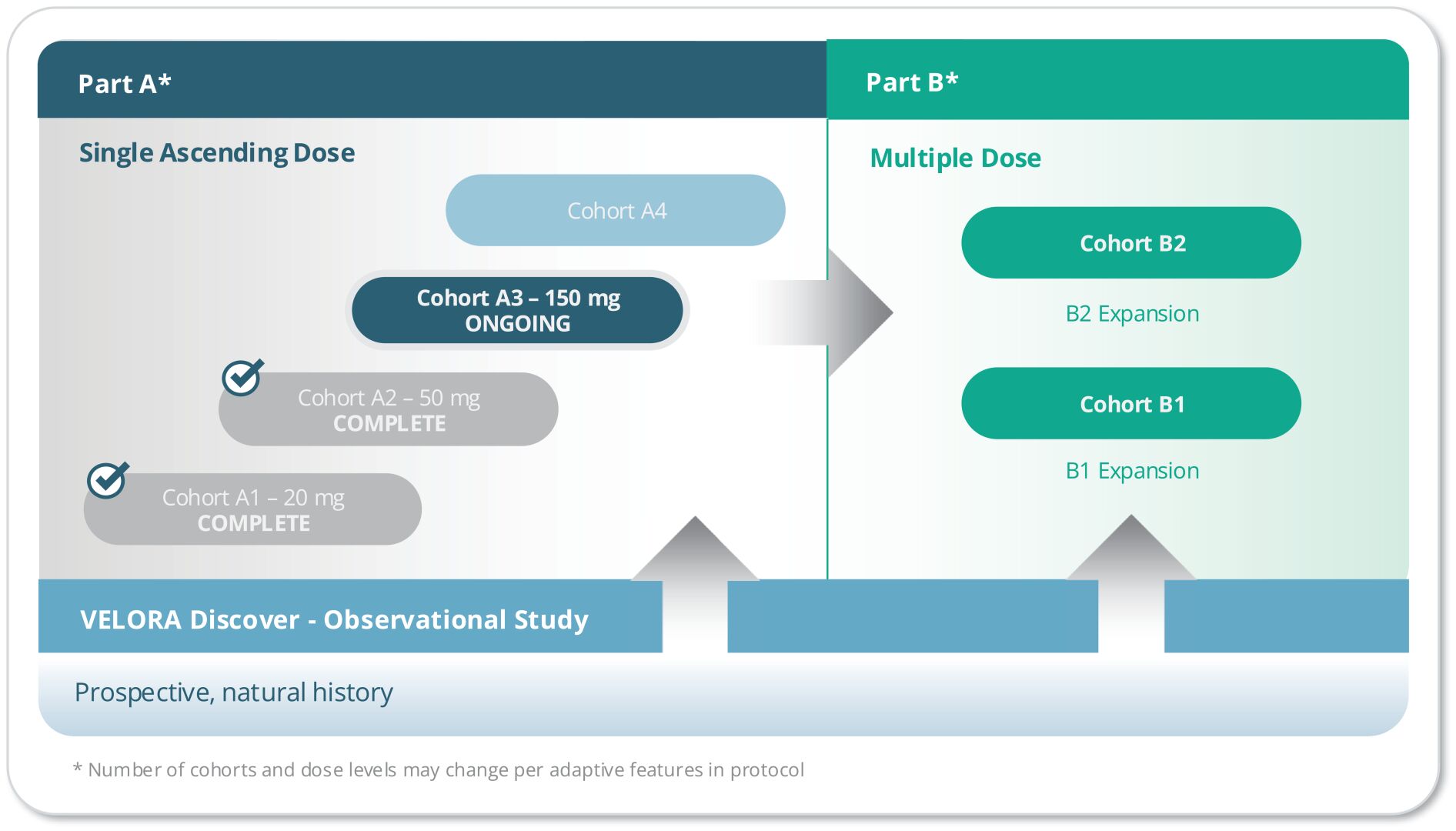
162
Table of Contents
As of the data cutoff date of September 2, 2025, we have completed dosing of a total of six patients in the 20 mg (Cohort A1) and 50 mg (Cohort A2) dose levels in Part A of the trial and are currently enrolling patients into a 150 mg dose cohort (Cohort A3). Demographic information and baseline characteristics of the patients from the first two dose cohorts of Part A of the trial are included in the image below.
Phase 1/2 Clinical Trial of HMB-002– Demographics and Baseline Characteristics
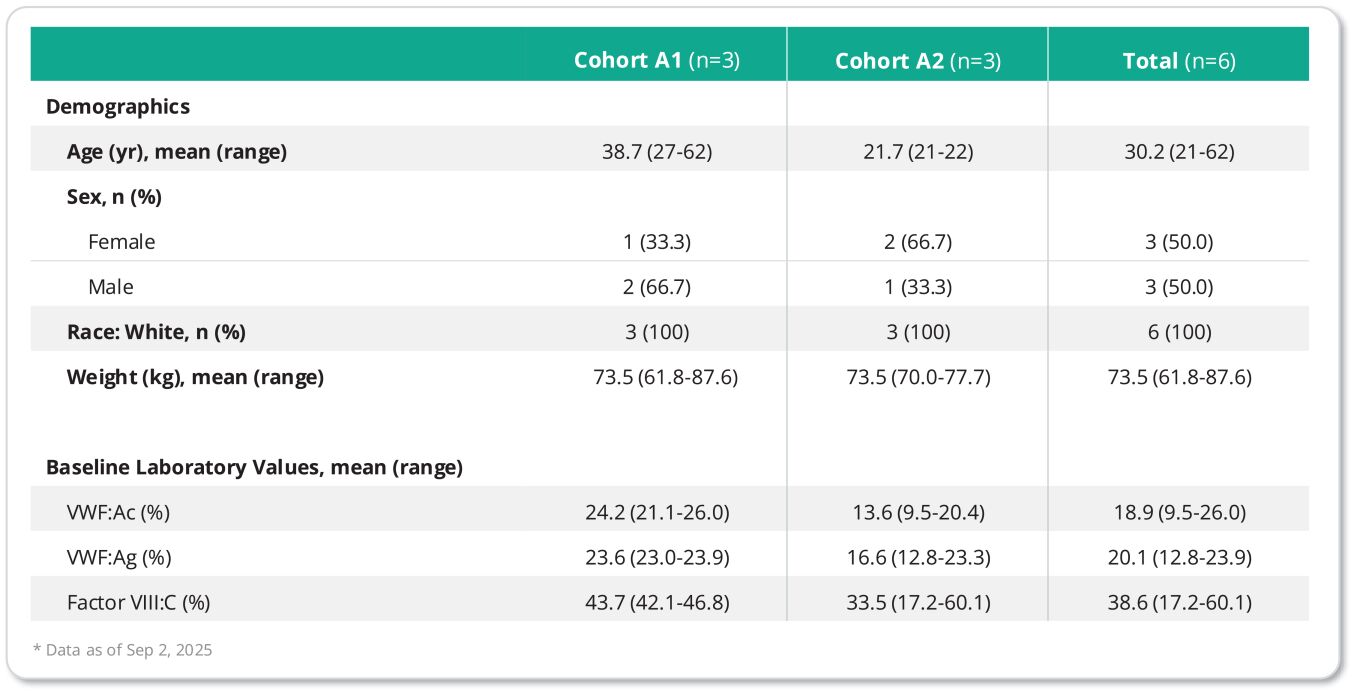
Initial Safety and Tolerability Data: As of the data cutoff date, HMB-002 was generally well tolerated. None of the patients in the 20 mg cohort reported adverse events and only two Grade 1 adverse events that were deemed unrelated to treatment were reported in the 50 mg cohort. In addition, no safety signals of concern have been observed, including no thrombotic events, thrombocytopenia, D-dimer elevations, injection site reactions, or hypersensitivity reactions. Additionally, interim immunogenicity assessments showed no ADA formation at any timepoint evaluated, and inflammatory markers (C3a and cytokines) remained unchanged, indicating no complement activation or inflammatory response to the drug at the dose levels evaluated.
Pharmacokinetic Data. Initial data from the first two cohorts in the Phase 1/2 clinical trial suggest dose dependent plasma exposure of HMB-002 after subcutaneous administration, as depicted in the image below.
Cohorts A1 and A2 – Pharmacokinetics
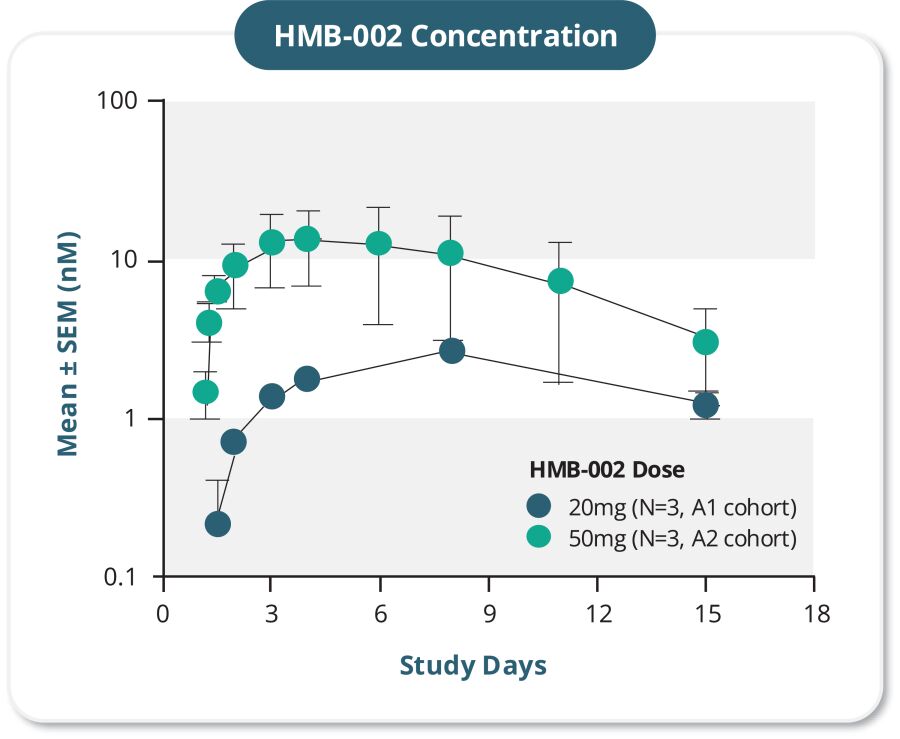
163
Table of Contents
Pharmacodynamic Data. In the first two cohorts from Part A of the trial, following administration with HMB-002, we observed dose-dependent accumulation of plasma VWF antigen, as depicted in the image on the left below, VWF activity, as depicted in the image in the middle below, and Factor VIII coagulant activity, as depicted in the image on the right below. Notably, VWF and Factor VIII levels increased over 1.5-fold from baseline in a dose-dependent manner, with sustained increases for at least eight to ten days, commensurate with the pharmacokinetic data described above.
Cohorts A1 and A2 – Pharmacodynamics
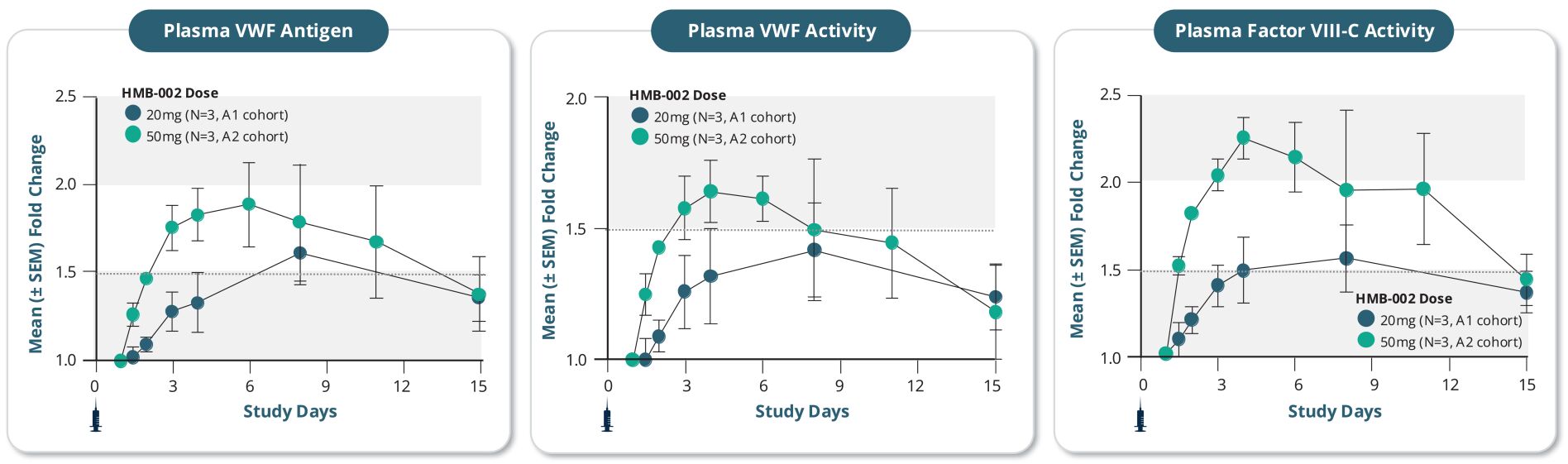
Data from Cohort A1 demonstrated that HMB-002 corrected aPTT and improved thrombin generation assays, resulting in enhanced overall coagulation activity. Furthermore, a sustained VWF multimer distribution was observed, suggesting that HMB-002 did not impact the protein structure of VWF.
Cohorts A1 and A2 – Coagulation Parameters and Multimer Distribution
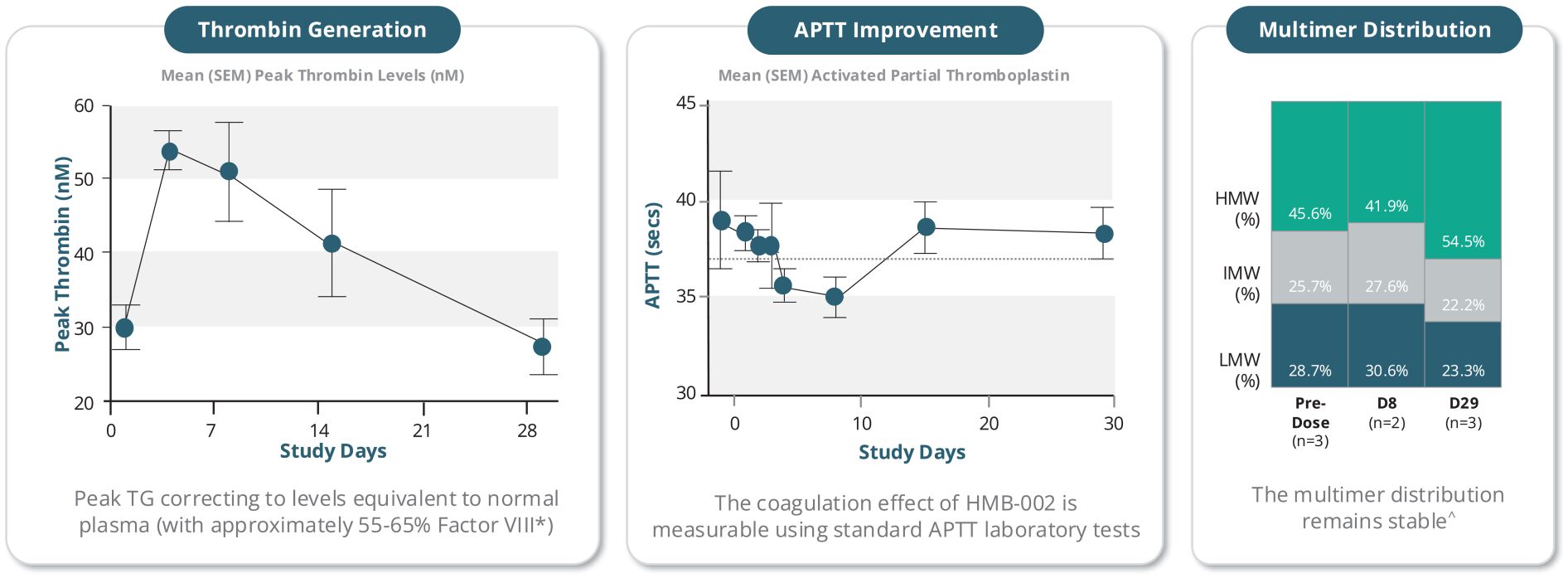
Status and Next Steps
We anticipate reporting initial data from Part B of the trial in late 2026 or early 2027.
Preclinical and Discovery Stage Assets for Additional Coagulation Disorders
In addition to sutacimig and HMB-002, we are advancing multiple preclinical and discovery-stage assets. The first of our preclinical assets, which is expected to enter clinical development in the second half of 2026, subject to regulatory submission and clearance. We plan to report initial clinical data for this asset in mid-2027.
164
Table of Contents
Intellectual Property
We strive to protect and enhance the proprietary technology, inventions and improvements that are commercially important to the development of our business, including seeking, maintaining and defending patent rights, whether developed internally or licensed from third parties. We also rely on trademarks, copyrights and trade secrets relating to our proprietary technology platforms and on know-how, continuing technological innovation and in-licensing opportunities to develop, strengthen and maintain our proprietary and intellectual property position. We additionally may rely on regulatory and other protections afforded through data exclusivity, market exclusivity and patent term extensions, where available.
Our commercial success may depend in part on our ability to: obtain, maintain, enforce and protect our intellectual property and other proprietary rights for commercially important technology, inventions and know-how related to our business; defend and enforce any patents we may own or in-license in the future; prevent others from infringing any patents we may own or in-license in the future; preserve the confidentiality of our trade secrets; and operate without infringing the valid enforceable patents and proprietary rights of third parties. Our ability to limit third parties from making, using, selling, offering to sell or importing our products may depend on the extent to which we have rights under valid and enforceable licenses, patents or trade secrets that cover these activities. In some cases, enforcement of these rights may depend on third party licensors. With respect to both licensed and company-owned intellectual property, we cannot be sure that patents will be granted with respect to any of our pending patent applications or with respect to any patent applications filed by us in the future, nor can we be sure that any of our existing patents or any patents that may be granted to us in the future will be commercially useful in protecting our commercial products and methods of manufacturing the same.
Sutacimig
Our intellectual property portfolio for sutacimig includes a foundational composition of matter patent application filed in April 2020 (and claims priority to April 2019) covering the bispecific antibody composition, with an expected expiration in April 2040, excluding any potential available patent term extensions or similar regulatory extensions. The foundational sutacimig composition of matter patent application family is exclusively licensed to us from Novo Nordisk, as described under the section entitled “—License Agreements” below. This application family has granted patents in the United States, Bahrain, Russia, China, Malaysia, South Africa, Saudi Arabia, South Korea, and Japan; and also has currently pending applications in the United States, Europe, Australia, Brazil, Israel, India, Kuwait, Mexico, Peru, Qatar, Thailand, United Arab Emirates, Canada, Chile, Algeria, Egypt, Morocco, Oman, Russia and Japan. We filed an additional patent application in February 2025 (which claims priority to February 2024) covering dosing regimens for sutacimig, with an expected expiration in February 2045, excluding any potential available patent term extensions or similar regulatory extensions, and national phase entry due in August 2026. We solely own the dosing application. We are actively pursuing additional patent filings covering formulation improvements, biomarkers for patient selection, manufacturing processes, and routes of administration to further strengthen and extend our intellectual property protection for sutacimig. These additional filings are designed to create multiple layers of patent protection extending the commercial exclusivity period beyond the expiration of our composition of matter patents.
HMB-002
Our patent portfolio for HMB-002 includes multiple patent families providing layered protection. Our initial composition of matter patent application for the VWF-targeting antibody was filed in February 2023 (and claims priority to February 2022) with an expected expiration in February 2043, excluding any potential available patent term extensions or similar regulatory extensions. This application family
165
Table of Contents
is currently pending in the United States, Europe, Saudi Arabia, Brazil, Japan, South Korea, Russia, Canada, Australia, China, India, and Hong Kong. We solely own the initial HMB-002 composition of matter patent family. We filed a subsequent composition of matter patent application in August 2024 (which claims priority to August 2023) with an expected expiration in August 2044, excluding any potential available patent term extensions or similar regulatory extensions. The second HMB-002 composition of matter patent family is currently pending in the United States, Europe, United Arab Emirates, Argentina, Australia, Bahrain, Brazil, Canada, Chile, China, Colombia, Algeria, Egypt, Indonesia, Israel, India, Japan, Korea, Kuwait, Mexico, Morocco, Malaysia, Oman, Peru, Philippines, Qatar, Russia, Saudi Arabia, Thailand, Taiwan, Vietnam, and South Africa. We solely own the second HMB-002 composition of matter patent family. We filed an additional patent application covering combination therapy of HMB-002 with VWF replacement products and dosing regimens in February 2026 (which claims priority to February 2025), with expected expiration in February 2046, excluding any potential available patent term extensions or similar regulatory extensions. We solely own the HMB-002 combination therapy and dosing regimens patent family. This application is not yet published. Similar to sutacimig, we are pursuing additional patent filings covering formulation, biomarkers, manufacturing processes, and routes of administration to maximize the duration of intellectual property protection for HMB-002.
License Agreements
We are a party to license agreements under which we license patents, patent applications, and other intellectual property from third parties. The licensed intellectual property covers, in part, our lead product candidate, sutacimig. These licenses impose various diligence and financial payment obligations on us. We consider the following license agreements to be material to our business.
License Agreement with Novo Nordisk
In November 2019, we entered into a license agreement with Novo Nordisk A/S, or Novo Nordisk, pursuant to which Novo Nordisk granted us an exclusive (even as to Novo Nordisk), worldwide and sublicensable license under specified patent rights, and a non-exclusive, worldwide and sublicensable license under specified know-how, to research, develop, make, have made, use, offer for sale, sell, import, export or otherwise exploit, or transfer possession of or title in, products, or Novo Licensed Products, containing bispecific IgG antibodies targeting TLT-1 and Factor VII, including sutacimig, for the treatment of bleeding conditions, including hemophilia. We refer to this agreement as the Novo Nordisk Agreement. Under the terms of the Novo Nordisk Agreement, we have agreed to use commercially reasonable efforts to develop and commercialize a Novo Licensed Product.
We are obligated to pay to Novo Nordisk a one-time DKK 40 million milestone payment upon achievement by a Novo Licensed Product of a specified regulatory milestone event, and we are also obligated to pay Novo Nordisk tiered royalties, in the low single-digit percentages, on aggregate annual net sales of all Novo Licensed Products, on a Novo Licensed Product-by-Novo Licensed Product and country-by-country basis, until the later of the expiration of the last valid claim in the licensed patents under the Novo Nordisk Agreement covering such Novo Licensed Product in such country and ten years following the first commercial sale of such Novo Licensed Product in such country. We currently expect that all of the licensed patents under the Novo Nordisk Agreement will expire by 2040, potentially extending to 2045 with patent term extension. To date, we have not made any payments to Novo Nordisk under the Novo Nordisk Agreement. Under the Novo Nordisk Agreement, we initially granted to Novo Nordisk a right of first negotiation, following a specified clinical event and during a specified period of time, to obtain a license back from us to exploit Novo Licensed Products if we determined to engage with a third party with respect to a license of any Novo Licensed Products. However, Novo Nordisk’s right of first negotiation under the Novo Nordisk Agreement has expired.
The Novo Nordisk Agreement will continue in force until it is terminated. On expiration of each royalty term, our license becomes royalty-free, perpetual, and irrevocable with respect to the applicable
166
Table of Contents
Novo Licensed Product in the applicable country. Either party may terminate the Novo Nordisk Agreement for the other party’s uncured material breach or insolvency. We may terminate the Novo Nordisk Agreement for any reason upon 90 days’ written notice to Novo Nordisk. In the event that Novo Nordisk regains control of the exclusive right to exploit the Novo Licensed Product, the Novo Nordisk Agreement will automatically terminate.
License Agreement with Genmab
In April 2020, we entered into a license agreement with Genmab A/S, or Genmab, pursuant to which Genmab granted us an exclusive (even as to Genmab and its affiliates), worldwide and sublicensable license under platform technology patent rights and know-how relating to Genmab’s proprietary DuoBody® platform to research, develop, make, have made, use, manufacture, import, export and commercialize products comprising bispecific IgG antibodies targeting TLT-1 and Factor VII, or TLT-1/Factor VII Antibody Products, including sutacimig, for the treatment of bleeding conditions, including hemophilia. We refer to this agreement as the Genmab Agreement.
Under the terms of the Genmab Agreement, we have agreed to use commercially reasonable efforts to develop, manufacture, obtain regulatory approval for and commercialize TLT-1/Factor VII Antibody Products worldwide.
Under the Genmab Agreement, we are obligated to pay Genmab a percentage of all net profit (i.e., revenue and other proceeds less specified direct costs we incur to conduct research, development, manufacture and commercialization of TLT-1/Factor VII Antibody Products) we or our affiliates receive with respect to any TLT-1/Factor VII Antibody Products, including (1) net profit from commercial sales of TLT-1/Factor VII Antibody Products and any revenue from third parties, other than Novo Nordisk, in respect of a sublicense or assignment with respect to TLT-1/Factor VII Antibody Products, including assignment fees, sublicensing fees, upfront and milestone fees, royalties and other consideration, whether in kind or cash, and (2) the net profit allocated to TLT-1/Factor VII Antibody Products that we or our affiliates receive if we undergo a change of control (other than an acquisition by Novo Nordisk). The percentage of net profit we owe with respect to each TLT-1/Factor VII Antibody Product is in the low teens from the effective date of the Genmab Agreement until the first commercial sale of such TLT-1/Factor VII Antibody Product. From and after the first commercial sale of a TLT-1/Factor VII Antibody Product, the percentage of net profit we owe with respect to such TLT-1/Factor VII Antibody Product is in the high single digits in all territories in which we commercialize such TLT-1/Factor VII Antibody Product and in the mid-teens in all territories in which a third party, other than Novo Nordisk, commercializes such TLT-1/Factor VII Antibody Product. We are obligated to pay such percentage of net profit on a country-by-country and TLT-1/Factor VII Antibody Product-by-TLT-1/Factor VII Antibody Product basis until the later of the expiration of the last-to-expire of the platform technology patent rights licensed under the Genmab Agreement covering such TLT-1/Factor VII Antibody Product in such country and twelve years following the first commercial sale of such TLT-1/Factor VII Antibody Product in such country, which we refer to as the net profit share term. Following the expiration of the last-to-expire of the platform technology patent rights licensed under the Genmab Agreement covering a given TLT-1/Factor VII Antibody Product in a given country, the percentage of net profit that we are obligated to pay with respect to sales of such TLT-1/Factor VII Antibody Product in such country will be reduced by a specified percentage for the remainder of the net profit share term for such TLT-1/Factor VII Antibody Product in such country. We currently expect that all of the platform technology patent rights licensed under the Genmab Agreement will expire by 2032, though this date may be extended if, for example, Genmab files additional patents covering its platform technology. To date, we have not made any payments to Genmab under the Genmab Agreement.
In the event we seek to sell, license or otherwise dispose of our rights to TLT-1/Factor VII Antibody Products, including through a change of control to any third party other than Novo Nordisk,
167
Table of Contents
we are obligated to provide Genmab the right to participate in any bidding process as a bona fide potential acquirer of such rights.
Unless earlier terminated, the Genmab Agreement will expire, on a TLT-1/Factor VII Antibody Product-by-TLT-1/Factor VII Antibody Product and country-by-country basis, upon the expiration of the last net profit share term for such TLT-1/Factor VII Antibody Product in such country. On expiration of each net profit share term, our license becomes perpetual, fully paid-up and non-exclusive with respect to the applicable TLT-1/Factor VII Antibody Product in the applicable country. Either party may terminate the Genmab Agreement for the other party’s uncured material breach or insolvency or in certain events of force majeure. Genmab may terminate the Genmab Agreement if we or our affiliates or sublicensees challenge any of the platform technology patent rights licensed under the Genmab Agreement. We may terminate the Genmab Agreement for any reason upon 120 days written notice to Genmab. If Novo Nordisk obtains from us the exclusive right to exploit TLT-1/Factor VII Antibody Products, including upon termination of the Novo Nordisk Agreement, then the Genmab Agreement will terminate in all territories in which Novo Nordisk obtains such exclusive rights.
Manufacturing and Supply Chain
We have leveraged multiple third-party manufacturers to support the manufacturing of our assets for clinical trials and, if we receive regulatory approval, we intend to rely on third parties for commercial manufacture. We do not own or operate, and currently have no plans to establish, any manufacturing facilities. We expect this strategy will enable us to maintain a more efficient infrastructure, outsourcing instead of building manufacturing and supply chain capabilities, while simultaneously enabling us to focus our expertise on the clinical development of our assets. We expect to enter into commercial supply agreements with such manufacturers prior to any potential approval of our assets.
Competition
The biotechnology and pharmaceutical industries are characterized by rapidly advancing innovative technologies under intense competition with an emphasis on proprietary products or product candidates. While we believe we have competitive advantages, we face substantial competition from many different sources, including from major pharmaceutical companies, specialty pharmaceutical companies and biotechnology companies worldwide. Any product candidates that we successfully develop and commercialize will compete with existing products and new products that may become available in the future.
We face potential competition from many different sources, including larger and better-funded pharmaceutical and biotechnology companies. Moreover, we may also compete with academic institutions, government agencies and other public and private research organizations that conduct research, seek patent protection and establish collaborative arrangements for research, development, manufacturing and commercialization. Many of our potential competitors, either alone or through strategic partnerships, have significantly greater access to financial, technical, manufacturing, marketing, sales and supply resources. These entities may also compete with us in hiring and retaining scientific and management personnel, establishing clinical trial sites, enrolling patients in clinical trials and pursuing strategic collaborations. As a result, our competitors may discover, develop or commercialize products before or more successfully than we do.
There are currently no subcutaneous, prophylactic therapies for Glanzmann thrombasthenia or Factor VII deficiency that are in development or approved. Patients with these disorders mainly receive reactive treatment in response to bleeding events without the ability to prevent them. However, companies could develop new therapies or repurpose existing therapies for Glanzmann thrombasthenia or Factor VII deficiency, such as emicizumab (Hemlibra), which was developed for
168
Table of Contents
hemophilia A, but could potentially be studied in other bleeding disorders, potentially including our target indications.
For Von Willebrand Disease, the competitive landscape includes currently available therapies and products in development. The current standard of care includes DDAVP and VWF replacement products, including both plasma-derived products (Humate-P, Wilate, Alphanate) and recombinant Won Willebrand Factor (Vonvendi). These products have established positions in the market and physician familiarity. In addition, Star Therapeutics Inc. is currently developing VGA-039, an investigational monoclonal antibody that inhibits protein S, which is currently in Phase 3 clinical development for Von Willebrand Disease.
If we obtain marketing approval for any of our product candidates, there will be several factors that will be important to the commercial success of such products. These factors include efficacy, safety, tolerability, convenience, price and the availability of reimbursement. Inability to be competitive in any of these categories could potentially reduce the commercial opportunity of our product candidates.
Sales and Marketing
In light of our stage of development, we have not yet established a commercial organization or distribution capabilities. We maintain all global economic development and commercialization rights to the assets in our franchise. If our product candidates receive marketing approval, we may choose to commercialize them with our own sales force and will also consider commercial partnerships to maximize the worldwide opportunity for and value of our product candidates and programs.
In addition, particularly with respect to sutacimig for the treatment of Glanzmann thrombasthenia and Factor VII deficiency, if approved, we intend to build a focused, commercial organization targeting the specialized bleeding disorders care network. In the United States, approximately 140 federally-funded Hemophilia Treatment Centers and comprehensive bleeding disorder centers manage many patients with inherited bleeding disorders across our target indications. We expect that this concentrated care model will enable us to efficiently commercialize sutacimig with relatively small field teams. In addition to the United States, we intend to commercialize our product candidates in the European Union, Japan, the GCC countries and other select regions.
Government Regulation
Government authorities in the United States, at the federal, state and local level, and in other countries and jurisdictions, such as the European Union, or EU, extensively regulate, among other things, the research, development, testing, manufacture, pricing, quality control, approval, packaging, storage, recordkeeping, labeling, advertising, promotion, distribution, marketing, sales, reimbursement, post-approval monitoring and reporting, and import and export of pharmaceutical products. The processes for obtaining marketing approvals in the United States and in foreign countries and jurisdictions, along with compliance with applicable statutes and regulations and other regulatory authorities, require the expenditure of substantial time and financial resources.
Approval and Regulation of Biologics in the United States
In the United States, our product candidates are regulated and licensed as biological products, or biologics, under the Public Health Service Act, or the PHSA, and the Food, Drug, and Cosmetic Act, or FDCA, and applicable implementing regulations and guidance. A company, institution, or organization which takes responsibility for the initiation and management of a clinical development program for investigational products, and for their regulatory approval, is typically referred to as a sponsor. The failure of a sponsor to comply with the applicable regulatory requirements at any time during the
169
Table of Contents
product development process, including nonclinical testing, clinical testing, the approval process or post-approval process, may result in delays to the conduct of a study, regulatory review and approval and/or administrative or judicial sanctions.
A sponsor seeking approval to market and distribute a new biologic product in the United States generally must satisfactorily complete each of the following steps before the product candidate will be approved by the FDA:
| • | preclinical testing including laboratory tests, animal studies and formulation studies, which must be performed in accordance with the FDA’s good laboratory practice, or GLP, regulations and standards; |
| • | completion of the manufacture, under current good manufacturing practices, or cGMP, conditions, of the drug substance and product that the sponsor intends to use in human clinical trials along with required analytical and stability testing; |
| • | design of a clinical protocol and submission to the FDA of an investigational new drug application, or IND, for human clinical testing, which must become effective before human clinical trials may begin; |
| • | approval by an independent institutional review board, or IRB, representing each clinical site before each clinical trial may be initiated; |
| • | performance of adequate and well-controlled human clinical trials to establish the safety, potency and purity of the product candidate for each proposed indication, in accordance with good clinical practices, or GCP; |
| • | preparation and submission to the FDA of a biologic license application, or BLA, for a biologic product, which includes not only the results of the clinical trials, but also, detailed information on the chemistry, manufacture controls, or CMC, for the product candidate and proposed labeling for one or more proposed indication(s); |
| • | review of the product candidate by an FDA advisory committee, where appropriate or if applicable; |
| • | satisfactory completion of an FDA inspection of the manufacturing facility or facilities, including those of third parties, at which the product candidate or components thereof are manufactured to assess compliance with cGMP requirements and to assure that the facilities, methods and controls are adequate to preserve the product’s identity, strength, quality and purity; |
| • | satisfactory completion of any FDA audits of the clinical trial sites to assure compliance with GCP and the integrity of clinical data in support of the BLA; |
| • | payment of user fees pursuant to the Prescription Drug User Fee Act, or PDUFA, and securing FDA approval of the BLA to allow marketing of the new product; and |
| • | compliance with any post-approval requirements, including the potential requirement to implement a Risk Evaluation and Mitigation Strategies, or REMS, and the potential requirement to conduct any post-approval studies or other post-marketing commitments required by the FDA. |
Preclinical Studies
Before a sponsor begins testing a product candidate with potential therapeutic value in humans, the product candidate enters the preclinical testing stage. Preclinical tests include laboratory evaluations of product chemistry, formulation and stability, as well as other studies to evaluate, among other things, the toxicity of the product candidate. These studies are generally referred to as IND-enabling studies. The conduct of the preclinical tests and formulation of the compounds for testing must comply with federal regulations and requirements, including GLP regulations and standards.
170
Table of Contents
With passage of the FDA’s Modernization Act 2.0 in December 2022, Congress eliminated provisions in both the FDCA and the PHSA that required animal testing in support of a BLA. While animal testing may still be conducted, the FDA was authorized to rely on alternative non-clinical tests, including cell-based assays, microphysiological systems, or bioprinted or computer models. The results of the preclinical tests, together with manufacturing information and analytical data, are submitted to the FDA as part of an IND. Some long-term preclinical testing, such as animal tests of reproductive adverse events and carcinogenicity, and long-term toxicity studies, may continue after the IND is submitted.
The IND and IRB Processes
An IND is an exemption from the FDCA that allows an unapproved product candidate to be shipped in interstate commerce for use in an investigational clinical trial and a request for FDA authorization to administer such investigational product to humans. An IND must be secured prior to interstate shipment and administration of any product candidate that is not the subject of an approved BLA. In support of a request for an IND, sponsors must submit a protocol for each clinical trial and any subsequent protocol amendments must also be submitted to the FDA as part of the IND. An IND automatically becomes effective 30 days after receipt by the FDA, unless before that time the FDA raises concerns or questions related to one or more proposed clinical trials or studies and places the trial on a clinical hold. The FDA may also place a hold or partial hold on a clinical trial based on chemistry, manufacturing, and controls issues involving the investigational product. In either case, the IND sponsor and the FDA must resolve any outstanding concerns before the clinical trial may proceed. As a result, submission of an IND may not result in the FDA allowing clinical trials to commence.
Following commencement of a clinical trial under an IND, the FDA may also place a clinical hold or partial clinical hold on that trial. A clinical hold is an order issued by the FDA to the sponsor to delay a proposed clinical investigation or to suspend an ongoing investigation. A partial clinical hold is a delay or suspension of only part of the clinical work requested under the IND. For example, a partial clinical hold might state that a specific protocol or part of a protocol may not proceed, while other parts of a protocol or other protocols may do so. No more than 30 days after the imposition of a clinical hold or partial clinical hold, the FDA will provide the sponsor a written explanation of the basis for the hold. Following the issuance of a clinical hold or partial clinical hold, a clinical investigation may only resume once the FDA has notified the sponsor that the investigation may proceed. The FDA will base that determination on information provided by the sponsor correcting the deficiencies previously cited or otherwise satisfying the FDA that the investigation can proceed or recommence. Occasionally, clinical holds are imposed due to manufacturing issues that may present safety issues for the clinical study subjects.
An IRB representing each institution participating in the clinical trial must also review and approve the plan for any clinical trial before it commences at that institution, and the IRB must conduct continuing review and reapprove the study at least annually. The IRB, which must operate in compliance with Health and Human Services, or HHS, and FDA regulations, must review and approve, among other things, the study protocol and informed consent information to be provided to study subjects before the study can commence at the institution and must monitor the trial until it is completed. An IRB can suspend or terminate approval of a clinical trial at its institution, or an institution it represents, if the clinical trial is not being conducted in accordance with the IRB’s requirements or if the product candidate has been associated with unexpected serious harm to patients.
Additionally, some trials are overseen by an independent group of qualified experts organized by the trial sponsor, known as a data monitoring committee, or DMC. This group provides an independent recommendation as to whether or not a trial may move forward at designated checkpoints based on review of available data from the study, to which only the DMC has access. Suspension or termination
171
Table of Contents
of development during any phase of a clinical trial can occur if the DMC recommends stopping a trial due to safety, potency, purity or other issues.
Expanded Access to an Investigational Product
Expanded access, sometimes called “compassionate use,” is the use of investigational products outside of clinical trials to treat patients with serious or immediately life-threatening diseases or conditions when there are no comparable or satisfactory alternative treatment options. The rules and regulations related to expanded access are intended to improve access to investigational products for patients who may benefit from investigational therapies. FDA regulations allow access to investigational products under an IND by the company or the treating physician for treatment purposes on a case-by-case basis for: individual patients (single-patient IND applications for treatment in emergency settings and non-emergency settings); intermediate-size patient populations; and larger populations for use of the investigational product under a treatment protocol or treatment IND application.
When considering an IND application for expanded access to an investigational product with the purpose of treating a patient or a group of patients, the sponsor and treating physicians or investigators will determine suitability when all of the following criteria apply: patient(s) have a serious or immediately life-threatening disease or condition, and there is no comparable or satisfactory alternative therapy to diagnose, monitor, or treat the disease or condition; the potential patient benefit justifies the potential risks of the treatment and the potential risks are not unreasonable in the context or condition to be treated; and the expanded use of the investigational product for the requested treatment will not interfere with initiation, conduct, or completion of clinical investigations that could support marketing approval of the product or otherwise compromise the potential development of the product.
There is no obligation for a sponsor to make its investigational products available for expanded access. However, if a sponsor has a policy regarding how it responds to expanded access requests, it must make that policy publicly available. Specifically, sponsors are required to make such policies publicly available upon the earlier of initiation of a Phase 2 or Phase 3 clinical trial, or 15 days after the investigational product receives designation as a breakthrough therapy, fast track product, or regenerative medicine advanced therapy. In October 2025, the FDA issued final guidance further clarifying the statutory and regulatory requirements governing expanded access.
In addition to and separate from expanded access, the Right to Try Act, which was enacted in 2018, provides a federal framework for certain patients to access certain investigational new products that have completed a Phase 1 clinical trial and that are undergoing investigation for FDA approval. Under certain circumstances, eligible patients can seek treatment without enrolling in clinical trials and without needing FDA permission under the FDA expanded access program. There is no obligation for a drug manufacturer to make its investigational products available to eligible patients under the Right to Try Act.
Human Clinical Trials in Support of a BLA
Clinical trials involve the administration of the investigational product candidate to human subjects under the supervision of a qualified investigator in accordance with GCP requirements, which include, among other things, the requirement that all research subjects provide their informed consent in writing before they participate in any clinical trial. Clinical trials are conducted under written clinical trial protocols detailing, among other things, the objectives of the trial, inclusion and exclusion criteria, the parameters to be used in monitoring safety and the effectiveness criteria to be evaluated. Each protocol, and any subsequent material amendment to the protocol, must be submitted to the FDA as part of the IND, and progress reports detailing the status of the clinical trials must be submitted to the FDA annually.
172
Table of Contents
Human clinical trials are typically conducted in three sequential phases, but the phases may overlap or be combined. Additional studies may also be required after approval.
Phase 1 clinical trials are initially conducted in a limited population, which may be healthy volunteers or patients with the target disease, to test the product candidate for safety, including adverse effects, dose tolerance, absorption, metabolism, distribution, excretion and pharmacodynamics. During Phase 1 clinical trials, information about the product candidate’s pharmacokinetics and pharmacological effects may be obtained.
Phase 2 clinical trials are generally conducted in a patient population to identify possible adverse effects and safety risks, evaluate the efficacy of the product candidate for specific targeted indications and determine dose tolerance and optimal dosage. Multiple Phase 2 clinical trials may be conducted by the sponsor to obtain information prior to beginning larger and more costly Phase 3 clinical trials.
Phase 3 clinical trials proceed if the prior clinical trials demonstrate that the product candidate is potentially effective and has an acceptable safety profile. Phase 3 clinical trials are undertaken in the proposed patient population to provide evidence of clinical safety, potency and purity. A well-controlled, statistically robust Phase 3 clinical trial is designed to deliver the data that regulatory authorities will use to decide whether or not to approve the product candidate, and, if approved, how to appropriately label a new biologic product. Such Phase 3 clinical trials are referred to as “pivotal” trials.
A clinical trial may combine the elements of more than one phase. The FDA has often required more than one Phase 3 trial to support marketing approval of a product candidate. A company’s designation of a clinical trial as being of a particular phase is not necessarily indicative that the study will be sufficient to satisfy the FDA requirements of that phase because this determination cannot be made until the protocol and data have been submitted to and reviewed by the FDA. Moreover, as noted above, a pivotal trial is a clinical trial that is believed to satisfy FDA requirements for the evaluation of a product candidate’s safety, potency and purity such that it can be used, alone or with other pivotal or non-pivotal trials, to support regulatory approval. Generally, pivotal trials are Phase 3 trials, but they may be Phase 2 trials if the design provides a well-controlled and reliable assessment of clinical benefit, particularly in an area of unmet medical need or rare patient population.
In some cases, the FDA may approve a BLA for a product candidate but require the sponsor to conduct additional clinical trials to further assess the product candidate’s safety, potency and purity after approval. Such post-approval trials, typically referred to as post-marketing studies or clinical trials, may be conducted after initial marketing approval. These trials are used to either gain additional experience from the treatment of a larger number of patients in the intended treatment group or to evaluate a specific outcome of interest (safety or efficacy). In certain instances, the FDA may mandate the performance of post-marketing studies or clinical trials, such as to verify clinical benefit in the case of products approved under accelerated approval regulations. Failure to exhibit due diligence with regard to conducting mandatory post-marketing studies or clinical trials could result in withdrawal of FDA approval for products.
Sponsors of clinical trials are required to register and disclose certain clinical trial information on a public registry (clinicaltrials.gov) maintained by the U.S. National Institutes of Health. In particular, information related to the product candidate, patient population, phase of investigation, study sites and investigators and other aspects of the clinical trial is made public as part of the registration of the clinical trial. The failure of a sponsor to submit clinical trial information to clinicaltrials.gov is a prohibited act under the FDCA, with violations subject to potential civil monetary penalties of up to $10,000 for each day the violation continues. Violations may also result in injunctions and/or criminal prosecution or disqualification from federal grants.
173
Table of Contents
Clinical Studies Outside of the United States
When a foreign clinical study is conducted under an IND, all IND requirements must be met unless waived. When a foreign clinical study is not conducted under an IND, the sponsor must ensure that the study complies with certain regulatory requirements of the FDA in order to use the study as support for a BLA. Specifically, the studies must be conducted in accordance with GCPs, including undergoing review and receiving approval by an independent ethics committee and seeking and receiving informed consent from subjects. GCP requirements encompass both ethical and data integrity standards for clinical studies. The FDA’s regulations are intended to help ensure the protection of human subjects enrolled in non-IND foreign clinical studies, as well as the quality and integrity of the resulting data. They further help ensure that non-IND foreign studies are conducted in a manner comparable to that required for IND studies.
The acceptance by the FDA of study data from clinical trials conducted outside the United States in support of United States approval may be subject to certain conditions or may not be accepted at all. In cases where data from foreign clinical trials are intended to serve as the sole basis for marketing approval in the United States, the FDA will generally not approve the application on the basis of foreign data alone unless (i) the data are applicable to the U.S. population and U.S. medical practice; (ii) the trials were performed by clinical investigators of recognized competence and pursuant to GCP regulations; and (iii) the data may be considered valid without the need for an on-site inspection by the FDA, or if the FDA considers such inspection to be necessary, the FDA is able to validate the data through an on-site inspection or other appropriate means.
In addition, even where the foreign study data are not intended to serve as the sole basis for approval, the FDA will not accept the data as support for an application for marketing approval unless the study is well-designed and well-conducted in accordance with GCP requirements and the FDA is able to validate the data from the study through an onsite inspection if deemed necessary. Many foreign regulatory authorities have similar approval requirements. In addition, such foreign trials are subject to the applicable local laws of the foreign jurisdictions where the trials are conducted.
Interactions with the FDA During the Clinical Development Program
Following the clearance of an IND and the commencement of clinical trials, a sponsor is given the opportunity to meet with the FDA at certain points in the clinical development program. There are five types of meetings that occur between sponsors and the FDA. Type A meetings are those that are necessary for an otherwise stalled product development program to proceed or to address an important safety issue. Type B meetings include pre-IND and pre-BLA meetings as well as end of phase meetings, such as end of Phase 2, or EOP2, meetings. A Type C meeting is any meeting other than a Type A or Type B meeting regarding the development and review of a product candidate. A Type D meeting is focused on a narrow set of issues and should not require input from more than three disciplines or divisions. Finally, INTERACT meetings are intended for novel products and development programs that present unique challenges early in the development of an investigational product candidate.
At the conclusion of these meetings, the FDA will typically provide its responses to questions posed by the sponsor regarding the clinical development program. The FDA will not indicate whether a BLA will be approved, but it will provide guidance to the sponsor on various questions, including whether an application should be submitted in the first place on the basis of the studies and data proposed by the sponsor. The FDA may also generally express support for the sponsor’s approach in the clinical development program but indicate that questions concerning whether the data support approval will be subject to review by the FDA following its acceptance for filing of the BLA. The FDA has indicated that its responses, as conveyed in meeting minutes and advice letters, only constitute mere recommendations and/or advice made to a sponsor and, as such, sponsors are not bound by
174
Table of Contents
such recommendations and/or advice. Nonetheless, from a practical perspective, a sponsor’s failure to follow the FDA’s recommendations for design of a clinical program may put the program at significant risk of failure.
Manufacturing Requirements
Concurrently with clinical trials, sponsors usually complete additional animal safety studies, develop additional information about the chemistry and physical characteristics of the product candidate and finalize a process for manufacturing commercial quantities of the product candidate in accordance with cGMP requirements. The manufacturing process must be capable of consistently producing quality batches of the product candidate and, among other criteria, the sponsor must develop methods for testing the identity, strength, quality, and purity of the finished product. Additionally, appropriate packaging must be selected and tested, and stability studies must be conducted to demonstrate that the product candidate does not undergo unacceptable deterioration over its shelf life.
Specifically, the FDA’s regulations require that pharmaceutical products be manufactured in specific approved facilities and in accordance with cGMPs. The cGMP regulations include requirements relating to organization of personnel, buildings and facilities, equipment, control of components and product containers and closures, production and process controls, packaging and labeling controls, holding and distribution, laboratory controls, records and reports and returned or salvaged products. Manufacturers and other entities involved in the manufacture and distribution of approved pharmaceuticals are required to register their establishments with the FDA and some state agencies and are subject to periodic unannounced inspections by the FDA for compliance with cGMPs and other requirements.
The PREVENT Pandemics Act, which was enacted in December 2022, clarifies that foreign manufacturing establishments are subject to registration and listing requirements even if a biologic undergoes further manufacture, preparation, propagation, compounding, or processing at a separate establishment outside of the United States prior to being imported or offered for import into the United States. Inspections must follow a “risk-based schedule” that may result in certain establishments being inspected more frequently. Manufacturers may also have to provide, on request, electronic or physical records regarding their establishments. Delaying, denying, limiting, or refusing inspection by the FDA may lead to a product being deemed to be adulterated. Changes to the manufacturing process, specifications or container closure system for an approved product are strictly regulated and often require prior FDA approval before being implemented.
Pediatric Studies
Under the Pediatric Research Equity Act of 2003, or PREA, a BLA or supplement thereto must contain data that are adequate to assess the safety, potency and purity of the product for the claimed indications in all relevant pediatric subpopulations and to support dosing and administration for each pediatric subpopulation for which the product is safe and effective, unless granted a deferral or waiver. The sponsor must submit an initial pediatric study plan within 60 days of an EOP2 meeting or as may be agreed between the sponsor and the FDA. Sponsors must also submit pediatric study plans prior to the assessment data. Those plans must contain an outline of the proposed pediatric study or studies the sponsor plans to conduct, including study objectives and design, any deferral or waiver requests, and other information required by regulation. The sponsor, the FDA, and the FDA’s internal review committee must then review the information submitted, consult with each other, and agree upon a final plan. The FDA or the sponsor may request an amendment to the plan at any time.
The FDA may, on its own initiative or at the request of the sponsor, grant deferrals for submission of some or all pediatric data until after approval of the product for use in adults, or full or partial waivers
175
Table of Contents
from the pediatric data requirements. A deferral may be granted for several reasons, including a finding that the product or therapeutic candidate is ready for approval for use in adults before pediatric trials are complete or that additional safety or effectiveness data needs to be collected before the pediatric trials begin. A waiver may be granted when the disease or condition does not occur in pediatrics. Unless otherwise required by regulation, the pediatric data requirements generally do not apply to products with orphan designation, although FDA has taken steps to limit what it considers abuse of this statutory exemption in the PREA by announcing that it does not intend to grant any additional orphan drug designations for rare pediatric subpopulations of what is otherwise a common disease. The FDA maintains a list of diseases that are exempt from PREA requirements due to low prevalence of disease in the pediatric population.
Expedited Review Programs
The FDA is authorized to expedite the review of applications in several ways. None of these expedited programs, however, changes the standards for approval but each may help expedite the development or approval process governing product candidates.
| • | Fast Track Designation. Product candidates are eligible for Fast Track designation if they are intended to treat a serious or life-threatening condition and demonstrate the potential to address unmet medical needs for the condition. Fast Track designation applies to the combination of the product candidate and the specific indication for which it is being studied. In addition to other benefits, such as the ability to have greater interactions with the FDA, this designation enables a company to petition the FDA to initiate review of sections of a BLA before the application is complete, a process known as rolling review. |
| • | Breakthrough therapy designation. To qualify for the breakthrough therapy program, a product candidate must be intended to treat a serious or life-threatening disease or condition, and preliminary clinical evidence must indicate that such product candidate may demonstrate substantial improvement on one or more clinically significant endpoints over existing therapies. The FDA will seek to ensure the sponsor of a breakthrough therapy product candidate receives intensive guidance on an efficient development program, involvement of senior managers and experienced staff on a proactive, collaborative and cross-disciplinary review and rolling review. |
| • | Priority review. A product candidate is eligible for priority review if it treats a serious condition and, if approved, it would be a significant improvement in the safety or effectiveness of the treatment, diagnosis or prevention compared to marketed products. Significant improvement may be illustrated by evidence of increased effectiveness in the treatment of a condition, elimination or substantial reduction of a treatment-limiting product reaction, documented enhancement of patient compliance that may lead to improvement in serious outcomes, and evidence of safety and effectiveness in a new subpopulation. The FDA aims to complete its review of priority review applications within six months as opposed to ten months for standard review. |
| • | Regenerative Medicine Advanced Therapy designation. With the passage of the 21st Century Cures Act in December 2016, Congress authorized the FDA to accelerate review and approval of product candidates designated as regenerative advanced therapies. A product candidate is eligible for this designation if it is a regenerative medicine therapy that is intended to treat, modify, reverse or cure a serious or life-threatening disease or condition and preliminary clinical evidence indicates that the product candidate has the potential to address unmet medical needs for such disease or condition. The benefits of a regenerative advanced therapy designation include early interactions with the FDA to expedite development and review, benefits available to breakthrough therapies, potential eligibility for priority review and accelerated approval based on surrogate or intermediate endpoints. |
176
Table of Contents
| • | Commissioner’s National Priority Voucher Program. On June 17, 2025, the FDA announced the creation of the “Commissioner’s National Priority Voucher, or CNPV, Program. Vouchers issued under this program can be redeemed by sponsors to shorten the review time of a BLA from approximately ten to twelve months to one to two months. The CNPV Program convenes experts from the FDA’s offices for a team-based review rather than using the standard review system. Clinical data will be reviewed by a multidisciplinary team of physicians and scientists who will pre-review the submitted information and convene for a one-day meeting. Vouchers under the CNPV Program will be given to companies aligned with U.S. national priorities. |
| • | Rare Disease Evidence Principles. In September 2025, the FDA introduced a framework intended to streamline the approval of new therapies for ultrarare diseases. The Rare Disease Evidence Principles framework is intended to allow sponsors to rely on a single-arm trial in support of approval of biologics that treat rare diseases with very small patient populations and where the disease is linked to a known genetic defect and characterized by progressive functional deterioration leading to disability or death in a short period of time. The targeted diseases should also lack adequate alternative therapies. |
Accelerated Approval
In addition to programs that allow for expedited review of BLAs, the FDA is authorized to approve new products through an accelerated approval pathway. Under this pathway, a product candidate may be approved on the basis of adequate and well controlled clinical trials establishing that the product candidate has an effect on a surrogate endpoint that is reasonably likely to predict a clinical benefit, or on the basis of an effect on a clinical endpoint other than survival or irreversible morbidity or mortality or other clinical benefit, taking into account the severity, rarity and prevalence of the condition and the availability or lack of alternative treatments. As a condition of approval, the FDA may require that a sponsor of a biologic product candidate receiving accelerated approval perform adequate and well controlled post-marketing studies or clinical trials. In addition, the FDA currently requires as a condition for accelerated approval pre-approval of all promotional materials.
In 2022, Congress directed the FDA to require a sponsor to have its confirmatory clinical trial underway before accelerated approval is awarded and to submit progress reports on its post-approval studies to the FDA every six months until the trial is completed. Moreover, the FDA was authorized to withdraw an accelerated approval if certain conditions are met, including where a required confirmatory study fails to verify and describe the predicted clinical benefit or where evidence demonstrates the product candidate is not shown to be safe or effective under the conditions of use. The FDA may also use such procedures to withdraw an accelerated approval if a sponsor fails to conduct any required post-approval study of the product with due diligence, including with respect to “conditions specified by the Secretary.” The procedures include the provision of due notice, an explanation for a proposed withdrawal, opportunities to meet with the FDA Commissioner or the FDA Commissioner’s designee and a written appeal, among other things.
Submission of a BLA to the FDA
The FDA’s approval is required before any new biologic product can be marketed in the United States. Assuming successful completion of all required preclinical and human testing in accordance with all applicable regulatory requirements, detailed product information is submitted to the FDA in the form of a BLA. Under the Prescription Drug User Fee Act, or PDUFA, each BLA must be accompanied by a significant user fee, unless an exception or waiver applies, such as the first application filed by a small business or BLAs for product candidates designated as orphan drugs for indications that are rare diseases or conditions. For federal fiscal year 2026, the application user fee is $4,682,003 for an application requiring clinical data, and the sponsor of a licensed BLA is subject to an annual program fee, which for fiscal year 2026 is $442,213.
177
Table of Contents
The FDA conducts a preliminary review of all applications within 60 days of receipt and must inform the sponsor during that period whether an application is sufficiently complete to permit substantive review. The FDA’s regulations state that an application “shall not be considered as filed until all pertinent information and data have been received” by the FDA. In the event the FDA determines that an application does not satisfy this standard, it will issue a Refuse to File, or RTF, determination to the sponsor. In this event, the BLA must be resubmitted. In October 2025, the FDA issued internal guidance clarifying that “materially incomplete or inadequately organized” applications that would not permit timely, efficient and complete review will be the subject of an RTF. The internal guidance also provides that the FDA will issue an RTF for an application that relies on a single, adequate and well-controlled investigation to support approval if prior communications with the FDA determined the need for more than one clinical trial and any justification for a single investigation is inadequate.
If the BLA submission is accepted for filing, the FDA’s goal is to review the BLA, within ten months for a standard review, or, if the BLA relates to an unmet medical need in the treatment of a serious or life-threatening condition, perform a priority review, within six months. The review process may be extended by the FDA for three additional months to consider new information or after a clarification provided by the sponsor to address an outstanding deficiency identified by the FDA following the original submission. Despite these review goals, it is not uncommon for FDA review of an application to extend beyond the PDUFA target action date.
The FDA seeks to meet these timelines for review of a BLA but its ability to do so may be affected by a variety of factors, including government budget and funding levels, the ability to hire and retain key personnel and statutory, regulatory and policy changes. Average review times at the FDA have fluctuated in recent years as a result. For example, the U.S. government has shut down several times during the past decade and certain regulatory agencies, including the FDA, have had to furlough critical employees and stop critical activities, including the review of BLAs, when funding from PDUFA fee payments was exhausted.
The FDA may refer applications for novel biological products or biological products that present difficult questions of safety or efficacy to an advisory committee, typically a panel that includes clinicians and other experts, for review, evaluation and a recommendation as to whether the BLA should be approved and under what conditions. The FDA is not bound by the recommendations of an advisory committee, but it considers such recommendations carefully when making decisions. During the biological product approval process, the FDA also will determine whether a REMS is necessary to assure the safe use of the biological product. If the FDA concludes a REMS is needed, the sponsor of the BLA must submit a proposed REMS, and the FDA will not approve the BLA without a REMS, if required.
Moreover, the FDA will review a sponsor’s financial relationship with the principal investigators who conducted the clinical trials in support of the BLA. Depending on the level of compensation and any other financial interest a principal investigator may have in a sponsor, the sponsor may be required to report these relationships to the FDA. The FDA will then evaluate that financial relationship and determine whether it creates a conflict of interest or otherwise affects the interpretation of the clinical trial, or the integrity of the data generated at the principal investigator’s clinical trial site. If so, the FDA may exclude data from the clinical trial site in connection with its determination of the approvability of the application for the investigational product.
In connection with its review of a BLA, the FDA will inspect the facilities at which the product is manufactured. The FDA will not approve the product candidate unless it determines that the manufacturing processes and facilities are in compliance with cGMP requirements and adequate to assure consistent production of the product within required specifications. Additionally, the FDA will
178
Table of Contents
typically inspect one or more clinical trial sites to assure that the clinical trials were conducted in compliance with IND requirements and GCP requirements. With passage of FDORA, Congress expressly permitted inspection by the FDA of facilities involved in the preparation, conduct, or analysis of clinical and non-clinical studies submitted to the FDA as well as other persons holding clinical trial records or involved in the clinical trial process.
The FDA’s Decision on a BLA
The FDA reviews a BLA to determine, among other things, whether the product is safe, pure, and potent. To reach this determination, the FDA must determine that the investigational product is effective and that its expected benefits outweigh its potential risks to patients. This “benefit-risk” assessment is informed by the extensive body of evidence about the product candidate’s safety, purity and potency in the BLA. This assessment is also informed by other factors, including the severity of the underlying condition and how well patients’ medical needs are addressed by currently available therapies, uncertainty about how the premarket clinical trial evidence will extrapolate to real-world use of the product candidate in the post-market setting, and whether risk management tools are necessary to manage specific risks.
In February 2026, the Commissioner of the FDA and the Director of Center for Biologics Evaluation and Research published an editorial in the New England Journal of Medicine in which they declared that, in most cases, the new default requirement for FDA approval of a new product will be one adequate and well-controlled pivotal clinical trial plus confirmatory evidence, rather than two pivotal clinical trials. In determining whether to rely on one trial, the FDA will focus on the single trial’s quality, including magnitude of effect, appropriateness of control arms, endpoint selection, statistical power, blinding, handling of missing data, biological plausibility and alignment with intermediate biomarkers. The FDA has long had authority to approve new products on the basis of one trial plus confirmatory evidence and, in recent years, the FDA has exercised that authority with respect to certain types of products. The FDA now takes the position that this will be the new official default standard for most new products. At this point, it is unclear how this new policy will be implemented by the FDA and how, if at all, it will affect our clinical development programs.
After evaluating the BLA and all related information, including the advisory committee recommendations, if any, and inspection reports of manufacturing facilities and clinical trial sites, the FDA will issue either a Complete Response Letter, or CRL, or an approval letter. A CRL indicates that the review cycle of the application is complete, and the application will not be approved in its present form. A CRL generally outlines the deficiencies in the BLA submission and may require substantial additional testing or information in order for the FDA to reconsider the application. If a CRL is issued, the sponsor will have one year to respond to the deficiencies identified by the FDA, at which time the FDA can deem the application withdrawn or, in its discretion, grant the sponsor an additional six-month extension to respond. While CRLs were previously treated by the FDA as confidential and were only disclosed in action packages for approved products, the FDA announced in September 2025 that it will now release CRLs promptly after they are issued to sponsors.
An approval letter, on the other hand, authorizes commercial marketing of the product with specific prescribing information for specific indications. That is, the approval will be limited to the conditions of use (e.g., patient population, indication) described in the FDA-approved labeling. Further, depending on the specific risk(s) to be addressed, the FDA may require that contraindications, warnings or precautions be included in the product labeling, require that post-approval trials, including post-marketing studies or clinical trials, be conducted to further assess a product’s safety after approval, require testing and surveillance programs to monitor the product after commercialization or impose other conditions, including distribution and use restrictions or other risk management mechanisms under a REMS, which can materially affect the potential market and profitability of the
179
Table of Contents
product. The FDA may prevent or limit further marketing of a product based on the results of post-marketing studies, clinical trials, or surveillance programs. After approval, some types of changes to the approved product, such as adding new indications, manufacturing changes and additional labeling claims, are subject to further testing requirements and FDA review and approval.
Post-Approval Requirements
Biologic products manufactured or distributed pursuant to regulatory approvals are subject to pervasive and continuing regulation by the regulatory authorities, including, among other things, requirements relating to formal commitments for post approval clinical trials and studies, manufacturing, recordkeeping, periodic reporting, product sampling and distribution, marketing, labeling, advertising and promotion and reporting of adverse experiences with the product. After approval, most changes to the approved product, such as adding new indications or other labeling claims, are subject to prior FDA review and approval.
Manufacturers are subject to periodic unannounced inspections by regulatory authorities and country or state agencies for compliance with cGMP and other requirements. Changes to the manufacturing process are strictly regulated, and, depending on the significance of the change, may require prior FDA approval. The FDA’s regulations also require investigation and correction of any deviations from cGMP and impose reporting and documentation requirements upon a company and any third-party manufacturers that it may decide to use. Accordingly, manufacturers must continue to expend time, money and effort in the area of production and quality control to maintain compliance with cGMP and other aspects of regulatory compliance.
Further, although physicians may prescribe legally available products for unapproved uses or patient populations, which are commonly referred to as “off-label uses,” manufacturers may not market or promote such uses. The FDA and other agencies actively enforce the laws and regulations prohibiting the promotion of off-label uses, and a company that is found to have improperly promoted off-label uses may be subject to significant liability. In September 2021, the FDA published final regulations which describe the types of evidence that the FDA will consider in determining the intended use of a biologic. If a company is found to have promoted off-label uses, it may become subject to administrative and judicial enforcement by the FDA, the Department of Justice, or the Office of the Inspector General of the HHS, as well as state authorities.
It may be permissible under very specific and narrow conditions for a manufacturer to engage in nonpromotional, non-misleading communication regarding off-label information, such as distributing scientific or medical journal information. Moreover, with passage of the Pre-Approval Information Exchange Act in December 2022, sponsors of product candidates that have not been approved may proactively communicate to payors certain information about product candidates in development to help expedite patient access upon approval. Previously, such communications were permitted under FDA guidance, but this legislation explicitly provides protection to sponsors who convey certain information about product candidates in development to payors, including unapproved uses of approved products.
In addition, in January 2025, the FDA published final guidance outlining its policies governing the distribution of scientific information to healthcare providers about unapproved uses of approved products. The final guidance calls for such communications to be truthful, non-misleading and scientifically sound and to include all information necessary for healthcare providers to interpret the strengths and weaknesses and validity and utility of the information about the unapproved use of the approved product. If a company engages in such communications consistent with the guidance’s recommendations, the FDA indicated that it will not treat such communications as evidence of unlawful promotion of a new intended use for the approved product.
180
Table of Contents
Further, the distribution of prescription pharmaceutical products is subject to a variety of federal and state laws. The Prescription Drug Marketing Act, or PDMA, was the first federal law to set minimum standards for the registration and regulation of distributors by the states and to regulate the distribution of samples. Both the PDMA and state laws limit the distribution of prescription pharmaceutical product samples and impose requirements to ensure accountability in distribution. In November 2013, the federal Drug Supply Chain Security Act became effective in the United States, mandating an industry-wide, electronic, interoperable system to trace prescription products through the pharmaceutical distribution supply chain with a ten-year phase-in process. Manufacturers were required by November 2023 to have such systems and processes in place. So as not to disrupt supply chains, the FDA granted certain exemptions from enhanced distribution security requirements for eligible trading partners for particular periods of time. The exemptions for manufacturers have expired, and entities that are unable to meet the enhanced drug distribution security requirements must now request a waiver, exception, or exemption from the FDA.
Reference Product Exclusivity
When a biological product is licensed for marketing by the FDA with approval of a BLA, the product may be entitled to certain types of market and data exclusivity barring the FDA from approving competing products for certain periods of time. In March 2010, the Biologics Price Competition and Innovation Act of 2009, or the BPCIA, was enacted into law. The BPCIA amended the PHSA to create an abbreviated approval pathway for biological products that are biosimilar to or interchangeable with an FDA-licensed reference biological product. To date, the FDA has approved both biosimilar products and interchangeable biosimilar products. In December 2022, Congress clarified through FDORA that the FDA may approve multiple first interchangeable biosimilar biological products so long as the products are all approved on the first day on which such a product is approved as interchangeable with the reference product.
Under the BPCIA, the approval of a BLA for a biosimilar product may not be made effective until twelve years after the date of first licensure of the reference product, which under the statute excludes the date of licensure of supplements and certain other applications. Additionally, an application for a biosimilar or interchangeable biosimilar product cannot be submitted for review until four years after the date on which the reference product was first licensed under the PHSA. Even if a product is considered to be a reference product eligible for exclusivity, however, another company could market a competing version of that product if the FDA approves a full BLA for such product containing the sponsor’s own preclinical data and data from adequate and well controlled clinical trials to demonstrate the safety, purity, and potency of their product.
The BPCIA also includes provisions to protect reference products that have patent protection. The biosimilar product sponsor and reference product sponsor may exchange certain patent and product information for the purpose of determining whether there should be a legal patent challenge. Based on the outcome of negotiations surrounding the exchanged information, the reference product sponsor may bring a patent infringement suit and injunction proceedings against the biosimilar product sponsor. The biosimilar applicant may also be able to bring an action for declaratory judgment concerning the patent.
The FDA maintains the Purple Book. The Purple Book lists product names, dates of licensure, and applicable periods of exclusivity. Further, the reference product sponsor must provide patent information and patent expiry dates to FDA following the exchange of patent information between biosimilar and reference product sponsors. This information is then published in the Purple Book.
181
Table of Contents
Orphan Drug Designation and Exclusivity
A biologic product may qualify for orphan drug designation under the Orphan Drug Act, if it is intended to treat a rare disease or condition, which is generally a disease or condition that affects fewer than 200,000 individuals in the United States, or more than 200,000 individuals in the United States and for which there is no reasonable expectation that the cost of developing and making a biological product available in the United States for this type of disease or condition will be recovered from sales of the product as stipulated in the Orphan Drug Act. Orphan drug designation must be requested before submitting a BLA. After the FDA grants orphan drug designation, the identity of the therapeutic agent and its potential orphan use are disclosed publicly by the FDA. Orphan drug designation entitles a party to financial incentives such as opportunities for grant funding towards clinical study costs, tax advantages and user-fee waivers. Orphan drug designation does not convey any advantage in or shorten the duration of the regulatory review and approval process.
If a product that has orphan drug designation receives the first FDA approval for the disease or condition for which it has such designation, the product is entitled to orphan product exclusivity. That exclusivity bars the FDA from approving any other applications to market the same product for the same indication for seven years, except in limited circumstances, such as not being able to supply the product for patients or showing clinical superiority to the product with orphan exclusivity. Competitors, however, may receive approval of a different therapy for the indication for which the orphan product has exclusivity or obtain approval for the same product but for a different indication for which the orphan product has exclusivity.
The FDA and Congress may further reevaluate and revise the Orphan Drug Act and its regulations and policies. For example, in September 2021, the Court of Appeals for the 11th Circuit held that, for the purpose of determining the scope of orphan drug exclusivity, the term “same disease or condition” means the designated “rare disease or condition” and not the “indication or use” for which the product is approved. Subsequently, in another case, a federal district court in Washington, D.C. followed the reasoning of the 11th Circuit decision and that decision was appealed to the U.S. Court of Appeals for the D.C. Circuit. On February 3, 2026, the Consolidated Appropriations Act of 2026 was enacted into law. It overruled these court decisions and codified the FDA’s longstanding interpretation of the scope of orphan drug exclusivity to apply to “the same drug for the same approved use or indication within such [designated] rare disease or condition.” This change, which applies retroactively, expressly authorizes the FDA to approve multiple versions of the same orphan drug for different sub-indications and subpopulations, such as adult and pediatric patients or multiple variations of the same disease that are caused by different genetic variants.
Pediatric Exclusivity
Pediatric exclusivity is a type of non-patent marketing exclusivity in the United States and, if granted, provides for the attachment of an additional six months of exclusivity. For biologic products, the six-month period may be attached to any existing regulatory exclusivities but not to any patent terms. The conditions for pediatric exclusivity include the FDA determining that information relating to the use of a new product in the pediatric population may produce health benefits in that population, the FDA making a written request for pediatric clinical trials, and the sponsor agreeing to perform, and report on, the requested clinical trials within the statutory time period. This six-month exclusivity may be granted if a sponsor submits pediatric data that fairly responds to a written request from the FDA for such data within statutory time limits. The data does not need to show the product to be effective in the pediatric population studied, rather if the clinical trial is deemed to fairly respond to the FDA’s request, the additional protection is granted.
182
Table of Contents
Patent Term Restoration
Depending upon the timing, duration and specifics of FDA approval of the use of our product candidates, some of our U.S. patents may be eligible for limited patent term extension under the Drug Price Competition and Patent Term Restoration Act of 1984, commonly referred to as the Hatch-Waxman Amendments. The Hatch-Waxman Amendments permit a patent restoration term of up to five years as compensation for patent term lost during product development and the FDA regulatory review process. However, patent term restoration cannot extend the remaining term of a patent beyond a total of 14 years from the product’s approval date. The patent term restoration period is generally one-half the time between the effective date of an IND and the submission date of a BLA plus the time between the submission date and approval of a BLA, less any time the sponsor failed to act with due diligence. Only one patent applicable to an approved biological product is eligible for extension, and the application for the extension must be submitted prior to the expiration of the patent. The U.S. Patent and Trademark Office, in consultation with the FDA, reviews and approves the application for any patent term extension or restoration. In the future, we may apply for restoration of patent term for one of our owned or licensed patents, depending on the expected length of the applicable clinical trials and other factors involved in the filing of the relevant BLA.
Healthcare Reform
A primary trend in the U.S. healthcare industry and elsewhere is cost containment. There have been a number of federal and state proposals during the last few years regarding the pricing of biologic products, limiting coverage and reimbursement for medical products and other changes to the healthcare system in the United States. In March 2010, the U.S. Congress enacted the Affordable Care Act, or ACA, which, among other things, changed the coverage and payment for pharmaceutical products under government healthcare programs. The ACA was intended to broaden access to health insurance, reduce or constrain the growth of healthcare spending, enhance remedies against fraud and abuse, add transparency requirements for the healthcare and health insurance industries, impose taxes and fees on the health industry and impose additional health policy reforms.
The American Taxpayer Relief Act of 2012, which was enacted in January 2013, among other things, further reduced Medicare payments to several providers, including hospitals, imaging centers, and cancer treatment centers, and increased the statute of limitations period for the government to recover overpayments to providers from three to five years. These laws may result in additional reductions in Medicare and other healthcare funding and otherwise affect the prices we may obtain for any of our product candidates for which we may obtain regulatory approval or the frequency with which any such product candidate is prescribed or used. Under current legislation, the actual reductions in Medicare payments may vary up to 4%.
Since enactment of the ACA, there have been, and continue to be, numerous legal challenges and Congressional actions to repeal and replace provisions of the law. For example, with the enactment of the Tax Cuts and Jobs Act of 2017, which was signed by President Trump on December 22, 2017, Congress repealed the “individual mandate.” The repeal of this provision, which required most Americans to carry a minimal level of health insurance, became effective in 2019. Further, on June 17, 2021, the U.S. Supreme Court dismissed a challenge to the ACA after finding that the plaintiffs did not have standing to challenge the constitutionality of the ACA. Litigation and legislation over the ACA are likely to continue, with unpredictable and uncertain results.
Pharmaceutical Price Reform
The prices of prescription pharmaceuticals have also been the subject of considerable discussion in the United States. There have been U.S. congressional inquiries, as well as proposed and enacted
183
Table of Contents
state and federal legislation designed to, among other things, bring more transparency to pharmaceutical pricing, review the relationship between pricing and manufacturer patient programs, and reduce the costs of pharmaceuticals under Medicare and Medicaid.
For example, on August 16, 2022, the Inflation Reduction Act, or IRA, was signed into law. The legislation has implications for Medicare Part D, which is a program available to individuals who are entitled to Medicare Part A or enrolled in Medicare Part B providing the option of paying a monthly premium for outpatient prescription drug coverage. Among other things, the IRA requires manufacturers of certain drugs to engage in price negotiations with Medicare, with prices that can be negotiated subject to a cap; imposes rebates under Medicare Part B and Medicare Part D to penalize price increases that outpace inflation (first due in 2023); and replaces the Part D coverage gap discount program with a new discounting program (first due in 2025). The IRA permits the Secretary of the HHS to implement many of these provisions through guidance, as opposed to regulation, for the initial years.
Specifically, with respect to price negotiations, Congress authorized Medicare to negotiate lower prices for certain single-source drug and biologic products that do not have competing generics or biosimilars and are reimbursed under Medicare Part B and Part D. The Center for Medicare & Medicaid Services, or CMS, was directed to negotiate prices for ten high-cost drugs paid for by Medicare Part D, beginning in 2026, followed by 15 Part D drugs in 2027, 15 Part B or Part D drugs in 2028, and 20 Part B or Part D drugs in 2029 and beyond. This provision applies to drug products that have been approved for at least 9 years and biologics that have been licensed for 13 years. Drugs and biologics that have been approved for a single rare disease or condition were originally categorically excluded from price negotiation but, with passage of the One Big Beautiful Bill Act in July 2025, Congress extended this exemption to drugs and biologics with multiple orphan drug designations.
The IRA subjects drug manufacturers to civil monetary penalties and a potential excise tax for failing to comply with the legislation by offering a price that is not equal to or less than the negotiated “maximum fair price” under the law or for taking price increases that exceed inflation. In addition, the IRA established inflation rebate programs under Medicare Part B and Part D. These programs require manufacturers to pay rebates to Medicare if they raise their prices for certain Part B and Part D drugs faster than the rate of inflation. The legislation also requires manufacturers to pay rebates for drugs in Medicare Part D whose price increases exceed inflation. The new law also caps Medicare out-of-pocket drug costs at an estimated $2,000 a year beginning in 2025.
The first cycle of negotiations for the Medicare Drug Price Negotiation Program commenced in the summer of 2023 with the negotiated prices for ten selected drug products becoming effective on January 1, 2026. The second cycle of negotiations with participating drug companies occurred during 2025, and the negotiated prices for this second set of 15 drugs will become effective on January 1, 2027. On January 27, 2026, CMS published the list of 15 drugs selected for the third cycle of negotiations, and the negotiated prices will become effective on January 1, 2028.
On June 6, 2023, Merck & Co. filed a lawsuit against HHS and CMS asserting that, among other things, the IRA’s Drug Price Negotiation Program for Medicare constitutes an uncompensated taking in violation of the Fifth Amendment of the U.S. Constitution. Subsequently, a number of other parties also filed lawsuits in various courts with similar constitutional claims. HHS has generally won the substantive disputes in these cases or succeeded in getting claims dismissed for lack of standing or on the merits. Litigation involving these and other provisions of the IRA will likely continue with unpredictable and uncertain results. Since adoption of the IRA, the Trump Administration has taken a number of actions to reduce the costs of pharmaceutical products. For example, on April 15, 2025, President Trump issued an Executive Order which directs HHS to take steps to reduce the prices of pharmaceutical products. Further, on May 12, 2025, President Trump issued an additional Executive
184
Table of Contents
Order calling on pharmaceutical manufacturers to voluntarily reduce the prices of medicines in the United States. The Executive Order provides that if such actions do not lower the costs of pharmaceuticals, the Secretary of HHS would pursue other actions, including proposing a rulemaking that imposes most-favored nation, or MFN, pricing in the United States. Thereafter, on July 31, 2025, the President issued letters to 17 pharmaceutical companies reiterating the requirements of the May 12, 2025 Executive Order and demanding that such companies extend MFN pricing to Medicaid patients. Virtually all of these pharmaceutical companies have entered into agreements with the Trump Administration to provide for lower prices on certain pharmaceuticals. On February 5, 2026, President Trump launched TrumpRx.gov, a website that directs individuals to pharmaceutical manufacturer websites that are offering pricing discounts based on the Trump Administration’s pricing agreements with pharmaceutical manufacturers.
On December 23, 2025, CMS, through its Center for Medicare and Medicaid Innovation, proposed two five-year pilot programs to implement a “reference pricing” regime for drugs paid for under Medicare for 25% of covered beneficiaries. The programs are referred to as the Global Benchmark for Efficient Drug Pricing Model for Medicare Part B drugs, referred to as GLOBE, and the Guarding U.S. Medicare Against Rising Drug Costs for Medicare Part D drugs, referred to as GUARD. Under the proposed pilot programs, a manufacturer would owe rebates to Medicare if prices for their drugs exceeded the prices paid by other economically comparable reference countries, defined in the proposed regulations as Organisation for Economic Co-operation and Development countries with a gross domestic product of $400 billion and a per capita gross domestic product that is at least 60% of the U.S. per capita gross domestic product (an initial list of 19 reference countries is included in the proposed rule). The pilot programs are proposed to go into effect beginning October 1, 2026.
At the state level, individual states are increasingly aggressive in passing legislation and implementing regulations designed to control pharmaceutical and biological product pricing, including price or patient reimbursement constraints, discounts, restrictions on certain product access and marketing cost disclosure and transparency measures. In some cases, these regulations are designed to encourage importation from other countries and bulk purchasing, which may be increasingly true with respect to products approved pursuant to the accelerated approval pathway. State Medicaid programs and other payers are developing strategies and implementing significant coverage barriers, or refusing to cover these products outright, arguing that accelerated approval drugs have insufficient or limited evidence despite meeting the FDA’s standards for accelerated approval.
Federal and State Data Privacy Laws
There are multiple privacy and data security laws that may impact our business activities in the United States and in other countries where we operate, conduct clinical trials or may do business in the future. These laws are evolving and may increase both our obligations and our regulatory risks in the future. In the health care industry generally, under the federal Health Insurance Portability and Accountability Act of 1996, or HIPAA, the HHS has issued regulations to protect the privacy and security of protected health information used or disclosed by covered entities including certain healthcare providers, health plans and healthcare clearinghouses. HIPAA also regulates standardization of data content, codes and formats used in healthcare transactions and standardization of identifiers for health plans and providers. HIPAA also imposes certain obligations on the business associates of covered entities that obtain protected health information in providing services to or on behalf of covered entities. HIPAA may apply to us in certain circumstances and may also apply to our business partners in ways that may impact our relationships with them.
Clinical trials are regulated by the Common Rule, which also includes specific privacy-related provisions. In addition to federal privacy regulations, there are a number of state laws governing the confidentiality and security of health information that may be applicable to our business. In addition to
185
Table of Contents
possible federal civil and criminal penalties for HIPAA violations, state attorneys general are authorized to file civil actions for damages or injunctions in federal courts to enforce HIPAA and seek attorney’s fees and costs associated with pursuing federal civil actions. In addition, state attorneys general (along with private plaintiffs) have brought civil actions seeking injunctions and damages resulting from alleged violations of HIPAA’s privacy and security rules. State attorneys general also have authority to enforce state privacy and security laws. New laws and regulations governing privacy and security may be adopted in the future as well.
At the state level, California has enacted legislation that has been dubbed the first “GDPR-like” law in the United States, referring to the EU’s General Data Protection Regulation, which is described in more detail below. Known as the California Consumer Privacy Act, or CCPA, it creates new individual privacy rights for consumers (as that word is broadly defined in the law) and places increased privacy and security obligations on entities handling personal data of consumers or households. The CCPA went into effect on January 1, 2020 and requires covered companies to provide new disclosures to California consumers, provides such consumers new ways to opt-out of certain sales of personal information, and allows for a new cause of action for data breaches. In November 2020, California voters passed a ballot initiative for the California Privacy Rights Act, or the CPRA, which went into effect on January 1, 2023, and significantly expanded the CCPA to incorporate additional GDPR-like provisions, including requiring that the use, retention, and sharing of personal information of California residents be reasonably necessary and proportionate to the purposes of collection or processing, granting additional protections for sensitive personal information, and requiring greater disclosures related to notice to residents regarding retention of information. The CPRA also created a new enforcement agency – the California Privacy Protection Agency – whose sole responsibility is to enforce the CPRA, which will further increase compliance risk. The provisions in the CPRA may apply to some of our business activities.
In addition to California, at least eighteen other states have passed comprehensive privacy laws similar to the CCPA and CPRA. These laws are either in effect or will go into effect sometime before the end of 2026. Like the CCPA and CPRA, these laws create obligations related to the processing of personal information, as well as special obligations for the processing of “sensitive” data, which includes health data in some cases. Some of the provisions of these laws may apply to our business activities. There are also states that are strongly considering additional laws that will go into effect that could go into effect in 2026 and beyond. Other states will be considering similar laws in the future, and Congress has also been debating passing a federal privacy law. There are also states that are specifically regulating health information that may affect our business. For example, the State of Washington passed the My Health My Data Act in 2023 which specifically regulated health information that is not otherwise regulated by the HIPAA rules, and the law also has a private right of action, which further increases the relevant compliance risk. Connecticut and Nevada have also passed similar laws regulating consumer health data, and more states are considering such legislation. These laws may impact our business activities, including our identification of research subjects, relationships with business partners and ultimately the marketing and distribution of our products.
Plaintiffs’ lawyers are also increasingly using privacy-related statutes at both the state and federal level to bring lawsuits against companies for their data-related practices. In particular, there have been a significant number of cases filed against companies for their use of pixels and other web trackers. These cases often allege violations of the California Invasion of Privacy Act and other state laws regulating wiretapping, as well as the federal Video Privacy Protection Act.
Approval and Regulation of Biologics in the European Union
To market any product outside of the United States, a sponsor must also comply with numerous regulatory requirements of other countries and jurisdictions regarding quality, safety and efficacy and
186
Table of Contents
governing, among other things, clinical trials, marketing authorization, commercial sales and distribution of products. Whether or not it obtains FDA approval for a product, a sponsor will need to obtain the necessary approvals by the comparable regulatory authorities of foreign countries or economic areas, such as the 27-member EU, before it can commence clinical trials or marketing of the product in those countries or jurisdictions. This process in the EU generally follows the same lines as in the United States and requires the satisfactory completion of preclinical studies and adequate and well-controlled clinical trials to establish the safety and efficacy of the product for each proposed indication.
Preclinical Studies
Before a product enters clinical testing in the EU, the sponsor must conduct preclinical studies to demonstrate the safety of the investigational product for such clinical testing. These studies must be conducted in compliance with the principles of GLP, as set forth in EU Directive 2004/10/EC. In particular, preclinical studies, both in vitro and in vivo, must be planned, performed, monitored, recorded, reported and archived in accordance with GLP principles, which reflect the requirements of the Organization for Economic Co-operation and Development.
Human Clinical Trials in Support of a Marketing Authorization
Clinical trials in the EU are governed by the Clinical Trials Regulation (EU) No 536/2014, or CTR, which replaced the prior Clinical Trials Directive 2001/20/EC, or CTD. The CTR is designed to simplify and streamline the authorization, conduct and transparency of clinical trials in the EU. Under the new coordinated procedure for the approval of clinical trials, the sponsor of a clinical trial to be conducted in more than one Member State of the EU submits a single application for approval. The submission is made through the Clinical Trials Information System, the new clinical trials portal overseen by the EMA and available to clinical trial sponsors, competent authorities of the EU Member States and the public. All clinical trials in the EU are now subject to the CTR following completion of the transition from the Clinical Trials Directive.
The CTR streamlines the process and includes a single set of documents to be prepared and submitted for the application, simplified reporting procedures for clinical trial sponsors, and a harmonized procedure for the assessment of applications for clinical trials, which is divided in two parts. Part I is assessed by the competent authorities of all EU Member States in which an application for authorization of a clinical trial has been submitted, and Part II is assessed separately by each Member State concerned. Strict deadlines have been established for the assessment of clinical trial applications under the CTR. The role of the relevant ethics committees in the assessment procedure is governed by the national law of the relevant EU Member State.
As in the United States, sponsors conducting certain clinical studies in the EU must submit clinical and make public trial information through the Clinical Trials Information System (CTIS) which has replaced Edura CT under the CTR.
Pediatric Studies
Prior to obtaining a marketing authorization in the EU, sponsors must demonstrate compliance with all measures included in an EMA-approved Pediatric Investigation Plan, or PIP, covering all subsets of the pediatric population, unless the EMA has granted a product-specific waiver, a class waiver, or a deferral for one or more of the measures included in the PIP. This requirement also applies when a sponsor wants to add a new indication, pharmaceutical form or route of administration for a medicine that is already authorized. The Pediatric Committee of the EMA, or PDCO, may grant deferrals for some products, allowing a company to delay development of the medicine for children until there is enough information to demonstrate its effectiveness and safety in adults. The PDCO may also grant waivers
187
Table of Contents
when the development of a medicine for children is not needed or is not appropriate, such as for diseases that only affect the elderly population. Before a Marketing Authorization Application, or MAA, can be filed, or an existing marketing authorization can be amended, the EMA determines whether a sponsor has complied with the agreed studies and measures listed in each relevant PIP.
PRIME Designation
In March 2016, the EMA launched an initiative to facilitate development of product candidates in indications, which are often rare, for which few or no therapies currently exist. The PRIority MEdicines, or PRIME, scheme is intended to encourage drug development in areas of unmet medical need, and it provides for the accelerated regulatory review of product candidates that represent substantial innovation. Products from small- and medium-sized enterprises, or SMEs, may qualify for earlier entry into the PRIME scheme than larger companies. Many benefits accrue to sponsors of product candidates with PRIME designation, including early and proactive regulatory dialogue with the EMA, frequent discussions on clinical trial designs and other development program elements, and accelerated MAA assessment once an application has been submitted. Importantly, a dedicated EMA contact and rapporteur from the CHMP, or Committee for Advanced Therapies, or CAT, are appointed early in PRIME scheme facilitating increased understanding of the product candidate at the EMA committee level.
Marketing Authorization
To obtain a marketing authorization, or MA, for a product under the EU regulatory system, a sponsor must submit an MAA either under a centralized procedure administered by the EMA or one of the procedures administered by competent authorities in EU Member States, including the decentralized procedure, national procedure, or mutual recognition procedure.
The centralized procedure provides for the grant of an MA by the European Commission, or EC, that is valid for all EU Member States. Pursuant to Regulation (EC) No. 726/2004, the centralized procedure is compulsory for certain types of product candidates, including those produced by certain biotechnological processes, designated as orphan drugs, that are advanced therapies, and that have a new active substance indicated for the treatment of certain diseases, including cancer. However, the centralized procedure may be optional for product candidates with a new active substance indicated for the treatment of other diseases and product candidates that are highly innovative or for which a centralized process is in the interest of patients. Sponsors must demonstrate the quality, safety, and efficacy of their product candidates to the EMA, which provides an opinion regarding the MAA. The EC then decides whether to grant or refuse marketing authorization in light of the opinion delivered by the EMA.
The CHMP was established at the EMA and plays a vital role in the authorization of products in the EU. The CHMP provides scientific advice to sponsors investigating and developing new products, prepares scientific guidelines and regulatory guidance to help sponsors prepare MAAs, and cooperates with international partners on the harmonization of regulatory requirements. With respect to MAAs filed under the centralized procedure, the CHMP is responsible for conducting an initial assessment of a product candidate and the data supporting the MAA. The maximum timeframe for the evaluation of an MAA is 210 days, excluding interruptions when additional information or written or oral explanation is to be provided by the sponsor in response to questions from the CHMP. Accelerated assessment with a time limit of 150 days may be granted by the CHMP in exceptional cases.
On the basis of its review, the CHMP provides a scientific opinion on whether or not an MA should be granted for a product candidate. Within 15 calendar days of receipt of a final opinion from the CHMP, the EC must prepare a draft decision concerning an MAA. This draft decision must take the
188
Table of Contents
CHMP opinion and any relevant provisions of EU law into account. Before arriving at a final decision, the EC must consult the Standing Committee on Medicinal Products for Human Use. This committee is composed of representatives of the EU Member States and is chaired by a non-voting EC representative.
The decentralized marketing authorization procedure requires a separate application to, and leads to separate approval by, the competent authorities of each EU Member State in which the product candidate is applying to be marketed. This application is substantially the same as an MAA submitted to the EMA in the centralized procedure. The reference Member State, or RMS, prepares a draft assessment and drafts of the related materials within 120 days after receipt of a valid application. The resulting assessment report is submitted to the concerned EU Member States which, within 90 days of receipt, must decide whether to approve the assessment report and related materials. If the relevant EU Member State cannot approve the RMS’s assessment report and related materials due to concerns relating to a potential serious risk to public health, disputed elements may be referred to the CMDh and, if unresolved, to the CHMP for arbitration, following which the European Commission adopts a binding decision.
The mutual recognition procedure similarly is based on the acceptance by the competent authorities of the EU Member States of the MA of a product by the competent authorities of other EU Member States. The holder of a national MA may submit an application to the competent authority of an EU Member State requesting that this authority recognize the MA delivered by the competent authority of another EU Member State.
Periods of Authorization and Renewals
An MA is initially valid for five years and may be renewed after five years following a re-evaluation of the risk-benefit balance by the EMA or by the competent authority of the EU Member State. In connection with seeking a renewal, the MA holder must provide the EMA or the competent authority of the EU Member State with a consolidated version of the file in respect of quality, safety and efficacy or the medicine, including all variations introduced since the MAwas granted, at least six months before the MA ceases to be valid. The EC or the competent authority of the EU Member State may decide, on justified grounds relating to pharmacovigilance, to proceed with an additional five-year period of MA. Once definitively renewed, the MA shall be valid for an unlimited period. If a renewed MA is not followed by the actual placing of the medicine on the EU market (in the case of the centralized procedure) or on the market of the authorizing EU Member State within three years after renewal, and is no longer actually present on the applicable market for three consecutive years, the MA ceases to be valid.
Marketing Authorization Under Exceptional Circumstances
The EC may grant a “marketing authorization under exceptional circumstances” under Article 14(8) of Regulation (EC) No 726/2004. This authorization is intended for products for which the sponsor can demonstrate that it is unable to provide comprehensive data on the efficacy and safety under normal conditions of use, because: the indications for which the product in question is intended are encountered so rarely that the sponsor cannot reasonably be expected to provide comprehensive evidence; given the present state of scientific knowledge, comprehensive information cannot be provided; or it would be contrary to generally accepted principles of medical ethics to collect such information.
A marketing authorization under exceptional circumstances may be granted subject to certain specific obligations, which may include the following: the sponsor must complete an identified program of studies within a time period specified by the competent authority, the results of which form the basis of a reassessment of the benefit-risk profile; the medicine in question may be supplied by medical
189
Table of Contents
prescription only and may in certain cases be administered only under strict medical supervision, possibly in a hospital and in the case of a radiopharmaceutical, by an authorized person; and the package leaflet and any medical information must draw the attention of the medical practitioner to the fact that the particulars available concerning the product in question are as yet inadequate in certain specified respects.
A marketing authorization under exceptional circumstances is subject to an annual process to review and reassess the risk-benefit balance. Continuation of the authorization is linked to the annual reassessment and a negative assessment could potentially result in the marketing authorization being suspended or revoked. The renewal of a marketing authorization under exceptional circumstances, however, follows the same rules as a standard MA. Thus, it is granted for an initial five year period, after which the authorization will become valid indefinitely, unless the EMA decides that safety grounds merit one additional five-year renewal.
Conditional Marketing Authorization
The EC may also grant a “conditional marketing authorization” to a product prior to obtaining the comprehensive clinical data required for an application for a full MA under Article 14-a of Regulation (EC) No 726/2004. A conditional marketing authorization may be granted for product candidate (including product candidates designated as orphan drugs) if: (i) the risk-benefit balance of the product candidate is positive, (ii) it is likely that the sponsor will be in a position to provide the required comprehensive clinical trial data, (iii) the product candidate fulfills an unmet medical need and (iv) the benefit to public health of the immediate availability on the market of the product candidate outweighs the risk inherent in the fact that additional data are still required. A conditional marketing authorization may contain specific obligations to be fulfilled by the holder, including obligations with respect to the completion of ongoing or new studies and with respect to the collection of pharmacovigilance data. Conditional marketing authorizations are valid for one year, and may be renewed annually, if the risk-benefit balance remains positive, and after an assessment of the need for additional or modified conditions and/or specific obligations.
Post-Approval Regulatory Requirements
Following the issuance of an MA for a medicine, the sponsor of the MA is required to comply with a range of requirements applicable to the manufacturing, marketing, promotion and sale of products. These requirements include compliance with the EU’s stringent pharmacovigilance or safety reporting rules, which may include post-authorization studies and additional monitoring obligations. Further, the manufacturing of authorized products, for which a separate manufacturer’s license is mandatory, must also be conducted in strict compliance with the applicable EU laws, regulations and guidance, including Directive 2001/83/EC, Directive 2003/94/EC, Regulation (EC) No 726/2004 and the EC Guidelines for Good Manufacturing Practice. These requirements include compliance with EU Good Manufacturing Practice (GMP) standards when manufacturing products and active pharmaceutical ingredients, including the manufacture of active pharmaceutical ingredients outside of the EU with the intention to import the active pharmaceutical ingredients into the EU.
At the same time, the marketing and promotion of authorized drugs, including industry-sponsored continuing medical education and advertising directed toward the prescribers of drugs and/or the general public, are strictly regulated in the EU under Directive 2001/83/EC, as amended, and are also subject to EU Member State laws. Direct-to-consumer advertising of prescription medicines is prohibited across the EU.
190
Table of Contents
Regulatory Exclusivity
New products approved on the basis of a complete data package currently qualify for eight years of data exclusivity and an additional two years of market exclusivity. Data exclusivity prevents sponsors that seek MA of generic products from referencing the innovator’s data in support of an abbreviated application. During the additional two-year period of market exclusivity, a generic MAA can be submitted and the innovator’s data may be referenced in that application, but no generic product can be placed on the EU market until the expiration of the market exclusivity. The overall ten-year period may be extended to a maximum of 11 years if, during the first eight years of those ten years, the MA holder for the innovative product obtains an authorization for one or more new therapeutic indications which are determined to bring a significant clinical benefit in comparison with existing therapies.
In November 2020, the EC launched a review of the EU’s pharmaceutical legislation, including its provisions governing regulatory exclusivity. The EC’s proposal for revision of several legislative measures was published in April 2023 and includes, among other things, provisions that would potentially reduce the duration of regulatory exclusivity protection. On December 11, 2025, the European Parliament and Council reached a provisional political agreement on the legislation, which is expected to be adopted by mid-2026. Key changes include updating regulatory exclusivity to a new system with eight years of data exclusivity and a reduced market exclusivity period to one year, which can be extended if specific conditions are fulfilled up to a maximum of 11 years. This measure, and others, are expected to be adopted by mid-2026 and, following a transition period of 24 months, will likely take effect in mid-2028.
Orphan Drug Designation and Exclusivity
As in the United States, a product candidate can be designated as an orphan medicinal product by the EC if its sponsor can establish that the product candidate is intended for the diagnosis, prevention or treatment of (1) a life-threatening or chronically debilitating condition affecting not more than five in ten thousand persons in the EU when the application is made, or (2) a life-threatening, seriously debilitating or serious and chronic condition in the EU that without incentives is unlikely to generate sufficient return from marketing in the EU to justify the necessary investment. For either of these categories, the sponsor must demonstrate that there is no satisfactory method of diagnosis, prevention or treatment of the condition in question that has been authorized in the EU or, if such method exists, the drug will be of significant benefit to those affected by the condition.
If a product candidate is designated as an orphan medicinal product, the product will be eligible for a range of benefits during the development and regulatory review process, including scientific assistance for study protocols, authorization through the centralized marketing authorization procedure, which is mandatory for orphan medicinal products and results in a single marketing authorization covering all EU Member States and a reduction or elimination of registration and MA fees.
Further, if and when the product is authorized for marketing, the orphan medicinal product will be entitled to ten years of market exclusivity in all EU Member States. However, MA may be granted to a similar product with the same orphan indication during the 10-year period with the consent of the MA holder of the original orphan drug or if the manufacturer of the original orphan drug is unable to supply sufficient quantities. MA may also be granted to a similar product with the same orphan indication if the product is safer, more effective or otherwise clinically superior to the original orphan drug. The period of market exclusivity may, in addition, be reduced to six years if it can be demonstrated on the basis of available evidence that the original orphan drug is sufficiently profitable not to justify maintenance of market exclusivity.
191
Table of Contents
Pediatric Exclusivity
If a sponsor obtains a MA in all EU Member States, or a MA granted in the centralized procedure by the EC, and the study results for the pediatric population are included in the application, even when negative, the product is eligible for an additional six-month period of qualifying patent protection through extension of the term of the SPC.
Patent Term Extensions
The EU provides for patent term extension through SPCs. The rules and requirements for obtaining a SPC are set out in Regulation (EC) 469/2009 and are similar to those in the United States. An SPC may extend the term of a patent for up to five years after its originally scheduled expiration date and can provide up to a maximum of fifteen years of marketing exclusivity for a drug. Although SPCs are available throughout the EU, sponsors must apply on a country-by-country basis.
Pricing Decisions
In the EU, pricing and reimbursement schemes vary widely from country to country. Some countries provide that products may be marketed only after a reimbursement price has been agreed. Other countries may require the completion of additional studies that compare the cost-effectiveness of a particular product candidate to currently available therapies or so-called health technology assessments, in order to obtain reimbursement or pricing approval. For example, EU Member States have the option to restrict the range of products for which their national health insurance systems provide reimbursement and to control the prices of products for human use. EU Member States may approve a specific price for a product or it may instead adopt a system of direct or indirect controls on the profitability of the company placing the product on the market. Other EU Member States allow companies to fix their own prices for products, but monitor and control prescription volumes and issue guidance to physicians to limit prescriptions.
Recently, many countries in the EU have increased the amount of discounts required on pharmaceuticals, and these efforts could continue as countries attempt to manage health care expenditures, especially in light of the severe fiscal and debt crises experienced by many countries in the EU. The downward pressure on health care costs in general, particularly prescription products, has become intense. As a result, increasingly high barriers are being erected to the entry of new products. Political, economic and regulatory developments may further complicate pricing negotiations, and pricing negotiations may continue after reimbursement has been obtained. Reference pricing used by various EU Member States, and parallel trade, i.e., arbitrage between low-priced and high-priced EU Member States, can further reduce prices.
General Data Protection Regulation
There are significant privacy and data security laws that apply in Europe and other countries. The collection, use, disclosure, transfer, or other processing of personal data, including personal health data, regarding individuals who are located in the European Economic Area, or EEA, and the processing of personal data that takes place in the EEA, is subject to the EU’s General Data Protection Regulation, or GDPR, which became effective in 2018. The GDPR is wide-ranging in scope, imposes numerous requirements on companies that process personal data, and imposes heightened requirements on companies that process health and other sensitive data. These requirements include, in many situations, that a company obtain consent from an individual before processing their sensitive personal data.
Examples of obligations imposed by the GDPR on companies processing personal data within its scope include providing information to individuals regarding data processing activities, implementing safeguards to protect the security and confidentiality of personal data, appointing a data protection
192
Table of Contents
officer, providing notifications of data breaches, and taking certain measures when engaging third-party processors. The GDPR also imposes strict rules on the transfer of personal data to countries outside the EEA, including the U.S., and permits data protection authorities to impose large penalties for violations of the GDPR, including potential fines of up to the greater of €20 million or 4% of annual global revenues. The GDPR also confers a private right of action on data subjects and consumer associations to lodge complaints with supervisory authorities, seek judicial remedies, and obtain compensation for damages resulting from violations of the GDPR. Compliance with the GDPR is a rigorous and time-intensive process that may increase the cost of doing business or require companies to change their business practices to ensure full compliance.
Following the July 2020 Court of Justice of the EU judgement invalidating the so-called EU-U.S. Privacy Shield, the EC adopted an adequacy decision for the EU-U.S. Data Privacy Framework in July 2023. This adequacy decision permits U.S. companies who self-certify under the EU-U.S. Data Privacy Framework to rely on it as a valid data transfer mechanism for data transfers from the EU to the United States. However, some privacy advocacy groups have already suggested that they will be challenging the EU-U.S. Data Privacy Framework, and there is currently one pending litigation against the EU-U.S. Data Privacy Framework before the Court of Justice of the EU (CJEU), C-703/25 P – Latombe v Commission. If these challenges are successful, they may not only impact the EU-U.S. Data Privacy Framework, but also further limit the viability of the so-called standard contractual clauses and other data transfer mechanisms.
Approval and Regulation of Biologics in the United Kingdom
As of January 1, 2025, the Medicines and Healthcare Products Regulatory Agency, or the MHRA, is responsible for approving all products destined for the United Kingdom market (Great Britain and Northern Ireland). The MHRA relies on the Human Medicines Regulations 2012 (SI 2012/1916) (as amended), or the HMR, as the basis for regulating products. The HMR has incorporated into domestic law the body of EU law instruments governing products that existed prior to the United Kingdom’s withdrawal from the EU. On April 28, 2025, the U.K. Parliament adopted amendments to improve and strengthen the clinical trials regulatory regime in the United Kingdom. These revisions will take effect on April 28, 2026, and were needed to replace the prior requirements in the United Kingdom that were based on the repealed CTD, which has been replaced by the CTR, while the United Kingdom has established its own standalone clinical trials regime.
In addition, as of January 1, 2024, an international recognition procedure, or IRP, applies in the United Kingdom and is designed to facilitate approval of pharmaceutical products in the United Kingdom. The IRP is open to sponsors that have previously received an authorization for the same product from one of the MHRA’s specified Reference Regulators, or RRs. The RRs include the EMA and regulators in the EEA member states, for approvals in the EU centralized procedure and mutual recognition procedure, and the FDA for approvals granted in the United States. The RR assessment must have undergone a full and standalone review. RR assessments based on reliance or recognition cannot be used to support an IRP application. A CHMP positive opinion is an RR authorization for the purposes of IRP.
Following the withdrawal of the United Kingdom from the EU, the U.K. Data Protection Act applies to the processing of personal data that takes place in the United Kingdom and includes parallel obligations to those set forth by GDPR. The United Kingdom government has determined that it considers all EU Member States and EEA member states to be adequate for the purposes of data protection, ensuring that data flows from the United Kingdom to the EU/EEA remain unaffected. Further, the EC decided in June 2021 that the level of data protection in the United Kingdom is “essentially adequate” for purposes of data transfer from the EU to the United Kingdom. On December 19, 2025, the EC renewed this decision until December 27, 2031. The United Kingdom and
193
Table of Contents
the U.S. have also agreed to a U.S.- United Kingdom “Data Bridge,” which functions similarly to the EU-U.S. Data Privacy Framework and provides an additional legal mechanism for companies to transfer personal data from the United Kingdom to the United States.
In the United Kingdom, following Brexit, the MHRA has established and administers the Innovation Licensing and Access Pathway, or ILAP, to accelerate the development and approval of new pharmaceutical products. The ILAP is open to sponsors of potentially transformative medicines or drug-device combination products that address unmet medical needs. It supports products with evidence of safe use in humans but before confirmatory trials have started. It is designed to reduce the end-to-end timeline for research and development, regulatory approval and timely adoption of new technologies to benefit patients and the healthcare system in the United Kingdom. To these ends, the ILAP comprises an Innovation Passport designation, a Target Development profile and a toolkit to support all stages of the design, development and approval process. In 2025, the MHRA relaunched the ILAP with updated eligibility criteria, simplified application steps, and an increased focus on advanced therapy medicinal products, rare diseases and high unmet medical needs.
Employees and Human Capital Resources
As of March 31, 2026, we had 72 full-time employees, of which 33 employees are based in the United States and 34 employees are based in Denmark. None of our employees are represented by labor unions or covered by collective bargaining agreements. We consider our relationship with our employees to be good.
Our human capital resources objectives include, as applicable, identifying, recruiting, retaining, incentivizing and integrating our existing and new employees, advisors and consultants. Our compensation program is designed to retain, motivate and, as needed, attract highly qualified employees. Accordingly, we use a mix of competitive base salary, cash-based annual incentive compensation, equity awards and other employee benefits.
Facilities
Our principal facilities consist of office space. We occupy approximately 6,200 square feet of office space in Copenhagen, Denmark under a lease that currently expires in January 2029. We also occupy 4,274 square feet of office space in Cambridge, Massachusetts under a lease that currently expires in October 2026. We believe our facilities are adequate and suitable for our current needs and that should it be needed, suitable additional or alternative space will be available to accommodate our operations.
Legal Proceedings
From time to time, we may become involved in legal proceedings arising in the ordinary course of our business. We are not currently subject to any material legal proceedings.
194
Table of Contents
Executive Officers and Directors
The following table sets forth the name, age as of March 31, 2026 and position of each of our executive officers and directors.
| Name |
Age |
Position | ||
| Executive Officers |
||||
| Benny Sørensen, M.D., Ph.D |
52 | President and Chief Executive Officer, Director | ||
| Mads Behrndt, M.Sc |
43 | Chief Financial Officer and General Manager | ||
| Catherine Madigan, M.D |
54 | Chief Medical Officer | ||
| Ananthram Murthy, Ph.D., M.Sc. |
48 | Chief Operating Officer | ||
| Non-Employee Directors |
||||
| John Maraganore, Ph.D.(2)(3) |
63 | Chair of the Board of Directors | ||
| Linda Bain(1) |
55 | Director | ||
| Laura Tadvalkar, Ph.D.(1)(2) |
38 | Director | ||
| Akshay Vaishnaw, M.D., Ph.D.(1)(3) |
63 | Director | ||
| (1) | Member of the Audit Committee. |
| (2) | Member of the Compensation Committee. |
| (3) | Member of the Nominating and Corporate Governance Committee. |
Executive Officers
Benny Sørensen, M.D., Ph.D. has served as our president and chief executive officer since July 2021 and as a member of our board of directors since November 2021. Prior to that, Dr. Sørensen served as Senior Vice President, Strategic Projects at Codiak Biosciences, Inc., or Codiak, a biopharmaceutical company, from October 2016 to July 2021. Previously, Dr. Sørensen served as Senior Director of Clinical Research at Alnylam Pharmaceuticals, Inc., or Alnylam, a biopharmaceutical company, from October 2013 to October 2016. From May 2012 to October 2013, Dr. Sørensen served as a Global Medical Director at Baxter Healthcare Corporation, or Baxter, a medical equipment manufacturing company. Prior to Baxter, Dr. Sørensen was the Director of the Haemostasias Research Unit and Honorary Lecturer at Guy’s and St. Thomas’ Hospital and King’s College London School of Medicine. Dr. Sørensen previously served on the Scientific Advisory Board of Codiak from July 2021 to March 2023. He also served as an Associate Professor of Thrombosis and Haemostasis at Aarhus University, Denmark from 2007 until 2016. Dr. Sørensen holds an M.D. and Ph.D. from Aarhus University. We believe that Dr. Sørensen is qualified to serve on our board of directors based on his extensive knowledge of our company and the biopharmaceutical industry, his experience in hematological research and his current role as our president and chief executive officer.
Mads Behrndt-Eriksen, M.Sc. has served as our chief financial officer and general manager since September 2021. Prior to that, Mr. Behrndt served in roles of increasing responsibility, including as a Partner, in PricewaterhouseCoopers’ Corporate Finance practice from 2007 to September 2021. Mr. Behrndt holds an M.Sc. in Finance & Strategic and a B.Sc. in Economics and Business Administration Management from the Copenhagen Business School.
Catherine Madigan, M.D. has served as our chief medical officer since January 2025. Prior to that, Dr. Madigan served as Chief Medical Officer at Syndax Pharmaceuticals, Inc., a biopharmaceutical company, from March 2022 to December 2024. Previously, Dr. Madigan served as
195
Table of Contents
Vice President, Head of Clinical Development at Syros Pharmaceuticals, Inc., a biopharmaceutical company, from June 2019 to February 2022. Prior to that, she served as Senior Medical Director, Clinical Research at Alnylam from March 2018 to June 2019 and as Medical Director from June 2016 to March 2018. Dr. Madigan also was a Medical Director in the Rare Disease Innovation Unit of Biogen Inc., a biotechnology company, from February 2016 to May 2016 and served as Associate Medical Director from January 2014 to January 2016. Dr. Madigan previously held various academic positions of increasing responsibility at the University of California San Diego/Rady Children’s Hospital San Diego. Dr. Madigan holds an M.D. from the Keck School of Medicine of the University of Southern California and a B.A. in Asian Studies from Dartmouth College.
Ananthram Murthy, Ph.D., M.Sc. has served as our chief operating officer since September 2025. Prior to that, Dr. Murthy served as General Manager of Europe, the Middle East and Africa at argenx SE, a biotechnology company, from December 2020 to April 2025. From February 2017 to December 2020, Dr. Murthy served as Vice President, General Manager, Midsize EU Markets & Canada, and Vice President, Market Access, Pricing & Policy at Alnylam. From December 2012 to February 2017, Dr. Murthy served as Head of Pricing & Market Access at ARIAD Pharmaceuticals, Inc., a pharmaceutical company, which was acquired by Takeda Pharmaceutical Company Limited in February 2017. He also served in roles of increasing responsibility, including as Executive Director, Global Pricing & Market Access, at Celgene Corporation, or Celgene, a biopharmaceutical company, which was acquired by Bristol-Myers Squibb Company in November 2019, from October 2008 to December 2012. Prior to Celgene, Dr. Murthy was a Reimbursement Manager at Medtronic plc, a medical device company, from June 2005 to October 2008. Earlier in his career, Dr. Murthy served as a health economics and policy consultant at several private, public and non-profit organizations and held roles at Johnson & Johnson and Ernst & Young. From February 2001 to August 2002, Dr. Murthy also served as a Legislative Advisor at the U.S. Congress. Dr. Murthy holds a Ph.D. in Health Systems from the Johns Hopkins Bloomberg School of Public Health, an M.Sc. in International Health Policy from the London School of Economics and a B.A. in Health and Society and Political Science from the University of Rochester.
Non-Employee Directors
John Maraganore, Ph.D. has served as chair of our board of directors since January 2022. Dr. Maraganore has served as the co-chief executive officer at Corsera Health, Inc., a privately-held clinical-stage cardiovascular company, since September 2025. He has also served as a Senior Advisor at Jefferies Financial Services, an investment banking and capital markets firm, since November 2024, a Venture Advisor at Atlas Venture, an early-stage venture capital firm, since January 2022, a Senior Advisor at Blackstone Life Sciences, a private equity investment strategy firm, since January 2022, an Executive Partner at RTW Investments, LP, a life sciences investment and innovation firm, since January 2022, a principal and Chief Executive Officer of JMM Innovations, LLC, a biotechnology strategic advisory practice, since January 2022, and a Venture Partner at ARCH Venture Partners, an early stage venture capital firm, since October 2021. Previously, Dr. Maraganore served as the founding Chief Executive Officer and a member of the board of directors of Alnylam from December 2002 to December 2021, and as President of Alnylam from December 2002 to December 2007. Dr. Maraganore has been a member of the boards of directors of Rapport Therapeutics, Inc. since March 2024, Takeda Pharmaceutical Company Limited since June 2022, Kymera Therapeutics, Inc. since February 2022 and Beam Therapeutics Inc. since November 2021, which are all biopharmaceutical companies. He also previously served on the boards of directors of ProKidney Corp. from August 2022 to May 2024 and Agios Pharmaceuticals, Inc. from June 2010 to May 2023. Dr. Maraganore holds an M.S. and a Ph.D. in Biochemistry and Molecular Biology and a B.A. in Biological Sciences from the University of Chicago. We believe that Dr. Maraganore is qualified to serve on our board of directors based on his scientific background, his experience in the venture capital industry, and his leadership and management experience in building biopharmaceutical companies.
196
Table of Contents
Linda Bain has served as a member of our board of directors since January 2022. Since April 2025, Ms. Bain has served as a Venture Partner at Atlas Venture. Prior to that, Ms. Bain was the Chief Operating Officer and Chief Financial Officer of Mariana Oncology, Inc., a radiopharmaceutical company and a Novartis company as of May 2024, from May 2023 to April 2025. Ms. Bain also served as the Chief Financial Officer of Codiak from December 2015 to April 2023, and the Chief Financial Officer and Treasurer of Avalanche Biotechnologies, Inc., a clinical stage gene therapy company, from April 2014 to November 2015. Previously, Ms. Bain served at bluebird bio, Inc., a gene therapy biotechnology company, as Vice President of Finance and Business Operations from October 2011 to March 2014 and as the Principal Accounting Officer from June 2013 to March 2014. Ms. Bain previously held senior roles at Genzyme Corporation, a biotechnology company, including Vice President of Finance, Global Manufacturing and Operations, and Vice President of Finance, Genzyme Genetics, and earlier in her career at Fidelity Investments, AstraZeneca plc, and Deloitte & Touche LLP. Ms. Bain has served as a member of the boards of directors of Arvinas, Inc. since June 2020 and Autolus since June 2018. She also previously served on the board of directors of VBI Vaccines, Inc. from July 2021 to September 2022. Ms. Bain holds a B.S. degree in Accounting and Business Administration and an Honors Degree in Accounting and Business Administration from the University of the Free State in South Africa. She is a certified public accountant. We believe that Ms. Bain is qualified to serve on our board of directors based on her extensive experience in the biopharmaceutical industry and her background in accounting and finance.
Laura Tadvalkar, Ph.D. has served as a member of our board of directors since July 2021. Dr. Tadvalkar is currently a Managing Director on the Venture Team at RA Capital Management, a venture capital firm, where she has served in roles of increasing responsibility since April 2020. Prior to that, Dr. Tadvalkar served at MP Healthcare Venture Management, Inc., the strategic venture capital fund for Mitsubishi Tanabe Pharma Corporation, a pharmaceutical company, from March 2017 through April 2020. Previously, Dr. Tadvalkar was a consultant at Clarion Healthcare, a life sciences consultancy company, from September 2014 to March 2017. Dr. Tadvalkar previously served on the board of directors of Cidara Therapeutics, Inc. from April 2024 to January 2025. Dr. Tadvalkar holds a Ph.D. in Chemical Biology from Harvard University and a B.S. in Chemistry from Yale University. We believe that Dr. Tadvalkar is qualified to serve on our board of directors based on her extensive experience in the life sciences and venture capital industries.
Akshay Vaishnaw, M.D., Ph.D. has served as a member of our board of directors since January 2024. Dr. Vaishnaw has served as President of Research & Development at Scholar Rock Holding Corporation, or Scholar Rock, a global biopharmaceutical company, since April 2025, and as a member of the board of directors of Scholar Rock since May 2019. He also has been a Venture Partner at Atlas Venture since August 2024. Previously, at Alnylam, Dr. Vaishnaw served as Chief Innovation Officer and Member of the Scientific Advisory Board from October 2023 to December 2024, as President from January 2022 to September 2023 and as President of Research & Development from March 2018 to January 2022. Prior to that, Dr. Vaishnaw served in various other roles of increasing responsibility at Alnylam from January 2006 to February 2018. He previously served on the board of directors of Editas Medicine, Inc. from 2016 to July 2024. Dr. Vaishnaw holds an MBBCh from Cardiff University School of Medicine (formerly, the University of Wales College of Medicine, U.K.), and a Ph.D. in Molecular Immunology from the University of London, U.K. He is a Fellow of the Royal College of Physicians, U.K. We believe that Dr. Vaishnaw is qualified to serve on our board of directors based on his scientific background and his experience in the life sciences and venture capital industries.
197
Table of Contents
Board Composition and Election of Directors
Board Composition
Effective upon the completion of this offering, our board of directors will be authorized to have five members and will consist of five members. Our directors hold office until their successors have been elected and qualified or until the earlier of their death, resignation or removal.
Our restated certificate of incorporation and amended and restated bylaws that will become effective upon the completion of this offering provide that the authorized number of directors may be changed only by resolution of our board of directors. Our restated certificate of incorporation and amended and restated bylaws will also provide that any vacancy on our board of directors, including a vacancy resulting from an enlargement of our board of directors, may be filled only by vote of a majority of our directors then in office.
In accordance with the terms of our restated certificate of incorporation and amended and restated bylaws that will become effective upon the completion of this offering, our board of directors will be divided into three classes, class I, class II and class III, with members of each class serving staggered three-year terms. As a result, only one class of directors will be elected at each annual meeting of our stockholders, with the other classes continuing for the remainder of their respective three-year terms. Upon the completion of this offering, the members of the classes will be divided as follows:
| • | the class I director will be Laura Tadvalkar, and her term will expire at the annual meeting of stockholders to be held in 2027; |
| • | the class II directors will be Linda Bain and John Maraganore, and their term will expire at the annual meeting of stockholders to be held in 2028; and |
| • | the class III directors will be Benny Sørensen and Akshay Vaishnaw, and their term will expire at the annual meeting of stockholders to be held in 2029. |
Upon the expiration of the term of a class of directors, directors in that class will be eligible to be elected for a new three-year term at the annual meeting of stockholders in the year in which their term expires.
The classification of our board of directors may have the effect of delaying or preventing changes in our control or management. See the section titled, “Description of Capital Stock—Delaware Anti-Takeover Law and Certain Charter and Bylaw Provisions”.
Director Independence
We have applied to list our common stock on the Nasdaq Global Select Market. Nasdaq rules require a majority of a listed company’s board of directors to be comprised of independent directors within one year of listing. In addition, Nasdaq rules require that, subject to specified exceptions, each member of a listed company’s audit, compensation and nominating and corporate governance committees be independent. Audit committee members must also satisfy the independence criteria set forth in Rule 10A-3 under the Exchange Act and compensation committee members must also satisfy the independence criteria set forth in Rule 10C-1 under the Exchange Act.
Under applicable Nasdaq rules, a director will only qualify as an “independent director” if, in the opinion of the listed company’s board of directors, that person does not have a relationship that would interfere with the exercise of independent judgment in carrying out the responsibilities of a director. In order to be considered independent for purposes of Rule 10A-3, a member of an audit committee of a
198
Table of Contents
listed company may not, other than in his or her capacity as a member of the audit committee, the board of directors, or any other board committee, accept, directly or indirectly, any consulting, advisory, or other compensatory fee from the listed company or any of its subsidiaries or otherwise be an affiliated person of the listed company or any of its subsidiaries. In order to be considered independent for purposes of Rule 10C-1, the board must consider, for each member of a compensation committee of a listed company, all factors specifically relevant to determining whether a director has a relationship to such company which is material to that director’s ability to be independent from management in connection with the duties of a compensation committee member, including, but not limited to: (1) the source of compensation of the director, including any consulting, advisory or other compensatory fee paid by such company to the director; and (2) whether the director is affiliated with the company or any of its subsidiaries or affiliates.
In April 2026, our board of directors undertook a review of the composition of our board of directors and its committees and the independence of each director. Based upon information requested from and provided by each director concerning his or her background, employment, and affiliations, including family relationships, our board of directors has determined that each of our directors, with the exception of Dr. Sørensen, is an “independent director” as defined under applicable Nasdaq rules, including, in the case of all the members of our audit committee, the independence criteria set forth in Rule 10A-3 under the Exchange Act, and in the case of all the members of our compensation committee, the independence criteria set forth in Rule 10C-1 under the Exchange Act. In making such determination, our board of directors considered the relationships that each such non-employee director has with our company and all other facts and circumstances that our board of directors deemed relevant in determining his or her independence, including the beneficial ownership of our capital stock by each non-employee director. Dr. Sørensen is not an independent director under these rules because he is our president and chief executive officer.
There are no family relationships among any of our directors or executive officers.
Bankruptcies
Ms. Bain previously served as Chief Financial Officer of Codiak from December 2015 to April 2023. In March 2023, Codiak filed a voluntary petition for relief under Chapter 11 of the U.S. Bankruptcy Code.
Board leadership structure
Our board of directors is currently chaired by John Maraganore, who has authority, among other things, to call and preside over meetings of the board of directors, to set meeting agendas and to determine materials to be distributed to the board of directors. Accordingly, the chair has substantial ability to shape the work of the board of directors. We believe that separation of the positions of chair and chief executive officer reinforces the independence of the board of directors in its oversight of our business and affairs. In addition, we have a separate chair for each committee of our board of directors. The chair of each committee is expected to report annually to our board of directors on the activities of their committee in fulfilling their responsibilities as detailed in their respective charters or specify any shortcomings should that be the case.
Role of the Board of Directors in Risk Oversight
One of the key functions of our board of directors is informed oversight of our risk management process. Our board of directors does not have a standing risk management committee but rather administers this oversight function directly through the board of directors as a whole, as well as through various standing committees of our board of directors that address risks inherent in their respective
199
Table of Contents
areas of oversight. In particular, our board of directors is responsible for monitoring and assessing strategic risk exposure and our audit committee has the responsibility to consider and discuss our major financial risk exposures and the steps our management has taken to monitor and control these exposures, including guidelines and policies to govern the process by which risk assessment and management is undertaken. The audit committee also monitors compliance with legal and regulatory requirements.
Board Committees
Our board of directors has established an audit committee, a compensation committee and a nominating and corporate governance committee, each of which will operate under a charter that has been adopted by our board of directors and which, together with the composition of each committee, will become effective upon the effectiveness of the registration statement of which this prospectus forms a part.
Audit Committee
The members of our audit committee are Linda Bain, Laura Tadvalkar and Akshay Vaishnaw. Linda Bain is the chair of the audit committee. Effective upon the effectiveness of the registration statement of which this prospectus forms a part, our audit committee’s responsibilities will include:
| • | appointing, evaluating, and when necessary, terminating and setting the compensation of, and overseeing the independence of our registered public accounting firm; |
| • | overseeing the work of our independent registered public accounting firm, including through the receipt and consideration of reports from that firm; |
| • | reviewing and discussing with management and our independent registered public accounting firm our annual and quarterly financial statements and related disclosures; |
| • | coordinating our board of director’s oversight of our internal control over financial reporting, disclosure controls and procedures and code of business conduct and ethics; |
| • | overseeing our risk assessment and risk management policies; |
| • | establishing procedures for the receipt, retention and treatment of accounting related complaints and concerns; |
| • | meeting independently with our internal auditing staff, if any, our independent registered public accounting firm and management; |
| • | reviewing and approving or ratifying any related person transactions; and |
| • | preparing the audit committee report required by SEC rules. |
All audit and non-audit services, other than de minimis non-audit services, to be provided to us by our independent registered public accounting firm must be approved in advance by our audit committee.
Our board of directors has determined that Linda Bain is an “audit committee financial expert” as defined in applicable SEC rules and that each of the members of our audit committee possesses the financial sophistication required for audit committee members under Nasdaq rules. We believe that the composition of our audit committee will meet the requirements for independence under current Nasdaq and SEC rules and regulations.
Our audit committee will operate under a written charter, which will be effective upon the effectiveness of the registration statement of which this prospectus forms a part, that satisfies the applicable Nasdaq Listing Rules.
200
Table of Contents
Compensation Committee
The members of our compensation committee are John Maraganore and Laura Tadvalkar. John Maraganore is the chair of the compensation committee. Effective upon the effectiveness of the registration statement of which this prospectus forms a part, our compensation committee’s responsibilities will include:
| • | reviewing and approving, or making recommendations to our board of directors with respect to, the compensation of our chief executive officer and our other executive officers; |
| • | overseeing an evaluation of our senior executives; |
| • | overseeing and administering our cash and equity incentive plans; |
| • | reviewing and making recommendations to our board of directors with respect to director compensation; |
| • | reviewing and discussing annually with management our “Compensation Discussion and Analysis” disclosure if and to the extent then required by SEC rules; |
| • | preparing the compensation committee report if and to the extent then required by SEC rules; |
| • | retaining or obtaining the advice of compensation consultants, legal counsel or other advisors; and |
| • | approving or recommending for approval by our board of directors, the implementation or revision of any compensation recovery or “clawback” policies and overseeing the administration of such policies. |
We believe that the composition of our compensation committee will meet the requirements for independence under current Nasdaq and SEC rules and regulations.
Our compensation committee will operate under a written charter, which will be effective upon the effectiveness of the registration statement of which this prospectus forms a part, that satisfies the applicable Nasdaq Listing Rules.
Nominating and Corporate Governance Committee
The members of our nominating and corporate governance committee are John Maraganore and Akshay Vaishnaw. Akshay Vaishnaw is the chair of the nominating and corporate governance committee. Effective upon the effectiveness of the registration statement of which this prospectus forms a part, our nominating and corporate governance committee’s responsibilities will include:
| • | identifying individuals and recommending to our board of directors the nominees for election as directors and to each of our board’s committees; |
| • | reviewing and making recommendations to our board with respect to our board leadership structure; |
| • | reviewing and making recommendations to our board with respect to management succession planning; |
| • | developing and recommending to our board of directors corporate governance principles; and |
| • | overseeing a periodic evaluation of our board of directors. |
We believe that the composition of our nominating and corporate governance committee will meet the requirements for independence under current Nasdaq and SEC rules and regulations.
Our nominating and corporate governance committee will operate under a written charter, which will be effective upon the effectiveness of the registration statement of which this prospectus forms a part, that satisfies the applicable Nasdaq Listing Rules.
201
Table of Contents
Compensation Committee Interlocks and Insider Participation
None of our executive officers serves, or in the past year has served, as a member of the board of directors or compensation committee, or other committee serving an equivalent function, of any other entity that has one or more of its executive officers serving as a member of our board of directors or our compensation committee. None of the members of our compensation committee is, or has ever been, an officer or employee of our company.
Code of Business Conduct and Ethics
We have adopted a written code of business conduct and ethics, which will become effective upon the effectiveness of the registration statement of which this prospectus forms a part, that applies to our directors, officers, and employees, including our principal executive officer, principal financial officer, principal accounting officer or controller, or persons performing similar functions. We intend to post a current copy of the code on our website, www.hemab.com. In addition, we intend to post on our website all disclosures that are required by law or Nasdaq listing standards concerning any amendments to, or waivers from, any provision of the code. Our website is not incorporated by reference into this prospectus, and you should not consider any information contained in or accessible from our website to be a part of this prospectus.
202
Table of Contents
The following discussion relates to the compensation of Benny Sørensen, our president and chief executive officer, Mads Behrndt, our chief financial officer and general manager, and Catherine Madigan, our chief medical officer. Dr. Sørensen, Mr. Behrndt, and Dr. Madigan are collectively referred to in this prospectus as our named executive officers.
In preparing to become a public company, we have begun a thorough review of all elements of our executive compensation program, including the function and design of our equity incentive programs. We have begun, and expect to continue in the coming months, to evaluate the need for revisions to our executive compensation program to ensure that our program is competitive with the companies with which we compete for executive talent and is appropriate for a public company.
Summary Compensation Table
The following table sets forth information regarding compensation awarded to, earned by or paid to each of our named executive officers for the year ended December 31, 2025.
| Name and Principal Position |
Year | Salary ($) | Option Awards ($)(1) |
Non-Equity Incentive Plan Compensation ($)(2) |
All Other Compensation ($) |
Total ($) | ||||||||||||||||||
| Benny Sørensen (3) |
2025 | 561,269 | — | 238,900 | 19,501 | (4) | 819,670 | |||||||||||||||||
| President and Chief Executive Officer |
||||||||||||||||||||||||
| Mads Behrndt (5) |
2025 | 493,366 | — | 173,664 | 22,112 | (6) | 689,142 | |||||||||||||||||
| Chief Financial Officer and General Manager |
||||||||||||||||||||||||
| Catherine Madigan |
2025 | 457,019 | 1,267,256 | 170,300 | 13,241 | (7) | 1,907,816 | |||||||||||||||||
| Chief Medical Officer |
||||||||||||||||||||||||
| (1) | The amount reported in the “Option Awards” column reflects the aggregate grant date fair value of warrants granted during 2025 and computed in accordance with the provisions of Financial Accounting Standards Board Accounting Standards Codification Topic 718. See Note 2 to our financial statements appearing elsewhere in this prospectus regarding assumptions underlying the valuation of equity awards. |
| (2) | The amounts reported in the “Non-Equity Incentive Plan Compensation” column represent performance-based cash bonuses earned by our named executive officers in the year ended December 31, 2025, which amounts were paid in February 2026. See “—Narrative Disclosure to Summary Compensation Table—Annual Bonus” below for a general description of the criteria that our board of directors used to determine the performance-based cash bonuses. |
| (3) | Dr. Sørensen also serves as a member of our board of directors but does not receive any additional compensation for service as a director. |
| (4) | All other compensation for 2025 to Dr. Sørensen reflects: (1) matching contributions of $18,535 made by us under our 401(k) plan and (2) premiums of $966 paid by us during 2025 with respect to life insurance policies. |
| (5) | For Mr. Behrndt, amounts reported in the Salary, Non-Equity Incentive Plan Compensation, and All Other Compensation columns were paid in Danish kroner and converted to U.S. dollars using a U.S. dollar/Danish kroner exchange rate of 0.1573 (rounded to 0.16) as of December 31, 2025. |
| (6) | All other compensation for 2025 to Mr. Behrndt reflects a contribution to our Pension Plan (as defined below) for Mr. Behrndt. |
| (7) | All other compensation for 2025 to Dr. Madigan reflects: (1) matching contributions of $12,312 made by us under our 401(k) plan and (2) premiums of $929 paid by us during 2025 with respect to life insurance policies. |
203
Table of Contents
Narrative Disclosure to Summary Compensation Table
Base Salary. In 2025, we paid Dr. Sørensen an annualized base salary of $561,269, Mr. Behrndt an annualized base salary of DKK 3,083,535, and Dr. Madigan an annualized base salary of $457,019.
We use base salaries to recognize the experience, skills, knowledge, and responsibilities required of all our employees, including our named executive officers. None of our named executive officers is currently party to an employment agreement or other agreement or arrangement that provides for automatic or scheduled increases in base salary.
Annual Bonus. Our board of directors may, in its discretion, award annual cash bonuses to our named executive officers from time to time based on the executive’s achievement of milestones for the applicable year. Our existing employment arrangements with our named executive officers provide that they will be eligible for annual cash bonuses up to a specified percentage of their salary (50% for Dr. Sørensen, 40% for Mr. Behrndt, and 40% for Dr. Madigan), subject to approval by our board of directors. Annual cash bonuses, which are calculated as a percentage of base salary, are designed to motivate our employees to achieve annual goals based on our strategic, financial and operating performance objectives.
With respect to 2025, our board of directors awarded performance-based cash bonuses of $238,900, DKK 1,085,400 and $170,300 to Dr. Sørensen, Mr. Behrndt and Dr. Madigan, respectively.
Equity Incentives. To further align the interests of our executive officers with the interests of our stockholders and to further focus our executive officers on our long-term performance, we have historically granted equity compensation in the form of warrants. Warrants operate in a manner similar to options in that the recipient is allowed to exercise the warrant and receive shares upon exercise, with the exercise price determined by the board of directors in connection with each issuance of warrants at the time of grant. Please see the “Outstanding Equity Awards at December 31, 2025” table for further information regarding the outstanding warrants held by our named executive officers as of December 31, 2025. In connection with the corporate reorganization, each outstanding warrant to subscribe for the purchase of ordinary shares of Hemab ApS was assumed by us and converted into a warrant to purchase the same number of shares of our common stock.
All Other Compensation. We provide an employer-matching contribution on the behalf of our U.S.-based employees under our 401(k) plan of up to 3.5% of their respective eligible compensation as well as payment of insurance premiums on our employees’ behalf. We also provide a pension plan, or the Pension Plan, to all of our employees in Denmark. Contributions to the Pension Plan for each Denmark-based employee are calculated as a percentage of base salary and paid to an external pension fund.
204
Table of Contents
Outstanding Equity Awards at December 31, 2025
The following table sets forth information regarding all outstanding warrants to subscribe for ordinary shares of Hemab ApS held by each of our named executive officers as of December 31, 2025.
| Option Awards | ||||||||
| Name |
Number of
securities |
Number
of unexercisable |
Option |
Option | ||||
| Benny Sørensen, M.D., Ph.D. |
76,824 | — | 6.08(3) | 02/01/2031 | ||||
| 251,922 | — | 2.16(3) | 03/20/2032 | |||||
| 278,872 | 126,786(1) | 7.07 | 08/23/2033 | |||||
| Mads Behrndt, M.Sc. |
94,974 | — | 2.16(3) | 03/20/2032 | ||||
| 92,488 | 42,042(1) | 7.07 | 08/28/2033 | |||||
| Catherine Madigan, M.D. |
— | 165,242(2) | 7.67 | 02/10/2035 | ||||
| (1) | Of the shares underlying the warrant, 25% vested on March 1, 2024, and the remaining shares vest in 36 equal monthly installments thereafter, subject to the officer’s continued service through each vesting date. |
| (2) | Of the shares underlying the warrant, 25% vested on January 1, 2026, and the remaining shares vest in 36 equal monthly installments thereafter, subject to the officer’s continued service through each vesting date. |
| (3) | Converted from Danish kroner to U.S. dollars using a U.S. dollar/Danish kroner exchange rate of 0.154133078 as of the close of business on the business day prior to the corporate reorganization. |
Employment Arrangements
Executive Employment Agreement with Dr. Sørensen
Dr. Sørensen was appointed as our president and chief executive officer pursuant to an executive employment agreement, or the Sørensen Employment Agreement, entered into in July 2021, which was amended in 2022 and April 2026, which we refer to collectively as the Sørensen Employment Agreement. The amendment entered into in April 2026 will be effective on the closing date of this offering. Dr. Sørensen is an at-will employee, and his employment with us can be terminated by him or us at any time and for any reason.
Dr. Sørensen’s base salary is subject to review and adjustment by our compensation committee. Effective as of the closing date of this offering, Dr. Sørensen’s annual base salary is $625,000. Dr. Sørensen is eligible, at our sole discretion, to earn an annual bonus targeted at 55% of his base salary, or the Sørensen Target Bonus. Dr. Sørensen is also eligible to participate in our employee benefit plans, subject to the terms of those plans.
Under the Sørensen Employment Agreement, if Dr. Sørensen’s employment is terminated by us for “cause” or by him without “good reason” (each as defined in the Sørensen Employment Agreement), Dr. Sørensen is entitled to receive, (i) his base salary through the effective date of termination or resignation, as applicable, (ii) reimbursement of all business expenses for which he is entitled to be reimbursed pursuant to the Sørensen Employment Agreement, and (iii) provided that he is eligible for and timely elects to continue receiving group medical insurance pursuant to Consolidated Omnibus Budget Reconciliation Act of 1985, as amended, or COBRA, the right to continue health care benefits under COBRA, at his own cost, to the extent required and available by law.
205
Table of Contents
If more than three months prior to or more than 12 months following a “change in control” (as defined in the Sørensen Employment Agreement), Dr. Sørensen’s employment is terminated by us without “cause” or by him with “good reason”, Dr. Sørensen is entitled to receive, subject to (a) his continued compliance with the terms of the Sørensen Employment Agreement and the Sørensen Confidential Information Agreement (as defined below) and (b) his execution of a separation and release of claims agreement in favor of us, which agreement must become irrevocable within 60 days following his termination, (i) continued payment of his base salary for a period of 12 months following his termination date, or the Sørensen Non-CIC Severance Period, and (ii) provided that he is eligible for and timely elects to continue receiving group medical insurance pursuant to COBRA, until the earliest of (x) the end of the Sørensen Non-CIC Severance Period, (y) the date he becomes eligible for health insurance through another employer and (z) the date he otherwise becomes ineligible for COBRA, the continued payment of the share of the premiums for such coverage that is paid by us for active and similarly-situated employees who receive the same type of coverage, for so long as we can provide such benefit without violating the nondiscrimination requirements of applicable law.
However, if within three months prior to or within 12 months following a “change in control”, Dr. Sørensen’s employment is terminated by us without “cause” or by him with “good reason”, Dr. Sørensen is entitled to receive, subject to (a) his continued compliance with the terms of the Sørensen Employment Agreement and the Sørensen Confidential Information Agreement and (b) his execution of a separation and release of claims agreement in favor of us, which agreement must become irrevocable within 60 days following his termination, (i) continued payment of his base salary for a period of 18 months following his termination date, or the Sørensen CIC Severance Period, (ii) a payment equal to 150% of the Sørensen Target Bonus for the year in which his termination occurs, which shall be paid during the Sørensen CIC Severance Period in 18 equal monthly installments, (iii) provided that he is eligible for and timely elects to continue receiving group medical insurance pursuant to COBRA, until the earliest of (x) the end of the Sørensen CIC Severance Period, (y) the date he becomes eligible for health insurance through another employer and (z) the date he otherwise becomes ineligible for COBRA, the continued payment of the share of the premiums for such coverage that is paid by us for active and similarly-situated employees who receive the same type of coverage, for so long as we can provide such benefit without violating the nondiscrimination requirements of applicable law, and (iv) the acceleration of his then-unvested equity awards that vest based solely on the passage of time, such that all such then-unvested equity awards immediately vest and become fully exercisable or non-forfeitable as of his termination date.
If any payments or benefits provided to Dr. Sørensen constitute “parachute payments” within the meaning of Section 280G of the U.S. Internal Revenue Code of 1986, as amended, or the Code, such that the excise tax imposed by Section 4999 of the Code becomes applicable, then Dr. Sørensen will either receive the full amount of such payments or his payments will be reduced to such lesser amount that results in no portion of such payments being subject to the excise tax, whichever results in the greater after-tax benefit to Dr. Sørensen.
We have also entered an employee confidential information and inventions assignment agreement with Dr. Sørensen, as amended by the Sørensen Employment Agreement, or the Sørensen Confidential Information Agreement, pursuant to which Dr. Sørensen has agreed to protect our confidential and proprietary information and to assign to us related intellectual property developed during the course of his employment. Additionally, Dr. Sørensen has agreed not to compete with us during his employment and for a period of 12 months after the termination of his employment, and not to solicit our customers, employees and independent contractors during his employment and for a period of 12 months after the termination of his employment.
206
Table of Contents
Service Agreement with Mr. Behrndt
Mr. Behrndt was appointed as our chief financial officer pursuant to a service agreement, entered into in July 2021 and amended in April 2026, or the Behrndt Employment Agreement. The April 2026 amendment will be effective on the closing date of this offering. Mr. Behrndt‘s employment may be terminated by us with 12 month’s written notice effective to the end of a month, or by Mr. Behrndt with six months’ written notice effective to the end of a month. If there is a material breach by Mr. Behrndt of the Behrndt Employment Agreement or if Mr. Behrndt resigns for “good reason” (as defined in the Behrndt Employment Agreement), then the foregoing notice periods do not apply and termination can be immediate.
Mr. Behrndt’s base salary is subject to annual review and adjustment by our compensation committee. Mr. Behrndt’s annual base salary is DKK 3,191,500, effective January 1, 2026. Mr. Behrndt is eligible, upon achieving performance targets, to earn an annual bonus targeted at 40% of his base salary.
Under the Behrndt Employment Agreement, if within three months prior to or within 12 months following a “change in control” (as defined in the Behrndt Employment Agreement), or the Behrndt CIC Severance Period, Mr. Behrndt’s employment is terminated by us upon 12 months’ notice or by Mr. Behrndt for good reason, Mr. Behrndt is entitled to receive, subject to (a) his continued compliance with the terms of the Behrndt Employment Agreement and (b) his execution of a separation and release of claims agreement in favor of us, or the Severance Conditions, (i) the acceleration of his then-unvested equity awards that vest based solely on the passage of time, such that all such then-unvested equity awards immediately vest and become fully exercisable or non-forfeitable as of his termination date, and (ii) if Mr. Behrndt terminates his employment for good reason, he is entitled to receive, subject to the Severance Conditions, (x) continued payment of his base salary and payment of 100% of his annual target bonus, paid over a period of 12 months following his termination date, if his termination for good reason occurs during the Behrndt CIC Severance Period and (y) continued payment of his base salary for a period of nine months following his termination date if such termination for good reason occurs outside of the Behrndt CIC Severance Period, in each case less any notice, garden leave, or other payment(s) made by us to him pursuant to applicable law or otherwise.
If any payments or benefits provided to Mr. Behrndt constitute “parachute payments” within the meaning of Section 280G of the Code such that the excise tax imposed by Section 4999 of the Code would apply, then Mr. Behrndt will either receive the full amount of such payments or Mr. Behrndt’s payments will be reduced to such lesser amount that result in no portion of such payments being subject to the excise tax, whichever results in the greater after-tax benefit to Mr. Behrndt.
The Behrndt Employment Agreement also includes certain non-solicitation, non-competition and other restrictive covenants. Mr. Behrndt has agreed to protect our confidential and proprietary information and to assign to us related intellectual property developed during the course of his employment. Additionally, Mr. Behrndt has agreed not to compete with us during his employment and for a period of 12 months after the termination of his employment, and not to solicit our customers during his employment and for a period of 12 months after the termination of his employment.
Employment Offer Letter with Dr. Madigan
Dr. Madigan was appointed as our chief medical officer pursuant to an employment offer letter entered into in December 2024 and amended in April 2026, or the Madigan Employment Agreement. The April 2026 amendment will be effective on the closing date of this offering. Dr. Madigan is an at-will employee, and her employment with us can be terminated by her or us at any time and for any reason.
207
Table of Contents
Effective upon the closing of this offering, Dr. Madigan is entitled to an annualized base salary of $525,000. Dr. Madigan is eligible, at our sole discretion, to earn an annual bonus targeted at 40% of her base salary, or the Madigan Target Bonus. Dr. Madigan is also eligible to participate in our employee benefit plans, subject to the terms of those plans.
If Dr. Madigan’s employment is terminated for any reason, she is entitled to (i) her base salary through the effective date of termination or resignation, as applicable, and (ii) reimbursement of all business expenses for which she is entitled to be reimbursed pursuant to the Madigan Employment Agreement. We refer to these payments as the Madigan Accrued Benefits.
Further, if more than three months prior to or more than 12 months following a “change in control” (as defined in the Madigan Employment Agreement), Dr. Madigan’s employment is terminated by us without “cause” or by her with “good reason”, Dr. Madigan is entitled to receive, in addition to the Madigan Accrued Benefits and subject to (a) her continued compliance with the terms of the Madigan Restrictive Covenant Agreement (as defined below), (b) her resignation from all positions at our company, and (c) her execution of a separation and release of claims agreement in favor of us, which agreement must become irrevocable within 60 days following her termination, (i) continued payment of her base salary for a period of nine months following her termination date, or the Madigan Non-CIC Severance Period, and (ii) provided that she is eligible for and timely elects to continue receiving group medical insurance pursuant to COBRA, until the earliest of (x) the end of the Madigan Non-CIC Severance Period, (y) the date she becomes eligible for health insurance through another employer and (z) the date she otherwise becomes ineligible for COBRA, the continued payment of the share of the premiums for such coverage that is paid by us for active and similarly-situated employees who receive the same type of coverage, for so long as we can provide such benefit without violating the nondiscrimination requirements of applicable law.
However, if within three months prior to or within 12 months following a “change in control”, Dr. Madigan’s employment is terminated by us without “cause” or by her with “good reason”, Dr. Madigan is entitled to receive, in addition to the Madigan Accrued Benefits and subject to (a) her continued compliance with the terms of the Madigan Restrictive Covenant Agreement, (b) her resignation from all positions at our company, and (c) her execution of a separation and release of claims agreement in favor of us, which agreement must become irrevocable within 60 days following her termination, (i) continued payment of her base salary for a period of 12 months following her termination date, or the Madigan CIC Severance Period, (ii) a payment equal to 100% of the Madigan Target Bonus for the year in which her termination occurs, which shall be paid during the Madigan CIC Severance Period in 12 equal monthly installments, (iii) provided that she is eligible for and timely elects to continue receiving group medical insurance pursuant to COBRA, until the earliest of (x) the end of the Madigan CIC Severance Period, (y) the date she becomes eligible for health insurance through another employer and (z) the date she otherwise becomes ineligible for COBRA, the continued payment of the share of the premiums for such coverage that is paid by us for active and similarly-situated employees who receive the same type of coverage, for so long as we can provide such benefit without violating the nondiscrimination requirements of applicable law, and (iv) the acceleration of her then-unvested equity awards that vest based solely on the passage of time, such that all such then-unvested equity awards immediately vest and become fully exercisable or non-forfeitable as of her termination date.
If any payments or benefits provided to Dr. Madigan constitute “parachute payments” within the meaning of Section 280G of the Code such that the excise tax imposed by Section 4999 of the Code would apply, then Dr. Madigan will either receive the full amount of such payments or Dr. Madigan’s payments will be reduced to such lesser amount that result in no portion of such payments being subject to the excise tax, whichever results in the greater after-tax benefit to Dr. Madigan.
208
Table of Contents
We have also entered an employee confidentiality, assignment and restrictive covenant agreement with Dr. Madigan, as amended by the Madigan Employment Agreement, or the Madigan Restrictive Covenant Agreement, pursuant to which Dr. Madigan has agreed to protect our confidential and proprietary information and to assign to us related intellectual property developed during the course of her employment. Dr. Madigan has also agreed not to compete with us during her employment and for a period of 12 months after the termination of her employment, and not to solicit our customers, employees and independent contractors during her employment and for a period of 12 months after the termination of her employment.
Master Service Agreement with Dr. Murthy
Dr. Murthy serves as our chief operating officer pursuant to a master service agreement, or the Murthy Service Agreement, entered into in July 2025 between us and Ancora Global Advisory AG, or Ancora, of which Dr. Murthy is a director. Pursuant to the Murthy Service Agreement, Ancora makes available to us Dr. Murthy’s services as our chief operating officer. The Murthy Service Agreement may be terminated by us or Ancora by giving six month’s written notice to the other party, or by us for cause.
Pursuant to the Murthy Service Agreement, we are responsible for the full costs of Dr. Murthy’s employment which are invoiced to us by Ancora, including the benefits and contributions required pursuant to the applicable laws of Switzerland. Dr. Murthy’s annual base salary is CHF 442,478, and he is eligible to earn an annual bonus targeted at 40% of his base salary. In addition, he is eligible to receive additional gross payments, or the Murthy Additional Payments, of (i) CHF 132,744, which was paid at the end of his first month of service, and (ii) CHF 110,620 and CHF 88,496, which are each payable upon completion of specified periods of providing services to us.
Further, Dr. Murthy is entitled to a benefit allowance in an annual amount of CHF 37,611, which we pay in 12 monthly installments. We also reimburse Ancora for the employer contribution and associated costs of a Swiss pension plan organized by Ancora.
In the event we terminate the Murthy Service Agreement without cause, or Dr. Murthy resigns for “good reason” (as defined in the Murthy Service Agreement), then he is entitled to (a) accrued but unpaid base salary through the termination date, (b) earned but unpaid bonuses for completed performance periods, and (c) a lump-sum payment equal to six months of his then-current base salary, which shall be paid within 30 days of termination. He may also be entitled to unpaid installments of the Murthy Additional Payments if terminated by us without cause,subject to applicable service conditions. Dr. Murthy has also agreed to customary confidentiality obligations.
Equity Compensation Plans and Other Benefit Plans
In April 2026, our board of directors adopted, and our current stockholders approved, the 2026 Plan and the 2026 ESPP, each of which to become effective immediately prior to the effectiveness of the registration statement of which this prospectus forms a part. Prior to this offering, we granted equity compensation in the form of warrants. Following this offering, we expect to grant awards to eligible participants from time to time only under the 2026 Plan. In this section, we describe the 2026 Plan and the 2026 ESPP. These summaries of the equity incentive plans are qualified in their entirety by reference to the actual text of the of plans, which are filed as exhibits to the registration statement of which this prospectus is a part.
209
Table of Contents
2026 Equity Incentive Plan
In April 2026, our board of directors adopted and our stockholders approved the 2026 Plan, to become effective immediately prior to the effectiveness of the registration statement of which this prospectus forms a part. The 2026 Plan provides for the grant of incentive stock options, nonstatutory stock options, stock appreciation rights, restricted stock awards, restricted stock units and other stock-based awards. Upon effectiveness of the 2026 Plan, the number of shares of our common stock that will be reserved for issuance under the 2026 Plan will be the sum of (1) 4,180,000; (2) the number of shares of our common stock subject to warrants that are outstanding as of immediately prior to the effectiveness of the registration statement for the offering and which warrants expire, terminate or are otherwise cancelled without the issuance of shares of common stock (subject to any limitations under the Code); plus (3) an annual increase, to be added on the first day of each fiscal year, beginning with the fiscal year ending December 31, 2027 and continuing until, and including, the fiscal year ending December 31, 2036, equal to the lower of (i) 5% of the sum of (I) the number of shares of our common stock outstanding on such date and (II) the number of shares of our common stock subject to pre-funded warrants or other investment warrants issued by us (without giving effect to any restrictions or limitations on conversion) as of such date, and (ii) an amount determined by our board of directors. A maximum of 11,000,000 shares of common stock may be issued pursuant to incentive stock options granted under the 2026 Plan.
Our employees, officers, directors, consultants and advisors are eligible to receive awards under the 2026 Plan; however, incentive stock options may only be granted to our employees. In April 2026, our board of directors approved, subject to the pricing of this offering, grants of stock options to purchase an aggregate of 306,900 shares of common stock, including grants of stock options to purchase 49,016 shares of common stock to each of Mr. Behrndt and Dr. Madigan, at an exercise price per share equal to the initial public offering price to certain of our employees.
Pursuant to the terms of the 2026 Plan, our board of directors (or a committee delegated by our board of directors) will administer the 2026 Plan and, subject to any limitations set forth in the 2026 Plan, will select the recipients of awards and determine:
| • | the number of shares of our common stock covered by options and the dates upon which the options become exercisable; |
| • | the type of options to be granted; |
| • | the exercise price of options, which price must be at least equal to the fair market value of our common stock on the date of grant; |
| • | the duration of options, which may not be in excess of ten years; |
| • | the methods of payment of the exercise price of options; and |
| • | the number of shares of our common stock subject to and the terms and conditions of any stock appreciation rights, awards of restricted stock, restricted stock units or other stock-based awards, including conditions for repurchase, measurement price, issue price and repurchase price, if any (though the measurement price of stock appreciation rights must be at least equal to the fair market value of our common stock on the date of grant and the duration of such awards may not be in excess of ten years) and any performance conditions. |
If our board of directors delegates authority to one or more delegated persons to grant awards under the 2026 Plan, the delegated person will have the power to make awards to all of our employees, except officers and executive officers (as such terms are defined in the 2026 Plan). Our board of directors will fix (i) the maximum number of shares that may be issued (which number shall include, for the avoidance of doubt, the maximum number of shares issuable upon exercise or settlement of awards), (ii) the time period during which such awards, and during which the shares issuable upon exercise thereof, may be issued, and (iii) the minimum consideration (if any) for which
210
Table of Contents
such awards may be issued, and the minimum consideration for the shares issuable upon exercise thereof; provided, however that no delegated person may be authorized to grant awards to itself.
The 2026 Plan contains limits on the compensation that may be paid to our non-employee directors. The maximum aggregate amount of cash and value (calculated based on grant date fair value for financial reporting purposes) of awards granted under the plan in any calendar year to any individual non-employee director in his or her capacity as a non-employee director may not exceed $750,000, or in the case of a new director during his or her first year of service, $1,000,000; provided, however, that fees paid by us on behalf of any non-employee director in connection with regulatory compliance, any amounts paid or awards made pursuant to a bona fide consulting agreement for services other than as a director, any amounts paid to a non-employee director as reimbursement of an expense and any financial statement expense associated with the modification of an outstanding award (whether or not granted under the 2026 Plan) shall not count against the foregoing limit. Our board of directors may make additional exceptions to this limit for individual non-employee directors in extraordinary circumstances, as the board of directors may determine in its discretion, provided that the non-employee director receiving such additional compensation may not participate in the decision to award such compensation.
Effect of certain changes in capitalization
In the event of any stock split, reverse stock split, stock dividend, recapitalization, combination of shares, reclassification of shares, spin-off or other similar change in capitalization or event, or any dividend or distribution to holders of our common stock other than an ordinary cash dividend, we are required by the 2026 Plan to make equitable adjustments (or make substitute awards, if applicable), in the manner determined by our board of directors, to:
| • | the number and class of shares available under the 2026 Plan, and the number and class of shares available for issuance under the 2026 Plan that may be issued as incentive stock options under the Plan; |
| • | the share counting rules of the 2026 Plan; |
| • | the number, class, exercise, measurement or purchase price and any other per share related provisions of shares subject to each outstanding award; and |
| • | any performance goals applicable to an award. |
Effect of certain corporate transactions
Upon the occurrence of a merger or other reorganization event (as defined in the 2026 Plan), our board of directors may, on such terms as our board of directors determines (except to the extent specifically provided otherwise in an applicable award agreement or other agreement between the participant and us), take any one or more of the following actions pursuant to the 2026 Plan as to all or any (or any portion of) outstanding awards, other than awards of restricted stock:
| • | provide that outstanding awards will be assumed, or substantially equivalent awards will be substituted, by the acquiring or succeeding corporation (or an affiliate thereof); |
| • | upon written notice to a participant, provide that all of the participant’s unvested awards will be forfeited immediately prior to the consummation of such reorganization event and/or vested but unexercised awards will terminate immediately prior to the consummation of such transaction unless exercised, to the extent exercisable, by the participant within a specified period following the date of such notice; |
| • | provide that outstanding awards will become exercisable, realizable or deliverable, or restrictions applicable to an award will lapse, in whole or in part, prior to or upon the reorganization event; |
211
Table of Contents
| • | make or provide for a payment in such form (which may include, without limitation, cash, cash equivalents and/or securities of the acquiring or succeeding corporation (or an affiliate thereof)) to participants with respect to an award held by a participant equal to (1) the number of shares of our common stock subject to the vested portion of the award (after giving effect to any acceleration of vesting that occurs upon or immediately prior to such reorganization event) multiplied by (2) the excess, if any, of (i) the amount of cash and/or value, as determined by our board of directors in its discretion, of any non-cash consideration per share of common stock to be received by holders of common stock as a result of the reorganization event (referred to as the acquisition price) over (ii) the exercise, measurement or purchase price of such award and any applicable tax withholdings, in exchange for the termination of such award, provided that any escrow, holdback, earn out or similar provisions in the definitive agreement governing the reorganization event may, as determined by our board of directors, apply to such payment to the same extent and in the same manner as such provisions apply to holders of our common stock, and provided further that if the acquisition price does not exceed the exercise price of such award, then the award shall be cancelled without any payment of consideration therefor; |
| • | provide that, in connection with our liquidation or dissolution, awards shall convert into the right to receive liquidation proceeds (if applicable, net of the exercise, measurement or purchase price thereof and any applicable tax withholdings); and |
| • | any combination of the foregoing. |
In taking any of the foregoing actions, our board of directors is not obligated by the 2026 Plan to treat all awards, all awards held by a participant, or all awards of the same type, identically.
In the case of certain restricted stock units, no assumption or substitution is permitted, and the restricted stock units will instead be settled in accordance with the terms of the applicable restricted stock unit agreement.
Our board of directors may impose a limitation on the ability of participants holding options and/or stock appreciation rights to exercise their awards for the minimum number of days prior to the closing of the reorganization event as is reasonably necessary to facilitate the orderly closing of the reorganization event. We shall provide reasonable notice to participants of any such limitation on exercise.
Upon the occurrence of a reorganization event other than our liquidation or dissolution, our repurchase and other rights with respect to each outstanding award of restricted stock will continue for the benefit of the acquiring or succeeding company (or any affiliate thereof) and will, unless our board of directors determines otherwise, apply to the cash, securities, or other property which our common stock is converted into or exchanged for pursuant to the reorganization event in the same manner and to the same extent as they applied to the common stock subject to the restricted stock award; provided, however, that our board of directors may provide for the termination or deemed satisfaction of such repurchase or other rights under the restricted stock award agreement or in any other agreement between a participant and us, either initially or by amendment, or to provide for forfeiture of such restricted stock if issued at no cost. Upon the occurrence of a reorganization event involving our liquidation or dissolution, except to the extent specifically provided to the contrary in the restricted stock award agreement or any other agreement between the participant and us, all restrictions and conditions on each outstanding restricted stock award will automatically be deemed terminated or satisfied.
Our board of directors may, at any time, provide that any award under the 2026 Plan will become immediately exercisable in whole or in part, free of some or all restrictions or conditions, or otherwise realizable in whole or in part, as the case may be.
212
Table of Contents
Except with respect to certain actions requiring stockholder approval under the Code, or Nasdaq Stock Market rules, our board of directors may amend, modify or terminate any outstanding award under the 2026 Plan, including but not limited to, substituting for the award another award of the same or a different type, changing the date of exercise or realization, and converting an incentive stock option to a nonstatutory stock option, subject to certain participant consent requirements. In addition, our board of directors may, without the approval of our stockholders:
| • | amend any outstanding stock option or stock appreciation right granted under the 2026 Plan to provide an exercise or measurement price per share that is lower than the then-current exercise or measurement price per share of such outstanding award; |
| • | cancel any outstanding stock option or stock appreciation right (whether or not granted under the 2026 Plan) and grant a new award under the 2026 Plan in substitution for the cancelled award covering the same or a different number of shares of our common stock and having an exercise or measurement price per share lower than the then-current exercise or measurement price per share of the cancelled award; |
| • | cancel in exchange for a cash payment any outstanding option or stock appreciation right with an exercise or measurement price per share above the then-current fair market value of our common stock (valued in the manner determined by (or in the manner approved by) our board of directors); or |
| • | take any other action that constitutes a “repricing” within the meaning of Nasdaq Stock Market rules or rules of any other exchange or marketplace on which our common stock is listed or traded. |
No award may be granted under the 2026 Plan on or after the date that is ten years from the effectiveness of the 2026 Plan. Our board of directors may amend, suspend or terminate the 2026 Plan at any time, except that stockholder approval may be required to comply with applicable law or stock market requirements.
2026 Employee Stock Purchase Plan
In April 2026, our board of directors adopted and our stockholders approved the 2026 ESPP, to become effective immediately prior to the effectiveness of the registration statement of which this prospectus forms a part. The 2026 ESPP will be administered by our board of directors or by a committee appointed by our board of directors. The 2026 ESPP initially provides participating employees with the opportunity to purchase up to an aggregate of 418,000 shares of our common stock.
The number of shares of our common stock reserved for issuance under the 2026 ESPP will automatically increase on the first day of each fiscal year, commencing on January 1, 2027 and continuing for each fiscal year until, and including the fiscal year commencing on, January 1, 2036, in an amount equal to the least of (i) 1,700,000 shares of our common stock, (ii) 1% of the number of shares of our common stock outstanding on such date and (iii) an amount determined by our board of directors.
Pursuant to the terms of the 2026 ESPP, our board of directors (or a committee delegated by our board of directors) will administer the 2026 ESPP.
All of our employees and employees of any designated subsidiary, as defined in the 2026 ESPP, are eligible to participate in the 2026 ESPP, provided that:
| • | such person is customarily employed by us or a designated subsidiary for more than 20 hours a week and for more than five months in a calendar year; |
213
Table of Contents
| • | such person has been employed by us or by a designated subsidiary for at least three months prior to the first day of the applicable plan period (as defined in the 2026 ESPP); and |
| • | such person was our employee or an employee of a designated subsidiary on the first day of the applicable plan period under the 2026 ESPP. |
We retain the discretion to determine which eligible employees may participate in an offering under applicable regulations.
We expect to make one or more offerings to our eligible employees to purchase stock under the 2026 ESPP beginning at such time and on such dates as our board of directors may determine, or on the first business day thereafter. Each offering will consist of a six-month plan period during which payroll deductions will be made and held for the purchase of our common stock at the end of the plan period. Our board of directors or a committee designated by our board of directors may, at its discretion, choose a different period of not more than twenty-seven months for offerings.
On each offering commencement date, each participant will be granted an option to purchase, on the last business day of the plan period, up to a number of shares of our common stock determined by multiplying $2,083 by the number of full months in the plan period and dividing that product by the closing price of our common stock on the first day of the plan period. No employee may be granted an option under the 2026 ESPP that permits the employee’s rights to purchase shares under the 2026 ESPP and any other employee stock purchase plan of ours or of any of our subsidiaries to accrue at a rate that exceeds $25,000 of the fair market value of our common stock (determined as of the first day of each plan period) for each calendar year in which the option is outstanding. In addition, no employee may purchase shares of our common stock under the 2026 ESPP that would result in the employee owning 5% or more of the total combined voting power or value of our stock or the stock of any of our subsidiaries. Our board of directors may, in its discretion, set a fixed maximum number of shares of our common stock that each eligible employee may purchase per plan period which number may not be greater than the number of shares of our common stock determined by applying the formulas and limitations set forth in the 2026 ESPP.
On the commencement date of each plan period, each eligible employee may authorize up to a maximum of 15% of his or her compensation to be deducted by us during the plan period. Each employee who continues to be a participant in the 2026 ESPP on the last business day of the plan period will be deemed to have exercised an option to purchase from us the number of whole shares of our common stock that his or her accumulated payroll deductions on such date will pay for, not in excess of the maximum numbers set forth above.
Under the terms of the 2026 ESPP, the purchase price will be determined by our board of directors for each plan period, including whether such option price shall be determined based on the lesser of the closing price of our common stock on (i) the first business day of the plan period or (ii) the exercise date, or shall be based solely on the closing price of the common stock on the exercise date; provided, however, that such option price will be at least 85% of the applicable closing price of our common stock. If our board of directors does not make a determination of the purchase price, the purchase price will be 85% of the lesser of the closing price of our common stock on (i) the first business day of the plan period or (ii) the last day of the plan period.
An employee may at any time prior to the close of business on the fifteenth business day prior to the end of the plan period (or such other number of days as is determined by us), and for any reason, permanently withdraw from participating in the offering and permanently withdraw the balance accumulated in the employee’s account. If an employee elects to discontinue his or her payroll deductions during a plan period but does not elect to withdraw his or her funds, funds previously deducted will be applied to the purchase of common stock at the end of the plan period. If a
214
Table of Contents
participating employee’s employment ends before the last business day of a plan period, no additional payroll deductions will be taken and the balance in the employee’s account will be paid to the employee.
We will be required to make equitable adjustments to the extent determined by our board of directors to the number and class of securities available under the 2026 ESPP, the share limitations under the 2026 ESPP, and the purchase price for a plan period under the 2026 ESPP to reflect stock splits, reverse stock splits, stock dividends, recapitalizations, combinations of shares, reclassifications of shares, spin-offs and other similar changes in capitalization or events or any dividends or distributions to holders of our common stock other than ordinary cash dividends.
In connection with a merger or other reorganization event, as defined in the 2026 ESPP, our board of directors or a committee of our board of directors may take any one or more of the following actions as to outstanding options to purchase shares of our common stock under the 2026 ESPP on such terms as our board of directors or committee thereof determines:
| • | provide that options will be assumed, or substantially equivalent options will be substituted, by the acquiring or succeeding corporation (or an affiliate thereof); |
| • | upon written notice to employees, provide that all outstanding options will be terminated immediately prior to the consummation of such reorganization event and that all such outstanding options will become exercisable to the extent of accumulated payroll deductions as of a date specified by board of directors in such notice, which date will not be less than ten days preceding the effective date of the reorganization event; |
| • | upon written notice to employees, provide that all outstanding options will be cancelled as of a date prior to the effective date of the reorganization event and that all accumulated payroll deductions will be returned to participating employees on such date; |
| • | in the event of a reorganization event under the terms of which holders of our common stock will receive upon consummation thereof a cash payment for each share surrendered in the reorganization event, change the last day of the plan period to be the date of the consummation of the reorganization event and make or provide for a cash payment to each employee equal to (1) the cash payment for each share surrendered in the reorganization event times the number of shares of our common stock that the employee’s accumulated payroll deductions as of immediately prior to the reorganization event could purchase at the applicable purchase price, where the cash payment for each share surrendered in the reorganization event is treated as the fair market value of our common stock on the last day of the applicable plan period for purposes of determining the purchase price and where the number of shares that could be purchased is subject to the applicable limitations under the 2026 ESPP minus (2) the result of multiplying such number of shares by the purchase price; |
| • | provide that, in connection with our liquidation or dissolution, options will convert into the right to receive liquidation proceeds (net of the purchase price thereof); and |
| • | any combination of the foregoing. |
Our board of directors may at any time, and from time to time, amend or suspend the 2026 ESPP or any portion of the 2026 ESPP. We will obtain stockholder approval for any amendment if such approval is required by Section 423 of the Code. Further, our board of directors may not make any amendment that would cause the 2026 ESPP to fail to comply with Section 423 of the Code. The 2026 ESPP may be terminated at any time by our board of directors. Upon termination, we will refund all amounts in the accounts of participating employees.
215
Table of Contents
Pension Plan
We provide the Pension Plan to all of our employees in Denmark. Contributions for each employee are calculated as a percentage of base salary and paid to an external pension fund. For 2025 and 2026, the base salary contribution percentage was 3.5%. All contributions to the Pension Plan begin at the time of employment and cease upon termination of employment, with contributions distributed by the pension fund to the participant at retirement. In addition to the Pension Plan, we also maintain a 401(k) Plan for our employees in the United States.
401(k) Plan
We maintain the Hemab Therapeutics Inc. 401(k) Plan, a defined contribution employee retirement plan for our eligible employees in the United States. Our 401(k) plan is intended to qualify as a tax-qualified plan under Section 401(a) of the Code so that contributions to our 401(k) plan, and income earned on such contributions, are not taxable to participants until withdrawn or distributed from the plan. Our 401(k) plan provides that each participant may contribute up to 100% of his or her eligible compensation, subject to annual statutory limits under the Code. Eligible employees may make both pre-tax and Roth elective deferral contributions to the plan, as well as catch-up contributions for participants who are at least 50 years old, in each case, subject to applicable statutory limits under the Code. We may make discretionary employer matching contributions under the plan, determined annually at our discretion. In addition, the Code imposes a limit on the amount of compensation that may be taken into account for plan purposes, including employer contributions. Each employee is always fully vested in his or her own contributions. Employer matching contributions vest based on years of service, with participants becoming fully vested after completing two years of service with us. Participants direct the investment of their accounts among investment options offered under the plan. The plan is intended to comply with Section 404(c) of ERISA.
Health and Welfare Benefits
All of our full-time employees, including our named executive officers, are eligible to participate in our health and welfare plans, including medical and dental benefits, short-term and long-term disability insurance, and life insurance. We believe these benefits are necessary and appropriate to provide a competitive compensation package to our named executive officers.
Dodd-Frank Compensation Recovery Policy or “Clawback” Policy
In connection with this offering, we adopted a compensation recovery policy in accordance with Nasdaq Listing Rule 5608, which implements Rule 10D-1 under the Exchange Act, which will become effective upon the effectiveness of the registration statement of which this prospectus forms a part. The policy provides that, in the event that we are required to prepare an accounting restatement due to our material noncompliance with any financial reporting requirement under U.S. federal securities laws, including any required accounting restatement to correct an error in previously issued financial statements that is material to the previously issued financial statements, or that would result in a material misstatement if the error were corrected in the current period or left uncorrected in the current period, we will attempt to recover, reasonably promptly from each covered executive, any erroneously awarded incentive-based compensation received by our covered executives during the recovery period under the policy. The policy will be administered by our compensation committee.
For purposes of this policy, covered executives means any person who served as an executive officer (as defined in Rule 16a-1(f) under the Exchange Act) at any time during the performance period for the applicable incentive-based compensation. Incentive-based compensation means any compensation that is granted, earned or vested based wholly or in part upon the attainment of (1) measures that are determined and presented in accordance with the accounting principles used in preparing our financial statements, and any measures that are derived wholly or in part from such
216
Table of Contents
measures, (2) stock price and (3) total shareholder return. Erroneously awarded incentive-based compensation means the amount of incentive-based compensation that was received that exceeds the amount of incentive-based compensation that otherwise would have been received had it been determined based on the restated amounts, computed without regard to any taxes paid by the covered executives (or by us on their behalf). If the incentive-based compensation is based on our stock price or total shareholder return and the amount of the erroneously awarded incentive-based compensation is not subject to recalculation directly from the information in an accounting restatement, the amount to be recovered shall be based on a reasonable estimate by the compensation committee of the effect of the accounting restatement on the stock price or total shareholder return upon which the incentive-based compensation was received. The policy will not apply to incentive-based compensation received prior to our adoption of the policy or to incentive-based compensation that was received by a covered executive before beginning service as an executive officer.
Limitation of Liability and Indemnification
Our restated certificate of incorporation, which will become effective immediately prior to the completion of this offering, limits the personal liability of directors and officers for breach of fiduciary duty to the maximum extent permitted by the Delaware General Corporation Law, or the DGCL, and provides that no director or officer will have personal liability to us or to our stockholders for monetary damages for a breach of their fiduciary duty of care as a director or officer. However, these provisions do not eliminate or limit the liability of any of our directors or officers:
| • | for any breach of the director’s or officers’ duty of loyalty to us or our stockholders; |
| • | for acts or omissions not in good faith or that involve intentional misconduct or a knowing violation of law; |
| • | for voting for or assenting to unlawful payments of dividends, stock repurchases or other distributions; |
| • | for our officers, any derivative action by or in the right of the corporation; or |
| • | for any transaction from which the director or officer derived an improper personal benefit. |
Any amendment to or repeal of these provisions will not eliminate or reduce the effect of these provisions in respect of any act, omission, or claim that occurred or arose prior to such amendment or repeal. If the DGCL is amended to provide for further limitations on the personal liability of directors or officers of corporations, then the personal liability of our directors and officers will be further limited to the greatest extent permitted by the DGCL.
In addition, our restated certificate of incorporation, which will become effective immediately prior to the completion of this offering, provides that we must indemnify our directors and officers and we must advance expenses, including attorneys’ fees, to our directors and officers in connection with legal proceedings, subject to very limited exceptions.
We maintain a general liability insurance policy that covers specified liabilities of our directors and officers arising out of claims based on acts or omissions in their capacities as directors or officers. In addition, we intend to enter into indemnification agreements with all of our executive officers and directors prior to the completion of this offering. These indemnification agreements may require us, among other things, to indemnify each such executive officer or director for some expenses, including attorneys’ fees, judgments, fines, and settlement amounts incurred by him or her in any action or proceeding arising out of his or her service as one of our executive officers or directors.
Some of our non-employee directors may, through their relationships with their employers, be insured or indemnified against specified liabilities incurred in their capacities as members of our board of directors.
217
Table of Contents
Insofar as indemnification for liabilities arising under the Securities Act, may be permitted to directors, executive officers, or persons controlling us, in the opinion of the SEC, such indemnification is against public policy as expressed in the Securities Act and is therefore unenforceable.
Rule 10b5-1 Sales Plans
Our directors and executive officers may adopt written plans, known as Rule 10b5-1 plans, in which they will contract with a broker to buy or sell shares of our common stock on a periodic basis. Under a Rule 10b5-1 plan, a broker executes trades pursuant to parameters established by the director or officer when entering into the plan, without further direction from the director or officer. It also is possible that the director or officer could amend or terminate the plan when not in possession of material, nonpublic information. In addition, our directors and executive officers may buy or sell additional shares outside of a Rule 10b5-1 plan when they are not in possession of material, nonpublic information.
Director Compensation
The table below shows all compensation to our non-employee directors during the year ended December 31, 2025.
| Name | Fees Earned or Paid in Cash ($) |
Option Awards ($)(1)(2) |
All Other Compensation ($)(3) |
Total ($) | ||||||||||||
| John Maraganore, Ph.D. |
60,000 | (4) | — | 11,365 | 71,365 | |||||||||||
| Joseph Anderson, Ph.D.(5) |
— | — | — | — | ||||||||||||
| Linda Bain |
30,000 | (6) | — | 10,405 | 40,405 | |||||||||||
| Dan Becker, M.D., Ph.D.(5) |
— | — | — | — | ||||||||||||
| Uya Chuluunbaatar, Ph.D.(5) |
— | — | — | — | ||||||||||||
| Laura Tadvalkar, Ph.D. |
— | — | — | — | ||||||||||||
| Akshay Vaishnaw, M.D., Ph.D. |
30,000 | (7) | — | — | 30,000 | |||||||||||
| Jørgen Søberg Petersen, M.D., Ph.D., D.M.Sc., M.B.A(5) |
— | — | — | — | ||||||||||||
| Mårten Steen, M.D., Ph.D.(8) |
— | — | — | — | ||||||||||||
| (1) | The amount reported in the “Option Awards” column reflects the aggregate grant date fair value of warrants granted during 2025 and computed in accordance with the provisions of Financial Accounting Standards Board Accounting Standards Codification Topic 718. See Note 2 to our financial statements appearing elsewhere in this prospectus regarding assumptions underlying the valuation of equity awards. |
| (2) | As of December 31, 2025, the aggregate number of ordinary shares subject to outstanding warrants for each non-employee director was as follows: |
| Name |
Aggregate Number of Ordinary Shares Underlying Outstanding Warrants |
|||
| John Maraganore, Ph.D. |
137,698 | |||
| Joseph Anderson, Ph.D. |
— | |||
| Linda Bain |
45,892 | |||
| Dan Becker, M.D., Ph.D. |
— | |||
| Uya Chuluunbaatar, Ph.D. |
— | |||
| Laura Tadvalkar, Ph.D. |
— | |||
| Akshay Vaishnaw, M.D., Ph.D. |
27,544 | |||
| Jørgen Søberg Petersen, M.D., Ph.D., D.M.Sc., M.B.A |
— | |||
| Mårten Steen, M.D., Ph.D. |
— | |||
218
Table of Contents
| (3) | The amounts reported in the “All Other Compensation” column represent reimbursements we paid related to travel expenses. |
| (4) | Reflects fees paid to Dr. Maraganore as the chair of our board of directors. |
| (5) | Each of Dr. Anderson, Dr. Becker, Dr. Chuluunbaatar and Dr. Petersen resigned from our board of directors in April 2026. |
| (6) | Reflects fees paid to Ms. Bain as a member of our board of directors. |
| (7) | Reflects fees paid to Dr. Vaishnaw as a member of our board of directors. |
| (8) | Dr. Steen no longer serves on our board of directors as of November 2025. |
Prior to this offering, we paid cash fees and granted warrants to subscribe for ordinary shares to certain of our non-employee directors for their service on our board of directors. We have reimbursed our non-employee directors, on an as requested basis, for reasonable travel and out-of-pocket expenses incurred in connection with attending board of director and committee meetings.
Dr. Sørensen, one of our directors who also serves as our president and chief executive officer, does not receive any additional compensation for his service as a director. Dr. Sørensen is one of our named executive officers and, accordingly, the compensation that we pay to Dr. Sørensen is discussed above under “—Summary Compensation Table” and “—Narrative Disclosure to Summary Compensation Table.”
In April 2026, our board of directors approved a director compensation program that will become effective on the effective date of the registration statement of which this prospectus is a part. Under this director compensation program, we will pay our non-employee directors a cash retainer for service on the board of directors and for service on each committee on which the director is a member. The chair of the board of directors and of each committee will receive higher retainers for such service. These fees are payable in arrears in four equal quarterly installments on the last day of each quarter, provided that (i) the amount of such payment will be prorated for any portion of such quarter (based on the number of days served in the applicable quarter) that the director is not serving on our board of directors, on such committee or in such position, and (ii) no retainer under the program will be payable in respect of any period prior to the completion of this offering and the first payment under the program will be prorated. The cash retainers paid to non-employee directors for service on the board of directors and for service on each committee of the board of directors on which the director is a member are as follows:
| Member Annual Fee |
Chair Incremental Annual Fee |
|||||||
| Board of Directors |
$ | 40,000 | $ | 30,000 | ||||
| Audit Committee |
$ | 10,000 | $ | 10,000 | ||||
| Compensation Committee |
$ | 6,000 | $ | 6,000 | ||||
| Nominating and Corporate Governance Committee |
$ | 5,000 | $ | 5,000 | ||||
We also will continue to reimburse our non-employee directors for reasonable travel and other expenses incurred in connection with attending meetings of our board of directors and any committee of our board of directors on which he or she serves.
In addition, under our director compensation program to be effective on the effective date of the registration statement of which this prospectus is a part, each non-employee director will receive, upon his or her initial election or appointment to our board of directors, an option to purchase 36,000 shares of our common stock under the 2026 Plan. Each of these options will vest as to 2.7778% of the shares of our common stock underlying such option at the end of each successive one-month period following the grant date until the third anniversary of the grant date, subject to the non-employee director’s
219
Table of Contents
continued service as a director through the applicable vesting date. Further, on the date of each annual meeting of stockholders commencing with our 2027 annual meeting of stockholders, each non-employee director will receive an option to purchase 18,000 shares of our common stock under the 2026 Plan (or a successor plan); provided, however, that for a non-employee director who was initially elected to our board of directors within the six months preceding the annual meeting of stockholders, the number of shares subject to such option shall be prorated based on the number of days served by such director during the preceding year. The annual option grant will vest on the one-year anniversary of the date of grant of the option (or, if earlier, the date of the next annual meeting of stockholders following the date of grant of the option), subject to the non-employee director’s continued service through the applicable vesting date. The foregoing share numbers for initial and annual option grants to our non-employee directors are subject to adjustment in the event of stock splits, reverse stock splits and other events. All options issued to our non-employee directors under our director compensation program will be issued at exercise prices equal to the fair market value of our common stock on the date of grant and will become exercisable in full upon a change in control of the company.
220
Table of Contents
TRANSACTIONS WITH RELATED PERSONS
Since January 1, 2023, we have engaged in the following transactions in which the amounts involved exceeded $120,000 and any of our directors, executive officers or holders of more than 5% of our voting securities, or any member of the immediate family of, or person sharing the household with, the foregoing persons, had or will have a direct or indirect material interest.
Agreements and Transactions with Stockholders
Series B Preference Shares Financing
In February 2023, we issued and sold an aggregate of 442,205 shares of our Series B Preference Shares at a purchase price of $305.85 per share for aggregate gross proceeds of $135,248,399.25.
The following table sets forth the aggregate number of shares of our Series B Preference Shares that were issued to our directors, executive officers and holders of more than 5% of our voting securities and their affiliates in the transaction and the aggregate amount of consideration for such shares:
| Purchaser (1) |
Shares of Series B Preference Shares Purchased for Cash (#) |
Total Cash Purchase Price ($) |
||||||
| AI DEN-MAB LLC (2) |
114,435 | $ | 34,999,944.75 | |||||
| Entities affiliated with Deep Track Capital, LP (3) |
65,391 | $ | 19,999,837.35 | |||||
| Novo Holdings A/S (4) |
62,121 | $ | 18,999,707.85 | |||||
| Entities affiliated with RA Capital Management, L.P. (5) |
60,487 | $ | 18,499,948.95 | |||||
| Avoro Ventures Fund L.P. (6) |
39,234 | $ | 11,999,718.90 | |||||
| HealthCap VIII, L.P. (7) |
24,521 | $ | 7,499,747.85 | |||||
| John Maraganore (8) |
817 | $ | 249,879.45 | |||||
| (1) | See “Principal Stockholders” for additional information about shares held by these entities. |
| (2) | AI DEN-MAB LLC is a holder of five percent or more of our capital stock. Dan Becker, M.D., Ph.D., who was a member of our board of directors until his resignation in April 2026, is the managing director of Access Biotechnology, the biopharmaceutical investing arm of Access Industries Management, LLC, which controls Access Industries Holdings LLC, which directly controls all of the outstanding voting interest in AI DEN-MAB LLC. |
| (3) | Entities affiliated with Deep Track Capital, LP are holders of five percent or more of our capital stock. |
| (4) | Novo Holdings A/S, or Novo Holdings, is a holder of five percent or more of our capital stock. Jørgen Søberg Petersen, who was a member of our board of directors until his resignation in April 2026, is employed as a senior partner at Novo Holdings. |
| (5) | Entities affiliated with RA Capital Management, L.P. are holders of five percent or more of our capital stock. Laura Tadvalkar, Ph.D., a member of our board of directors, is a managing director at RA Capital Healthcare Fund, L.P. |
| (6) | Entities affiliated with Avoro Ventures are holders of five percent or more of our capital stock. Uya Chuluunbaatar, Ph.D., who was a member of our board of directors until her resignation in April 2026, is a partner at Avoro Ventures. |
| (7) | HealthCap VIII, L.P., or HealthCap, is a holder of five percent or more of our capital stock. Novo Holdings is also an investor in HealthCap. Mårten Steen, M.D., who was a member of our board of directors until his resignation in November 2025, is a managing partner of HealthCap. |
| (8) | John Maraganore is the chair of our board of directors. |
Series C Preference Shares Financing
In October 2025, we issued and sold an aggregate of 512,991 shares of our Series C Preference Shares at a purchase price of $305.85 per share for aggregate gross proceeds of $156,898,297.35.
221
Table of Contents
The following table sets forth the aggregate number of shares of our Series C Preference Shares that were issued to our directors, executive officers and holders of more than 5% of our voting securities and their affiliates in the transaction and the aggregate amount of consideration for such shares:
| Purchaser (1) |
Shares of Series C Preference Shares Purchased for Cash (#) |
Total Cash Purchase Price ($) |
||||||
| Sofinnova Crossover II SLP (2) |
107,896 | $ | 32,999,991.60 | |||||
| SMALLCAP World Fund, Inc. (3) |
98,087 | $ | 29,999,908.95 | |||||
| Entities affiliated with RA Capital Management, L.P. (4) |
67,026 | $ | 20,499,902.10 | |||||
| AI DEN-MAB LLC (5) |
57,217 | $ | 17,499,819.45 | |||||
| Entities affiliated with Avoro Ventures (6) |
42,504 | $ | 12,999,848.40 | |||||
| Entities affiliated with Deep Track Capital, LP (7) |
34,330 | $ | 10,499,830.50 | |||||
| Novo Holdings A/S (8) |
32,695 | $ | 9,999,765.75 | |||||
| John Maraganore (9) |
817 | $ | 249,879.45 | |||||
| (1) | See “Principal Stockholders” for additional information about shares held by these entities and person. |
| (2) | Sofinnova Crossover II SLP, or Sofinnova, is a holder of 5% or more of our capital stock. Joseph Anderson, who was a member of our board of directors until his resignation in April 2026, is a member of the investment committee of Sofinnova. |
| (3) | SMALLCAP World Fund, Inc. is a holder of 5% or more of our capital stock. |
| (4) | Entities affiliated with RA Capital Management, L.P. are holders of five percent or more of our capital stock. Laura Tadvalkar, Ph.D., a member of our board of directors, is a managing director at RA Capital Healthcare Fund, L.P. |
| (5) | AI DEN-MAB LLC is a holder of five percent or more of our capital stock. Dan Becker, M.D., Ph.D., who was a member of our board of directors until his resignation in April 2026, and is the managing director of Access Biotechnology, the biopharmaceutical investing arm of Access Industries Management, LLC, which controls Access Industries Holdings LLC, which directly controls all of the outstanding voting interest in AI DEN-MAB LLC. |
| (6) | Entities affiliated with Avoro Ventures are holders of five percent or more of our capital stock. Uya Chuluunbaatar, Ph.D., who was a member of our board of directors until her resignation in April 2026, is a partner at Avoro Ventures. |
| (7) | Entities affiliated with Deep Track Capital, LP are holders of five percent or more of our capital stock. |
| (8) | Novo Holdings is a holder of five percent or more of our capital stock. Jørgen Søberg Petersen, who was a member of our board of directors until his resignation in April 2026, is employed as a senior partner at Novo Holdings. |
| (9) | John Maraganore is the chair of our board of directors. |
Corporate Reorganization
On March 30, 2026, we effected the corporate reorganization. Pursuant to the corporate reorganization, the shareholders of Hemab ApS, including our 5% stockholders, our executive officers, and certain of our directors, contributed and exchanged all of their securities of Hemab ApS for securities of Hemab Therapeutics Holdings, Inc. See “Corporate Reorganization” for additional details.
Management Rights Letters
In connection with the issuance and sale of our preference shares of Hemab ApS, Hemab ApS entered into management rights letters with certain holders of more than 5% of our capital stock and entities with which certain of our directors or officers are affiliated, pursuant to which these entities are entitled to certain management rights, including, among other things, the right to consult with and advise our management on significant business issues, review operating plans, examine our books
222
Table of Contents
and records and inspect our facilities. On March 30, 2026, in connection with the corporation reorganization, Hemab ApS assigned the management rights letters to us. These management rights letters will terminate upon completion of this offering.
Transactions with Novo Holdings and Affiliated Entities
License Agreement
Novo Holdings is wholly owned by the Novo Nordisk Foundation and serves as the holding company for the Novo group of companies, including Novo Nordisk A/S, or Novo Nordisk. In November 2019, we entered into a license agreement with Novo Nordisk, pursuant to which Novo Nordisk granted us an exclusive (even to Novo Nordisk) worldwide and sublicensable license under specified patent rights, and a non-exclusive, worldwide and sublicensable license under specified know-how, to research, develop, make, have made, use, offer for sale, sell, import, export or otherwise exploit, or transfer possession of or title in, products containing bispecific IgG antibodies targeting TLT-1 and Factor VII, including sutacimig, for the treatment of bleeding conditions, including hemophilia. For additional information about our license agreement with Novo Nordisk, see “Business – License Agreements – License Agreement with Novo Nordisk.”
Preference Shares Financing
In addition to Novo Holdings purchasing shares of our Series B Preference Shares and Series C Preference Shares, Novo Holdings is also an investor in HealthCap. HealthCap purchased shares of our Series B Preference Shares in our Series B Preference Shares financing in February 2023. For more information, see “ – Series B Preference Shares Financing” and – Series C Preference Shares Financing” above.
Agreements with Catalent
In December 2024, Novo Holdings completed its acquisition of Catalent, Inc., including its subsidiary, Catalent Pharma Solutions GmbH, or Catalent. In December 2023, we entered into an agreement with Catalent related to the development and manufacturing of sutacimig for approximately €1.27 million. Additionally, in April 2025, we entered into an agreement with Catalent to perform an analytical study related to sutacimig for approximately €1.18 million.
Registration Rights and Agreements with Stockholders
We are a party to an investors’ rights agreement with the holders of our convertible preferred stock, including our 5% stockholders and their affiliates and entities affiliated with some of our directors. This investors’ rights agreement provides these holders the right, subject to certain conditions, beginning 180 days following the completion of this offering, to demand that we file a registration statement or to request that their shares be covered by a registration statement that we are otherwise filing.
In addition, we are also a party to voting and right of first refusal and co-sale agreements containing information rights, voting rights and rights of first refusal, among other things, with holders of our convertible preferred stock and certain holders of our common stock. Our voting agreement provides for drag-along rights in respect of certain transactions approved by the requisite holders of our capital stock. The voting agreement also contains provisions with respect to the composition of our board of directors and the right of certain of our stockholders to designate directors. These agreements will terminate upon the closing of this offering, except for the registration rights granted under our investors’ rights agreement, as more fully described in “Description of Capital Stock – Registration Rights.”
Prior to the corporate reorganization, we were party to a shareholders agreement, or the Shareholders Agreement, with our shareholders, including our 5% shareholders and their affiliates and
223
Table of Contents
entities affiliated with some of our directors, that provided for substantially the same rights as those described above, which terminated in connection with our corporate reorganization. Laura Tadvalkar, a member of our board of directors, is affiliated with entities affiliated with RA Capital Management, L.P., which beneficially owns 5% or more of our voting securities. Dr. Tadvalkar was elected to our board of directors pursuant to the board composition provisions of the Shareholders Agreement.
Indemnification Agreements
Our restated certificate of incorporation, which will become effective immediately prior to the completion of this offering, provides that we will indemnify our directors and officers to the fullest extent permitted by Delaware law. In addition, we intend to enter into indemnification agreements with all of our directors and executive officers prior to the completion of this offering. These indemnification agreements may require us, among other things, to indemnify each such director or executive officer for some expenses, including attorneys’ fees, judgments, fines, and settlement amounts incurred by him or her in any action or proceeding arising out of his or her service as one of our directors or executive officers.
Equity Grants to Directors and Executive Officers
We have granted warrants to subscribe for ordinary shares to our directors and executive officers as more fully described in the section titled “Executive Compensation.” In connection with the corporate reorganization, each outstanding warrant to subscribe for the purchase of ordinary shares of Hemab ApS was assumed by us and converted into a warrant to purchase the same number of shares of our common stock, provided that any warrant exercise price that had been denominated in DKK prior to the corporate reorganization was converted into an exercise price in U.S. dollars at the exchange rate as in effect at the close of business on the business day prior to the corporate reorganization.
We have also granted stock options to purchase 49,016 shares of common stock, at an exercise price per share equal to the initial public offering price, effective upon the pricing of this offering, to each of Mr. Behrndt and Dr. Madigan.
Employment Arrangements
We have entered into written employment agreements with each of our executive officers other than Dr. Murthy. In July 2025, we entered into the Murthy Service Agreement with Ancora Global Advisory AG of which Dr. Murthy is a director, pursuant to which Dr. Murthy provides us with services as our chief operating officer. For more information regarding these agreements, see the section titled “Executive Compensation – Employment Agreements.”
Policies and Procedures for Related Person Transactions
Our board of directors has adopted written policies and procedures, which will be effective upon the effectiveness of the registration statement of which this prospectus forms a part, for the review of any transaction, arrangement or relationship in which our company is a participant, the amount involved exceeds $120,000 and one of our executive officers, directors, director nominees, or 5% stockholders, or their immediate family members, each of whom we refer to as a “related person,” has a direct or indirect material interest.
If a related person proposes to enter into such a transaction, arrangement, or relationship, which we refer to as a “related person transaction,” the related person must report the proposed related person transaction to our chief executive officer or chief financial officer. The policy calls for the proposed related person transaction to be reviewed and, if deemed appropriate, approved by our audit committee. Whenever practicable, the reporting, review and approval will occur prior to entry into the transaction. If advance review and approval is not practicable, the audit committee will review, and, in
224
Table of Contents
its discretion, may ratify the related person transaction. The policy also permits the chair of the audit committee to review and, if deemed appropriate, approve proposed related person transactions that arise between committee meetings, subject to ratification by the committee at its next meeting. Any related person transactions that are ongoing in nature will be reviewed annually.
A related person transaction reviewed under the policy will be considered approved or ratified if it is authorized by the audit committee after full disclosure of the related person’s interest in the transaction. As appropriate for the circumstances, the audit committee will review and consider:
| • | the related person’s interest in the related person transaction; |
| • | the approximate dollar value of the amount involved in the related person transaction; |
| • | the approximate dollar value of the amount of the related person’s interest in the transaction without regard to the amount of any profit or loss; |
| • | whether the transaction was undertaken in the ordinary course of our business; |
| • | whether the terms of the transaction are no less favorable to us than terms that could have been reached with an unrelated third party; |
| • | the purpose, and the potential benefits to us, of the transaction; and |
| • | any other information regarding the related person transaction or the related person in the context of the proposed transaction that would be material to investors in light of the circumstances of the particular transaction. |
Our audit committee may approve or ratify the transaction only if it determines that, under all of the circumstances, the transaction is in, or is not inconsistent with, our best interests. Our audit committee may impose any conditions on the related person transaction that it deems appropriate.
In addition to the transactions that are excluded by the instructions to the SEC’s related person transaction disclosure rule, our board of directors has determined that the following transactions, among others, do not create a material direct or indirect interest on behalf of related persons and, therefore, are not related person transactions for purposes of this policy:
| • | interests arising solely from the related person’s position as an executive officer of another entity, whether or not the person is also a director of the entity, that is a participant in the transaction where the related person and all other related persons own in the aggregate less than a 10% equity interest in such entity, the related person and his or her immediate family members are not involved in the negotiation of the terms of the transaction and do not receive any special benefits as a result of the transaction and the amount involved in the transaction is less than the greater of $200,000 or 5% of the annual gross revenues of the company receiving payment under the transaction; and |
| • | a transaction that is specifically contemplated by provisions of our restated certificate of incorporation or amended and restated bylaws. |
The policy provides that transactions involving compensation of executive officers shall be reviewed and approved by our compensation committee in the manner specified in the compensation committee’s charter.
We did not have a written policy regarding the review and approval of related person transactions prior to this offering. Nevertheless, with respect to such transactions, it has been the practice of our board of directors to consider the nature of and business reasons for such transactions, how the terms of such transactions compared to those which might be obtained from unaffiliated third parties and whether such transactions were otherwise fair to and in the best interests of, or not contrary to, our best interests.
225
Table of Contents
The following table sets forth information with respect to the beneficial ownership of our capital stock as of March 31, 2026 by:
| • | each of our directors; |
| • | each of our named executive officers; |
| • | all of our directors and executive officers as a group; and |
| • | each person, or group of affiliated persons, who is known by us to beneficially own more than 5% of our capital stock. |
The column entitled “Percentage of Shares Beneficially Owned—Before Offering” is based on a total of 27,442,910 shares of our common stock outstanding as of March 31, 2026, after giving effect to the automatic conversion of 1,204,405 shares of our preferred stock into an aggregate of 26,496,910 shares of our common stock upon the completion of this offering. The column entitled “Percentage of Shares Beneficially Owned—After Offering” are based on shares of our common stock to be outstanding after this offering, including the shares of our common stock that we are selling in this offering, but not including any additional shares issuable pursuant to the underwriters’ option to purchase additional shares in this offering or any additional shares issuable upon exercise of outstanding warrants.
Beneficial ownership is determined in accordance with the rules and regulations of the Securities and Exchange Commission and includes voting or investment power with respect to our securities. Shares of our common stock subject to warrants that are currently exercisable or exercisable within 60 days after March 31, 2026 are considered outstanding and beneficially owned by the person holding the warrants for the purpose of calculating the percentage ownership of that person but not for the purpose of calculating the percentage ownership of any other person. Except as otherwise noted, the persons and entities in this table have sole voting and investment power with respect to all of the shares of our common stock beneficially owned by them, subject to community property laws, where applicable. Except as otherwise set forth below, the address of each beneficial owner is c/o Hemab Therapeutics Holdings, Inc., 101 Main Street, Suite 1220, Cambridge, Massachusetts 02142.
226
Table of Contents
| Number of Shares Beneficially Owned |
Percentage of Shares Beneficially Owned |
|||||||||||
| Name of Beneficial Owner |
Before Offering | After Offering |
||||||||||
| 5% Stockholders |
||||||||||||
| Entities affiliated with RA Capital Management, L.P. (1) |
4,838,086 | 17.63 | % | 12.34 | % | |||||||
| Novo Holdings A/S (2) |
4,180,550 | 15.23 | 10.66 | |||||||||
| AI DEN-MAB LLC (3) |
3,776,344 | 13.76 | 9.63 | |||||||||
| Sofinnova Crossover II SLP (4) |
2,373,712 | 8.65 | 6.05 | |||||||||
| Entities affiliated with Deep Track Capital, LP (5) |
2,193,862 | 7.99 | 5.60 | |||||||||
| SMALLCAP World Fund, Inc. (6) |
2,157,914 | 7.86 | 5.50 | |||||||||
| Healthcap VIII, L.P. (7) |
1,894,662 | 6.90 | 4.83 | |||||||||
| Entities affiliated with Avoro Ventures (8) |
1,798,236 | 6.55 | 4.59 | |||||||||
| Directors and Named Executive Officers |
||||||||||||
| Benny Sørensen (9) |
649,880 | 2.37 | % | 1.66 | ||||||||
| Mads Behrndt (10) |
288,596 | 1.05 | * | |||||||||
| Catherine Madigan (11) |
55,066 | * | * | |||||||||
| John Maraganore (12) |
185,570 | * | * | |||||||||
| Linda Bain (13) |
48,048 | * | * | |||||||||
| Laura Tadvalkar |
- | - | - | |||||||||
| Akshay Vaishnaw (14) |
25,586 | * | * | |||||||||
| All executive officers and directors as a group (8 persons) (15) |
1,252,746 | 4.56 | % | 3.20 | % | |||||||
| * | Less than one percent |
| (1) | Consists of (a) 3,607,846 shares of common stock held by RA Capital Healthcare Fund, L.P., or RACHF, (b) 1,009,052 shares of common stock held by RA Capital Nexus Fund II, L.P., or RACNFII, and (c) 221,188 shares of common stock held by RA Capital Nexus Fund IV, L.P., or RACNFIV. We refer to RACHF, RACNFII, and RACNFIV, collectively as the RA Capital Funds. RA Capital Healthcare Fund GP, LLC is the general partner of RACHF, RA Capital Nexus Fund II GP, LLC is the general partner of RACNFII and RA Capital Nexus Fund IV GP, LLC is the general partner of RACNFIV. RA Capital Management, L.P., or RACM, is the investment manager for RACHF, RACNFII and RACNFIV. The general partner of RACM is RA Capital Management GP, LLC, or RACM GP, of which Peter Kolchinsky, Ph.D. and Rajeev Shah are the managing members. Each of RACM, RACM GP, Dr. Kolchinsky and Mr. Shah may be deemed to have voting and investment power over the shares held of record by RACHF, RACNFII and RACNFIV. RACM, RACM GP, Dr. Kolchinsky and Mr. Shah expressly disclaim beneficial ownership of all shares held by RACHF, RACNFII and RACNFIV except to the extent of any pecuniary interest therein. The principal business address for each of RACHF, RACNFII, RACNFIV and RACM is 200 Berkeley Street, 18th Floor, Boston, MA 02116. |
| (2) | Consists of 4,180,550 shares of common stock held by Novo Holdings A/S, or Novo Holdings. Novo Holdings is an investment firm focused on life sciences and finance that is wholly owned by Novo Nordisk Foundation, or Novo Foundation, a Danish commercial foundation. Novo Holdings is the holding company in the group of Novo companies, currently comprised of Novo Nordisk A/S and Novozymes A/S (also known as Novonesis A/S), and is responsible for managing Novo Foundation’s assets, including its financial assets. Based on the governance structure of Novo Holdings and Novo Foundation, Novo Foundation is not deemed to have any beneficial ownership of the securities of our company held by Novo Holdings. Novo Holdings has the sole power to vote and dispose of the shares held by Novo Holdings, and no individual or other entity is deemed to hold any beneficial ownership in such shares. The business address of Novo Holdings is Tuborg Havnevej 19, 2900 Hellerup, Denmark. |
227
Table of Contents
| (3) | Consists of 3,776,344 shares of common stock held directly by AI DEN-MAB LLC, or AI DMAB. The shares held by AI DMAB may be deemed to be beneficially owned by AI Biotechnology LLC, or AIB, Access Industries Management, LLC, or AIM, Access Industries Holdings LLC, or AIH and Len Blavatnik, because (i) Mr. Blavatnik controls AIM and AIH, (ii) AIM controls AIH and AIB (iii) AIH owns all of the voting units of AIB, and (iv) AIB owns all of the voting units of AI DMAB. Each of AIH, AIB, AIM and Mr. Blavatnik, and each of their affiliated entities and the officers, partners, members and managers thereof, disclaims beneficial ownership of the common stock held by AI DEN-MAB LLC. The address of AI DEN-MAB LLC is c/o AIM, 40 West 57th Street, 28th Floor, New York, NY 10019. |
| (4) | Consists of 2,373,712 shares of common stock held by Sofinnova Crossover II SLP, or Sofinnova. Sofinnova Partners SAS is the management company of Sofinnova and has voting and investment control over the securities. The address of Sofinnova Crossover is 7-11, boulevard Haussmann 75009 Paris, France. |
| (5) | Consists of (a) 1,816,232 shares of common stock held by Deep Track Biotechnology Master Fund, LTD, or Deep Track Master Fund, and (b) 377,630 shares of common stock held by Deep Track Special Opportunities Fund, LP, or Deep Track Opportunities Fund. We refer to Deep Track Master Fund and Deep Track Opportunities Fund, together as the Deep Track Funds. Deep Track Capital, LP, or Deep Track Capital, is the investment manager of the Deep Track Funds, and Deep Track Capital GP, LLC, or Deep Track GP, is the general partner of Deep Track Capital. Each of Deep Track Capital and Deep Track GP have shared voting and dispositive power with respect to the securities held by the Deep Track Funds. The address for each of Deep Track Capital, Deep Track GP and the Deep Track Funds is 200 Greenwich Avenue, 3rd Floor Greenwich, CT 06830. |
| (6) | Consists of 2,157,914 shares of common stock held by SMALLCAP World Fund, Inc, or SCWF. Capital Research and Management Company, or CRMC, is the investment adviser of SCWF. For purposes of the reporting requirements of the Exchange Act, CRMC, Capital World Investors, or CWI, and Capital International Investors, or CII may be deemed to be the beneficial owner of the shares of common stock held by SCWF; however, each of CRMC, CWI, and CII expressly disclaims that it is, in fact, the beneficial owner of such securities. Julian N. Abdey, Peter Eliot, Brady L. Enright, Brittain Ezzes, Bradford F. Freer, Peter Gusev, Leo Hee, M. Taylor Hinshaw, Roz Hongsaranagon, Shlok Melwani, Dimitrije Mitrinovic, Aidan O’Connell, Samir Parekh, Piyada Phanaphat, Andraz Razen, Arun Swaminathan, Thatcher Thompson, as portfolio managers, have voting and investment powers over the shares held by SCWF. The portfolio managers named above expressly disclaim beneficial ownership of the shares of common stock owned by SCWF. The address for SCWF is c/o Capital Research and Management Company, 333 S. Hope St., 55th Floor, Los Angeles, California 90071. |
| (7) | Consists of 1,894,662 shares of common stock held by HealthCap VIII, L.P., or HealthCap Fund. HealthCap VIII GP LLC, or HealthCap GP, is the general partner of HealthCap Fund. HealthCap GP has delegated voting and dispositive power over the shares held by HealthCap Fund to HealthCap Investments S.A., a Swiss registered company, or HealthCap Investments, and disclaims beneficial ownership over the shares held by the HealthCap Fund, except to the extent of its pecuniary interest therein. Vanessa Malier and Thomas Ramdahl are each directors of HealthCap GP. Fabrice Bernhard is the General Manager of HealthCap Investments, and Oern Stuge, Francois Kaiser and Daniel Schafer are each Directors of HealthCap Investments, who we refer to collectively as the HealthCap Managers. Each of the HealthCap Managers may be deemed to share voting and investment power with respect to the shares held by HealthCap Fund and disclaim beneficial ownership of all shares held by HealthCap Fund, except to the extent of their pecuniary interest therein. The business address of HealthCap Fund is c/o HealthCap Investments S.A., 23 Avenue Villamont, Lausanne, CH 1005, Switzerland. |
228
Table of Contents
| (8) | Consists of (a) 647,372 shares of common stock held by Avoro Life Science Fund LLC, or Avoro Life Science Fund, and (b) 1,150,864 shares of common stock held by Avoro Ventures Fund L.P., or Avoro Ventures Fund. We refer to Avoro Life Science Fund and Avoro Ventures Fund together as the Avoro Funds. Avoro Capital Advisors LLC, or Avoro Capital, is the investment advisor for Avoro Life Sciences Fund and Avoro Ventures LLC, or Avoro Ventures, is the investment manager for Avoro Ventures Fund. Avoro Capital has sole voting power and sole dispositive power with regard to the securities held by Avoro Life Science Fund and Avoro Ventures has sole dispositive power with regard to securities held by Avoro Ventures Fund. Behzad Aghazadeh serves as the portfolio manager and controlling person of Avoro Capital and Avoro Ventures and may be deemed to have investment discretion and voting power over the shares held by Avoro Capital. Mr. Aghazadeh disclaims beneficial ownership of these shares, except to the extent of his pecuniary interest in such shares, if any. The address of each of the Avoro Funds, Avoro Capital, Avoro Ventures and Mr. Aghazadeh is 110 Greene Street, Suite 800, New York, NY 10012. |
| (9) | Consists of 649,880 shares of common stock issuable upon exercise of warrants held by Dr. Sørensen exercisable within 60 days of March 31, 2026. |
| (10) | Consists of (a) 50,600 shares of common stock held by Mabe Invest ApS, (b) 36,520 shares of common stock held by Ebumab Holding ApS and (c) 201,476 shares of common stock issuable upon exercise of warrants held by Mr. Behrndt exercisable within 60 days of March 31, 2026. Mabe Invest ApS is a shareholder of Ebumab Holding ApS. Mr. Behrndt, our chief financial officer and general manager, is the sole shareholder of Mabe Invest ApS and may be deemed to have shared voting and investment power over the shares of common stock held by Mabe Invest ApS. |
| (11) | Consists of 55,066 shares of common stock issuable upon exercise of warrants held by Dr. Madigan exercisable within 60 days of March 31, 2026. |
| (12) | Consists of (a) 35,948 shares of common stock held directly by Dr. Maraganore and (b) 149,622 shares of common stock issuable upon exercise of warrants held by Dr. Maraganore exercisable within 60 days of March 31, 2026. |
| (13) | Consists of 48,048 shares of common stock issuable upon exercise of warrants held by Ms. Bain exercisable within 60 days of March 31, 2026. |
| (14) | Consists of 25,586 shares of common stock issuable upon exercise of warrants held by Dr. Vaishnaw exercisable within 60 days of March 31, 2026. |
| (15) | Consists of (a) 123,068 shares of common stock held directly or indirectly by all current executive officers and directors as a group and (b) 1,129,678 shares of common stock issuable upon exercise of warrants held by all current executive officers and directors as a group within 60 days of March 31, 2026. |
229
Table of Contents
Following the completion of this offering, our authorized capital stock will consist of 400,000,000 shares of common stock, par value $0.0001 per share, and 5,000,000 shares of preferred stock, par value $0.0001 per share, all of which preferred stock will be undesignated. The following description of our capital stock and provisions of our restated certificate of incorporation and amended and restated bylaws are summaries only and are qualified by reference to the restated certificate of incorporation and the amended and restated bylaws that will be in effect immediately prior to the completion of this offering. We will file copies of these documents with the SEC as exhibits to our registration statement of which this prospectus is a part. The description of the capital stock reflects changes to our capital structure that will be in effect immediately prior to the completion of this offering.
As of March 31, 2026, we had issued and outstanding:
| • | 946,000 shares of our common stock held by six stockholders of record; |
| • | 23,343 shares of our Series Seed Preferred Stock held by one stockholder of record, convertible into 513,546 shares of our common stock; |
| • | 225,866 shares of our Series A Preferred Stock held by four stockholders of record, convertible into 4,969,052 shares of our common stock; |
| • | 442,205 shares of our Series B Preferred Stock held by twelve stockholders of record, convertible into 9,728,510 shares of our common stock; and |
| • | 512,991 shares of our Series C Preferred Stock held by seventeen stockholders of record, convertible into 11,285,802 shares of our common stock. |
As of March 31, 2026, after giving effect to the automatic conversion of 1,204,405 shares of our preferred stock into an aggregate of 26,496,910 shares of our common stock upon the completion of this offering, there would have been 27,442,910 shares of our common stock issued and outstanding held by 25 stockholders of record and no shares of preferred stock outstanding.
Common Stock
Voting Rights. Holders of our common stock are entitled to one vote for each share held on all matters submitted to a vote of stockholders, except on matters relating solely to terms of preferred stock, and do not have cumulative voting rights. Each election of directors by our stockholders will be determined by a plurality of the votes cast by the stockholders entitled to vote on the election.
Dividends. Dividends may be declared and paid on our common stock from funds lawfully available therefor if, as and when determined by our board of directors, subject to any preferential dividend or other rights or preferences of any then outstanding shares of preferred stock that we may designate and issue in the future.
Liquidation, Dissolution and Winding Up. Upon our dissolution, liquidation or winding up, whether voluntary or involuntary, the holders of our common stock, as such, will be entitled to receive all of our assets available for distribution to our stockholders subject to any preferential liquidation or other rights or preferences of any then outstanding shares of preferred stock that we designate and issue in the future. Holders of our common stock have no preemptive, subscription, redemption or conversion rights. The rights, preferences and privileges of holders of our common stock are subject to and may be adversely affected by the rights of the holders of shares of any series of our preferred stock that we may designate and issue in the future.
230
Table of Contents
Other Rights. Holders of the common stock have no right to:
| • | convert the stock into any other security; |
| • | have the stock redeemed; |
| • | purchase additional stock; or |
| • | maintain their proportionate ownership interest. |
Holders of shares of the common stock are not required to make additional capital contributions.
Preferred Stock
Under the terms of our restated certificate of incorporation that will become effective immediately prior to the completion of this offering, our board of directors is authorized to issue shares of preferred stock in one or more series without stockholder approval. Our board of directors has the discretion to determine the rights, preferences, privileges, and restrictions, including voting rights, dividend rights, conversion rights, redemption privileges, and liquidation preferences, of each series of preferred stock. The ability of our board of directors, without action by the stockholders, to issue shares of preferred stock with voting or other rights or preferences as designated by our board of directors could impede the success of any attempt to change control of us.
The purpose of authorizing our board of directors to issue preferred stock and determine its rights and preferences is to eliminate delays associated with a stockholder vote on specific issuances. The issuance of preferred stock, while providing flexibility in connection with possible acquisitions, future financings, and other corporate purposes, could have the effect of making it more difficult for a third party to acquire, or could discourage a third party from seeking to acquire, a majority of our outstanding voting stock. These provisions may also have the effect of deferring hostile takeovers or delaying changes in control or management of our company.
The issuance of shares of preferred stock could decrease the amount of earnings and assets available for distribution to holders of shares of common stock. Upon the completion of this offering, there will be no shares of preferred stock outstanding, and we have no present plans to issue any shares of preferred stock.
Equity Grants
As of March 31, 2026, warrants for the subscription for an aggregate of 4,372,742 shares of our common stock at a weighted average exercise price of $5.84, were outstanding. See “Executive Compensation –Equity Compensation Plans and Other Benefit Plans” for additional information regarding the terms of the outstanding warrants. In connection with the corporate reorganization, each outstanding warrant to subscribe for the purchase of ordinary shares of Hemab ApS was assumed by us and converted into a warrant to purchase the same number of shares of our common stock. Any warrant exercise price that had been denominated in DKK prior to the corporate reorganization was converted into an exercise price in U.S. dollars at the exchange rate as in effect at the close of business on the business day prior to the corporate reorganization.
Delaware Anti-Takeover Law and Certain Charter and Bylaw Provisions
Delaware Law
Upon completion of this offering, we will be subject to Section 203 of the DGCL. Subject to certain exceptions, Section 203 prevents a publicly held Delaware corporation from engaging in a “business combination” with any “interested stockholder” for three years following the date that the person
231
Table of Contents
became an interested stockholder, unless either the interested stockholder attained such status with the approval of our board of directors, the business combination is approved by our board of directors and stockholders in a prescribed manner or the interested stockholder acquired at least 85% of our outstanding voting stock in the transaction in which it became an interested stockholder. A “business combination” includes, among other things, a merger or consolidation involving us and the “interested stockholder” and the sale of more than 10% of our assets. In general, an “interested stockholder” is any entity or person beneficially owning 15% or more of our outstanding voting stock and any entity or person affiliated with or controlling or controlled by such entity or person. The restrictions contained in Section 203 are not applicable to any of our existing stockholders that will own 15% or more of our outstanding voting stock upon the completion of this offering.
Staggered Board; Removal of Directors
Our restated certificate of incorporation and our amended and restated bylaws to be effective immediately prior to the completion of this offering divide our board of directors into three classes with staggered three-year terms. In addition, our restated certificate of incorporation and our amended and restated bylaws to be effective immediately prior to the completion of this offering provide that, subject to the rights of holders of any series of preferred stock, our directors may be removed only for cause and only by the affirmative vote of the holders of at least 75% of the voting power of the outstanding shares of our capital stock entitled to vote in the election of directors. Under our restated certificate of incorporation and our amended and restated bylaws to be effective immediately prior to the completion of this offering, subject to the rights of any holders of any series of preferred stock, any vacancies or newly-creased directorships on our board of directors, however occurring, shall be filled only by vote of a majority of our directors then in office, although less than a quorum, or by a sole remaining director and shall not be filled by the stockholders. Furthermore, our restated certificate of incorporation to be effective immediately prior to the completion of this offering provides that subject to the rights of any holders of any series of preferred stock, the number of directors shall be established from time to time by our board of directors. The classification of our board of directors and the limitations on the ability of our stockholders to remove directors, change the authorized number of directors and fill vacancies could make it more difficult for a third party to acquire, or discourage a third party from seeking to acquire, control of our company.
Super-Majority Voting
The DGCL provides generally that the affirmative vote of a majority of the shares entitled to vote on any matter is required to amend a corporation’s certificate of incorporation or bylaws, unless a corporation’s certificate of incorporation or bylaws, as the case may be, requires a greater percentage. Our amended and restated bylaws to be effective immediately prior to the completion of this offering may be amended or repealed by a majority vote of our board of directors or the affirmative vote of the holders of at least 75% of the votes that all our stockholders would be entitled to cast in any annual election of directors. In addition, the affirmative vote of the holders of at least 75% of the votes that all our stockholders would be entitled to cast in any election of directors is required to amend or repeal or to adopt any provisions inconsistent with any of the provisions of our restated certificate of incorporation described above.
Undesignated Preferred Stock
The ability of our board of directors, without action by the stockholders, to issue up to 5,000,000 shares of undesignated preferred stock with voting or other rights or preferences as designated by our board of directors could impede the success of any attempt to change control of us. These and other provisions may have the effect of deferring hostile takeovers or delaying changes in control or management of our company.
232
Table of Contents
No Written Consent of Stockholders
Our restated certificate of incorporation will provide that all stockholder actions are required to be taken by a vote of the stockholders at an annual or special meeting, and that stockholders may not take any action by written consent in lieu of a meeting. This limit may lengthen the amount of time required to take stockholder actions and would prevent the amendment of our amended and restated bylaws or removal of directors by our stockholders without holding a meeting of stockholders.
Stockholder Action; Special Meeting of Stockholders; Advance Notice Requirements for Stockholder Proposals and Director Nominations
Our restated certificate of incorporation and our amended and restated bylaws to be effective immediately prior to the completion of this offering provide that:
| • | any action required or permitted to be taken by our stockholders at an annual meeting or special meeting of stockholders may only be taken if it is properly brought before such meeting; |
| • | stockholders may not take action by written consent in lieu of a meeting; and |
| • | except as otherwise required by law, special meetings of the stockholders can only be called by our board of directors. |
Our amended and restated bylaws to be effective immediately prior to the completion of this offering establish an advance notice procedure for stockholder proposals to be brought before an annual or special meeting of stockholders, including proposed nominations of candidates for election to our board of directors. Stockholders at an annual or special meeting may only consider proposals or nominations specified in the notice of meeting or brought before the meeting by or at the direction of our board of directors, or by a stockholder of record on the record date for the meeting who is entitled to vote at the meeting and who has delivered timely written notice in proper form to our secretary of the stockholder’s intention to bring such business before the meeting.
The advance notice provisions in our amended and restated bylaws could have the effect of delaying stockholder actions that are favored by the holders of a majority of our outstanding voting securities. Moreover, the prohibition on stockholder action by written consent except as noted above could discourage a third party from making a tender offer for our common stock because even if the third party acquired a majority of our outstanding voting stock, it would be able to take action as a stockholder, such as electing new directors or approving a merger, only at a duly called stockholders meeting and not by written consent.
Indemnification Agreements
Our restated certificate of incorporation, which will become effective immediately prior to the completion of this offering, provides that we will indemnify our directors and officers to the fullest extent permitted by Delaware law. In addition, we intend to enter into indemnification agreements with all of our directors and executive officers prior to the completion of this offering. These indemnification agreements may require us, among other things, to indemnify each such director or executive officer for some expenses, including attorneys’ fees, judgments, fines, and settlement amounts incurred by him or her in any action or proceeding arising out of his or her service as one of our directors or executive officers.
Exclusive Forum Selection
Our restated certificate of incorporation to be effective immediately prior to the completion of this offering provides that, unless we consent in writing to the selection of an alternative forum, the Court of Chancery of the State of Delaware (or, if the Court of Chancery of the State of Delaware does not have
233
Table of Contents
jurisdiction, the federal district court for the District of Delaware) shall, to the fullest extent permitted by law, be the sole and exclusive forum for any action asserting an internal corporate claim as defined in Section 115 of the DGCL.
This choice of forum provision does not apply to claims arising under the Securities Act, the Exchange Act or any other claim for which the federal courts have exclusive jurisdiction. Furthermore, Section 22 of the Securities Act creates concurrent jurisdiction for federal and state courts over all such Securities Act actions. Accordingly, both state and federal courts have jurisdiction to entertain such claims. To prevent having to litigate claims in multiple jurisdictions and the threat of inconsistent or contrary rulings by different courts, among other considerations, our restated certificate of incorporation that will become effective immediately prior to the completion of this offering provides that, unless we consent in writing to the selection of an alternative forum, the federal district courts of the United States of America shall, to the fullest extent permitted by law, be the sole and exclusive forum for the resolution of any claims that are brought by stockholders, when acting in their capacity as stockholders or in our right, and that relate to our business, the conduct of its affairs, or our rights or powers or pir stockholders, directors or officers, including without limitation claims arising under the Securities Act, the Exchange Act and other applicable claims for which the federal courts have exclusive jurisdiction. While the Delaware courts have determined that such choice of forum provisions are facially valid, a stockholder may nevertheless seek to bring a claim in a venue other than those designated in the exclusive forum provisions. In such instance, we would expect to vigorously assert the validity and enforceability of the exclusive forum provisions of our restated certificate of incorporation. This may require significant additional costs associated with resolving such action in other jurisdictions and there can be no assurance that the provisions will be enforced by a court in those other jurisdictions.
Registration Rights
In connection with the corporate reorganization, we entered into an investors’ rights agreement dated as of March 30, 2026, or the Investors’ Rights Agreement, with holders of our convertible preferred stock. Beginning 180 days after this offering, holders of a total of 27,442,910 shares of our common stock, including those issued upon the conversion of our convertible preferred stock upon the closing of this offering, will have the right to require us to register these shares under the Securities Act upon demand and in connection with any registration statement that we plan to file, as described below under “—Demand Registration Rights” and “—Incidental Registration Rights.” We refer to the shares with these registration rights as registrable securities. After registration pursuant to these rights, the registrable securities will become freely tradable without restriction under the Securities Act.
Demand Registration Rights
Beginning 180 days after the effective date of the registration statement of which this prospectus is a part, subject to specified limitations set forth in the Investors’ Rights Agreement, at any time, the holders of at least 30% of the then outstanding registrable securities may demand that we register at least 25% of the registrable securities then outstanding on a Registration Statement on Form S-1 under the Securities Act for purposes of a public offering. We are not obligated to file a registration statement pursuant to this provision on more than two occasions.
In addition, subject to specified limitations set forth in the Investors’ Rights Agreement, at any time after we become eligible to file a registration statement on Form S-3, the holders of at least 20% of the then outstanding registrable securities may request that we register their registrable securities on Form S-3 for purposes of a public offering for which the reasonably anticipated aggregate offering price to the public of at least $5 million, net of selling expenses. We are not obligated to file a registration statement pursuant to this provision on more than two occasions in any 12-month period.
234
Table of Contents
Incidental Registration Rights
If, at any time after the closing of this offering, we propose to register for our own account any of our securities under the Securities Act, the holders of registrable securities will be entitled to notice of the registration and, subject to specified exceptions, have the right to require us to register all or a portion of the registrable securities then held by them in that registration. We have the right to terminate or withdraw any registration initiated by us before the effective date of such registration.
In the event that any registration in which the holders of registrable securities participate pursuant to our Investors’ Rights Agreement is an underwritten public offering, we have agreed to enter into an underwriting agreement in usual and customary form.
Expiration of Registration Rights
The demand registration rights and incidental registration rights granted under the Investors’ Rights Agreement will terminate on the earliest to occur of (i) the closing of certain liquidation events, (ii) the third anniversary of the completion of this offering or (iii) at such time after this offering when the holder’s shares may be sold without limitation pursuant to Rule 144 or another similar exemption under the Securities Act during a three- month period without registration.
Expenses
Pursuant to the Investors’ Rights Agreement, we are required to pay all registration expenses, including all registration, filing and qualification fees, printing and accounting expenses, and reasonable fees and disbursements, not to exceed $50,000, of one counsel selected by the selling stockholders to represent the selling stockholders, but excluding estimated underwriting discounts, selling commissions, stock transfer taxes applicable to the sale of any registrable securities and the fees and disbursements of the selling stockholders’ own counsel (other than the counsel selected to represent all selling stockholders). If a registration is withdrawn at the request of the stockholders initiating the registration, then the stockholders will bear the expenses of the registration.
The Investors’ Rights Agreement contains customary cross-indemnification provisions, pursuant to which we are obligated to indemnify the selling stockholders in the event of material misstatements or omissions in the registration statement attributable to us or any violation or alleged violation whether by action or inaction by us under the Securities Act, the Exchange Act, any state securities or Blue Sky law or any rule or regulation promulgated under the Securities Act, the Exchange Act or any state securities or Blue Sky law in connection with such registration statement or the qualification or compliance of the offering, and they are obligated to indemnify us for material misstatements or omissions in the registration statement attributable to them.
Transfer Agent and Registrar
The transfer agent and registrar for our common stock will be Computershare Trust Company, N.A.
Nasdaq Global Select Market
We have applied to have our common stock listed on the Nasdaq Global Select Market under the symbol “COAG”.
235
Table of Contents
SHARES ELIGIBLE FOR FUTURE SALE
Prior to this offering, there has been no public market for our common stock, and a liquid trading market for our common stock may not develop or be sustained after this offering. As described below, only a limited number of shares will be available for sale shortly after this offering due to contractual and legal restrictions on resale. Future sales of substantial amounts of our common stock in the public market, including shares issued upon exercise of outstanding warrants, or the anticipation of these sales, could adversely affect market prices prevailing from time to time and could impair our ability to raise capital through sales of equity securities.
Upon the completion of this offering, we will have outstanding 39,207,616 shares of our common stock, based on the 946,000 shares of our common stock that were outstanding on March 31, 2026, and after giving effect to (i) the issuance of 11,764,706 shares of our common stock in this offering, assuming no exercise by the underwriters of their option to purchase additional shares of our common stock and (ii) the automatic conversion of all outstanding shares of our preferred stock into an aggregate of 26,496,910 shares of our common stock upon the completion of this offering. Of these shares, all shares sold in this offering will be freely tradable without restriction or further registration under the Securities Act, unless purchased by our “affiliates,” as that term is defined in Rule 144 under the Securities Act, or Rule 144. The remaining 27,442,910 shares of our common stock will be “restricted securities” under Rule 144, and we expect that substantially all of these restricted securities will be subject to the 180-day lock-up period under the lock-up agreements as described below. These restricted securities may be sold in the public market only upon release or waiver of any applicable lock-up agreement, which release or waiver may be effected with the consent of Goldman Sachs & Co. LLC, Jefferies LLC, and Evercore Group L.L.C. in their sole discretion at any time, and only if registered under the Securities Act or pursuant to an exemption from registration under the Securities Act, such as the exemptions provided by Rule 144 or Rule 701 under the Securities Act, or Rule 701.
Rule 144
In general, under Rule 144, beginning 90 days after the date of this prospectus, any person who is not our affiliate and has held their shares for at least six months, including the holding period of any prior owner other than one of our affiliates, may sell those shares without restriction, subject to the availability of current public information about us. In addition, under Rule 144, any person who is not our affiliate and has not been our affiliate at any time during the preceding three months and has held their shares for at least one year, including the holding period of any prior owner other than one of our affiliates, would be entitled to sell an unlimited number of shares immediately upon the completion of this offering without regard to whether current public information about us is available, subject to the expiration of the lock-up agreements described below.
Beginning 90 days after the date of this prospectus, a person who is our affiliate or who was our affiliate at any time during the preceding three months and who has beneficially owned restricted securities for at least six months, including the holding period of any prior owner other than one of our affiliates, is entitled to sell a number of shares within any three-month period that does not exceed the greater of:
| • | 1% of the number of shares of our common stock then outstanding, which will equal approximately 392,076 shares immediately after this offering; and |
| • | the average weekly trading volume in our common stock on the Nasdaq Global Select Market during the four calendar weeks preceding the date of filing of a Notice of Proposed Sale of Securities Pursuant to Rule 144 with respect to the sale. |
Sales under Rule 144 by our affiliates are also subject to manner of sale provisions and notice requirements and to the availability of current public information about us.
236
Table of Contents
Upon waiver or expiration of the 180-day lock-up period described below, approximately 26,496,910 shares of our common stock will be eligible for sale under Rule 144. We cannot estimate the number of shares of our common stock that our existing stockholders will elect to sell under Rule 144.
Rule 701
In general, under Rule 701, any of our employees, consultants, or advisors, other than our affiliates, who purchased shares from us in connection with a qualified compensatory stock plan or other written agreement is eligible to resell these shares 90 days after the date of this prospectus in reliance on Rule 144, but without compliance with the various restrictions, including the availability of public information about us and holding period and volume limitations, contained in Rule 144. Substantially all Rule 701 shares are subject to lock-up agreements described below and will become eligible for sale upon the expiration of the restrictions set forth in those agreements.
Lock-up Agreements
We, each of our executive officers and directors and the holders of substantially all of our outstanding equity securities and securities convertible into or exchangeable for our common stock have agreed that, without the prior written consent of Goldman Sachs & Co. LLC, Jefferies LLC, and Evercore Group L.L.C., we and they will not, subject to limited exceptions, during the period ending 180 days after the date of this prospectus:
| • | offer, sell, contract to sell, pledge, grant any option, right or warrant to purchase, purchase any option or contract to sell, lend or otherwise transfer or dispose of any ordinary shares or preference shares of Hemab ApS, any shares of our common stock, or any options or warrants to purchase any shares of our common stock, or any securities convertible into, exchangeable for or that represent the right to receive shares of our common stock; |
| • | enter into any hedging, swap or other arrangement that transfers to another, in whole or in part, any of the economic consequences of ownership of our common stock; |
| • | make any demand for or exercise any right with respect to the registration of any such equity securities; or |
| • | make any public announcement of an intention to do any of the foregoing. |
These agreements are subject to certain exceptions, as described in the section of this prospectus titled “Underwriting.”
Registration Rights
Beginning 180 days after the completion of this offering, the holders of an aggregate of 27,442,910 shares of our common stock will have rights, subject to certain conditions, to require us to file registration statements covering their shares or to include their shares in registration statements that we may file for ourselves or other stockholders. After registration pursuant to these rights, these shares will become freely tradable without restriction under the Securities Act. See “Description of Capital Stock—Registration Rights” for additional information regarding these registration rights.
Form S-8 Registration Statement
Following this offering, we intend to file one or more registration statements on Form S-8 under the Securities Act to register all of the shares of our common stock subject to outstanding warrants and
237
Table of Contents
reserved for future options and other awards under the 2026 Plan and the 2026 ESPP. See “Executive Compensation—Equity Compensation Plans and Other Benefit Plans” for additional information regarding these plans. The registration statements on Form S-8 we intend to file will become effective immediately upon filing. Shares covered by these registration statements will then be eligible for sale in the public markets, subject to vesting restrictions, any applicable lock-up agreements described above, and Rule 144 limitations applicable to affiliates.
238
Table of Contents
MATERIAL U.S. FEDERAL INCOME TAX CONSIDERATIONS FOR NON-U.S.
HOLDERS OF COMMON STOCK
The following is a discussion of material U.S. federal income tax considerations relating to ownership and disposition of shares of our common stock acquired pursuant to this offering by a non-U.S. holder. For purposes of this discussion, the term “non-U.S. holder” means a beneficial owner (other than a partnership or other entity or arrangement treated as a pass-through entity) of our common stock that is not, for U.S. federal income tax purposes:
| • | an individual who is a citizen or resident of the United States; |
| • | a corporation, or other entity treated as a corporation for U.S. federal income tax purposes, created or organized in or under the laws of the United States, any state thereof, or the District of Columbia; |
| • | an estate, the income of which is subject to U.S. federal income taxation regardless of its source; or |
| • | a trust, if (i) a U.S. court is able to exercise primary supervision over the administration of the trust and one or more U.S. persons has authority to control all substantial decisions of the trust, or (ii) the trust has a valid election in effect to be treated as a U.S. person under applicable U.S. Treasury Regulations. |
This discussion is based on current provisions of the Code, existing and proposed U.S. Treasury Regulations promulgated thereunder, current administrative rulings, and judicial decisions, as in effect as of the date of this prospectus and all of which are subject to change or to differing interpretation, possibly with retroactive effect. Any change or differing interpretation could alter the tax consequences to non-U.S. holders described in this prospectus. We have not requested a ruling from the Internal Revenue Service, or the IRS, with respect to statements made and the conclusions reached in the following summary, and there can be no assurance that the IRS will not challenge one or more of the tax consequences described in this prospectus or that any such challenge would not be sustained by a court.
This discussion addresses only non-U.S. holders that hold shares of our common stock as a capital asset within the meaning of Section 1221 of the Code (generally, property held for investment). This discussion does not address all aspects of U.S. federal income taxation that may be relevant to a particular non-U.S. holder in light of that non-U.S. holder’s individual circumstances nor does it address the alternative minimum tax, the special tax accounting rules under Section 451(b) of the Code, the Medicare tax on net investment income, or any aspects of U.S. state, local, or non-U.S. taxes. This discussion also does not consider any specific facts or circumstances that may apply to a non-U.S. holder and does not address the special tax rules applicable to particular non-U.S. holders, such as:
| • | insurance companies; |
| • | tax-exempt organizations or governmental organizations; |
| • | financial institutions; |
| • | brokers or dealers in securities; |
| • | pension plans; |
| • | controlled foreign corporations; |
| • | passive foreign investment companies; |
| • | corporations that accumulate earnings to avoid U.S. federal income tax; |
239
Table of Contents
| • | “qualified foreign pension funds” as defined in Section 897(1)(2) of the Code and entities all of the interests of which are held by qualified foreign pension funds; |
| • | persons that own, or are deemed to own, more than 5% of our capital stock; |
| • | owners that hold our common stock as part of a straddle, hedge, conversion transaction, synthetic security, or other integrated investment; and |
| • | certain U.S. expatriates and former citizens or long-term residents of the United States. |
In addition, this discussion does not address the tax treatment of partnerships or persons who hold their common stock through partnerships or other entities or arrangements that are treated as pass-through entities for U.S. federal income tax purposes. A partner in a partnership or other pass-through entity that will hold our common stock should consult his, her, or its own tax advisor regarding the tax consequences of the purchase, ownership, and disposition of our common stock through a partnership or other pass-through entity, as applicable.
Prospective investors should consult their own tax advisors regarding the U.S. federal, state, local, and non-U.S. income and other tax considerations of acquiring, holding, and disposing of our common stock in light of their particular situations as well as any consequences of any U.S. federal non-income tax laws.
Distributions
If we pay distributions on our common stock, those distributions generally will constitute dividends for U.S. federal income tax purposes to the extent paid from our current or accumulated earnings and profits, as determined under U.S. federal income tax principles. If a distribution exceeds our current and accumulated earnings and profits, the excess will be treated as a tax-free return of the non-U.S. holder’s investment, up to such holder’s tax basis in the common stock. Any remaining excess will be treated as capital gain, subject to the tax treatment described below under the heading “—Gain on Disposition of Common Stock.”
Dividends paid to a non-U.S. holder generally will be subject to withholding of U.S. federal income tax at a 30% rate or such lower rate as may be specified by an applicable income tax treaty between the United States and such holder’s country of residence. A non-U.S. holder who claims the benefit of an applicable income tax treaty between the United States and such holder’s country of residence generally will be required to provide a properly executed IRS Form W-8BEN or W-8BEN-E (or successor form) and satisfy applicable certification and other requirements. A non-U.S. holder that is eligible for a reduced rate of U.S. withholding tax under an income tax treaty may obtain a refund or credit of any excess amounts withheld by timely filing an appropriate claim with the IRS. Non-U.S. holders are urged to consult their own tax advisors regarding their entitlement to benefits under a relevant income tax treaty.
Dividends that are treated as effectively connected with a trade or business conducted by a non-U.S. holder within the United States and, if an applicable income tax treaty so provides, that are attributable to a permanent establishment or a fixed base maintained by the non-U.S. holder within the United States, are generally exempt from the 30% withholding tax if the non-U.S. holder delivers a properly executed IRS Form W-8ECI, stating that the dividends are so connected and satisfies applicable certification and disclosure requirements. However, such U.S. effectively connected income is taxed on a net income basis at the same U.S. federal income tax rates applicable to United States persons (as defined in the Code). Any U.S. effectively connected income received by a non-U.S. holder that is a corporation may also, under certain circumstances, be subject to an additional “branch profits tax” at a 30% rate or such lower rate as may be specified by an applicable income tax treaty between the United States and such holder’s country of residence.
240
Table of Contents
Gain on Disposition of Common Stock
Subject to the discussions below under the sections entitled “ - Information Reporting and Backup Withholding” and “ - FATCA,” a non-U.S. holder generally will not be subject to U.S. federal income tax on gain realized on a disposition of our common stock unless:
| • | the gain is effectively connected with the non-U.S. holder’s conduct of a trade or business in the United States and, if an applicable income tax treaty so provides, the gain is attributable to a permanent establishment or fixed base maintained by the non-U.S. holder in the United States; in these cases, the non-U.S. holder will be taxed on a net income basis at the same U.S. federal income tax rates applicable to United States persons (as defined in the Code), and if the non-U.S. holder is a foreign corporation, an additional branch profits tax at a 30% rate, or such lower rate as may be specified by an applicable income tax treaty, may also apply; |
| • | the non-U.S. holder is a nonresident alien present in the United States for 183 days or more in the taxable year of the disposition and certain other conditions are met, in which case the non-U.S. holder will be subject to a 30% tax (or such lower rate as may be specified by an applicable income tax treaty) on the net gain derived from the disposition, which may be offset by U.S.-source capital losses of the non-U.S. holder provided the non-U.S. holder has timely filed U.S. federal income tax returns with respect to such losses, if any; or |
| • | we are, or have been at any time during the five-year period preceding such disposition (or the non-U.S. holder’s holding period, if shorter), a “U.S. real property holding corporation,” unless our common stock is regularly traded on an established securities market and the non-U.S. holder held no more than 5% of our outstanding common stock, directly or indirectly, during the shorter of the five-year period ending on the date of the disposition or the period that the non-U.S. holder held our common stock. If we are determined to be a U.S. real property holding corporation and the foregoing exception does not apply, then the non-U.S. holder generally will be taxed on its net gain derived from the disposition at the U.S. federal income tax rates applicable to United States persons (as defined in the Code). Generally, a corporation is a “U.S. real property holding corporation” if the fair market value of its “U.S. real property interests” equals or exceeds 50% of the sum of the fair market value of its worldwide real property interests plus its other assets used or held for use in a trade or business. Although there can be no assurance, we believe that we are not currently, and we do not anticipate becoming, a “U.S. real property holding corporation” for U.S. federal income tax purposes. No assurance can be provided that our common stock will be regularly traded on an established securities market for purposes of the rule described above. |
Information Reporting and Backup Withholding
We must report annually to the IRS and to each non-U.S. holder the gross amount of the distributions on our common stock paid to such holder and the tax withheld, if any, with respect to such distributions. Non-U.S. holders may have to comply with specific certification procedures to establish that the holder is not a United States person (as defined in the Code) in order to avoid backup withholding at the applicable rate with respect to dividends on our common stock. Generally, a non-U.S. holder will comply with such procedures if it provides a properly executed IRS Form W-8BEN, W-8BEN-E, or W-8ECI (or other applicable Form W-8) or otherwise meets documentary evidence requirements for establishing that it is a non-U.S. holder, or otherwise establishes an exemption. Dividends paid to non-U.S. holders subject to withholding of U.S. federal income tax, as described above under the heading “—Distributions,” will generally be exempt from U.S. backup withholding.
Information reporting and backup withholding generally will apply to the proceeds of a disposition of our common stock by a non-U.S. holder effected by or through the U.S. office of any broker, U.S. or foreign, unless the holder certifies its status as a non-U.S. holder and satisfies certain other
241
Table of Contents
requirements, or otherwise establishes an exemption. Generally, information reporting and backup withholding will not apply to a payment of disposition proceeds to a non-U.S. holder where the transaction is effected outside the United States through a non-U.S. office of a broker. However, for information reporting purposes, dispositions effected through a non-U.S. office of a broker with substantial U.S. ownership or operations generally will be treated in a manner similar to dispositions effected through a U.S. office of a broker. Non-U.S. holders should consult their own tax advisors regarding the application of the information reporting and backup withholding rules to them.
Copies of information returns may be made available to the tax authorities of the country in which the non-U.S. holder resides or is incorporated under the provisions of a specific treaty or agreement.
Backup withholding is not an additional tax. Rather, any amounts withheld under the backup withholding rules from a payment to a non-U.S. holder may be refunded or credited against the non-U.S. holder’s U.S. federal income tax liability, if any, provided that an appropriate claim is timely filed with the IRS.
FATCA
Sections 1471 to 1474 of the Code, commonly referred to as the Foreign Account Tax Compliance Act, or FATCA, generally impose a 30% U.S. federal withholding tax on dividends on, and gross proceeds from the sale or other disposition of, our common stock if paid to a foreign entity unless (i) if the foreign entity is a “foreign financial institution,” the foreign entity undertakes certain due diligence, reporting, withholding, and certification obligations, (ii) if the foreign entity is not a “foreign financial institution,” the foreign entity identifies certain of its U.S. investors, or (iii) the foreign entity is otherwise excepted under FATCA.
Withholding under FATCA generally will apply to payments of dividends on our common stock. While withholding under FATCA may also apply to payments of gross proceeds from a sale or other disposition of our common stock, under proposed U.S. Treasury Regulations, withholding on payments of gross proceeds is not required. Although such regulations are not final, applicable withholding agents are permitted to rely on such proposed regulations until final regulations are issued.
If withholding under FATCA is required on any payment related to our common stock, investors not otherwise subject to withholding (or that otherwise would be entitled to a reduced rate of withholding) on such payment may be required to seek a refund or credit from the IRS. An intergovernmental agreement between the United States and an applicable foreign country may modify the requirements described in this section. Non-U.S. holders should consult their own tax advisors regarding the possible implications of FATCA on their investment in our common stock and the entities through which they hold our common stock.
The preceding discussion of material U.S. federal income tax considerations is for prospective investors’ information only. It is not tax advice. Prospective investors should consult their own tax advisors regarding the particular U.S. federal, state, local, and non-U.S. tax consequences of purchasing, holding, and disposing of our common stock, including the consequences of any proposed changes in applicable laws.
242
Table of Contents
We and the underwriters named below have entered into an underwriting agreement with respect to the shares being offered. Subject to certain conditions, each underwriter has severally agreed to purchase the number of shares indicated in the following table. Goldman Sachs & Co. LLC, Jefferies LLC and Evercore Group L.L.C. are the representatives of the underwriters.
| Underwriters |
Number of Shares |
|||
| Goldman Sachs & Co. LLC |
||||
| Jefferies LLC |
||||
| Evercore Group L.L.C. |
||||
| Wedbush Securities Inc. |
||||
|
|
|
|||
| Total |
11,764,706 | |||
|
|
|
|||
The underwriters are committed to take and pay for all of the shares being offered, if any are taken, other than the shares covered by the option described below unless and until this option is exercised.
The underwriters have an option to buy up to an additional 1,764,706 shares of our common stock from us to cover sales by the underwriters of a greater number of shares than the total number set forth in the table above. The underwriters may exercise that option for 30 days from the date of this prospectus. If any shares are purchased pursuant to this option, the underwriters will severally purchase shares in approximately the same proportion as set forth in the table above.
The following table shows the per share and total underwriting discounts and commissions to be paid to the underwriters by us. Such amounts are shown assuming both no exercise and full exercise of the underwriters’ option to purchase 1,764,706 additional shares.
Paid by Us
| No Exercise |
Full Exercise |
|||||||
| Per Share |
$ | $ | ||||||
| Total |
$ | $ | ||||||
Shares sold by the underwriters to the public will initially be offered at the initial public offering price set forth on the cover of this prospectus. Any shares sold by the underwriters to securities dealers may be sold at a discount of up to $ per share from the initial public offering price. After the initial offering of the shares, the representatives may change the offering price and the other selling terms. The offering of the shares by the underwriters is subject to receipt and acceptance and subject to the underwriters’ right to reject any order in whole or in part.
We and our officers, directors and holders of substantially all of our equity securities have agreed with the underwriters, subject to certain exceptions, not to dispose of or hedge any of their ordinary shares or preference shares of Hemab ApS, any shares of common stock, or any options or warrant to purchase any share of common stock, or any securities convertible into, exchangeable for or that represent the right to receive shares of common stock (the “Lock-Up Securities”) during the period from the date of such lock-up agreement continuing through the date 180 days after the date of this prospectus, except with the prior written consent of Goldman Sachs & Co. LLC, Jefferies LLC and Evercore Group L.L.C. See the section titled “Shares Eligible for Future Sale” for a discussion of certain transfer restrictions.
243
Table of Contents
The restrictions described in the immediately preceding paragraph do not apply to our officers, directors and holders of substantially all of our capital stock and securities convertible into or exchangeable for our common stock with respect to:
Transfers of Lock-Up Securities (i) as one or more bona fide gifts or charitable contributions, or for bona fide estate planning purposes, (ii) upon death by will, testamentary document or intestate succession, (iii) if the lock-up party is a natural person, to any member of the lock-up party’s immediate family or to any trust for the direct or indirect benefit of the lock-up party or the immediate family of the lock-up party or, if the lock-up party is a trust, to a trustor, trustee (or co-trustee) or beneficiary of the trust or the estate of a beneficiary of such trust, (iv) to a corporation, partnership, limited liability company or other entity of which the lock-up party and the immediate family of the lock-up party are the legal and beneficial owner of all of the outstanding equity securities or similar interests, (v) to a nominee or custodian of a person or entity to whom a disposition or transfer would be permissible under clauses (a)(i) through (iv) above, (vi) if the undersigned is a corporation, partnership, limited liability company, trust or other business entity, (A) to another corporation, partnership, limited liability company, trust or other business entity that is a subsidiary or an affiliate (as defined in Rule 405 promulgated under the Securities Act) of the lock-up party or immediate family of the lock-up party, or to any investment fund or other entity which fund or entity is directly or indirectly controlled or managed by or under common control or common investment management with the lock-up party or affiliates of the undersigned, or (B) as part of a disposition, transfer or distribution by the lock-up party to its stockholders, partners, members or other equityholders or to the estate of any such stockholders, partners, members or other equityholders of the lock-up party, (vii) by operation of law, such as pursuant to a merger, acquisition, reorganization, qualified domestic order, divorce settlement, divorce decree or separation agreement, (viii) to us from an employee of our company upon death, disability or termination of employment, in each case, of such employee, (ix) if the lock-up party is not an officer or director of our company, in connection with a sale of the lock-up party’s shares of common stock acquired (A) from the underwriters in this offering or (B) in open market transactions after the closing date of this offering, (x) to us in connection with the vesting, settlement or exercise of restricted stock units, options, warrants or other rights to purchase shares of common stock or other Lock-Up Securities (including, in each case, by way of “net” or “cashless” exercise) that are scheduled to expire or automatically vest during the lock-up period, including any transfer to us for the payment of tax withholdings or remittance payments due as a result of the vesting, settlement or exercise of such restricted stock units, options, warrants or other rights, or in connection with the conversion of convertible securities, in all cases pursuant to equity awards granted under a stock incentive plan, other equity award plan or otherwise, or pursuant to the terms of convertible securities, each as described in the prospectus, provided that any securities received upon such vesting, settlement, exercise or conversion shall be subject to the terms of the lock-up agreement, or (xi) with the prior written consent of Goldman Sachs & Co. LLC, Jefferies LLC and Evercore Group L.L.C. on behalf of the underwriters; provided that (A) in the case of clauses (a)(i), (ii), (iii), (iv), (v) and (vi) above, such transfer or distribution shall not involve a disposition for value, (B) in the case of clauses (a)(i), (ii), (iii), (iv), (v), (vi) and (vii) above, it shall be a condition to the transfer or distribution that the donee, devisee, transferee or distributee, as the case may be, shall sign and deliver a lock-up agreement in the form of the lock-up agreement, (C) in the case of clauses (a)(ii), (iii), (iv), (v) and (vi) above, no filing by any party (including, without limitation, any donor, donee, devisee, transferor, transferee, distributor or distributee) under the Exchange Act, or other public filing, report or announcement reporting a reduction in beneficial ownership of Lock-Up Securities shall be required or shall be voluntarily made in connection with such transfer or distribution, and (D) in the case of clauses (a)(i), (vii), (viii), (ix) and (x) above, no filing under the Exchange Act or other public filing, report or announcement shall be voluntarily made, and if any such filing, report or announcement shall be legally required during the lock-up period, such filing, report or announcement shall clearly indicate in the footnotes thereto (A) the circumstances of such transfer or distribution and (B) in the case of a transfer or distribution pursuant to clauses (a)(i) or (vii) above, that the donee, devisee, transferee or distributee has agreed to be bound by a lock-up agreement containing the same restrictions set forth above.
244
Table of Contents
In addition, the lock-up party may (a) enter into a written plan meeting the requirements of Rule 10b5-1 under the Exchange Act relating to the transfer, sale or other disposition of the undersigned’s Lock-Up Securities, if then permitted by us, provided that none of the securities subject to such plan may be transferred, sold or otherwise disposed of until after the expiration of the lock-up period and no public announcement, report or filing under the Exchange Act, or any other public filing, report or announcement, shall be voluntarily made regarding the establishment of such plan during the lock-up period, and if any such filing, report or announcement shall be legally required during the lock-up period, such filing, report or announcement shall clearly indicate that none of the securities subject to such plan may be transferred, sold or otherwise disposed of pursuant to such plan until after the expiration of the lock-up period; (b) (i) transfer the lock-up party’s Lock-Up Securities pursuant to a bona fide third-party tender offer, merger, consolidation or other similar transaction that is approved by our board of directors and made to all holders of our capital stock involving a change of control of our company, in one transaction or a series of related transactions, to a person or group of affiliated persons, of shares of capital stock if, after such transfer, such person or group of affiliated persons would hold at least a majority of our (or the surviving company’s) outstanding voting securities and (ii) enter into any lock-up, voting or similar agreement pursuant to which the lock-up party may agree to transfer, sell, tender or otherwise dispose of lock-up securities in connection with a transaction described in clause (b)(i) above; provided that in the event that such tender offer, merger, consolidation or other similar transaction is not completed, the lock-up party’s Lock-Up Securities shall remain subject to the provisions of the lock-up agreement; (c) convert or exchange our outstanding preferred stock or preference shares into ordinary shares or shares of common stock, provided that any such shares received upon such conversion shall remain subject to the provisions of the lock-up agreement; and (d) transfer the Lock-Up Securities or take any other action in connection with the corporate reorganization; provided that any securities converted, transferred pursuant to or otherwise affected by the corporate reorganization shall remain subject to the terms of the lock-up agreement.
The restrictions on transfers or other dispositions described above do not apply to us with respect to (i) the shares to be sold in this offering, (ii) shares of common stock or any securities convertible into, or exercisable for, shares of common stock (including, without limitation, options, warrants, restricted stock or restricted stock units) outstanding as of the date of this prospectus and described in this prospectus, (iii) the grant of any shares of common stock or any securities convertible into, or exercisable for, shares of common stock (including, without limitation, options, warrants, restricted stock or restricted stock units) pursuant to employee equity-based compensation plans, incentive plans, stock plans, dividend reinvestment plans or other arrangements in place as of the date of this prospectus and described in this prospectus, (iv) the filing of a registration statement on Form S-8 in connection with the registration of securities issuable under any employee equity-based compensation plan, incentive plan, stock plan or dividend reinvestment plan adopted and approved by our board of directors prior to the date of this prospectus and as described in this prospectus and (v) shares of common stock or other securities issued in connection with any bona fide merger, joint venture, strategic alliance, commercial or other collaborative transaction, or the acquisition or license by us of the business, property, technology or other assets of another individual or entity that is an unaffiliated third party of ours, or the assumption of an employee benefit plan in connection with such a merger or acquisition. In the case of clause (v), the aggregate number of shares of our common stock that we may sell or issue or agree to sell or issue may not exceed 5.0% of the total number of shares of our common stock issued and outstanding immediately following this offering, and each recipient of any such shares of our common stock issued pursuant to clause (v) during such period must execute and deliver to the representatives an agreement having substantially the same terms as those agreements governing the Lock-Up Securities described above prior to, or concurrently with, such issuance or sale.
245
Table of Contents
Prior to the offering, there has been no public market for the shares. The initial public offering price has been negotiated among us and the representatives. Among the factors to be considered in determining the initial public offering price of the shares, in addition to prevailing market conditions, will be our historical performance, estimates of our business potential and earnings prospects, an assessment of our management and the consideration of the above factors in relation to market valuation of companies in related businesses.
We have applied to list our common stock on The Nasdaq Global Select Market under the symbol “COAG.”
In connection with the offering, the underwriters may purchase and sell shares of our common stock in the open market. These transactions may include short sales, stabilizing transactions and purchases to cover positions created by short sales. Short sales involve the sale by the underwriters of a greater number of shares than they are required to purchase in the offering, and a short position represents the amount of such sales that have not been covered by subsequent purchases. A “covered short position” is a short position that is not greater than the amount of additional shares for which the underwriters’ option described above may be exercised. The underwriters may cover any covered short position by either exercising their option to purchase additional shares or purchasing shares in the open market. In determining the source of shares to cover the covered short position, the underwriters will consider, among other things, the price of shares available for purchase in the open market as compared to the price at which they may purchase additional shares pursuant to the option described above. “Naked” short sales are any short sales that create a short position greater than the amount of additional shares for which the option described above may be exercised. The underwriters must cover any such naked short position by purchasing shares in the open market. A naked short position is more likely to be created if the underwriters are concerned that there may be downward pressure on the price of the common stock in the open market after pricing that could adversely affect investors who purchase in the offering. Stabilizing transactions consist of various bids for or purchases of common stock made by the underwriters in the open market prior to the completion of the offering.
The underwriters may also impose a penalty bid. This occurs when a particular underwriter repays to the underwriters a portion of the underwriting discount received by it because the representatives have repurchased shares sold by or for the account of such underwriter in stabilizing or short covering transactions.
Purchases to cover a short position and stabilizing transactions, as well as other purchases by the underwriters for their own accounts, may have the effect of preventing or retarding a decline in the market price of our stock, and together with the imposition of the penalty bid, may stabilize, maintain or otherwise affect the market price of the common stock. As a result, the price of the common stock may be higher than the price that otherwise might exist in the open market. The underwriters are not required to engage in these activities and may end any of these activities at any time. These transactions may be effected on Nasdaq, in the over-the-counter market or otherwise.
We estimate that our share of the total expenses of the offering, including registration, filing and listing fees, printing fees and legal and accounting expenses, but excluding underwriting discounts and commissions, will be approximately $5.8 million. We have agreed to reimburse the underwriters for certain of their expenses in an amount up to $40,000.
We have agreed to indemnify the several underwriters against certain liabilities, including liabilities under the Securities Act.
The underwriters and their respective affiliates are full service financial institutions engaged in various activities, which may include sales and trading, commercial and investment banking, advisory, investment management, investment research, principal investment, hedging, market making,
246
Table of Contents
brokerage and other financial and non-financial activities and services. Certain of the underwriters and their respective affiliates have provided, and may in the future provide, a variety of these services to us and to persons and entities with relationships with us, for which they received or will receive customary fees and expenses.
In the ordinary course of their various business activities, the underwriters and their respective affiliates, officers, directors and employees may purchase, sell or hold a broad array of investments and actively trade securities, derivatives, loans, commodities, currencies, credit default swaps and other financial instruments for their own account and for the accounts of their customers, and such investment and trading activities may involve or relate to assets, securities and/or instruments of ours (directly, as collateral securing other obligations or otherwise) and/or persons and entities with relationships with us. The underwriters and their respective affiliates may also communicate independent investment recommendations, market color or trading ideas and/or publish or express independent research views in respect of such assets, securities or instruments and may at any time hold, or recommend to clients that they should acquire, long and/or short positions in such assets, securities and instruments.
Selling Restrictions
European Economic Area
In relation to each Member State of the European Economic Area (each, a “Relevant Member”), no shares have been offered or will be offered pursuant to the offering to the public in that Relevant Member prior to the publication of a prospectus in relation to the shares which has been approved by the competent authority in that Relevant Member or, where appropriate, approved in another Relevant Member and notified to the competent authority in that Relevant Member, all in accordance with the Prospectus Regulation, except that the shares may be offered to the public in that Relevant Member at any time:
| (i) | to any legal entity which is a qualified investor as defined under Article 2 of the Prospectus Regulation; |
| (ii) | to fewer than 150 natural or legal persons (other than qualified investors as defined under Article 2 of the Prospectus Regulation), subject to obtaining the prior consent of the representatives for any such offer; or |
| (iii) | in any other circumstances falling within Article 1(4) of the Prospectus Regulation, |
provided that no such offer of the shares shall require us or any of the representatives to publish a prospectus pursuant to Article 3 of the Prospectus Regulation or supplement a prospectus pursuant to Article 23 of the Prospectus Regulation.
For the purposes of this provision, the expression an “offer to the public” in relation to the shares in any Relevant Member means the communication in any form and by any means of sufficient information on the terms of the offer and any shares to be offered so as to enable an investor to decide to purchase or subscribe for any shares, and the expression “Prospectus Regulation” means Regulation (EU) 2017/1129.
In the case of any shares being offered to a financial intermediary as that term is used in Article 5 of the Prospectus Regulation, such financial intermediary will also be deemed to have represented, acknowledged and agreed that the shares acquired by it in the offering have not been acquired on a non-discretionary basis on behalf of, nor have they been acquired with a view to their offer or resale to, persons in circumstances which may give rise to an offer of any shares to the public other than their offer or resale in a Relevant Member to qualified investors as so defined or in circumstances in which
247
Table of Contents
the prior consent of the underwriters has been obtained to each such proposed offer or resale. We and the underwriters and their affiliates, and others will rely upon the truth and accuracy of the foregoing representation, acknowledgement and agreement.
United Kingdom
No shares have been offered or will be offered pursuant to the offering to the public in the United Kingdom prior to the publication of a prospectus in relation to the shares which has been approved by the Financial Conduct Authority, except that the shares may be offered to the public in the United Kingdom at any time:
| (i) | to any legal entity which is a qualified investor as defined under Article 2 of the UK Prospectus Regulation; |
| (ii) | to fewer than 150 natural or legal persons (other than qualified investors as defined under Article 2 of the UK Prospectus Regulation), subject to obtaining the prior consent of the representatives for any such offer; or |
| (iii) | in any other circumstances falling within Section 86 of the FSMA, |
provided that no such offer of the shares shall require the Issuer or Manager to publish a prospectus pursuant to Section 85 of the FSMA or supplement a prospectus pursuant to Article 23 of the UK Prospectus Regulation. For the purposes of this provision, the expression an “offer to the public” in relation to the shares in the United Kingdom means the communication in any form and by any means of sufficient information on the terms of the offer and any shares to be offered so as to enable an investor to decide to purchase or subscribe for any shares and the expression. “UK Prospectus Regulation” means Regulation (EU) 2017/1129 as it forms part of domestic law by virtue of the European Union (Withdrawal) Act 2018.
Canada
The securities may be sold in Canada only to purchasers purchasing, or deemed to be purchasing, as principal that are accredited investors, as defined in National Instrument 45-106 Prospectus Exemptions or subsection 73.3(1) of the Securities Act (Ontario), and are permitted clients, as defined in National Instrument 31-103 Registration Requirements, Exemptions, and Ongoing Registrant Obligations. Any resale of the securities must be made in accordance with an exemption form, or in a transaction not subject to, the prospectus requirements of applicable securities laws.
Securities legislation in certain provinces or territories of Canada may provide a purchaser with remedies for rescission or damages if this offering memorandum (including any amendment thereto) contains a misrepresentation, provided that the remedies for rescission or damages are exercised by the purchaser within the time limit prescribed by the securities legislation of the purchaser’s province or territory. The purchaser should refer to any applicable provisions of the securities legislation of the purchaser’s province or territory of these rights or consult with a legal advisor.
Pursuant to section 3A.3 of National Instrument 33-105 Underwriting Conflicts (NI 33-105), the underwriters are not required to comply with the disclosure requirements of NI 33-105 regarding underwriter conflicts of interest in connection with this offering.
Hong Kong
The shares may not be offered or sold in Hong Kong by means of any document other than (i) in circumstances which do not constitute an offer to the public within the meaning of the Companies (Winding Up and Miscellaneous Provisions) Ordinance (Cap. 32 of the Laws of Hong Kong)
248
Table of Contents
(“Companies (Winding Up and Miscellaneous Provisions) Ordinance”) or which do not constitute an invitation to the public within the meaning of the Securities and Futures Ordinance (Cap. 571 of the Laws of Hong Kong) (“Securities and Futures Ordinance”), or (ii) to “professional investors” as defined in the Securities and Futures Ordinance and any rules made thereunder, or (iii) in other circumstances which do not result in the document being a “prospectus” as defined in the Companies (Winding Up and Miscellaneous Provisions) Ordinance, and no advertisement, invitation or document relating to the shares may be issued or may be in the possession of any person for the purpose of issue (in each case whether in Hong Kong or elsewhere), which is directed at, or the contents of which are likely to be accessed or read by, the public in Hong Kong (except if permitted to do so under the securities laws of Hong Kong) other than with respect to shares which are or are intended to be disposed of only to persons outside Hong Kong or only to “professional investors” in Hong Kong as defined in the Securities and Futures Ordinance and any rules made thereunder.
Singapore
This prospectus has not been registered as a prospectus with the Monetary Authority of Singapore. Accordingly, this prospectus and any other document or material in connection with the offer or sale, or invitation for subscription or purchase, of the shares may not be circulated or distributed, nor may the shares be offered or sold, or be made the subject of an invitation for subscription or purchase, whether directly or indirectly, to persons in Singapore other than (i) to an institutional investor (as defined under Section 4A of the Securities and Futures Act, Chapter 289 of Singapore (the “SFA”)) under Section 274 of the SFA, (ii) to a relevant person (as defined in Section 275(2) of the SFA) pursuant to Section 275(1) of the SFA, or any person pursuant to Section 275(1A) of the SFA, and in accordance with the conditions specified in Section 275 of the SFA or (iii) otherwise pursuant to, and in accordance with the conditions of, any other applicable provision of the SFA, in each case subject to conditions set forth in the SFA.
Where the shares are subscribed or purchased under Section 275 of the SFA by a relevant person which is a corporation (which is not an accredited investor (as defined in Section 4A of the SFA)) the sole business of which is to hold investments and the entire share capital of which is owned by one or more individuals, each of whom is an accredited investor, the securities (as defined in Section 239(1) of the SFA) of that corporation shall not be transferable for 6 months after that corporation has acquired the shares under Section 275 of the SFA except: (1) to an institutional investor under Section 274 of the SFA or to a relevant person (as defined in Section 275(2) of the SFA), (2) where such transfer arises from an offer in that corporation’s securities pursuant to Section 275(1A) of the SFA, (3) where no consideration is or will be given for the transfer, (4) where the transfer is by operation of law, (5) as specified in Section 276(7) of the SFA or (6) as specified in Regulation 32 of the Securities and Futures (Offers of Investments) (Shares and Debentures) Regulations 2005 of Singapore (“Regulation 32”).
Where the shares are subscribed or purchased under Section 275 of the SFA by a relevant person which is a trust (where the trustee is not an accredited investor (as defined in Section 4A of the SFA)) whose sole purpose is to hold investments and each beneficiary of the trust is an accredited investor, the beneficiaries’ rights and interest (howsoever described) in that trust shall not be transferable for 6 months after that trust has acquired the shares under Section 275 of the SFA except: (1) to an institutional investor under Section 274 of the SFA or to a relevant person (as defined in Section 275(2) of the SFA), (2) where such transfer arises from an offer that is made on terms that such rights or interest are acquired at a consideration of not less than S$200,000 (or its equivalent in a foreign currency) for each transaction (whether such amount is to be paid for in cash or by exchange of securities or other assets), (3) where no consideration is or will be given for the transfer, (4) where the transfer is by operation of law, (5) as specified in Section 276(7) of the SFA or (6) as specified in Regulation 32.
249
Table of Contents
Solely for the purposes of its obligations pursuant to Section 309B of the SFA, we have determined, and hereby notify all relevant persons (as defined in the CMP Regulations 2018), that the shares are “prescribed capital markets products” (as defined in the CMP Regulations 2018) and Excluded Investment Products (as defined in MAS Notice SFA 04-N12: Notice on the Sale of Investment Products and MAS Notice FAA-N16: Notice on Recommendations on Investment Products).
Japan
The securities have not been and will not be registered under the Financial Instruments and Exchange Act of Japan (Act No. 25 of 1948, as amended) (“the FIEA”). The securities may not be offered or sold, directly or indirectly, in Japan or to or for the benefit of any resident of Japan (including any person resident in Japan or any corporation or other entity organized under the laws of Japan) or to others for reoffering or resale, directly or indirectly, in Japan or to or for the benefit of any resident of Japan, except pursuant to an exemption from the registration requirements of the FIEA and otherwise in compliance with any relevant laws and regulations of Japan.
Australia
No placement document, prospectus, product disclosure statement or other disclosure document has been lodged with the Australian Securities and Investments Commission, in relation to the offering. This offering document does not constitute a prospectus, product disclosure statement or other disclosure document under the Corporations Act 2001 (the “Corporations Act”), and does not purport to include the information required for a prospectus, product disclosure statement or other disclosure document under the Corporations Act.
Any offer in Australia of the shares may only be made to persons (“Exempt Investors”) who are “sophisticated investors” (within the meaning of Section 708(8) of the Corporations Act), “professional investors” (within the meaning of Section 708(11) of the Corporations Act) or otherwise pursuant to one or more exemptions contained in Section 708 of the Corporations Act so that it is lawful to offer the shares without disclosure to investors under Chapter 6D of the Corporations Act.
The shares applied for by Exempt Investors in Australia must not be offered for sale in Australia in the period of 12 months after the date of allotment under the offering, except in circumstances where disclosure to investors under Chapter 6D of the Corporations Act would not be required pursuant to an exemption under Section 708 of the Corporations Act or otherwise or where the offer is pursuant to a disclosure document which complies with Chapter 6D of the Corporations Act. Any person acquiring shares must observe such Australian on-sale restrictions.
This offering document contains general information only and does not take account of the investment objectives, financial situation or particular needs of any particular person. It does not contain any securities recommendations or financial product advice. Before making an investment decision, investors need to consider whether the information in this offering document is appropriate to their needs, objectives and circumstances, and, if necessary, seek expert advice on those matters.
Dubai International Financial Centre
This offering document relates to an Exempt Offer in accordance with the Offered Securities Rules of the Dubai Financial Services Authority (“DFSA”). This offering document is intended for distribution only to persons of a type specified in the Offered Securities Rules of the DFSA. It must not be delivered to, or relied on by, any other person. The DFSA has no responsibility for reviewing or verifying any documents in connection with Exempt Offers. The DFSA has not approved this
250
Table of Contents
prospectus nor taken steps to verify the information set forth in this prospectus and has no responsibility for the offering document. The securities to which this offering document relates may be illiquid and/or subject to restrictions on their resale. Prospective purchasers of the securities offered should conduct their own due diligence on the securities. If you do not understand the contents of this offering document you should consult an authorized financial advisor.
Switzerland
This offering document is not intended to constitute an offer or solicitation to purchase or invest in the shares of our common stock. The shares of common stock may not be publicly offered, directly or indirectly, in Switzerland within the meaning of the Swiss Financial Services Act (“FinSA”), and no application has or will be made to admit the shares of common stock to trading on any trading venue (exchange or multilateral trading facility) in Switzerland. Neither this offering document nor any other offering or marketing material relating to the shares of common stock constitutes a prospectus pursuant to the FinSA, and neither this offering document nor any other offering or marketing material relating to the shares of common stock may be publicly distributed or otherwise made publicly available in Switzerland.
Neither this offering document nor any other offering or marketing material relating to the offering, us or the securities have been or will be filed with or approved by any Swiss regulatory authority. In particular, this offering document will not be filed with, and the offer of securities will not be supervised by, the Swiss Financial Market Supervisory Authority, and the offer of securities has not been and will not be authorized under the Swiss Federal Act on Collective Investment Schemes (“CISA”). The investor protection afforded to acquirers of interests in collective investment schemes under the CISA does not extend to acquirers of securities.
Brazil
The offer and sale of the securities have not been and will not be registered with the Brazilian Securities Commission (Comissão de Valores Mobiliários, or “CVM”) and, therefore, will not be carried out by any means that would constitute a public offering in Brazil under CVM Resolution No 160, dated 13 July 2022, as amended (“CVM Resolution 160”) or unauthorized distribution under Brazilian laws and regulations. The securities may only be offered to Brazilian professional investors (as defined by applicable CVM regulation), who may only acquire the securities through a non-Brazilian account, with settlement outside Brazil in non-Brazilian currency. the trading of these securities on regulated securities markets in Brazil is prohibited.
Israel
This document does not constitute a prospectus under the Israeli Securities Law, 5728-1968, or the Israeli Securities Law, and has not been filed with or approved by the Israel Securities Authority. In Israel, this prospectus is being distributed only to, and is directed only at, and any offer of the shares of common stock is directed only at, (i) a limited number of persons in accordance with the Israeli Securities Law and (ii) investors listed in the first addendum, or the Addendum, to the Israeli Securities Law, consisting primarily of joint investment in trust funds, provident funds, insurance companies, banks, portfolio managers, investment advisors, members of the Tel Aviv Stock Exchange, underwriters, venture capital funds, entities with equity in excess of NIS 50 million and “qualified individuals,” each as defined in the Addendum (as it may be amended from time to time), collectively referred to as qualified investors (in each case, purchasing for their own account or, where permitted under the Addendum, for the accounts of their clients who are investors listed in the Addendum). Qualified investors are required to submit written confirmation that they fall within the scope of the Addendum, are aware of the meaning of same and agree to it.
251
Table of Contents
Table of Contents
The consolidated financial statements of Hemab ApS at December 31, 2024 and 2025, and for each of the two years in the period ended December 31, 2025, appearing in this prospectus and registration statement, have been audited by EY Godkendt Revisionspartnerselskab, independent registered public accounting firm, as set forth in their report thereon appearing elsewhere herein, and are included in reliance upon such report given the authority of such firm as experts in accounting and auditing.
253
Table of Contents
WHERE YOU CAN FIND MORE INFORMATION
We have filed with the SEC a registration statement on Form S-1 under the Securities Act with respect to the shares of common stock we are offering to sell. This prospectus, which constitutes part of the registration statement, does not include all of the information contained in the registration statement or the exhibits, schedules and amendments to the registration statement. For further information with respect to us and our common stock, we refer you to the registration statement and to the exhibits and schedules to the registration statement. Statements contained in this prospectus about the contents of any contract, agreement or other document are not necessarily complete, and in each instance, we refer you to the copy of the contract, agreement or other document filed as an exhibit to the registration statement. Each of these statements is qualified in all respects by this reference to such contract, agreement or document.
The SEC maintains a website, which is located at www.sec.gov, that contains reports, proxy and information statements, and other information regarding issuers that file electronically with the SEC. You may access the registration statement of which this prospectus is a part at the SEC’s website at www.sec.gov. Upon completion of this offering, we will be subject to the informational requirements of the Exchange Act and will file annual, quarterly and current reports, proxy statements and other information with the SEC. We also maintain a website at www.hemab.com and upon completion of this offering, you may access, free of charge, our annual reports on Form 10-K, quarterly reports on Form 10-Q, current reports on Form 8-K and any amendments to those reports, as soon as reasonably practicable after such material is electronically filed with, or furnished to, the SEC. The information contained on, or that can be accessed through, our website is not a part of this prospectus. We have included our website address in this prospectus solely as an inactive textual reference.
254
Table of Contents
INDEX TO CONSOLIDATED FINANCIAL STATEMENTS
| Page | ||||
| F-2 | ||||
| Consolidated Financial Statements as of and for the Years Ended December 31, 2024 and 2025: |
||||
| F-3 | ||||
| Consolidated Statements of Operations and Comprehensive Loss |
F-4 | |||
| Consolidated Statements of Changes in Convertible Preference Shares and Stockholders’ Deficit |
F-5 | |||
| F-6 | ||||
| F-7 | ||||
F-1
Table of Contents
Report of Independent Registered Public Accounting Firm
To the Shareholders and the Board of Directors of Hemab ApS
Opinion on the Financial Statements
We have audited the accompanying consolidated balance sheets of Hemab ApS (the Company) as of December 31, 2024 and 2025, the related consolidated statements of operations and comprehensive loss, convertible preference shares and stockholders’ deficit and cash flows for each of the two years in the period ended December 31, 2025, and the related notes (collectively referred to as the “consolidated financial statements”). In our opinion, the consolidated financial statements present fairly, in all material respects, the financial position of the Company at December 31, 2024 and 2025, and the results of its operations and its cash flows for each of the two years in the period ended December 31, 2025, in conformity with U.S. generally accepted accounting principles.
Basis for Opinion
These financial statements are the responsibility of the Company’s management. Our responsibility is to express an opinion on the Company’s financial statements based on our audits. We are a public accounting firm registered with the Public Company Accounting Oversight Board (United States) (PCAOB) and are required to be independent with respect to the Company in accordance with the U.S. federal securities laws and the applicable rules and regulations of the Securities and Exchange Commission and the PCAOB.
We conducted our audits in accordance with the standards of the PCAOB. Those standards require that we plan and perform the audit to obtain reasonable assurance about whether the financial statements are free of material misstatement, whether due to error or fraud. The Company is not required to have, nor were we engaged to perform, an audit of its internal control over financial reporting. As part of our audits we are required to obtain an understanding of internal control over financial reporting but not for the purpose of expressing an opinion on the effectiveness of the Company’s internal control over financial reporting. Accordingly, we express no such opinion.
Our audits included performing procedures to assess the risks of material misstatement of the financial statements, whether due to error or fraud, and performing procedures that respond to those risks. Such procedures included examining, on a test basis, evidence regarding the amounts and disclosures in the financial statements. Our audits also included evaluating the accounting principles used and significant estimates made by management, as well as evaluating the overall presentation of the financial statements. We believe that our audits provide a reasonable basis for our opinion.
/s/ EY Godkendt Revisionspartnerselskab
We have served as the Company’s auditor since 2021.
Copenhagen, Denmark
February 27, 2026, except for Note 16(a), as to which the date is April 10, 2026, and Note 16(b) and (c), as to which the date is April 27, 2026.
F-2
Table of Contents
Consolidated Balance Sheets
(in thousands, except share and per share amounts)
| December 31, | ||||||||
| 2024 | 2025 | |||||||
| Assets |
||||||||
| Current assets: |
||||||||
| Cash and cash equivalents |
$ | 74,407 | $ | 87,974 | ||||
| Marketable securities |
13,918 | 97,511 | ||||||
| Prepaid expenses and other current assets |
4,910 | 7,066 | ||||||
|
|
|
|
|
|||||
| Total current assets |
93,235 | 192,551 | ||||||
|
|
|
|
|
|||||
| Property and equipment, net |
897 | 609 | ||||||
| Operating right-of-use assets |
1,670 | 1,092 | ||||||
| Other non-current assets |
476 | 531 | ||||||
|
|
|
|
|
|||||
| Total assets |
$ | 96,278 | $ | 194,783 | ||||
|
|
|
|
|
|||||
| Liabilities, convertible preference shares and stockholders’ deficit |
||||||||
| Current liabilities: |
||||||||
| Accounts payable |
$ | 3,157 | $ | 5,734 | ||||
| Accrued expenses and other current liabilities |
2,859 | 4,296 | ||||||
| Operating lease liabilities |
669 | 647 | ||||||
|
|
|
|
|
|||||
| Total current liabilities |
6,685 | 10,677 | ||||||
| Operating lease liabilities, net of current portion |
1,056 | 573 | ||||||
| Other non-current liabilities |
63 | — | ||||||
|
|
|
|
|
|||||
| Total liabilities |
7,804 | 11,250 | ||||||
|
|
|
|
|
|||||
| Commitments and contingencies (Note 8) |
||||||||
| Convertible preference shares: |
||||||||
| Series Seed convertible preference shares, DKK 1 par value; 23,343 shares authorized, issued, and outstanding as of December 31, 2024 and December 31, 2025; liquidation preference of $2,611 and $2,939 as of December 31, 2024 and December 31, 2025, respectively |
5,236 | 5,236 | ||||||
| Series A convertible preference shares, DKK 1 par value; 225,866 shares authorized, issued, and outstanding as of December 31, 2024 and December 31, 2025; liquidation preference of $48,496 and $54,528 as of December 31, 2024 and December 31, 2025, respectively |
63,536 | 63,536 | ||||||
| Series B convertible preference shares, DKK 1 par value; 442,205 shares authorized, issued, and outstanding as of December 31, 2024 and December 31, 2025; liquidation preference of $135,248 as of December 31, 2024 and December 31, 2025 |
134,975 | 134,975 | ||||||
| Series C convertible preference shares, DKK 1 par value; no shares authorized, issued, and outstanding as of December 31, 2024 and 512,991 shares authorized, issued, and outstanding as of December 31, 2025; liquidation preference of $0 and $156,898 as of December 31, 2024 and December 31, 2025, respectively |
— | 156,421 | ||||||
| Stockholders’ deficit: |
||||||||
| Ordinary shares, DKK 1 par value; 946,000 shares authorized, issued, and outstanding as of December 31, 2024 and December 31, 2025 |
132 | 132 | ||||||
| Additional paid-in capital |
2,905 | 4,916 | ||||||
| Accumulated other comprehensive income (loss) |
(365 | ) | 175 | |||||
| Accumulated deficit |
(117,945 | ) | (181,858 | ) | ||||
|
|
|
|
|
|||||
| Total stockholders’ deficit |
(115,273 | ) | (176,635 | ) | ||||
|
|
|
|
|
|||||
| Total liabilities, convertible preference shares and stockholders’ deficit |
$ | 96,278 | $ | 194,783 | ||||
|
|
|
|
|
|||||
See accompanying notes to the financial statements.
F-3
Table of Contents
Consolidated Statements of Operations and Comprehensive Loss
(in thousands, except share and per share amounts)
| Year Ended December 31, |
||||||||
| 2024 | 2025 | |||||||
| Operating expenses: |
||||||||
| Research and development |
$ | 41,412 | $ | 59,632 | ||||
| General and administrative |
8,971 | 10,487 | ||||||
|
|
|
|
|
|||||
| Total operating expenses |
50,383 | 70,119 | ||||||
|
|
|
|
|
|||||
| Loss from operations |
(50,383 | ) | (70,119 | ) | ||||
|
|
|
|
|
|||||
| Other income (expense), net: |
||||||||
| Interest income |
3,740 | 1,974 | ||||||
| Other income (expense), net |
(1,879 | ) | 4,005 | |||||
|
|
|
|
|
|||||
| Total other income (expense), net |
1,861 | 5,979 | ||||||
|
|
|
|
|
|||||
| Loss before income tax (expense) benefit |
(48,522 | ) | (64,140 | ) | ||||
| Income tax (expense) benefit |
(185 | ) | 227 | |||||
|
|
|
|
|
|||||
| Net loss |
$ | (48,707 | ) | $ | (63,913 | ) | ||
|
|
|
|
|
|||||
| Net loss per share, basic and diluted |
$ | (51.49 | ) | $ | (67.56 | ) | ||
|
|
|
|
|
|||||
| Weighted average ordinary shares outstanding, basic and diluted |
946,000 | 946,000 | ||||||
|
|
|
|
|
|||||
| Other comprehensive income (loss): |
||||||||
| Net unrealized gain (loss) on available-for-sale debt securities |
(1,333 | ) | 540 | |||||
|
|
|
|
|
|||||
| Total other comprehensive income (loss) |
(1,333 | ) | 540 | |||||
|
|
|
|
|
|||||
| Total comprehensive loss |
$ | (50,040 | ) | $ | (63,373 | ) | ||
|
|
|
|
|
|||||
See accompanying notes to the financial statements.
F-4
Table of Contents
Consolidated Statements of Changes in Convertible Preference Shares and Stockholders’ Deficit
(in thousands, except share amounts)
| Series Seed Convertible Preference Shares |
Series A Convertible Preference Shares |
Series B Convertible Preference Shares |
Series C Convertible Preference Shares |
Ordinary Shares | Additional Paid-In Capital |
Accumulated Other Comprehensive Income (Loss) |
Accumulated Deficit |
Total Stockholders’ Deficit |
||||||||||||||||||||||||||||||||||||||||||||||||
| Shares | Amount | Shares | Amount | Shares | Amount | Shares | Amount | Shares | Amount | |||||||||||||||||||||||||||||||||||||||||||||||
| Balance at December 31, 2023 |
23,343 | $ | 5,236 | 225,866 | $ | 63,536 | 442,205 | $ | 134,975 | — | $ | — | 946,000 | $ | 132 | $ | 999 | $ | 968 | $ | (69,238 | ) | $ | (67,139 | ) | |||||||||||||||||||||||||||||||
| Equity-based compensation |
— | — | — | — | — | — | — | — | — | — | 1,906 | — | — | 1,906 | ||||||||||||||||||||||||||||||||||||||||||
| Other comprehensive loss |
— | — | — | — | — | — | — | — | — | — | — | (1,333 | ) | — | (1,333 | ) | ||||||||||||||||||||||||||||||||||||||||
| Net loss |
— | — | — | — | — | — | — | — | — | — | — | — | (48,707 | ) | (48,707 | ) | ||||||||||||||||||||||||||||||||||||||||
|
|
|
|
|
|
|
|
|
|
|
|
|
|
|
|
|
|
|
|
|
|
|
|
|
|
|
|
|
|||||||||||||||||||||||||||||
| Balance at December 31, 2024 |
23,343 | $ | 5,236 | 225,866 | $ | 63,536 | 442,205 | $ | 134,975 | — | $ | — | 946,000 | $ | 132 | $ | 2,905 | $ | (365 | ) | $ | (117,945 | ) | $ | (115,273 | ) | ||||||||||||||||||||||||||||||
|
|
|
|
|
|
|
|
|
|
|
|
|
|
|
|
|
|
|
|
|
|
|
|
|
|
|
|
|
|||||||||||||||||||||||||||||
| Issuance of Series C convertible preference shares, net of issuance costs of $477 |
— | — | — | — | — | — | 512,991 | 156,421 | — | — | — | — | — | — | ||||||||||||||||||||||||||||||||||||||||||
| Equity-based compensation |
— | — | — | — | — | — | — | — | — | — | 2,011 | — | — | 2,011 | ||||||||||||||||||||||||||||||||||||||||||
| Other comprehensive income |
— | — | — | — | — | — | — | — | — | — | — | 540 | — | 540 | ||||||||||||||||||||||||||||||||||||||||||
| Net loss |
— | — | — | — | — | — | — | — | — | — | — | — | (63,913 | ) | (63,913 | ) | ||||||||||||||||||||||||||||||||||||||||
|
|
|
|
|
|
|
|
|
|
|
|
|
|
|
|
|
|
|
|
|
|
|
|
|
|
|
|
|
|||||||||||||||||||||||||||||
| Balance at December 31, 2025 |
23,343 | $ | 5,236 | 225,866 | $ | 63,536 | 442,205 | $ | 134,975 | 512,991 | $ | 156,421 | 946,000 | $ | 132 | $ | 4,916 | $ | 175 | $ | (181,858 | ) | $ | (176,635 | ) | |||||||||||||||||||||||||||||||
|
|
|
|
|
|
|
|
|
|
|
|
|
|
|
|
|
|
|
|
|
|
|
|
|
|
|
|
|
|||||||||||||||||||||||||||||
See accompanying notes to the financial statements.
F-5
Table of Contents
Consolidated Statements of Cash Flows
(in thousands)
| Year Ended December 31, | ||||||||
| 2024 | 2025 | |||||||
| Cash flows from operating activities: |
||||||||
| Net loss |
$ | (48,707 | ) | $ | (63,913 | ) | ||
| Adjustments to reconcile net loss to net cash used in operating activities: |
||||||||
| Equity-based compensation |
1,906 | 2,011 | ||||||
| Depreciation and amortization |
248 | 304 | ||||||
| Non-cash lease expense |
527 | 578 | ||||||
| Accretion of discount on available-for-sale debt securities |
(1,280 | ) | (768 | ) | ||||
| Other non-cash items |
267 | (1,042 | ) | |||||
| Changes in operating assets and liabilities: |
||||||||
| Prepaid expenses and other current assets |
(344 | ) | (2,156 | ) | ||||
| Other non-current assets |
(9 | ) | (55 | ) | ||||
| Accounts payable |
911 | 2,577 | ||||||
| Accrued expenses and other current liabilities |
1,360 | 1,511 | ||||||
| Operating lease liabilities |
(470 | ) | (505 | ) | ||||
| Other non-current liabilities |
(1 | ) | (17 | ) | ||||
|
|
|
|
|
|||||
| Net cash used in operating activities |
(45,592 | ) | (61,475 | ) | ||||
|
|
|
|
|
|||||
| Cash flows from investing activities: |
||||||||
| Purchases of available-for-sale debt securities |
(53,289 | ) | (252,497 | ) | ||||
| Maturities of available-for-sale debt securities |
115,474 | 171,031 | ||||||
| Purchases of property and equipment |
(282 | ) | (16 | ) | ||||
|
|
|
|
|
|||||
| Net cash provided by (used in) investing activities |
61,903 | (81,482 | ) | |||||
|
|
|
|
|
|||||
| Cash flows from financing activities: |
||||||||
| Proceeds from issuance of Series C convertible preference shares, net of issuance costs of $477 |
— | 156,421 | ||||||
| Principal payments on finance lease |
(100 | ) | (120 | ) | ||||
|
|
|
|
|
|||||
| Net cash provided by (used in) financing activities |
(100 | ) | 156,301 | |||||
|
|
|
|
|
|||||
| Effect of foreign exchange rate changes on cash and cash equivalents |
— | 223 | ||||||
|
|
|
|
|
|||||
| Net increase in cash and cash equivalents |
16,211 | 13,567 | ||||||
| Cash and cash equivalents at beginning of period |
58,196 | 74,407 | ||||||
|
|
|
|
|
|||||
| Cash and cash equivalents at end of period |
$ | 74,407 | $ | 87,974 | ||||
|
|
|
|
|
|||||
| Supplemental disclosure of cash flow activities: |
||||||||
| Cash paid for interest |
$ | 18 | $ | 10 | ||||
| Cash paid for income taxes |
$ | 88 | $ | 172 | ||||
| Supplemental disclosure of non-cash investing and financing activities: |
||||||||
| Right-of-use assets obtained in exchange for operating lease liabilities |
$ | 1,152 | $ | — | ||||
See accompanying notes to the financial statements.
F-6
Table of Contents
Notes to Consolidated Financial Statements
1. Description of Business and Liquidity
Nature of Business
Hemab ApS (the “Company”) is a clinical-stage biotechnology company developing therapies that reimagine the treatment of blood coagulation disorders to sustain life and human resilience. Based in Denmark and the United States, the Company’s mission is to build the leading coagulation company by discovering, developing, and commercializing innovative therapies for the millions of patients worldwide suffering from serious bleeding and thrombotic diseases, including Glanzmann thrombasthenia, Factor VII deficiency, Von Willebrand Disease and other conditions of abnormal bleeding, all of which can cause significant life-long burden to patients.
The Company’s lead asset, sutacimig (HMB-001), is a bispecific antibody currently in Phase 1/2 clinical development for the prophylactic treatment of Glanzmann thrombasthenia and Phase 2 clinical development for the prophylactic treatment of Factor VII deficiency. The Company’s second clinical-stage asset, HMB-002, is a monovalent antibody in Phase 1/2 clinical development for the subcutaneous prophylactic treatment of Von Willebrand Disease. The Company is also advancing multiple preclinical and discovery-stage assets.
Risks and Uncertainties
The Company is subject to risks common to companies in the biotechnology industry including, but not limited to, new technological innovations, protection of proprietary technology, dependence on key personnel, compliance with government regulations and the need to obtain additional financing. Product candidates currently under development will require significant additional research and development efforts, including extensive preclinical and clinical testing and regulatory approval, prior to commercialization.
The Company’s product candidates and programs are in preclinical and clinical development. There can be no assurance that the Company’s research and development efforts will be successfully completed, that adequate protection for its intellectual property will be obtained, that any product candidates developed will obtain necessary government regulatory approval or that any approved products will be commercially viable. Even if the Company’s product development efforts are successful, it is uncertain when, if ever, the Company will generate significant revenue from product sales. The Company operates in an environment of rapid change in technology and substantial competition from pharmaceutical and biotechnology companies. In addition, the Company is dependent upon the services of its employees and consultants.
Liquidity and Managements Plan
Since inception, the Company has devoted substantially all its efforts to business planning, conducting research and development, recruiting management and technical staff, and raising capital. The Company has financed its operations primarily through private placements of convertible preference shares and issuance of convertible debt.
The Company’s continued discovery and development of product candidates will require significant additional research and development efforts, including extensive preclinical and clinical testing and regulatory approval prior to commercialization. These efforts require significant amounts of additional capital, adequate personnel, infrastructure, and compliance-reporting capabilities. Even if the Company’s product development efforts are successful, it is uncertain when, if ever, the Company will generate significant revenue from product sales.
F-7
Table of Contents
The Company has incurred losses since inception and had an accumulated deficit of $181.9 million as of December 31, 2025. The Company expects that its operating losses and negative cash flows will continue for the foreseeable future as it continues development of its product candidates.
As of December 31, 2025, the Company had cash and cash equivalents, and marketable securities of $185.5 million. The Company believes that its existing cash, cash equivalents, and marketable securities will enable it to fund its operating expenses and capital expenditure requirements for at least one year from the date of the issuance of these consolidated financial statements.
Until such a time when the Company can generate significant revenue from product sales, if ever, the Company expects to finance its operations through a combination of equity offerings, debt financings, collaborations, strategic alliances, and marketing, distribution or licensing arrangements. The company may be unable to raise additional funds or enter into such other agreements or arrangements when needed, on favorable terms, or at all. The Company’s failure to raise capital or enter into such agreements or arrangements as, and when needed, could have a material adverse effect on its business, results of operations and financial condition, including potentially requiring it to delay, limit, reduce or eliminate product development or future commercialization efforts, or grant rights to develop and market current or future development product candidates that the Company would otherwise prefer to develop and market itself.
2. Summary of Significant Accounting Policies
Principles of Consolidation
The consolidated financial statements comprise the Company and its wholly-owned subsidiary, Hemab Therapeutics, Inc. All intercompany amounts have been eliminated in consolidation.
Basis of Presentation
The accompanying consolidated financial statements have been prepared in conformity with accounting principles generally accepted in the United States of America (“U.S. GAAP”). Any reference in these notes to applicable guidance is meant to refer to the authoritative U.S. GAAP as found in the Accounting Standards Codification (“ASC”) and Accounting Standards Updates (“ASU”) of the Financial Accounting Standards Board (“FASB”).
Foreign Currency
The financial statements are presented in U.S. dollars, the Company’s reporting currency. The functional currency of Hemab ApS and Hemab Therapeutics, Inc. is the U.S. dollar. Transaction gains and losses resulting from exchange rate changes on transactions denominated in currencies other than the U.S. dollar are recognized in other (expense) income, net in the consolidated statements of operations and comprehensive loss.
Use of Estimates
The preparation of financial statements in conformity with U.S. GAAP requires management to make estimates and assumptions that affect the amounts reported in the consolidated financial statements and in these accompanying notes. The Company bases its estimates on historical experience, known trends and other market-specific or other relevant factors and assumptions that it believes to be reasonable under the circumstances. On an ongoing basis, management evaluates its estimates, which include, but are not limited to, accrued research and development expenses, the fair value of the ordinary shares for equity-based compensation expense, and the valuation of the Company’s deferred tax assets. Changes in estimates are recorded in the period in which they become known.
F-8
Table of Contents
Cash and Cash Equivalents
The Company’s cash as of December 31, 2024 and 2025 was held in standard checking accounts maintained by major financial institutions. Cash equivalents are highly liquid investments that are readily convertible into cash with original maturities of three months or less when purchased. As of December 31, 2024, the Company had no cash equivalents.
Marketable Securities
The Company classifies its investments in debt instruments as available-for-sale. Available-for-sale debt securities are carried at fair value with the unrealized gains and losses included in other comprehensive income (loss) as a component of stockholders’ deficit until realized. Any premium or discount arising at purchase is amortized and/or accreted to interest income and/or expense over the life of the instrument. Realized gains and losses are recognized in the income statement, using the specific identification method and are included in other income (expense), net. The Company also reviews its portfolio of available-for-sale debt securities, using both quantitative and qualitative factors, to determine if declines in fair value below cost have resulted from a credit-related loss. If the decline in fair value is due to credit-related factors, a loss is recognized in other income (expense), net.
Concentrations of Credit Risk
Financial instruments that potentially expose the Company to concentrations of credit risk primarily consist of cash, cash equivalents, and marketable securities. The Company’s investment portfolio is primarily comprised of short term debt securities issued by the U.S., Danish, and German governments. The Company places its cash in financial institutions that management believes to be of high credit quality and, consequently, the Company does not believe it is subject to unusual credit risk beyond the normal credit risk associated with commercial banking relationships. Bank accounts in the United States are insured by the Federal Deposit Insurance Corporation up to $250,000.
Fair Value Measurements
The Company follows ASC 820, Fair Value Measurement (“ASC 820”), which among other things, defines fair value, establishes a consistent framework for measuring fair value and expands disclosure for each major asset and liability category measured at fair value on either a recurring or nonrecurring basis. Fair value is an exit price, representing the amount that would be received to sell an asset or paid to transfer a liability in an orderly transaction between market participants. Accordingly, fair value is a market-based measurement determined based on assumptions that market participants would use in pricing an asset or liability. The fair value hierarchy requires an entity to maximize the use of observable inputs and minimize the use of unobservable inputs when measuring fair value.
ASC 820 establishes a fair value hierarchy based on three levels of inputs, of which the first two are considered observable and the last unobservable, that may be used to measure fair value, which are as follows:
Level 1: Quoted prices in active markets for identical assets and liabilities;
Level 2: Inputs other than Level 1 that are observable, either directly or indirectly, such as quoted market prices for similar assets or liabilities; quoted prices in markets that are not active; or other inputs that are observable or can be corroborated by observable market data for substantially the full term of the assets or liabilities; and
Level 3: Unobservable inputs that are supported by little or no market activity and that are significant to determining the fair value of the assets, including pricing models, discounted cash flow methodologies and similar techniques.
F-9
Table of Contents
The carrying values of the Company’s prepaid expenses, accounts payable, and certain accruals approximate their fair value due to their short-term nature.
Property and Equipment
Property and equipment is recorded at cost, less accumulated depreciation. Depreciation is recorded using the straight-line method over the following estimated useful lives of the assets:
| Asset |
Estimated Useful Life | |
| Laboratory equipment |
Three years | |
| Computer equipment |
Three years | |
| Furniture and fixtures |
Five years | |
| Leasehold improvements |
Shorter period of useful life or remaining lease term |
Major replacements and improvements are capitalized, while general repairs and maintenance are expensed as incurred.
Upon retirement or sale, the cost and related accumulated depreciation of assets disposed of are removed from the accounts and any resulting gain or loss is included in the consolidated statements of operations and comprehensive loss.
Leases
Pursuant to ASC Topic 842, Leases, at the inception of an arrangement, the Company determines whether the arrangement is or contains a lease based on the unique facts and circumstances present. A contract is or contains a lease if the contract conveys the right to control the use of an identified asset for a period of time in exchange for consideration. At the lease commencement date, when control of the underlying asset is transferred from the lessor to the Company, the Company classifies a lease as either an operating or finance lease. The Company has elected not to recognize leases with an original term of one year or less on the balance sheet. Options to renew a lease are not included in the Company’s assessment unless there is reasonable certainty that the Company will renew. Leases with a term greater than one year are recognized on the balance sheet as right-of-use assets, lease liabilities and, if applicable, non-current operating lease liabilities. Lease liabilities and their corresponding right-of-use assets are recorded based on the present value of lease payments over the expected remaining lease term. However, certain adjustments to the right-of-use asset may be required for items such as incentives received. The Company has elected as an accounting policy to combine lease and non-lease components, such as common area maintenance, for all classes of underlying assets. The interest rate implicit in lease contracts has not historically been readily determinable. As a result, the Company utilizes its incremental borrowing rates, which are the rates incurred to borrow on a collateralized basis over a similar term an amount equal to the lease payments in a similar economic environment.
Impairment of Long-lived Assets
Long-lived assets consist of property and equipment and right-of-use assets. The Company continually evaluates whether events or circumstances have occurred that indicate that the estimated remaining useful life of its long-lived assets may warrant revision or that the carrying value of these assets may be impaired. An impairment loss would be recognized when estimated undiscounted future cash flows expected to result from the use or disposition of an asset group are less than its carrying amount. The impairment loss would be based on the excess of the carrying value of the impaired asset group over its fair value, determined based on discounted cash flows. No impairment losses were recorded during the years ended December 31, 2024 and 2025.
F-10
Table of Contents
Research and Development Costs
Research and development costs are expensed as incurred and include internal and external costs incurred in the development of the Company’s product candidates and programs. These costs primarily consist of personnel costs, including equity-based compensation, expenses incurred under agreements with third-party laboratories, contract research organizations (“CROs”), contract manufacturing organizations (“CMOs”) and other vendors, facility-related costs, supplies, and consulting costs.
The Company has historically met the requirements to receive a tax credit in Denmark for losses resulting from research and development costs. The tax credit is reported as a reduction to research and development expense in the consolidated statements of operations and comprehensive loss. For each of the years ended December 31, 2024 and 2025, research and development expenses include refundable tax credits of $0.8 million.
Accrued Research and Development Costs
Substantial portions of the Company’s preclinical studies and clinical trials are performed by CROs, CMOs and other vendors. These vendors generally bill monthly or quarterly for services performed. For studies and trials, the Company accrues expenses based upon estimated percentage of work completed by each vendor.
The Company’s estimates depend on the timeliness and accuracy of the data provided by the CROs regarding the status of each program and total program spending. The Company evaluates the estimates to determine if adjustments are necessary or appropriate based on information received.
CROs invoice the Company upon the occurrence of predetermined contractual or activity-based milestones; however, the timing of these invoices and the Company’s related payments often do not correspond directly to the level of performance of contracted activities. To the extent payments are made by the Company in advance of the related activities performed by the vendors, they are recorded as prepaid expenses and are recognized as expense when the activities are performed by the vendors.
Patent Costs
Costs to secure, defend and maintain patents are expensed as incurred, and are classified as general and administrative expenses due to the uncertainty of future benefits.
Convertible Preference Shares
The Company records all convertible preference shares at their respective fair values on the dates of issuance, net of tranche assets and liabilities and associated issuance costs, if applicable. The Company has classified its convertible preference shares as temporary equity in the consolidated balance sheets due to terms that allow for redemption of the shares upon certain events that are outside of the Company’s control. The carrying value of the convertible preference shares is not adjusted to the redemption value until the contingent redemption events are considered probable of occurring.
Equity-Based Compensation
The Company issues equity-based awards to employees, managers, executives, and non-employees in the form of warrants. The Company accounts for equity-based compensation awards in accordance with ASC 718, Compensation—Stock Compensation.
F-11
Table of Contents
The fair value of the Company’s ordinary shares issued was determined by management, considering third-party valuations and an assessment of additional objective and subjective factors that it believed were relevant and which may have changed from the date of the most recent valuation through the date of the grant.
The Company estimates the fair value of its warrants using the Black-Scholes option pricing model, which uses as inputs certain management estimates, including the fair value of the Company’s ordinary shares, the expected stock price volatility, the expected term of the award, the risk-free rate, and expected dividends.
| • | The fair value of the Company’s ordinary shares issued was determined by management, considering third-party valuations and an assessment of additional objective and subjective factors that it believed were relevant and which may have changed from the date of the most recent valuation through the date of the grant. The independent third-party valuations were prepared in accordance with the guidance outlined in the American Institute of Certified Public Accountants’ Technical Practice Aid, Valuation of Privately-Held Company Equity Securities Issued as Compensation. |
| • | Expected volatility is calculated based on reported volatility data for a representative group of publicly traded companies for which historical information is available. The Company selects companies with comparable characteristics with historical share price information that approximates the expected term of the equity-based awards. The Company computes the historical volatility data using the daily closing prices for the selected companies’ shares during the equivalent period that approximates the calculated expected term of the warrants. The Company will continue to apply this method until a sufficient amount of historical information regarding the volatility of its stock price becomes available. |
| • | The risk-free interest rate is based on the U.S. Treasury, or applicable government issues denominated in the currency of the applicable underlying share, yield curve in effect at the time of grant commensurate with the expected term assumption. |
| • | The expected term is determined by the simplified method for service-based awards, under which the expected term is presumed to be the midpoint between the vesting date and the end of the contractual term. For awards with service-based and performance-based conditions, the expected term is determined based on the expected period to vest and the contractual term. The Company utilizes these methods due to a lack of historical exercise data. |
| • | The expected dividend yield is assumed to be zero as the Company has no current plans to pay any dividends on ordinary shares. |
The Company generally issues equity awards that are subject to service-based vesting conditions and in limited instances, service-based and performance-based vesting conditions. Compensation expense for awards issued to grantees with service-based vesting conditions are recognized on a straight-line basis based on the grant date fair value over the associated requisite service period of the award, which is generally the vesting term. Compensation expense for awards to grantees with service-based and performance-based vesting conditions are recognized based on the grant-date fair value over the requisite service period using the accelerated attribution method to the extent achievement of the performance condition is probable. As of each reporting date, the Company estimates the probability that specified performance criteria will be met and does not recognize compensation expense until it is probable that the performance-based vesting condition will be achieved.
The Company evaluates whether an equity award should be classified and accounted for as a liability award or equity award for all equity-based compensation awards granted. As of December 31, 2024 and 2025, all of the Company’s equity-based awards were equity classified. Forfeitures are
F-12
Table of Contents
recognized as they occur. The Company classifies equity-based compensation expense in the consolidated statements of operations and comprehensive loss in the same manner in which the award recipient’s salary and related costs are classified or in which the award recipient’s service payments are classified, as applicable.
Income Taxes
Deferred income tax assets and liabilities arise from temporary differences between the financial statements and tax basis of assets and liabilities, as measured by the enacted tax rates, which are expected to be in effect when these differences reverse. Deferred tax assets and liabilities are classified as current or non-current, depending upon the classification of the asset or liabilities to which they relate. Deferred tax assets and liabilities not related to an asset or liability are classified as current or non-current depending on the periods in which the temporary differences are expected to reverse. Valuation allowances are established when necessary, to reduce deferred tax assets to the amount expected to be realized.
The Company has generated net losses since inception and accordingly has not recorded a provision for income taxes.
The Company follows the provisions of ASC 740-10, Uncertainty in Income Taxes (“ASC 740-10”). The Company has not recognized a liability related to ASC 740-10. A reconciliation of the beginning and ending amount of unrecognized tax benefits has not been provided since there is no unrecognized benefit since the date of adoption. The Company has not recognized interest expense or penalties related to ASC 740-10. If there were an unrecognized tax benefit, the Company would recognize interest accrued related to unrecognized tax benefits in interest expense and penalties in operating expenses.
The Company has identified Denmark as its major tax jurisdiction.
Net Loss Per Share
Basic net loss per share is calculated by dividing basic net loss by the weighted average number of ordinary shares outstanding for the period. Diluted net loss per share is calculated by dividing diluted net loss by the weighted average number of ordinary shares outstanding for the period, including potentially dilutive ordinary shares. For purpose of this calculation, outstanding warrants to purchase ordinary shares and convertible preference shares are considered potentially dilutive ordinary shares. The Company has generated a net loss in all periods presented, and therefore basic and diluted net loss per share is the same, as the inclusion of the potentially dilutive securities would be anti-dilutive.
Segments
The Company has one operating segment and one reporting unit. The Company’s chief operating decision maker (“CODM”) is a committee that includes its Chief Executive Officer and Chief Financial Officer. The CODM manages the Company’s operations on a consolidated basis for the purposes of assessing performance and allocating resources.
Comprehensive Loss
Comprehensive loss includes net loss as well as other changes in stockholders’ deficit that result from transactions and events other than those with stockholders. The Company’s unrealized gains and losses on available-for sale-debt securities represent the only component of other comprehensive income (loss).
F-13
Table of Contents
Emerging Growth Company Status
The Company is an emerging growth company, as defined in the Jumpstart Our Business Startups Act (“JOBS Act”). The JOBS Act provides that an “emerging growth company” can take advantage of an extended transition period for complying with new or revised accounting standards. The Company has elected not to “opt out” of such extended transition period, which means that when a standard is issued or revised and it has different application dates for public or private companies, the Company can adopt the new or revised standard at the time private companies adopt the new or revised standard and may do so until such time that the Company either (1) irrevocably elect to “opt out” of such extended transition period or (2) no longer qualify as an emerging growth company. As a result, these consolidated financial statements may not be comparable to companies that comply with the new or revised accounting pronouncements as of public company effective dates.
Recently Adopted Accounting Standards
In November 2023, the FASB issued ASU 2023-07, Segment Reporting (Topic 280): Improvements to Reportable Segment Disclosures (“ASU 2023-07”). ASU 2023-07 improved reportable segment disclosure requirements, primarily through enhanced disclosures about significant segment expenses. ASU 2023-07 also enhanced interim disclosure requirements, clarifies circumstances in which an entity can disclose multiple segment measures of profit or loss, provided new segment disclosure requirements for entities with a single reportable segment and contained other disclosure requirements. The enhanced segment disclosure requirements apply retrospectively to all prior periods presented in the financial statements. The guidance is effective in the annual periods beginning after December 15, 2023, and interim periods in fiscal years beginning after December 15, 2024, with early adoption permitted. The Company adopted ASU 2023-07 effective December 31, 2024. For additional information, refer to Note 15.
Recently Issued Accounting Standards
In December 2023, the FASB issued ASU 2023-09, Income Taxes (Topic 740): Improvements to Income Tax Disclosures (“ASU 2023-09”). ASU 2023-09 will require disclosure of additional information in specified categories with respect to the reconciliation of the effective tax rate to the statutory rate (the rate reconciliation) for federal, state and foreign income taxes. ASU 2023-09 will also require information pertaining to taxes paid (net of refunds received) to be disaggregated for federal, state and foreign taxes and further disaggregated for specific jurisdictions to the extent the related amounts exceed a quantitative threshold. ASU 2023-09 will be effective for the Company in the annual periods beginning after December 15, 2025. Early adoption is permitted for annual financial statements that have not yet been issued or made available for issuance. The Company is currently assessing the impact adoption of ASU 2023-09 will have on its consolidated financial statements and related disclosures.
In November 2024, the FASB issued ASU 2024-03, Income Statement—Reporting Comprehensive Income—Expense Disaggregation Disclosures (Subtopic 220-40): Disaggregation of Income Statement Expenses (“ASU 2024-03”). ASU 2024-03 will require disclosure of disaggregated information about certain income statement expense line items on an annual and interim basis, including purchases of inventory, employee compensation, depreciation, intangible asset amortization and depletion for each income statement line item that contains those expenses. ASU 2024-03 also will require certain amounts already disclosed under existing U.S. GAAP to also be disclosed as a separate category in disaggregated expense table(s), if those amounts are recognized in the relevant expense line item. The amendments in ASU 2024-03 will be effective for the Company in annual reporting periods beginning after December 15, 2026, and interim reporting periods within annual reporting periods beginning after December 15, 2027. The Company is currently assessing the impact adoption of ASU 2024-03 will have on its consolidated financial statements and related disclosures.
F-14
Table of Contents
In September 2025, the FASB issued ASU 2025-06, Intangibles—Goodwill and Other—Internal-Use Software (Subtopic 350-40): Targeted Improvements to the Accounting for Internal-Use Software (“ASU 2025-06”). ASU 2025-06 eliminates accounting considerations of software project development stages and clarifies the threshold applied to begin capitalizing costs. ASU 2025-06 will now require entities to capitalize costs associated with internal-use software only when management has authorized and committed funding, and it is probable that the project will be completed and the software will be used to perform its intended function. The guidance is effective for fiscal years beginning after December 15, 2027 and interim periods within those fiscal years. Early adoption is permitted, and entities may apply the standard prospectively or retrospectively. The Company is currently assessing the impact adoption of ASU 2025-06 will have on its consolidated financial statements and related disclosures.
3. Fair Value Measurements
The following tables present information about the Company’s financial assets measured at fair value on a recurring basis and indicate the level of the fair value hierarchy utilized to determine such fair values as of December 31, 2024 and 2025 (in thousands):
| December 31, 2024 | ||||||||||||||||
| Level 1 | Level 2 | Level 3 | Total | |||||||||||||
| Marketable securities: |
||||||||||||||||
| U.S. treasury securities |
$ | — | $ | 3,976 | $ | — | $ | 3,976 | ||||||||
| Non-U.S. debt securities |
— | 9,942 | — | 9,942 | ||||||||||||
|
|
|
|
|
|
|
|
|
|||||||||
| Total assets measured at fair value |
$ | — | $ | 13,918 | $ | — | $ | 13,918 | ||||||||
|
|
|
|
|
|
|
|
|
|||||||||
| December 31, 2025 | ||||||||||||||||
| Level 1 | Level 2 | Level 3 | Total | |||||||||||||
| Cash equivalents: |
||||||||||||||||
| Certificates of deposit |
$ | — | $ | 50,930 | — | $ | 50,930 | |||||||||
| Non-U.S. debt securities |
— | 17,638 | — | 17,638 | ||||||||||||
| Marketable securities: |
||||||||||||||||
| U.S. treasury securities |
$ | — | $ | 97,511 | $ | — | $ | 97,511 | ||||||||
|
|
|
|
|
|
|
|
|
|||||||||
| Total assets measured at fair value |
$ | — | $ | 166,079 | $ | — | $ | 166,079 | ||||||||
|
|
|
|
|
|
|
|
|
|||||||||
The Company’s cash equivalents and marketable securities were valued based on Level 2 inputs and in determining the fair value the Company relied on quoted prices for similar securities in active markets or other inputs that are observable or can be corroborated by observable market data.
4. Available-For-Sale Debt Securities
Available-for-sale debt securities consisted of the following as of December 31, 2024 and 2025 (in thousands):
| December 31, 2024 | ||||||||||||||||
| Amortized Cost |
Unrealized Gains |
Unrealized Losses |
Fair Value | |||||||||||||
| Marketable securities: |
||||||||||||||||
| U.S. treasury securities |
$ | 3,972 | $ | 4 | $ | — | $ | 3,976 | ||||||||
| Non-U.S. debt securities |
10,311 | — | (369 | ) | 9,942 | |||||||||||
|
|
|
|
|
|
|
|
|
|||||||||
| Total |
$ | 14,283 | $ | 4 | $ | (369 | ) | $ | 13,918 | |||||||
|
|
|
|
|
|
|
|
|
|||||||||
F-15
Table of Contents
| December 31, 2025 | ||||||||||||||||
| Amortized Cost |
Unrealized Gains |
Unrealized Losses |
Fair Value | |||||||||||||
| Cash equivalents: |
||||||||||||||||
| Non-U.S. debt securities |
$ | 17,415 | $ | 223 | $ | — | $ | 17,638 | ||||||||
| Marketable securities: |
||||||||||||||||
| U.S. treasury securities |
97,559 | — | (48 | ) | 97,511 | |||||||||||
|
|
|
|
|
|
|
|
|
|||||||||
| Total |
$ | 114,974 | $ | 223 | $ | (48 | ) | $ | 115,149 | |||||||
|
|
|
|
|
|
|
|
|
|||||||||
All of the Company’s available-for-sale debt securities as of December 31, 2024 and 2025 had a contractual maturity of less than 12 months. The Company did not realize any gains or losses recognized on the sale of available-for-sale debt securities during the years ended December 31, 2024 and 2025, and, as a result, the Company did not reclassify any amounts out of accumulated comprehensive loss. All of the Company’s available-for-sale debt securities as of December 31, 2024 and 2025 are classified as current as they mature within one year from the balance sheet date.
As of December 31, 2024, the Company held two securities in an unrealized loss position with an aggregate fair value of $9.9 million. As of December 31, 2025, the Company held three securities in an unrealized loss position with an aggregate fair value of $97.5 million. None of the securities were in an unrealized loss position for greater than 12 months.
The Company has the intent and ability to hold its debt securities until recovery of their amortized cost bases, which may be maturity. As a result, the Company did not recognize any differences between the fair value and amortized cost basis as a loss in its consolidated statements of operations and comprehensive loss for the years ended December 31, 2024 and 2025. The Company did not record any credit-related impairments for its available-for-sale debt securities for the years ended December 31, 2024 and 2025.
5. Prepaid Expenses and Other Current Assets
Prepaid expenses and other current assets consisted of the following (in thousands):
| As of December 31, | ||||||||
| 2024 | 2025 | |||||||
| Prepaid expenses |
$ | 3,327 | $ | 4,437 | ||||
| Other receivables |
1,583 | 2,629 | ||||||
|
|
|
|
|
|||||
| Total |
$ | 4,910 | $ | 7,066 | ||||
|
|
|
|
|
|||||
6. Property and Equipment, net
Property and equipment, net, consisted of the following (in thousands):
| As of December 31, | ||||||||
| 2024 | 2025 | |||||||
| Laboratory equipment |
$ | 775 | $ | 775 | ||||
| Computer equipment |
62 | 62 | ||||||
| Furniture and fixtures |
397 | 413 | ||||||
| Leasehold improvements |
82 | 82 | ||||||
|
|
|
|
|
|||||
| Total property and equipment, at cost |
1,316 | 1,332 | ||||||
| Less: accumulated depreciation |
(419 | ) | (723 | ) | ||||
|
|
|
|
|
|||||
| Property and equipment, net |
$ | 897 | $ | 609 | ||||
|
|
|
|
|
|||||
F-16
Table of Contents
As of December 31, 2024 and 2025, property and equipment, net included finance leased assets of approximately $0.5 million, with accumulated depreciation of approximately $0.2 million and $0.3 million, respectively. Depreciation expense for each of the years ended December 31, 2024 and 2025 was approximately $0.2 million and $0.3 million, respectively.
7. Accrued Expenses and Other Current Liabilities
Accrued expenses and other current liabilities consist of the following (in thousands):
| As of December 31, | ||||||||
| 2024 | 2025 | |||||||
| Accrued employee compensation |
$ | 1,666 | $ | 3,007 | ||||
| Accrued contract research and development costs |
799 | 949 | ||||||
| Other |
394 | 340 | ||||||
|
|
|
|
|
|||||
| Total |
$ | 2,859 | $ | 4,296 | ||||
|
|
|
|
|
|||||
8. Commitments and Contingencies
License and Collaboration Agreements
The Company is party to certain agreements that may require future payments upon the achievement of specified development, regulatory, and commercial milestones, as well as royalty payments. These potential obligations are not recorded as liabilities until the underlying milestone event is deemed probable of occurrence and the related amount is reasonably estimable.
Agreement with Novo Nordisk
In November 2019, the Company entered into a license agreement with Novo Nordisk A/S (“Novo Nordisk”), pursuant to which Novo Nordisk granted the Company an exclusive (even as to Novo Nordisk), worldwide and sublicensable license under specified patent rights, and a non-exclusive, worldwide and sublicensable license under specified know-how, to research, develop, make, have made, use, offer for sale, sell, import, export or otherwise exploit, or transfer possession of or title in, products (“Novo Licensed Products”), containing bispecific IgG antibodies targeting TLT-1 and Factor VII, including sutacimig, for the treatment of bleeding conditions, including hemophilia (the “Novo Nordisk Agreement”). Under the terms of the Novo Nordisk Agreement, the Company has agreed to use commercially reasonable efforts to develop and commercialize a Novo Licensed Product.
The Company is obligated to pay to Novo Nordisk a one-time DKK 40 million milestone payment upon achievement by a Novo Licensed Product of a specified regulatory milestone event, and the Company is also obligated to pay Novo Nordisk tiered royalties, in the low single-digit percentages, on aggregate annual net sales of all Novo Licensed Products, on a Novo Licensed Product-by-Novo Licensed Product and country-by-country basis, until the later of the expiration of the last valid claim in the licensed patents under the Novo Nordisk Agreement covering such Novo Licensed Product in such country and ten years following the first commercial sale of such Novo Licensed Product in such country. The Company currently expects that all of the licensed patents under the Novo Nordisk Agreement will expire by 2040, potentially extending to 2045 with patent term extension. To date, the Company has not made any payments to Novo Nordisk under the Novo Nordisk Agreement.
The Novo Nordisk Agreement will continue in force until it is terminated. On expiration of each royalty term, the Company’s license becomes royalty-free, perpetual, and irrevocable with respect to the applicable Novo Licensed Product in the applicable country. Either party may terminate the Novo Nordisk Agreement for the other party’s uncured material breach or insolvency. The Company may
F-17
Table of Contents
terminate the Novo Nordisk Agreement for any reason upon 90 days’ written notice to Novo Nordisk. In the event that Novo Nordisk regains control of the exclusive right to exploit the Novo Licensed Product, the Novo Nordisk Agreement will automatically terminate.
Agreement with Genmab
In April 2020, the Company entered into a license agreement with Genmab A/S (“Genmab”), pursuant to which Genmab granted the Company an exclusive (even as to Genmab and its affiliates), worldwide and sublicensable license under platform technology patent rights and know-how relating to Genmab’s proprietary DuoBody® platform to research, develop, make, have made, use, manufacture, import, export and commercialize products comprising bispecific IgG antibodies targeting TLT-1 and Factor VII (the “TLT-1/Factor VII Antibody Products”), including sutacimig, for the treatment of bleeding conditions, including hemophilia (the “Genmab Agreement”). Under the terms of the Genmab Agreement, the Company has agreed to use commercially reasonable efforts to develop, manufacture, obtain regulatory approval for and commercialize TLT-1/Factor VII Antibody Products worldwide.
Under the Genmab Agreement, the Company is obligated to pay Genmab a percentage of all net profit (i.e., revenue and other proceeds less specified direct costs the Company incurs to conduct research, development, manufacture and commercialization of TLT-1/Factor VII Antibody Products) the Company or its affiliates receive with respect to any TLT-1/Factor VII Antibody Products, including (1) net profit from commercial sales of TLT-1/Factor VII Antibody Products and any revenue from third parties, other than Novo Nordisk, in respect of a sublicense or assignment with respect to TLT-1/Factor VII Antibody Products, including assignment fees, sublicensing fees, upfront and milestone fees, royalties and other consideration, whether in kind or cash, and (2) the net profit allocated to TLT-1/Factor VII Antibody Products that the Company or its affiliates receive if the Company undergoes a change of control (other than an acquisition by Novo Nordisk). The percentage of net profit the Company owes with respect to each TLT-1/Factor VII Antibody Product is in the low teens from the effective date of the Genmab Agreement until the first commercial sale of such TLT-1/Factor VII Antibody Product. From and after the first commercial sale of a TLT-1/Factor VII Antibody Product, the percentage of net profit the Company owes with respect to such TLT-1/Factor VII Antibody Product is in the high single digits in all territories in which the Company commercializes such TLT-1/Factor VII Antibody Product and in the mid-teens in all territories in which a third party, other than Novo Nordisk, commercializes such TLT-1/Factor VII Antibody Product. The Company is obligated to pay such percentage of net profit on a country-by-country and TLT-1/Factor VII Antibody Product-by-TLT-1/Factor VII Antibody Product basis until the later of the expiration of the last-to-expire of the platform technology patent rights licensed under the Genmab Agreement covering such TLT-1/Factor VII Antibody Product in such country and twelve years following the first commercial sale of such TLT-1/Factor VII Antibody Product in such country, which the Company refers to as the net profit share term. Following the expiration of the last-to-expire of the platform technology patent rights licensed under the Genmab Agreement covering a given TLT-1/Factor VII Antibody Product in a given country, the percentage of net profit that the Company is obligated to pay with respect to sales of such TLT-1/Factor VII Antibody Product in such country will be reduced by a specified percentage for the remainder of the net profit share term for such TLT-1/Factor VII Antibody Product in such country. The Company currently expects that all of the platform technology patent rights licensed under the Genmab Agreement will expire by 2032, though this date may be extended if, for example, Genmab files additional patents covering its platform technology. To date, the Company has not made any payments to Genmab under the Genmab Agreement.
In the event the Company seeks to sell, license or otherwise dispose of its rights to TLT-1/Factor VII Antibody Products, including through a change of control to any third party other than Novo Nordisk, the Company is obligated to provide Genmab the right to participate in any bidding process as a bona fide potential acquirer of such rights.
F-18
Table of Contents
Unless earlier terminated, the Genmab Agreement will expire, on a TLT-1/Factor VII Antibody Product-by-TLT-1/Factor VII Antibody Product and country-by-country basis, upon the expiration of the last net profit share term for such TLT-1/Factor VII Antibody Product in such country. On expiration of each net profit share term, the Company’s license becomes perpetual, fully paid-up and non-exclusive with respect to the applicable TLT-1/Factor VII Antibody Product in the applicable country. Either party may terminate the Genmab Agreement for the other party’s uncured material breach or insolvency or in certain events of force majeure. Genmab may terminate the Genmab Agreement if the Company or its affiliates or sublicensees challenge any of the platform technology patent rights licensed under the Genmab Agreement. The Company may terminate the Genmab Agreement for any reason upon 120 days written notice to Genmab. If Novo Nordisk obtains from us the exclusive right to exploit TLT-1/Factor VII Antibody Products, including upon termination of the Novo Nordisk Agreement, then the Genmab Agreement will terminate in all territories in which Novo Nordisk obtains such exclusive rights.
Indemnification Agreements
In the ordinary course of business, the Company may provide indemnification of varying scope and terms to vendors, lessors, business partners and other parties with respect to certain matters arising out of the relationship between such parties and the Company. In addition, the Company has entered into indemnification agreements with members of its board of directors that will require the Company, among other things, to indemnify them against certain liabilities that may arise by reason of their status or service as directors. The maximum potential amount of future payments the Company could be required to make under these indemnification agreements is, in many cases, unlimited. To date, the Company has not incurred any material costs as a result of such indemnifications. The Company is not aware of any claims under indemnification arrangements, and it has not accrued any liabilities related to such obligations as of December 31, 2024 and 2025.
Legal Proceedings
The Company, from time to time, may be party to litigation arising in the ordinary course of business. The Company was not subject to any material legal proceedings during the years ended December 31, 2024 and 2025 and, to the best of its knowledge, no material legal proceedings are currently pending or threatened.
9. Leases
Finance Leases
In January 2023, the Company entered into a finance lease for certain laboratory equipment in Copenhagen, Denmark. The laboratory equipment was classified as a finance lease due to the existence of a bargain purchase option in the lease agreement. In connection with this lease, the Company recorded a finance lease right-of-use asset and finance lease liability of approximately $0.5 million.
Operating Leases
In September 2023, the Company entered into a non-cancelable operating lease for office space in Cambridge, Massachusetts. The lease requires the Company to pay annual base rent of approximately $0.4 million, which is subject to a 2% annual increase over the term of the lease. The lease expires in October 2026 and contains a two-year renewal option exercisable by the Company. The renewal option is not reasonably certain to be exercised by the Company and as such, the additional term is not included in the measurement of the lease. In connection with the signing of the lease, the Company is required to maintain a cash deposit of $0.2 million which is classified in other non-current assets as of December 31, 2024 and 2025.
F-19
Table of Contents
In March 2024, the Company entered into a non-cancelable operating sublease for office and laboratory space in Copenhagen, Denmark. The lease requires the Company to pay annual base rent of approximately $0.3 million, which is subject to a 3% annual increase over the term of the lease. The lease expires in February 2029 and contains a one-year renewal option exercisable by the Company. The renewal option is not reasonably certain to be exercised by the Company and as such, the additional term is not included in the measurement of the lease. In connection with the signing of the lease, the Company is required to maintain a cash deposit of $0.2 million which is classified in other non-current assets as of December 31, 2024 and 2025.
The right-of-use assets and lease liabilities are recorded within the consolidated balance sheets as follows (in thousands):
| As of December 31, | ||||||||||
| Consolidated Balance Sheet |
2024 | 2025 | ||||||||
| Assets |
||||||||||
| Right-of-use assets, operating |
Operating right-of-use assets |
$ | 1,670 | $ | 1,092 | |||||
| Right-of-use assets, finance |
Property and equipment, net |
$ | 279 | $ | 187 | |||||
| Liabilities |
||||||||||
| Current: |
||||||||||
| Lease liabilities, operating |
Operating lease liabilities |
$ | 669 | $ | 647 | |||||
| Lease liabilities, finance |
Accrued expenses and other current liabilities |
$ | 120 | $ | 46 | |||||
| Non-current: |
||||||||||
| Lease liabilities, operating |
Operating lease liabilities, net of current |
$ | 1,056 | $ | 573 | |||||
| Lease liabilities, finance |
Other non-current liabilities |
$ | 46 | $ | — | |||||
The components of lease costs for the years ended December 31, 2024 and 2025 were as follows (in thousands):
| Year Ended December 31, | ||||||||
| 2024 | 2025 | |||||||
| Operating lease costs |
$ | 644 | $ | 712 | ||||
| Finance lease costs: |
||||||||
| Amortization of finance lease right-of-use assets |
92 | 92 | ||||||
| Interest expense on finance lease liabilities |
21 | 10 | ||||||
| Variable lease costs |
238 | 291 | ||||||
| Short-term lease costs |
13 | 15 | ||||||
|
|
|
|
|
|||||
| Total |
$ | 1,008 | $ | 1,120 | ||||
|
|
|
|
|
|||||
Variable lease costs include payments for the Company’s proportionate share of facilities operating expenses under its operating leases. Such amounts are not included in the measurement of lease liabilities.
Supplemental disclosure of cash flow information related to the leases was as follows (in thousands):
| Year Ended December 31, | ||||||||
| 2024 | 2025 | |||||||
| Cash paid for amounts included in the measurement of lease liabilities: |
||||||||
| Operating cash flows used in operating leases |
$ | 588 | $ | 710 | ||||
| Operating cash flows used in finance leases |
$ | 18 | $ | 10 | ||||
| Financing cash flows used in finance leases |
$ | 100 | $ | 120 | ||||
F-20
Table of Contents
The weighted-average remaining lease terms and discount rates were as follows:
| Year Ended December 31, | ||||||||
| 2024 | 2025 | |||||||
| Operating leases |
||||||||
| Weighted-average remaining lease term (in years) |
3.2 | 2.5 | ||||||
| Weighted-average discount rate |
9.0 | % | 9.0 | % | ||||
| Finance leases |
||||||||
| Weighted-average remaining lease term (in years) |
1.0 | — | ||||||
| Weighted-average discount rate |
9.0 | % | 9.0 | % | ||||
Because the interest rate implicit in the lease was not readily determinable, the Company’s estimated incremental borrowing rate was used to calculate the present value of the lease.
As of December 31, 2025, the future minimum lease payments due under the non-cancelable leases was as follows (in thousands):
| Operating Leases | Finance Leases | |||||||
| 2026 |
$ | 665 | $ | 50 | ||||
| 2027 |
310 | — | ||||||
| 2028 |
320 | — | ||||||
| 2029 |
55 | — | ||||||
| 2030 |
— | — | ||||||
| Thereafter |
— | — | ||||||
|
|
|
|
|
|||||
| Total future minimum lease payments |
$ | 1,350 | $ | 50 | ||||
| Less: amounts representing interest or imputed interest |
(130 | ) | (4 | ) | ||||
|
|
|
|
|
|||||
| Total lease liabilities |
$ | 1,220 | $ | 46 | ||||
|
|
|
|
|
|||||
10. Convertible Preference Shares
Series Seed Convertible Preference Shares
In November 2020, the Company executed an investment agreement under which it issued and sold 23,343 shares of Series Seed convertible preference shares (“Series Seed Convertible Preference Shares”) for gross cash proceeds of €2.5 million ($3.0 million).
Series A Convertible Preference Shares
In July 2021, the Company executed an investment agreement (“Series A Investment Agreement”) to issue and sell up to 225,866 shares of Series A convertible preference shares (“Series A Convertible Preference Shares”) for gross proceeds of up to DKK 346.4 million ($50.9 million). In the initial closing in July 2021, the Company issued 61,600 shares of Series A Convertible Preference Shares. This included DKK 57.2 million ($9.0 million) in gross cash proceeds (37,297 shares) and DKK 37.3 million ($5.9 million) from the conversion of the principal and interest balance of debt (24,303 shares). Pursuant to the Series A Investment Agreement, the Company was obligated to issue and the investors were obligated to purchase an additional 164,266 shares of Series A Convertible Preference Shares for total cash proceeds of DKK 251.9 million ($36.0 million) in three separate closings upon the satisfaction of certain conditions related to clinical development. All of the conditions were achieved prior to February 2023. The Company incurred DKK 1.8 million ($0.3 million) of issuance costs.
F-21
Table of Contents
Series B Convertible Preference Shares
In February 2023, the Company executed an investment agreement under which it issued and sold 442,205 shares of Series B convertible preference shares (“Series B Convertible Preference Shares”) for gross cash proceeds of $135.2 million. The Company incurred $0.3 million of issuance costs.
Series C Convertible Preference Shares
In October 2025, the Company executed an investment agreement under which it issued and sold 512,991 shares of Series C convertible preference shares (“Series C Convertible Preference Shares”) for gross cash proceeds of $156.9 million. The Company incurred $0.5 million of issuance costs.
As of December 31, 2024 and 2025, the convertible preference shares consisted of the following (in thousands, except share data):
| December 31, 2024 | ||||||||||||||||||||
| Preference Shares Authorized |
Preference Shares Issued and Outstanding |
Carrying Value |
Liquidation Preference |
Ordinary Shares Issuable Upon Conversion |
||||||||||||||||
| Series Seed |
23,343 | 23,343 | $ | 5,236 | $ | 2,611 | 513,546 | |||||||||||||
| Series A |
225,866 | 225,866 | 63,536 | 48,496 | 4,969,052 | |||||||||||||||
| Series B |
442,205 | 442,205 | 134,975 | 135,248 | 9,728,510 | |||||||||||||||
|
|
|
|
|
|
|
|
|
|
|
|||||||||||
| 691,414 | 691,414 | $ | 203,747 | $ | 186,355 | 15,211,108 | ||||||||||||||
|
|
|
|
|
|
|
|
|
|
|
|||||||||||
| December 31, 2025 | ||||||||||||||||||||
| Preference Shares Authorized |
Preference Shares Issued and Outstanding |
Carrying Value |
Liquidation Preference |
Ordinary Shares Issuable Upon Conversion |
||||||||||||||||
| Series Seed |
23,343 | 23,343 | $ | 5,236 | $ | 2,939 | 513,546 | |||||||||||||
| Series A |
225,866 | 225,866 | 63,536 | 54,528 | 4,969,052 | |||||||||||||||
| Series B |
442,205 | 442,205 | 134,975 | 135,248 | 9,728,510 | |||||||||||||||
| Series C |
512,991 | 512,991 | 156,421 | 156,898 | 11,285,802 | |||||||||||||||
|
|
|
|
|
|
|
|
|
|
|
|||||||||||
| 1,204,405 | 1,204,405 | $ | 360,068 | $ | 349,613 | 26,496,910 | ||||||||||||||
|
|
|
|
|
|
|
|
|
|
|
|||||||||||
The rights, preferences, and privileges of the convertible preference shares were as follows as of December 31, 2025:
Liquidity Preference
The Company liquidity events (“Liquidity Events”) under its articles of association include: (i) the sale, or other transfer of shares, involving all or part of the shares in which shares from more than one share class are transferred, and which represents more than 20% of the share capital, or by payment for an option to subsequently purchase shares from the shareholders as a whole, (ii) listing of the Company’s shares on an alternative or regulated market, (iii) payment of dividends, (iv) reduction of the share capital for distribution to shareholders, (v) liquidation or other dissolution of the Company, (vi) a merger whereby the Company is dissolved, (vii) a demerger of the Company, or (viii) a combination of Liquidity Events as well as any other situations leading to allocation of proceeds and/or
F-22
Table of Contents
any other consideration among the shareholders. In the case of a Liquidity Event, the proceeds, if any, shall be distributed to the shareholders in accordance with the following priority:
| (i) | First, the holders of Series C Convertible Preference Shares shall, for every Series C Convertible Preference Share of DKK 1, receive in advance the part of the proceeds or other consideration equal to the subscription price paid for the Series C Convertible Preference Share (as adjusted for any stock splits, combinations, and, to the extent relevant, capital reductions or capital increases or any other similar actions); if the available proceeds are insufficient to make payment in full on the Series C Convertible Preference Shares, then the available proceeds shall be allocated pro rata amongst the holders in proportion to their holdings of Series C Convertible Preference Shares. |
| (ii) | Second, the holders of Series A and/or Series B Convertible Preference Shares shall, for every Series A and/or Series B Convertible Preference Share of DKK 1, receive in advance the part of the proceeds or other consideration equal to the applicable subscription price paid for the Series A and/or Series B Convertible Preference Shares (as adjusted for any stock splits, combinations, and, to the extent relevant, capital reductions or capital increases or any other similar actions); if the available proceeds are insufficient to make payment in full on the Series A and/or Series B Convertible Preference Shares, then the available proceeds shall be allocated pro rata amongst the holders in proportion to their holdings of Series A and/or Series B Convertible Preference Shares. |
| (iii) | Third, the holders of Series Seed Convertible Preference Shares shall, for every Series Seed Convertible Preference Share of DKK 1, receive in advance the part of the proceeds or other consideration equal to the subscription price paid for the Series Seed Convertible Preference Share (as adjusted for any stock splits, combinations, and, to the extent relevant, capital reductions or capital increases or any other similar actions); if the available proceeds are insufficient to make payment in full on the Series Seed Convertible Preference Shares, then the available proceeds shall be allocated pro rata amongst the holders in proportion to their holdings of Series Seed Convertible Preference Shares (together with clauses (i) and (ii) above, the “Liquidity Preference”). |
The remaining proceeds, if any, following distribution of the Liquidity Preference shall be distributed to the ordinary shares on a pro rata basis.
If a Liquidity Event will result in all holders of convertible preference shares receiving a higher amount of proceeds by allocating such proceeds pro rata to all shares in the Company compared to applying the Liquidity Preference, the Liquidity Preference shall not apply, and the convertible preference shares shall automatically convert into ordinary shares on a one-for-one basis (adjusted for any stock splits, combinations, and to the extent relevant, capital reductions or capital increases or any other similar actions), following which the total proceeds shall be allocated pro rata to all shares in the Company.
Conversion
The convertible preference shares are convertible at the option of the holder at any time on a one-for-one basis (adjusted for any stock splits, combinations, and to the extent relevant, capital reductions or capital increases or any other similar actions). In addition, the convertible preference shares will be automatically converted into ordinary shares on a one-for-one basis (adjusted for any stock splits, combinations, and to the extent relevant, capital reductions or capital increases or any other similar actions) (i) in the event that 50% of all Preference Shares voting as one share class, including 60% of the Series C Convertible Preference Shares (the “Investor Majority”), consents to such conversion, or (ii) in the event of a public offering which generates gross proceeds of not less than $100 million.
F-23
Table of Contents
Voting
The holders of convertible preference shares are entitled to one vote per share on all matters to be voted upon at all general meetings and written actions in lieu of meetings.
Redemption
The convertible preference shares are not subject to mandatory redemption. Upon certain events that are outside of the Company’s control, the convertible preference shares are contingently redeemable at a price equal to the greater of the Liquidity Preference or the amount that would be received on an as-converted basis.
11. Ordinary Shares
As of December 31, 2024 and 2025, the Company had 43,000 ordinary shares authorized, issued and outstanding.
The holders of ordinary shares are entitled to an allocation and distribution of proceeds in a Liquidity Event subject to the Liquidity Preference. When the Liquidity Preference has been paid in full, any remaining proceeds shall be distributed to the ordinary shares on a pro rata basis.
The holders of ordinary shares are entitled to one vote per share on all matters to be voted upon at all general meetings and written actions in lieu of meetings.
12. Equity-Based Compensation
Warrants
As of December 31, 2025, the Company is authorized to award up to 5,227,222 warrants. Each vested warrant will entitle the warrant holder the right to subscribe for one ordinary share. Holders of stock warrants are entitled to exercise the vested portion of the warrant. The service-based warrant grants generally vest over a four-year service period, with the first 25% vesting on the one-year anniversary of the vesting start date and the remaining vesting in equal monthly installments over the following 36 months. The service-based and performance-based warrant grants vest in the same manner as the service-based only awards to the extent the performance condition is met. The Company’s warrants expire ten years after the initial grant date if they remain unexercised. Upon the exercise date, the Company issues new ordinary shares to the participant.
As of December 31, 2025, the Company had 3,125,870 warrants available for future grant. No warrants were exercised during the years ended December 31, 2024 or 2025.
The following assumptions were used in determining the fair value of warrants granted during the periods:
| Year Ended December 31, | ||||||||
| 2024 | 2025 | |||||||
| Expected volatility |
89.2% - 90.2% | 89.5% - 89.7% | ||||||
| Risk-free interest rate |
3.9% - 4.5% | 4.2% - 4.4% | ||||||
| Expected term (in years) |
5.7 - 6.2 | 6.2 | ||||||
| Expected dividend yield |
0% | 0% | ||||||
| Fair value per ordinary share |
$ | 6.97 | $ | 7.67 | ||||
F-24
Table of Contents
The following table summarizes the Company’s warrants for the years ended December 31, 2024 and 2025:
| Number of Warrants |
Weighted-average exercise price per share |
Weighted-average remaining contractual term |
Aggregate intrinsic value |
|||||||||||||
| (in years) | (in thousands) | |||||||||||||||
| Outstanding, December 31, 2023 |
1,659,570 | $ | 5.21 | 9.0 | $ | 3,048 | ||||||||||
| Granted |
175,296 | $ | 6.97 | — | $ | — | ||||||||||
| Forfeited |
(13,772 | ) | $ | 7.07 | — | $ | — | |||||||||
|
|
|
|||||||||||||||
| Outstanding, December 31, 2024 |
1,821,094 | $ | 5.37 | 8.2 | $ | 4,230 | ||||||||||
| Granted |
303,182 | $ | 7.67 | — | $ | — | ||||||||||
| Forfeited |
(22,924 | ) | $ | 7.31 | — | $ | — | |||||||||
|
|
|
|||||||||||||||
| Outstanding, December 31, 2025 |
2,101,352 | $ | 5.68 | 7.4 | $ | 2,409 | ||||||||||
|
|
|
|||||||||||||||
| Exercisable at December 31, 2025 |
1,461,724 | $ | 4.89 | 7.0 | $ | 2,305 | ||||||||||
|
|
|
|||||||||||||||
| Vested and expected to vest, December 31, 2025 |
2,101,352 | $ | 5.68 | 7.4 | $ | 2,409 | ||||||||||
|
|
|
|||||||||||||||
The weighted-average grant date fair value of the warrants granted during the years ended December 31, 2024 and 2025 was $5.33 and $5.90, respectively. The total fair value of the warrants that vested during the years ended December 31, 2024 and 2025 was $2.4 million and $1.8 million, respectively.
Performance-Based Warrants
During 2022, the Company issued warrants to certain employees that included two components: (i) a performance condition that is achieved upon the separate closings of the Series A Convertible Preferred Shares, and (ii) a service condition where the employee provides service over a four-year period. Upon the final closing of the Series A Convertible Preferred Shares in January 2023, all performance conditions had been satisfied and the warrants were subject to ongoing service conditions. Equity-based compensation expense is recognized using an accelerated attribution method over the remaining requisite service period.
Equity-Based Compensation
Equity-based compensation expense recorded as research and development and general and administrative expenses is as follows (in thousands):
| Year Ended December 31, | ||||||||
| 2024 | 2025 | |||||||
| Research and development |
$ | 603 | $ | 898 | ||||
| General and administrative |
1,303 | 1,113 | ||||||
|
|
|
|
|
|||||
| Total |
$ | 1,906 | $ | 2,011 | ||||
|
|
|
|
|
|||||
As of December 31, 2025, the total unrecognized compensation expense related to the Company’s warrants was $3.1 million, which the Company expects to recognize over a weighted-average period of approximately 2.1 years.
F-25
Table of Contents
13. Income Taxes
The Company is subject to taxation in the United States and Denmark. The Company had income tax expense of $0.2 million and income tax benefit of $0.2 million for the years ended December 31, 2024 and 2025, respectively. The Company’s effective tax rate differs from the statutory rate each year mainly due to a valuation allowance.
The Company’s loss before income tax expense for income taxes for the years ended December 31, 2024 and 2025 consisted of the following (in thousands):
| Year Ended December 31, | ||||||||
| 2024 | 2025 | |||||||
| Domestic |
$ | (49,165 | ) | $ | (65,274 | ) | ||
| Foreign |
643 | 1,134 | ||||||
|
|
|
|
|
|||||
| Total |
$ | (48,522 | ) | $ | (64,140 | ) | ||
|
|
|
|
|
|||||
Reconciliation of Effective Tax Rate
The Company’s effective tax rate for the years ended December 31, 2024 and 2025 is different from the statutory rate in Denmark primarily due to the valuation allowance against deferred tax assets as a result of insufficient sources of income. The reconciliation of the statutory income tax rate to the Company’s effective income tax rate is as follows:
| Year Ended December 31, | ||||||||
| 2024 | 2025 | |||||||
| Income tax benefit at the statutory rate |
22.0 | % | 22.0 | % | ||||
| Change in valuation allowance |
(21.5 | ) | (23.3 | ) | ||||
| Permanent adjustments |
(0.8 | ) | (0.1 | ) | ||||
| Federal research and development tax credits |
— | 0.4 | ||||||
| Other adjustments |
(0.1 | ) | 1.4 | |||||
|
|
|
|
|
|||||
| Total |
(0.4 | %) | 0.4 | % | ||||
|
|
|
|
|
|||||
Deferred Taxes
Deferred tax assets and liabilities represent future tax consequences of temporary differences between the financial statement carrying amounts and the tax basis of assets and liabilities and for loss carryforwards using enacted tax rates expected to be in effect in the years in which the differences reverse. A valuation allowance is recorded when it is more likely than not that some or all of the deferred tax assets will not be realized. The principal components of the Company’s deferred tax assets consisted of the following (in thousands):
| Year Ended December 31, | ||||||||
| 2024 | 2025 | |||||||
| Deferred tax assets |
||||||||
| Operating lease liability |
$ | 451 | $ | 348 | ||||
| Research and development tax credits—Federal |
— | 413 | ||||||
| Research and development tax credits—State |
— | 273 | ||||||
| Net operating loss |
23,286 | 37,597 | ||||||
|
|
|
|
|
|||||
| Total deferred tax assets |
$ | 23,737 | $ | 38,631 | ||||
| Less: valuation allowance |
(23,282 | ) | (38,270 | ) | ||||
|
|
|
|
|
|||||
| Net deferred tax assets |
$ | 455 | $ | 361 | ||||
|
|
|
|
|
|||||
F-26
Table of Contents
| Year Ended December 31, | ||||||||
| 2024 | 2025 | |||||||
| Deferred tax liabilities |
||||||||
| Depreciation/fixed assets |
48 | 38 | ||||||
| Operating right-of-use assets |
424 | 323 | ||||||
|
|
|
|
|
|||||
| Total deferred tax liabilities |
472 | 361 | ||||||
|
|
|
|
|
|||||
| Net deferred tax assets (liabilities) |
$ | (17 | ) | $ | — | |||
|
|
|
|
|
|||||
The Company determines whether it is more likely than not that a tax position will be sustained upon examination. If it is not more likely than not that a position will be sustained, none of the benefit attributable to the position is recognized. The tax benefit to be recognized for any tax position that meets the more likely than not recognition threshold is calculated as the largest amount that is more than 50%.
When realization of a deferred tax asset is more likely than not to occur, the benefit related to the deductible temporary differences attributable to operations is recognized as a reduction of income tax expense. Valuation allowances are provided against deferred tax assets when, based on all available evidence, it is considered more likely than not that some portion or all of the recorded deferred tax assets will not be realized in future periods. The Company cannot be certain that future income in Denmark will be sufficient to realize the Company’s deferred tax assets. Accordingly, a full valuation allowance has been provided only against the net deferred tax assets of Hemab ApS. The valuation allowance increased by $15.0 million in 2025. The increase in 2025 is primarily the result of an increase in net operating loss carryforwards (“NOLs”).
Available Carryforward Tax Losses
At December 31, 2025, the Company had NOL carryforwards of approximately $170.9 million that can be carried forward indefinitely according to Danish Tax Authority regulations.
Uncertain Tax Positions
The Company determines its uncertain tax positions based on whether and how much of a tax benefit taken by the Company in its tax filings is more likely than not to be sustained upon examination by the relevant income tax authorities. The Company has reviewed the tax positions taken, or to be taken, in its tax returns for all tax years currently open to examination by the Danish Tax Authority. As of December 31, 2024 and 2025, the Company has not recorded an uncertain tax position liability.
Tax filings in Denmark remain subject to examination by the Danish Tax Authority. As of December 31, 2025, tax years 2022 and forward were generally open to examination by the Danish Tax Authority.
Other Tax Matters
The Company recognizes accrued interest related to unrecognized tax benefits and penalties as income tax expense. The Company does not have any material unrecognized tax benefits which would affect the effective tax rate if recognized. The Company does not have any unrecognized tax benefits which would reverse within the next twelve months.
The Company is eligible for the Danish enhanced research and development tax allowance, providing for an increase in the deductible value of the amount of certain R&D expenditures. The deduction for R&D expenditures is set at 108% for 2023 through 2025, 114% for 2026, 116% for 2027 and 120% for 2028 and onwards. A combined cap applies to the enhanced deduction at the consolidated group level; expenditures exceeding the cap may be deducted at 110%. For 2026, the cap amounts to DKK 1,088.8 million.
F-27
Table of Contents
In addition, in 2012 the Folketinget, or Danish Parliament, introduced a tax credit policy that allows companies with losses resulting from research and development costs to receive payment of the tax base of losses of up to DKK 25 million. The Company has historically met the requirements to receive payment. The tax credit is reported as a reduction to research and development expense in the consolidated statements of operations and comprehensive loss. For the years ended December 31, 2024 and 2025, the Company applied for refundable tax credit of DKK 25 million for each year and a receivable was recorded for $0.8 million. Starting in 2027, the limit will increase to DKK 35 million.
14. Net Loss Per Share
The following table sets forth the outstanding ordinary share equivalents, presented based on amounts outstanding at each period end, that were excluded from the calculation of diluted net loss per share for the periods indicated because including them would have been anti-dilutive:
| Year Ended December 31, | ||||||||
| 2024 | 2025 | |||||||
| Convertible preference shares |
15,211,108 | 26,496,910 | ||||||
| Warrants to purchase ordinary shares |
1,821,094 | 2,101,352 | ||||||
15. Segment Reporting
The Company has one operating segment. The Company’s operating segment is engaged in the research and development of prophylactic therapeutics for bleeding disorders. The Company’s Chief Executive Officer and Chief Financial Officer/General Manager are together considered the Company’s CODM and together manage the Company’s operations on a consolidated basis for the purposes of assessing performance and allocating resources based on net loss that also is reported on the consolidated statement of operations as consolidated net loss. This financial metric is used by the CODM to make key operating decisions such as the allocation of capital between program expenses, early-stage discovery expenses, and general and administrative expense, including headcount and facilities decisions. The measure of segment assets is reported on the balance sheet as total consolidated assets. The following table presents long-lived assets by geographic location as of December 31, 2024 and 2025 (amounts in thousands):
| Year Ended December 31, | ||||||||
| 2024 | 2025 | |||||||
| United States of America |
$ | 873 | $ | 461 | ||||
| Denmark |
1,694 | 1,240 | ||||||
|
|
|
|
|
|||||
| $ | 2,567 | $ | 1,701 | |||||
|
|
|
|
|
|||||
The following table presents selected financial information about the Company’s single operating segment for the years ended December 31, 2024 and 2025 (amounts in thousands):
| Year Ended December 31, | ||||||||
| 2024 | 2025 | |||||||
| Operating Expenses(a): |
||||||||
| Research and development personnel-related (excluding equity-based compensation) |
$ | 7,328 | $ | 13,725 | ||||
| External research and development costs—sutacimig |
12,733 | 22,167 | ||||||
| External research and development costs—HMB-002 |
15,281 | 12,582 | ||||||
| External—discovery related costs and other |
5,467 | 10,260 | ||||||
| Personnel-related (excluding equity-based compensation) |
2,690 | 3,296 | ||||||
F-28
Table of Contents
| Year Ended December 31, | ||||||||
| 2024 | 2025 | |||||||
| External—general and administrative |
4,730 | 5,783 | ||||||
| Equity-based compensation expense |
1,906 | 2,011 | ||||||
| Depreciation expense |
248 | 295 | ||||||
| Other segment (income) expenses(b) |
1,879 | (4,005 | ) | |||||
| Interest income |
(3,740 | ) | (1,974 | ) | ||||
| Income tax expense (benefit) |
185 | (227 | ) | |||||
|
|
|
|
|
|||||
| Consolidated net loss |
$ | 48,707 | $ | 63,913 | ||||
|
|
|
|
|
|||||
| (a) | The significant expense categories and amounts align with the segment-level information that is regularly provided to the CODM. |
| (b) | Other segment expenses include foreign currency exchange loss and other income/expense. |
16. Subsequent Events
The Company has evaluated subsequent events through February 27, 2026, the original date the financial statements were issued, except for the corporate reorganization as described below, for which the date is April 10, 2026 and the stock split and the 2026 equity plans as described below, for which the date is April 27, 2026.
(a) Corporate Reorganization
On March 30, 2026, the Company completed a corporate reorganization pursuant to which the shareholders of Hemab ApS exchanged their shares in Hemab ApS for the same number, class and series of newly issued shares, on a one to one basis, in the newly incorporated Delaware company, Hemab Therapeutics Holdings, Inc. and, as a result, Hemab ApS became a wholly owned subsidiary of Hemab Therapeutics Holdings, Inc. The newly issued shares of Hemab Therapeutics Holdings, Inc. have substantially identical rights to the exchanged shares of Hemab ApS. As a result of the exchange, Hemab Therapeutics Holdings, Inc. became the sole shareholder of Hemab ApS, and the prior shareholders of Hemab ApS solely hold shares of Hemab Therapeutics Holdings, Inc. Hemab Therapeutics Holdings, Inc. had nominal assets and liabilities and did not conduct any operations prior to the corporate reorganization other than its incorporation. Upon completion of the corporate reorganization, the historical consolidated financial statements of Hemab ApS became the historical consolidated financial statements of Hemab Therapeutics Holdings, Inc.
In connection with the corporate reorganization, each outstanding warrant to subscribe for the purchase of ordinary shares of Hemab ApS was assumed by Hemab Therapeutics Holdings, Inc. and converted into a warrant to purchase the same number of shares of common stock of Hemab Therapeutics Holdings, Inc. Each new warrant otherwise has and is subject to the same terms and conditions as were in effect immediately prior to the assumption and conversion, except that any warrant exercise price that had been denominated in DKK prior to the corporate reorganization was converted into an exercise price in U.S. dollars at the exchange rate as in effect at the close of business on the business day prior to the corporate reorganization. No warrants of Hemab ApS are outstanding following the assumption and conversion.
Additionally, promptly following the corporate reorganization, on April 1, 2026, Hemab ApS transferred its shares of Hemab Therapeutics Inc., a Delaware corporation and wholly-owned subsidiary of Hemab ApS, to Hemab Therapeutics Holdings, Inc. in exchange for the issuance of a promissory note and, as a result, Hemab Therapeutics Inc. became a wholly owned subsidiary of Hemab Therapeutics Holdings, Inc.
F-29
Table of Contents
(b) Stock Split
The Company’s board of directors and stockholders approved a 22-for-one stock split of the Company’s issued and outstanding common stock and a proportional adjustment to the existing conversion ratios for the outstanding shares of convertible preferred stock, which became effective on April 24, 2026. Accordingly, all share and per share amounts for all periods presented in the accompanying financial statements and notes thereto have been retroactively adjusted, where applicable, to reflect the stock split.
(c) 2026 Equity Plans
In April 2026, the Company’s board of directors adopted and the Company’s stockholders approved the 2026 Equity Incentive Plan (the “2026 Plan”), which will become effective immediately prior to the effectiveness of the registration statement for the offering. The 2026 Plan initially provides for the grant of awards with respect to an additional 4,180,000 shares of common stock.
In April 2026 the Company’s board of directors adopted and the Company’s stockholders approved the 2026 Employee Stock Purchase Plan (the “2026 ESPP”), which will become effective immediately prior to the effectiveness of the registration statement for the offering. The 2026 ESPP initially provides participating employees with the opportunity to purchase up to an aggregate of 418,000 shares of common stock.
F-30
Table of Contents
11,764,706 Shares
Common Stock
Preliminary Prospectus
Joint Book-Running Managers
| Goldman Sachs & Co. LLC | Jefferies | Evercore ISI |
Lead Manager
| Wedbush PacGrow | ||||
Until , 2026 (25 days after the date of this prospectus), all dealers that effect transactions in these securities, whether or not participating in this offering, may be required to deliver a prospectus. This delivery requirement is in addition to the dealers’ obligation to deliver a prospectus when acting as underwriters and with respect to their unsold allotments or subscriptions.
, 2026
Table of Contents
PART II
INFORMATION NOT REQUIRED IN PROSPECTUS
Item 13. Other Expenses of Issuance and Distribution.
The following table sets forth the expenses to be incurred in connection with the offering described in this registration statement, other than underwriting discounts and commissions, all of which will be paid by the registrant. All amounts are estimates except the SEC registration fee, the Financial Industry Regulatory Authority, Inc. filing fee and the Nasdaq Global Select Market initial listing fee.
| Amount | ||||
| Securities and Exchange Commission registration fee |
$ | 33,632 | ||
| Financial Industry Regulatory Authority, Inc. filing fee |
30,500 | |||
| Nasdaq Global Select Market initial listing fee |
325,000 | |||
| Accounting fees and expenses |
1,200,000 | |||
| Legal fees and expenses |
3,700,000 | |||
| Transfer agent and registrar’s fees and expenses |
7,500 | |||
| Printing and mailing expenses |
150,000 | |||
| Miscellaneous |
303,368 | |||
|
|
|
|||
| Total expenses |
$ | 5,750,000 | ||
|
|
|
|||
* To be filed by amendment.
Item 14. Indemnification of Directors and Officers.
Section 102(b)(7) of the DGCL provides, generally, that a corporation may include in its certificate of incorporation a provision eliminating or limiting the personal liability of a director or officer to the corporation or its shareholders for monetary damages for breach of fiduciary duty as a director or officer, provided that such provision may not eliminate or limit the liability of (i) a director or officer for any breach of the director’s or officer’s duty of loyalty to the corporation or its shareholders, (ii) a director or officer for acts or omissions not in good faith or which involve intentional misconduct or a knowing violation of law, (iii) a director under section 174 of the DGCL, (iv) a director or officer for any transaction from which the director or officer derived an improper personal benefit or (v) an officer in any action by or in the right of the corporation. No such provision may eliminate or limit the liability of a director or officer for any act or omission occurring prior to the date when such provision became effective.
Section 145 of the DGCL provides, generally, that a corporation shall have the power to indemnify any person who was or is a party or is threatened to be made a party to any threatened, pending or completed action, suit or proceeding (except actions by or in the right of the corporation) by reason of the fact that such person is or was a director, officer, employee or agent of the corporation against all expenses, judgments, fines and amounts paid in settlement actually and reasonably incurred by such person in connection with such action, suit or proceeding if such person acted in good faith and in a manner such person reasonably believed to be in or not opposed to the best interests of the corporation and, with respect to any criminal action or proceeding, had no reasonable cause to believe his or her conduct was unlawful. A corporation may similarly indemnify such person for expenses actually and reasonably incurred by such person in connection with the defense or settlement of any action or suit by or in the right of the corporation, provided that such person acted in good faith and in a manner he or she reasonably believed to be in or not opposed to the best interests of the corporation, and, in the case of claims, issues and matters as to which such person shall have been adjudged liable to the corporation, provided that a court shall have determined, upon application,
II-1
Table of Contents
that, despite the adjudication of liability but in view of all of the circumstances of the case, such person is fairly and reasonably entitled to indemnity for such expenses which such court shall deem proper.
Our restated certificate of incorporation that will be effective immediately prior to the completion of this offering provides that we will indemnify each person who was or is a party or threatened to be made a party to any threatened, pending or completed action, suit or proceeding, whether civil, criminal, administrative or investigative (other than an action by or in the right of us), by reason of the fact that he or she is or was, or has agreed to become, our director or officer or, while our director or officer, is or was serving, or has agreed to serve, at our request as a director, officer, partner, employee or trustee of, or in a similar capacity with, another corporation, partnership, joint venture, trust or other enterprise (including any employment benefit plan) (all such persons being referred to as an “Indemnitee”), or by reason of any action alleged to have been taken or omitted by an Indemnitee in such capacity, against all expenses (including attorneys’ fees), liabilities, losses judgments, fines (including excise taxes and penalties arising under the Employee Retirement Income Security Act of 1974), and amounts paid in settlement actually and reasonably incurred on or on behalf of the Indemnitee in connection with such action, suit or proceeding and any appeal therefrom, if such Indemnitee acted in good faith and in a manner he or she reasonably believed to be in, or not opposed to, our best interests, and, with respect to any criminal action or proceeding, he or she had no reasonable cause to believe his or her conduct was unlawful.
Our restated certificate of incorporation that will be effective immediately prior to the completion of this offering also provides that we will indemnify any Indemnitee who was or is a party to or threatened to be made a party to any threatened, pending or completed action or suit by or in the right of us to procure a judgment in our favor by reason of the fact that the Indemnitee is or was, or has agreed to become, our director or officer or, while our director or officer, is or was serving, or has agreed to serve, at our request as a director, officer, partner, employee, or trustee of, or in a similar capacity with, another corporation, partnership, joint venture, trust, or other enterprise (including any employee benefit plan), or by reason of any action alleged to have been taken or omitted by he or she in such capacity, against all expenses (including attorneys’ fees) and, to the extent permitted by law, amounts paid in settlement actually and reasonably incurred by or on behalf of the Indemnitee in connection with such action, suit or proceeding, and any appeal therefrom, if the Indemnitee acted in good faith and in a manner he or she reasonably believed to be in, or not opposed to, our best interests, except that no indemnification shall be made in respect of any claim, issue or matter as to which such person shall have been adjudged to be liable to us, unless, and only to the extent, that the Court of Chancery of Delaware or the court in which such action or suit was brought shall determine upon applications that, despite the adjudication of such liability but in view of all the circumstances of the case, he or she is fairly and reasonably entitled to indemnify for expenses (including attorney’s fees) which the Court of Chancery of Delaware or such other court shall deem proper. Notwithstanding the foregoing, to the extent that any Indemnitee has been successful, on the merits or otherwise, he or she will be indemnified by us against all expenses (including attorneys’ fees) actually and reasonably incurred by him or her or on his or her behalf in connection therewith. If we do not assume the defense, expenses must be advanced to an Indemnitee under certain circumstances.
In addition, we intend to enter into indemnification agreements with all of our executive officers and directors prior to the completion of this offering. In general, these agreements provide that we will indemnify the executive officer or director to the fullest extent permitted by law for claims arising in his or her capacity as an executive officer or director of our company or in connection with his or her service at our request for another corporation or entity. The indemnification agreements also provide for procedures that will apply in the event that an executive officer or director makes a claim for indemnification and establish certain presumptions that are favorable to the executive officer or director.
II-2
Table of Contents
We maintain a general liability insurance policy that covers certain liabilities of our directors and officers arising out of claims based on acts or omissions in their capacities as directors or officers.
The underwriting agreement filed as Exhibit 1.1 to this registration statement provides for indemnification of us and our directors and officers by the underwriters against certain liabilities under the Securities Act and the Exchange Act in connection with such offering. Insofar as the foregoing provisions permit indemnification of directors, executive officers or persons controlling us for liability arising under the Securities Act we have been informed that, in the opinion of the SEC, such indemnification is against public policy as expressed in the Securities Act and is therefore unenforceable.
Item 15. Recent Sales of Unregistered Securities.
Set forth below is information regarding securities issued by us within the past three years that were not registered under the Securities Act. Also included is the consideration, if any, received by us for such securities and information relating to the section of the Securities Act, or rule of the SEC, under which exemption from registration was claimed.
(a) Issuances of Share Capital
On February 15, 2023, Hemab ApS issued and sold 442,205 shares of its Series B Preference Shares to twelve investors at a price per share of $305.85 in cash, for an aggregate purchase price of $135,248,399.25.
On October 23, 2025, Hemab ApS issued and sold 512,991 shares of its Series C Preference Shares to seventeen investors at a price per share of $305.85 in cash, for an aggregate purchase price of $156,898,297.35.
On March 30, 2026, in connection with the corporate reorganization, we issued 23,343 shares of Series Seed Preferred Stock, 225,866 shares of Series A Preferred Stock, 442,205 shares of Series B Preferred Stock, 512,991 shares of Series C Preferred Stock and 946,000 shares of common stock, to the then-existing shareholders of Hemab ApS in exchange for the same number and class of shares of Hemab ApS. No cash consideration was paid in connection with the corporate reorganization.
No underwriters were involved in the foregoing issuances of securities. The securities described in this section (a) of Item 15 were issued to investors in reliance upon the exemption from the registration requirements of the Securities Act, as set forth in Section 4(a)(2) under the Securities Act and, in certain cases, Regulation D thereunder relative to transactions by an issuer not involving any public offering, or pursuant to Regulation S thereunder in that offers, sales and issuances were not made to persons in the United States and no directed selling efforts were made in the United States, to the extent an exemption from such registration was required. All purchasers received written disclosures that the securities had not been registered under the Securities Act and that any resale must be made pursuant to a registration statement or an available exemption from such registration.
(b) Equity Grants and Exercises
From March 28, 2023 to December 14, 2023, Hemab ApS granted to certain of its employees, directors, advisors and consultants warrants to subscribe for an aggregate of 969,232 ordinary shares at an exercise price of $7.07.
From May 13, 2024 to October 21, 2024, Hemab ApS granted to certain of its employees, directors, advisors and consultants warrants to subscribe for an aggregate of 175,296 ordinary shares at an exercise price of $6.97.
II-3
Table of Contents
From February 11, 2025 to June 19, 2025, Hemab ApS granted to certain of its employees, directors, advisors and consultants warrants to subscribe for an aggregate of 303,182 ordinary shares at an exercise price of $7.67.
From January 4, 2026 to February 16, 2026, Hemab ApS granted to certain of its employees, directors, advisors and consultants warrants to subscribe for an aggregate of 2,294,798 ordinary shares at an exercise price of $6.00.
On March 30, 2026, in connection with the corporate reorganization, each outstanding warrant to subscribe for the purchase of ordinary shares of Hemab ApS was assumed by Hemab Therapeutics Holdings, Inc. and converted into a warrant to purchase the same number of shares of common stock of Hemab Therapeutics Holdings, Inc. Any warrant exercise price that had been denominated in DKK prior to the corporate reorganization was converted into an exercise price in U.S. dollars at the exchange rate as in effect at the close of business on the business day prior to the corporate reorganization.
On April 23, 2026, we granted stock options to purchase an aggregate of 306,900 shares of common stock, at an exercise price per share equal to the initial public offering price, effective upon the pricing of this offering.
The securities described in this section (b) of Item 15 were issued pursuant to written compensatory plans or arrangements with our employees, directors, advisors, and consultants, in reliance on the exemption provided by Rule 701 promulgated under the Securities Act, or pursuant to Section 4(a)(2) under the Securities Act, relative to transactions by an issuer not involving any public offering, or pursuant to Regulation S thereunder in that offers, sales and issuances were not made to persons in the United States and no directed selling efforts were made in the United States, relative to transactions by an issuer not involving any public offering, to the extent an exemption from such registration was required. All recipients either received adequate information about our company or had access, through employment or other relationships, to such information.
Item 16. Exhibits and Financial Statement Schedules.
(a) Exhibits
II-4
Table of Contents
| * | Previously filed. |
| † | Portions of this exhibit have been omitted pursuant to Item 601(b)(10)(iv) of Regulation S-K. |
(b) Financial Statement Schedules
No financial statement schedules are provided because the information called for is not required or is shown either in the financial statements or the related notes.
(c) Filing Fee Table
The information required to be furnished by paragraph (c) of this Item is incorporated herein by reference to Exhibit 107.
II-5
Table of Contents
Item 17. Undertakings.
(a) Insofar as indemnification for liabilities arising under the Securities Act may be permitted to directors, officers and controlling persons of the registrant pursuant to the foregoing provisions, or otherwise, the registrant has been advised that in the opinion of the SEC such indemnification is against public policy as expressed in the Securities Act and is, therefore, unenforceable. In the event that a claim for indemnification against such liabilities (other than the payment by the registrant of expenses incurred or paid by a director, officer or controlling person of the registrant in the successful defense of any action, suit or proceeding) is asserted by such director, officer or controlling person in connection with the securities being registered, the registrant will, unless in the opinion of its counsel the matter has been settled by controlling precedent, submit to a court of appropriate jurisdiction the question whether such indemnification by it is against public policy as expressed in the Securities Act and will be governed by the final adjudication of such issue.
(b) The undersigned registrant hereby undertakes that:
(1) For purposes of determining any liability under the Securities Act, the information omitted from the form of prospectus filed as part of this registration statement in reliance upon Rule 430A and contained in a form of prospectus filed by the registrant pursuant to Rule 424(b)(1) or (4) or 497(h) under the Securities Act shall be deemed to be part of this registration statement as of the time it was declared effective.
(2) For the purpose of determining any liability under the Securities Act, each post-effective amendment that contains a form of prospectus shall be deemed to be a new registration statement relating to the securities offered therein, and the offering of such securities at that time shall be deemed to be the initial bona fide offering thereof.
II-6
Table of Contents
Pursuant to the requirements of the Securities Act of 1933, as amended, the registrant has duly caused this registration statement to be signed on its behalf by the undersigned, thereunto duly authorized, in the City of Cambridge, Commonwealth of Massachusetts, on this 27th day of April, 2026.
| Hemab Therapeutics Holdings, Inc. | ||
| By: /s/ Benny Sørensen, M.D., Ph.D. | ||
| Benny Sørensen, M.D., Ph.D. President and Chief Executive Officer | ||
Pursuant to the requirements of the Securities Act of 1933, as amended, this registration statement has been signed by the following persons in the capacities and on the dates indicated.
| Signature |
Title |
Date | ||
| /s/ Benny Sørensen, M.D., Ph.D. Benny Sørensen, M.D., Ph.D. |
President and Chief Executive Officer, Director (Principal Executive Officer) |
April 27, 2026 | ||
| /s/ Mads Behrndt, M.Sc. Mads Behrndt, M.Sc. |
Chief Financial Officer (Principal Financial and Accounting Officer) |
April 27, 2026 | ||
| * John Maraganore, Ph.D. |
Chair of the Board | April 27, 2026 | ||
| * Linda Bain |
Director | April 27, 2026 | ||
| * Laura Tadvalkar, Ph.D. |
Director | April 27, 2026 | ||
| * Akshay Vaishnaw, M.D., Ph.D. |
Director | April 27, 2026 | ||
| *By: |
/s/ Benny Sørensen, M.D., Ph.D. | |
| Benny Sørensen, M.D., Ph.D. Attorney-in-fact |
II-7
Exhibit 1.1
Hemab Therapeutics Holdings, Inc.
Common Stock, par value $0.0001 per share
Underwriting Agreement
_______________, 2026
Goldman Sachs & Co. LLC
Jefferies LLC
Evercore Group L.L.C.
As representatives (the “Representatives”) of the several Underwriters
named in Schedule I hereto,
c/o Goldman Sachs & Co. LLC
200 West Street
New York, New York 10282-2198
c/o Jefferies LLC
520 Madison Avenue
New York, New York 10022
c/o Evercore Group L.L.C.
55 East 52nd Street
New York, NY 10055
Ladies and Gentlemen:
Hemab Therapeutics Holdings, Inc., a Delaware corporation (the “Company”), proposes, subject to the terms and conditions stated in this agreement (this “Agreement”), to issue and sell to the Underwriters named in Schedule I hereto (the “Underwriters”) an aggregate of [•] shares (the “Firm Shares”) and, at the election of the Underwriters, up to [•] additional shares (the “Optional Shares”) of common stock, par value $0.0001 per share (“Stock”) of the Company (the Firm Shares and the Optional Shares that the Underwriters elect to purchase pursuant to Section 2 hereof being collectively called the “Shares”).
Pursuant to the Share Contribution and Exchange Agreement, dated March 30, 2026 (the “Contribution Agreement”), the holders of existing shares in Hemab ApS, a private limited company organized under the laws of the Kingdom of Denmark (“Hemab ApS”) exchanged their shares for substantially identical shares of the Company and outstanding warrants for shares in Hemab ApS were assumed by the Company and converted into warrants to purchase Stock.
As a result of these transactions (collectively, the “Corporate Reorganization”), Hemab ApS became a wholly owned direct subsidiary of the Company as described in the Corporate Reorganization section of the Pricing Prospectus (as defined below).
1. The Company represents and warrants to, and agrees with, each of the Underwriters that:
(a) A registration statement on Form S-1 (File No. 333-294989) (the “Initial Registration Statement”) in respect of the Shares has been filed with the Securities and Exchange Commission (the “Commission”); the Initial Registration Statement and any post-effective amendment thereto, each in the form heretofore delivered to you, have been declared effective by the Commission in such form; other than a registration statement, if any, increasing the size of the offering (a “Rule 462(b) Registration Statement”), filed pursuant to Rule 462(b) under the Securities Act of 1933, as amended (the “Act”), which became effective upon filing, no other document with respect to the Initial Registration Statement has been filed with the Commission; and no stop order suspending the effectiveness of the Initial Registration Statement, any post-effective amendment thereto or the Rule 462(b) Registration Statement, if any, has been issued and no proceeding for that purpose or pursuant to Section 8A of the Act has been initiated or, to the Company’s knowledge, threatened by the Commission (any preliminary prospectus included in the Initial Registration Statement or filed with the Commission pursuant to Rule 424(a) under the Act is hereinafter called a “Preliminary Prospectus”; the various parts of the Initial Registration Statement and the Rule 462(b) Registration Statement, if any, including all exhibits thereto and including the information contained in the form of final prospectus filed with the Commission pursuant to Rule 424(b) under the Act in accordance with Section 5(a) hereof and deemed by virtue of Rule 430A under the Act to be part of the Initial Registration Statement at the time it was declared effective, each as amended at the time such part of the Initial Registration Statement became effective or such part of the Rule 462(b) Registration Statement, if any, became or hereafter becomes effective, are hereinafter collectively called the “Registration Statement”; the Preliminary Prospectus relating to the Shares that was included in the Registration Statement immediately prior to the Applicable Time (as defined in Section 1(c) hereof) is hereinafter called the “Pricing Prospectus”; such final prospectus, in the form first filed pursuant to Rule 424(b) under the Act, is hereinafter called the “Prospectus”; any oral or written communication with potential investors undertaken in reliance on Section 5(d) of the Act or Rule 163B under the Act is hereinafter called a “Testing-the-Waters Communication”; and any Testing-the-Waters Communication that is a written communication within the meaning of Rule 405 under the Act is hereinafter called a “Written Testing-the-Waters Communication”; and any “issuer free writing prospectus” as defined in Rule 433 under the Act relating to the Shares is hereinafter called an “Issuer Free Writing Prospectus”);
(b) (A) No order preventing or suspending the use of any Preliminary Prospectus or any Issuer Free Writing Prospectus has been issued by the Commission, and (B) each Preliminary Prospectus, at the time of filing thereof, conformed in all material respects to the requirements of the Act and the rules and regulations of the Commission thereunder, and did not contain an untrue statement of a material fact or omit to state a material fact required to be stated therein or necessary to make the statements therein, in the light of the circumstances under which they were made, not misleading; provided, however, that this representation and warranty shall not apply to any statements or omissions made in reliance upon and in conformity with the Underwriter Information (as defined in Section 9(b) of this Agreement);
2
(c) For the purposes of this Agreement, the “Applicable Time” is [•] p.m. (Eastern time) on the date of this Agreement. The Pricing Prospectus, as supplemented by the information listed on Schedule II(b) hereto, taken together (collectively, the “Pricing Disclosure Package”) as of the Applicable Time, did not, and as of each Time of Delivery (as defined in Section 4(a) of this Agreement) will not, include any untrue statement of a material fact or omit to state any material fact necessary in order to make the statements therein, in the light of the circumstances under which they were made, not misleading; and each Issuer Free Writing Prospectus and each Written Testing-the-Waters Communication does not conflict with the information contained in the Registration Statement, the Pricing Prospectus or the Prospectus and each Issuer Free Writing Prospectus and each Written Testing-the-Waters Communication, as supplemented by and taken together with the Pricing Disclosure Package, as of the Applicable Time, did not , and as of each Time of Delivery will not, include any untrue statement of a material fact or omit to state any material fact necessary in order to make the statements therein, in the light of the circumstances under which they were made, not misleading; provided, however, that this representation and warranty shall not apply to statements or omissions made in reliance upon and in conformity with the Underwriter Information;
(d) The Registration Statement conforms, and the Prospectus and any further amendments or supplements to the Registration Statement and the Prospectus will conform, in all material respects to the requirements of the Act and the rules and regulations of the Commission thereunder and do not and will not, as of the applicable effective date as to each part of the Registration Statement, as of the applicable filing date as to the Prospectus and any amendment or supplement thereto, and as each Time of Delivery, contain an untrue statement of a material fact or omit to state a material fact required to be stated therein or necessary to make the statements therein not misleading; provided, however, that this representation and warranty shall not apply to any statements or omissions made in reliance upon and in conformity with the Underwriter Information;
(e) None of the Company or its subsidiaries has, since the date of the latest audited financial statements included in the Pricing Prospectus, (i) sustained any material loss or interference with its business from fire, explosion, flood or other calamity, whether or not covered by insurance, or from any labor dispute or court or governmental action, order or decree or (ii) entered into any transaction or agreement (whether or not in the ordinary course of business) that is material to the Company and its subsidiaries taken as a whole or incurred any liability or obligation, direct or contingent, that is material to the Company and its subsidiaries taken as a whole, in each case otherwise than as set forth or contemplated in the Pricing Prospectus; and, since the respective dates as of which information is given in the Registration Statement and the Pricing Prospectus, there has not been (x) any change in the capital stock (other than as a result of (i) the exercise, if any, of stock options or warrants or the award, if any, of stock options, warrants or restricted stock in the ordinary course of business that are described in the Pricing Prospectus and the Prospectus or (ii) the issuance, if any, of stock upon conversion of Company securities as described in the Pricing Prospectus and the Prospectus) or
3
long-term debt of the Company or its subsidiaries or (y) any Material Adverse Effect (as defined below); as used in this Agreement, “Material Adverse Effect” shall mean any material adverse change or effect, or any development involving a prospective material adverse change or effect, in or affecting (i) the business, properties, general affairs, management, financial position, stockholders’ equity or results of operations or prospects of the Company and its subsidiaries, taken as a whole, except as set forth or contemplated in the Pricing Prospectus, or (ii) the ability of the Company to perform its obligations under this Agreement, including the issuance and sale of the Shares, or to consummate the transactions contemplated in the Pricing Prospectus and the Prospectus;
(f) Each of the Company and its subsidiaries have good and marketable title in fee simple to all real property and good and marketable title to all personal property owned by them, in each case free and clear of all liens, encumbrances and defects except such as do not materially affect the value of such property and do not interfere with the use made and proposed to be made of such property by the Company and its subsidiaries; and any real property and buildings held under lease by the Company and its subsidiaries are held by them under valid, subsisting and enforceable leases with such exceptions as are not material and do not materially interfere with the use made and proposed to be made of such property and buildings by the Company and its subsidiaries;
(g) Each of the Company and its subsidiaries has been (i) duly organized and is validly existing and in good standing under the laws of its jurisdiction of organization (or their jurisdictional equivalent, and to the extent such concept is applicable in the relevant jurisdiction), with power and authority (corporate and other) to own its properties and conduct its business as described in the Pricing Prospectus, and (ii) duly qualified as a foreign corporation for the transaction of business and is in good standing (or their jurisdictional equivalent, and to the extent such concept is applicable in the relevant jurisdiction) under the laws of each other jurisdiction in which it owns or leases properties or conducts any business so as to require such qualification, except, in the case of clauses (i) and (ii), where the failure to be so qualified or in good standing (or its jurisdictional equivalent) would not, individually or in the aggregate, have a Material Adverse Effect, and each subsidiary of the Company has been listed in Exhibit 21.1 to the Registration Statement. The Corporate Reorganization and the exchange of all equity interests in Hemab ApS for shares of Stock or other securities of the Company in connection with the Corporate Reorganization, have been duly authorized by all requisite corporate action of each of the Company and Hemab ApS, as applicable;
(h) The Company has an authorized capitalization as set forth in the Pricing Prospectus as of the dates indicated and all of the issued shares of capital stock of the Company have been duly and validly authorized and issued and are fully paid and non-assessable and conform, in all material respects, to the description of the Stock contained in the Pricing Disclosure Package and Prospectus; and all of the issued shares of capital stock of each subsidiary of the Company have been duly and validly authorized and issued, are fully paid and non-assessable and (except, in the case of any foreign subsidiary, for directors’ qualifying shares) are owned directly or indirectly by the Company, free and clear of all liens, encumbrances, equities or claims;
4
(i) The unissued Shares to be issued and sold by the Company to the Underwriters hereunder have been duly and validly authorized and, when issued and delivered against payment therefor as provided herein, will be duly and validly issued and fully paid and non-assessable and will conform, in all material respects, to the description of the Stock contained in the Pricing Disclosure Package and the Prospectus; and the issuance of the Shares is not subject to any preemptive or similar rights, except as have been duly and validly waived;
(j) The issue and sale of the Shares and the compliance by the Company with this Agreement and the consummation of the transactions contemplated in this Agreement and the Pricing Prospectus will not conflict with or result in a breach or violation of any of the terms or provisions of, or constitute a default under, (A) any indenture, mortgage, deed of trust, loan agreement or other agreement or instrument to which the Company or any of its subsidiaries is a party or by which the Company or any of its subsidiaries is bound or to which any of the property or assets of the Company or any of its subsidiaries is subject, except, in the case of this clause (A) for such defaults, breaches, or violations that would not, individually or in the aggregate, have a Material Adverse Effect, (B) the certificate of incorporation or by-laws (or other applicable organizational document) of the Company or any of its subsidiaries, or (C) any statute or any judgment, order, rule or regulation of any court or governmental agency or body having jurisdiction over the Company or any of its subsidiaries or any of their properties, except for such breaches and violations that would not, individually or in the aggregate, have a Material Adverse Effect; and no consent, approval, authorization, order, registration or qualification of or with any such court or governmental agency or body is required for the issue and sale of the Shares or the consummation by the Company of the transactions contemplated by this Agreement, except such as have been obtained under the Act, the approval by the Financial Industry Regulatory Authority (“FINRA”) of the underwriting terms and arrangements and such consents, approvals, authorizations, orders, registrations or qualifications as may be required under state securities or Blue Sky laws in connection with the purchase and distribution of the Shares by the Underwriters;
(k) Neither the Company nor any of its subsidiaries is (i) in violation of its certificate of incorporation or by-laws (or other applicable organizational document), (ii) in violation of any statute or any judgment, order, rule or regulation of any court or governmental agency or body having jurisdiction over the Company or any of its subsidiaries or any of their properties, or (iii) in default in the performance or observance of any obligation, agreement, covenant or condition contained in any indenture, mortgage, deed of trust, loan agreement, lease or other agreement or instrument to which it is a party or by which it or any of its properties may be bound, except, in the case of the foregoing clauses (ii) and (iii), for such violations and defaults as would not, individually or in the aggregate, reasonably be expected to have a Material Adverse Effect;
(l) The statements set forth in the Pricing Prospectus and the Prospectus under the caption “Description of Capital Stock”, insofar as they purport to constitute a summary of the terms of the Stock, under the caption “Material U.S. Federal Income Tax Considerations for Non-U.S. Holders of Common Stock” and under the caption “Underwriting”, insofar as they purport to describe the provisions of the laws and documents referred to therein, are accurate, complete and fair in all material respects;
5
(m) Other than as set forth in the Pricing Prospectus, there are no legal, governmental or regulatory investigations, actions, demands, claims, suits, arbitrations, inquiries or proceedings (“Actions”) pending to which the Company or any of its subsidiaries or, to the Company’s knowledge, any officer or director of the Company, is a party or of which any property or assets of the Company or any of its subsidiaries or, to the Company’s knowledge, any officer or director of the Company or any of its subsidiaries, is the subject which, if determined adversely to the Company or any of its subsidiaries (or such officer or director), would individually or in the aggregate reasonably be expected to have a Material Adverse Effect; and, to the Company’s knowledge, no such proceedings are threatened or contemplated by governmental authorities or others; there are no current or pending Actions that are required under the Act to be described in the Registration Statement or the Pricing Prospectus that are not so described therein; and there are no statutes, regulations or contracts or other documents that are required under the Act to be filed as exhibits to the Registration Statement or described in the Registration Statement, the Pricing Prospectus that are not so filed as exhibits to the Registration Statement or described in the Registration Statement and the Pricing Prospectus;
(n) The Company is not and, immediately after giving effect to the offering and sale of the Shares and the application of the proceeds thereof, will not be an “investment company”, as such term is defined in the Investment Company Act of 1940, as amended (the “Investment Company Act”);
(o) At the time of filing the Initial Registration Statement and any post-effective amendment thereto, at the earliest time thereafter that the Company or any offering participant made a bona fide offer (within the meaning of Rule 164(h)(2) under the Act) of the Shares, and at the date hereof, the Company was not and is not an “ineligible issuer,” as defined under Rule 405 under the Act;
(p) EY Godkendt Revisionspartnerselskab who have certified the consolidated financial statements of the Hemab ApS, which became the historical financial statements of the Company in connection with the Corporate Reorganization, are independent public accountants as required by the Act and the rules and regulations of the Commission thereunder;
(q) The Company and each of its subsidiaries, to the extent required, maintains a system of internal control over financial reporting (as such term is defined in Rule 13a-15(f) under the Exchange Act) that (i) complies with the requirements of the Exchange Act, (ii) has been designed by the Company’s principal executive officer and principal financial officer, or under their supervision, to provide reasonable assurance regarding the reliability of financial reporting and the preparation of financial statements for external purposes in accordance with generally accepted accounting principles and (iii) is designed to provide reasonable assurance that (A) transactions are executed in accordance with management’s general or specific authorization, (B) transactions are recorded as necessary to permit preparation of financial statements in conformity with generally accepted accounting principles and to maintain accountability for assets, (C) access to assets is permitted only in accordance with management’s general or specific authorization and (D) the recorded accountability for assets is compared with the existing assets at reasonable intervals and appropriate action is taken with respect to any differences (it being understood that this subsection shall not require the Company to
6
comply with Section 404 of the Sarbanes-Oxley Act of 2002, as amended, and the rules and regulations promulgated in connection therewith (the “Sarbanes-Oxley Act”), as of an earlier date than it would otherwise be required to so comply under applicable law); and except as disclosed in the Pricing Prospectus, the Company’s and its subsidiaries’ internal control over financial reporting is effective and neither the Company nor any of its subsidiaries is aware of any material weaknesses in its internal control over financial reporting that have not been disclosed in the Pricing Prospectus;
(r) Since the date of the latest audited financial statements included in the Pricing Prospectus, there has been no change in the Company’s or Hemab ApS’ internal control over financial reporting that has materially and adversely affected, or is reasonably likely to materially and adversely affect, the Company’s or Hemab ApS’ internal control over financial reporting;
(s) Each of the Company and its subsidiaries, to the extent required, maintains disclosure controls and procedures (as such term is defined in Rule 13a-15(e) under the Exchange Act) that comply with the requirements of the Exchange Act; such disclosure controls and procedures have been designed to ensure that material information relating to the Company and its subsidiaries is made known to the Company’s principal executive officer and principal financial officer by others within those entities; and such disclosure controls and procedures are effective;
(t) This Agreement has been duly authorized, executed and delivered by the Company;
(u) Neither the Company nor any of its subsidiaries, nor any director, officer or employee of the Company or any of its subsidiaries nor, to the knowledge of the Company, any agent, affiliate or other person associated with or acting on behalf of the Company or any of its subsidiaries has (i) made, offered, promised or authorized any unlawful contribution, gift, entertainment or other unlawful expense (or taken any act in furtherance thereof); (ii) made, offered, promised or authorized any direct or indirect unlawful payment; or (iii) violated or is in violation of any provision of the Foreign Corrupt Practices Act of 1977, as amended, or the rules and regulations thereunder, the Bribery Act 2010 of the United Kingdom or any other applicable anti-corruption, anti-bribery or related law, statute or regulation (collectively, “Anti-Corruption Laws”); the Company and its subsidiaries have conducted their businesses in compliance with Anti-Corruption Laws and have instituted and maintained and will continue to maintain policies and procedures reasonably designed to promote and achieve compliance with such laws; neither the Company nor any of its subsidiaries will use, directly or indirectly, the proceeds of the offering in furtherance of an unlawful offer, payment, promise to pay, or authorization of the payment or giving of money, or anything else of value, to any person in violation of Anti-Corruption Laws;
(v) The operations of the Company and its subsidiaries are and have been conducted at all times in compliance with the requirements of applicable anti-money laundering laws, including, but not limited to, the Bank Secrecy Act of 1970, as amended by the USA PATRIOT ACT of 2001, and the rules and regulations promulgated thereunder, and the anti-money laundering laws of the various jurisdictions in which the Company and its subsidiaries conduct business, the rules and regulations thereunder and
7
any related or similar rules, regulation or guidelines issued, administered or enforced by any governmental agency (collectively, the “Money Laundering Laws”) and no action, suit or proceeding by or before any court or governmental agency, authority or body or any arbitrator involving the Company or any of its subsidiaries with respect to the Money Laundering Laws is pending or, to the knowledge of the Company, threatened;
(w) None of the Company nor any of its subsidiaries, nor any director, officer or employee of the Company or any of its subsidiaries nor, to the knowledge of the Company, any agent, affiliate or other person associated with or acting on behalf of the Company any of its subsidiaries is (i) currently the subject or the target of any sanctions administered or enforced by the U.S. Government, including, without limitation, the Office of Foreign Assets Control of the U.S. Department of the Treasury (“OFAC”), or the U.S. Department of State and including, without limitation, the designation as a “specially designated national” or “blocked person,” the European Union, His Majesty’s Treasury, the United Nations Security Council, or other relevant sanctions authority (collectively, “Sanctions”), (ii) located, organized, or resident in a country or territory that is the subject or target of Sanctions (a “Sanctioned Jurisdiction”), and the Company will not directly or indirectly use the proceeds of the offering of the Shares hereunder, or lend, contribute or otherwise make available such proceeds to any subsidiary, joint venture partner or other person or entity (x) to fund or facilitate any activities of or business with any person, or in any country or territory, that, at the time of such funding, is the subject or the target of Sanctions or (y) in any other manner that will result in a violation by any person (including any person participating in the transaction, whether as underwriter, advisor, investor or otherwise) of Sanctions; neither the Company nor any of its subsidiaries is engaged in, or has, at any time in the past ten years, engaged in, any dealings or transactions with or involving any individual or entity that was or is, as applicable, at the time of such dealing or transaction, the subject or target of Sanctions or with any Sanctioned Jurisdiction; the Company and its subsidiaries have instituted, and maintain, policies and procedures designed to promote and achieve continued compliance with Sanctions;
(x) The consolidated financial statements included in the Registration Statement, the Pricing Prospectus and the Prospectus, together with the related schedules and notes, present fairly, in all material respects, the financial position of Hemab ApS and its subsidiaries at the dates indicated and the consolidated statement of operations, stockholders’ equity and cash flows of Hemab ApS for the periods specified; said financial statements have been prepared in conformity with U.S. generally accepted accounting principles (“GAAP”) applied on a consistent basis throughout the periods involved. The supporting schedules, if any, present fairly in accordance with GAAP the information required to be stated therein. The summary financial information included in the Registration Statement, the Pricing Prospectus and the Prospectus presents fairly the information shown therein and have been compiled on a basis consistent with that of the audited financial statements included therein. Except as included therein, no historical or pro forma financial statements or supporting schedules are required to be included in the Registration Statement, the Pricing Prospectus or the Prospectus under the Act or the rules and regulations promulgated thereunder;
8
(y) The Company and each of its subsidiaries (i) own or otherwise possess adequate rights to use all material patents, patent applications, trademarks, service marks, trade names, domain names, copyrights and registrations and applications thereof, licenses, know-how, software, systems and technology (including trade secrets and other unpatented and/or unpatentable proprietary or confidential information, systems or procedures and other intellectual property) necessary for the conduct of their respective businesses, the issued patents and patent applications, trademarks, and copyrights owned by Company, if any, that are included within the Intellectual Property are subsisting and, to the knowledge of the Company, valid and enforceable; (ii) is not currently obligated to pay a material royalty, grant a license to, or provide other material consideration to any third party in connection with the Intellectual Property, except as disclosed in the Pricing Prospectus; (iii) do not, through the conduct of their respective businesses, infringe, violate or conflict with any such right of others; (iv) have not received any written notice of any material claim of infringement, violation, conflict, or misappropriation with, any asserted rights of others with respect to any of the Company’s drug candidates, services, processes or Intellectual Property; (v) to the knowledge of the Company, neither the sale nor use of any of the discoveries, inventions, drug candidates, services or processes of the Company infringe, misappropriate or violate any right or valid patent claim of any third party; (vi) none of the technology employed by the Company has been obtained or is being used by the Company in material violation of any contractual obligation binding on the Company or, to the Company’s knowledge, upon any of its officers, directors or employees or otherwise in violation of the rights of any persons; (vii) to the knowledge of the Company, no third party has any ownership right in or to any material Intellectual Property that is owned by the Company, and, to the knowledge of the Company, no third party has any ownership right in or to any material Intellectual Property in any field of use that is exclusively licensed to the Company, other than any licensor to the Company of such Intellectual Property, except as disclosed in the Pricing Prospectus; (viii) to the knowledge of the Company, there is no material infringement by third parties of any registered Intellectual Property owned or exclusively licensed by the Company; (ix) there is no pending or, to the Company’s knowledge, threatened action, suit, proceeding (not including routine prosecution) or claim by others challenging the Company’s rights in or to any applications to register material Intellectual Property owned or exclusively licensed by the Company; and (x) there is no pending or, to the Company’s knowledge, threatened action, suit, proceeding (not including routine prosecution) or claim by others challenging the validity or scope of any registered material Intellectual Property owned or exclusively licensed by the Company. The Company is in compliance in all material respects with the terms of each agreement pursuant to which Intellectual Property has been licensed to the Company, and all such agreements are in full force and effect. All patents and patent applications owned by or licensed to the Company or under which the Company has rights have, to the knowledge of the Company, been duly and properly filed and maintained; to the knowledge of the Company, the parties prosecuting such patent applications have complied with their duty of candor and disclosure to the U.S. Patent and Trademark Office (the “USPTO”) in connection with such applications; and the Company is not aware of any facts required to be disclosed to the USPTO that were not disclosed to the USPTO and which would preclude the grant of a patent in connection with any such application or would reasonably be expected to form the basis of a finding of invalidity with respect to any patents that have issued with respect to such applications. To the Company’s knowledge, all patents and patent applications owned by the Company and filed with the USPTO or any foreign or international patent authority (the “Company Patent Rights”) and all patents and patent applications in-licensed by the Company and filed with the USPTO or any
9
foreign or international patent authority (the “In-licensed Patent Rights”) have been duly and properly filed; the Company believes it has complied with its duty of candor and disclosure to the USPTO for the Company Patent Rights and, to the Company’s knowledge, the licensors of the In-licensed Patent Rights have complied with their duty of candor and disclosure to the USPTO for the In-licensed Patent Rights;
(z) The Company and its subsidiaries’ information technology assets and equipment, computers, systems, networks, hardware, software, websites, applications, and databases (collectively, “IT Systems”) (i) are adequate for, and operate and perform in all material respects in accordance with, their documentation and functional specifications and otherwise as required in connection with the operation of the business of the Company and its subsidiaries as currently conducted, (ii) have not materially malfunctioned or failed, and are and have been, to the Company’s knowledge, free and clear of all vulnerabilities, bugs, errors, defects, Trojan horses, time bombs, malware and other corruptants. The Company and its subsidiaries have implemented, maintained, and tested the effectiveness of backup and disaster recovery technology processes and facilities consistent with industry standard practices for similarly-situated companies, which measures, facilities, and testing are reasonable for the business of the Company and its subsidiaries;
(aa) The Company and each of its subsidiaries have retained third-party service providers to implement and maintain a commercially reasonable information security program, with reasonable controls, policies, procedures, and safeguards, consistent with industry standard practice, for a company of comparable size, stage of development and organizational setup, and legally binding risk-based self-governance standards that is designed to maintain and protect their confidential information and the integrity, continuous operation, redundancy and security of all IT Systems and data (including all information and data regarding and/or that is capable of being associated with an individual, natural person or device (“Personal Data”), and all other sensitive, confidential or regulated data used in connection with their businesses (collectively, “Company Data”). None of the Company nor any of its subsidiaries, nor, to the knowledge of the Company, any of their Data Processors have experienced any security incident or security breach involving any material loss of, or unauthorized access to or acquisition, use, alteration, or disclosure of, Company Data or IT Systems;
(bb) The Company and its subsidiaries (i) have operated their respective businesses in compliance with all of their respective published policies and Data Processing Obligations (as such term is defined below), and (ii) are in compliance in all material respects with all applicable laws, regulations, statutes, binding self-regulatory obligations, industry standards binding upon the Company and its subsidiaries (including, as applicable, the payment card industry – data security standard) and all binding judgments, orders, rules and regulations of any court or arbitrator or governmental or regulatory authority, internal policies and contractual obligations relating to the receipt, collection, handling, sharing, transfer, retention, usage, disclosure and other processing of all Personal Data and to the protection of all IT Systems and Personal Data from unauthorized use, access, misappropriation or modification ((i)-(ii) collectively, the “Data Processing Obligations”) The Company and its subsidiaries are not party to any order, decree, or agreement by or with any court or arbitrator or governmental or regulatory authority that imposes an obligation or liability relating to any Data Processing Obligation;
10
(cc) The Company and its subsidiaries have required and do require all third parties to which they provide, or that they permit to collect, maintain or otherwise process any Personal Data or other sensitive, confidential Company data (“Data Processors”) to maintain the privacy and security of such data and to comply with all applicable Data Processing Obligations in all material respects. Neither the Company nor any of its subsidiaries have received written (or, to the Company’s knowledge, other) notice of any actual or potential liability under or relating to, or actual or potential violation of, any Data Processing Obligations;
(dd) No forward-looking statement (within the meaning of Section 27A of the Act) included in the Registration Statement, the Pricing Prospectus or the Prospectus has been made or reaffirmed without a reasonable basis or has been disclosed other than in good faith;
(ee) Nothing has come to the attention of the Company that has caused the Company to believe that the statistical and market-related data included in each of the Registration Statement, the Pricing Prospectus and the Prospectus is not based on or derived from sources that are reliable and accurate in all material respects;
(ff) Neither the Company nor any of its affiliates has taken or will take, directly or indirectly, any action designed to or that could reasonably be expected to cause or result in the stabilization or manipulation of the price of any security of the Company in connection with the offering of the Shares;
(gg) The Company and each of its subsidiaries have such permits, licenses, approvals, consents, franchises, certificates of need and other approvals or authorizations of governmental or regulatory authorities (“Permits”) as are necessary under applicable law to own their respective properties and conduct their respective businesses in the manner described in the Registration Statement, the Pricing Prospectus and the Prospectus, except for any of the foregoing that would not, individually or in the aggregate, be reasonably expected to have a Material Adverse Effect. Neither the Company nor any of its subsidiaries has received notice of any proceedings related to the revocation or modification of any such Permits that, individually or in the aggregate, if the subject of an unfavorable decision, ruling or finding, would be reasonably expected to have a Material Adverse Effect;
(hh) The Company and its subsidiaries, taken as a whole, are insured against such losses and risks and in such amounts as are prudent and customary in the businesses in which they are engaged and as required by law. The Company does not have any reason to believe that it will not be able to renew its existing insurance coverage as and when such coverage expires or to obtain similar coverage from similar insurers as may be necessary to continue its business;
(ii) From the time of initial confidential submission of a registration statement relating to the Shares with the Commission through the date hereof, the Company has been and is an “emerging growth company” as defined in Section 2(a)(19) of the Act (an “Emerging Growth Company”);
11
(jj) The Company and each of its subsidiaries (i) are and have, within the past three (3) years, been in material compliance with all applicable statutes, rules and regulations related to the conduct of its business, including, but not limited to, the testing, development, registration, licensure, application approval, manufacture, packaging, labeling, processing, use, distribution, marketing, advertising, promotion, sale, offer for sale, recordkeeping, filing of reports, storage, import, export or disposal of any product candidate under development by the Company, including, without limitation, the applicable provisions of Title XVIII of the Social Security Act, 42 U.S.C. §§ 1395-1395hhh; Title XIX of the Social Security Act, 42 U.S.C. §§ 1396-1396v; the Federal Anti-Kickback Statute, 42 U.S.C. § 1320a-7b(b); the civil False Claims Act, 31 U.S.C. §§ 3729 et seq.; the criminal False Claims Act 42 U.S.C. 1320a-7b(a); any criminal laws relating to health care fraud and abuse, including but not limited to 18 U.S.C. Sections 286 and 287 and the health care fraud criminal provisions under the Health Insurance Portability and Accountability Act of 1996, 42 U.S.C. §§ 1320d et seq., (“HIPAA”); the Civil Monetary Penalties Law, 42 U.S.C. §§ 1320a-7a; the Physician Payments Sunshine Act, 42 U.S.C. § 1320a-7h; the Exclusion Laws, 42 U.S.C. § 1320a-7; the Federal Food, Drug, and Cosmetic Act, 21 U.S.C. §§ 301 et seq. (“FDCA”); the Patient Protection and Affordable Care Act of 2010 (Pub. Law 111-148), as amended by the Health Care and Education Reconciliation Act of 2010 (Pub. Law 111-152); the Public Health Service Act (42 U.S.C. §§ 201 et seq.), and the regulations promulgated pursuant to such laws; the European Union (“EU”) Clinical Trials Regulation (Regulation (EU) No. 536/2014); the EU Regulation regarding community procedures for authorization and supervision of medicinal products for human and veterinary use and establishing a European Medicines Agency (“EMA”) (Regulation (EC) No. 726/2004); the UK Human Medicines Regulations 2012 (as amended); the Medicines for Human Use (Clinical Trials) Regulations 2004 (as amended); and any corresponding foreign, federal, state and local laws and regulations (collectively, the “Healthcare Laws”); (ii) have not received any written notice of any Action, or any U.S. Food and Drug Administration (“FDA”) Form 483, EMA inspection findings, Medicines and Healthcare products Regulatory Agency (“MHRA”) inspection reports, or deficiency letters from competent authorities in EU Member States, notice of adverse finding, warning letter, untitled letter or other similar written communication from the FDA, EMA, the MHRA, or any other similar foreign, federal, state or local governmental or regulatory authority (“Regulatory Authorities”), any court or arbitrator, or third party alleging or asserting material non-compliance with any Healthcare Laws, nor, to the Company’s knowledge, is any such claim, action, suit, proceeding, hearing, enforcement, investigation, arbitration or other action or communication pending (or threatened); (iii) have filed, obtained, maintained or submitted all material reports, documents, forms, notices, applications, records, claims, submissions and supplements or amendments as required by any Healthcare Laws, and all such reports, documents, forms, notices, applications, records, claims, submissions and supplements or amendments were complete and accurate on the date filed in all material respects (or were corrected or supplemented by a subsequent submission); (iv) have not made any untrue statement of a material fact or fraudulent statement to any Regulatory Authorities or failed to disclose a material fact required to be disclosed to any such Regulatory Authorities; and (v) are not a party to any corporate integrity agreements, monitoring agreements, consent decrees, settlement orders, or similar agreements with or imposed by any Regulatory Authority;
12
(kk) The Company and each of its subsidiaries have possessed and currently possess, and are in material compliance with the terms of, all applications, certificates, approvals, clearances, registrations, exemptions, franchises, licenses, permits, consents and other authorizations necessary to conduct its business (collectively, “Licenses”), issued by governmental authorities, including, without limitation, all Licenses required by the FDA, or any other Regulatory Authority, except, in each case, as would not, individually or in the aggregate, be reasonably expected to have a Material Adverse Effect. All Licenses are in full force and effect and the Company and its subsidiaries are not in material violation of any term or conditions of any License. The Company and its subsidiaries have materially fulfilled and performed all obligations with respect to the Licenses and, to the Company’s knowledge, no event has occurred which allows, or after notice or lapse of time would allow, revocation or termination thereof or result in any other impairment of the rights of the holder of any License except, in each case, as would not, individually or in the aggregate, be reasonably expected to have a Material Adverse Effect. The Company and its subsidiaries have not received any notice of proceedings relating to the revocation or modification of any Licenses and, to the Company’s knowledge, no Regulatory Authority has taken any action to limit, suspend or revoke any License possessed by the Company or its subsidiaries;
(ll) (i) The preclinical studies and clinical trials conducted by or on behalf of or sponsored by the Company or any of its subsidiaries, or in which the Company or any of its subsidiaries has participated, with respect to the Company’s or its subsidiaries’ product candidates, including any studies that are described in the Registration Statement, the Pricing Prospectus and the Prospectus, or the results of which are referred to in the Registration Statement, the Pricing Prospectus or the Prospectus, or are intended to be submitted to the FDA or any other Regulatory Authorities (collectively, “Company Studies”), were and, if ongoing, are being, conducted in all material respects in accordance with the protocols, procedures, and controls established for each such Company Study, standard medical and scientific research procedures, and all Healthcare Laws including, without limitation, the FDCA and its implementing regulations at 21 C.F.R. Parts 11, 50, 54, 56, 58, and 312, the EU Clinical Trials Regulation (Regulation (EU) No. 536/2014), the UK Medicines for Human Use (Clinical Trials) Regulations 2004 (as amended), ICH Good Clinical Practice guidelines (E6(R2)), and all requirements of: competent authorities in EU Member States where the Company conducts clinical trials; the MHRA; and applicable ethics committees in the EU and UK; (ii) the descriptions in the Registration Statement, the Pricing Prospectus and the Prospectus of the results of the Company Studies are accurate and complete in all material respects; (iii) the Company has no knowledge of any other studies or trials the results of which are inconsistent with or otherwise could reasonably be expected to discredit or call into question the results described or referred to in the Registration Statement, the Pricing Prospectus or the Prospectus; and (iv) neither the Company nor any of its subsidiaries has received any written notices, correspondence or other communication from any Regulatory Authority or any institutional review board or ethics committee, or other similar entity, requiring or threatening the termination, suspension or material modification of any Company Study and, to the Company’s knowledge, there are no reasonable grounds for the same;
(mm) Neither the Company nor any of its officers, directors or employees, nor, to the Company’s knowledge, any of its agents or clinical investigators, is excluded, suspended or debarred from participation in any national or regional health care program, debarred by FDA or any other Regulatory Authorities pursuant to 21 U.S.C. § 335a (or similar laws) or comparable foreign law, or, to the knowledge of the Company, is or has been subject to a governmental inquiry, investigation, proceeding, or other similar action that would reasonably be expected to result in debarment, disqualification, suspension, or exclusion, or convicted of any crime or engaged in any conduct that would reasonably be expected to result in debarment under 21 U.S.C. § 335a or comparable foreign law;
13
(nn) There are no debt or preferred securities issued, or guaranteed, by the Company that are rated by a “nationally recognized statistical rating organization,” as such term is defined in Section 3(a)(62) of the Exchange Act;
(oo) The Company and each if its subsidiaries has filed all federal, state, local and foreign tax returns required to be filed through the date hereof (taking into account valid and timely requested extensions of time to file), and have paid all taxes due (except those contested in good faith), and no tax deficiency has been, or could reasonably be expected to be, determined adversely to the Company or any of its properties or assets, except, in each case, as would not, individually or in the aggregate, reasonably be expected to have a Material Adverse Effect;
(pp) Except pursuant to this Agreement, there are no contracts, agreements or understandings between the Company and any person that would give rise to a valid claim against the Company or any Underwriter for a brokerage commission, finder’s fee or other like payment in connection with the offering of the Shares;
(qq) Each employee benefit plan, within the meaning of Section 3(3) of the Employee Retirement Income Security Act of 1974, as amended (“ERISA”), that the Company or any member of its “Controlled Group” (defined as any organization which is under common control with the Company within the meaning of Section 414 of the Internal Revenue Code of 1986 (as amended, the “Code”)) sponsors or maintains has been maintained in compliance with its terms and the requirements of any applicable statutes, orders, rules and regulations, including but not limited to, ERISA and the Code, except for non-compliance that would not, individually or in the aggregate, reasonably be expected to result in a Material Adverse Effect;
(rr) No material labor dispute with the employees of the Company or any of its subsidiaries exists or, to the Company’s knowledge, is imminent. The Company is not aware of any existing, threatened or imminent labor disturbance by the employees of any of its principal suppliers, manufacturers or contractors that could, individually or in the aggregate, reasonably be expected to result in a Material Adverse Effect;
(ss) Except as would not, individually or in the aggregate, reasonably be expected to have a Material Adverse Effect, the Company (i) is not in violation of any applicable statute, law, rule, regulation, ordinance, code, policy or rule of common law or any judicial or administrative interpretation thereof, including any judicial or administrative order, consent, decree or judgment, relating to pollution or protection of human health, the environment (including, without limitation, ambient air, surface water, groundwater, land surface or subsurface strata) or wildlife, including, without limitation, laws and regulations relating to the release or threatened release of chemicals, pollutants, contaminants, wastes, toxic substances, hazardous substances, petroleum or petroleum products, asbestos-containing materials or mold (collectively, “Hazardous Materials”) or to the manufacture, processing, distribution, use, treatment, storage, disposal, transport or handling of Hazardous Materials (collectively, “Environmental Laws”), and (ii) to the Company’s knowledge, has all Permits required of the Company under any applicable Environmental Laws and is in compliance with their requirements. Except as would not
14
reasonably be expected to have a Material Adverse Effect, there are no (x) pending or threatened administrative, regulatory or judicial actions, suits, demands, demand letters, claims, liens, notices of noncompliance or violation, investigations or proceedings relating to any Environmental Law against the Company or (y) events or circumstances that would reasonably be expected to form the basis of an order for clean-up or remediation, or an action, suit or proceeding by any private party or governmental authority, against or affecting the Company relating to Hazardous Materials or any Environmental Laws;
(tt) There are no persons with registration rights or other similar rights to have any securities registered pursuant to the Registration Statement or otherwise registered by the Company under the Act except as have been validly waived or complied with in connection with the offering of the Shares;
(uu) With respect to the warrants and stock options (collectively, the “Stock Options”) granted by the Company and its subsidiaries, (i) each grant of a Stock Option was duly authorized by all necessary corporate action, including, as applicable, approval by the applicable board of directors (or a duly constituted and authorized committee thereof) and any required stockholder approval by the necessary number of votes or written consents, and the award agreement governing such grant (if any) was duly executed and delivered by each party thereto, (ii) each such grant was made in accordance with applicable laws and regulatory rules or requirements, and (iii) each such grant was properly accounted for in accordance with GAAP in the financial statements (including the related notes) of Hemab ApS;
(vv) There is and has been no failure on the part of the Company or any of the Company’s directors or officers, in their capacities as such, to comply with any applicable provision of the Sarbanes-Oxley Act of 2002, as amended and the rules and regulations promulgated in connection therewith (the “Sarbanes-Oxley Act”), including Section 402 related to loans and Sections 302 and 906 related to certifications;
(ww) No subsidiary of the Company is currently prohibited, directly or indirectly, under any agreement or other instrument to which it is a party or is subject, from paying any dividends to the Company, from making any other distribution on such subsidiary’s capital stock or similar ownership interest, from repaying to the Company any loans or advances to such subsidiary from the Company or from transferring any of such subsidiary’s properties or assets to the Company or any other subsidiary of the Company; and
(xx) Neither the issuance, sale and delivery of the Shares nor the application of the proceeds thereof by the Company as described in each of the Registration Statement, the Pricing Disclosure Package and the Prospectus will violate Regulation T, U or X of the Board of Governors of the Federal Reserve System or any other regulation of such Board of Governors.
2. Subject to the terms and conditions herein set forth, (a) the Company agrees to issue and sell to each of the Underwriters, and each of the Underwriters agrees, severally and not jointly, to purchase from the Company, at a purchase price per share of $[•], the number of Firm Shares set forth opposite the name of such Underwriter in Schedule I hereto and (b) in the event and to the extent that the Underwriters shall exercise the election to purchase Optional Shares as provided below, the Company agrees to issue and sell to each of the Underwriters, and each of the Underwriters agrees, severally and
15
not jointly, to purchase from the Company, at the purchase price per share set forth in clause (a) of this Section 2 (provided that the purchase price per Optional Share shall be reduced by an amount per share equal to any dividends or distributions declared by the Company and payable on the Firm Shares but not payable on the Optional Shares), that portion of the number of Optional Shares as to which such election shall have been exercised (to be adjusted by the Representatives so as to eliminate fractional shares) determined by multiplying such number of Optional Shares by a fraction, the numerator of which is the maximum number of Optional Shares which such Underwriter is entitled to purchase as set forth opposite the name of such Underwriter in Schedule I hereto and the denominator of which is the maximum number of Optional Shares that all of the Underwriters are entitled to purchase hereunder.
The Company hereby grants to the Underwriters the right to purchase at their election up to [•] Optional Shares, at the purchase price per share set forth in the paragraph above, provided that the purchase price per Optional Share shall be reduced by an amount per share equal to any dividends or distributions declared by the Company and payable on the Firm Shares but not payable on the Optional Shares. Any such election to purchase Optional Shares may be exercised only by written notice from the Representatives to the Company, given within a period of 30 calendar days after the date of this Agreement, setting forth the aggregate number of Optional Shares to be purchased and the date on which such Optional Shares are to be delivered, as determined by the Representatives but in no event earlier than the First Time of Delivery (as defined in Section 4 hereof) or, unless the Representatives and the Company otherwise agree in writing, earlier than one or later than ten business days after the date of such notice.
3. Upon the authorization by the Representatives of the release of the Shares, the several Underwriters propose to offer the Shares for sale upon the terms and conditions set forth in the Pricing Disclosure Package and the Prospectus.
4. (a) The Shares to be purchased by each Underwriter hereunder, in definitive or book-entry form, and in such authorized denominations and registered in such names as the Representatives may request upon at least twenty-four hours’ prior notice to the Company shall be delivered by or on behalf of the Company to the Representatives, through the facilities of the Depository Trust Company (“DTC”), for the account of such Underwriter, against payment by or on behalf of such Underwriter of the purchase price therefor by wire transfer of Federal (same-day) funds to the account specified by the Company to the Representatives at least twenty-four hours in advance. The Company will cause the certificates, if any, representing the Shares to be made available for checking and packaging at least twenty-four hours prior to the Time of Delivery (as defined below) with respect thereto at the office of DTC or its designated custodian (the “Designated Office”). Each time and date of such delivery and payment is herein called the “Time of Delivery”. The Time of Delivery shall be, with respect to the Firm Shares, 9:30 a.m., New York City time, on [•], 2026 or such other time and date as the Representatives and the Company may agree upon in writing, and, with respect to the Optional Shares, 9:30 a.m., New York time, on the date specified by the Representatives in the written notice given by the Representatives of the Underwriters’ election to purchase such Optional Shares, or such other time and date as the Representatives and the Company may agree upon in writing. Such time and date for delivery of the Firm Shares is herein called the “First Time of Delivery”, such time and date for delivery of the Optional Shares, if not the First Time of Delivery, is herein called the “Second Time of Delivery”.
16
(b) The documents to be delivered at each Time of Delivery by or on behalf of the parties hereto pursuant to Section 8 hereof, including the cross receipt for the Shares and any additional documents requested by the Underwriters pursuant to Section 8(m) hereof, will be delivered at the offices of Goodwin Procter LLP, New York Times Building, 620 Eighth Avenue, New York, New York 10018 (the “Closing Location”), and the Shares will be delivered at the Designated Office, all at such Time of Delivery. A meeting will be held at the Closing Location at [•] p.m., New York City time, on the New York Business Day next preceding such Time of Delivery, at which meeting the final drafts of the documents to be delivered pursuant to the preceding sentence will be available for review by the parties hereto. For the purposes of this Section 4, “New York Business Day” shall mean each Monday, Tuesday, Wednesday, Thursday and Friday which is not a day on which banking institutions in New York City are generally authorized or obligated by law or executive order to close.
5. The Company agrees with each of the Underwriters:
(a) To prepare the Prospectus in a form approved by the Representatives and to file such Prospectus pursuant to Rule 424(b) under the Act prior to the earlier of (i) the First Time of Delivery and (ii) the Commission’s close of business on the second business day following the execution and delivery of this Agreement, or, if applicable, such earlier time as may be required by Rule 430A(a)(3) under the Act; to make no further amendment or any supplement to the Registration Statement or the Prospectus prior to the last Time of Delivery which shall be disapproved by the Representatives promptly after reasonable notice thereof; to advise the Representatives, promptly after it receives notice thereof, of the time when any amendment to the Registration Statement has been filed or becomes effective or any amendment or supplement to the Prospectus has been filed and to furnish the Representatives with copies thereof; to file promptly all material required to be filed by the Company with the Commission pursuant to Rule 433(d) under the Act; to advise you, promptly after it receives notice thereof, of the issuance by the Commission of any stop order or of any order preventing or suspending the use of any Preliminary Prospectus or other prospectus in respect of the Shares, of the suspension of the qualification of the Shares for offering or sale in any jurisdiction, of the initiation or threatening of any proceeding for any such purpose, or of any request by the Commission for the amending or supplementing of the Registration Statement or the Prospectus or for additional information; and, in the event of the issuance of any stop order or of any order preventing or suspending the use of any Preliminary Prospectus or other prospectus relating to the Shares or suspending any such qualification, to promptly use its best efforts to obtain the withdrawal of such order;
(b) Promptly from time to time to take such action as the Representatives may reasonably request to qualify the Shares for offering and sale under the securities laws of such jurisdictions as the Representatives may request and to comply with such laws so as to permit the continuance of sales and dealings therein in such jurisdictions for as long as may be necessary to complete the distribution of the Shares, provided that in connection therewith the Company shall not be required to qualify as a foreign corporation (where not otherwise required) or to file a general consent to service of process in any jurisdiction (where not otherwise required);
17
(c) Prior to 10:00 a.m., New York City time, on the New York Business Day next succeeding the date of this Agreement and from time to time, to furnish the Underwriters with written and electronic copies of the Prospectus in New York City in such quantities as the Representatives may reasonably request, and, if the delivery of a prospectus (or in lieu thereof, the notice referred to in Rule 173(a) under the Act) is required at any time prior to the expiration of nine months after the time of issue of the Prospectus in connection with the offering or sale of the Shares and if at such time any event shall have occurred as a result of which the Prospectus as then amended or supplemented would include an untrue statement of a material fact or omit to state any material fact necessary in order to make the statements therein, in the light of the circumstances under which they were made when such Prospectus (or in lieu thereof, the notice referred to in Rule 173(a) under the Act) is delivered, not misleading, or, if for any other reason it shall be necessary during such same period to amend or supplement the Prospectus, to notify the Representatives and upon the Representatives’ request to file such document and to prepare and furnish without charge to each Underwriter and to any dealer (whose name and address the Underwriters shall furnish to the Company) in securities as many written and electronic copies as the Representatives may from time to time reasonably request of an amended Prospectus or a supplement to the Prospectus which will correct such statement or omission or effect such compliance; and in case any Underwriter is required to deliver a prospectus (or in lieu thereof, the notice referred to in Rule 173(a) under the Act) in connection with sales of any of the Shares at any time nine months or more after the time of issue of the Prospectus, upon your request but at the expense of such Underwriter, to prepare and deliver to such Underwriter as many written and electronic copies as the Representatives may request of an amended or supplemented Prospectus complying with Section 10(a)(3) of the Act;
(d) To make generally available to its securityholders as soon as practicable (which may be satisfied by filing with the Commission’s Electronic Data Gathering, Analysis and Retrieval System (“EDGAR”)), but in any event not later than sixteen months after the effective date of the Registration Statement (as defined in Rule 158(c) under the Act), an earnings statement of the Company and its subsidiaries (which need not be audited) complying with Section 11(a) of the Act and the rules and regulations of the Commission thereunder (including, at the option of the Company, Rule 158);
(e)(1) During the period beginning from the date hereof and continuing to and including the date 180 days after the date of the Prospectus, not to (i) offer, sell, contract to sell, pledge, grant any option to purchase, make any short sale or otherwise transfer or dispose of, directly or indirectly, or file with or confidentially submit to the Commission a registration statement under the Act relating to, any securities of the Company that are substantially similar to the Shares, including but not limited to any options or warrants to purchase shares of Stock or any securities that are convertible into or exchangeable for, or that represent the right to receive, Stock or any such substantially similar securities, or publicly disclose the intention to make any offer, sale, pledge, disposition or filing or (ii) enter into any swap or other agreement that transfers, in whole or in part, any of the economic consequences of ownership of the Stock or any such other securities, whether any such transaction described in clause (i) or (ii) above is to be settled by delivery of
18
Stock or such other securities, in cash or otherwise, without the prior written consent of Goldman Sachs & Co. LLC, Jefferies LLC and Evercore Group L.L.C.; provided, however, that the restrictions in the foregoing sentence shall not apply to (A) the Shares to be sold hereunder; (B) shares of Stock or any securities convertible into, or exercisable for, shares of Stock (including without limitation preferred stock, options, warrants, restricted stock or restricted stock units) outstanding as of the Applicable Time as described in the Pricing Disclosure Package; (C) the grant of any shares of Stock or any securities convertible into, or exercisable for, shares of Stock (including without limitation options, warrants, restricted stock or restricted stock units) pursuant to employee equity-based compensation plans, incentive plans, stock plans, dividend reinvestment plans or other arrangements in place as of the Applicable Time and as described in the Pricing Disclosure Package; (D) the filing of a registration statement on Form S-8 in connection with the registration of securities issuable under any employee equity-based compensation plan, incentive plan, stock plan, or dividend reinvestment plan adopted and approved by the Company’s board of directors prior to the Applicable Time and as described in the Pricing Disclosure Package; and (E) shares of Stock or other securities issued in connection with any bona fide merger, joint venture, strategic alliance, commercial or other collaborative transaction, or the acquisition or license by the Company of the business, property, technology or other assets of another individual or entity that is an unaffiliated third party of the Company, or the assumption of an employee benefit plan in connection with such a merger or acquisition, provided that (i) the aggregate number of shares issued pursuant to this clause (E) (on an as-converted or as-exercised basis, as the case may be) shall not exceed five percent of the total number of outstanding shares of Stock immediately following the issuance and sale of the Shares hereunder and (ii) the recipient of any such shares of Stock or securities issued pursuant to this clause (E) during such period shall enter into an agreement substantially in the form of Annex II hereto;
(e)(2) If Goldman Sachs & Co. LLC, Jefferies LLC and Evercore Group L.L.C., in their sole discretion, agree to release or waive the restrictions set forth in a lock-up letter described in Section 8(k) hereof for an officer or director of the Company and provides the Company with notice of the impending release or waiver at least three business days before the effective date of the release or waiver, the Company agrees to announce the impending release or waiver by a press release substantially in the form of Annex I hereto through a major news service at least two business days before the effective date of the release or waiver;
(f) During a period of three years from the effective date of the Registration Statement, so long as the Company is subject to the reporting requirements of either Section 13 or Section 15(d) of the Exchange Act, to furnish to its stockholders as soon as practicable after the end of each fiscal year an annual report (including a balance sheet and statements of income, stockholders’ equity and cash flows of the Company and its consolidated subsidiaries certified by independent public accountants) and, as soon as practicable after the end of each of the first three quarters of each fiscal year (beginning with the fiscal quarter ending after the effective date of the Registration Statement), to make available to its stockholders consolidated summary financial information of the Company and its subsidiaries for such quarter in reasonable detail, provided that no reports, documents or other information need to be furnished pursuant to this Section 5(f) to the extent that they are available on the Commission’s EDGAR system;
19
(g) During a period of three years from the effective date of the Registration Statement, so long as the Company is subject to the reporting requirements of either Section 13 or Section 15(d) of the Exchange Act, to furnish to the Representatives copies of all reports or other communications (financial or other) furnished to stockholders, and to deliver to the Representatives (i) as soon as they are available, copies of any reports and financial statements furnished to or filed with the Commission or any national securities exchange on which any class of securities of the Company is listed; and (ii) such additional information concerning the business and financial condition of the Company as the Representatives may from time to time reasonably request (such financial statements to be on a consolidated basis to the extent the accounts of the Company and its subsidiaries are consolidated in reports furnished to its stockholders generally or to the Commission), provided that no reports, documents or other information need to be furnished pursuant to this Section 5(g) to the extent that they are available on the Commission’s EDGAR system;
(h) To use the net proceeds received by it from the sale of the Shares pursuant to this Agreement in the manner specified in the Pricing Prospectus under the caption “Use of Proceeds”;
(i) To use its best efforts to list for trading, subject to notice of issuance, the Shares on the Nasdaq Stock Market LLC (the “Exchange”);
(j) To file with the Commission such information on Form 10-Q or Form 10-K as may be required by Rule 463 under the Act;
(k) If the Company elects to rely upon Rule 462(b), the Company shall file a Rule 462(b) Registration Statement with the Commission in compliance with Rule 462(b) by 10:00 P.M., Washington, D.C. time, on the date of this Agreement, and the Company shall at the time of filing either pay to the Commission the filing fee for the Rule 462(b) Registration Statement or give irrevocable instructions for the payment of such fee pursuant to Rule 3a(c) of the Commission’s Informal and Other Procedures (16 CFR 202.3a);
(l) Upon the reasonable request of any Underwriter, to furnish, or cause to be furnished, to such Underwriter an electronic version of the Company’s trademarks, servicemarks and corporate logo for use on the website, if any, operated by such Underwriter for the purpose of facilitating the on-line offering of the Shares (the “Licenses”); provided, however, that the Licenses shall be used solely for the purpose described above, is granted without any fee and may not be assigned or transferred; provided further that such Licenses are terminated at the last Time of Delivery; and
(m) To promptly notify the Representatives if the Company ceases to be an Emerging Growth Company at any time prior to the later of (i) completion of the distribution of the Shares within the meaning of the Act and (ii) the last Time of Delivery.
6. (a) The Company represents and agrees that, without the prior consent of the Representatives, it has not made and will not make any offer relating to the Shares that would constitute a “free writing prospectus” as defined in Rule 405 under the Act; each Underwriter represents and agrees that, without the prior consent of the Company and the Representatives, it has not made and will not make any offer relating to the Shares that would constitute a free writing prospectus required to be filed with the Commission; any such free writing prospectus the use of which has been consented to by the Company and the Representatives is listed on Schedule II(a) hereto;
20
(b) The Company has complied and will comply with the requirements of Rule 433 under the Act applicable to any Issuer Free Writing Prospectus, including timely filing with the Commission or retention where required and legending; and the Company represents that it has satisfied and agrees that it will satisfy the conditions under Rule 433 under the Act to avoid a requirement to file with the Commission any electronic road show;
(c) The Company agrees that if at any time following issuance of an Issuer Free Writing Prospectus or Written Testing-the-Waters Communication any event occurred or occurs as a result of which such Issuer Free Writing Prospectus or Written Testing-the-Waters Communication would conflict with the information in the Registration Statement, the Pricing Prospectus or the Prospectus or would include an untrue statement of a material fact or omit to state any material fact necessary in order to make the statements therein, in the light of the circumstances then prevailing, not misleading, the Company will give prompt notice thereof to the Representatives and, if requested by the Representatives, will prepare and furnish without charge to each Underwriter an Issuer Free Writing Prospectus, Written Testing-the-Waters Communication or other document which will correct such conflict, statement or omission, provided, however, that this covenant shall not apply to any statements or omissions in a Written Testing-the-Waters Communication prepared or authorized by the Company made in reliance upon and in conformity with the Underwriter Information;
(d) The Company represents and agrees that (i) it has not engaged in, or authorized any other person to engage in, any Testing-the-Waters Communications, other than Testing-the-Waters Communications with the prior consent of the Representatives with entities that the Company reasonably believes are qualified institutional buyers as defined in Rule 144A under the Act or institutions that are accredited investors as defined in Rule 501(a)(1), (a)(2), (a)(3), (a)(7) or (a)(8) under the Act; and (ii) it has not distributed, or authorized any other person to distribute, any Written Testing-the-Waters Communication, other than those distributed with the prior consent of the Representatives that are listed on Schedule II(c) hereto; and the Company reconfirms that the Underwriters have been authorized to act on its behalf in engaging in Testing-the-Waters Communications; and
(e) Each Underwriter represents and agrees that any Testing-the-Waters Communications undertaken by it were with entities that such Underwriter reasonably believes are qualified institutional buyers as defined in Rule 144A under the Act or institutions that are accredited investors as defined in Rule 501(a)(1), (a)(2), (a)(3), (a)(7) or (a)(8) under the Act.
7. The Company covenants and agrees with the several Underwriters that the Company will pay or cause to be paid the following: (i) the fees, disbursements and expenses of the Company’s counsel and accountants in connection with the registration of the Shares under the Act and all other expenses in connection with the preparation, printing, reproduction and filing of the Registration Statement, any Preliminary Prospectus, any Written Testing-the-Waters Communication, any Issuer Free Writing
21
Prospectus and the Prospectus and amendments and supplements thereto and the mailing and delivering of copies thereof to the Underwriters and dealers; (ii) the cost of printing or producing any Agreement among Underwriters, this Agreement, the Blue Sky Memorandum, closing documents (including any compilations thereof) and any other documents in connection with the offering, purchase, sale and delivery of the Shares; (iii) all expenses in connection with the qualification of the Shares for offering and sale under state securities laws as provided in Section 5(b) hereof, including the reasonable and documented fees and disbursements of counsel for the Underwriters in connection with such qualification and in connection with the Blue Sky survey; (iv) all fees and expenses in connection with listing the Shares on the Exchange; (v) the filing fees incident to, and the reasonable and documented fees and disbursements of counsel for the Underwriters in connection with, any required review by FINRA of the terms of the sale of the Shares, provided, however, that the reasonable and documented fees and disbursements of counsel for the Underwriters related to clauses (iii) and (v) shall not exceed $40,000 in the aggregate; (vi) the cost of preparing stock certificates, if any; (vii) the cost and charges of any transfer agent or registrar; and (viii) all other costs and expenses incident to the performance of its obligations hereunder which are not otherwise specifically provided for in this Section. It is understood, however, that, except as provided in this Section, and Sections 9 and 12 hereof, the Underwriters will pay all of their own costs and expenses, including the fees of their counsel, stock transfer taxes on resale of any of the Shares by them, and any advertising expenses connected with any offers they may make.
8. The obligations of the Underwriters hereunder, as to the Shares to be delivered at each Time of Delivery, shall be subject, in their discretion, to the condition that all representations and warranties and other statements of the Company herein are, at and as of the Applicable Time and such Time of Delivery, true and correct, the condition that the Company shall have performed all of its obligations hereunder theretofore to be performed, and the following additional conditions:
(a) The Prospectus shall have been filed with the Commission pursuant to Rule 424(b) under the Act within the applicable time period prescribed for such filing by the rules and regulations under the Act and in accordance with Section 5(a) hereof; all material required to be filed by the Company pursuant to Rule 433(d) under the Act shall have been filed with the Commission within the applicable time period prescribed for such filing by Rule 433; if the Company has elected to rely upon Rule 462(b) under the Act, the Rule 462(b) Registration Statement shall have become effective by 10:00 P.M., Washington, D.C. time, on the date of this Agreement; no stop order suspending the effectiveness of the Registration Statement or any part thereof shall have been issued and no proceeding for that purpose or pursuant to Section 8A of the Act shall have been initiated or threatened by the Commission; no stop order suspending or preventing the use of the Pricing Prospectus, Prospectus or any Issuer Free Writing Prospectus shall have been initiated or threatened by the Commission; and all requests for additional information on the part of the Commission shall have been complied with to your reasonable satisfaction;
22
(b) Goodwin Procter LLP, counsel for the Underwriters, shall have furnished to the Representatives such written opinion, or opinions, and negative assurance letter, dated such Time of Delivery, each in form and substance reasonably satisfactory to the Representatives, and such counsel shall have received such papers and information as they may reasonably request to enable them to pass upon such matters;
(c) Wilmer Cutler Pickering Hale and Dorr LLP, counsel for the Company, shall have furnished to the Representatives their written opinion, or opinions, and negative assurance letter, dated such Time of Delivery, each in form and substance reasonably satisfactory to the Representatives and substantially similar to the form previously provided to the Underwriters and their counsel;
(d) Gorrissen Federspiel, Danish counsel for the Company, shall have furnished to the Representatives their written opinion, or opinions, dated such Time of Delivery, each in form and substance reasonably satisfactory to the Representatives and substantially similar to the form previously provided to the Underwriters and their counsel;
(e) Sterne Kessler Goldstein & Fox PLLC, intellectual property counsel for the Company, shall have furnished to the Representatives their written opinion, or opinions, including negative assurance, with respect to certain intellectual property matters, dated such Time of Delivery, each in form and substance reasonably satisfactory to the Representatives and substantially similar to the form previously provided to the Underwriters and their counsel;
(f) On the date of the Prospectus at a time promptly following the execution of this Agreement, at 9:30 a.m., New York City time, on the effective date of any post-effective amendment to the Registration Statement filed subsequent to the date of this Agreement and also at each Time of Delivery, EY Godkendt Revisionspartnerselskab shall have furnished to the Representatives a letter or letters, dated the respective dates of delivery thereof, in form and substance reasonably satisfactory to the Representatives;
(g) (i) Neither the Company nor any of its subsidiaries shall have sustained since the date of the latest audited financial statements included in the Pricing Prospectus any loss or interference with its business from fire, explosion, flood or other calamity, whether or not covered by insurance, or from any labor dispute or court or governmental action, order or decree, otherwise than as set forth or contemplated in the Pricing Prospectus, and (ii) since the respective dates as of which information is given in the Pricing Prospectus there shall not have been any change in the capital stock (other than as a result of (a) the exercise or vesting, if any, of stock options, warrants or other equity awards or the award of stock options, restricted stock or restricted stock units in the ordinary course of business that is described in the Pricing Prospectus or (b) the issuance, if any, of stock upon exercise, vesting or conversion of Company securities or the grant of other equity awards as described in the Pricing Prospectus) or long-term debt of the Company or any of its subsidiaries or any change or effect, or any development involving a prospective change or effect, in or affecting (x) the business, properties, general affairs, management, financial position, stockholders’ equity or results of operations of the Company and its subsidiaries, taken as a whole, except as set forth or contemplated in the Pricing Prospectus, or (y) the ability of the Company to perform its obligations under this Agreement, including the
23
issuance and sale of the Shares, or to consummate the transactions contemplated in the Pricing Prospectus and the Prospectus, the effect of which, in any such case described in clause (i) or (ii), is in the judgment of the Representatives is so material and adverse as to make it impracticable or inadvisable to proceed with the public offering or the delivery of the Shares being delivered at such Time of Delivery on the terms and in the manner contemplated in the Pricing Prospectus and the Prospectus;
(h) On or after the Applicable Time (i) no downgrading shall have occurred in the rating accorded the Company’s debt securities by any “nationally recognized statistical rating organization”, as defined in Section 3(a)(62) of the Exchange Act, and (ii) no such organization shall have publicly announced that it has under surveillance or review, with possible negative implications, its rating of any of the Company’s debt securities;
(i) On or after the Applicable Time there shall not have occurred any of the following: (i) a suspension or material limitation in trading in securities generally on the New York Stock Exchange or the Nasdaq Global Select Market; (ii) a suspension or material limitation in trading in the Company’s securities on the Exchange; (iii) a general moratorium on commercial banking activities declared by either Federal or New York State authorities or a material disruption in commercial banking or securities settlement or clearance services in the United States; (iv) the outbreak or escalation of hostilities involving the United States or the declaration by the United States of a national emergency or war; or (v) the occurrence of any other calamity or crisis or any change in financial, political or economic conditions in the United States or elsewhere, if the effect of any such event specified in clause (iv) or (v) in the judgment of the Representatives makes it impracticable or inadvisable to proceed with the public offering or the delivery of the Shares being delivered at such Time of Delivery on the terms and in the manner contemplated in the Pricing Prospectus and the Prospectus;
(j) The Shares to be sold at such Time of Delivery shall have been duly listed, subject to official notice of issuance, on the Exchange;
(k) The Company shall have obtained and delivered to the Underwriters executed copies of an agreement from each officer, director, and stockholder of the Company, substantially to the effect set forth in Annex II hereto in form and substance satisfactory to the Representatives;
(l) The Company shall have complied with the provisions of Section 5(c) hereof with respect to the furnishing of prospectuses on the New York Business Day next succeeding the date of this Agreement; and
(m) The Company shall have furnished or caused to be furnished to the Representatives at such Time of Delivery certificates of officers of the Company satisfactory to the Representatives as to the accuracy of the representations and warranties of the Company herein at and as of such Time of Delivery, as to the performance by the Company of all of its obligations hereunder to be performed at or prior to such Time of Delivery, as to the matters set forth in subsections (a) and (g) of this Section and as to such other matters as the Representatives may reasonably request.
24
(n) The Company shall have delivered to the Representatives on the date of the Prospectus at a time prior to the execution of this Agreement and at such Time of Delivery a certificate of the Chief Financial Officer of the Company, in form and substance satisfactory to the Representatives.
9. (a) The Company agrees that it will indemnify and hold harmless each Underwriter against any losses, claims, damages or liabilities, joint or several, to which such Underwriter may become subject, under the Act or otherwise, insofar as such losses, claims, damages or liabilities (or actions in respect thereof) arise out of or are based upon an untrue statement or alleged untrue statement of a material fact contained in the Registration Statement, any Preliminary Prospectus, the Pricing Prospectus or the Prospectus, or any amendment or supplement thereto, any Issuer Free Writing Prospectus, any “roadshow” as defined in Rule 433(h) under the Act (a “roadshow”), any “issuer information” filed or required to be filed pursuant to Rule 433(d) under the Act or any Testing-the-Waters Communication, or arise out of or are based upon the omission or alleged omission to state therein a material fact required to be stated therein or necessary to make the statements therein not misleading, and will reimburse each Underwriter for any legal or other expenses reasonably incurred by such Underwriter in connection with investigating or defending any such action or claim as such expenses are incurred; provided, however, that the Company shall not be liable in any such case to the extent that any such loss, claim, damage or liability arises out of or is based upon an untrue statement or alleged untrue statement or omission or alleged omission made in the Registration Statement, any Preliminary Prospectus, the Pricing Prospectus or the Prospectus, or any amendment or supplement thereto, or any Issuer Free Writing Prospectus, any roadshow or any Testing-the-Waters Communication, in reliance upon and in conformity with the Underwriter Information.
(b) Each Underwriter, severally and not jointly, will indemnify and hold harmless the Company against any losses, claims, damages or liabilities to which the Company may become subject, under the Act or otherwise, insofar as such losses, claims, damages or liabilities (or actions in respect thereof) arise out of or are based upon an untrue statement or alleged untrue statement of a material fact contained in the Registration Statement, any Preliminary Prospectus, the Pricing Prospectus or the Prospectus, or any amendment or supplement thereto, or any Issuer Free Writing Prospectus, or any roadshow or any Testing-the-Waters Communication, or arise out of or are based upon the omission or alleged omission to state therein a material fact required to be stated therein or necessary to make the statements therein not misleading, in each case to the extent, but only to the extent, that such untrue statement or alleged untrue statement or omission or alleged omission was made in the Registration Statement, any Preliminary Prospectus, the Pricing Prospectus or the Prospectus, or any amendment or supplement thereto, or any Issuer Free Writing Prospectus, or any roadshow or any Testing-the-Waters Communication, in reliance upon and in conformity with the Underwriter Information; and will reimburse the Company for any legal or other expenses reasonably incurred by the Company in connection with investigating or defending any such action or claim as such expenses are incurred. As used in this Agreement with respect to an Underwriter and an applicable document, “Underwriter Information” shall mean the written information furnished to the Company by such Underwriter through the Representatives expressly for use therein; it being understood and agreed upon that the only such information furnished by any Underwriter consists of the following information in the Prospectus furnished on behalf of each Underwriter: the concession and reallowance figures appearing in the [•] paragraph under the caption “Underwriting”, and the information contained in the [•] paragraph under the caption “Underwriting”.
25
(c) Promptly after receipt by an indemnified party under subsection (a) or (b) of this Section 9 of notice of the commencement of any action, such indemnified party shall, if a claim in respect thereof is to be made against the indemnifying party under such subsection, notify the indemnifying party in writing of the commencement thereof; provided that the failure to notify the indemnifying party shall not relieve it from any liability that it may have under the preceding paragraphs of this Section 9 except to the extent that it has been materially prejudiced (through the forfeiture of substantive rights or defenses) by such failure; and provided further that the failure to notify the indemnifying party shall not relieve it from any liability that it may have to an indemnified party otherwise than under the preceding paragraphs of this Section 9. In case any such action shall be brought against any indemnified party and it shall notify the indemnifying party of the commencement thereof, the indemnifying party shall be entitled to participate therein and, to the extent that it shall wish, jointly with any other indemnifying party similarly notified, to assume the defense thereof, with counsel reasonably satisfactory to such indemnified party (who shall not, except with the consent of the indemnified party, be counsel to the indemnifying party), and, after notice from the indemnifying party to such indemnified party of its election so to assume the defense thereof, the indemnifying party shall not be liable to such indemnified party under such subsection for any legal expenses of other counsel or any other expenses, in each case subsequently incurred by such indemnified party, in connection with the defense thereof other than reasonable costs of investigation. No indemnifying party shall, without the written consent of the indemnified party, effect the settlement or compromise of, or consent to the entry of any judgment with respect to, any pending or threatened action or claim in respect of which indemnification or contribution may be sought hereunder (whether or not the indemnified party is an actual or potential party to such action or claim) unless such settlement, compromise or judgment (i) includes an unconditional release of the indemnified party from all liability arising out of such action or claim and (ii) does not include a statement as to or an admission of fault, culpability or a failure to act, by or on behalf of any indemnified party.
(d) If the indemnification provided for in this Section 9 is unavailable to or insufficient to hold harmless an indemnified party under subsection (a) or (b) above in respect of any losses, claims, damages or liabilities (or actions in respect thereof) referred to therein, then each indemnifying party shall contribute to the amount paid or payable by such indemnified party as a result of such losses, claims, damages or liabilities (or actions in respect thereof) in such proportion as is appropriate to reflect the relative benefits received by the Company on the one hand and the Underwriters on the other from the offering of the Shares. If, however, the allocation provided by the immediately preceding sentence is not permitted by applicable law, then each indemnifying party shall contribute to such amount paid or payable by such indemnified party in such proportion as is appropriate to reflect not only such relative benefits but also the relative fault of the Company on the one hand and the Underwriters on the other in connection with the statements or omissions which resulted in such losses, claims, damages or liabilities (or actions in respect thereof), as well as any other relevant
26
equitable considerations. The relative benefits received by the Company on the one hand and the Underwriters on the other shall be deemed to be in the same proportion as the total net proceeds from the offering (before deducting expenses) received by the Company bear to the total underwriting discounts and commissions received by the Underwriters, in each case as set forth in the table on the cover page of the Prospectus. The relative fault shall be determined by reference to, among other things, whether the untrue or alleged untrue statement of a material fact or the omission or alleged omission to state a material fact relates to information supplied by the Company on the one hand or the Underwriters on the other and the parties’ relative intent, knowledge, access to information and opportunity to correct or prevent such statement or omission. The Company and the Underwriters agree that it would not be just and equitable if contribution pursuant to this subsection (d) were determined by pro rata allocation (even if the Underwriters were treated as one entity for such purpose) or by any other method of allocation which does not take account of the equitable considerations referred to above in this subsection (d). The amount paid or payable by an indemnified party as a result of the losses, claims, damages or liabilities (or actions in respect thereof) referred to above in this subsection (d) shall be deemed to include any documented legal or other expenses reasonably incurred by such indemnified party in connection with investigating or defending any such action or claim. Notwithstanding the provisions of this subsection (d), no Underwriter shall be required to contribute any amount in excess of the amount by which the total price at which the Shares underwritten by it and distributed to the public were offered to the public exceeds the amount of any damages which such Underwriter has otherwise been required to pay by reason of such untrue or alleged untrue statement or omission or alleged omission. No person guilty of fraudulent misrepresentation (within the meaning of Section 11(f) of the Act) shall be entitled to contribution from any person who was not guilty of such fraudulent misrepresentation. The Underwriters’ obligations in this subsection (d) to contribute are several in proportion to their respective underwriting obligations and not joint.
(e) The obligations of the Company under this Section 9 shall be in addition to any liability which the Company may otherwise have and shall extend, upon the same terms and conditions, to each employee, officer and director of each Underwriter and each person, if any, who controls any Underwriter within the meaning of the Act and each broker-dealer or other affiliate of any Underwriter; and the obligations of the Underwriters under this Section 9 shall be in addition to any liability which the respective Underwriters may otherwise have and shall extend, upon the same terms and conditions, to each officer and director of the Company (including any person who, with his or her consent, is named in the Registration Statement as about to become a director of the Company) and to each person, if any, who controls the Company within the meaning of the Act.
10. (a) If any Underwriter shall default in its obligation to purchase the Shares which it has agreed to purchase hereunder at a Time of Delivery, the Representatives may in their discretion arrange for the Representatives or another party or other parties to purchase such Shares on the terms contained herein. If within thirty-six hours after such default by any Underwriter the Representatives do not arrange for the purchase of such Shares, then the Company shall be entitled to a further period of thirty-six hours within which to procure another party or other parties satisfactory to the Representatives to purchase such Shares on such terms. In the event that, within the respective prescribed periods, the Representatives notify the Company that they have so arranged for the
27
purchase of such Shares, or the Company notifies the Representatives that it has so arranged for the purchase of such Shares, the Representatives or the Company shall have the right to postpone such Time of Delivery for a period of not more than seven days, in order to effect whatever changes may thereby be made necessary in the Registration Statement or the Prospectus, or in any other documents or arrangements, and the Company agrees to file promptly any amendments or supplements to the Registration Statement or the Prospectus which in the Representatives opinion may thereby be made necessary. The term “Underwriter” as used in this Agreement shall include any person substituted under this Section with like effect as if such person had originally been a party to this Agreement with respect to such Shares.
(b) If, after giving effect to any arrangements for the purchase of the Shares of a defaulting Underwriter or Underwriters by the Representatives and the Company as provided in subsection (a) above, the aggregate number of such Shares which remains unpurchased does not exceed one-eleventh of the aggregate number of all the Shares to be purchased at such Time of Delivery, then the Company shall have the right to require each non-defaulting Underwriter to purchase the number of Shares which such Underwriter agreed to purchase hereunder at such Time of Delivery and, in addition, to require each non-defaulting Underwriter to purchase its pro rata share (based on the number of Shares which such Underwriter agreed to purchase hereunder) of the Shares of such defaulting Underwriter or Underwriters for which such arrangements have not been made; but nothing herein shall relieve a defaulting Underwriter from liability for its default.
(c) If, after giving effect to any arrangements for the purchase of the Shares of a defaulting Underwriter or Underwriters by the Representatives and the Company as provided in subsection (a) above, the aggregate number of such Shares which remains unpurchased exceeds one-eleventh of the aggregate number of all the Shares to be purchased at such Time of Delivery, or if the Company shall not exercise the right described in subsection (b) above to require non-defaulting Underwriters to purchase Shares of a defaulting Underwriter or Underwriters, then this Agreement (or, with respect to the Second Time of Delivery, the obligations of the Underwriters to purchase and of the Company to sell the Optional Shares) shall thereupon terminate, without liability on the part of any non-defaulting Underwriter or the Company, except for the expenses to be borne by the Company and the Underwriters as provided in Section 7 hereof and the indemnity and contribution agreements in Section 9 hereof; but nothing herein shall relieve a defaulting Underwriter from liability for its default.
11. The respective indemnities, rights of contribution, agreements, representations, warranties and other statements of the Company and the several Underwriters, as set forth in this Agreement or made by or on behalf of them, respectively, pursuant to this Agreement, shall remain in full force and effect, regardless of any investigation (or any statement as to the results thereof) made by or on behalf of any Underwriter or any director, officer, employee, affiliate or controlling person of any Underwriter, or the Company, or any officer or director or controlling person of the Company, and shall survive delivery of and payment for the Shares.
28
12. If this Agreement shall be terminated pursuant to Section 10 hereof, the Company shall not then be under any liability to any Underwriter except as provided in Sections 7 and 9 hereof; but, if for any other reason, any Shares are not delivered by or on behalf of the Company as provided herein or the Underwriters decline to purchase the Shares for any reason permitted under this Agreement, the Company will reimburse the Underwriters through the Representatives for all out-of-pocket expenses approved in writing by the Representatives, including fees and disbursements of counsel, reasonably incurred by the Underwriters in making preparations for the purchase, sale and delivery of the Shares not so delivered, but the Company shall then be under no further liability to any Underwriter except as provided in Sections 7 and 9 hereof.
13. In all dealings hereunder, the Representatives shall act on behalf of each of the Underwriters, and the parties hereto shall be entitled to act and rely upon any statement, request, notice or agreement on behalf of any Underwriter made or given by the Representatives jointly or by each of Goldman Sachs & Co. LLC, Jefferies LLC and Evercore Group L.L.C. on behalf of you as the Representatives.
All statements, requests, notices and agreements hereunder shall be in writing, and if to the Underwriters shall be delivered or sent by mail, telex or facsimile transmission to the Representatives in care of (a) Goldman Sachs & Co. LLC, 200 West Street, New York, New York 10282-2198, Attention: Registration Department, (b) Jefferies LLC, 520 Madison Avenue, New York, New York 10022, Attention: General Counsel, and (c) Evercore Group L.L.C., 55 East 52nd Street, New York, NY 10055 Attention: ECM General Counsel; and if to the Company shall be delivered or sent by mail, telex or facsimile transmission to the address of the Company set forth in the Registration Statement, Attention: Chief Executive Officer, with a copy (which shall not constitute notice) to Wilmer Cutler Pickering Hale and Dorr LLP, 60 State Street, Boston, MA 02109, Attention: Cynthia T. Mazareas and Scott N. Lunin; provided, however, that any notice to an Underwriter pursuant to Section 9(c) hereof shall be delivered or sent by mail, telex or facsimile transmission to such Underwriter at its address set forth in its Underwriters’ Questionnaire, or telex constituting such Questionnaire, which address will be supplied to the Company by the Representatives upon request. Any such statements, requests, notices or agreements shall take effect upon receipt thereof.
In accordance with the requirements of the USA Patriot Act (Title III of Pub. L. 107-56 (signed into law October 26, 2001)), the underwriters are required to obtain, verify and record information that identifies their respective clients, including the Company, which information may include the name and address of their respective clients, as well as other information that will allow the underwriters to properly identify their respective clients.
14. This Agreement shall be binding upon, and inure solely to the benefit of, the Underwriters and the Company and, to the extent provided in Sections 9 and 11 hereof, the officers and directors of the Company and each person who controls the Company or any Underwriter, or any director, officer, employee, or affiliate of any Underwriter, and their respective heirs, executors, administrators, successors and assigns, and no other person shall acquire or have any right under or by virtue of this Agreement. No purchaser of any of the Shares from any Underwriter shall be deemed a successor or assign by reason merely of such purchase.
15. Time shall be of the essence of this Agreement. As used herein, the term “business day” shall mean any day when the Commission’s office in Washington, D.C. is open for business.
29
16. The Company acknowledges and agrees that (i) the purchase and sale of the Shares pursuant to this Agreement is an arm’s-length commercial transaction between the Company, on the one hand, and the several Underwriters, on the other, (ii) in connection therewith and with the process leading to such transaction each Underwriter is acting solely as a principal and not the agent or fiduciary of the Company, (iii) no Underwriter has assumed an advisory or fiduciary responsibility in favor of the Company with respect to the offering contemplated hereby or the process leading thereto (irrespective of whether such Underwriter has advised or is currently advising the Company on other matters) or any other obligation to the Company except the obligations expressly set forth in this Agreement, (iv) the Company has consulted its own legal and financial advisors to the extent it deemed appropriate, and (v) none of the activities of the Underwriters in connection with the transactions contemplated herein constitutes a recommendation, investment advice, or solicitation of any action by the Underwriters with respect to any entity or natural person. The Company agrees that it will not claim that the Underwriters, or any of them, has rendered advisory services of any nature or respect, or owes a fiduciary or similar duty to the Company, in connection with such transaction or the process leading thereto.
17. This Agreement supersedes all prior agreements and understandings (whether written or oral) between the Company (including any subsidiary of the Company)and the Underwriters, or any of them, with respect to the subject matter hereof.
18. This Agreement and any transaction contemplated by this Agreement and any claim, controversy or dispute arising under or related thereto shall be governed by and construed in accordance with the laws of the State of New York without regard to principles of conflict of laws that would results in the application of any other law than the laws of the State of New York. The Company agrees that any suit or proceeding arising in respect of this Agreement or any transaction contemplated by this Agreement will be tried exclusively in the U.S. District Court for the Southern District of New York or, if that court does not have subject matter jurisdiction, in any state court located in The City and County of New York and the Company agrees to submit to the jurisdiction of, and to venue in, such courts.
19. The Company and each of the Underwriters hereby irrevocably waives, to the fullest extent permitted by applicable law, any and all right to trial by jury in any legal proceeding arising out of or relating to this Agreement or the transactions contemplated hereby.
20. This Agreement may be executed by any one or more of the parties hereto in any number of counterparts, each of which shall be deemed to be an original, but all such counterparts shall together constitute one and the same instrument. Counterparts may be delivered via facsimile, electronic mail (including any electronic signature covered by the U.S. federal ESIGN Act of 2000, Uniform Electronic Transactions Act, the Electronic Signatures and Records Act or other applicable law, e.g., www.docusign.com) or other transmission method and any counterpart so delivered shall be deemed to have been duly and validly delivered and be valid and effective for all purposes.
30
21. Notwithstanding anything herein to the contrary, the Company is authorized to disclose to any persons the U.S. federal and state income tax treatment and tax structure of the potential transaction and all materials of any kind (including tax opinions and other tax analyses) provided to the Company relating to that treatment and structure, without the Underwriters imposing any limitation of any kind. However, any information relating to the tax treatment and tax structure shall remain confidential (and the foregoing sentence shall not apply) to the extent necessary to enable any person to comply with securities laws. For this purpose, “tax structure” is limited to any facts that may be relevant to that treatment.
22. Recognition of the U.S. Special Resolution Regimes.
(a) In the event that any Underwriter that is a Covered Entity becomes subject to a proceeding under a U.S. Special Resolution Regime, the transfer from such Underwriter of this Agreement, and any interest and obligation in or under this Agreement, will be effective to the same extent as the transfer would be effective under the U.S. Special Resolution Regime if this Agreement, and any such interest and obligation, were governed by the laws of the United States or a state of the United States.
(b) In the event that any Underwriter that is a Covered Entity or a BHC Act Affiliate of such Underwriter becomes subject to a proceeding under a U.S. Special Resolution Regime, Default Rights under this Agreement that may be exercised against such Underwriter are permitted to be exercised to no greater extent than such Default Rights could be exercised under the U.S. Special Resolution Regime if this Agreement were governed by the laws of the United States or a state of the United States.
(c) As used in this section:
“BHC Act Affiliate” has the meaning assigned to the term “affiliate” in, and shall be interpreted in accordance with, 12 U.S.C. § 1841(k).
“Covered Entity” means any of the following:
(i) a “covered entity” as that term is defined in, and interpreted in accordance with, 12 C.F.R. § 252.82(b);
(ii) a “covered bank” as that term is defined in, and interpreted in accordance with, 12 C.F.R. § 47.3(b); or
(iii) a “covered FSI” as that term is defined in, and interpreted in accordance with, 12 C.F.R. § 382.2(b).
“Default Right” has the meaning assigned to that term in, and shall be interpreted in accordance with, 12 C.F.R. §§ 252.81, 47.2 or 382.1, as applicable.
“U.S. Special Resolution Regime” means each of (i) the Federal Deposit Insurance Act and the regulations promulgated thereunder and (ii) Title II of the Dodd-Frank Wall Street Reform and Consumer Protection Act and the regulations promulgated thereunder.
31
If the foregoing is in accordance with your understanding, please sign and return to us counterparts hereof, and upon the acceptance hereof by you, on behalf of each of the Underwriters, this letter and such acceptance hereof shall constitute a binding agreement between each of the Underwriters and the Company. It is understood that your acceptance of this letter on behalf of each of the Underwriters is pursuant to the authority set forth in a form of Agreement among Underwriters, the form of which shall be submitted to the Company for examination upon request, but without warranty on your part as to the authority of the signers thereof.
| Very truly yours, | ||
| Hemab Therapeutics Holdings, Inc. | ||
| By: |
||
| Name: | ||
| Title: | ||
Accepted as of the date hereof:
Goldman Sachs & Co. LLC
Jefferies LLC
Evercore Group L.L.C.
| Goldman Sachs & Co. LLC | ||
| By: |
||
| Name: | ||
| Title: | ||
| Jefferies LLC | ||
| By: |
||
| Name: | ||
| Title: | ||
| Evercore Group L.L.C. | ||
| By: |
||
| Name: | ||
| Title: | ||
On behalf of each of the Underwriters
SCHEDULE I
| Underwriter |
Total Number of Firm Shares to be Purchased |
Number of Optional Shares to be Purchased if Maximum Option Exercised |
||||||
| Goldman Sachs & Co. LLC |
||||||||
| Jefferies LLC |
||||||||
| Evercore Group L.L.C. |
||||||||
| Wedbush Securities Inc. |
||||||||
|
|
|
|
|
|||||
| Total |
||||||||
|
|
|
|
|
|||||
SCHEDULE II
(a) Issuer Free Writing Prospectuses not included in the Pricing Disclosure Package:
Electronic roadshow dated [•]
(b) Information other than the Pricing Prospectus that comprise the Pricing Disclosure Package:
The initial public offering price per share for the Shares is $[•].
The number of Shares purchased by the Underwriters is [•].
The number of Optional Shares that may be purchased by the Underwriters from the Company is [•].
(c) Written Testing-the-Waters Communications:
[•]
ANNEX I
Form of Press Release
Hemab Therapeutics Holdings, Inc.
[Date]
Hemab Therapeutics Holdings, Inc. (the “Company”) announced today that Goldman Sachs & Co. LLC, Jefferies LLC and Evercore Group L.L.C. the lead book-running managers in the Company’s recent public sale of [•] shares of common stock, are [waiving] [releasing] a lock-up restriction with respect to [•] shares of the Company’s common stock held by [certain officers or directors] [an officer or director] of the Company. The [waiver] [release] will take effect on [•], 20[•], and the shares may be sold on or after such date.
This press release is not an offer for sale of the securities in the United States or in any other jurisdiction where such offer is prohibited, and such securities may not be offered or sold in the United States absent registration or an exemption from registration under the United States Securities Act of 1933, as amended.
ANNEX II
FORM OF LOCK-UP AGREEMENT
Hemab ApS
LOCK-UP AGREEMENT
, 2026
Goldman Sachs & Co. LLC
Jefferies LLC
Evercore Group L.L.C.
As Representatives of the several Underwriters
named in Schedule I to the Underwriting Agreement
c/o Goldman Sachs & Co. LLC
200 West Street
New York, NY 10282-2198
c/o Jefferies LLC
520 Madison Avenue
New York, NY 10022
c/o Evercore Group L.L.C.
55 East 52nd Street
New York, NY 10055
| Re:Hemab | ApS - Lock-Up Agreement |
Ladies and Gentlemen:
The undersigned understands that you, as representatives (the “Representatives”), propose to enter into an underwriting agreement (the “Underwriting Agreement”) on behalf of the several Underwriters named in Schedule I to such agreement (collectively, the “Underwriters”), with Hemab ApS, a Danish Anpartsselskab (“Hemab ApS”), or its successor or parent entity following a corporate reorganization or any substantially similar transaction (such successor parent together with Hemab ApS, the “Company”) as described under the caption “Corporate Reorganization” in the Registration Statement and the final prospectus relating to the Public Offering (each as defined below) (such reorganization or transaction, the “Reorganization”), providing for a public offering (the “Public Offering”) of shares (the “Shares”) of the common stock, par value $0.0001 per share, of the Company (the “Common Stock”) pursuant to a Registration Statement on Form S-1 (the “Registration Statement”) to be filed with the Securities and Exchange Commission (the “SEC”).
In consideration of the agreement by the Underwriters to offer and sell the Shares, and of other good and valuable consideration the receipt and sufficiency of which is hereby acknowledged, the undersigned agrees that, during the period beginning from the date of this Lock-Up Agreement and continuing to and including the date 180 days after the date of the final prospectus relating to the Public Offering (the “Prospectus”) (such period, the “Lock-Up Period”), the undersigned shall not, and shall not cause or direct any of its affiliates to, (i) offer, sell, contract to sell, pledge, grant any option, right or warrant to purchase, purchase any option or contract to sell, lend or otherwise transfer or dispose of any ordinary shares or preference shares of Hemab ApS, any shares of Common Stock, or any options or warrants to purchase any shares of Common Stock, or any securities convertible into, exchangeable for or that represent the right to receive shares of Common Stock (such shares of Common Stock, options, rights, warrants, ordinary shares or preference shares of or other securities of the Company, collectively, “Lock-Up Securities”), including without limitation any such Lock-Up Securities now owned or hereafter acquired by the undersigned, (ii) engage in any hedging or other transaction or arrangement (including, without limitation, any short sale or the purchase or sale of, or entry into, any put or call option, or combination thereof, forward, swap or any other derivative transaction or instrument, however described or defined) which is designed to or which reasonably could be expected to lead to or result in a sale, loan, pledge or other disposition (whether by the undersigned or someone other than the undersigned), or transfer of any of the economic consequences of ownership, in whole or in part, directly or indirectly, of any Lock-Up Securities, whether any such transaction or arrangement (or instrument provided for thereunder) would be settled by delivery of Common Stock or other securities, in cash or otherwise (any such sale, loan, pledge or other disposition, or transfer of economic consequences, a “Transfer”), (iii) make any demand for or exercise any right with respect to the registration of any Lock-Up Securities or (iv) otherwise publicly announce any intention to engage in or cause any action, activity, transaction or arrangement described in clause (i), (ii) or (iii) above. The undersigned represents and warrants that the undersigned is not, and has not caused or directed any of its affiliates to be or become, currently a party to any agreement or arrangement that provides for, is designed to or reasonably could be expected to lead to or result in any Transfer during the Lock-Up Period.
Notwithstanding the foregoing, the undersigned may:
| (a) | transfer the undersigned’s Lock-Up Securities (i) as one or more bona fide gifts or charitable contributions, or for bona fide estate planning purposes, (ii) upon death by will, testamentary document or intestate succession, (iii) if the undersigned is a natural person, to any member of the undersigned’s immediate family (for purposes of this Lock-Up Agreement, “immediate family” shall mean any relationship by blood, current or former marriage, domestic partnership, civil union or adoption, not more remote than first cousin) or to any trust for the direct or indirect benefit of the undersigned or the immediate family of the undersigned or, if the undersigned is a trust, to a trustor, trustee (or co-trustee) or beneficiary of the trust or the estate of a beneficiary of such trust, (iv) to a corporation, partnership, limited liability company or other entity of which the undersigned and the immediate family of the undersigned are the legal and beneficial owner of all of the outstanding equity securities or similar interests, (v) to a nominee or custodian of a person or entity to whom a disposition or transfer would be permissible under clauses (a)(i) through (iv) above, (vi) if the undersigned is a corporation, partnership, limited liability company, trust or other business entity, (A) to another corporation, partnership, limited liability company, trust or other business entity that is a subsidiary or an affiliate (as defined in Rule 405 promulgated under the Securities Act of 1933, as amended) of the undersigned or the immediate family of the undersigned, or to any investment fund or other entity which fund or entity is directly or indirectly controlled or |
| managed by or under common control or common investment management with the undersigned or affiliates of the undersigned (including, for the avoidance of doubt, pursuant to a merger, acquisition or reorganization of the undersigned, and, further, where the undersigned is a partnership, to its general partner or a successor partnership or fund, or any other funds managed by such partnership), or (B) as part of a disposition, transfer or distribution by the undersigned to its stockholders, partners, members or other equityholders or to the estate of any such stockholders, partners, members or other equityholders of the undersigned, (vii) by operation of law, such as pursuant to a merger, acquisition, reorganization, qualified domestic order, divorce settlement, divorce decree or separation agreement, (viii) to the Company from an employee of the Company upon death, disability or termination of employment, in each case, of such employee, (ix) if the undersigned is not an officer or director of the Company, in connection with a sale of the undersigned’s shares of Common Stock acquired (A) from the Underwriters in the Public Offering or (B) in open market transactions after the closing date of the Public Offering, (x) to the Company in connection with the vesting, settlement or exercise of restricted stock units, options, warrants or other rights to purchase shares of Common Stock or other Lock-up Securities (including, in each case, by way of “net” or “cashless” exercise) that are scheduled to expire or automatically vest during the Lock-Up Period, including any transfer to the Company for the payment of tax withholdings or remittance payments due as a result of the vesting, settlement or exercise of such restricted stock units, options, warrants or other rights, or in connection with the conversion of convertible securities, in all cases pursuant to equity awards granted under a stock incentive plan, other equity award plan or otherwise, or pursuant to the terms of convertible securities, each as described in the Registration Statement, the preliminary prospectus relating to the Shares included in the Registration Statement immediately prior to the time the Underwriting Agreement is executed and the Prospectus, provided that any securities received upon such vesting, settlement, exercise or conversion shall be subject to the terms of this Lock-Up Agreement,; or (xi) with the prior written consent of Goldman Sachs & Co. LLC, Jefferies LLC and Evercore Group L.L.C. on behalf of the Underwriters; provided that (A) in the case of clauses (a)(i), (ii), (iii), (iv), (v) and (vi) above, such transfer or distribution shall not involve a disposition for value, (B) in the case of clauses (a)(i), (ii), (iii), (iv), (v), (vi) and (vii) above, it shall be a condition to the transfer or distribution that the donee, devisee, transferee or distributee, as the case may be, shall sign and deliver a lock-up agreement in the form of this Lock-Up Agreement, (C) in the case of clauses (a)(ii), (iii), (iv), (v) and (vi) above, no filing by any party (including, without limitation, any donor, donee, devisee, transferor, transferee, distributor or distributee) under the Securities Exchange Act of 1934, as amended (the “Exchange Act”), or other public filing, report or announcement reporting a reduction in beneficial ownership of Lock-Up Securities shall be required or shall be voluntarily made in connection with such transfer or distribution, and (D) in the case of clauses (a)(i), (vii), (viii), (ix) and (x) above, no filing under the Exchange Act or other public filing, report or announcement shall be voluntarily made, and if any such filing, report or announcement shall be legally required during the Lock-Up Period, such filing, report or announcement shall clearly indicate in the footnotes thereto (A) the circumstances of such transfer or distribution and (B) in the case of a transfer or distribution pursuant to clauses (a)(i) or (vii) above, that the donee, devisee, transferee or distributee has agreed to be bound by a lock-up agreement in the form of this Lock-Up Agreement; |
| (b) | enter into a written plan meeting the requirements of Rule 10b5-1 under the Exchange Act relating to the transfer, sale or other disposition of the undersigned’s Lock-Up Securities, if then permitted by the Company, provided that none of the securities subject to such plan may be transferred, sold or otherwise disposed of until after the expiration of the Lock-Up Period and no public announcement, report or filing under the Exchange Act, or any other public filing, report or announcement, shall be voluntarily made regarding the establishment of such plan during the Lock-Up Period, and if any such filing, report or announcement shall be legally required during the Lock-Up Period, such filing, report or announcement shall clearly indicate that that none of the securities subject to such plan may be transferred, sold or otherwise disposed of pursuant to such plan until after the expiration of the Lock-Up Period; |
| (c) | (i) transfer the undersigned’s Lock-Up Securities pursuant to a bona fide third-party tender offer, merger, consolidation or other similar transaction that is approved by the Board of Directors of the Company and made to all holders of the Company’s capital stock involving a Change of Control of the Company (for purposes hereof, “Change of Control” shall mean the transfer (whether by tender offer, merger, consolidation or other similar transaction), in one transaction or a series of related transactions, to a person or group of affiliated persons, of shares of capital stock if, after such transfer, such person or group of affiliated persons would hold at least a majority of the outstanding voting securities of the Company (or the surviving entity)) and (ii) enter into any lock-up, voting or similar agreement pursuant to which the undersigned may agree to transfer, sell, tender or otherwise dispose of Lock-up Securities in connection with a transaction described in clause (i) above; provided that in the event that such tender offer, merger, consolidation or other similar transaction is not completed, the undersigned’s Lock-Up Securities shall remain subject to the provisions of this Lock-Up Agreement; |
| (d) | convert or exchange outstanding preferred stock or preference shares of the Company into ordinary shares or shares of Common Stock, provided that any such shares received upon such conversion shall remain subject to the provisions of this Lock-Up Agreement; and |
| (e) | transfer the Lock-up Securities or take any other action in connection with the Reorganization; provided that any securities converted, transferred pursuant to or otherwise affected by the Reorganization shall remain subject to the terms of this Lock-Up Agreement. |
If the undersigned is an officer or director of the Company, the undersigned further agrees that the foregoing provisions shall be equally applicable to any issuer-directed or other Shares the undersigned may purchase in the Public Offering.
If the undersigned is not a natural person, the undersigned represents and warrants that no single natural person, entity or “group” (within the meaning of Section 13(d)(3) of the Exchange Act), other than a natural person, entity or “group” (as described above) that has executed a Lock-Up Agreement in substantially the same form as this Lock-Up Agreement, beneficially owns, directly or indirectly, 50% or more of the common equity interests, or 50% or more of the voting power, in the undersigned.
If the undersigned is an officer or director of the Company, (i) Goldman Sachs & Co. LLC, Jefferies LLC and Evercore Group L.L.C. agree that, at least three business days before the effective date of any release or waiver of the foregoing restrictions in connection with a transfer of Lock-Up Securities, Goldman Sachs & Co. LLC, Jefferies LLC and Evercore Group L.L.C. will notify the Company of the impending release or waiver, and (ii) the Company has agreed in the Underwriting Agreement to announce the impending release or waiver by press release through a major news service (or such other method approved by Goldman Sachs & Co. LLC, Jefferies LLC and Evercore Group L.L.C. that satisfies the requirements of FINRA Rule 5131(d)(2)) at least two business days before the effective date of the release or waiver. Any release or waiver granted by Goldman Sachs & Co. LLC, Jefferies LLC and Evercore Group L.L.C. hereunder to any such officer or director shall only be effective two business days after the publication date of such press release. The provisions of this paragraph will not apply if (i) the release or waiver is effected solely to permit a transfer not for consideration or that is to an immediate family member as defined in FINRA Rule 5130(i)(5) and (ii) the transferee has agreed in writing to be bound by the same terms described in this Lock-Up Agreement to the extent and for the duration that such terms remain in effect at the time of the transfer.
The undersigned now has, and, except as contemplated by clauses (a), (c), (d), and (e) of the third paragraph of this Lock-Up Agreement, for the duration of this Lock-Up Agreement will have, good and marketable title to the undersigned’s Lock-Up Securities, free and clear of all liens, encumbrances and claims whatsoever. The undersigned also agrees and consents to the entry of stop transfer instructions with the Company’s transfer agent and registrar against the transfer of the undersigned’s Lock-Up Securities except in compliance with the foregoing restrictions.
The undersigned acknowledges and agrees that none of the Underwriters has made any recommendation or provided any investment or other advice to the undersigned with respect to this Lock-Up Agreement or the subject matter hereof, and the undersigned has consulted its own legal, accounting, financial, regulatory, tax and other advisors with respect to this Lock-Up Agreement and the subject matter hereof to the extent the undersigned has deemed appropriate. The undersigned further acknowledges and agrees that, although the Underwriters may have provided or hereafter provide to the undersigned in connection with the Public Offering a Form CRS and/or certain other disclosures as contemplated by Regulation Best Interest, the Underwriters have not made and are not making a recommendation to the undersigned to enter into this Lock-Up Agreement or to transfer, sell or dispose of, or to refrain from transferring, selling or disposing of, any shares of Common Stock, and nothing set forth in such disclosures or herein is intended to suggest that any Underwriter is making such a recommendation.
This Lock-Up Agreement shall automatically terminate and the undersigned shall be released from all of his, her or its obligations hereunder upon the earlier of (i) the date on which the Registration Statement filed with the SEC with respect to the Public Offering is withdrawn, (ii) the date on which for any reason the Underwriting Agreement is terminated (other than the provisions thereof that survive termination) prior to payment for and delivery of the Shares to be sold thereunder (other than pursuant to the Underwriters’ option thereunder to purchase additional Shares), (iii) the date on which the Company notifies the Representatives, in writing and prior to the execution of the Underwriting Agreement, that it does not intend to proceed with the Public Offering and (iv) October 15, 2026, in the event that the Underwriting Agreement has not been executed by such date (provided, however, that the Company may, by written notice to the undersigned prior to such date, extend such date by a period of up to an additional 90 days).
The undersigned understands that the Company and the Underwriters are relying upon this Lock-Up Agreement in proceeding toward consummation of the Public Offering. The undersigned further understands that this Lock-Up Agreement is irrevocable and shall be binding upon the undersigned’s heirs, legal representatives, successors and assigns. The undersigned hereby represents and warrants that the undersigned has full power and authority to enter into this Lock-Up Agreement. This Lock-Up Agreement shall be governed by, and construed in accordance with, the laws of the State of New York, without regard to principles of conflict of laws that would result in the application of any law other than the laws of the State of New York. This Lock-Up Agreement may be delivered via facsimile, electronic mail (including pdf or any electronic signature complying with the U.S. federal ESIGN Act of 2000, e.g., www.docusign.com or www.echosign.com) or other transmission method, and any counterpart so delivered shall be deemed to have been duly and validly delivered and be valid and effective for all purposes.
Very truly yours,
| IF AN INDIVIDUAL: | IF AN ENTITY: | |||||||
| By: | ||||||||
| (duly authorized signature) | (please print complete name of entity) | |||||||
| Name: | By: | |||||||
| (please print full name) | (duly authorized signature) | |||||||
| Name: | ||||||||
| (please print full name) | ||||||||
| Title: | ||||||||
| (please print full title) | ||||||||
[Signature Page to Lock-Up Agreement]
Exhibit 3.3
RESTATED CERTIFICATE OF INCORPORATION
OF
HEMAB THERAPEUTICS HOLDINGS, INC.
Hemab Therapeutics Holdings, Inc., a corporation organized and existing under the General Corporation Law of the State of Delaware, does hereby certify that the name of the corporation is Hemab Therapeutics Holdings, Inc. and the original certificate of incorporation of the corporation was filed with the Secretary of State of the State of Delaware on February 12, 2026. This Restated Certificate of Incorporation, having been duly adopted in accordance with Sections 228, 242 and 245 of the General Corporation Law of the State of Delaware, restates, integrates and amends the certificate of incorporation of the Corporation as follows:
FIRST: The name of the Corporation is Hemab Therapeutics Holdings, Inc. (the “Corporation”).
SECOND: The address of the Corporation’s registered office in the State of Delaware is 850 New Burton Road, Suite 201, in the City of Dover, County of Kent, Delaware 19904. The name of its registered agent at that address is Cogency Global Inc.
THIRD: The nature of the business or purposes to be conducted or promoted by the Corporation is to engage in any lawful act or activity for which corporations may be organized under the General Corporation Law of the State of Delaware.
FOURTH: The total number of shares of all classes of stock that the Corporation shall have authority to issue is 405,000,000 shares, consisting of (i) 400,000,000 shares of Common Stock, $0.0001 par value per share (“Common Stock”) and (ii) 5,000,000 shares of Preferred Stock, $0.0001 par value per share (“Preferred Stock”).
The following is a statement of the designations and the powers, preferences and rights, and the qualifications, limitations or restrictions thereof in respect of each class of capital stock of the Corporation.
A COMMON STOCK.
1. General. The voting, dividend and liquidation rights of the holders of the Common Stock are subject to and qualified by the powers, preferences and rights of the Preferred Stock of any series as may be designated by the Board of Directors upon any issuance of the Preferred Stock of any series.
2. Voting. The holders of the Common Stock, as such, shall be entitled to vote on all matters submitted to a vote of the stockholders generally, each such holder being entitled to one vote for each share thereof held by such holder; provided, however, that, except as otherwise required by law, holders of Common Stock, as such, shall not be entitled to vote on any amendment to this Certificate of Incorporation (which, as used herein, shall mean the certificate
of incorporation of the Corporation, as amended from time to time, including the terms of any certificate of designations of any series of Preferred Stock) that relates solely to the terms of one or more outstanding series of Preferred Stock if the holders of such affected series are entitled, either separately or together as a class with the holders of one or more other such series, to vote thereon pursuant to this Certificate of Incorporation or the General Corporation Law of the State of Delaware. There shall be no cumulative voting.
Subject to the rights of the holders of any series of Preferred Stock, the number of authorized shares of Common Stock may be increased or decreased (but not below the number of shares thereof then outstanding) by the requisite vote of the holders of the outstanding stock of the Corporation entitled to vote thereon, and no vote of the holders of Common Stock voting separately as a class shall be required therefor irrespective of the provisions of Section 242(b)(2) of the General Corporation Law of the State of Delaware.
3. Dividends. Dividends may be declared and paid on the Common Stock from funds lawfully available therefor if, as and when determined by the Board of Directors and subject to any preferential dividend or other rights or preferences of any then outstanding shares of Preferred Stock.
4. Liquidation. Upon the dissolution, liquidation or winding up of the Corporation, whether voluntary or involuntary, holders of Common Stock, as such, will be entitled to receive all assets of the Corporation available for distribution to its stockholders, subject to any preferential liquidation or other rights or preferences of any then outstanding shares of Preferred Stock.
B PREFERRED STOCK.
Shares of Preferred Stock may be issued from time to time in one or more series, each of such series to have such terms as stated or expressed herein and in the resolution or resolutions providing for the issue of such series adopted by the Board of Directors of the Corporation as hereinafter provided. Any shares of Preferred Stock that may be redeemed, purchased or acquired by the Corporation may be reissued except as otherwise provided by law.
Authority is hereby expressly granted to the Board of Directors from time to time to issue the Preferred Stock in one or more series, and in connection with the creation of any such series, by adopting a resolution or resolutions providing for the issuance of the shares thereof and by filing a certificate of designations relating thereto in accordance with the General Corporation Law of the State of Delaware, to determine and fix the number of shares of such series and such voting powers, full or limited, or no voting powers, and such designations, preferences and relative, participating, optional or other special rights, and qualifications, limitations or restrictions thereof, including dividend rights, conversion rights, redemption rights and liquidation preferences, as shall be stated and expressed in such resolutions, all to the full extent now or hereafter permitted by the General Corporation Law of the State of Delaware. Without limiting the generality of the foregoing, the resolutions providing for issuance of any series of Preferred Stock may provide that such series shall be superior or rank equally or be junior to any other series of Preferred Stock to the extent permitted by law. The powers, preferences and relative, participating, optional and other special rights of each series of Preferred Stock, and the qualifications, limitations or restrictions thereof, if any, may differ from those of any and all other series at any time outstanding.
-2-
Subject to the rights of the holders of any series of Preferred Stock, the number of authorized shares of Preferred Stock may be increased or decreased (but not below the number of shares thereof then outstanding) by the requisite vote of the holders of the outstanding stock of the Corporation entitled to vote thereon, and no vote of the holders of Preferred Stock voting separately as a class shall be required therefor irrespective of the provisions of Section 242(b)(2) of the General Corporation Law of the State of Delaware.
FIFTH: Except as otherwise provided herein, the Corporation reserves the right to amend, alter, change or repeal any provision contained in this Certificate of Incorporation, in the manner now or hereafter prescribed by statute and this Certificate of Incorporation, and all rights conferred upon stockholders herein are granted subject to this reservation.
SIXTH: In furtherance and not in limitation of the powers conferred upon it by the General Corporation Law of the State of Delaware, and subject to the terms of any series of Preferred Stock, the Board of Directors shall have the power to adopt, amend, alter or repeal the Bylaws of the Corporation by the affirmative vote of a majority of the directors present at any regular or special meeting of the Board of Directors at which a quorum is present. The stockholders may not adopt, amend, alter or repeal the Bylaws of the Corporation, or adopt any provision inconsistent therewith, unless such action is approved, in addition to any other vote required by this Certificate of Incorporation, by the affirmative vote of the holders of at least seventy-five percent (75%) of the voting power of the outstanding shares of capital stock of the Corporation entitled to vote generally in the election of directors. Notwithstanding any other provisions of law, this Certificate of Incorporation or the Bylaws of the Corporation that may otherwise permit a lesser vote, but in addition to any vote of the holders of shares of any class or series of capital stock of the Corporation required by law or this Certificate of Incorporation, the affirmative vote of the holders of at least seventy-five percent (75%) of the voting power of the outstanding shares of capital stock of the Corporation entitled to vote in the election of directors shall be required to amend or repeal, or to adopt any provision inconsistent with, this Article SIXTH.
SEVENTH: To the fullest extent permitted by the General Corporation Law of the State of Delaware, no director or officer of the Corporation shall be personally liable to the Corporation (in the case of directors) or its stockholders (in the case of directors and officers) for monetary damages for any breach of fiduciary duty as a director or officer. No amendment, repeal or elimination of this provision shall apply to or have any effect on its application with respect to any act or omission of a director or officer occurring before such amendment, repeal or elimination. If the General Corporation Law of the State of Delaware is amended to permit further elimination or limitation of the personal liability of directors or officers, then the liability of a director or officer of the Corporation shall be eliminated or limited to the fullest extent permitted by the General Corporation Law of the State of Delaware as so amended.
-3-
EIGHTH: The Corporation shall provide indemnification and advancement of expenses as follows:
1. Actions, Suits and Proceedings Other than by or in the Right of the Corporation. The Corporation shall indemnify each person who was or is a party or threatened to be made a party to any threatened, pending or completed action, suit or proceeding, whether civil, criminal, administrative or investigative (other than an action by or in the right of the Corporation) by reason of the fact that such person is or was, or has agreed to become, a director or officer of the Corporation or, while a director or officer of the Corporation, is or was serving, or has agreed to serve, at the request of the Corporation, as a director, officer, partner, employee or trustee of, or in a similar capacity with, another corporation, partnership, joint venture, trust or other enterprise (including any employee benefit plan) (all such persons being referred to hereafter as an “Indemnitee”), or by reason of any action alleged to have been taken or omitted by an Indemnitee in such capacity, against all expenses (including attorneys’ fees), liabilities, losses, judgments, fines (including excise taxes and penalties arising under the Employee Retirement Income Security Act of 1974), and amounts paid in settlement actually and reasonably incurred by or on behalf of Indemnitee in connection with such action, suit or proceeding and any appeal therefrom, if Indemnitee acted in good faith and in a manner which Indemnitee reasonably believed to be in, or not opposed to, the best interests of the Corporation, and, with respect to any criminal action or proceeding, had no reasonable cause to believe such Indemnitee’s conduct was unlawful. The termination of any action, suit or proceeding by judgment, order, settlement, conviction or upon a plea of nolo contendere or its equivalent, shall not, of itself, create a presumption that Indemnitee did not act in good faith and in a manner which Indemnitee reasonably believed to be in, or not opposed to, the best interests of the Corporation, and, with respect to any criminal action or proceeding, had reasonable cause to believe that such Indemnitee’s conduct was unlawful.
2. Actions or Suits by or in the Right of the Corporation. The Corporation shall indemnify any Indemnitee who was or is a party to or threatened to be made a party to any threatened, pending or completed action or suit by or in the right of the Corporation to procure a judgment in its favor by reason of the fact that Indemnitee is or was, or has agreed to become, a director or officer of the Corporation or, while a director or officer of the Corporation, is or was serving, or has agreed to serve, at the request of the Corporation, as a director, officer, partner, employee or trustee of, or in a similar capacity with, another corporation, partnership, joint venture, trust or other enterprise (including any employee benefit plan), or by reason of any action alleged to have been taken or omitted by an Indemnitee in such capacity, against all expenses (including attorneys’ fees) and, to the extent permitted by law, amounts paid in settlement actually and reasonably incurred by or on behalf of Indemnitee in connection with such action, suit or proceeding and any appeal therefrom, if Indemnitee acted in good faith and in a manner which Indemnitee reasonably believed to be in, or not opposed to, the best interests of the Corporation, except that no indemnification shall be made under this Section 2 in respect of any claim, issue or matter as to which Indemnitee shall have been adjudged to be liable to the Corporation, unless, and only to the extent, that the Court of Chancery of Delaware or the court in which such action or suit was brought shall determine upon application that, despite the adjudication of such liability but in view of all the circumstances of the case, Indemnitee is fairly and reasonably entitled to indemnity for such expenses (including attorneys’ fees) which the Court of Chancery of Delaware or such other court shall deem proper.
-4-
3. Indemnification for Expenses of Successful Party. Notwithstanding any other provisions of this Article EIGHTH, to the extent that an Indemnitee has been successful on the merits or otherwise in defense of any action, suit or proceeding referred to in Sections 1 and 2 of this Article EIGHTH, or in defense of any claim, issue or matter therein, or on appeal from any such action, suit or proceeding, Indemnitee shall be indemnified against all expenses (including attorneys’ fees) actually and reasonably incurred by or on behalf of Indemnitee in connection therewith.
4. Notification and Defense of Claim. As a condition precedent to an Indemnitee’s right to be indemnified under this Article EIGHTH, such Indemnitee must notify the Corporation in writing as soon as practicable of any action, suit, proceeding or investigation involving such Indemnitee for which indemnity will or could be sought. With respect to any action, suit, proceeding or investigation of which the Corporation is so notified, the Corporation will be entitled to participate therein at its own expense and/or to assume the defense thereof at its own expense, with legal counsel reasonably acceptable to Indemnitee. After notice from the Corporation to Indemnitee of its election so to assume such defense, the Corporation shall not be liable to Indemnitee for any legal or other expenses subsequently incurred by Indemnitee in connection with such action, suit, proceeding or investigation, other than as provided below in this Section 4. Indemnitee shall have the right to employ such Indemnitee’s own counsel in connection with such action, suit, proceeding or investigation, but the fees and expenses of such counsel incurred after notice from the Corporation of its assumption of the defense thereof shall be at the expense of Indemnitee unless (i) the employment of counsel by Indemnitee has been authorized by the Corporation, (ii) counsel to Indemnitee shall have reasonably concluded that there may be a conflict of interest or position on any significant issue between the Corporation and Indemnitee in the conduct of the defense of such action, suit, proceeding or investigation or (iii) the Corporation shall not in fact have employed counsel to assume the defense of such action, suit, proceeding or investigation, in each of which cases the fees and expenses of counsel for Indemnitee shall be at the expense of the Corporation, except as otherwise expressly provided by this Article EIGHTH. The Corporation shall not be entitled, without the consent of Indemnitee, to assume the defense of any claim brought by or in the right of the Corporation or as to which counsel for Indemnitee shall have reasonably made the conclusion provided for in clause (ii) above. The Corporation shall not be required to indemnify Indemnitee under this Article EIGHTH for any amounts paid in settlement of any action, suit, proceeding or investigation effected without its written consent. The Corporation shall not settle any action, suit, proceeding or investigation in any manner which would impose any penalty or limitation on Indemnitee without Indemnitee’s written consent. Neither the Corporation nor Indemnitee will unreasonably withhold or delay its consent to any proposed settlement.
5. Advancement of Expenses. Subject to the provisions of Section 6 of this Article EIGHTH, in the event of any threatened or pending action, suit, proceeding or investigation of which the Corporation receives notice under this Article EIGHTH, any expenses (including attorneys’ fees) incurred by or on behalf of Indemnitee in defending an action, suit, proceeding or investigation or any appeal therefrom shall be paid by the Corporation in advance of the final
-5-
disposition of such matter; provided, however, that the payment of such expenses incurred by or on behalf of Indemnitee in advance of the final disposition of such matter shall be made only upon receipt of an undertaking by or on behalf of Indemnitee to repay all amounts so advanced in the event that it shall ultimately be determined that Indemnitee is not entitled to be indemnified by the Corporation as authorized in this Article EIGHTH; and provided further that no such advancement of expenses shall be made under this Article EIGHTH if it is determined (in the manner described in Section 6) that (i) Indemnitee did not act in good faith and in a manner such Indemnitee reasonably believed to be in, or not opposed to, the best interests of the Corporation, or (ii) with respect to any criminal action or proceeding, Indemnitee had reasonable cause to believe such Indemnitee’s conduct was unlawful. Such undertaking shall be accepted without reference to the financial ability of Indemnitee to make such repayment.
6. Procedure for Indemnification and Advancement of Expenses. In order to obtain indemnification or advancement of expenses pursuant to Section 1, 2, 3 or 5 of this Article EIGHTH, an Indemnitee shall submit to the Corporation a written request therefor. Any such advancement of expenses shall be made promptly, and in any event within 60 days after receipt by the Corporation of the written request of Indemnitee therefor, unless (i) the Corporation has assumed the defense pursuant to Section 4 of this Article EIGHTH (and none of the circumstances described in Section 4 of this Article EIGHTH that would nonetheless entitle the Indemnitee to indemnification for the fees and expenses of separate counsel have occurred) or (ii) the Corporation determines within such 60-day period that Indemnitee did not meet the applicable standard of conduct set forth in Section 1, 2 or 5 of this Article EIGHTH, as the case may be. Any such indemnification, unless ordered by a court, shall be made with respect to requests under Section 1 or 2 of this Article EIGHTH only as authorized in the specific case upon a determination by the Corporation that the indemnification of Indemnitee is proper because Indemnitee has met the applicable standard of conduct set forth in Section 1 or 2 of this Article EIGHTH, as the case may be. Such determination shall be made in each instance (a) by a majority vote of the directors of the Corporation consisting of persons who are not at that time parties to the action, suit or proceeding in question (“disinterested directors”), whether or not a quorum, (b) by a committee of disinterested directors designated by majority vote of disinterested directors, whether or not a quorum, (c) if there are no disinterested directors, or if the disinterested directors so direct, by independent legal counsel (who may, to the extent permitted by law, be regular legal counsel to the Corporation) in a written opinion, or (d) by the stockholders of the Corporation.
7. Remedies. Subject to Article TWELFTH, the right to indemnification or advancement of expenses as granted by this Article EIGHTH shall be enforceable by Indemnitee in any court of competent jurisdiction. Neither the failure of the Corporation to have made a determination prior to the commencement of such action that indemnification or advancement of expenses is proper in the circumstances because Indemnitee has met the applicable standard of conduct, nor an actual determination by the Corporation pursuant to Section 6 of this Article EIGHTH that Indemnitee has not met such applicable standard of conduct, shall be a defense to the action or create a presumption that Indemnitee has not met the applicable standard of conduct. Indemnitee’s expenses (including attorneys’ fees) reasonably incurred in connection with successfully establishing Indemnitee’s right to indemnification or advancement of expenses, in whole or in part, in any such proceeding shall also be indemnified by the Corporation to the fullest extent permitted by applicable law. Notwithstanding the foregoing, in any suit brought by Indemnitee to enforce a right to indemnification or advancement of expenses hereunder it shall be a defense that the Indemnitee has not met any applicable standard for indemnification set forth in the General Corporation Law of the State of Delaware or in this Article EIGHTH.
-6-
8. Limitations. Notwithstanding anything to the contrary in this Article EIGHTH, except as set forth in Section 7 of this Article EIGHTH, the Corporation shall not indemnify, or advance expenses to, an Indemnitee pursuant to this Article EIGHTH in connection with a proceeding (or part thereof) initiated by such Indemnitee unless the initiation thereof was approved by the Board of Directors. Notwithstanding anything to the contrary in this Article EIGHTH, the Corporation shall not indemnify or advance expenses to an Indemnitee to the extent such Indemnitee is reimbursed from the proceeds of insurance, and in the event the Corporation makes any indemnification or advancement payments to an Indemnitee and such Indemnitee is subsequently reimbursed from the proceeds of insurance, such Indemnitee shall promptly refund indemnification or advancement payments to the Corporation to the extent of such insurance reimbursement.
9. Subsequent Amendment. No amendment, termination or repeal of this Article EIGHTH or of the relevant provisions of the General Corporation Law of the State of Delaware or any other applicable laws shall adversely affect or diminish in any way the rights of any Indemnitee to indemnification or advancement of expenses under the provisions hereof with respect to any action, suit, proceeding or investigation arising out of or relating to any actions, transactions or facts occurring prior to the final adoption of such amendment, termination or repeal.
10. Other Rights. The indemnification and advancement of expenses provided by this Article EIGHTH shall not be deemed exclusive of any other rights to which an Indemnitee seeking indemnification or advancement of expenses may be entitled under any law (common or statutory), agreement or vote of stockholders or disinterested directors or otherwise, both as to action in Indemnitee’s official capacity and as to action in any other capacity while holding office for the Corporation, and shall continue as to an Indemnitee who has ceased to be a director or officer, and shall inure to the benefit of the estate, heirs, executors and administrators of Indemnitee. Nothing contained in this Article EIGHTH shall be deemed to prohibit, and the Corporation is specifically authorized to enter into, agreements with officers and directors providing indemnification and expense advancement rights and procedures different from those set forth in this Article EIGHTH. In addition, the Corporation may, to the extent authorized from time to time by its Board of Directors, grant indemnification and expense advancement rights to other employees or agents of the Corporation or other persons serving the Corporation and such rights may be equivalent to, or greater or less than, those set forth in this Article EIGHTH.
11. Partial Indemnification. If an Indemnitee is entitled under any provision of this Article EIGHTH to indemnification by the Corporation for some or a portion of the expenses (including attorneys’ fees), liabilities, losses, judgments, fines (including excise taxes and penalties arising under the Employee Retirement Income Security Act of 1974) or amounts paid in settlement actually and reasonably incurred by or on behalf of Indemnitee in connection with
-7-
any action, suit, proceeding or investigation and any appeal therefrom but not, however, for the total amount thereof, the Corporation shall nevertheless indemnify Indemnitee for the portion of such expenses (including attorneys’ fees), liabilities, losses, judgments, fines (including excise taxes and penalties arising under the Employee Retirement Income Security Act of 1974) or amounts paid in settlement to which Indemnitee is entitled.
12. Insurance. The Corporation may purchase and maintain insurance, at its expense, to protect itself and any director, officer, employee or agent of the Corporation or another corporation, partnership, joint venture, trust or other enterprise (including any employee benefit plan) against any expense, liability or loss incurred by such person or entity in any such capacity, or arising out of the status of such person or entity as such, whether or not the Corporation would have the power to indemnify such person against such expense, liability or loss under the General Corporation Law of the State of Delaware. Such insurance may include insurance provided directly or indirectly by or through a captive insurance company to the extent permitted by Section 145(g) of the General Corporation Law of the State of Delaware.
13. Savings Clause. If this Article EIGHTH or any portion hereof shall be invalidated on any ground by any court of competent jurisdiction, then the Corporation shall nevertheless indemnify each Indemnitee as to any expenses (including attorneys’ fees), liabilities, losses, judgments, fines (including excise taxes and penalties arising under the Employee Retirement Income Security Act of 1974) and amounts paid in settlement in connection with any action, suit, proceeding or investigation, whether civil, criminal or administrative, including an action by or in the right of the Corporation, to the fullest extent permitted by any applicable portion of this Article EIGHTH that shall not have been invalidated and to the fullest extent permitted by applicable law.
14. Definitions. Terms used herein and defined in Section 145(h) and Section 145(i) of the General Corporation Law of the State of Delaware shall have the respective meanings assigned to such terms in such Section 145(h) and Section 145(i).
NINTH: This Article NINTH is inserted for the management of the business and for the conduct of the affairs of the Corporation.
1. General Powers. The business and affairs of the Corporation shall be managed by or under the direction of the Board of Directors.
2. Number of Directors; Election of Directors. Subject to the rights of holders of any series of Preferred Stock to elect directors, the number of directors of the Corporation shall be established from time to time by the Board of Directors. Election of directors need not be by written ballot, except as and to the extent provided in the Bylaws of the Corporation.
3. Classes of Directors. Subject to the rights of holders of any series of Preferred Stock to elect directors, the Board of Directors shall be and is divided into three classes, designated Class I, Class II and Class III. Each class shall consist, as nearly as may be possible, of one-third of the total number of directors constituting the entire Board of Directors. The Board of Directors is authorized to assign members of the Board of Directors already in office to Class I, Class II or Class III at the time such classification becomes effective.
-8-
4. Terms of Office. Subject to the rights of holders of any series of Preferred Stock to elect directors, each director shall serve for a term ending on the date of the third annual meeting of stockholders following the annual meeting of stockholders at which the directors of the class to which such director has been assigned were elected; provided that each director initially assigned to Class I shall serve for a term expiring at the Corporation’s first annual meeting of stockholders held after the time at which the initial classification of the Board of Directors becomes effective; each director initially assigned to Class II shall serve for a term expiring at the Corporation’s second annual meeting of stockholders held after the time at which the initial classification of the Board of Directors becomes effective; and each director initially assigned to Class III shall serve for a term expiring at the Corporation’s third annual meeting of stockholders held after the time at which the initial classification of the Board of Directors becomes effective; provided further, that the term of each director shall continue until the election and qualification of such director’s successor and be subject to such director’s earlier death, resignation or removal.
5. Quorum. The greater of (a) a majority of the directors at any time in office and (b) one-third of the number of directors fixed pursuant to Section 2 of this Article NINTH shall constitute a quorum of the Board of Directors. If at any meeting of the Board of Directors there shall be less than such a quorum, a majority of the directors present may adjourn the meeting from time to time without further notice other than announcement at the meeting, until a quorum shall be present.
6. Action at Meeting. Every act or decision done or made by a majority of the directors present at a meeting duly held at which a quorum is present shall be regarded as the act of the Board of Directors unless a greater number is required by law or by this Certificate of Incorporation.
7. Removal. Subject to the rights of holders of any series of Preferred Stock, directors of the Corporation may be removed only for cause and only by the affirmative vote of the holders of at least seventy-five percent (75%) of the voting power of the outstanding shares of capital stock of the Corporation entitled to vote in the election of directors.
8. Vacancies. Subject to the rights of holders of any series of Preferred Stock, any vacancies or newly-created directorships on the Board of Directors, however occurring, shall be filled only by vote of a majority of the directors then in office, although less than a quorum, or by a sole remaining director and shall not be filled by the stockholders. A director elected to fill a vacancy or to fill a position resulting from a newly-created directorship shall hold office until the next election of the class for which such director shall have been chosen, subject to the election and qualification of a successor and to such director’s earlier death, resignation or removal.
-9-
9. Stockholder Nominations and Introduction of Business, Etc. Advance notice of stockholder nominations for election of directors and other business to be brought by stockholders before a meeting of stockholders shall be given in the manner provided by the Bylaws of the Corporation.
10. Amendments to Article. Notwithstanding any other provisions of law, this Certificate of Incorporation or the Bylaws of the Corporation that may otherwise permit a lesser vote, but in addition to any vote of the holders of shares of any class or series of capital stock of the Corporation required by law or this Certificate of Incorporation, the affirmative vote of the holders of at least seventy-five percent (75%) of the voting power of the outstanding shares of capital stock of the Corporation entitled to vote in the election of directors shall be required to amend or repeal, or to adopt any provision inconsistent with, this Article NINTH.
TENTH: Subject to the rights of holders of any outstanding series of Preferred Stock, stockholders of the Corporation may not take any action by consent in lieu of a meeting of stockholders. Notwithstanding any other provisions of law, this Certificate of Incorporation or the Bylaws of the Corporation that may otherwise permit a lesser vote, but in addition to any vote of the holders of shares of any class or series of capital stock of the Corporation required by law or this Certificate of Incorporation, the affirmative vote of the holders of at least seventy-five percent (75%) of the voting power of the outstanding shares of capital stock of the Corporation entitled to vote in the election of directors shall be required to amend or repeal, or to adopt any provision inconsistent with, this Article TENTH.
ELEVENTH: Special meetings of stockholders for any purpose or purposes may be called at any time only by the Board of Directors, and may not be called by any other person or persons. Business transacted at any special meeting of stockholders shall be limited to matters relating to the purpose or purposes stated in the notice of meeting. Notwithstanding any other provisions of law, this Certificate of Incorporation or the Bylaws of the Corporation that may otherwise permit a lesser vote, but in addition to any vote of the holders of shares of any class or series of capital stock of the Corporation required by law or this Certificate of Incorporation, the affirmative vote of the holders of at least seventy-five percent (75%) of the voting power of the outstanding shares of capital stock of the Corporation entitled to vote in the election of directors shall be required to amend or repeal, or to adopt any provision inconsistent with, this Article ELEVENTH.
TWELFTH: (a) Unless the Corporation consents in writing to the selection of an alternative forum, the Court of Chancery of the State of Delaware (or, if the Court of Chancery of the State of Delaware does not have jurisdiction, the federal district court for the District of Delaware) shall, to the fullest extent permitted by law, be the sole and exclusive forum for any action asserting an internal corporate claim as defined in Section 115 of the General Corporation Law of the State of Delaware. This paragraph (a) of Article TWELFTH does not apply to claims arising under the Securities Act of 1933, the Securities Exchange Act of 1934 or any other claim for which the federal courts have exclusive jurisdiction.
-10-
(b) Unless the Corporation consents in writing to the selection of an alternative forum, the federal district courts of the United States of America shall, to the fullest extent permitted by law, be the sole and exclusive forum for the resolution of any claims not covered by paragraph (a) above that are brought by stockholders, when acting in their capacity as stockholders or in the right of the Corporation, and that relate to the business of the Corporation, the conduct of its affairs, or the rights or powers of the Corporation or its stockholders, directors or officers, including without limitation claims arising under the Securities Act of 1933, the Securities Exchange Act of 1934 and any other applicable claims for which the federal courts have exclusive jurisdiction.
(c) Any person or entity purchasing or otherwise acquiring or holding any interest in shares of capital stock of the Corporation shall be deemed to have notice of, and to have consented to, the provisions of this Article TWELFTH.
[Signature Page Follows]
-11-
IN WITNESS WHEREOF, this Restated Certificate of Incorporation, which restates, integrates and amends the certificate of incorporation of the Corporation, and which has been duly adopted in accordance with Sections 228, 242 and 245 of the General Corporation Law of the State of Delaware, has been executed by its duly authorized officer this [_____] day of [_____], 2026.
| HEMAB THERAPEUTICS HOLDINGS, INC. | ||
| By: |
| |
| Name: Benny Sørensen | ||
| Title: President and Chief Executive Officer | ||
Exhibit 3.4
AMENDED AND RESTATED BYLAWS
OF
HEMAB THERAPEUTICS HOLDINGS, INC.
TABLE OF CONTENTS
| Page | ||||||
| ARTICLE I |
STOCKHOLDERS | 1 | ||||
| 1.1 |
Place of Meetings | 1 | ||||
| 1.2 |
Annual Meeting | 1 | ||||
| 1.3 |
Special Meetings | 1 | ||||
| 1.4 |
Record Date for Stockholder Meetings | 1 | ||||
| 1.5 |
Notice of Meetings | 2 | ||||
| 1.6 |
Voting List | 2 | ||||
| 1.7 |
Quorum | 2 | ||||
| 1.8 |
Adjournments | 2 | ||||
| 1.9 |
Voting and Proxies | 3 | ||||
| 1.10 |
Action at Meeting | 3 | ||||
| 1.11 |
Nomination of Directors | 4 | ||||
| 1.12 |
Notice of Business at Annual Meetings | 9 | ||||
| 1.13 |
Conduct of Meetings | 13 | ||||
| 1.14 |
No Action by Consent in Lieu of a Meeting | 13 | ||||
| ARTICLE II |
DIRECTORS | 14 | ||||
| 2.1 |
General Powers | 14 | ||||
| 2.2 |
Number, Election and Qualification | 14 | ||||
| 2.3 |
Chair of the Board; Vice Chair of the Board | 14 | ||||
| 2.4 |
Terms of Office | 14 | ||||
| 2.5 |
Quorum | 14 | ||||
| 2.6 |
Action at Meeting | 14 | ||||
| 2.7 |
Removal | 14 | ||||
| 2.8 |
Vacancies | 14 | ||||
| 2.9 |
Resignation | 15 | ||||
| 2.10 |
Regular Meetings | 15 | ||||
| 2.11 |
Special Meetings | 15 | ||||
| 2.12 |
Notice of Special Meetings | 15 | ||||
| 2.13 |
Meetings by Conference Communications Equipment | 15 | ||||
| 2.14 |
Action by Consent | 15 | ||||
| 2.15 |
Committees | 15 | ||||
| 2.16 |
Emergency Bylaws | 16 | ||||
| ARTICLE III |
OFFICERS | 16 | ||||
| 3.1 |
Titles | 16 | ||||
| 3.2 |
Election | 17 | ||||
| 3.3 |
Qualification | 17 | ||||
| 3.4 |
Tenure | 17 | ||||
| 3.5 |
Resignation and Removal | 17 | ||||
| 3.6 |
Vacancies | 17 | ||||
| 3.7 |
President; Chief Executive Officer | 17 | ||||
- i -
| 3.8 |
Vice Presidents | 18 | ||||
| 3.9 |
Secretary and Assistant Secretaries | 18 | ||||
| 3.10 |
Treasurer and Assistant Treasurers | 18 | ||||
| 3.11 |
Salaries | 18 | ||||
| 3.12 |
Delegation of Authority | 19 | ||||
| ARTICLE IV |
CAPITAL STOCK | 19 | ||||
| 4.1 |
Issuance of Stock | 19 | ||||
| 4.2 |
Stock Certificates; Uncertificated Shares | 19 | ||||
| 4.3 |
Transfers | 20 | ||||
| 4.4 |
Lost, Stolen or Destroyed Certificates | 20 | ||||
| 4.5 |
Regulations | 20 | ||||
| ARTICLE V |
GENERAL PROVISIONS | 20 | ||||
| 5.1 |
Fiscal Year | 20 | ||||
| 5.2 |
Corporate Seal | 20 | ||||
| 5.3 |
Record Date for Purposes Other Than Stockholder Meetings | 21 | ||||
| 5.4 |
Waiver of Notice | 21 | ||||
| 5.5 |
Voting of Securities | 21 | ||||
| 5.6 |
Evidence of Authority | 21 | ||||
| 5.7 |
Certificate of Incorporation | 21 | ||||
| 5.8 |
Severability | 21 | ||||
| 5.9 |
Pronouns | 21 | ||||
| ARTICLE VI |
AMENDMENTS | 22 | ||||
- ii -
ARTICLE I
STOCKHOLDERS
1.1 Place of Meetings. All meetings of stockholders shall be held at such place, if any, as may be designated from time to time by the Board of Directors, the Chair of the Board or the Chief Executive Officer or, if not so designated, at the principal executive office of the corporation. The Board of Directors may, in its sole discretion, determine that a meeting shall not be held at any place, but shall instead be held solely by means of remote communication in a manner consistent with the General Corporation Law of the State of Delaware.
1.2 Annual Meeting. The annual meeting of stockholders for the election of directors to succeed those whose terms expire and for the transaction of such other business as may properly be brought before the meeting shall be held on a date and at an hour designated by the Board of Directors, the Chair of the Board or the Chief Executive Officer. The corporation may postpone, reschedule or cancel any previously scheduled annual meeting of stockholders.
1.3 Special Meetings. Special meetings of stockholders for any purpose or purposes may be called at any time only by the Board of Directors, and may not be called by any other person or persons. Business transacted at any special meeting of stockholders shall be limited to matters relating to the purpose or purposes stated in the notice of meeting. The corporation may postpone, reschedule or cancel any previously scheduled special meeting of stockholders.
1.4 Record Date for Stockholder Meetings. In order that the corporation may determine the stockholders entitled to notice of any meeting of stockholders or any adjournment thereof, the Board of Directors may fix a record date, which record date shall not precede the date upon which the resolution fixing the record date is adopted by the Board of Directors, and which record date shall not be more than 60 nor less than 10 days before the date of such meeting. If the Board of Directors so fixes a date, such date shall also be the record date for determining the stockholders entitled to vote at such meeting unless the Board of Directors determines, at the time it fixes such record date, that a later date on or before the date of the meeting shall be the date for making such determination. If no record date is fixed by the Board of Directors, the record date for determining stockholders entitled to notice of and to vote at a meeting of stockholders shall be at the close of business on the day next preceding the day on which notice is given, or, if notice is waived, at the close of business on the day next preceding the day on which the meeting is held. A determination of stockholders of record entitled to notice of and to vote at a meeting of stockholders shall apply to any adjournment of the meeting; provided, however, that the Board of Directors may fix a new record date for determination of stockholders entitled to vote at the adjourned meeting, and in such case shall also fix as the record date for stockholders entitled to notice of such adjourned meeting the same or an earlier date as that fixed for determination of stockholders entitled to vote in accordance herewith at the adjourned meeting.
1.5 Notice of Meetings. Except as otherwise provided by law, the Certificate of Incorporation or these bylaws, notice of each meeting of stockholders, whether annual or special, shall be given not less than 10 nor more than 60 days before the date of the meeting to each stockholder entitled to vote at such meeting as of the record date for determining the stockholders entitled to notice of the meeting. Without limiting the manner by which notice otherwise may be given to stockholders, any notice shall be effective if given in accordance with Section 232 of the General Corporation Law of the State of Delaware. The notices of all meetings shall state the place, if any, date and hour of the meeting, the means of remote communications, if any, by which stockholders and proxyholders may be deemed to be present in person and vote at such meeting, and the record date for determining stockholders entitled to vote at the meeting, if such date is different from the record date for determining stockholders entitled to notice of the meeting. The notice of a special meeting shall state, in addition, the purpose or purposes for which the meeting is called.
1.6 Voting List. The corporation shall prepare, no later than the tenth day before each meeting of stockholders, a complete list of the stockholders entitled to vote at the meeting (provided, however, if the record date for determining the stockholders entitled to vote is less than 10 days before the meeting date, the list shall reflect the stockholders entitled to vote as of the tenth day before the meeting), arranged in alphabetical order, and showing the address of each stockholder and the number of shares registered in the name of each stockholder. Such list shall be open to the examination of any stockholder for any purpose germane to the meeting for a period of 10 days ending on the day before the meeting date: (a) on a reasonably accessible electronic network, provided that the information required to gain access to such list is provided with the notice of the meeting, or (b) during ordinary business hours, at the principal place of business of the corporation. Except as otherwise provided by law, the stock ledger shall be the only evidence as to who are the stockholders entitled to examine the list of stockholders required by this Section 1.6 or to vote in person or by proxy at any meeting of stockholders.
1.7 Quorum. Except as otherwise provided by law, the Certificate of Incorporation or these bylaws, the holders of a majority in voting power of the shares of the capital stock of the corporation issued and outstanding and entitled to vote at the meeting, present in person, present by means of remote communication in a manner, if any, authorized by the Board of Directors in its sole discretion, or represented by proxy, shall constitute a quorum for the transaction of business; provided, however, that where a separate vote by a class or classes or series of capital stock is required by law or the Certificate of Incorporation, the holders of a majority in voting power of the shares of such class or classes or series of the capital stock of the corporation issued and outstanding and entitled to vote on such matter, present in person, present by means of remote communication in a manner, if any, authorized by the Board of Directors in its sole discretion, or represented by proxy, shall constitute a quorum entitled to take action with respect to the vote on such matter. A quorum, once established at a meeting, shall not be broken by the withdrawal of enough votes to leave less than a quorum.
1.8 Adjournments. Any meeting of stockholders may be adjourned from time to time to reconvene at any other time and to any other place at which a meeting of stockholders may be held under these bylaws by the chair of the meeting. When a meeting is adjourned to another time or place (including an adjournment taken to address a technical failure to convene or continue a meeting using remote communication), notice need not be given of the adjourned meeting if the time, place, if any, thereof, and the means of remote communications, if any, by which stockholders and proxy holders may be deemed to be present in person and vote at such adjourned meeting are (i) announced at the meeting at which the adjournment is taken, (ii) displayed, during the time scheduled for the meeting, on the same electronic network used to
- 2 -
enable stockholders and proxy holders to participate in the meeting by means of remote communication or (iii) set forth in the notice of meeting given in accordance with Section 1.5 hereof. At the adjourned meeting, the corporation may transact any business that might have been transacted at the original meeting. If the adjournment is for more than 30 days, a notice of the adjourned meeting shall be given to each stockholder of record entitled to vote at the meeting. If after the adjournment a new record date for determination of stockholders entitled to vote is fixed for the adjourned meeting, the Board of Directors shall fix a new record date for determining stockholders entitled to notice of such adjourned meeting that is the same or an earlier date as that fixed for determination of stockholders entitled to vote at such adjourned meeting, and shall give notice of the adjourned meeting to each stockholder of record entitled to vote at such adjourned meeting as of the record date fixed for notice of such adjourned meeting.
1.9 Voting and Proxies. Each stockholder shall have one vote upon the matter in question for each share of stock entitled to vote held of record by such stockholder and a proportionate vote for each fractional share so held, unless otherwise provided by law or the Certificate of Incorporation. Each stockholder of record entitled to vote at a meeting of stockholders may vote in person (including by means of remote communications, if any, by which stockholders may be deemed to be present in person and vote at such meeting) or may authorize another person or persons to vote for such stockholder by a proxy executed or transmitted in a manner permitted by the General Corporation Law of the State of Delaware by the stockholder or such stockholder’s authorized officer, director, employee or agent and delivered (including by electronic transmission) to the Secretary of the corporation. No such proxy shall be voted upon after three years from the date of its execution, unless the proxy expressly provides for a longer period. Any person directly or indirectly soliciting proxies from stockholders of the corporation must use a proxy card color other than white, the color white being reserved for the exclusive use of the Board of Directors of the corporation.
1.10 Action at Meeting. When a quorum is present at any meeting, any matter other than the election of directors to be voted upon by the stockholders at such meeting shall be decided by the vote of the holders of shares of stock having a majority in voting power of the votes cast by the holders of all of the shares of stock present or represented at the meeting and voting affirmatively or negatively on such matter (or if there are two or more classes or series of stock entitled to vote as separate classes, then in the case of each such class or series, the holders of a majority in voting power of the shares of stock of that class or series present or represented at the meeting and voting affirmatively or negatively on such matter), except when a different vote is required by law, the Certificate of Incorporation or these bylaws. When a quorum is present at any meeting, any election by stockholders of directors shall be determined by a plurality of the votes cast by the stockholders entitled to vote on the election.
- 3 -
1.11 Nomination of Directors.
(a) Right to Submit Nominations. Except for any directors entitled to be elected by the holders of preferred stock, only persons who are nominated in accordance with the procedures in this Section 1.11 shall be eligible for election as directors at any meeting of stockholders. Nomination for election to the Board of Directors at a meeting of stockholders may be made only (i) by or at the direction of the Board of Directors or (ii) by any stockholder of the corporation who (x) has given timely notice thereof in writing and in proper form to the Secretary in accordance with the procedures in, and otherwise complies with, this Section 1.11, (y) is a stockholder of record who is entitled to vote for the election of such nominee on the date of the giving of such notice and on the record date for the determination of stockholders entitled to vote at such meeting and (z) is entitled to vote at such meeting. Notwithstanding the foregoing or anything herein to the contrary, a stockholder of the corporation may make nominations for election to the Board of Directors at a special meeting of stockholders pursuant to the foregoing clause (ii) only if the Board of Directors has determined, in accordance with Section 1.3, that directors shall be elected at such special meeting and at such time that the stockholders are not prohibited from filling vacancies or newly created directorships on the Board of Directors. The number of nominees a stockholder may nominate for election at a meeting on its own behalf (or in the case of one or more stockholders giving the notice on behalf of a beneficial owner, the number of nominees such stockholders may collectively nominate for election at the meeting on behalf of such beneficial owner) shall not exceed the number of directors to be elected at such meeting.
(b) Deadlines and Manner of Submission.
(1) To be timely, a stockholder’s notice must be received in writing by the Secretary at the principal executive office of the corporation as follows: (i) in the case of an election of directors at an annual meeting of stockholders, not less than 90 days nor more than 120 days prior to the first anniversary of the preceding year’s annual meeting (which date of the preceding year’s annual meeting date shall, for purposes of the corporation’s first annual meeting of stockholders after its shares of common stock are first publicly traded, be deemed to have occurred on June 1, 2026 for all purposes of this Section 1.11 and Section 1.12 of these bylaws); provided, however, that in the event that the date of the annual meeting is advanced by more than 30 days, or delayed by more than 60 days, from the first anniversary of the preceding year’s annual meeting, or if no annual meeting was held or deemed to have been held in the preceding year, a stockholder’s notice must be so received not earlier than the 120th day prior to such annual meeting and not later than the close of business on the later of (x) the 90th day prior to such annual meeting and (y) the tenth day following the day on which notice of the date of such annual meeting was given or public disclosure of the date of such annual meeting was made, whichever first occurs; or (ii) in the case of an election of directors at a special meeting of stockholders, provided that the Board of Directors has determined, in accordance with Section 1.3, that directors shall be elected at such special meeting and the stockholders are not then prohibited from filling vacancies or newly created directorships on the Board of Directors, and provided further that the nomination made by the stockholder is for one of the director positions that the Board of Directors has determined will be filled at such special meeting, not earlier than the 120th day prior to such special meeting and not later than the close of business on the later of (x) the 90th day prior to such special meeting and (y) the tenth day following the day on which notice of the date of such special meeting was given or public disclosure of the date of such special meeting was made, whichever first occurs.
- 4 -
(2) In no event shall the adjournment or postponement of a meeting (or the public disclosure thereof) commence a new time period (or extend any time period) for the giving of a stockholder’s notice.
(3) Unless the corporation elects otherwise, a stockholder’s notice to the corporation of nominations shall be in writing exclusively (and not in an electronic transmission) and shall be delivered exclusively by hand (including, without limitation, overnight courier service) or by certified or registered mail, return receipt requested, and the corporation shall not be required to accept delivery of any document not in such written form or so delivered.
(c) Contents of Stockholder’s Notice. To be in proper form:
(1) The stockholder’s notice to the Secretary shall set forth the following information as to each proposed nominee:
(A) such person’s name, age, business address and, if known, residence address;
(B) such person’s principal occupation and employment at present and during the past five years;
(C) the class and series and number of shares of stock of the corporation that are, directly or indirectly, owned, beneficially or of record, by such person;
(D) a description of all direct and indirect compensation and other material monetary agreements, arrangements and understandings during the past three years between or among (x) the stockholder, the beneficial owner, if any, on whose behalf the nomination is being made and the respective Affiliates and Associates of, or others Acting in Concert with, such stockholder and/or such beneficial owner (each, a “Stockholder Associated Person”), on the one hand, and (y) each proposed nominee, and such nominee’s respective Affiliates and Associates, or others Acting in Concert with such nominee, on the other hand, including all information that would be required to be disclosed pursuant to Item 404 of Regulation S-K if the stockholder making the nomination, any beneficial owner on whose behalf the nomination is made or any Stockholder Associated Person were the “registrant” for purposes of such Item and the proposed nominee were a director or executive officer of such registrant; and
(E) any other information concerning such person that must be disclosed as to nominees in proxy solicitations pursuant to Regulation 14A under the Securities Exchange Act of 1934, as amended (the “Exchange Act”).
- 5 -
(2) The stockholder’s notice to the Secretary shall set forth the following information as to the stockholder giving the notice and the beneficial owner, if any, on whose behalf the nomination is being made:
(A) the name and address of such stockholder, as they appear on the corporation’s books, and of such beneficial owner;
(B) the class and series and number of shares of stock of the corporation that are, directly or indirectly, owned, beneficially or of record, by such stockholder and such beneficial owner;
(C) a description of any material financial interest related to the nomination of such stockholder, such beneficial owner and/or any Stockholder Associated Person;
(D) a description of any agreement, arrangement or understanding between or among such stockholder, such beneficial owner and/or any Stockholder Associated Person and each proposed nominee and any other person or persons (including their names) pursuant to which the nomination(s) are being made or who may participate in the solicitation of proxies or votes in favor of electing such nominee(s);
(E) a description of any agreement, arrangement or understanding (including any derivative or short positions, swaps, profit interests, options, warrants, convertible securities, stock appreciation or similar rights, hedging transactions, and borrowed or loaned shares) that has been entered into by, or on behalf of, such stockholder, such beneficial owner and/or any Stockholder Associated Person, the effect or intent of which is to mitigate loss to, manage risk or benefit of share price changes for, or increase or decrease the voting power of, such stockholder, such beneficial owner and/or any Stockholder Associated Person with respect to shares of stock or other securities of the corporation; and
(F) any other information relating to such stockholder, such beneficial owner and/or any Stockholder Associated Person that would be required to be disclosed in a proxy statement or other filings required to be made in connection with solicitations of proxies for the election of directors in a contested election pursuant to Section 14 of the Exchange Act and the rules and regulations promulgated thereunder.
(3) The stockholder’s notice to the Secretary shall set forth the following representations of the stockholder giving the notice and the beneficial owner, if any, on whose behalf the nomination is being made:
(A) a representation that such stockholder intends to appear in person or by proxy at the meeting to nominate the person(s) named in its notice;
(B) a representation that such stockholder, such beneficial owner and/or any Stockholder Associated Person has complied, and will comply, with all applicable requirements of state law and the Exchange Act with respect to matters set forth in this Section 1.11;
- 6 -
(C) a representation as to whether or not such stockholder, such beneficial owner and/or any Stockholder Associated Person intends or is part of a group that intends (x) to deliver a proxy statement and/or form of proxy to holders of at least the percentage of the corporation’s outstanding capital stock reasonably believed by such stockholder or such beneficial owner to be sufficient to elect the nominee (and such representation shall be included in any such proxy statement and form of proxy) and/or (y) otherwise to solicit proxies or votes from stockholders in support of such nomination (and such representation shall be included in any such solicitation materials); and
(D) a representation as to whether or not such stockholder, beneficial owner and/or any Stockholder Associated Person intends to solicit proxies in support of any director nominees other than the corporation’s nominees in accordance with Rule 14a-19 under the Exchange Act, and, where such stockholder, beneficial owner and/or Stockholder Associated Person intends to so solicit proxies, the notice and information required by Rule 14a-19(b) under the Exchange Act.
(4) The stockholder’s notice to the Secretary must be accompanied by the written consent of the proposed nominee to being named in the corporation’s proxy statement and accompanying proxy card and to serve as a director if elected.
(d) Additional Information; Updates.
(1) Not later than 10 days after the record date for the meeting, the information required by Sections 1.11(c)(1) and (c)(2) shall be supplemented by the stockholder giving the notice to provide updated information as of the record date; provided, that no such supplement shall cure or affect the accuracy (or inaccuracy) of any representations made by any stockholder, beneficial owner, nominee or other Stockholder Associated Person or the validity (or invalidity) of any nomination that failed to comply with this Section 1.11 or is rendered invalid as a result of any inaccuracy therein.
(2) Upon request by the corporation, if any stockholder, beneficial owner and/or Stockholder Associated Person provides notice pursuant to Rule 14a-19(b) under the Exchange Act, such stockholder, beneficial owner and/or Stockholder Associated Person shall deliver to the corporation, no later than five business days prior to the applicable meeting, reasonable evidence that it has met the requirements of Rule 14a-19(a)(3) under the Exchange Act.
(3) The corporation may require any proposed nominee to furnish such other information as the corporation may reasonably require to determine whether such proposed nominee is qualified under (i) the Certificate of Incorporation, (ii) these bylaws, (iii) any other publicly disclosed standards used by the Board of Directors, or (iv) any law, rule, regulation or stock exchange listing standard applicable to the corporation to serve as a director and/or independent director of the corporation.
- 7 -
(e) Other Requirements and Limitations.
(1) The chair of any meeting (and, in advance of any meeting, the Board of Directors) shall have the power and duty to determine whether a nomination was made in accordance with the provisions of this Section 1.11 (including whether the stockholder, beneficial owner and/or any Stockholder Associated Person did or did not so solicit, as the case may be, proxies or votes in support of such stockholder’s nominee in compliance with the representations with respect thereto required by this Section 1.11), and if the chair (or the Board of Directors) should determine that a nomination was not made in accordance with the provisions of this Section 1.11, the chair shall so declare to the meeting and such nomination shall not be brought before the meeting.
(2) Notwithstanding anything herein to the contrary, a stockholder shall not have complied with this Section 1.11 if the stockholder, beneficial owner and/or any Stockholder Associated Person solicits or does not solicit, as the case may be, proxies or votes in support of such stockholder’s nominee in contravention of the representations with respect thereto required by this Section 1.11.
(3) Except as otherwise required by law (including Rule 14a-19 under the Exchange Act), nothing in this Section 1.11 shall obligate the corporation or the Board of Directors to include in any proxy statement, proxy card or other stockholder communication distributed on behalf of the corporation or the Board of Directors the name of or other information with respect to any nominee for director submitted by a stockholder.
(4) Notwithstanding the foregoing provisions of this Section 1.11, unless otherwise required by law, if the stockholder (or a qualified representative of the stockholder) does not appear at the meeting to present a nomination, such nomination shall not be brought before the meeting, notwithstanding that proxies or votes in respect of such nominee may have been received by the corporation.
(5) Notwithstanding anything to the contrary in these bylaws, unless otherwise required by law, if any stockholder, beneficial owner and/or Stockholder Associated Person (i) provides notice pursuant to Rule 14a-19(b) under the Exchange Act and (ii) subsequently fails to comply with the requirements of Rule 14a-19(a)(2) and Rule 14a-19(a)(3) under the Exchange Act (or fails to timely provide reasonable evidence sufficient to satisfy the corporation that such stockholder, beneficial owner and/or Stockholder Associated Person has met the requirements of Rule 14a-19(a)(3) promulgated under the Exchange Act in accordance with Section 1.11(d)(2)), then the nomination of each of the director nominees proposed by such stockholder, beneficial owner and/or Stockholder Associated Person shall be disregarded, notwithstanding that proxies or votes in respect of the election of such proposed nominees may have been received by the corporation (which proxies and votes, as they relate to such disregarded nominee, shall be disregarded).
(f) Definitions. For purposes of this Section 1.11, each of the following terms shall have the meaning set forth below.
(1) The term “public disclosure” shall include disclosure in a press release reported by the Dow Jones News Service, Associated Press or comparable national news service or in a document publicly filed by the corporation with the Securities and Exchange Commission pursuant to Section 13, 14 or 15(d) of the Exchange Act.
- 8 -
(2) The terms “Affiliate” and “Associate” shall have the meanings given in Rule 12b-2 under the Exchange Act.
(3) A person shall be deemed to be “Acting in Concert” with another person if such person knowingly acts pursuant to an agreement, arrangement or understanding (whether or not in writing) in concert with, or toward a common goal relating to the management, governance or control of the corporation in substantial parallel with, such other person; provided that a person shall not be deemed to be Acting in Concert with any other person solely as a result of the solicitation or receipt of revocable proxies or consents from such other person in response to a solicitation made pursuant to, and in accordance with, Section 14(a) (or any successor provision) of the Exchange Act by way of a proxy or consent solicitation statement filed on Schedule 14A.
(4) To be considered a “qualified representative of the stockholder,” a person must be a duly authorized officer, manager or partner of such stockholder or must be authorized by a written instrument executed by such stockholder or an electronic transmission delivered by such stockholder to act for such stockholder as proxy at the meeting of stockholders and such person must produce such written instrument or electronic transmission, or a reliable reproduction of the written instrument or electronic transmission, at the meeting of stockholders.
1.12 Notice of Business at Annual Meetings.
(a) Right to Submit Proposals. At any annual meeting of the stockholders, only such business shall be conducted as shall have been properly brought before the meeting. To be properly brought before an annual meeting, business must be (1) specified in the notice of meeting (or any supplement thereto) given by or at the direction of the Board of Directors, (2) otherwise properly brought before the meeting by or at the direction of the Board of Directors, or (3) properly brought before the meeting by a stockholder. For business to be properly brought before an annual meeting by a stockholder, (i) if such business relates to the nomination of a person for election as a director of the corporation, the procedures in Section 1.11 must be complied with and (ii) if such business relates to any other matter, the business must constitute a proper matter under Delaware law for stockholder action and the stockholder must (x) have given timely notice thereof in writing and in proper form to the Secretary in accordance with the procedures in, and otherwise complied with, this Section 1.12, (y) be a stockholder of record who is entitled to vote on such business on the date of the giving of such notice and on the record date for the determination of stockholders entitled to vote at such annual meeting and (z) be entitled to vote at such annual meeting.
(b) Deadlines and Manner of Submission.
(1) To be timely, a stockholder’s notice must be received in writing by the Secretary at the principal executive office of the corporation not less than 90 days nor more than 120 days prior to the first anniversary of the preceding year’s annual meeting; provided, however, that in the event that the date of the annual meeting is advanced by more than 30 days, or delayed by more than 60 days, from the first anniversary of the preceding year’s annual meeting, or if no annual meeting was held or deemed to have been held in the preceding year, a stockholder’s notice must be so received not earlier than the 120th day prior to such annual meeting and not later than the close of business on the later of (x) the 90th day prior to such annual meeting and (y) the tenth day following the day on which notice of the date of such annual meeting was given or public disclosure of the date of such annual meeting was made, whichever first occurs.
- 9 -
(2) In no event shall the adjournment or postponement of an annual meeting (or the public disclosure thereof) commence a new time period (or extend any time period) for the giving of a stockholder’s notice.
(3) Unless the corporation elects otherwise, a stockholder’s notice to the corporation of other business shall be in writing exclusively (and not in an electronic transmission) and shall be delivered exclusively by hand (including, without limitation, overnight courier service) or by certified or registered mail, return receipt requested, and the corporation shall not be required to accept delivery of any document not in such written form or so delivered.
(c) Contents of Stockholder’s Notice. To be in proper form:
(1) The stockholder’s notice to the Secretary shall set forth the following information as to each matter the stockholder proposes to bring before the annual meeting:
(A) a brief description of the business desired to be brought before the annual meeting;
(B) the text of the proposal (including the exact text of any resolutions proposed for consideration and, in the event that such business includes a proposal to amend the bylaws, the exact text of the proposed amendment); and
(C) the reasons for conducting such business at the annual meeting.
(2) The stockholder’s notice to the Secretary shall set forth the following information as to the stockholder giving the notice and the beneficial owner, if any, on whose behalf the proposal is being made:
(A) the name and address of such stockholder, as they appear on the corporation’s books, and of such beneficial owner;
(B) the class and series and number of shares of stock of the corporation that are, directly or indirectly, owned, beneficially or of record, by such stockholder and such beneficial owner;
(C) a description of any material financial interest of such stockholder, such beneficial owner and/or any Stockholder Associated Person in the business proposed to be brought before the annual meeting;
- 10 -
(D) a description of any agreement, arrangement or understanding between or among such stockholder, such beneficial owner, any Stockholder Associated Person and any other person or persons (including their names) in connection with the proposal of such business or who may participate in the solicitation of proxies in favor of such proposal;
(E) a description of any agreement, arrangement or understanding (including any derivative or short positions, swaps, profit interests, options, warrants, convertible securities, stock appreciation or similar rights, hedging transactions, and borrowed or loaned shares) that has been entered into by, or on behalf of, such stockholder, such beneficial owner and/or any Stockholder Associated Person, the effect or intent of which is to mitigate loss to, manage risk or benefit of share price changes for, or increase or decrease the voting power of, such stockholder, such beneficial owner and/or any Stockholder Associated Person with respect to shares of stock of the corporation; and
(F) any other information relating to such stockholder, such beneficial owner and/or any Stockholder Associated Person that would be required to be disclosed in a proxy statement or other filings required to be made in connection with solicitations of proxies for the business proposed pursuant to Section 14 of the Exchange Act and the rules and regulations promulgated thereunder.
(3) The stockholder’s notice to the Secretary shall set forth the following representations of the stockholder giving the notice and the beneficial owner, if any, on whose behalf the proposal is being made:
(A) a representation that such stockholder intends to appear in person or by proxy at the annual meeting to bring such business before the meeting;
(B) a representation that such stockholder, such beneficial owner and/or any Stockholder Associated Person has complied, and will comply, with all applicable requirements of state law and the Exchange Act with respect to matters set forth in this Section 1.12; and
(C) a representation as to whether or not such stockholder, such beneficial owner and/or any Stockholder Associated Person intends or is part of a group that intends (x) to deliver a proxy statement and/or form of proxy to holders of at least the percentage of the corporation’s outstanding capital stock required to approve or adopt the proposal (and such representation shall be included in any such proxy statement and form of proxy) and/or (y) otherwise to solicit proxies or votes from stockholders in support of such proposal (and such representation shall be included in any such solicitation materials).
(d) Additional Information; Updates. Not later than 10 days after the record date for the meeting, the information required by Sections 1.12(c)(1) and 1.12(c)(2) shall be supplemented by the stockholder giving the notice to provide updated information as of the record date; provided that no such supplement shall cure or affect the accuracy (or inaccuracy) of any representations made by any stockholder, beneficial owner and/or other Stockholder Associated Person or the validity (or invalidity) of any proposal that failed to comply with this Section 1.12 or is rendered invalid as a result of any inaccuracy therein.
- 11 -
(e) Other Requirements and Limitations.
(1) The chair of any annual meeting (and, in advance of any annual meeting, the Board of Directors) shall have the power and duty to determine whether business was properly brought before the annual meeting in accordance with the provisions of this Section 1.12 (including whether the stockholder, beneficial owner and/or any Stockholder Associated Person did or did not so solicit, as the case may be, proxies or votes in support of such stockholder’s proposal in compliance with the representation with respect thereto required by this Section 1.12), and if the chair (or the Board of Directors) should determine that business was not properly brought before the annual meeting in accordance with the provisions of this Section 1.12, the chair shall so declare to the meeting and such business shall not be brought before the annual meeting.
(2) Notwithstanding anything herein to the contrary, a stockholder shall not have complied with this Section 1.12 if the stockholder, beneficial owner and/or any Stockholder Associated Person solicits or does not solicit, as the case may be, proxies or votes in support of such stockholder’s proposal in contravention of the representations with respect thereto required by this Section 1.12.
(3) Except as otherwise required by law, nothing in this Section 1.12 shall obligate the corporation or the Board of Directors to include in any proxy statement or other stockholder communication distributed on behalf of the corporation or the Board of Directors information with respect to any proposal submitted by a stockholder.
(4) Notwithstanding the foregoing provisions of this Section 1.12, unless otherwise required by law, if the stockholder (or a qualified representative of the stockholder) does not appear at the annual meeting to present business, such business shall not be considered, notwithstanding that proxies or votes in respect of such business may have been received by the corporation.
(5) Notwithstanding anything in these bylaws to the contrary, no business shall be conducted at any annual meeting of stockholders except in accordance with the procedures in this Section 1.12; provided that any stockholder proposal that complies with Rule 14a-8 of the proxy rules (or any successor provision) promulgated under the Exchange Act and is to be included in the corporation’s proxy statement for an annual meeting of stockholders shall be deemed to comply with the notice requirements of this Section 1.12.
(f) Definitions. For purposes of this Section 1.12, the terms used herein that are defined in Section 1.11 shall have the same meanings given to them in Section 1.11.
- 12 -
1.13 Conduct of Meetings.
(a) Unless otherwise provided by the Board of Directors, meetings of stockholders shall be presided over by the Chair of the Board, if any, or in the Chair’s absence by the Vice Chair of the Board, if any, or in the Vice Chair’s absence by the Chief Executive Officer, or in the Chief Executive Officer’s absence by the President, or in the President’s absence by a Vice President, or in the absence of all of the foregoing persons by another officer or director of the corporation designated by the Board of Directors. The Secretary shall act as secretary of the meeting, but in the Secretary’s absence the chair of the meeting may appoint any person to act as secretary of the meeting.
(b) The Board of Directors may adopt by resolution such rules, regulations and procedures for the conduct of any meeting of stockholders of the corporation as it shall deem appropriate. Except to the extent inconsistent with such rules, regulations and procedures as adopted by the Board of Directors, the chair of any meeting of stockholders shall have the right and authority to convene and (for any or no reason) to recess and/or adjourn the meeting (whether or not a quorum is present) and prescribe such rules, regulations and procedures and to do all such acts as, in the judgment of such chair, are appropriate for the proper conduct of the meeting. Such rules, regulations or procedures, whether adopted by the Board of Directors or prescribed by the chair of the meeting, may include, without limitation, the following: (i) the establishment of an agenda or order of business for the meeting; (ii) rules and procedures for maintaining order at the meeting and the safety of those present; (iii) limitations on attendance at or participation in the meeting to stockholders entitled to vote at the meeting, their duly authorized and constituted proxies or such other persons as shall be determined by the Board of Directors or the chair of any meeting; (iv) restrictions on entry to the meeting after the time fixed for the commencement thereof; and (v) limitations on the time allotted to questions or comments by participants. Unless and to the extent determined by the Board of Directors or the chair of the meeting, meetings of stockholders shall not be required to be held in accordance with the rules of parliamentary procedure.
(c) The chair of the meeting shall announce at the meeting when the polls for each matter to be voted upon at the meeting will be opened and closed. After the polls close, no ballots, proxies or votes or any revocations or changes thereto may be accepted.
(d) In advance of any meeting of stockholders, the corporation shall appoint one or more inspectors of election to act at the meeting and make a written report thereof. One or more other persons may be designated as alternate inspectors to replace any inspector who fails to act. If no inspector or alternate is present, ready and willing to act at a meeting of stockholders, the chair of the meeting shall appoint one or more inspectors to act at the meeting. Unless otherwise required by law, inspectors may be officers, employees or agents of the corporation. Each inspector, before entering upon the discharge of such inspector’s duties, shall take and sign an oath faithfully to execute the duties of inspector with strict impartiality and according to the best of such inspector’s ability. The inspector shall have the duties prescribed by law and, when the vote is completed, shall make a certificate of the result of the vote taken and of such other facts as may be required by law. Every vote taken by ballots shall be counted by a duly appointed inspector or duly appointed inspectors.
1.14 No Action by Consent in Lieu of a Meeting. Except as otherwise provided by the Certificate of Incorporation, stockholders of the corporation may not take any action by consent in lieu of a meeting of stockholders.
- 13 -
ARTICLE II
DIRECTORS
2.1 General Powers. The business and affairs of the corporation shall be managed by or under the direction of a Board of Directors, who may exercise all of the powers of the corporation except as otherwise provided by law or the Certificate of Incorporation.
2.2 Number, Election and Qualification. The number of directors of the corporation shall be the number fixed by, or determined in the manner provided in, the Certificate of Incorporation. Election of directors need not be by written ballot. Directors need not be stockholders of the corporation.
2.3 Chair of the Board; Vice Chair of the Board. The Board of Directors may appoint from its members a Chair of the Board and a Vice Chair of the Board, neither of whom need be an employee or officer of the corporation. If the Board of Directors appoints a Chair of the Board, such Chair shall perform such duties and possess such powers as are assigned by the Board of Directors and, if the Chair of the Board is also designated as the corporation’s Chief Executive Officer, shall have the powers and duties of the Chief Executive Officer prescribed in Section 3.7 of these bylaws. If the Board of Directors appoints a Vice Chair of the Board, such Vice Chair shall perform such duties and possess such powers as are assigned by the Board of Directors or the Chair of the Board. Unless otherwise provided by the Board of Directors, the Chair of the Board or, in the Chair’s absence, the Vice Chair of the Board, if any, shall preside at all meetings of the Board of Directors.
2.4 Terms of Office. Directors shall be elected for such terms and in the manner provided by the Certificate of Incorporation and applicable law. The term of each director shall continue until the election and qualification of such director’s successor or such director’s earlier death, resignation or removal.
2.5 Quorum. The greater of (a) a majority of the directors at any time in office and (b) one-third of the number of directors established by the Board of Directors pursuant to the Certificate of Incorporation shall constitute a quorum of the Board of Directors. If at any meeting of the Board of Directors there shall be less than such a quorum, a majority of the directors present may adjourn the meeting from time to time without further notice other than announcement at the meeting, until a quorum shall be present.
2.6 Action at Meeting. Every act or decision done or made by a majority of the directors present at a meeting duly held at which a quorum is present shall be regarded as the act of the Board of Directors, unless a greater number is required by law or by the Certificate of Incorporation.
2.7 Removal. Directors of the corporation may be removed in the manner specified by the Certificate of Incorporation and applicable law.
2.8 Vacancies. Any vacancy or newly-created directorship on the Board of Directors, however occurring, shall be filled in the manner specified by the Certificate of Incorporation and applicable law.
- 14 -
2.9 Resignation. Any director may resign by delivering a resignation in writing or by electronic transmission to the corporation at its principal executive office or to the Chair of the Board, the Chief Executive Officer, the President or the Secretary. Such resignation shall be effective upon receipt unless it is specified to be effective at some later time or upon the happening of some later event.
2.10 Regular Meetings. Regular meetings of the Board of Directors may be held without notice at such time and place as shall be determined from time to time by the Board of Directors; provided that any director who is absent when such a determination is made shall be given notice of the determination. A regular meeting of the Board of Directors may be held without notice immediately after and at the same place as the annual meeting of stockholders.
2.11 Special Meetings. Special meetings of the Board of Directors may be held at any time and place designated in a call by the Chair of the Board, the Chief Executive Officer, the President, two or more directors, or by one director in the event that there is only a single director in office.
2.12 Notice of Special Meetings. Notice of the time and place of any special meeting of directors shall be given to each director by the Secretary or by the officer or one of the directors calling the meeting. Notice shall be duly given to each director (a) in person, by telephone or by electronic transmission at least 24 hours in advance of the meeting, (b) by delivering written notice by hand, to such director’s last known business or home address at least 48 hours in advance of the meeting, or (c) by sending written notice by first-class mail to such director’s last known business or home address at least 72 hours in advance of the meeting. A notice or waiver of notice of a meeting of the Board of Directors need not specify the purposes of the meeting.
2.13 Meetings by Conference Communications Equipment. Directors may participate in meetings of the Board of Directors or any committee thereof by means of conference telephone or other communications equipment by means of which all persons participating in the meeting can hear each other, and participation by such means shall constitute presence in person at such meeting.
2.14 Action by Consent. Any action required or permitted to be taken at any meeting of the Board of Directors or of any committee thereof may be taken without a meeting if all members of the Board of Directors or committee, as the case may be, consent to the action in writing or by electronic transmission. After an action is taken, the consent or consents relating thereto shall be filed with the minutes of proceedings of the Board of Directors or committee in the same paper or electronic form as the minutes are maintained.
2.15 Committees. The Board of Directors may designate one or more committees, each committee to consist of one or more of the directors of the corporation with such lawfully delegable powers and duties as the Board of Directors thereby confers, to serve at the pleasure of the Board of Directors. The Board of Directors may designate one or more directors as alternate members of any committee, who may replace any absent or disqualified member at any meeting of the committee. In the absence or disqualification of a member of a committee, the member or members of the committee present at any meeting and not disqualified from voting, whether or
- 15 -
not such member or members constitute a quorum, may unanimously appoint another member of the Board of Directors to act at the meeting in the place of any such absent or disqualified member. Any such committee, to the extent provided in the resolution of the Board of Directors and subject to the provisions of law, shall have and may exercise all the powers and authority of the Board of Directors in the management of the business and affairs of the corporation and may authorize the seal of the corporation to be affixed to all papers that may require it. Each such committee shall keep minutes and make such reports as the Board of Directors may from time to time request. Except as the Board of Directors may otherwise determine, any committee may make rules for the conduct of its business, but unless otherwise provided by the directors or in such rules, its business shall be conducted as nearly as possible in the same manner as is provided in these bylaws for the Board of Directors. Except as otherwise provided in the Certificate of Incorporation, these bylaws, or the resolution of the Board of Directors designating the committee, a committee may create one or more subcommittees, each subcommittee to consist of one or more members of the committee, and delegate to a subcommittee any or all of the powers and authority of the committee.
2.16 Emergency Bylaws. In the event of any emergency, disaster, catastrophe or other similar emergency condition of a type described in Section 110(a) of the General Corporation Law of the State of Delaware (an “Emergency”), notwithstanding any different or conflicting provisions in the General Corporation Law of the State of Delaware, the Certificate of Incorporation or these bylaws, during such Emergency:
(a) Notice. A meeting of the Board of Directors or a committee thereof may be called by any director, the Chair of the Board, the Chief Executive Officer, the President or the Secretary by such means as, in the judgment of the person calling the meeting, may be feasible at the time, and notice of any such meeting of the Board of Directors or any committee may be given, in the judgment of the person calling the meeting, only to such directors as it may be feasible to reach at the time and by such means as may be feasible at the time. Such notice shall be given at such time in advance of the meeting as, in the judgment of the person calling the meeting, circumstances permit.
(b) Quorum. The director or directors in attendance at a meeting called in accordance with Section 2.16(a) shall constitute a quorum.
(c) Liability. No officer, director or employee acting in accordance with this Section 2.16 shall be liable except for willful misconduct. No amendment, repeal or change to this Section 2.16 shall modify the prior sentence with regard to actions taken prior to the time of such amendment, repeal or change.
ARTICLE III
OFFICERS
3.1 Titles. The officers of the corporation shall consist of a Chief Executive Officer, a President, a Secretary, a Treasurer and such other officers with such other titles as the Board of Directors shall determine, including one or more Vice Presidents, Assistant Treasurers and Assistant Secretaries. The Board of Directors may appoint such other officers as it may deem appropriate.
- 16 -
3.2 Election. The Chief Executive Officer, President, Treasurer and Secretary shall be elected annually by the Board of Directors at its first meeting following the annual meeting of stockholders (or such other time as determined by the Board of Directors). Other officers may be appointed by the Board of Directors at such meeting or at any other meeting.
3.3 Qualification. No officer need be a stockholder. Any two or more offices may be held by the same person.
3.4 Tenure. Except as otherwise provided by law, the Certificate of Incorporation or these bylaws, each officer shall hold office until such officer’s successor is elected and qualified, unless a different term is specified in the resolution electing or appointing such officer, or until such officer’s earlier death, resignation or removal.
3.5 Resignation and Removal. Any officer may resign by delivering a resignation in writing or by electronic transmission to the corporation at its principal executive office or to the Chief Executive Officer, the President or the Secretary. Such resignation shall be effective upon receipt unless it is specified to be effective at some later time or upon the happening of some later event. Any officer may be removed at any time, with or without cause, by the Board of Directors. Except as the Board of Directors may otherwise determine or to the extent required by law, no officer who resigns or is removed shall have any right to any compensation as an officer for any period following such officer’s resignation or removal, or any right to damages on account of such removal, whether such officer’s compensation be by the month or by the year or otherwise, unless such compensation is expressly provided for in a duly authorized written agreement with the corporation.
3.6 Vacancies. The Board of Directors may fill any vacancy occurring in any office for any reason and may, in its discretion, leave unfilled for such period as it may determine any offices. Each such successor shall hold office for the unexpired term of such officer’s predecessor and until a successor is elected and qualified, or until such officer’s earlier death, resignation or removal.
3.7 President; Chief Executive Officer. Unless the Board of Directors has designated another person as the corporation’s Chief Executive Officer, the President shall be the Chief Executive Officer of the corporation. The Chief Executive Officer shall have general charge and supervision of the business of the corporation subject to the direction of the Board of Directors, and shall perform all duties and have all powers that are commonly incident to the office of the chief executive or that are delegated to such officer by the Board of Directors. The President shall perform such other duties and shall have such other powers as the Board of Directors or the Chief Executive Officer (if the President is not the Chief Executive Officer) may from time to time prescribe. In the event of the absence, inability or refusal to act of the Chief Executive Officer or the President (if the President is not the Chief Executive Officer), the Vice President (or if there shall be more than one, the Vice Presidents in the order determined by the Board of Directors) shall perform the duties of the Chief Executive Officer and when so performing such duties shall have all the powers of and be subject to all the restrictions upon the Chief Executive Officer.
- 17 -
3.8 Vice Presidents. Each Vice President shall perform such duties and possess such powers as the Board of Directors or the Chief Executive Officer may from time to time prescribe. The Board of Directors may assign to any Vice President the title of Executive Vice President, Senior Vice President or any other title selected by the Board of Directors.
3.9 Secretary and Assistant Secretaries. The Secretary shall perform such duties and shall have such powers as the Board of Directors or the Chief Executive Officer may from time to time prescribe. In addition, the Secretary shall perform such duties and have such powers as are incident to the office of the secretary, including without limitation the duty and power to give notices of all meetings of stockholders and special meetings of the Board of Directors, to attend all meetings of stockholders and the Board of Directors and keep a record of the proceedings, to maintain a stock ledger and prepare lists of stockholders and their addresses as required, to be custodian of corporate records and the corporate seal and to affix and attest to the same on documents.
Any Assistant Secretary shall perform such duties and possess such powers as the Board of Directors, the Chief Executive Officer or the Secretary may from time to time prescribe. In the event of the absence, inability or refusal to act of the Secretary, the Assistant Secretary (or if there shall be more than one, the Assistant Secretaries in the order determined by the Board of Directors) shall perform the duties and exercise the powers of the Secretary.
In the absence of the Secretary or any Assistant Secretary at any meeting of stockholders or directors, the chair of the meeting shall designate a temporary secretary to keep a record of the meeting.
3.10 Treasurer and Assistant Treasurers. The Treasurer shall perform such duties and shall have such powers as may from time to time be assigned by the Board of Directors or the Chief Executive Officer. In addition, the Treasurer shall perform such duties and have such powers as are incident to the office of treasurer, including without limitation the duty and power to keep and be responsible for all funds and securities of the corporation, to deposit funds of the corporation in depositories selected in accordance with these bylaws, to disburse such funds as ordered by the Board of Directors, to make proper accounts of such funds, and to render as required by the Board of Directors statements of all such transactions and of the financial condition of the corporation.
The Assistant Treasurers shall perform such duties and possess such powers as the Board of Directors, the Chief Executive Officer or the Treasurer may from time to time prescribe. In the event of the absence, inability or refusal to act of the Treasurer, the Assistant Treasurer (or if there shall be more than one, the Assistant Treasurers in the order determined by the Board of Directors) shall perform the duties and exercise the powers of the Treasurer.
3.11 Salaries. Officers of the corporation shall be entitled to such salaries, compensation or reimbursement as shall be fixed or allowed from time to time by the Board of Directors.
- 18 -
3.12 Delegation of Authority. The Board of Directors may from time to time delegate the powers or duties of any officer to any other officer or agent, notwithstanding any provision hereof.
ARTICLE IV
CAPITAL STOCK
4.1 Issuance of Stock. Subject to the provisions of the Certificate of Incorporation, the whole or any part of any unissued balance of the authorized capital stock of the corporation or the whole or any part of any shares of the authorized capital stock of the corporation held in the corporation’s treasury may be issued, sold, transferred or otherwise disposed of by the Board of Directors in such manner, for such lawful consideration and on such terms as the Board of Directors may determine.
4.2 Stock Certificates; Uncertificated Shares. The shares of the corporation shall be represented by certificates, provided that the Board of Directors may provide by resolution or resolutions that some or all of any or all classes or series of the corporation’s stock shall be uncertificated shares. Any such resolution shall not apply to shares represented by a certificate until such certificate is surrendered to the corporation. Every holder of stock of the corporation represented by certificates shall be entitled to have a certificate, in such form as may be prescribed by law and by the Board of Directors, representing the number of shares held by such holder registered in certificate form. Each such certificate shall be signed in a manner that complies with Section 158 of the General Corporation Law of the State of Delaware by or in the name of the corporation by any two officers of the corporation, each of whom is an authorized officer for this purpose.
Each certificate representing shares of stock that are subject to any restriction on transfer pursuant to the Certificate of Incorporation, these bylaws, applicable securities laws or any agreement among any number of stockholders or among such holders and the corporation shall have conspicuously noted on the face or back of the certificate either the full text of the restriction or a statement of the existence of such restriction.
If the corporation shall be authorized to issue more than one class of stock or more than one series of any class, the powers, designations, preferences and relative, participating, optional or other special rights of each class of stock or series thereof and the qualifications, limitations or restrictions of such preferences and/or rights shall be set forth in full or summarized on the face or back of each certificate representing shares of such class or series of stock, provided that in lieu of the foregoing requirements there may be set forth on the face or back of each certificate representing shares of such class or series of stock a statement that the corporation will furnish without charge to each stockholder who so requests a copy of the full text of the powers, designations, preferences and relative, participating, optional or other special rights of each class of stock or series thereof and the qualifications, limitations or restrictions of such preferences and/or rights.
- 19 -
Within a reasonable time after the issuance or transfer of uncertificated shares, the registered owner thereof shall be given a notice, in writing or by electronic transmission, containing the information required to be set forth or stated on certificates pursuant to Sections 151, 156, 202(a) or 218(a) of the General Corporation Law of the State of Delaware or, with respect to Section 151 of the General Corporation Law of the State of Delaware, a statement that the corporation will furnish without charge to each stockholder who so requests the powers, designations, preferences and relative, participating, optional or other special rights of each class of stock or series thereof and the qualifications, limitations or restrictions of such preferences and/or rights.
4.3 Transfers. Shares of stock of the corporation shall be transferable in the manner prescribed by law and in these bylaws. Transfers of shares of stock of the corporation shall be made only on the books of the corporation or by transfer agents designated to transfer shares of stock of the corporation. Subject to applicable law, shares of stock represented by certificates shall be transferred only on the books of the corporation by the surrender to the corporation or its transfer agent of the certificate representing such shares properly endorsed or accompanied by a written assignment or power of attorney properly executed, and with such proof of authority or the authenticity of signature as the corporation or its transfer agent may reasonably require. Uncertificated shares may be transferred by delivery of a written assignment or power of attorney properly executed, and with such proof of authority or the authenticity of signature as the corporation or its transfer agent may reasonably require. Except as may be otherwise required by law, the Certificate of Incorporation or these bylaws, the corporation shall be entitled to treat the record holder of stock as shown on its books as the owner of such stock for all purposes, including the payment of dividends and the right to vote with respect to such stock, regardless of any transfer, pledge or other disposition of such stock until the shares have been transferred on the books of the corporation in accordance with the requirements of these bylaws.
4.4 Lost, Stolen or Destroyed Certificates. The corporation may issue a new certificate of stock or uncertificated shares in place of any previously issued certificate alleged to have been lost, stolen or destroyed, upon such terms and conditions as the corporation may prescribe, including the presentation of reasonable evidence of such loss, theft or destruction and the giving of such indemnity and posting of such bond as the corporation may require for the protection of the corporation or any transfer agent or registrar.
4.5 Regulations. The issue, transfer, conversion and registration of shares of stock of the corporation shall be governed by such other regulations as the Board of Directors may establish.
ARTICLE V
GENERAL PROVISIONS
5.1 Fiscal Year. Except as from time to time otherwise designated by the Board of Directors, the fiscal year of the corporation shall begin on the first day of January of each year and end on the last day of December in each year.
5.2 Corporate Seal. The corporate seal shall be in such form as shall be approved by the Board of Directors.
- 20 -
5.3 Record Date for Purposes Other Than Stockholder Meetings. In order that the corporation may determine the stockholders entitled to receive payment of any dividend or other distribution or allotment of any rights, entitled to exercise any rights in respect of any change, conversion or exchange of stock, or for the purpose of any other lawful action (other than with respect to determining stockholders entitled to notice of and to vote at a meeting of stockholders, which is addressed in Section 1.4 of these bylaws), the Board of Directors may fix a record date, which shall not precede the date upon which the resolution fixing the record date is adopted, and which record date shall not be more than 60 days prior to such action. If no such record date is fixed, the record date for determining stockholders for any such purpose shall be at the close of business on the day on which the Board of Directors adopts the resolution relating thereto.
5.4 Waiver of Notice. Whenever notice is required to be given by law, the Certificate of Incorporation or these bylaws, a written waiver signed by the person entitled to notice, or a waiver by electronic transmission by the person entitled to notice, whether provided before, at or after the time of the event for which notice is to be given, shall be deemed equivalent to notice required to be given to such person. Neither the business nor the purpose of any meeting need be specified in any such waiver. Attendance of a person at a meeting shall constitute a waiver of notice of such meeting, except when the person attends a meeting for the express purpose of objecting at the beginning of the meeting, to the transaction of any business because the meeting is not lawfully called or convened.
5.5 Voting of Securities. Except as the Board of Directors may otherwise designate, the Chief Executive Officer, the President, the Secretary or the Treasurer may waive notice of, vote, or appoint any person or persons to vote, on behalf of the corporation at, and act as, or appoint any person or persons to act as, proxy or attorney-in-fact for this corporation (with or without power of substitution) at, any meeting of stockholders or securityholders of any other entity, the securities of which may be held by this corporation, or with respect to the execution of any written or electronic consent in the name of the corporation as a holder of such securities.
5.6 Evidence of Authority. A certificate by the Secretary, or an Assistant Secretary, or a temporary Secretary, as to any action taken by the stockholders, directors, a committee or any officer or representative of the corporation shall as to all persons who rely on the certificate in good faith be conclusive evidence of such action.
5.7 Certificate of Incorporation. All references in these bylaws to the Certificate of Incorporation shall be deemed to refer to the Certificate of Incorporation of the corporation, as amended and/or restated and in effect from time to time, including the terms of any certificate of designations of any series of preferred stock.
5.8 Severability. Any determination that any provision of these bylaws is for any reason inapplicable, illegal or ineffective shall not affect or invalidate any other provision of these bylaws.
5.9 Pronouns. All pronouns used in these bylaws shall be deemed to refer to the masculine, feminine or neuter, singular or plural, as the identity of the person or persons may require.
- 21 -
ARTICLE VI
AMENDMENTS
These bylaws may be altered, amended or repealed, in whole or in part, or new bylaws may be adopted by the Board of Directors or by the stockholders as provided in the Certificate of Incorporation.
- 22 -
Exhibit 3.5
CERTIFICATE OF AMENDMENT
TO THE
AMENDED AND RESTATED CERTIFICATE OF INCORPORATION
OF
HEMAB THERAPEUTICS HOLDINGS, INC.
Hemab Therapeutics Holdings, Inc. (the “Corporation”), a corporation organized and existing under and by virtue of the General Corporation Law of the State of Delaware (the “General Corporation Law”), does hereby certify as follows:
FIRST: The following amendment to the Corporation’s Amended and Restated Certificate of Incorporation (the “Certificate of Incorporation”), was duly adopted in accordance with Section 242 of the General Corporation Law, with the stockholders of the Corporation acting by written consent in accordance with Section 228 of the General Corporation Law.
| SECOND: | That the first paragraph of Article FOURTH of the Certificate of Incorporation be and hereby is deleted in its entirety and the following is inserted in lieu thereof: |
“That, effective as of the filing and effectiveness of this Certificate of Amendment to the Amended and Restated Certificate of Incorporation with the Secretary of State of the State of Delaware (the “Effective Time”), a 22-for-one forward stock split of the Corporation’s Common Stock, $0.0001 par value per share (“Common Stock”), shall become effective, pursuant to which each one (1) share of Common Stock issued and outstanding and held of record by each stockholder of the Corporation or held by the Corporation as treasury stock immediately prior to the Effective Time shall be reclassified and subdivided into twenty-two (22) validly issued, fully paid and nonassessable shares of Common Stock automatically and without any action by the Corporation or the holder thereof upon the Effective Time (such reclassification and subdivision of shares, the “Stock Split”). The par value of the Common Stock following the Stock Split shall remain at $0.0001 per share. No fractional shares of Common Stock shall be issued as a result of the Stock Split and, in lieu thereof, upon surrender after the Effective Time of a certificate which formerly represented shares of Common Stock that were issued and outstanding immediately prior to the Effective Time, any person who would otherwise be entitled to a fractional share of Common Stock as a result of the Stock Split, following the Effective Time, shall be entitled to receive a cash payment equal to the fraction of a share of Common Stock to which such holder would otherwise be entitled multiplied by the fair value per share of the Common Stock immediately prior to the Effective Time as determined by the Board of Directors of the Corporation.
Each stock certificate that, immediately prior to the Effective Time, represented shares of Common Stock that were issued and outstanding
immediately prior to the Effective Time shall, from and after the Effective Time, automatically and without the necessity of presenting the same for exchange, represent that number of whole shares of Common Stock after the Effective Time into which the shares formerly represented by such certificate have been reclassified (as well as the right to receive cash in lieu of fractional shares of Common Stock after the Effective Time); provided, however, that each person of record holding a certificate that represented shares of Common Stock that were issued and outstanding immediately prior to the Effective Time shall receive, upon surrender of such certificate, a new certificate evidencing and representing the number of whole shares of Common Stock after the Effective Time into which the shares of Common Stock formerly represented by such certificate shall have been reclassified, together with cash in lieu of any fractional shares.
The total number of shares of all classes of stock which the Corporation shall have the authority to issue is 37,618,057. The Corporation has two classes of stock, referred to as Common Stock and Preferred Stock. There are 36,413,652 shares of authorized Common Stock, $0.0001 par value per share (“Common Stock”), and 1,204,405 shares of authorized Preferred Stock, $0.0001 par value per share (“Preferred Stock”), of which 23,343 shares are hereby designated as “Series Seed Preferred Stock,” 225,866 shares are hereby designated as “Series A Preferred Stock,” 442,205 shares are hereby designated as “Series B Preferred Stock” and 512,991 shares are hereby designated as “Series C Preferred Stock”.”
[Remainder of Page Intentionally Left Blank]
- 2 -
IN WITNESS WHEREOF, this Certificate of Amendment has been executed by a duly authorized officer of the Corporation on this 24th day of April, 2026.
| HEMAB THERAPEUTICS HOLDINGS, INC. |
| /s/ Benny Sørensen |
| Benny Sørensen, President |
[Signature Page to Certificate of Amendment]
Exhibit 4.1
ZQ|CERT#|COY|CLS|RGSTRY|ACCT#|TRANSTYPE|RUN#|TRANS# COMMON STOCK PAR VALUE $0.0001 COMMON STOCK Hemab Therapeutics Holdings, Inc. INCORPORATED UNDER THE LAWS OF THE STATE OF DELAWARE THIS CERTIFIES THAT N.A. TRANSFER AGENT AND REGISTRAR, FULLY-PAID AND NON-ASSESSABLE SHARES OF COMMON STOCK OF Hemab Therapeutics Holdings, Inc. (hereinafter called the “Company”), transferable on the books of the Company in person or by duly authorized attorney, upon surrender of this Certificate properly endorsed. This Certificate and the shares represented hereby, are issued and shall be held subject to all of the provisions of the Certificate of Incorporation, as amended, and the By-Laws, as amended, of the Company (copies of which are on file with the Company and with the Transfer Agent), to all of which each holder, by acceptance hereof, assents. This Certificate is not valid unless countersigned and registered by the Transfer Agent and Registrar. Witness the facsimile seal of the Company and the facsimile signatures of its duly authorized officers. FACSIMILE SIGNATURE TO COME FACSIMILE SIGNATURE TO COME DATED COUNTERSIGNED AND REGISTERED: COMPUTERSHARE TRUST COMPANY, N.A. TRANSFER AGENT AND REGISTRAR, PO Box 43004, Providence RI 02940-3004 CUSIP/IDENTIFIER XXXXXX XX X Holder ID XXXXXXXXXX Insurance Value 1,000,000.00 Number of Shares 123456 DTC 12345678 123456789012345
HEMAB THERAPEUTICS HOLDINGS, INC. THE COMPANY WILL FURNISH WITHOUT CHARGE TO EACH SHAREHOLDER WHO SO REQUESTS, A SUMMARY OF THE POWERS, DESIGNATIONS, PREFERENCES AND RELATIVE, PARTICIPATING, OPTIONAL OR OTHER SPECIAL RIGHTS OF EACH CLASS OF STOCK OF THE COMPANY AND THE QUALIFICATIONS, LIMITATIONS OR RESTRICTIONS OF SUCH PREFERENCES AND RIGHTS, AND THE VARIATIONS IN RIGHTS, PREFERENCES AND LIMITATIONS DETERMINED FOR EACH SERIES, WHICH ARE FIXED BY THE CERTIFICATE OF INCORPORATION OF THE COMPANY, AS AMENDED, AND THE RESOLUTIONS OF THE BOARD OF DIRECTORS OF THE COMPANY, AND THE AUTHORITY OF THE BOARD OF DIRECTORS TO DETERMINE VARIATIONS FOR FUTURE SERIES. SUCH REQUEST MAY BE MADE TO THE OFFICE OF THE SECRETARY OF THE COMPANY OR TO THE TRANSFER AGENT. THE BOARD OF DIRECTORS MAY REQUIRE THE OWNER OF A LOST OR DESTROYED STOCK CERTIFICATE, OR HIS LEGAL REPRESENTATIVES, TO GIVE THE COMPANY A BOND TO INDEMNIFY IT AND ITS TRANSFER AGENTS AND REGISTRARS AGAINST ANY CLAIM THAT MAY BE MADE AGAINST THEM ON ACCOUNT OF THE ALLEGED LOSS OR DESTRUCTION OF ANY SUCH CERTIFICATE. For US purposes the following abbreviations, when used in the inscription on the face of this certificate, shall be construed as though they were written out in full according to applicable laws or regulations: TEN COM—as tenants in common UNIF GIFT MIN ACT -.Custodian.. ( Cust) ( Minor) TEN ENT—as tenants by the entireties under Uniform Gifts to Minors Act. (State) JT TEN—as joint tenants with right of survivorship UNIF TRF MIN ACT -...Custodian (until age..) and not as tenants in common ( Cust) ....under Uniform Transfers to Minors Act. (Minor) (State) Additional abbreviations may also be used though not in the above list. For value received, _____________ hereby sell, assign and transfer unto Shares Attorney to transfer the said stock on the books of the within-named Company with full power of substitution in the premises. Notice: The signature to this assignment must correspond with the name as written upon the face of the certificate, in every particular, without alteration or enlargement, or any change whatever.
Exhibit 5.1

+1 617 526 6000 (t)
+1 617 526 5000 (f)
wilmerhale.com
April 27, 2026
Hemab Therapeutics Holdings, Inc.
100 Main Street, Suite 1220
Cambridge, MA 02142
| Re: | Registration Statement on Form S-1 |
Ladies and Gentlemen:
This opinion is furnished to you in connection with a Registration Statement on Form S-1 (File No. 333-294989) (the “Registration Statement”) filed with the Securities and Exchange Commission (the “Commission”) under the Securities Act of 1933, as amended (the “Securities Act”), for the registration of 13,529,412 shares of Common Stock, $0.0001 par value per share (the “Shares”), of Hemab Therapeutics Holdings, Inc., a Delaware corporation (the “Company”), including 1,764,706 Shares issuable upon exercise of an over-allotment option granted by the Company.
The Shares are to be sold by the Company pursuant to an underwriting agreement (the “Underwriting Agreement”) to be entered into by and among the Company and Goldman Sachs & Co. LLC, Jefferies LLC, and Evercore Group L.L.C., as representatives of the several underwriters named in the Underwriting Agreement, the form of which has been filed as Exhibit 1.1 to the Registration Statement.
We are acting as counsel for the Company in connection with the issue and sale by the Company of the Shares. We have examined signed copies of the Registration Statement as filed with the Commission. We have also examined and relied upon the Underwriting Agreement, minutes of meetings and actions of the stockholders and the Board of Directors of the Company as provided to us by the Company, stock record books of the Company as provided to us by the Company, the Certificate of Incorporation and Bylaws of the Company, each as restated and/or amended to date, and such other documents as we have deemed necessary for purposes of rendering the opinions hereinafter set forth.
In our examination of the foregoing documents, we have assumed the genuineness of all signatures, the authenticity of all documents submitted to us as originals, the conformity to original documents of all documents submitted to us as copies, the authenticity of the originals of such latter documents and the legal competence of all signatories to such documents.
We express no opinion herein as to the laws of any state or jurisdiction other than the General Corporation Law of the State of Delaware.
Based upon and subject to the foregoing, we are of the opinion that the Shares have been duly authorized for issuance and, when the Shares are issued and paid for in accordance with the terms and conditions of the Underwriting Agreement, the Shares will be validly issued, fully paid and nonassessable.
Please note that we are opining only as to the matters expressly set forth herein, and no opinion should be inferred as to any other matters. This opinion is based upon currently existing statutes, rules, regulations and judicial decisions, and we disclaim any obligation to advise you of any change in any of these sources of law or subsequent legal or factual developments which might affect any matters or opinions set forth herein.

| April 27, 2026 Page 2 |
|
We hereby consent to the filing of this opinion with the Commission as an exhibit to the Registration Statement in accordance with the requirements of Item 601(b)(5) of Regulation S-K under the Securities Act and to the use of our name therein and in the related Prospectus under the caption “Legal Matters.” In giving such consent, we do not hereby admit that we are in the category of persons whose consent is required under Section 7 of the Securities Act or the rules and regulations of the Commission.
Very truly yours,
| By: | /s/ Wilmer Cutler Pickering Hale and Dorr LLP | |
| WILMER CUTLER PICKERING HALE AND DORR LLP |
Exhibit 10.1
HEMAB THERAPEUTICS HOLDINGS, INC.
2026 EQUITY INCENTIVE PLAN
1. Purpose
The purpose of this 2026 Equity Incentive Plan (the “Plan”) of Hemab Therapeutics Holdings, Inc., a Delaware corporation (the “Company”), is to advance the interests of the Company’s stockholders by enhancing the Company’s ability to attract, retain and motivate persons who are expected to make important contributions to the Company and by providing such persons with equity ownership opportunities and performance-based incentives that are intended to better align the interests of such persons with those of the Company’s stockholders. Except where the context otherwise requires, the term “Company” shall include any of the Company’s present or future parent or subsidiary corporations as defined in Sections 424(e) or (f) of the Internal Revenue Code of 1986, as amended, and any regulations thereunder (the “Code”) and any other business venture (including, without limitation, joint venture or limited liability company) in which the Company has a controlling interest, as determined by the Board of Directors of the Company (the “Board”).
2. Eligibility
All of the Company’s employees, officers and directors, as well as consultants and advisors to the Company (as the terms consultants and advisors are defined and interpreted for purposes of Form S-8 under the Securities Act of 1933, as amended (the “Securities Act”), or any successor form) are eligible to be granted Awards (as defined below) under the Plan. Each person who is granted an Award under the Plan is deemed a “Participant.” The Plan provides for the following types of awards, each of which is referred to as an “Award”: Options (as defined in Section 5), SARs (as defined in Section 6), Restricted Stock (as defined in Section 7), RSUs (as defined in Section 7), Other Stock-Based Awards (as defined in Section 8) and Cash-Based Awards (as defined in Section 8). Any type of Award may be granted as a Performance Award under Section 9. Except as otherwise provided by the Plan, each Award may be made alone or in addition or in relation to any other Award. The terms of each Award need not be identical, and the Board need not treat Participants uniformly.
3. Administration and Delegation
(a) Administration by Board of Directors. The Plan will be administered by the Board. The Board shall have authority to grant Awards and to adopt, amend and repeal such administrative rules, guidelines and practices relating to the Plan as it shall deem advisable. The Board may construe and interpret the terms of the Plan and any Award agreements entered into under the Plan. The Board may correct any defect, supply any omission or reconcile any inconsistency in the Plan or any Award. All actions and decisions by the Board with respect to the Plan and any Awards shall be made in the Board’s discretion and shall be final and binding on all persons having or claiming any interest in the Plan or in any Award.
(b) Appointment of Committees. To the extent permitted by applicable law, the Board may delegate any or all of its powers under the Plan to one or more committees or subcommittees of the Board (a “Committee”). All references in the Plan to the “Board” shall mean the Board or a Committee of the Board (or the Delegated Persons referred to in Section 3(c)) to the extent that the Board’s powers or authority under the Plan have been delegated to such Committee (or such Delegated Persons).
(c) Delegation to Delegated Persons. Subject to any requirements of applicable law (including as applicable Sections 152(b) and 157(c) of the General Corporation Law of the State of Delaware), the Board may, by resolution, delegate to one or more persons (including officers of the Company) or bodies (such persons or bodies, the “Delegated Persons”) the power to grant Awards (subject to any limitations under the Plan) to eligible service providers of the Company and to exercise such other powers under the Plan as the Board may determine, provided that the Board shall fix: (i) the maximum number of shares that may be issued pursuant to such resolution (which number shall include, for the avoidance of doubt, the maximum number of shares issuable upon exercise or settlement of Awards), (ii) the time period during which such Awards, and during which the shares issuable upon exercise thereof, may be issued, and (iii) the minimum consideration (if any) for which such Awards may be issued, and the minimum consideration for the shares issuable upon exercise thereof; and provided further, that no Delegated Person shall be authorized to grant Awards to itself; and provided further, that no Delegated Person shall be authorized to grant Awards to any “executive officer” of the Company (as defined by Rule 3b-7 under the Securities Exchange Act of 1934, as amended (the “Exchange Act”)) or to any “officer” of the Company (as defined by Rule 16a-1(f) under the Exchange Act).
(d) Awards to Non-Employee Directors. Awards to non-employee directors will be granted and administered by a Committee, all of the members of which are independent directors as defined in Section 5605(a)(2) of the Nasdaq Marketplace Rules.
4. Stock Available for Awards
(a) Number of Shares; Share Counting.
(1) Authorized Number of Shares. Subject to adjustment under Section 10, Awards may be made under the Plan for up to such number of shares of common stock, $0.0001 par value per share, of the Company (the “Common Stock”) as is equal to the sum of:
(A) 4,180,000 shares of Common Stock; plus
(B) such additional number of shares of Common Stock as is equal to the number of shares of Common Stock subject to the warrants to acquire Common Stock that are outstanding immediately prior to the effectiveness of the registration statement for the Company’s initial public offering (the “Offering”) and which awards expire, terminate or are otherwise surrendered, cancelled, forfeited or repurchased by the Company at their original issuance price pursuant to a contractual repurchase right (subject, however, in the case of Incentive Stock Options (as defined in Section 5(b) of the Plan) to any limitations under the Code); plus
(C) an annual increase to be added on the first day of each calendar year, commencing on the first day of the 2027 calendar year and continuing for each calendar year until, and including, the first day of the 2036 calendar year, equal to the lower of (i) 5% of the sum of (a) the number of outstanding shares of Common Stock on such date and (b) the number of shares of Common Stock subject to pre-funded warrants or other investment warrants issued by the Company as of such date, and (ii) an amount determined by the Board.
-2-
Subject to adjustment under Section 10, up to 11,000,000 of the shares of Common Stock available for issuance under the Plan may be issued as Incentive Stock Options under the Plan. Shares issued under the Plan may consist in whole or in part of authorized but unissued shares or treasury shares.
(2) Share Counting. For purposes of counting the number of shares available for the grant of Awards under the Plan under this Section 4(a):
(A) all shares of Common Stock covered by SARs shall be counted against the number of shares available for the grant of Awards under the Plan; provided, however, that (i) SARs that may be settled only in cash shall not be so counted and (ii) if the Company grants an SAR in tandem with an Option for the same number of shares of Common Stock and provides that only one such Award may be exercised (a “Tandem SAR”), only the shares covered by the Option, and not the shares covered by the Tandem SAR, shall be so counted, and the expiration of one in connection with the other’s exercise will not restore shares to the Plan;
(B) to the extent that an Award may be settled only in cash, no shares shall be counted against the shares available for the grant of Awards under the Plan;
(C) if any Award (i) expires or is terminated, surrendered or cancelled without having been fully exercised or is forfeited in whole or in part (including as the result of shares of Common Stock subject to such Award being repurchased by the Company at the original issuance price pursuant to a contractual repurchase right) or (ii) results in any Common Stock not being issued (including as a result of an Award that was settleable either in cash or in stock actually being settled in cash), the unused Common Stock covered by such Award shall again be available for the grant of Awards; provided, however, that (1) in the case of Incentive Stock Options, the foregoing shall be subject to any limitations under the Code, (2) in the case of the exercise of an SAR, the number of shares counted against the shares available under the Plan shall be the full number of shares subject to the SAR multiplied by the percentage of the SAR actually exercised, regardless of the number of shares actually used to settle such SAR upon exercise and (3) the shares covered by a Tandem SAR shall not again become available for grant upon the expiration or termination of such Tandem SAR;
(D) shares of Common Stock delivered (by actual delivery, attestation, or net exercise) to the Company by a Participant to (i) purchase shares of Common Stock upon the exercise of an Award or (ii) satisfy tax withholding obligations with respect to Awards (including shares retained from the Award creating the tax obligation) shall be added back to the number of shares available for the future grant of Awards; and
(E) shares of Common Stock repurchased by the Company on the open market using the proceeds from the exercise of an Award shall not increase the number of shares available for future Awards.
-3-
(b) Substitute Awards. In connection with a merger or consolidation of an entity with the Company or the acquisition by the Company of property or stock of an entity, the Board may grant Awards in substitution for any options or other stock or stock-based awards granted by such entity or an affiliate thereof. Substitute Awards may be granted on such terms as the Board deems appropriate in the circumstances, notwithstanding any limitations on Awards contained in the Plan. Substitute Awards shall not count against the overall share limit set forth in Section 4(a)(1) or any sublimit contained in the Plan, except as may be required by reason of Section 422 and related provisions of the Code.
(c) Limit on Awards to Non-Employee Directors. The maximum aggregate amount of cash and value of Awards (calculated based on grant date fair value for financial reporting purposes) granted in any calendar year to any individual non-employee director for services as a director shall not exceed $750,000 in the case of an incumbent director; provided, however, that such maximum aggregate amount shall not exceed $1,000,000 in any calendar year for any individual non-employee director for services as a director in such non-employee director’s initial year of election or appointment; and provided, further, however, that fees paid by the Company on behalf of any non-employee director in connection with regulatory compliance, any amounts paid or Awards made pursuant to a bona fide consulting agreement for services other than as a director, any amounts paid to a non-employee director as reimbursement of an expense and any financial statement expense associated with the modification of an outstanding award (whether or not granted under the Plan) shall not count against the foregoing limit. The Board may make exceptions to this limit for individual non-employee directors in extraordinary circumstances, as the Board may determine, provided that the non-employee director receiving such additional compensation may not participate in the decision to award such compensation.
5. Stock Options
(a) General. The Board may grant options to purchase Common Stock (each, an “Option”) and determine the number of shares of Common Stock to be covered by each Option, the exercise price of each Option and the conditions and limitations applicable to the exercise of each Option, including conditions relating to applicable federal or state securities laws, as the Board considers necessary or advisable.
(b) Incentive Stock Options. An Option that the Board intends to be an “incentive stock option” as defined in Section 422 of the Code (an “Incentive Stock Option”) shall only be granted to employees of Hemab Therapeutics Holdings, Inc., any of Hemab Therapeutics Holdings, Inc.’s present or future parent or subsidiary corporations as defined in Sections 424(e) or (f) of the Code, and any other entities the employees of which are eligible to receive Incentive Stock Options under the Code, and shall be subject to and shall be construed consistently with the requirements of Section 422 of the Code. An Option that is not intended to be an Incentive Stock Option shall be designated a “Nonstatutory Stock Option.” The Company shall have no liability to a Participant, or any other person, if an Option (or any part thereof) that is intended to be an Incentive Stock Option is not an Incentive Stock Option or if the Company converts an Incentive Stock Option to a Nonstatutory Stock Option.
-4-
(c) Exercise Price. The Board shall establish the exercise price of each Option or the formula by which such exercise price will be determined. The exercise price shall be specified in the applicable Option agreement. The exercise price shall be not less than 100% of the Grant Date Fair Market Value (as defined below) of the Common Stock on the date the Option is granted; provided that if the Board approves the grant of an Option with an exercise price to be determined on a future date, the exercise price shall be not less than 100% of the Grant Date Fair Market Value on such future date. “Grant Date Fair Market Value” of a share of Common Stock for purposes of the Plan will be determined as follows:
(1) if the Common Stock trades on a national securities exchange, the closing sale price (for the primary trading session) on the date of grant; or
(2) if the Common Stock does not trade on any such exchange, the average of the closing bid and asked prices on the date of grant as reported by an over-the-counter marketplace designated by the Board; or
(3) if the Common Stock is not publicly traded, the Board will determine the Grant Date Fair Market Value for purposes of the Plan using any measure of value it determines to be appropriate (including, as it considers appropriate, relying on appraisals) in a manner consistent with the valuation principles under Section 409A of the Code or any successor provision thereto, and the regulations thereunder (“Section 409A”), except as the Board may expressly determine otherwise.
For any date that is not a trading day, the Grant Date Fair Market Value of a share of Common Stock for such date will be determined by using the closing sale price or average of the bid and asked prices, as appropriate, for the immediately preceding trading day and with the timing in the formulas above adjusted accordingly. The Board can substitute a particular time of day or other measure of “closing sale price” or “bid and asked prices” if appropriate because of exchange or market procedures or can use weighted averages either on a daily basis or such longer period, in each case to the extent permitted by Section 409A.
Notwithstanding the foregoing, in respect of Options granted effective upon the pricing of the Offering, the Grant Date Fair Market Value of a share of Common Stock shall be the per share price at which shares of Common Stock are sold by the underwriters to the public in the Offering.
The Board shall determine the Grant Date Fair Market Value for purposes of the Plan, and all Awards are conditioned on the Participant’s agreement that the Board’s determination is conclusive and binding even though others might make a different determination.
(d) Duration of Options. Each Option shall be exercisable at such times and subject to such terms and conditions as the Board may specify in the applicable Option agreement; provided, however, that no Option will be granted with a term in excess of 10 years.
(e) Exercise of Options. Options may be exercised by delivery to the Company of a notice of exercise in a form (which may be electronic, and which may be provided to a third-party equity plan administrator) approved by the Company, together with payment in full (in the manner specified in Section 5(f)) of the exercise price for the number of shares for which the Option is exercised. Shares of Common Stock subject to the Option will be delivered by the Company as soon as practicable following exercise.
-5-
(f) Payment Upon Exercise. Common Stock purchased upon the exercise of an Option granted under the Plan shall be paid for as follows:
(1) in cash or by check, payable to the order of the Company;
(2) except as may otherwise be provided in the applicable Option agreement or approved by the Board, by (i) delivery of an irrevocable and unconditional undertaking by a creditworthy broker to deliver promptly to the Company sufficient funds to pay the exercise price and any required tax withholding or (ii) delivery by the Participant to the Company of a copy of irrevocable and unconditional instructions to a creditworthy broker to deliver promptly to the Company funds sufficient to pay the exercise price and any required tax withholding;
(3) to the extent provided for in the applicable Option agreement or approved by the Board, by delivery (either by actual delivery or attestation) of shares of Common Stock owned by the Participant valued at their fair market value (valued in the manner determined or approved by the Board), provided (i) such method of payment is then permitted under applicable law, (ii) such Common Stock, if acquired directly from the Company, was owned by the Participant for such minimum period of time, if any, as may be established by the Board and (iii) such Common Stock is not subject to any repurchase, forfeiture, unfulfilled vesting or other similar requirements;
(4) to the extent provided for in the applicable Nonstatutory Stock Option agreement or approved by the Board, by delivery of a notice of “net exercise” to the Company, as a result of which the Participant would receive (i) the number of shares underlying the portion of the Option being exercised, less (ii) such number of shares as is equal to (A) the aggregate exercise price for the portion of the Option being exercised divided by (B) the fair market value of the Common Stock (valued in the manner determined or approved by the Board) on the date of exercise;
(5) to the extent permitted by applicable law and provided for in the applicable Option agreement or approved by the Board by payment of such other lawful consideration as the Board may determine; or
(6) to the extent provided for in the applicable Option agreement or approved by the Board, by any combination of the above permitted forms of payment.
(g) Repricing. The Board may, without the approval of the Company’s stockholders: (1) amend any outstanding Option granted under the Plan to provide an exercise price per share that is lower than the then-current exercise price per share of such outstanding Option, (2) cancel any outstanding option (whether or not granted under the Plan) and grant in substitution therefor new Awards under the Plan covering the same or a different number of shares of Common Stock and having an exercise or measurement price per share lower than the then-current exercise price per share of the cancelled option, (3) cancel in exchange for a cash payment any outstanding Option with an exercise price per share above the then-current fair market value of the Common Stock (valued in the manner determined or approved by the Board) or (4) take any other action under the Plan that constitutes a “repricing” within the meaning of the rules of the Nasdaq Stock Market or any other exchange or marketplace on which the Company’s stock is listed or traded (the “Exchange”).
-6-
(h) No Reload Options. No Option granted under the Plan shall contain any provision entitling the Participant to the automatic grant of additional Options in connection with any exercise of the original Option.
(i) No Dividend Equivalents. No Option shall provide for the payment or accrual of dividend equivalents.
6. Stock Appreciation Rights
(a) General. The Board may grant Awards consisting of stock appreciation rights (“SARs”) entitling the holder, upon exercise, to receive an amount of Common Stock or cash or a combination thereof (such form to be determined by the Board) determined by reference to appreciation, from and after the date of grant, in the fair market value of a share of Common Stock (valued in the manner determined or approved by the Board) over the measurement price established pursuant to Section 6(b). The date as of which such appreciation is determined shall be the exercise date.
(b) Measurement Price. The Board shall establish the measurement price of each SAR and specify it in the applicable SAR agreement. The measurement price shall not be less than 100% of the Grant Date Fair Market Value (as defined in Section 5(c)) of the Common Stock on the date the SAR is granted; provided that if the Board approves the grant of an SAR effective as of a future date, the measurement price shall be not less than 100% of the Grant Date Fair Market Value on such future date.
(c) Duration of SARs. Each SAR shall be exercisable at such times and subject to such terms and conditions as the Board may specify in the applicable SAR agreement; provided, however, that no SAR will be granted with a term in excess of 10 years.
(d) Exercise of SARs. SARs may be exercised by delivery to the Company of a notice of exercise in a form (which may be electronic) approved by the Company, together with any other documents required by the Board.
(e) Repricing. The Board may, without the approval of the Company’s stockholders: (1) amend any outstanding SAR granted under the Plan to provide a measurement price per share that is lower than the then-current measurement price per share of such outstanding SAR, (2) cancel any outstanding SAR (whether or not granted under the Plan) and grant in substitution therefor new Awards under the Plan covering the same or a different number of shares of Common Stock and having an exercise or measurement price per share lower than the then-current measurement price per share of the cancelled SAR, (3) cancel in exchange for a cash payment any outstanding SAR with a measurement price per share above the then-current fair market value of the Common Stock (valued in the manner determined or approved by the Board) or (4) take any other action under the Plan that constitutes a “repricing” within the meaning of the rules of the Exchange.
-7-
(f) No Reload SARs. No SAR granted under the Plan shall contain any provision entitling the Participant to the automatic grant of additional SARs in connection with any exercise of the original SAR.
(g) No Dividend Equivalents. No SAR shall provide for the payment or accrual of dividend equivalents.
7. Restricted Stock; RSUs
(a) General. The Board may grant Awards entitling recipients to acquire shares of Common Stock (“Restricted Stock”), subject to the right of the Company to repurchase all or part of such shares at their issue price or other stated or formula price (or to require forfeiture of such shares if issued at no cost) from the recipient in the event that conditions specified by the Board in the applicable Award are not satisfied prior to the end of the applicable restriction period or periods established by the Board for such Award. The Board may also grant Awards entitling the recipient to receive shares of Common Stock or cash to be delivered as soon as practicable after the time such Award vests or on a deferred basis (“RSUs”).
(b) Terms and Conditions for All Restricted Stock and RSUs. The Board shall determine the terms and conditions of Restricted Stock and RSUs, including the conditions for vesting and repurchase (or forfeiture) and the issue price, if any.
(c) Additional Provisions Relating to Restricted Stock.
(1) Dividends. Any dividends (whether paid in cash, stock or property) declared and paid by the Company with respect to shares of Restricted Stock (“Unvested Dividends”) shall be paid to the Participant only if and when such shares become free from the restrictions on transferability and forfeitability that apply to such shares. Each payment of Unvested Dividends will be made no later than the end of the calendar year in which the dividends are paid to stockholders of that class of stock or, if later, the 15th day of the third month following the lapsing of the restrictions on transferability and the forfeitability provisions applicable to the underlying shares of Restricted Stock. No interest will be paid on Unvested Dividends.
(2) Stock Certificates/Issuance. The Company may require that any stock certificates issued in respect of shares of Restricted Stock, as well as dividends or distributions paid on such Restricted Stock, shall be deposited in escrow by the Participant, together with a stock power endorsed in blank, with the Company (or its designee) or, alternatively, that such shares be issued in book entry only, in the name of the Participant with appropriate transfer and forfeiture restrictions. At the expiration of the applicable restriction periods, the Company (or such designee) shall deliver the certificates no longer subject to such restrictions (or, to the extent the Restricted Stock was issued in book entry, remove the restrictions) to the Participant or if the Participant has died, to such Participant’s Designated Beneficiary (as defined below).
-8-
(d) Additional Provisions Relating to RSUs.
(1) Settlement. Upon the vesting of and/or lapsing of any other restrictions with respect to each RSU, the Participant shall be entitled to receive from the Company (i.e., settlement) the number of shares of Common Stock specified in the Award agreement or (if so provided in the applicable Award agreement or otherwise determined by the Board) an amount of cash equal to the fair market value (valued in the manner determined or approved by the Board) of such number of shares or a combination thereof. The Board may provide that settlement of RSUs shall be deferred, on a mandatory basis or at the election of the Participant, in a manner that complies with Section 409A.
(2) Voting Rights. A Participant shall have no voting rights with respect to any RSUs.
(3) Dividend Equivalents. The Award agreement for RSUs may provide Participants with the right to receive an amount equal to any dividends or other distributions declared and paid on an equal number of outstanding shares of Common Stock (“Dividend Equivalents”). Dividend Equivalents may be credited to an account for the Participant and may be settled in cash and/or shares of Common Stock, in each case to the extent provided in the applicable Award agreement. Dividend Equivalents with respect to RSUs will be subject to the same restrictions on transfer and forfeitability as the RSUs with respect to which paid. No interest will be paid on Dividend Equivalents.
8. Other Stock-Based and Cash-Based Awards
(a) General. The Board may grant other Awards of shares of Common Stock, and other Awards that are valued in whole or in part by reference to, or are otherwise based on, shares of Common Stock or other property (“Other Stock-Based Awards”). Such Other Stock-Based Awards shall also be available as a form of payment in the settlement of other Awards granted under the Plan or as payment in lieu of, or in satisfaction of, compensation to which a Participant is otherwise entitled. Other Stock-Based Awards may be paid in shares of Common Stock or cash, as the Board shall determine. The Company may also grant Awards denominated in cash rather than shares of Common Stock (“Cash-Based Awards”).
(b) Terms and Conditions. Subject to the provisions of the Plan, the Board shall determine the terms and conditions of each Other Stock-Based Award or Cash-Based Award, including any purchase price applicable thereto.
(c) Dividend Equivalents. The Award agreement for an Other Stock-Based Award may provide Participants with the right to receive Dividend Equivalents. Dividend Equivalents may be credited to an account for the Participant, and may be settled in cash and/or shares of Common Stock, in each case to the extent provided in the applicable Award agreement. Dividend Equivalents with respect to Other-Stock Based Awards will be subject to the same restrictions on transfer and forfeitability as the Other Stock-Based Award with respect to which paid. No interest will be paid on Dividend Equivalents.
-9-
9. Performance Awards.
(a) Grants. Awards under the Plan may be made subject to the achievement of performance goals pursuant to this Section 9 (“Performance Awards”).
(b) Performance Measures. The Board may specify that the degree of granting, vesting and/or payout of any Performance Award shall be subject to the achievement of one or more performance measures established by the Board, which may be based on the relative or absolute attainment of specified levels of one or any combination of the following, and which may be determined pursuant to generally accepted accounting principles (“GAAP”) or on a non-GAAP basis, as determined by the Board: (i) the entry into an arrangement or agreement with a third party for the development, commercialization, marketing or distribution of products, services or technologies, or for conducting a research program to discover and develop a product, service or technology, and/or the achievement of milestones under such arrangement or agreement, including events that trigger an obligation or payment right; (ii) achievement of domestic and international regulatory milestones, including the submission of filings required to advance products, services and technologies in clinical development and the achievement of approvals by regulatory authorities relating to the commercialization of products, services and technologies; (iii) the achievement of discovery, preclinical and clinical stage scientific objectives, discoveries or inventions for products, services and technologies under research and development; (iv) the entry into or completion of a phase of clinical development for any product, service or technology, such as the entry into or completion of phase 1, 2 and/or 3 clinical trials; (v) the consummation of debt or equity financing transactions, or acquisitions of businesses, technologies and assets; (vi) new product or service releases; (vii) the achievement of qualitative or quantitative performance measures set forth in operating plans approved by the Board from time to time; (viii) specified levels of product sales, net income, earnings before or after discontinued operations, interest, taxes, depreciation and/or amortization, operating profit before or after discontinued operations and/or taxes, sales, sales growth, earnings growth, cash flow or cash position, gross margins, stock price, market share, return on sales, assets, equity or investment; (ix) improvement of financial ratings; (x) achievement of balance sheet or income statement objectives; (xi) total stockholder return; (xii) other comparable measures of financial and operational performance; and/ or (xiii) any other measure selected by the Board. Such goals may reflect absolute entity or business unit performance or a relative comparison to the performance of a peer group of entities or other external measure of the selected performance criteria and may be absolute in their terms or measured against or in relationship to other companies comparably, similarly or otherwise situated. The Board may specify that such performance measures shall be adjusted to exclude any one or more of: (i) extraordinary items; (ii) gains or losses on the dispositions of discontinued operations; (iii) the cumulative effects of changes in accounting principles; (iv) the writedown of any asset; (v) fluctuation in foreign currency exchange rates; (vi) charges for restructuring and rationalization programs; (vii) non-cash, mark-to-market adjustments on derivative instruments; (viii) amortization of purchased intangibles; (ix) the net impact of tax rate changes; (x) non-cash asset impairment charges; and (xi) any other factors as the Board may determine. Such performance measures: (x) may vary by Participant and may be different for different Awards; (y) may be particular to a Participant or the department, branch, line of business, subsidiary or other unit in which the Participant works; and (z) may cover such period as may be specified by the Board. The Board shall have the authority to make equitable adjustments to the performance goals in
-10-
recognition of any changes in the Company’s capitalization, unusual or non-recurring events affecting the Company or the financial statements of the Company, in response to changes in applicable laws or regulations or to account for items of gain, loss or expense determined to be extraordinary or unusual in nature or infrequent in occurrence or related to the disposal of a segment of a business or related to a change in accounting principles.
(c) Adjustments. The Board may adjust the cash or number of shares payable pursuant to such Performance Award, and the Board may, at any time, waive the achievement of the applicable performance measures.
(d) Dividends; Dividend Equivalents. Notwithstanding its designation as a Performance Award, no Option or SAR shall provide for the payment or accrual of dividend equivalents in accordance with Sections 5(i) and 6(g), as applicable, any dividends declared and paid by the Company with respect to shares of Restricted Stock shall be subject to Section 7(c)(i), and any right to receive Dividend Equivalents on an award of RSUs and Other Stock-Based Awards shall be subject to Sections 7(d)(1) and 8(c), as applicable.
10. Adjustments for Changes in Common Stock and Certain Other Events.
(a) Changes in Capitalization. In the event of any stock split, reverse stock split, stock dividend, recapitalization, combination of shares, reclassification of shares, spin-off or other similar change in capitalization or event, or any dividend or distribution to holders of Common Stock other than an ordinary cash dividend, (i) the number and class of shares available under the Plan, and the number and class of shares available for issuance under the Plan that may be issued as Incentive Stock Options under the Plan, (ii) the share counting rules set forth in Section 4(a), (iii) the number, class, exercise, measurement or purchase price and any other per share related provisions of shares subject to each outstanding Award, and (iv) any performance goals applicable to an Award, shall be equitably adjusted by the Company (or substituted Awards may be made, if applicable) in the manner determined by the Board. Without limiting the generality of the foregoing, in the event the Company effects a split of the Common Stock by means of a stock dividend and the exercise price of and the number of shares subject to an outstanding Option are adjusted as of the date of the distribution of the dividend (rather than as of the record date for such dividend), then an optionee who exercises an Option between the record date and the distribution date for such stock dividend shall be entitled to receive, on the distribution date, the stock dividend with respect to the shares of Common Stock acquired upon such Option exercise, notwithstanding the fact that such shares were not outstanding as of the close of business on the record date for such stock dividend.
(b) Reorganization Events.
(1) Definition. A “Reorganization Event” shall mean: (a) any merger or consolidation of the Company with or into another entity as a result of which all of the Common Stock of the Company is converted into or exchanged for the right to receive cash, securities or other property or is cancelled, (b) any transfer or disposition of all of the Common Stock of the Company for cash, securities or other property pursuant to a share exchange or other transaction or (c) any liquidation or dissolution of the Company.
-11-
(2) Consequences of a Reorganization Event on Awards Other than Restricted Stock.
(A) In connection with a Reorganization Event, the Board may take any one or more of the following actions as to all or any (or any portion of) outstanding Awards other than Restricted Stock on such terms as the Board determines (except to the extent specifically provided otherwise in an applicable Award agreement, another agreement between the Company and the Participant or another Company plan):
(i) provide that Awards shall be assumed, or substantially equivalent awards shall be substituted, by the acquiring or succeeding corporation (or an affiliate thereof),
(ii) upon written notice to a Participant, provide that unvested Awards will be forfeited immediately prior to the consummation of such Reorganization Event and/or that unexercised Awards will terminate immediately prior to the consummation of such Reorganization Event unless exercised by the Participant (to the extent then exercisable) within a specified period following the date of such notice,
(iii) provide that Awards shall become exercisable, realizable or deliverable, or restrictions applicable to an Award shall lapse, in whole or in part prior to or upon such Reorganization Event,
(iv) make or provide for a payment, in such form (which may include, without limitation, cash, cash equivalents, and/or securities of the acquiring or succeeding corporation (or an affiliate thereof)) as may be determined by the Board, to Participants with respect to an Award held by a Participant equal in value to (A) the number of shares of Common Stock subject to the vested portion of the Award (after giving effect to any acceleration of vesting that occurs upon or immediately prior to such Reorganization Event) multiplied by (B) the excess, if any, of (I) the amount of cash and/or value, as determined by the Board, of any non-cash consideration per share of Common Stock to be received by holders of Common Stock as a result of the Reorganization Event (the “Acquisition Price”) over (II) the exercise, measurement or purchase price of such Award and any applicable tax withholdings, in exchange for the termination of such Award, provided that any escrow, holdback, earn out or similar provisions in the definitive agreement governing the Reorganization Event may, as determined by the Board, apply to such payment to the same extent and in the same manner as such provisions apply to holders of Common Stock, and provided further that if the Acquisition Price does not exceed the exercise price of such Award, then the Award shall be cancelled without any payment of consideration therefor,
(v) provide that, in connection with a liquidation or dissolution of the Company, Awards shall convert into the right to receive liquidation proceeds (if applicable, net of the exercise, measurement or purchase price thereof and any applicable tax withholdings), and
-12-
(vi) any combination of the foregoing.
In taking any of the actions permitted under this Section 10(b)(2)(A), the Board shall not be obligated by the Plan to treat all Awards, all Awards held by a Participant, or all Awards of the same type, identically.
(B) Notwithstanding the terms of Section 10(b)(2)(A), in the case of outstanding RSUs that are subject to Section 409A: (i) if the applicable RSU agreement provides that the RSUs shall be settled upon a “change in control event” within the meaning of Treasury Regulation Section 1.409A-3(i)(5)(i), and the Reorganization Event constitutes such a “change in control event”, then no assumption or substitution shall be permitted pursuant to Section 10(b)(2)(A)(i) and the RSUs shall instead be settled in accordance with the terms of the applicable RSU agreement; and (ii) the Board may only undertake the actions set forth in clauses (iii), (iv) or (v) of Section 10(b)(2)(A) if the Reorganization Event constitutes a “change in control event” as defined under Treasury Regulation Section 1.409A-3(i)(5)(i) and such action is permitted or required by Section 409A; if the Reorganization Event is not a “change in control event” as so defined or such action is not permitted or required by Section 409A, and the acquiring or succeeding corporation does not assume or substitute the RSUs pursuant to clause (i) of Section 10(b)(2)(A), then the unvested RSUs shall terminate immediately prior to the consummation of the Reorganization Event without any payment in exchange therefor.
(C) For purposes of Section 10(b)(2)(A)(i), an Award (other than Restricted Stock) shall be considered assumed if, following consummation of the Reorganization Event, such Award confers the right to purchase or receive pursuant to the terms of such Award, for each share of Common Stock subject to the Award immediately prior to the consummation of the Reorganization Event, the consideration (whether cash, securities or other property) received as a result of the Reorganization Event by holders of Common Stock for each share of Common Stock held immediately prior to the consummation of the Reorganization Event (and if holders were offered a choice of consideration, the type of consideration chosen by the holders of a majority of the outstanding shares of Common Stock); provided, however, that if the consideration received as a result of the Reorganization Event is not solely common stock of the acquiring or succeeding corporation (or an affiliate thereof), the Company may, with the consent of the acquiring or succeeding corporation, provide for the consideration to be received upon the exercise or settlement of the Award to consist solely of such number of shares of common stock of the acquiring or succeeding corporation (or an affiliate thereof) that the Board determines to be equivalent in value (as of the date of such determination or another date specified by the Board) to the per share consideration received by holders of outstanding shares of Common Stock as a result of the Reorganization Event.
(D) The Board may impose a limitation on the ability of Participants holding Options and/or SARs to exercise their Awards for the minimum number of days prior to the closing of the Reorganization Event as is reasonably necessary to facilitate the orderly closing of the Reorganization Event. The Company shall provide reasonable notice to Participants of any such limitation on exercise.
-13-
(3) Consequences of a Reorganization Event on Restricted Stock. Upon the occurrence of a Reorganization Event other than a liquidation or dissolution of the Company, the repurchase and other rights of the Company with respect to outstanding Restricted Stock shall inure to the benefit of the Company’s successor and shall, unless the Board determines otherwise, apply to the cash, securities or other property which the Common Stock was converted into or exchanged for pursuant to such Reorganization Event in the same manner and to the same extent as they applied to such Restricted Stock; provided, however, that the Board may either provide for termination or deemed satisfaction of such repurchase or other rights under the instrument evidencing any Restricted Stock or any other agreement between a Participant and the Company, either initially or by amendment, or provide for forfeiture of such Restricted Stock if issued at no cost. Upon the occurrence of a Reorganization Event involving the liquidation or dissolution of the Company, except to the extent specifically provided to the contrary in the instrument evidencing any Restricted Stock or any other agreement between a Participant and the Company, all restrictions and conditions on all Restricted Stock then outstanding shall automatically be deemed terminated or satisfied.
11. General Provisions Applicable to Awards
(a) Transferability of Awards. Awards shall not be sold, assigned, transferred, pledged or otherwise encumbered by a Participant, either voluntarily or by operation of law, except by will or the laws of descent and distribution or, other than in the case of an Incentive Stock Option, pursuant to a qualified domestic relations order, and, during the life of the Participant, shall be exercisable only by the Participant; provided, however, that, except with respect to Awards subject to Section 409A and Incentive Stock Options, the Board may permit or provide in an Award for the gratuitous transfer of the Award by the Participant to or for the benefit of any immediate family member, family trust or other entity established for the benefit of the Participant and/or an immediate family member thereof if the Company would be eligible to use a Form S-8 under the Securities Act for the registration of the sale of the Common Stock subject to such Award to such proposed transferee; provided further, that the Company shall not be required to recognize any such permitted transfer until such time as such permitted transferee shall, as a condition to such transfer, deliver to the Company a written instrument in form and substance satisfactory to the Company confirming that such transferee shall be bound by all of the terms and conditions of the Award. References to a Participant, to the extent relevant in the context, shall include references to authorized transferees. For the avoidance of doubt, nothing contained in this Section 11(a) shall be deemed to restrict a transfer to the Company.
(b) Documentation. Each Award shall be evidenced in such form (written, electronic or otherwise) as the Board shall determine. Each Award may contain terms and conditions in addition to those set forth in the Plan.
(c) Termination of Status. The Board shall determine the effect on an Award of the disability, death, termination or other cessation of employment or service, authorized leave of absence or other change in the employment or other service status of a Participant and the extent to which, and the period during which, the Participant, or the Participant’s legal representative, conservator, guardian or Designated Beneficiary, may exercise rights, or receive any benefits under, an Award. “Designated Beneficiary” means (i) the beneficiary designated, in a manner determined by the Board, by a Participant to receive amounts due or exercise rights of the Participant in the event of the Participant’s death or (ii) in the absence of an effective designation by a Participant, the Participant’s estate.
-14-
(d) Withholding. The Participant must satisfy all applicable federal, state, and local or other income and employment tax withholding obligations before the Company will deliver stock certificates or otherwise recognize ownership of Common Stock under an Award. The Company may elect to satisfy the withholding obligations through additional withholding on salary or wages. If the Company elects not to or cannot withhold from other compensation, the Participant must pay the Company the full amount, if any, required for withholding or have a broker tender to the Company cash equal to the withholding obligations. Payment of withholding obligations is due before the Company will issue any shares on exercise, vesting or release from forfeiture of an Award or at the same time as payment of the exercise or purchase price, unless the Company determines otherwise. If provided for in an Award or approved by the Board, a Participant may satisfy the tax obligations in whole or in part by delivery (either by actual delivery or attestation) of shares of Common Stock, including shares retained from the Award creating the tax obligation, valued at their fair market value (determined or approved by the Company); provided, however, except as otherwise provided by the Board, that the total tax withholding where stock is being used to satisfy such tax obligations cannot exceed the Company’s minimum statutory withholding obligations (based on minimum statutory withholding rates for federal, state and local tax purposes, including payroll taxes, that are applicable to such supplemental taxable income), except that, to the extent that the Company is able to retain shares of Common Stock having a fair market value (determined by, or in a manner approved by, the Company) that exceeds the statutory minimum applicable withholding tax without financial accounting implications or the Company is withholding in a jurisdiction that does not have a statutory minimum withholding tax, the Company may retain such number of shares of Common Stock (up to the number of shares having a fair market value equal to the maximum individual statutory rate of tax (determined or approved by the Company)) as the Company shall determine to be necessary to satisfy the tax liability associated with any Award. Shares used to satisfy tax withholding requirements cannot be subject to any repurchase, forfeiture, unfulfilled vesting or other similar requirements.
(e) Amendment of Award. Except as otherwise provided in Section 12(e) with respect to actions requiring stockholder approval, the Board may amend, modify or terminate any outstanding Award, including but not limited to, substituting therefor another Award of the same or a different type, changing the date of exercise or realization, and converting an Incentive Stock Option to a Nonstatutory Stock Option. The Participant’s consent to such action shall be required unless (i) the Board determines that the action, taking into account any related action, does not materially and adversely affect the Participant’s rights under the Plan or (ii) the change is permitted under Section 10.
(f) Conditions on Delivery of Stock. The Company will not be obligated to deliver any shares of Common Stock pursuant to the Plan or to remove restrictions from shares previously issued or delivered under the Plan until (i) all conditions of the Award have been met or removed to the satisfaction of the Company, (ii) in the opinion of the Company’s counsel, all other legal matters in connection with the issuance and delivery of such shares have been satisfied, including any applicable securities laws and regulations and any applicable stock exchange or stock market rules and regulations and (iii) the Participant has executed and delivered to the Company such representations or agreements as the Company may consider appropriate to satisfy the requirements of any applicable laws, rules or regulations.
-15-
(g) Acceleration. The Board may at any time provide that any Award shall become immediately exercisable in whole or in part, free from some or all restrictions or conditions, or otherwise realizable in whole or in part, as the case may be.
12. Miscellaneous
(a) No Right To Employment or Other Status. No person shall have any claim or right to be granted an Award by virtue of the adoption of the Plan, and the grant of an Award shall not be construed as giving a Participant the right to continued employment or any other relationship with the Company. The Company expressly reserves the right at any time to dismiss or otherwise terminate its relationship with a Participant free from any liability or claim under the Plan, except as expressly provided in the applicable Award.
(b) No Rights As Stockholder. Subject to the provisions of the applicable Award, no Participant or Designated Beneficiary shall have any rights as a stockholder with respect to any shares of Common Stock to be issued with respect to an Award until becoming the record holder of such shares.
(c) Clawback. In accepting an Award under the Plan, a Participant agrees to be bound by any clawback policy the Company has in effect or may adopt in the future, including, without limitation Hemab Therapeutics Holdings, Inc.’s Compensation Recovery Policy, as amended and restated from time to time, adopted in accordance with stock exchange listing requirements (or any successor policy). The Participant agrees that in the event it is determined in accordance with any such policy that any Award granted under the Plan (including any dividends, Unvested Dividends or Dividend Equivalents paid with respect thereto), any shares of Common Stock issued upon exercise or settlement thereof (including securities or other property received therefor), or any other proceeds from the exercise or settlement of such Award or the sale of such shares of Common Stock or any other compensation subject to such policy must be forfeited or reimbursed to the Company, the Participant will promptly take any action necessary to effectuate such forfeiture and/or reimbursement as determined by the Company.
(d) Effective Date and Term of Plan. The Plan shall become effective immediately prior to the effectiveness of the Company’s registration statement with respect to the Offering (the “Effective Date”). No Awards shall be granted under the Plan after the expiration of 10 years from the Effective Date, but Awards previously granted may extend beyond that date.
(e) Amendment of Plan. The Board may amend, suspend or terminate the Plan or any portion thereof at any time provided that no amendment that would require stockholder approval under the rules of the Exchange may be made effective unless and until the Company’s stockholders approve such amendment. In addition, if at any time the approval of the Company’s stockholders is required as to any other modification or amendment under Section 422 of the Code or any successor provision with respect to Incentive Stock Options, the Board may not effect such
-16-
modification or amendment without such approval. Unless otherwise specified in the amendment, any amendment to the Plan adopted in accordance with this Section 12(e) shall apply to, and be binding on the holders of, all Awards outstanding under the Plan at the time the amendment is adopted, provided the Board determines that such amendment, taking into account any related action, does not materially and adversely affect the rights of Participants under the Plan. No Award shall be made that is conditioned upon stockholder approval of any amendment to the Plan unless the Award provides that (i) it will terminate or be forfeited if stockholder approval of such amendment is not obtained within no more than 12 months from the date of grant and (ii) it may not be exercised or settled (or otherwise result in the issuance of Common Stock) prior to such stockholder approval.
(f) Authorization of Sub-Plans (including for Grants to non-U.S. Employees). The Board may from time to time establish one or more sub-plans under the Plan for purposes of satisfying applicable securities, tax or other laws of various jurisdictions. The Board shall establish such sub-plans by adopting supplements to the Plan containing (i) such limitations on the Board’s discretion under the Plan as the Board deems necessary or desirable or (ii) such additional terms and conditions not otherwise inconsistent with the Plan as the Board shall deem necessary or desirable. All supplements adopted by the Board shall be deemed to be part of the Plan, but each supplement shall apply only to Participants within the affected jurisdiction and the Company shall not be required to provide copies of any supplement to Participants in any jurisdiction which is not the subject of such supplement.
(g) Compliance with Section 409A. If and to the extent (i) any portion of any payment, compensation or other benefit provided to a Participant in connection with such Participant’s employment termination constitutes “nonqualified deferred compensation” within the meaning of Section 409A and (ii) the Participant is a specified employee as defined in Section 409A(a)(2)(B)(i) of the Code, in each case as determined by the Company in accordance with its procedures, by which determinations the Participant (through accepting the Award) agrees to be bound, such portion of the payment, compensation or other benefit shall not be paid before the day that is six months plus one day after the date of “separation from service” (as determined under Section 409A) (the “New Payment Date”), except as Section 409A may then permit. The aggregate of any payments that otherwise would have been paid to the Participant during the period between the date of separation from service and the New Payment Date shall be paid to the Participant in a lump sum on such New Payment Date, and any remaining payments will be paid on their original schedule.
The Company makes no representations or warranty and shall have no liability to the Participant or any other person if any provisions of or payments, compensation or other benefits under the Plan are determined to constitute nonqualified deferred compensation subject to Section 409A but do not satisfy the conditions of that section.
(h) Limitations on Liability. Notwithstanding any other provisions of the Plan, no individual acting as a director, officer, employee or agent of the Company will be liable to any Participant, former Participant, spouse, beneficiary, or any other person for any claim, loss, liability, or expense incurred in connection with the Plan, nor will such individual be personally liable with respect to the Plan because of any contract or other instrument such individual executes
-17-
in the capacity of a director, officer, employee or agent of the Company. The Company will indemnify and hold harmless each director, officer, employee or agent of the Company to whom any duty or power relating to the administration or interpretation of the Plan has been or will be delegated, against any cost or expense (including attorneys’ fees) or liability (including any sum paid in settlement of a claim with the Board’s approval) arising out of any act or omission to act concerning the Plan unless arising out of such person’s own fraud or bad faith.
(i) Governing Law. The provisions of the Plan and all Awards made hereunder shall be governed by and interpreted in accordance with the laws of the State of Delaware, excluding choice-of-law principles of the law of such state that would require the application of the laws of a jurisdiction other than the State of Delaware.
-18-
Exhibit 10.2
HEMAB THERAPEUTICS HOLDINGS, INC.
STOCK OPTION AGREEMENT
Hemab Therapeutics Holdings, Inc. (the “Company”) hereby grants the following stock option pursuant to its 2026 Equity Incentive Plan. The terms and conditions attached hereto are also a part hereof.
Notice of Grant
| Name of optionee (the “Participant”): |
||
| Grant Date: |
||
|
Incentive Stock Option or Nonstatutory Stock Option: |
||
| Number of shares of the Company’s Common Stock subject to this option (“Shares”): |
||
| Option exercise price per Share:1 |
||
| Vesting Start Date: |
||
| Final Exercise Date: 2 |
||
Vesting Schedule:
| Vesting Date: | Number of Options that Vest: | |
|
All vesting is dependent on the Participant remaining an Eligible Participant, as provided herein. | ||
This option satisfies in full all commitments that the Company has to the Participant with respect to the issuance of stock, stock options or other equity securities.
|
|
HEMAB THERAPEUTICS HOLDINGS, INC. | |||||
| Signature of Participant | ||||||
|
|
By: |
| ||||
| Street Address | Name of Officer | |||||
|
|
Title: | |||||
| City/State/Zip Code | ||||||
| 1 | This must be at least 100% of the Grant Date Fair Market Value (as defined in the Plan) of the Common Stock on the date of grant (110% in the case of a Participant that owns more than 10% of the total combined voting power of all classes of stock of the Company or its parent or subsidiary (a “10% Shareholder”)) for the option to qualify as an incentive stock option (an “ISO”) under Section 422 of the Internal Revenue Code. |
| 2 | The Final Exercise Date must be no more than 10 years (5 years in the case of a 10% Shareholder) from the date of grant for the option to qualify as an ISO. The correct approach to calculate the final exercise date is to use the day immediately prior to the date ten years out from the date of the stock option award grant (5 years in the case of a 10% stockholder). |
Hemab Therapeutics Holdings, Inc.
Stock Option Agreement
Incorporated Terms and Conditions
1. Grant of Option.
This agreement evidences the grant by the Company, on the grant date (the “Grant Date”) set forth in the Notice of Grant that forms part of this agreement (the “Notice of Grant”), to the Participant of an option to purchase, in whole or in part, on the terms provided herein and in the Company’s 2026 Equity Incentive Plan (the “Plan”), the number of Shares set forth in the Notice of Grant of common stock, $0.0001 par value per Share, of the Company (“Common Stock”), at the exercise price per Share set forth in the Notice of Grant. Unless earlier terminated, this option shall expire at 5:00 p.m., Eastern time, on the Final Exercise Date set forth in the Notice of Grant (the “Final Exercise Date”).
The option evidenced by this agreement is intended to be an incentive stock option as defined in Section 422 of the Internal Revenue Code of 1986, as amended, and any regulations promulgated thereunder (the “Code”) to the maximum extent permitted by law, solely to the extent designated as an incentive stock option in the Notice of Grant. Except as otherwise indicated by the context, the term “Participant”, as used in this option, shall be deemed to include any person who acquires the right to exercise this option validly under its terms.
2. Vesting Schedule.
This option will become exercisable (“vest”) in accordance with the vesting schedule set forth in the Notice of Grant.
The right of exercise shall be cumulative so that to the extent the option is not exercised in any period to the maximum extent permissible it shall continue to be exercisable, in whole or in part, with respect to all Shares for which it is vested until the earlier of the Final Exercise Date or the termination of this option under Section 3 hereof or the Plan.
3. Exercise of Option.
(a) Form of Exercise. Each election to exercise this option shall be in writing, or in such other form (which may be electronic) as is approved by the Company, and received by the Company, together with payment in full in the manner provided in the Plan, including in the manner set forth in Section 5(f)(3) of the Plan and, solely in the case of Nonstatutory Stock Options, in the manner set forth in Section 5(f)(4) of the Plan. The Participant may purchase less than the number of Shares covered hereby, provided that no partial exercise of this option may be for any fractional Share.
(b) Continuous Relationship with the Company Required. Except as otherwise provided in this Section 3, this option may not be exercised unless the Participant, at the time he or she exercises this option, is, and has been at all times since the Grant Date, an employee, director or officer of, or consultant or advisor to, the Company or any other entity the employees, officers, directors, consultants, or advisors of which are eligible to receive option grants under the Plan (an “Eligible Participant”).
- 2 -
(c) Termination of Relationship with the Company. If the Participant ceases to be an Eligible Participant for any reason, then, except as provided in paragraphs (d) and (e) below, the right to exercise this option shall terminate three months after such cessation (but in no event after the Final Exercise Date), provided that this option shall be exercisable only to the extent that the Participant was entitled to exercise this option on the date of such cessation. Notwithstanding the foregoing, if the Participant, prior to the Final Exercise Date, violates the restrictive covenants (including, without limitation, the non-competition, non-solicitation, or confidentiality provisions) of any employment contract, any non-competition, non-solicitation, confidentiality or assignment agreement to which the Participant is a party, or any other agreement between the Participant and the Company, the right to exercise this option shall terminate immediately upon such violation.
(d) Exercise Period Upon Death or Disability. If the Participant dies or becomes disabled (within the meaning of Section 22(e)(3) of the Code) prior to the Final Exercise Date while he or she is an Eligible Participant and the Company has not terminated such relationship for Cause (as defined in paragraph (e) below), this option shall be exercisable, within the period of one year following the date of death or disability of the Participant, by the Participant (or in the case of death by an authorized transferee), provided that this option shall be exercisable only to the extent that this option was exercisable by the Participant on the date of his or her death or disability, and further provided that this option shall not be exercisable after the Final Exercise Date.
(e) Termination for Cause. If, prior to the Final Exercise Date, the Participant’s service is terminated by the Company for Cause (as defined in below), the right to exercise this option shall terminate immediately upon the effective date of such termination of service. If, prior to the Final Exercise Date, the Participant is given notice by the Company of the termination of his or her service by the Company for Cause, and the effective date of such termination is subsequent to the date of delivery of such notice, the right to exercise this option shall be suspended from the time of the delivery of such notice until the earlier of (i) such time as it is determined or otherwise agreed that the Participant’s service shall not be terminated for Cause as provided in such notice or (ii) the effective date of such termination of service (in which case the right to exercise this option shall, pursuant to the preceding sentence, terminate upon the effective date of such termination of service). If the Participant is subject to an individual employment or other service agreement with the Company or eligible to participate in a Company severance plan or arrangement, in any case which agreement, plan or arrangement contains a definition of “cause” for termination of service, “Cause” shall have the meaning ascribed to such term in such agreement, plan or arrangement. Otherwise, “Cause” shall mean willful misconduct by the Participant or willful failure by the Participant to perform his or her responsibilities to the Company (including, without limitation, breach by the Participant of any provision of any employment, consulting, advisory, nondisclosure, non-competition or other similar agreement between the Participant and the Company), as determined by the Company, which determination shall be conclusive. The Participant’s service shall be considered to have been terminated for Cause if the Company determines, within 30 days after the Participant’s resignation, that termination for Cause was warranted.
- 3 -
4. Tax Matters.
(a) Withholding. No Shares will be issued pursuant to the exercise of this option unless and until the Participant pays to the Company, or makes provision satisfactory to the Company for payment of, any federal, state or local withholding taxes required by law to be withheld in respect of this option.
(b) Disqualifying Disposition. If this option is an incentive stock option and the Participant disposes of Shares acquired upon exercise of this option within two years from the Grant Date or one year after such Shares were acquired pursuant to exercise of this option, the Participant shall notify the Company in writing of such disposition.
5. Transfer Restrictions; Clawback.
(a) Transfer Restrictions. This option may not be sold, assigned, transferred, pledged, encumbered or otherwise disposed of by the Participant, either voluntarily or by operation of law, except by will or the laws of descent and distribution, and, during the lifetime of the Participant, this option shall be exercisable only by the Participant.
(b) Clawback. In accepting this option, the Participant agrees to be bound by any clawback policy that the Company has in place or may adopt in the future.
6. Data Privacy.
In order to administer the Plan and this Agreement and to implement or structure future equity grants, the Company will process certain personal data relating to the Participant. Such personal data may include, but is not limited to, the Participant’s name, Social Security or other identification number, home address and telephone number, date of birth, employment details, compensation information and other information that is necessary for the administration of the Plan and/or this Agreement (the “Relevant Information”).
The Relevant Information is processed on the following legal bases:
(a) Performance of Contract. The processing of Relevant Information is necessary for the performance of this Agreement and the administration of the Participant’s rights thereunder, including the grant, vesting and exercise of options and the issuance of Shares, pursuant to Article 6(1)(b) of the General Data Protection Regulation (EU) 2016/679 (“GDPR”). The provision of Relevant Information by the Participant is a contractual requirement. Without such information, the Company will not be able to administer the Plan or fulfil its obligations under this Agreement;
(b) Legal Obligation. To the extent required, the processing of Relevant Information is necessary for compliance with applicable legal obligations to which the Company is subject, including tax withholding, tax reporting and filing obligations pursuant to Article 6(1)(c) GDPR; and
(c) Legitimate Interests. The processing of Relevant Information is necessary for the purposes of the legitimate interests pursued by the Company, including ensuring the security of the Plan, maintaining accurate records of equity grants and protecting the legal rights of the Company in connection with the administration of the Plan, pursuant to Article 6(1)(f) GDPR.
- 4 -
The Relevant Information may be transferred to, and processed by, third parties and affiliates of the Company acting as processors or joint controllers in connection with the purposes set out above, including payroll providers, share plan administrators, tax authorities and legal or financial advisers.
Any transfer of Relevant Information to recipients located outside the European Economic Area shall be subject to appropriate safeguards in accordance with Chapter V GDPR, including, where applicable, standard contractual clauses adopted by the European Commission pursuant to Article 46(2)(c) GDPR. A copy of the standard contractual clauses is available upon request.
Relevant Information will be retained for as long as is necessary to fulfil the purposes set out in this Section 6 and to comply with applicable legal obligations. In determining the appropriate retention period, the Company will have regard to the nature and sensitivity of the Relevant Information, the purposes for which it is processed and applicable statutory retention requirements. Further details of applicable retention periods are set out in the Company’s privacy notice.
Subject to applicable law, the Participant has the following rights in respect of the Relevant Information:
(i) the right to request access to the Relevant Information held about the Participant;
(ii) the right to request rectification of inaccurate or incomplete Relevant Information;
(iii) the right to request erasure of Relevant Information in certain circumstances;
(iv) the right to request restriction of processing of Relevant Information in certain circumstances;
(v) the right to data portability in respect of Relevant Information processed on the basis of Article 6(1)(b) GDPR;
(vi) the right to object to processing carried out on the basis of Article 6(1)(f) GDPR, on grounds relating to the Participant’s particular situation; and
(vii) the right to lodge a complaint with the competent data protection supervisory authority in the Participant’s country of residence.
The Company does not carry out any automated decision-making, including profiling, in respect of the Relevant Information that produces legal or similarly significant effects on the Participant.
7. Provisions of the Plan.
This option is subject to the provisions of the Plan (including the provisions relating to amendments to the Plan), a copy of which is furnished to the Participant with this option.
- 5 -
Exhibit 10.3
HEMAB THERAPEUTICS HOLDINGS, INC.
2026 EMPLOYEE STOCK PURCHASE PLAN
The purpose of this 2026 Employee Stock Purchase Plan (this “Plan”) is to provide eligible employees of Hemab Therapeutics Holdings, Inc. (the “Company”) and certain of its subsidiaries with opportunities to purchase shares of the Company’s common stock, $0.0001 par value per share (the “Common Stock”), commencing at such time and on such dates as the Board of Directors of the Company (the “Board”) shall determine. Subject to adjustment under Section 15 hereof, the number of shares of Common Stock that have been approved for this purpose is the sum of:
(a) 418,000 shares of Common Stock; plus
(b) an annual increase to be added on the first day of each calendar year, commencing on the first day of 2027 and ending on the first day of 2036, equal to the least of (i) 1,700,000 shares of Common Stock, (ii) 1% of the outstanding shares on such date and (iii) an amount determined by the Board.
This Plan is intended to qualify as an “employee stock purchase plan” as defined in Section 423 of the Internal Revenue Code of 1986, as amended (the “Code”), and the regulations issued thereunder, and shall be interpreted consistent therewith.
1. Administration. The Plan will be administered by the Board or by a committee appointed by the Board (the “Committee”). All references in the Plan to the “Board” shall mean the Board or a Committee of the Board to the extent the Board’s powers or authority under the Plan have been delegated to such Committee. The Board has authority to make rules and regulations for the administration of the Plan and its interpretation and decisions with regard thereto shall be final and conclusive.
2. Eligibility. All employees of the Company and all employees of any subsidiary of the Company (as defined in Section 424(f) of the Code) designated by the Board from time to time (a “Designated Subsidiary”), are eligible to participate in any one or more of the offerings of Options (as defined in Section 9) to purchase Common Stock under the Plan provided that:
(a) they are customarily employed by the Company or a Designated Subsidiary for more than 20 hours a week and for more than five months in a calendar year;
(b) they have been employed by the Company or a Designated Subsidiary for at least three months prior to enrolling in the Plan; and
(c) they are employees of the Company or a Designated Subsidiary on the first day of the applicable Plan Period (as defined below).
No employee may be granted an Option hereunder if such employee, immediately after the Option is granted, owns 5% or more of the total combined voting power or value of the stock of the Company or any subsidiary. For purposes of the preceding sentence, the attribution rules of Section 424(d) of the Code shall apply in determining the stock ownership of an employee, and all stock that the employee has a contractual right to purchase shall be treated as stock owned by the employee.
The Company shall determine which eligible employees may participate in an offering pursuant to and consistent with Treasury Regulation Sections 1.423-2(e) and (f).
3. Offerings. The Company will make one or more offerings (“Offerings”) to employees to purchase stock under this Plan. Offerings will begin at such time and on such dates as the Board shall determine, or the first business day thereafter (such dates, the “Offering Commencement Dates”). Each Offering Commencement Date will begin a six month period (a “Plan Period”) during which payroll deductions will be made and held for the purchase of Common Stock at the end of the Plan Period. However, the Board may choose a different Plan Period of not more than twenty-seven (27) months for Offerings.
4. Participation. An employee eligible on the Offering Commencement Date of any Offering may participate in such Offering by completing and forwarding either a written or electronic payroll deduction authorization form to the employee’s appropriate payroll office at least 15 days (or such other number of days as is determined by the Company) prior to the applicable Offering Commencement Date. The form will authorize a regular payroll deduction from the Compensation received by the employee during the Plan Period. Unless an employee files a new form or withdraws from the Plan, his or her deductions and purchases will continue at the same rate for future Offerings under the Plan as long as the Plan remains in effect. The term “Compensation” means the amount of money reportable on the employee’s Federal Income Tax Withholding Statement (or analogous non-U.S. statement), excluding overtime, shift premium, incentive or bonus awards, allowances and reimbursements for expenses such as relocation allowances for travel expenses, income or gains associated with the grant or vesting of restricted stock or restricted stock units or other equity awards, income or gains on the exercise of Company stock options or stock appreciation rights, and similar items, whether or not shown or separately identified on the employee’s Federal Income Tax Withholding Statement (or analogous non-U.S. statement), but including, in the case of salespersons, sales commissions to the extent determined by the Board.
5. Deductions. The Company will maintain payroll deduction accounts for all participating employees. With respect to any Offering made under this Plan, an employee may authorize a payroll deduction in any percentage amount (in whole percentages) up to a maximum of 15% of the Compensation he or she receives during the Plan Period or such shorter period during which deductions from payroll are made. The Board may designate a lower maximum contribution rate. The minimum payroll deduction is such percentage of Compensation as may be established from time to time by the Board.
6. Deduction Changes. An employee may decrease or discontinue his or her payroll deduction once during any Plan Period, by filing either a written or electronic new payroll deduction authorization form, as determined by the Company. However, an employee may not increase his or her payroll deduction during a Plan Period. If an employee elects to discontinue his or her payroll deductions during a Plan Period, but does not elect to withdraw his or her funds pursuant to Section 8 hereof, funds deducted prior to his or her election to discontinue will be applied to the purchase of Common Stock on the Exercise Date (as defined below).
- 2 -
7. Interest. Interest will not be paid on any employee accounts, except to the extent that the Board elects to credit employee accounts with interest at such rate as it may from time to time determine.
8. Withdrawal of Funds. An employee may at any time prior to the close of business on the fifteenth business day (or such other number of days as is determined by the Company) prior to the end of a Plan Period and for any reason permanently draw out the balance accumulated in the employee’s account and thereby withdraw from participation in an Offering. Partial withdrawals are not permitted. The employee may not begin participation again during the remainder of the Plan Period during which the employee withdrew his or her balance. The employee may participate in any subsequent Offering in accordance with terms and conditions established by the Board.
9. Purchase of Shares.
(a) Number of Shares. On the Offering Commencement Date of each Plan Period, the Company will grant to each eligible employee who is then a participant in the Plan an option (an “Option”) to purchase on the last business day of such Plan Period (the “Exercise Date”) at the applicable purchase price (the “Option Price”) up to a whole number of shares of Common Stock determined by multiplying $2,083 by the number of full months in the Plan Period and dividing the result by the closing price (as determined below) on the Offering Commencement Date; provided, however, that no employee may be granted an Option which permits his or her rights to purchase Common Stock under this Plan and any other employee stock purchase plan (as defined in Section 423(b) of the Code) of the Company and its subsidiaries, to accrue at a rate which exceeds $25,000 of the fair market value of such Common Stock (determined at the date such Option is granted) for each calendar year in which the Option is outstanding at any time; and, provided, further, however, that the Board may set a fixed maximum number of shares of Common Stock that each eligible employee may purchase per Plan Period which number may not be greater than the number of shares of Common Stock determined by using the formula in the first clause of this Section 9(a) and which number shall be subject to the second clause of this Section 9(a).
(b) Option Price. The Board shall determine the Option Price for each Plan Period, including whether such Option Price shall be determined based on the lesser of the closing price of the Common Stock on (i) the first business day of the Plan Period or (ii) the Exercise Date, or shall be based solely on the closing price of the Common Stock on the Exercise Date; provided, however, that such Option Price shall be at least 85% of the applicable closing price. In the absence of a determination by the Board, the Option Price will be 85% of the lesser of the closing price of the Common Stock on (i) the first business day of the Plan Period and (ii) the Exercise Date. The closing price shall be (a) the closing price (for the primary trading session) on any national securities exchange on which the Common Stock is listed or (b) the average of the closing bid and asked prices in the over-the-counter-market, whichever is applicable, as published in The Wall Street Journal or another source selected by the Board. If no sales of Common Stock were made on such a day, the price of the Common Stock shall be the reported price for the next preceding day on which sales were made.
- 3 -
(c) Exercise of Option. Each employee who continues to be a participant in the Plan on the Exercise Date shall be deemed to have exercised his or her Option at the Option Price on such date and shall be deemed to have purchased from the Company the number of whole shares of Common Stock reserved for the purpose of the Plan that his or her accumulated payroll deductions on such date will pay for, but not in excess of the maximum numbers determined in the manner set forth above.
(d) Return of Unused Payroll Deductions. Any balance remaining in an employee’s payroll deduction account at the end of a Plan Period will be automatically refunded to the employee, except that any balance that is less than the purchase price of one share of Common Stock will be carried forward into the employee’s payroll deduction account for the following Offering, unless the employee elects not to participate in the following Offering under the Plan, in which case the balance in the employee’s account shall be refunded.
10. Issuance of Certificates. Certificates representing shares of Common Stock purchased under the Plan may be issued only in the name of the employee, in the name of the employee and another person of legal age as joint tenants with rights of survivorship, or (to the extent determined by the Company) in the name of a brokerage firm, bank, or other nominee holder designated by the employee. The Company may, in compliance with applicable laws, authorize the use of book entry registration of shares in lieu of issuing stock certificates.
11. Rights on Termination of Employment. If a participating employee’s employment ends before the last business day of a Plan Period, no payroll deduction shall be taken from any pay then due and owing to the employee and the balance in the employee’s account shall be paid to the employee. In the event of the employee’s death before the last business day of a Plan Period, the Company shall, upon notification of such death, pay the balance of the employee’s account (a) to the executor or administrator of the employee’s estate or (b) if no such executor or administrator has been appointed to the knowledge of the Company, to such other person(s) as the Company may designate. If, before the last business day of the Plan Period, the Designated Subsidiary by which an employee is employed ceases to be a subsidiary of the Company, or if the employee is transferred to a subsidiary of the Company that is not a Designated Subsidiary, the employee shall be deemed to have terminated employment for the purposes of this Plan.
12. Optionees Not Stockholders. Neither the granting of an Option to an employee nor the deductions from his or her pay shall make such employee a stockholder of the shares of Common Stock covered by an Option under this Plan until he or she has purchased and received such shares.
13. Options Not Transferable. Options under this Plan are not transferable by a participating employee other than by will or the laws of descent and distribution, and are exercisable during the employee’s lifetime only by the employee.
14. Application of Funds. All funds received or held by the Company under this Plan may be combined with other corporate funds and may be used for any corporate purpose.
- 4 -
15. Adjustment for Changes in Common Stock and Certain Other Events.
(a) Changes in Capitalization. In the event of any stock split, reverse stock split, stock dividend, recapitalization, combination of shares, reclassification of shares, spin-off or other similar change in capitalization or event, or any dividend or distribution to holders of Common Stock other than an ordinary cash dividend, (i) the number and class of securities available under this Plan, (ii) the share limitations set forth in Section 9, and (iii) the Option Price shall be equitably adjusted to the extent determined by the Board.
(b) Reorganization Events.
(1) Definition. A “Reorganization Event” shall mean: (a) any merger or consolidation of the Company with or into another entity as a result of which all of the Common Stock of the Company is converted into or exchanged for the right to receive cash, securities or other property or is cancelled, (b) any transfer or disposition of all of the Common Stock of the Company for cash, securities or other property pursuant to a share exchange or other transaction or (c) any liquidation or dissolution of the Company.
(2) Consequences of a Reorganization Event on Options. In connection with a Reorganization Event, the Board may take any one or more of the following actions as to outstanding Options on such terms as the Board determines: (i) provide that Options shall be assumed, or substantially equivalent Options shall be substituted, by the acquiring or succeeding corporation (or an affiliate thereof), (ii) upon written notice to employees, provide that all outstanding Options will be terminated immediately prior to the consummation of such Reorganization Event and that all such outstanding Options will become exercisable to the extent of accumulated payroll deductions as of a date specified by the Board in such notice, which date shall not be less than ten (10) days preceding the effective date of the Reorganization Event, (iii) upon written notice to employees, provide that all outstanding Options will be cancelled as of a date prior to the effective date of the Reorganization Event and that all accumulated payroll deductions will be returned to participating employees on such date, (iv) in the event of a Reorganization Event under the terms of which holders of Common Stock will receive upon consummation thereof a cash payment for each share surrendered in the Reorganization Event (the “Acquisition Price”), change the last day of the Plan Period to be the date of the consummation of the Reorganization Event and make or provide for a cash payment to each employee equal to (A) (1) the Acquisition Price times (2) the number of shares of Common Stock that the employee’s accumulated payroll deductions as of immediately prior to the Reorganization Event could purchase at the Option Price, where the Acquisition Price is treated as the fair market value of the Common Stock on the last day of the applicable Plan Period for purposes of determining the Option Price under Section 9(b) hereof, and where the number of shares that could be purchased is subject to the limitations set forth in Section 9(a), minus (B) the result of multiplying such number of shares by such Option Price, (v) provide that, in connection with a liquidation or dissolution of the Company, Options shall convert into the right to receive liquidation proceeds (net of the Option Price thereof) and (vi) any combination of the foregoing.
- 5 -
For purposes of clause (i) above, an Option shall be considered assumed if, following consummation of the Reorganization Event, the Option confers the right to purchase, for each share of Common Stock subject to the Option immediately prior to the consummation of the Reorganization Event, the consideration (whether cash, securities or other property) received as a result of the Reorganization Event by holders of Common Stock for each share of Common Stock held immediately prior to the consummation of the Reorganization Event (and if holders were offered a choice of consideration, the type of consideration chosen by the holders of a majority of the outstanding shares of Common Stock); provided, however, that if the consideration received as a result of the Reorganization Event is not solely common stock of the acquiring or succeeding corporation (or an affiliate thereof), the Company may, with the consent of the acquiring or succeeding corporation, provide for the consideration to be received upon the exercise of Options to consist solely of such number of shares of common stock of the acquiring or succeeding corporation (or an affiliate thereof) that the Board determines to be equivalent in value (as of the date of such determination or another date specified by the Board) to the per share consideration received by holders of outstanding shares of Common Stock as a result of the Reorganization Event.
16. Amendment of the Plan. The Board may at any time, and from time to time, amend or suspend this Plan or any portion thereof, except that (a) if the approval of any such amendment by the stockholders of the Company is required by Section 423 of the Code, such amendment shall not be effected without such approval, and (b) in no event may any amendment be made that would cause the Plan to fail to comply with Section 423 of the Code.
17. Insufficient Shares. If the total number of shares of Common Stock specified in elections to be purchased under any Offering plus the number of shares purchased under previous Offerings under this Plan exceeds the maximum number of shares issuable under this Plan, the Board will allot the shares then available on a pro-rata basis.
18. Termination of the Plan. This Plan may be terminated at any time by the Board. Upon termination of this Plan all amounts in the accounts of participating employees shall be promptly refunded.
19. Governmental Regulations. The Company’s obligation to sell and deliver Common Stock under this Plan is subject to listing on a national stock exchange (to the extent the Common Stock is then so listed or quoted) and the approval of all governmental authorities required in connection with the authorization, issuance or sale of such stock.
20. Governing Law. The Plan shall be governed by Delaware law except to the extent that such law is preempted by federal law.
21. Issuance of Shares. Shares may be issued upon exercise of an Option from authorized but unissued Common Stock, from shares held in the treasury of the Company, or from any other proper source.
22. Notification upon Sale of Shares. Each employee agrees, by participating in the Plan, to promptly give the Company notice of any disposition of shares purchased under the Plan where such disposition occurs within two years after the date of grant of the Option pursuant to which such shares were purchased.
- 6 -
23. Grants to Employees in Foreign Jurisdictions. The Company may, to comply with the laws of a foreign jurisdiction, grant Options to employees of the Company or a Designated Subsidiary who are citizens or residents of such foreign jurisdiction (without regard to whether they are also citizens of the United States or resident aliens (within the meaning of Section 7701(b)(1)(A) of the Code)) with terms that are less favorable (but not more favorable) than the terms of Options granted under the Plan to employees of the Company or a Designated Subsidiary who are resident in the United States. Notwithstanding the preceding provisions of this Plan, employees of the Company or a Designated Subsidiary who are citizens or residents of a foreign jurisdiction (without regard to whether they are also citizens of the United States or resident aliens (within the meaning of Section 7701(b)(1)(A) of the Code)) may be excluded from eligibility under the Plan if (a) the grant of an Option under the Plan to a citizen or resident of the foreign jurisdiction is prohibited under the laws of such jurisdiction or (b) compliance with the laws of the foreign jurisdiction would cause the Plan to violate the requirements of Section 423 of the Code. The Company may add one or more appendices to this Plan describing the operation of the Plan in those foreign jurisdictions in which employees are excluded from participation or granted less favorable Options.
24. Authorization of Sub-Plans. The Board may from time to time establish one or more sub-plans under the Plan with respect to one or more Designated Subsidiaries, provided that such sub-plan complies with Section 423 of the Code.
25. Withholding. If applicable tax laws impose a tax withholding obligation, each affected employee shall, no later than the date of the event creating the tax liability, make provision satisfactory to the Board for payment of any taxes required by law to be withheld in connection with any transaction related to Options granted to or shares acquired by such employee pursuant to the Plan. The Company may, to the extent permitted by law, deduct any such taxes from any payment of any kind otherwise due to an employee.
26. Effective Date and Approval of Stockholders. The Plan shall take effect as of immediately prior to the effectiveness of the Company’s registration statement with respect to its initial public offering, subject to approval by the stockholders of the Company as required by Section 423 of the Code, which approval must occur within twelve months of the adoption of the Plan by the Board.
| Adopted by the Board of Directors on |
| April 23, 2026 |
| Approved by the stockholders on |
| April 24, 2026 |
- 7 -
Exhibit 10.6
EXECUTIVE EMPLOYMENT AGREEMENT
THIS EXECUTIVE EMPLOYMENT AGREEMENT (this “Agreement”) was initially entered into on July 27, 2021, (the “Effective Date”) and has subsequently been amended on the date hereof by Hemab Inc. (the “Company”), and Benny Sørensen (“Executive”) (collectively referred to as the “Parties” or individually referred to as a “Party”).
R E C I T A L S
WHEREAS, the Company desires to employ Executive as its Chief Executive Officer and President, and to enter into an agreement embodying the terms of such employment; and
WHEREAS, Executive desires to accept such employment and enter into such an agreement.
A G R E E M E N T
NOW, THEREFORE, in consideration of the premises and mutual covenants herein and for other good and valuable consideration, the Parties agree as follows:
1. Duties and Scope of Employment.
(a) Positions and Duties. As of the Effective Date, Executive will serve as Chief Executive Officer and President of the Company. Executive will render such business and professional services in the performance of Executive’s duties, consistent with Executive’s position within the Company, as shall reasonably be assigned to Executive by the Company’s Board of Directors (the “Board”). The period of Executive’s at-will employment under the terms of this Agreement is referred to herein as the “Employment Term.”
(b) Obligations. During the Employment Term, Executive will perform Executive’s duties faithfully and to the best of Executive’s ability and will devote Executive’s full business efforts and time to the Company. For the duration of the Employment Term, Executive agrees not to actively engage in any other employment, occupation or consulting activity for any direct or indirect remuneration without the prior approval of the Board; it being understood and agreed that the Executive shall be entitled to act as the Chief Executive Officer of the Company’s parent company, Hemab ApS (the “Parent”).
(c) Acknowledgement of Other Obligations. The Company acknowledges that as of the date first written above Executive has been engaged by Codiak BioSciences, Inc., a Delaware corporation (“Codiak”) as an advisor and consultant (the “Advisory Services”). Anything to the contrary notwithstanding, Company acknowledges agrees that the performance by Executive of the Advisory Services shall not comprise a breach by Executive of his duties under clauses (a) and/or (b) above. In addition to the Advisory Services, the Executive may participate as a member of the board of directors or a strategic advisor to up to three (3) separate business entities, provided, however, that Executive may not participate as member of more than one (1) board of directors at a time, which are not directly or indirectly competitive with, or would otherwise conflict with Executive’s employment by the Company, upon the prior consent of the Board of Directors of the Company, which consent shall not be unreasonably withheld, conditioned or delayed.
2. At-Will Employment. The parties agree that Executive’s employment with the Company will be “at-will” employment and may be terminated at any time with or without cause or notice, for any reason or no reason. Executive understands and agrees that neither Executive’s job performance nor promotions, commendations, bonuses or the like from the Company give rise to or in any way serve as the basis for modification, amendment, or extension, by implication or otherwise, of Executive’s employment with the Company.
3. Compensation.
(a) Base Salary. During the Employment Term, the Company will pay Executive as compensation for Executive’s services a base salary at a rate of $40,000 per month, as modified from time to time at the discretion of the Board or a duly constituted committee of the Board (the “Base Salary”). The Base Salary will be paid in regular installments in accordance with the Company’s normal payroll practices (subject to required withholding). Any increase or decrease in Base Salary (together with the then existing Base Salary) shall serve as the “Base Salary” for future employment under this Agreement. The first and last payment will be adjusted, if necessary, to reflect a commencement or termination date other than the first or last working day of a pay period.
(b) Start Bonus. To compensate for the missed cash bonus from Executive’s prior employment, Executive will also be eligible to earn a one-time bonus in an amount equivalent to 100% of Executive’s 2021 bonus as determined by his prior employer (as documented to the Company by Executive) up to $120,000, less applicable withholdings (“Start Bonus”). The Company will pay Executive the Start Bonus, if any, by no later than March 15th, 2022. Executive will earn the Start Bonus if Executive remains continuously employed with the Company through the one-year anniversary of the Effective Date. If Executive’s employment with the Company terminates for any reason prior to the one-year anniversary of the Effective Date, Executive agrees to repay the entire Start Bonus paid to Executive by the Company in advance of becoming earned.
(c) Annual Bonus. Executive will also be eligible to earn an annual bonus with a target amount equal to 50% of the Base Salary (the “Annual Bonus”). The amount of this Annual Bonus, if any, will be determined based, in part, on Executive’s performance and the performance of the Company during the calendar year, as reflected in a mutually agreed plan, which plan will describe relevant milestones, targets and criteria for earning such Annual Bonus. The Company and the Executive will negotiate in good faith and cooperate in the preparation of such plan as soon as possible after the Effective Date of this Agreement and at or about the end of each fiscal year of the Company. The Company will pay Executive this Annual Bonus, if any, by no later than March 15th of the following calendar year for each calendar year during which the Executive was employed by the Company. In the event of a termination of the Executive without Cause or for Good Reason, a pro-rated portion of the Annual Bonus for the year in which such termination occurs will be paid based upon the time elapsed or portion of the applicable milestone criteria, as appropriate, and no pro-rated amount will be paid if Executive’s employment terminates for Cause or without Good Reason prior to the payment date.
(d) Stock Option. As of the Effective Date, it will be recommended to the Board of Directors of Parent (the “Parent Board”) that Parent grants Executive an option to subscribe for shares of Parent’s common stock at the fair market value as determined by the Parent Board as of the date of grant, equal to a total of 4.5% of Parent’s fully-diluted share capital after each respective tranche in Parent’s anticipated Series A Preferred Stock financing, consisting of existing Series Seed Round warrants (1.05%), which have already been fully granted to Executive on 2 February 2021 under a warrant agreement between Executive and Parent dated same day, plus warrants from the Series A Employee Stock Option Program to be implemented after closing of Parent’s anticipated Series A Preferred Stock financing (3.45%) (the “Option”). To be eligible, Executive must still be employed by the Company when the Parent Board grants the Option. It is intended that the Option shall, to the extent it so qualifies, be an incentive stock option as defined in Section 422 of the Internal Revenue Code of 1986, as amended (the “Code”) and any regulations promulgated thereunder. The Option will be subject to the terms, definitions and provisions of Parent’s Stock Plan (the “Option Plan”) to be implemented by Parent after closing of Parent’s anticipated Series A Preferred Stock financing, which is incorporated herein by reference.
(i) Executive will be eligible to receive awards of stock options, restricted stock or other equity awards pursuant to any plans or arrangements the Company may have in effect from time to time. The Board or a committee of the Board shall determine in its discretion whether Executive shall be granted any such equity awards and the terms of any such award in accordance with the terms of any applicable plan or arrangement that may be in effect from time to time.
- 2 -
4. Employee Benefits. During the Employment Term, Executive will be eligible to participate in the employee benefit plans currently and hereafter maintained by the Company of general applicability to other senior executives of the Company, including, without limitation, the Company’s group medical, dental, vision, disability, life insurance, and flexible-spending account plans. The Company reserves the right to cancel or change the benefit plans and programs it offers to its employees at any time.
5. Vacation. Executive will be eligible to accrue a maximum of six (6) weeks paid vacation per year, in accordance with the Company’s vacation policy, which shall be taken subject to the demands of the Company’s business and Executive’s obligations as an employee of the Company with a substantial degree of responsibility.
6. Business Expenses. During the Employment Term, the Company will reimburse Executive for reasonable business travel, entertainment or other business expenses incurred by Executive in the furtherance of or in connection with the performance of Executive’s duties hereunder, in accordance with the Company’s expense reimbursement policy as in effect from time to time.
7. Termination on Death or Disability.
(a) Effectiveness. Executive’s employment will terminate automatically upon Executive’s Death or, upon fourteen (14) days prior written notice from the Company, in the event of Disability.
(b) Effect of Termination. Upon any termination for death or Disability, Executive shall be entitled to: (i) Executive’s Base Salary through the effective date of termination; (ii) the right to continue health care benefits under Title X of the Consolidated Budget Reconciliation Act of 1985, as amended (“COBRA”), at Executive’s cost, to the extent required and available by law; (iii) reimbursement of expenses for which Executive is entitled to be reimbursed pursuant to Section 6 above, but for which Executive has not yet been reimbursed; and (v) no other severance or benefits of any kind, unless required by law or pursuant to any other written Company plans or policies, as then in effect.
8. Involuntary Termination for Cause; Resignation Without Good Reason.
(a) Effectiveness. Notwithstanding any other provision of this Agreement, the Company may terminate Executive’s employment at any time for Cause or Executive may resign from Executive’s employment with the Company at any time without Good Reason. Termination for Cause, or Executive’s resignation without Good Reason, shall be effective on the date either Party gives notice to the other Party of such termination in accordance with this Agreement unless otherwise agreed by the Parties. In the event that the Company accelerates the effective date of a resignation, such acceleration shall not be construed as a termination of Executives employment by the Company or deemed Good Reason for such resignation. For the avoidance of doubt, the Executive’s employment with the Company is “at-will” employment and neither the Company nor the Executive is in case of termination entitled to any notice period, see Section 2 above.
(b) Effect of Termination. In the case of the Company’s termination of Executive’s employment for Cause, or Executive’s resignation without Good Reason, Executive shall be entitled to receive: (i) Base Salary through the effective date of the termination or resignation, as applicable; (ii) reimbursement of all business expenses for which Executive is entitled to be reimbursed pursuant to Section 6 above, but for which Executive has not yet been reimbursed; (iii) the right to continue health care benefits under COBRA, at Executive’s cost, to the extent required and available by law; and (iv) no other severance or benefits of any kind, unless required by law or pursuant to any other written Company plans or policies, as then in effect.
- 3 -
9. Involuntary Termination Without Cause; Resignation for Good Reason.
(a) Effect of Termination. The Company shall be entitled to terminate Executive with or without Cause at any time, subject to the following (for the avoidance of doubt, the Executive’s employment with the Company is “at-will” employment and neither the Company nor the Executive is in case of termination entitled to any notice period, see Section 2 above):
(i) If Executive is terminated by the Company involuntarily without Cause (excluding any termination due to death or Disability) or Executive resigns for Good Reason, then, subject to the limitations of Sections 9(b) and 25 below, Executive shall be entitled to receive: (A) Executive’s Base Salary through the effective date of the termination or resignation; (B) a portion of the Annual Bonus, as determined in accordance with Section 3(c); (C) continuing severance pay at a rate equal to one hundred percent (100%) of Executive’s Base Salary, as then in effect (less applicable withholding), for a period of six (6) months from the date of such termination, plus one (1) additional month for each year of Executive’s employment by the Company up to a total of six (6) additional months after six (6) years of employment, to be paid periodically in accordance with the Company’s normal payroll practices or, at the Company’s sole discretion, as a lump sum payment; (D) reimbursement of all business expenses for which Executive is entitled to be reimbursed pursuant to Section 6 above, but for which Executive has not yet been reimbursed; (E) the right to continue health care benefits under COBRA, at Executive’s cost, to the extent required and available by law; and (F) no other severance or benefits of any kind, unless required by law or pursuant to any written Company plans or policies, as then in effect.
(b) Conditions Precedent. Any severance payments contemplated by Section 9(a) above are conditional on Executive: (i) continuing to comply with the terms of this Agreement and the Confidential Information Agreement; and (ii) signing and not revoking a separation agreement and release of known and unknown claims in the form containing customary and reasonable terms and conditions prepared and provided by the Company in good faith (including nondisparagement, non-competition, non-solicitation and cooperation provisions) (the “Release”) and provided that such Release becomes effective and irrevocable no later than sixty (60) days following the termination date or such earlier date required by the release (such deadline, the “Release Deadline”), unless the failure of such effectiveness to occur by the Release Deadline is a result of the Company’s failure to negotiate in good faith or to execute and deliver such Release for reasons which are not due to Executive’s breach of clauses (i) and (ii) above (a “Company Failure”). If the Release does not become effective by the Release Deadline other than a result of a Company Failure, Executive will forfeit any rights to severance or benefits under this Section 9 or elsewhere in this Agreement. Any severance payments or other benefits under this Agreement that would be considered Deferred Compensation Separation Benefits (as defined in Section 26) will be paid on, or, in the case of installments, will not commence until, the sixtieth (60th) day following Executive’s separation from service, or, if later, such time as required by Section 26(b). Except as required by Section 26(b), any installment payments that would have been made to Employee during the sixty (60) day period immediately following Executive’s separation from service but for the preceding sentence will be paid to Executive on the sixtieth (60th) day following Executive’s separation from service and the remaining payments will be made as provided in this Agreement, unless subject to the 6-month payment delay described herein. Any severance payments under this Agreement that would not be considered Deferred Compensation Separation Benefits will be paid on, or, in the case of installments, will not commence until, the first payroll date that occurs on or after the date the Release becomes effective and any installment payments that would have been made to Executive during the period prior to the date the Release becomes effective following Executive’s separation from service but for the preceding sentence will be paid to Executive on the first payroll date that occurs on or after the date the Release becomes effective. Notwithstanding the foregoing, this Section 9(b) shall not limit Executive’s ability to obtain expense reimbursements under Section 6 or any other compensation or benefits otherwise required by law or in accordance with written Company plans or policies, as then in effect.
- 4 -
(c) Transition. The Executive shall be obliged to negotiate, in good faith, the engagement of Executive to assist with the transition of Executive’s tasks, etc. to the new executive officer.
10. Definitions.
(a) Cause. For purposes of this Agreement, “Cause” shall mean: (i) Executive’s continued willful failure to substantially perform Executive’s material duties and obligations under this Agreement (for reasons other than death or Disability), which failure, if curable in the reasonable opinion of the Company, is not cured to the reasonable satisfaction of the Company within thirty (30) days after receipt of written notice from the Company of such failure, describing in reasonable detail the nature and scope of such failure; (ii) Executive’s failure or refusal to comply with the policies, standards and regulations established by the Company from time to time and communicated to Executive which failure, if curable in the reasonable opinion of the Company, is not cured to the reasonable satisfaction of the Company within thirty (30) days after receipt of written notice of such failure from the Company, describing in reasonable detail the nature and scope of such failure; (iii) any act of personal dishonesty, fraud, embezzlement, misrepresentation, or other unlawful act committed by Executive that benefits Executive at the expense of the Company; (iv) the Executive’s violation of a federal or state law or regulation applicable to the Company’s business; (v) the Executive’s violation of, or a plea of nolo contendre or guilty to, a felony under the laws of the United States or any state; or (vi) the Executive’s material breach of the terms of this Agreement or the Confidential Information Agreement (defined below).
(b) Disability. For purposes of this Agreement, “Disability” means that Executive, at the time notice is given, has been unable to substantially perform Executive’s duties under this Agreement for not less than one-hundred and twenty (120) work days within a twelve (12) consecutive month period as a result of Executive’s incapacity due to a physical or mental condition and, if reasonable accommodation is required by law, after any reasonable accommodation.
(c) Good Reason. For purposes of this Agreement, “Good Reason” means Executive’s written notice of Executive’s intent to resign for Good Reason with a reasonable description of the grounds therefor within 10 days after the occurrence of one or more of the following without Executive’s consent, and subsequent resignation within 30 days following the expiration of any Company cure period (discussed below): (i) a material reduction of Executive’s duties, position or responsibilities (provided, however, that any change in duties, position, or responsibilities due to the Company becoming a subsidiary or division of another entity shall not be Good Reason); (ii) a material reduction in Executive’s Base Salary (other than a reduction of not more than 10% that is applicable to similarly situated executives of the Company); (iii) a material breach of this Agreement by the Company; or (iv) a material change in the geographic location of Executive’s primary work facility or location; provided, that a relocation of less than 50 miles from Executive’s then present location will not be considered a material change in geographic location. Executive will not resign for Good Reason without first providing the Company with written notice of the acts or omissions constituting the grounds for “Good Reason” within 60 days of the initial existence of the grounds for “Good Reason” and a reasonable cure period of not less than 30 days following the date of such notice if such act or omission is capable of cure, in the reasonable opinion of Executive and is cured to the reasonable satisfaction of Executive within such period.
11. Company Matters.
(a) Proprietary Information and Inventions. In connection with Executive’s employment with the Company, Executive will receive and have access to Company confidential information and trade secrets. Accordingly, enclosed with this Agreement is an Employee Confidential Information and Inventions Assignment Agreement (the “Confidential Information Agreement”) which contains restrictive covenants and prohibits unauthorized use or disclosure of the Company’s confidential information and trade secrets, among other obligations. Executive agrees to review the Confidential Information Agreement and only sign it after careful consideration.
- 5 -
(b) Ventures. If, during Executive’s employment, Executive is engaged in or associated with planning or implementing of any project, program or venture involving the Company and any third parties, all rights in such project, program or venture shall belong to the Company (or third party, to the extent provided in any agreement between the Company and the third party). Except as approved by the Board in writing, Executive shall not be entitled to any interest in such project, program or venture or to any commission, finder’s fee or other compensation in connection therewith other than the salary or other compensation to be paid to Executive as provided in this Agreement.
(c) Resignation on Termination. On termination of Executive’s employment, regardless of the reason for such termination, Executive shall immediately (and with contemporaneous effect) resign any directorships, offices or other positions that Executive may hold in the Company or any affiliate, unless otherwise agreed in writing by the Parties.
12. Choice of Forum. Both parties consent to the personal jurisdiction of the state and federal courts in Suffolk County, Massachusetts.
13. Assignment. This Agreement will be binding upon and inure to the benefit of (a) the heirs, executors and legal representatives of Executive upon Executive’s death and (b) any successor of the Company. Any such successor of the Company will be deemed substituted for the Company under the terms of this Agreement for all purposes. For this purpose, “successor” means any person, firm, corporation or other business entity which at any time, whether by purchase, merger or otherwise, directly or indirectly acquires all or substantially all of the assets or business of the Company. None of the rights of Executive to receive any form of compensation payable pursuant to this Agreement may be assigned or transferred except by will or the laws of descent and distribution. Any other attempted assignment, transfer, conveyance or other disposition of Executive’s right to compensation or other benefits will be null and void.
14. Notices. All notices, requests, demands and other communications called for under this Agreement shall be in writing and shall be delivered via e-mail, personally by hand or by courier, mailed by United States first-class mail, postage prepaid, or sent by facsimile directed to the Party to be notified at the address or facsimile number indicated for such Party on the signature page to this Agreement, or at such other address or facsimile number as such Party may designate by ten (10) days’ advance written notice to the other Parties hereto. All such notices and other communications shall be deemed given upon personal delivery, three (3) days after the date of mailing, or upon confirmation of facsimile transfer or e-mail. Notices sent via e-mail under this Section shall be sent to either the e-mail address in this Agreement, or for e-mails sent by the Company to Executive, to the last e-mail address on file with the Company.
15. Severability. In the event that any provision hereof becomes or is declared by a court of competent jurisdiction to be illegal, unenforceable or void, this Agreement will continue in full force and effect without said provision.
16. Integration. This Agreement, together with the Option Plan and the Confidential Information Agreement represents the entire agreement and understanding between the Parties as to the subject matter herein and supersedes all prior or contemporaneous agreements whether written or oral. No waiver, alteration, or modification of any of the provisions of this Agreement will be binding unless in writing and signed by duly authorized representatives of the parties hereto.
17. Tax Withholding. All payments made pursuant to this Agreement will be subject to withholding of applicable taxes. The Executive accepts, that Executive will be liable to pay Danish taxes according to the Danish tax rules on International Hiring-out of Labour (currently a flat rate tax of 35.6%), for Executive’s work and services performed in Denmark on behalf of Hemab ApS. Executive accepts, that the Company will deduct Danish taxes incurred under the Danish rules on International Hiring-out of Labour from Executive’s Base Salary. Executive is responsible for claiming foreign tax credit in The United States of America for Danish taxes for work and services rendered in Denmark to Hemab ApS.
- 6 -
18. Waiver. No Party shall be deemed to have waived any right, power or privilege under this Agreement or any provisions hereof unless such waiver shall have been duly executed in writing and acknowledged by the Party to be charged with such waiver. The failure of any Party at any time to insist on performance of any of the provisions of this Agreement shall in no way be construed to be a waiver of such provisions, nor in any way to affect the validity of this Agreement or any part hereof. No waiver of any breach of this Agreement shall be held to be a waiver of any other subsequent breach
19. Governing Law. This Agreement will be governed by the laws of the Commonwealth of Massachusetts (with the exception of its conflict of laws provisions).
20. Acknowledgment. Executive acknowledges that Executive has had the opportunity to discuss this matter with and obtain advice from Executive’s legal counsel, has had sufficient time to, and has carefully read and fully understands all the provisions of this Agreement, and is knowingly and voluntarily entering into this Agreement.
21. Counterparts. This Agreement may be executed in multiple counterparts, each of which shall be deemed to be an original, and all such counterparts shall constitute but one instrument.
22. Effect of Headings. The section and subsection headings contained herein are for convenience only and shall not affect the construction hereof.
23. Construction of Agreement. This Agreement has been negotiated by the respective Parties, and the language shall not be construed for or against either Party.
24. Parachute Payments. If any payment or benefit Executive would receive from the Company or otherwise in connection with a Change in Control or other similar transaction (a “280G Payment”) would (i) constitute a “parachute payment” within the meaning of Section 280G of the Code, and (ii) but for this sentence, be subject to the excise tax imposed by Section 4999 of the Code (the “Excise Tax”), then any such 280G Payment (a “Payment”) shall be equal to the Reduced Amount. The “Reduced Amount” shall be either (x) the largest portion of the Payment that would result in no portion of the Payment (after reduction) being subject to the Excise Tax or (y) the largest portion, up to and including the total, of the Payment, whichever amount (i.e., the amount determined by clause (x) or by clause (y)), after taking into account all applicable federal, state and local employment taxes, income taxes, and the Excise Tax (all computed at the highest applicable marginal rate), results in Executive’s receipt, on an after-tax basis, of the greater economic benefit notwithstanding that all or some portion of the Payment may be subject to the Excise Tax. If a reduction in a Payment is required pursuant to the preceding sentence and the Reduced Amount is determined pursuant to clause (x) of the preceding sentence, the reduction shall occur in the manner (the “Reduction Method”) that results in the greatest economic benefit for Executive. If more than one method of reduction will result in the same economic benefit, the items so reduced will be reduced pro rata (the “Pro Rata Reduction Method”). Notwithstanding the foregoing, if the Reduction Method or the Pro Rata Reduction Method would result in any portion of the Payment being subject to taxes pursuant to Section 409A of the Code that would not otherwise be subject to taxes pursuant to Section 409A of the Code, then the Reduction Method and/or the Pro Rata Reduction Method, as the case may be, shall be modified so as to avoid the imposition of taxes pursuant to Section 409A of the Code as follows: (A) as a first priority, the modification shall preserve to the greatest extent possible, the greatest economic benefit for Executive as determined on an after-tax basis; (B) as a second priority, Payments that are contingent on future events (e.g., being terminated without cause), shall be reduced (or eliminated) before Payments that are not contingent on future events; and (C) as a third priority, Payments that are “deferred compensation” within the meaning of Section 409A of the Code shall be reduced (or eliminated) before Payments that are not deferred compensation within the meaning of Section 409A of the Code.
- 7 -
(a) Unless Executive and the Company agree on an alternative accounting firm, the accounting firm engaged by the Company for general tax compliance purposes as of the day prior to the effective date of the change in control transaction triggering the Payment shall perform the foregoing calculations. If the accounting firm so engaged by the Company is serving as accountant or auditor for the individual, entity or group effecting the change in control transaction, the Company shall appoint a nationally recognized accounting firm to make the determinations required hereunder. The Company shall bear all expenses with respect to the determinations by such accounting firm required to be made hereunder. The Company shall use commercially reasonable efforts to cause the accounting firm engaged to make the determinations hereunder to provide its calculations, together with detailed supporting documentation, to Executive and the Company within 15 calendar days after the date on which Executive’s right to a 280G Payment becomes reasonably likely to occur (if requested at that time by Executive or the Company) or such other time as requested by Executive or the Company.
(b) If Executive receives a Payment for which the Reduced Amount was determined pursuant to clause (x) of the first paragraph of this Section and the Internal Revenue Service determines thereafter that some portion of the Payment is subject to the Excise Tax, Executive shall promptly return to the Company a sufficient amount of the Payment (after reduction pursuant to clause (x) of the first paragraph of this Section so that no portion of the remaining Payment is subject to the Excise Tax. For the avoidance of doubt, if the Reduced Amount was determined pursuant to clause (y) in the first paragraph of this Section, Executive shall have no obligation to return any portion of the Payment pursuant to the preceding sentence.
25. Section 409A.
(a) Notwithstanding anything to the contrary in this Agreement, no severance pay or benefits to be paid or provided to Executive, if any, pursuant to this Agreement, when considered together with any other severance payments or separation benefits that are considered deferred compensation under Section 409A (together, the “Deferred Compensation Separation Benefits”) will be paid or otherwise provided until Executive has a “separation from service” within the meaning of Section 409A.
(b) Notwithstanding anything to the contrary in this Agreement, if Executive is a “specified employee” within the meaning of Section 409A at the time of Executive’s termination (other than due to death), then the Deferred Compensation Separation Benefits that are payable within the first six (6) months following Executive’s separation from service, will become payable on the first payroll date that occurs on or after the date six (6) months and one (1) day following the date of Executive’s separation from service. All subsequent Deferred Compensation Separation Benefits, if any, will be payable in accordance with the payment schedule applicable to each payment or benefit. Notwithstanding anything herein to the contrary, if Executive dies following Executive’s separation from service, but prior to the six (6) month anniversary of the separation from service, then any payments delayed in accordance with this paragraph will be payable in a lump sum as soon as administratively practicable after the date of Executive’s death and all other Deferred Compensation Separation Benefits will be payable in accordance with the payment schedule applicable to each payment or benefit. Each payment and benefit payable under this Agreement is intended to constitute separate payments for purposes of Section 1.409A-2(b)(2) of the Treasury Regulations.
(c) Any amount paid under this Agreement that satisfies the requirements of the “short-term deferral” rule set forth in Section 1.409A-1(b)(4) of the Treasury Regulations will not constitute Deferred Compensation Separation Benefits for purposes of clause (a) above.
(d) Any amount paid under this Agreement that qualifies as a payment made as a result of an involuntary separation from service pursuant to Section 1.409A-1(b)(9)(iii) of the Treasury Regulations that does not exceed the Section 409A Limit will not constitute Deferred Compensation Separation Benefits for purposes of clause (a) above. For purposes of this Agreement, “Section 409A Limit” will mean the lesser of two (2) times: (i) Executive’s annualized compensation based upon the annual rate of pay paid to Executive
- 8 -
during the Executive’s taxable year preceding Executive’s taxable year of Executive’s termination of employment as determined under Treasury Regulation Section 1.409A-1(b)(9)(iii)(A)(1) and any Internal Revenue Service guidance issued with respect thereto; or (ii) the maximum amount that may be taken into account under a qualified plan pursuant to Section 401(a)(17) of the Code for the year in which Executive’s employment is terminated.
(e) The foregoing provisions are intended to comply with the requirements of Section 409A so that none of the severance payments and benefits to be provided hereunder will be subject to the additional tax imposed under Section 409A, and any ambiguities herein will be interpreted to so comply. The Company and Executive agree to work together in good faith to consider amendments to this Agreement and to take such reasonable actions which are necessary, appropriate or desirable to avoid imposition of any additional tax or income recognition prior to actual payment to Executive under Section 409A.
[Remainder of page is intentionally blank; Signature page follows]
- 9 -
IN WITNESS WHEREOF, each of the Parties has executed this Agreement as of __ / __ 2022.
| “COMPANY” | ||
| HEMAB THERAPEUTICS INC. | ||
| By: | /s/ Mads Behrndt | |
| Address: |
| 251 Little Falls Drive |
| City of Wilmington, County of New Castle, 19808 |
| State of Delaware, U.S.A. |
|
Attn: Mads Behrndt |
| Fax Number: |
|
Email: [**] |
| “EXECUTIVE” |
| BENNY SØRENSEN |
| /s/ Benny Sørensen |
| Benny Sørensen |
| Address: |
| [**] |
| Fax Number: |
|
Email: [**] |
Enclosures
Duplicate Executive Employment Agreement
Employee Confidential Information and Inventions Assignment
Agreement Massachusetts Earned Sick Time Notice of Employee Rights
Equal Employment Opportunity and Policy Prohibiting Harassment, Discrimination and Retaliation
HEMAB INC.
EXECUTIVE EMPLOYMENT AGREEMENT
SIGNATURE PAGE
- 10 -
AMENDMENT TO EXECUTIVE EMPLOYMENT AGREEMENT
This Amendment (the “Amendment”), entered into as of the date indicated below, amends that certain 2022 Executive Employment Agreement by and between Hemab Therapeutics Inc. (the “Company”) and Benny Sørensen (“Executive”) (the “Employment Agreement”). The Amendment will take effect immediately upon the closing date of the initial public offering (the “IPO”) of Hemab Therapeutics Holdings, Inc. (the “Amendment Effective Date”), provided that Executive remains employed by the Company on such date. Until the Amendment Effective Date, the Employment Agreement (as in effect prior to this Amendment) will remain in full force and effect and continue to govern Executive’s employment with the Company. For the avoidance of doubt, if the contemplated IPO does not occur, this Amendment will not take effect and shall be null and void.
WHEREAS, the Company and the Executive desire to amend certain terms of the Employment Agreement effective upon the closing of the IPO;
NOW, THEREFORE, in consideration of the mutual covenants and promises contained herein and other good and valuable consideration, the receipt and sufficiency of which is hereby acknowledged, Executive and the Company hereby agree to the following changes to the Employment Agreement, effective as of the Amendment Effective Date:
| 1. | Section 1 of the Employment Agreement is hereby amended to add at the end of the Section the following sentence: “Executive will also serve as Chief Executive Officer and President of Hemab Therapeutics Holdings, Inc. (the “Parent”).” |
| 2. | Section 3(a) of the Employment Agreement is hereby amended to replace “$40,000 per month” with “$52,083.33 per month”. |
| 3. | Section 3(c) of the Employment Agreement is hereby deleted in its entirety and replaced with the following: |
(c) Annual Bonus. Following the end of each fiscal year during which Executive is employed by the Company, Executive will be eligible to receive an annual discretionary performance bonus for such year (the “Annual Bonus”). The target amount of the Annual Bonus will be 55% of the Base Salary during the applicable year (the “Target Bonus”). Executive’s actual Annual Bonus, if any, may be more or less than the Target Bonus and will be based on Executive’s performance and the performance of the Company during the applicable fiscal year, with the Company’s performance measured by a mutually agreed upon plan, which plan will describe relevant Company milestones, targets and criteria for evaluating Company performance for purposes of calculating an Annual Bonus. The Company and Executive will negotiate in good faith and cooperate in the preparation of such plan at or about the end of each fiscal year of the Company. Executive must be an active employee of the Company on the date annual bonuses are paid for a fiscal year (which will be no later than March 15th of the following fiscal year) in order to be eligible for and to earn an Annual Bonus for that year, as the Annual Bonus also serves as an incentive to remain employed by the Company.
1
| 4. | Section 9(a) (including, for the avoidance of doubt, Section 9(a)(i)) of the Employment Agreement) is hereby deleted in its entirety and replaced with the following: |
(a) Effect of Termination. Executive will be eligible to receive the severance benefits set forth in either (i) or (ii) below, as applicable:
(i) Termination Not in Connection with a Change in Control. If, outside the period commencing on the date three (3) months prior to a Change in Control (as defined below) and ending on the date twelve (12) months following a Change in Control (the “Change in Control Period”), Executive is terminated by the Company without Cause (excluding any termination due to death or Disability) or Executive resigns for Good Reason (either, a “Qualifying Termination”), then, subject to Sections 9(b) and 25 below, Executive shall be entitled to receive the following: (A) for a period of twelve (12) months from the date of the Qualifying Termination (the “Non-CIC Severance Period”), the Company will continue to pay to Executive his then current Base Salary, less all applicable taxes and withholdings, to be paid ratably in accordance with the Company’s regular payroll practices, beginning at such time as is set forth in Section 9(b) below; and (B) if Executive is eligible for and timely elects continuation of group health plan benefits pursuant to the “COBRA” law, and so long as the Company can provide such benefit without violating the nondiscrimination requirements of applicable law, the Company will, until the earliest of (x) the end of the Non-CIC Severance Period, (y) the date Executive becomes eligible for health insurance benefits through another employer, and (z) the date Executive otherwise become ineligible for COBRA, continue to pay the share of the premiums for such coverage that is paid by the Company for active and similarly-situated employees who receive the same type of coverage (the remaining balance of any premium costs shall timely be paid by Executive on a monthly basis for as long as, and to the extent that, Executive remains eligible for COBRA continuation). Executive authorizes the Company to deduct from his severance payments the portion of such premiums for which Executive is responsible.
(ii) Termination In Connection with a Change in Control. If, during the Change-In-Control Period, Executive is subject to a Qualifying Termination, then subject to Sections 9(b) and 25 below, Executive shall be entitled to receive the following: (A) for a period of eighteen (18) months from the date of the Qualifying Termination (the “CIC Severance Period”), the Company will continue to pay to Executive his then current Base Salary, less all applicable taxes and withholdings, to be paid ratably in accordance with the Company’s regular payroll practices, beginning at such time as is set forth in Section 9(b) below; (B) the Company will pay Executive an additional severance payment in an amount equal to one hundred fifty percent (150%) of the Target Bonus for the year in which the Qualifying
2
Termination occurs, to be paid during the CIC Severance Period in eighteen (18) substantially equal monthly installments in accordance with the Company’s regular payroll practices; (C) if Executive is eligible for and timely elects continuation of group health plan benefits pursuant to COBRA, and so long as the Company can provide such benefit without violating the nondiscrimination requirements of applicable law, the Company will, until the earliest of (x) the end of the CIC Severance Period, (y) the date Executive becomes eligible for health insurance benefits through another employer, and (z) the date Executive otherwise become ineligible for COBRA, continue to pay the share of the premiums for such coverage that is paid by the Company for active and similarly-situated employees who receive the same type of coverage (the remaining balance of any premium costs shall timely be paid by Executive on a monthly basis for as long as, and to the extent that, Executive remains eligible for COBRA continuation); and (D) the Company will accelerate the vesting of one hundred percent (100%) of Executive’s then outstanding unvested time-based equity awards, notwithstanding any provision to the contrary in any such equity awards. Executive authorizes the Company to deduct from his severance payments the portion of COBRA premiums for which Executive is responsible.
| 5. | Section 10 of the Employment Agreement is hereby amended to add the following definition as Section 10(d): |
(d) Change in Control. For purposes of this Agreement, “Change in Control” means the occurrence of any of the following events:
(i) the acquisition by an individual, entity or group (within the meaning of Section 13(d)(3) or 14(d)(2) of the Securities Exchange Act of 1934, as amended (the “Exchange Act”)) (a “Person”) of beneficial ownership of any capital stock of the Parent if, after such acquisition, such Person beneficially owns (within the meaning of Rule 13d-3 under the Exchange Act) 50% or more of either (x) the then-outstanding shares of common stock of the Parent (the “Outstanding Parent Common Stock”) or (y) the combined voting power of the then-outstanding securities of the Parent entitled to vote generally in the election of directors (the “Outstanding Parent Voting Securities”); provided, however, that for purposes of this Section 10(d) the following acquisitions shall not constitute a Change in Control: (A) any acquisition directly from the Parent or (B) any acquisition by any entity pursuant to a Business Combination (as defined below) which complies with clauses (x) and (y) of Section 10(d)(iii) of this definition;
(ii) a change in the composition of the Board of Directors of the Parent (the “Parent Board”) that results in the Continuing Directors (as defined below) no longer constituting a majority of the Parent Board (or, if applicable, the Board of Directors of a successor corporation to the Parent), where the term “Continuing Director” means at any date a member of the Parent Board (x)
3
who was a member of the Parent Board on the Amendment Effective Date or (y) who was nominated or elected subsequent to such date by at least a majority of the directors who were Continuing Directors at the time of such nomination or election or whose election to the Parent Board was recommended or endorsed by at least a majority of the directors who were Continuing Directors at the time of such nomination or election; provided, however, that there shall be excluded from this clause (y) any individual whose initial assumption of office occurred as a result of an actual or threatened election contest with respect to the election or removal of directors or other actual or threatened solicitation of proxies or consents, by or on behalf of a person other than the Parent Board; or
(iii) the consummation of a merger, consolidation, reorganization, recapitalization or share exchange involving the Parent or a sale or other disposition of all or substantially all of the assets of the Parent (a “Business Combination”), unless, immediately following such Business Combination, each of the following two conditions is satisfied: (x) the Outstanding Parent Common Stock and Outstanding Parent Voting Securities immediately prior to such Business Combination represent more than 50% of the then-outstanding shares of common stock or other common equity and the combined voting power of the then-outstanding securities entitled to vote generally in the election of directors or other governing body, respectively, of the resulting or acquiring entity in such Business Combination (which shall include, without limitation, a corporation which as a result of such transaction owns the Parent or substantially all of the Parent’s assets either directly or through one or more subsidiaries) (such resulting or acquiring entity is referred to herein as the “Acquiring Entity”) and (y) no Person (excluding any employee benefit plan (or related trust) maintained or sponsored by the Parent or by the Acquiring Entity) beneficially owns, directly or indirectly, 50% or more of the then-outstanding shares of common stock of the Acquiring Entity, or of the combined voting power of the then-outstanding securities of such entity entitled to vote generally in the election of directors or other governing body (except to the extent that such ownership existed prior to the Business Combination).
| 6. | Executive agrees to execute the Non-Competition and Non-Solicitation Agreement enclosed as Exhibit A hereto within ten (10) business days following Executive’s receipt of such Non-Competition and Non-Solicitation Agreement. Executive acknowledges that his eligibility to receive the severance benefits set forth in Section 3 of this Amendment, subject to the terms and conditions of Section 3, is contingent upon his agreement to the non-competition provision set forth in the Non-Competition and Non-Solicitation Agreement, and that such consideration was mutually agreed upon by Executive and the Company and is fair and reasonable in exchange for Executive’s compliance with such non-competition obligation. The Non-Competition and Non-Solicitation Agreement will take effect upon the later of (x) the eleventh (11th) business day following Executive’s receipt of the |
4
| Non-Competition and Non-Solicitation Agreement, and (y) the Amendment Effective Date. Once effective, the Non-Competition and Non-Solicitation Agreement shall be deemed to amend the Confidential Information Agreement (as defined in the Employment Agreement) by superseding and replacing Sections 5 and 6 of the Confidential Information Agreement in their entirety (but not, for the avoidance of doubt, the remaining sections of the Confidential Information Agreement, which remain unaltered and in full force and effect). |
| 7. | Except as expressly modified by this Amendment, all terms of the Employment Agreement and Confidential Information Agreement remain in full force and effect. |
[Remainder of Page Intentionally Left Blank]
5
IN WITNESS WHEREOF, the parties hereto have executed this Amendment as of the day and year set forth below.
| HEMAB THERAPEUTICS INC. | BENNY SØRENSEN | |||
| /s/ John Maraganore, Ph.D. |
/s/ Benny Sørensen | |||
| By: John Maraganore, Ph.D. | ||||
| Title: Chairman of the Board | ||||
| 4/16/2026 |
4/16/2026 | |||
| Date | Date | |||
6
Exhibit A
NON-COMPETITION AND NON-SOLICITATION AGREEMENT
Exhibit 10.7
|
SERVICE AGREEMENT
HEMAB APS
BETWEEN
Hemab ApS
AND
Mads Behrndt
DATED 22 JULY 2021 |

SERVICE AGREEMENT
ENTERED INTO BETWEEN
Hemab ApS
Ole Maaløes Vej 3
DK-2200 Copenhagen N
CVR-no. 40837590
(the “Company”)
AND
Mads Behrndt
[**]
(the “CFO”)
| 1. | DATE OF EMPLOYMENT |
| 1.1 | The CFO will take up the position as Chief Financial Officer of the Company as from 1 September 2021 and be registered as such with the Danish Business Authority. |
| 1.2 | This Service Agreement shall replace and supersede any prior agreement between the CFO and the Company. |
| 2. | THE DUTIES OF THE CFO |
| 2.1 | The Company’s executive board shall consist of three members: A Chief Executive Officer (CEO), a Chief Financial Officer (CFO) and a Chief Technology Officer (CTO), provided, however, that the Company’s current CEO shall for the time being take up the position as both CEO and CTO. The individual managers’ fields of work may be fixed by the Board of Directors by rules of procedure. |
| 2.2 | The CFO is responsible, together with the other managers of the Company at any time, for the daily management of the Company subject to the instructions and the guidelines issued by the Board of Directors. The CFO participates as the Chief Financial Officer in the day-to-day management of the Company and the CFO shall keep the chairman informed of all matters of major importance within his field of responsibility. However, for practical reasons, it has been agreed that the Company’s CEO normally will undertake the coordinating role between the chairman and the Company’s executive board. The CFO may reach out directly to the chairman, if relevant. |
2
| 2.3 | The Board of Directors determines the directions applicable to the activities of the Company at any time. It is the responsibility of the CFO, together with the other managers of the Company at any time, towards the Board of Directors that the activities of the Company are carried out in accordance with these directions, the Company’s Articles of Association, and current legislation. The individual members of the executive board are responsible for the activities of the Company, but so that the individual manager is responsible for the field undertaken by such manager following agreement with the Board of Directors. |
| 2.4 | All questions of extraordinary character or major importance to the Company shall be submitted by the CFO to the Board of Directors, cf. clause 2.2.. |
| 2.5 | The CFO is entitled to sign on behalf of the Company in matters concerning the day-to-day operations of the Company, subject to the restrictions in this Service Agreement and otherwise in accordance with the rule of signature in the Company’s Articles of Association. |
| 3. | ADDITIONAL DUTIES DURING THE EMPLOYMENT |
| 3.1 | The CFO is obliged to use his full working capacity in the service of the Company. The CFO is not entitled to overtime pay or standby allowance, just as the CFO is not entitled to take time off in lieu of overtime. |
| 3.2 | The CFO must not without the prior written consent of the Board of Directors engage in any other work, whether remunerated or not. |
| 3.3 | During the employment, the CFO must not have any interests in any other business activity, directly or indirectly, without the prior written consent of the Board of Directors. However, the CFO is entitled to make normal capital investments in assets, which are usually the subject of such investment, and which do not include personal working efforts of any kind and/or decisive influence. |
| 3.4 | The Company has been informed and approves that the CFO during the employment continues to hold the following executive positions, directorships and positions of trust provided this shall not negatively affect his performance in the Company or in any way give rise to conflict of interests: owner of Ebumab Holding ApS and owner and CEO of Mabe Invest ApS (CVR-no. 41258993). The CFO shall be entitled to continue his work for Ebumab Holding ApS and Ebumab ApS on the same conditions. |
3
| 4. | REMUNERATION |
| 4.1 | The monthly gross salary amounts to DKK 180,000 (including pension contribution, if any, cf. Clause 7.1) to be paid monthly in arrear not later than on the last business day of each month to an account designated by the CFO. |
| 4.2 | The gross salary is subject to a review by the chairman of the Board of Directors once a year. Any regulation of the gross salary will be effective from 1 January of the year in question and for the first time as of 1 January 2022. |
| 5. | BONUS |
| 5.1 | In addition to the base salary set out in Clause 4.1, the CFO shall in relation to each financial year of the Company be entitled to a cash annual bonus of 25 % of the CFO’s base salary pursuant to Clause 4.1, provided that the agreed bonus performance targets are achieved 100 % (partial achievement of targets shall entitle the CFO to a pro rata (linear) part of the annual bonus). The CFO’s bonus will be calculated relative to a predefined set of performance targets (100%) for both the CFO’s individual performance and the Company’s performance in the relevant financial year. |
| 5.2 | The CFO and the chairman of the Board of Director shall each year in December agree on the bonus performance targets for the subject financial year. For the financial year 2021, the CFO shall be eligible for bonus pro rata to the duration of his employment as CFO in the calendar year 2021 based on an annal bonus of 25 % of the CFO’s base salary for the full calendar year 2021 |
| 5.3 | In the event that the CFO’s employment with the Company terminates during a financial year (bonus year), the CFO shall be entitled to a pro rata bonus for the period employed with the Company in such bonus year pursuant to principles set out in section 17a of the Danish Salaried Employees Act (in Danish: funktionærloven). |
| 5.4 | Bonus (if any) falls due for payment each year no later than 30 days after the adoption of the Company’s annual report on the ordinary general meeting. |
| 6. | STOCK OPTION PROGRAM |
| 6.1 | The CFO shall be comprised by the Company’s Series A Employee Stock Option Program, which shall be implemented as soon as possible after closing of the Company’s Series A round, granting the CFO warrants in the Company with the right to subscribe for a number of ordinary shares in the Company equal to 1.3 % of the fully diluted share capital of the Company post each respective tranche in the Series A round. |
4
| 6.2 | In addition to the Company’s Series A Employee Stock Option Program mentioned in clause 6.1, the Company has procured that, as part of the CFO’s employment with the Company, a separate stock option agreement has been concluded between Ebumab Holding ApS (CVR-no. 39807556) and the CFO pursuant to which Ebumab Holding ApS has granted stock options to the CFO conferring the right to purchase from Ebumab Holding ApS a number of ordinary shares in the Company equal to 0.5 % of the fully diluted share capital of the Company post closing of all tranches actually paid in under the Series A round. To the extent possible, the stock options shall be subject to Section 7 P of the Danish Tax Assessment Act. |
| 7. | PENSION |
| 7.1 | The Company will at the request of the CFO pay a pension contribution corresponding to 10 % of the CFO’s salary. The pension contribution, if any, is included in the CFO’s salary as set out in clause 4.1 and will be paid into a pension scheme established by the CFO. |
| 8. | OTHER BENEFITS |
| 8.1 | The Company will provide the CFO with mobile telephone, internet access and a PC. The Company will pay all expenses in this respect. |
| 8.2 | Upon request from the Company, the CFO must return the above benefits not later than on the day when the CFO’s duty to work ceases. At this time, the Company’s payment of mobile telephone and internet connection will also cease. This applies, irrespective of whether the CFO receives salary after this date. The CFO cannot exercise any lien on the above benefits. |
| 8.3 | During any remaining part of the notice period, the CFO will receive a monthly amount corresponding to the actual tax value of the above benefits. |
| 8.4 | Any tax consequences to the CFO arising out of the above benefits are of no concern to the Company. |
| 9. | INSURANCE |
| 9.1 | The Company shall take out and pay an accident insurance which covers the CFO, both in Denmark and abroad, and both during working hours and leisure hours. The accident insurance policy should also cover death and loss of earning capacity. |
| 9.2 | The Company shall take out and pay the costs of an insurance policy covering management and board professional liability. |
5
| 9.3 | The Company will ensure that the CFO is covered by travel medical insurance while travelling in the interest of the Company. |
| 9.4 | Any tax consequences of the CFO’s insurance cover are of no concern to the Company. |
| 10. | TRAVEL EXPENSES |
| 10.1 | The CFO’s reasonable costs in connection with travel in the interest of the Company will be refunded by the Company subject to receipts in accordance with the Company’s guidelines in force from time to time. The CFO should account for travel expenses as soon as possible after the expenses have been paid. |
| 11. | HOLIDAYS |
| 11.1 | The CFO is entitled to 6 weeks’ holiday with pay per calendar year. |
| 11.2 | The CFO is obliged to take any remaining holidays during the notice period and will not be entitled to compensation if the CFO has been unable to take the holidays prior to resignation. The CFO is not covered by the Danish Holiday Act. |
| 11.3 | The CFO is entitled to days off with pay on 24 December, 31 December and Danish public holidays. |
| 12. | SICKNESS AND DEATH |
| 12.1 | The CFO is entitled to receive salary during periods of sickness. |
| 12.2 | The Company may terminate this Service Agreement subject to 3 months’ written notice effective from the end of a month, if, due to sickness, the CFO has been unable to perform the obligations as CFO during a consecutive period of 6 months or in total 8 months within a period of 12 months. |
| 12.3 | If the CFO passes away whilst employed by the Company, the Company will pay salary for the current month and 3 months’ post-service salary corresponding to the gross salary subject to clause 4.1 to the CFO’s cohabiting spouse/cohabitee, alternatively descendants (in Danish: livsarvinger) below 18 years of age. Post-service salary will, however, only be paid until the time when the employment otherwise would cease due to notice of termination given by the Company or the CFO before the CFO passed away. |
6
| 13. | CONFIDENTIALITY, DUTY OF LOYALTY AND RETURN OF MATERIALS |
| 13.1 | The CFO has a duty of strict confidentiality with respect to everything that the CFO may learn in connection with the performance of the CFO’s duties. The duty of confidentiality shall continue to apply after expiry of the employment. |
| 13.2 | During the period of employment - including during a notice period - the CFO is obliged to observe a duty of loyalty towards the Company. |
| 13.3 | Failure to observe the CFO’s duty of confidentiality and loyalty may have consequences for the CFO’s employment. |
| 13.4 | Not later than on the day when the CFO’s duty to work ceases, the CFO must return all materials and all assets in the CFO’s possession which belong to the Company or relate to the Company’s activities. No lien may be exercised on any materials belonging to the Company. |
| 14. | NON-COMPETITION CLAUSE |
| 14.1 | During the employment and for a period of 18 months after end of the employment, the CFO is not entitled, whether directly or indirectly, engage in or become financially interested in any business (whether as owner, shareholder, employee, consultant, director, board member or in any other manner whatsoever) that competes directly with the Company within research, development, production, marketing and/or sale of products for the diagnosis, treatment and/ or prevention of haematological disorders with excessive bleeding, for commercially acting third parties. |
| 14.2 | No separate compensation is paid for undertaking this non-competition clause. |
| 14.3 | The non-competition clause shall lapse if the employment is terminated by the Company, without the CFO having given reasonable cause for such termination, or if the CFO terminates the employment, and the Company’s omission to fulfil its obligations has given the CFO valid reason for terminating the employment. |
| 14.4 | The non-competition clause will apply globally. |
| 14.5 | Any breach of the non-competition clause may be subject to injunction. Furthermore, the CFO will, apart from damages, be obliged to pay an agreed penalty (in Danish: konventionalbod) of DKK 100,000 each time a breach occurs. If the breach concerns an ongoing situation which is in breach of the non-competition clause, one breach is deemed to have occurred for each calendar month commenced, during which the breach continues. Payment by the CFO of damages and/ or an agreed penalty will not cause the non-competition clause to terminate and will not exclude the Company from applying other statutory relief, including injunction. |
7
| 15. | NON-SOLICITATION CLAUSE |
| 15.1 | During the employment and for a period of 18 months after end of the employment, the CFO is not entitled, directly or indirectly, to have any commercial contact, including by employment, with companies or persons who at any time whatsoever within the last 18 months prior to the date of termination have been customers of or had commercial relations to the Company or any of its subsidiaries for purposes of offering or accepting goods or services competitive with those offered by the Company. |
| 15.2 | No separate compensation is paid for undertaking this non-solicitation clause. |
| 15.3 | Any breach of the non-solicitation clause may be subject to injunction. Furthermore, the CFO will, apart from damages, be obliged to pay an agreed penalty (in Danish: konventionalbod) corresponding to DKK 100,000, for each time a breach occurs. If the breach concerns an ongoing situation which is in breach of the non-solicitation clause, one breach is deemed to have occurred for each calendar month commenced, during which the breach continues. Payment by the CFO of damages and/ or agreed penalty will not cause the non-solicitation clause to terminate and will not exclude the Company from applying other statutory relief, including injunction. |
| 16. | INTELLECTUAL PROPERTY RIGHTS |
| 16.1 | All intellectual property rights and assets (including without limitation any patentable invention) that the CFO during his employment with the Company may develop or contribute in developing (including without limitation any intellectual property rights and assets relating to any and all bispecific antibodies targeting human coagulation FVIIa and human Trem-like- transcript-1 for any purpose, including hemophilia or any other bleeding disorder) shall belong to the Company. The CFO is not entitled to any separate remuneration in this respect. |
| 16.2 | Subject always to clause 3.4 above, the intellectual property rights and assets referred to in clause 16.1 shall not include knowhow or other intellectual property rights developed or co-developed by the CFO in the course of his services in Ebumab Holding ApS and/or Ebumab ApS related to the early exploration of solutions outside the area of business of the Company as described in the Business Plan of the Company, including research, development and promotion of antibodies that accumulate antigens in circulation. |
8
| 16.3 | The CFO shall sign all necessary declarations and permissions to ensure transfer, registration etc. of the rights in question. |
| 17. | TERMINATION |
| 17.1 | The CFO’s employment may be terminated by the Company with 12 months’ written notice effective to the end of a month and by the CFO with 6 months’ written notice effective to the end of a month. |
| 17.2 | If the Company or the CFO commits a material breach of the obligations of this Service Agreement, the other party is entitled to terminate the Agreement without notice. |
| 18. | PROCESSING OF PERSONAL DATA |
| 18.1 | As part of the employment relationship, the Company collects and processes personal data about the CFO as a data controller. |
| 18.2 | The CFO’s personal data will be processed in accordance with the Company’s guidelines for the processing of employees’ personal data in the schedule 18.2 to this Service Agreement. It also contains information on the CFO’s rights under the General Data Protection Regulation (GDPR) and the Danish Data Protection Act. |
| 18.3 | For the purposes of the Company’s compliance with its obligations under the General Data Protection Regulation and the Danish Data Protection Act, the Company regularly issues and updates guidelines and policies on data protection and information security. The CFO is obliged to read and adhere to the guidelines and policies in force at all times. |
| 19. | MISCELLANEOUS |
| 19.1 | To the extent that it is deemed necessary in consideration to the safety or operations of the Company, the Company will register and read the CFO’s e-mails and monitor the CFO’s use of the internet. |
| 19.2 | The CFO shall inform the Company of the CFO’s current private address. |
| 19.3 | The CFO is not considered an employee of the Company. Accordingly, the CFO is not covered by the Danish Salaried Employees Act, the Danish Holiday Act or other legislation protecting the interests of employees. |
| 20. | CHOICE OF LAW AND VENUE |
| 20.1 | This Service Agreement is governed by Danish law and any dispute arising in relation to the Service Agreement shall be settled at the venue of the Company. |
9
This Service Agreement is signed in 2 identical copies, of which each party receives one.
| The Company | ||||
| Date: 22 July 2021 | ||||
| /s/ Jørgen Søberg Petersen |
| |||
| Jørgen Søberg Petersen | Laura Tadvalkar | |||
| The CFO | ||||
| Date: 22 July 2021 | ||||
| /s/ Mads Behrndt |
|
| ||
| Mads Behrndt | ||||
10
This Service Agreement is signed in 2 identical copies, of which each party receives one.
| The Company | ||||
| Date: 22 July 2021 | ||||
|
|
/s/ Laura Tadvalkar | |||
| Jørgen Søberg Petersen | Laura Tadvalkar | |||
| The CFO | ||||
| Date: 22 July 2021 | ||||
|
|
| |||
| Mads Behrndt | ||||
10

Schedule 18.2
| 1 | Processing of personal data |
| 1.1 | As part of the employment relationship between the Company and the CFO, the Company will collect and process personal data about the CFO. The purposes (together the “Purpose”) of and the legal bases for the processing of personal data are: |
| 1.1.1 | Performance of the employment contract. The purpose of and the basis for collecting and processing the personal data listed below is to fulfil the employment contract between the CFO and the Company, cf. General Data Protection Regulation(“GDPR”), Article 6(i)(b). These categories of personal data are: |
| • | Name, |
| • | Address/place of living, |
| • | Date of commencement and duration of the employment relationship, |
| • | Terms of employment, |
| • | Bank account information, |
| • | Information on bonuses and salary, |
| • | Employment satisfaction evaluations*,1 |
| • | Holiday and absence, including sick leave*, |
| • | Warnings*, |
| • | Notice of termination*, and |
| • | Summary dismissal, including information concerning the cause hereof*. |
| * | Information marked with * will not generally be considered special categories of data and may be processed on the legal basis as informed. The Company will exert its best efforts to minimise the extent of special category personal data in the processing of the CFO’s HR-related personal data. |

| 1.1.2 | The Company’s legitimate interests. The purpose of and the basis for collecting and processing personal data listed below is to fulfil administrative purposes in connection with the Company’s day-to-day business operations, e.g. for reasons of security or for purposes of in-house training and allocation of resources, cf. GDPR Article 6(i)(f). These categories of personal data are: |
| • | Curriculum Vitae*, |
| • | References*, |
| • | Diplomas and grades, |
| • | Contact details on next of kin, |
| • | Personality tests*, |
| • | Training and course certificates, |
| • | Title and responsibilities, |
| • | Picture of the CFO for internal use, |
| • | Evaluations, and |
| • | Logging of email activity and internet searches. |
| 1.1.3 | Legal obligations. The purpose of and the basis for collecting and processing this per sonal data listed below is to ensure the Company’s compliance with the legal obligation imposed on the Company as an employer. As an example, the duty to withhold tax on income. In certain instances, the Company also has a statutory duty to register and report occupational injuries. For the purpose of complying with legal obligations in the field of employment law and collective agreements, the Company may process special categories of personal data, cf. GDPR Articles 6(i)(c) and 9(2)(b). These categories of personal data are: |
| • | Civil registration number (CPR-no.), |
| • | Information on criminal offences, including criminal records, |
| • | Health details related to illness or work-related injuries, and |
| • | Residence/work permits and personal data contained herein. |
| 1.1.4 | Consent. For certain categories of personal data and where another legal basis for processing cannot be applied, the Company will ask for the CFO’s consent for the processing of these categories in individual consent forms, cf. General Data Protection Regulation Article 6(1)(a) and (b), cf. Article 7. |
| • | Picture of the CFO for publication. |
| 1.2 | Collection, transfer and storage of personal data |
| 1.2.1 | Personal data will for the Purpose be collected from other sources than the CFO. These sources are: |
| • | The CFO’s day-to-day CFO and co-workers, and |
| • | public authorities, including the Danish Customs and Tax Administration. |
| 1.2.2 | Personal data may, when necessary for the Purpose, be forwarded to third party recipients in and outside of the EU/EEA. Any processing done by third parties will be subject to regulation set out in data processing agreements, and for public administration and authorities in accordance with applicable regulation. Any transfer outside of the EU/EEA will take place on the legal basis of the European Commission’s Standard Contractual Clauses. Upon request to the Company, the CFO may obtain information on the legal basis for transfer. The categories of recipients are: |
| • | Entities of the Company group, including Hemab Therapeutics Inc. |
| • | Accountants and advisors of the Company, |
| • | Potential buyers and their advisors, |
| • | Travel agencies and administrators, |
| • | Banks/pension funds/insurance providers, |
| • | Public authorities/administration, and |
| • | Service providers of IT- systems and services. |
| • | ...]. |
| • | All data will be treated as confidential and will be processed only for the Purpose it was collected for. Personal data is only processed for as long as necessary to fulfil the Purpose for which it was collected. |
| • | The Company will store the CFO’s personal data for up to five years after the termination of the employment relationship, unless the Company is required under applicable law to store the personal data for a longer period. However, the CFO’s name, position and length of employment will be stored for up to to years after the termination of the employment in order to enable the Company to verify employment history. |
| • | Rights of the CFOCFO is entitled to 1) access information on processed personal data regarding the CFO and on the Company’s processing hereof, 2) require rectification of incorrect information on the CFO, 3) object to the processing done by the Company on the legal basis of the pursuit of a legitimate interest, 4) require the restriction of processing or erasure of personal data regarding the CFO, and 5) data portability (to the extent that personal data is processed electronically on the legal basis of consent or to fulfil a contract). |
| • | The CFO can always contact HR for further information. The CFO also has the right to lodge a complaint with the Danish Data Protection Authority at https://www.datatilsvnet.dk/borgei7klage-til-datatilsvnet/. |
AMENDMENT TO SERVICE AGREEMENT
This Amendment (the “Amendment”), entered into as of the date indicated below, amends that certain Service Agreement by and between Hemab ApS (the “Company”) and Mads Behrndt (the “CFO”) dated July 22, 2021 (the “Service Agreement”). The Amendment will take effect immediately upon the closing date of the initial public offering (the “IPO”) of Hemab Therapeutics Holdings, Inc. (the “Amendment Effective Date”), provided that the CFO remains employed by the Company on such date. Until the Amendment Effective Date, the Service Agreement (as in effect prior to this Amendment) will remain in full force and effect and continue to govern the CFO’s employment with the Company. For the avoidance of doubt, if the contemplated IPO does not occur, this Amendment will not take effect and shall be null and void.
WHEREAS, the Company and the CFO desire to amend certain terms of the Service Agreement effective upon the closing of the IPO;
NOW, THEREFORE, in consideration of the mutual covenants and promises contained herein and other good and valuable consideration, the receipt and sufficiency of which is hereby acknowledged, the CFO and the Company hereby agree to the following changes to the Service Agreement, effective as of the Amendment Effective Date:
| 1. | Section 1.1 of the Service Agreement is hereby amended to add at the end of the Section the following sentence: “The CFO will also serve as Chief Financial Officer of Hemab Therapeutics Holdings, Inc. (the “Parent”).” |
| 2. | The first line of Section 14.1 of the Service Agreement is hereby amended to replace “18 months” with “12 months”. |
| 3. | The first line of Section 15.1 of the Service Agreement is hereby amended to replace “18 months” with “12 months”. |
| 4. | Section 17.2 of the Service Agreement is hereby deleted in its entirety and replaced with the following: |
17.2 If the CFO commits a material breach of the obligations of this Service Agreement, the Company is entitled to terminate the Agreement without notice. If the CFO has Good Reason (as defined below), he is entitled to terminate this Service Agreement without notice. For purposes of this Service Agreement, “Good Reason” means the CFO has complied with the Good Reason Process (defined below) following the occurrence of any of the following “Good Reason Conditions”: (i) a material diminution in the CFO’s responsibilities and duties (not including a mere title change or restructured reporting relationships), provided that a reduction in responsibilities and duties solely by virtue of the Company being acquired and made part of a larger entity, whether as a subsidiary, business unit or otherwise will not constitute Good Reason; (ii) a material diminution of more than 10% in the CFO’s gross salary and target bonus percentage, except for across-the-board salary and/or target bonus reductions based on the Company’s financial performance similarly affecting all or substantially all senior management employees; or (iii) the relocation of the physical Company office to which
the CFO reports by more than fifty (50) miles. “Good Reason Process” means that (A) the CFO reasonably determines in good faith that a Good Reason Condition has occurred; (B) the CFO notifies the Company in writing of the first occurrence of the Good Reason condition within 60 days of the first occurrence of such condition; (C) the CFO cooperates in good faith with the Company’s efforts, for a period not less than 30 days following such notice (the “Cure Period”), to remedy the condition; (D) notwithstanding such efforts, the Good Reason condition continues to exist; and (E) the CFO terminates his employment within 60 days after the end of the Cure Period. If the Company cures the Good Reason condition during the Cure Period, Good Reason shall be deemed not to have occurred.
| 5. | The Service Agreement is hereby amended to add the following as Section 17.3: |
17.3 If, during the period commencing on the date three (3) months prior to a Change in Control (as defined below) and ending on the date twelve (12) months following a Change in Control (the “Change-in-Control Period”), (x) the Company provides notice of termination pursuant to Section 17.1 above or (y) the CFO terminates this Agreement for Good Reason pursuant to Section 17.2 above, then, subject to the CFO entering into a full release of claims as and to the extent permitted by applicable law (the “Release Condition”) and complying with his continuing obligations to the Company (the “Compliance Condition”), the CFO shall be entitled to accelerated vesting of one hundred percent (100%) of the CFO’s then outstanding unvested time-based equity awards, notwithstanding any provision to the contrary in any such equity awards. In addition, if the CFO terminates his employment for Good Reason pursuant to Section 17.2 above during the Change-in-Control Period, the Company shall, subject to the CFO’s satisfaction of the Release Condition and the Compliance Condition, pay to him an amount equivalent to twelve (12) months of his then current gross salary (being base salary and 100% of the annual target bonus), paid over a twelve (12)-month period (the “Change-in-Control Severance Pay”). If the CFO terminates his employment for Good Reason pursuant to Section 17.2 above not during the Change-in-Control Period, the Company shall, subject to the CFO’s satisfaction of the Release Condition and the Compliance Condition, pay to him an amount equivalent to nine (9) months of his then current gross salary, paid over a nine (9) month period (the “Non-Change-in-Control Severance Pay.” Any Change-in-Control Severance Pay or Non-Change-In-Control Severance Pay shall be reduced by any notice, garden leave, or other payment(s) made by the Company to the CFO pursuant to applicable law or otherwise as a result of the CFO’s termination of his employment pursuant to Section 17.2 above. For the avoidance of doubt, this Section 17.3 shall not be construed to reduce the rights to which the CFO is entitled under the Service Agreement. For purposes hereof, “Change in Control” means the occurrence of any of the following events:
(i) the acquisition by an individual, entity or group (within the meaning of Section 13(d)(3) or 14(d)(2) of the Securities Exchange Act of 1934, as amended (the “Exchange Act”)) (a “Person”) of beneficial ownership of any capital stock of the Parent if, after such acquisition, such Person beneficially
2
owns (within the meaning of Rule 13d-3 under the Exchange Act) 50% or more of either (x) the then-outstanding shares of common stock of the Parent (the “Outstanding Parent Common Stock”) or (y) the combined voting power of the then-outstanding securities of the Parent entitled to vote generally in the election of directors (the “Outstanding Parent Voting Securities”); provided, however, that for purposes of this Section 17A.6 the following acquisitions shall not constitute a Change in Control: (A) any acquisition directly from the Parent or (B) any acquisition by any entity pursuant to a Business Combination (as defined below) which complies with clauses (x) and (y) of Section 9(c)(iii) of this definition;
(ii) a change in the composition of the Board of Directors of the Parent (the “Parent Board”) that results in the Continuing Directors (as defined below) no longer constituting a majority of the Parent Board (or, if applicable, the Board of Directors of a successor corporation to the Parent), where the term “Continuing Director” means at any date a member of the Parent Board (x) who was a member of the Parent Board on the Amendment Effective Date or (y) who was nominated or elected subsequent to such date by at least a majority of the directors who were Continuing Directors at the time of such nomination or election or whose election to the Parent Board was recommended or endorsed by at least a majority of the directors who were Continuing Directors at the time of such nomination or election; provided, however, that there shall be excluded from this clause (y) any individual whose initial assumption of office occurred as a result of an actual or threatened election contest with respect to the election or removal of directors or other actual or threatened solicitation of proxies or consents, by or on behalf of a person other than the Parent Board; or
(iii) the consummation of a merger, consolidation, reorganization, recapitalization or share exchange involving the Parent or a sale or other disposition of all or substantially all of the assets of the Parent (a “Business Combination”), unless, immediately following such Business Combination, each of the following two conditions is satisfied: (x) the Outstanding Parent Common Stock and Outstanding Parent Voting Securities immediately prior to such Business Combination represent more than 50% of the then-outstanding shares of common stock or other common equity and the combined voting power of the then-outstanding securities entitled to vote generally in the election of directors or other governing body, respectively, of the resulting or acquiring entity in such Business Combination (which shall include, without limitation, a corporation which as a result of such transaction owns the Parent or substantially all of the Parent’s assets either directly or through one or more subsidiaries) (such resulting or acquiring entity is referred to herein as the “Acquiring Entity”) and (y) no Person (excluding any employee benefit plan (or related trust) maintained or sponsored by the Parent or by the Acquiring Entity) beneficially owns, directly or indirectly, 50% or more of the then-
3
outstanding shares of common stock of the Acquiring Entity, or of the combined voting power of the then-outstanding securities of such entity entitled to vote generally in the election of directors or other governing body (except to the extent that such ownership existed prior to the Business Combination).
| 6. | The Service Agreement is hereby amended to add the following as Section 19.4: |
19.4 The following provisions shall apply, to the extent applicable:
(a) Notwithstanding anything to the contrary in this Agreement, no severance pay or benefits to be paid or provided to the CFO, if any, pursuant to this Agreement, when considered together with any other severance payments or separation benefits that are considered deferred compensation under Section 409A (“Section 409A”) of the Internal Revenue Code of 1986, as amended (the “Code”) (together, the “Deferred Compensation Separation Benefits”) will be paid or otherwise provided until the CFO has a “separation from service” within the meaning of Section 409A.
(b) Notwithstanding anything to the contrary in this Agreement, if the CFO is a “specified employee” within the meaning of Section 409A at the time of the CFO’s termination (other than due to death), then the Deferred Compensation Separation Benefits that are payable within the first six (6) months following the CFO’s separation from service, will become payable on the first payroll date that occurs on or after the date six (6) months and one (1) day following the date of the CFO’s separation from service. All subsequent Deferred Compensation Separation Benefits, if any, will be payable in accordance with the payment schedule applicable to each payment or benefit. Notwithstanding anything herein to the contrary, if the CFO dies following the CFO’s separation from service, but prior to the six (6) month anniversary of the separation from service, then any payments delayed in accordance with this paragraph will be payable in a lump sum as soon as administratively practicable after the date of the CFO’s death and all other Deferred Compensation Separation Benefits will be payable in accordance with the payment schedule applicable to each payment or benefit. Each payment and benefit payable under this Agreement is intended to constitute separate payments for purposes of Section 1.409A-2(b)(2) of the Treasury Regulations.
(c) Any amount paid under this Agreement that satisfies the requirements of the “short-term deferral” rule set forth in Section 1.409A-1(b)(4) of the Treasury Regulations will not constitute Deferred Compensation Separation Benefits for purposes of clause (a) above.
(d) Any amount paid under this Agreement that qualifies as a payment made as a result of an involuntary separation from service pursuant to Section 1.409A-1(b)(9)(iii) of the Treasury Regulations that does not exceed the Section 409A Limit will not constitute Deferred Compensation Separation Benefits for purposes of clause (a) above. For purposes of this Agreement, “Section 409A
4
Limit” will mean the lesser of two (2) times: (i) the CFO’s annualized compensation based upon the annual rate of pay paid to the CFO during the CFO’s taxable year preceding the CFO’s taxable year of the CFO’s termination of employment as determined under Treasury Regulation Section 1.409A-1(b)(9)(iii)(A)(1) and any Internal Revenue Service guidance issued with respect thereto; or (ii) the maximum amount that may be taken into account under a qualified plan pursuant to Section 401(a)(17) of the Code for the year in which the CFO’s employment is terminated.
(e) The foregoing provisions are intended to comply with the requirements of Section 409A so that none of the severance payments and benefits to be provided hereunder will be subject to the additional tax imposed under Section 409A, and any ambiguities herein will be interpreted to so comply. The Company and the CFO agree to work together in good faith to consider amendments to this Agreement and to take such reasonable actions which are necessary, appropriate or desirable to avoid imposition of any additional tax or income recognition prior to actual payment to the CFO under Section 409A.
| 7. | The Service Agreement is hereby amended to add the following as Section 19.5: |
19.5 The following provisions shall apply, to the extent applicable:
(a) If any payment or benefit the CFO would receive from the Company or otherwise in connection with a Change in Control or other similar transaction (a “280G Payment”) would (i) constitute a “parachute payment” within the meaning of Section 280G of the Code, and (ii) but for this sentence, be subject to the excise tax imposed by Section 4999 of the Code (the “Excise Tax”), then any such 280G Payment (a “Payment”) shall be equal to the Reduced Amount. The “Reduced Amount” shall be either (x) the largest portion of the Payment that would result in no portion of the Payment (after reduction) being subject to the Excise Tax or (y) the largest portion, up to and including the total, of the Payment, whichever amount (i.e., the amount determined by clause (x) or by clause (y)), after taking into account all applicable federal, state and local employment taxes, income taxes, and the Excise Tax (all computed at the highest applicable marginal rate), results in the CFO’s receipt, on an after-tax basis, of the greater economic benefit notwithstanding that all or some portion of the Payment may be subject to the Excise Tax. If a reduction in a Payment is required pursuant to the preceding sentence and the Reduced Amount is determined pursuant to clause (x) of the preceding sentence, the reduction shall occur in the manner (the “Reduction Method”) that results in the greatest economic benefit for the CFO. If more than one method of reduction will result in the same economic benefit, the items so reduced will be reduced pro rata (the “Pro Rata Reduction Method”). Notwithstanding the foregoing, if the Reduction Method or the Pro Rata Reduction Method would result in any portion of the Payment being subject to taxes pursuant to Section 409A of the Code that would not otherwise be subject to taxes pursuant to Section 409A of the Code, then the Reduction Method and/or the Pro Rata Reduction Method, as the case may be, shall be modified so as to avoid the imposition of taxes pursuant to Section 409A of the Code as follows: (A) as a first
5
priority, the modification shall preserve to the greatest extent possible, the greatest economic benefit for the CFO as determined on an after-tax basis; (B) as a second priority, Payments that are contingent on future events (e.g., being terminated without cause), shall be reduced (or eliminated) before Payments that are not contingent on future events; and (C) as a third priority, Payments that are “deferred compensation” within the meaning of Section 409A of the Code shall be reduced (or eliminated) before Payments that are not deferred compensation within the meaning of Section 409A of the Code.
(b) Unless the CFO and the Company agree on an alternative accounting firm, the accounting firm engaged by the Company for general tax compliance purposes as of the day prior to the effective date of the change in control transaction triggering the Payment shall perform the foregoing calculations. If the accounting firm so engaged by the Company is serving as accountant or auditor for the individual, entity or group effecting the change in control transaction, the Company shall appoint a nationally recognized accounting firm to make the determinations required hereunder. The Company shall bear all expenses with respect to the determinations by such accounting firm required to be made hereunder. The Company shall use commercially reasonable efforts to cause the accounting firm engaged to make the determinations hereunder to provide its calculations, together with detailed supporting documentation, to the CFO and the Company within 15 calendar days after the date on which the CFO’s right to a 280G Payment becomes reasonably likely to occur (if requested at that time by the CFO or the Company) or such other time as requested by the CFO or the Company.
(c) If the CFO receives a Payment for which the Reduced Amount was determined pursuant to clause (x) of the first paragraph of this Section and the Internal Revenue Service determines thereafter that some portion of the Payment is subject to the Excise Tax, the CFO shall promptly return to the Company a sufficient amount of the Payment (after reduction pursuant to clause (x) of the first paragraph of this Section so that no portion of the remaining Payment is subject to the Excise Tax. For the avoidance of doubt, if the Reduced Amount was determined pursuant to clause (y) in the first paragraph of this Section, the CFO shall have no obligation to return any portion of the Payment pursuant to the preceding sentence.
| 8. | Except as expressly modified herein, all terms of the Service Agreement remain in full force and effect. |
IN WITNESS WHEREOF, the parties hereto have executed this Amendment as of the day and year set forth below.
6
| HEMAB APS | MADS BEHRNDT | |||||||
| /s/ Benny Sørensen |
/s/ Mads Behrndt | |||||||
| By: Benny Sørensen | ||||||||
| Title: Chief Executive Officer | ||||||||
|
|
| |||||||
| Date: | 4/16/2026 |
Date: | 4/17/2026 | |||||
7
Exhibit 10.8

101 Main Street, 12th Floor
Cambridge, MA 02140
December 24, 2024
Catherine Madigan
Re: Employment Offer
Dear Kate:
I am pleased to offer you employment with Hemab Therapeutics (“Hemab” or the “Company”). The initial terms and conditions of your employment, should you accept this offer, are set forth below (the “Agreement”).
1. Position. Your position will be Chief Medical Officer (“CMO”), reporting to Benny Sørensen, Chief Executive Officer. You will have such duties as the Company determines. This is a full-time position. While you render services to the Company, you will not engage in any other employment, consulting or other business activities (whether full-time or part-time) time), except that, with the advance written approval of the Company’s CEO or Board, you may join up to two (2) outside boards of directors, provided that such board roles do not compete with the Company or conflict with your duties to the Company.
2. Start Date. The first day of your employment for purposes of this Agreement will be Start Date, unless another date is mutually agreed to by you and the Company (such actual first day of employment, the “Start Date”).
3. Salary. Initially, the Company will pay you a base salary at the rate of $485,000 annually. Your base salary will be subject to adjustment from time to time at the Company’s discretion. Your base salary in effect from time to time is referred to herein as the “Base Salary.” The Base Salary shall be payable in accordance with the Company’s standard payroll schedule and shall be subject to applicable deductions and withholdings.
4. Annual Bonus. You will be eligible for an annual cash bonus of up to 40% of your Base Salary. The criteria for any bonus, whether a bonus is awarded, and the amount of any bonus each shall be determined by the Company in its sole discretion. The bonus target percentage is subject to change. To earn any bonus, you must be employed with the Company on the date the bonus is paid. Any bonus for the year in which the Start Date occurs shall be prorated based on when the Start Date occurs.
5. Equity. Subject to the approval of the Company’s Board of Directors (including any committee thereof, the “Board”) you will be granted an option to purchase [______] shares of the Company’s common stock, which equals 0.9% of the Company’s shares outstanding on a fully-diluted basis as of the date of this Agreement, including for such purposes the exercise of all options and warrants, the conversion of all convertible securities and all shares reserved for issuance under the Company’s equity incentive plans (the “Option”). The exercise price per share of such Option will be equal to the fair market value per share of the Company’s common stock as of the date on which such Option is granted, as determined by the Board. The Option is subject in all respects to the Company’s stock plan and the associated stock option agreement required to be entered into by you and the Company (the “Equity Documents”).
6. Benefits. You will be eligible for the employee benefits the Company provides to senior executives from time to time, subject to the terms and conditions of the Company’s benefit plans and other applicable policies.
7. At-Will Employment; Accrued Obligations; Resignation(s) in Connection with Termination. Your employment with the Company is at-will, meaning either you or the Company may terminate your employment at any time and for any reason, with or without notice and with or without cause. Likewise, the terms and conditions of your employment, including without limitation your compensation, benefits and job duties, are subject to change by the Company in its discretion. In the event of the ending of your employment for any reason, the Company shall pay you (i) your Base Salary through your last day of employment (the “Date of Termination”), and (ii) the amount of any documented expenses properly incurred by you on behalf of the Company prior to any such termination and not yet reimbursed (the “Accrued Obligations”). In connection with the termination of your employment for any reason, you agree to (i) resign from any officer position or other position you have with the Company or any Company affiliate, effective as of the Date of Termination, and execute any document reasonably requested by the Company to effectuate such resignation(s); (ii) transition, or assist in transitioning, all Company accounts, passwords, access, signatory authority, systems, information, business relationships and customers, in each case (in the case of (ii) only) to the extent reasonably requested by the Company.
8. Severance. In the event you actually commence employment with the Company and the Company then terminates your employment without Cause, or the Company then terminates your employment for Good Reason (in each case as defined below) and provided you (i) enter into, do not revoke and comply with the terms of a separation agreement and release in the form provided by the Company which shall include, without limitation, a general release of claims against the Company and related persons and entities, nondisparagement obligations, a seven-business day revocation period and a twelve-month post-employment noncompetition obligation, substantially in the form attached as Exhibit A (the “Release”) within the time period provided in the Release but in no event later than 60 days after the Date of Termination (the “Release Requirement”); (ii) resign from any and all positions, including, without implication of limitation, as a director, trustee or officer, that you then hold with the Company and any affiliate of the Company; and (iii) comply with the Restrictive Covenant Agreement, then in addition to the Accrued Obligations, the Company will provide you with the following “Severance Benefits”:
(a) continuation of your Base Salary as of the Date of Termination for the six (6) month period that immediately follows the Date of Termination (the “Salary Continuation Payments,” and such period, the “Severance Period”); provided in the event you breach any of the Restrictive Covenant Obligations, all payments of the Salary Continuation Payments shall immediately cease; and
(b) if elected, continuation of group health plan benefits to the extent authorized by and consistent with 29 U.S.C. § 1161 et seq. (commonly known as “COBRA”), with the cost of the regular premium for such benefits shared in the same relative proportion by the Company and you as in effect on the Date of Termination until the earliest of (i) the end of the Severance Period; (ii) the date you become eligible for health benefits through another employer or (iii) the date you otherwise become ineligible for COBRA. You authorize the deduction from the Salary Continuation Payments of the portion of such premiums for which you are responsible.
2
The Salary Continuation Payments shall commence within 60 days after the Date of Termination and shall be made on the Company’s regular payroll dates; provided, however, that if the 60-day period begins in one calendar year and ends in a second calendar year, the Salary Continuation Payments shall begin to be paid in the second calendar year. In the event you miss a regular payroll period between the Date of Termination and first Salary Continuation Payment date, the first Salary Continuation Payment shall include a “catch up” payment. Solely for purposes of Section 409A of the Internal Revenue Code of 1986, as amended (“Section 409A”), each Salary Continuation Payment is considered a separate payment. Notwithstanding the foregoing, in the event you are entitled to any payments pursuant to the Restrictive Covenants Agreement (as defined below) (including without limitation Garden Leave Pay as defined therein), the Severance Benefits to be paid to you in any calendar year will be reduced by the amount that you are paid in the same such calendar year pursuant to the Restrictive Covenants Agreement.
For the avoidance of doubt, in the event your employment is terminated by the Company for Cause, by you for any reason, or due to your death or disability (the latter as determined by the Company in good faith), you will be entitled to the Accrued Obligations but not to the Severance Benefits.
9. Definitions.
(a) “Cause” means: (i) your material misconduct with respect to any of your duties or responsibilities, including without limitation unlawful harassment and misappropriation of funds or property of the Company or any of its affiliates; (ii) your commission of, indictment for, conviction of or plea of guilty or nolo contendere with respect to (A) any felony or (B) a misdemeanor involving moral turpitude, deceit, dishonesty or fraud; (iii) any conduct by you that would reasonably be expected to result in material injury or reputational harm to the Company or its affiliates if you were retained in your position; (iv) continued non-performance by you of any of your material responsibilities hereunder (other than by reason of your physical or mental illness, incapacity or disability); (v) a breach by you of the Restrictive Covenant Agreement or any other confidentiality or restrictive covenant obligation you have to the Company or any Company affiliate; or (vi) a material violation by you of any of the Company’s written employment policies. If the Company has terminated you without Cause or you have resigned and after the Date of Termination, matters constituting Cause become known to the Company, or if you resign after the Company learns of matters constituting Cause but before the Company is able to effect a termination for Cause, the Company may in any such case, by written notice to you, treat such termination as being for Cause. Any determination of Cause shall be made by the Board in its sole discretion, and such determination shall be conclusive.
(b) Good Reason. “Good Reason” means that you have complied with the Good Reason Process (defined below) following the occurrence of any of the following “Good Reason Conditions”: (i) a material diminution in your responsibilities and duties (not including a mere title change or restructured reporting relationships), provided that a reduction in responsibilities and duties solely by virtue of the Company being acquired and made part of a larger entity, whether as a subsidiary, business unit or otherwise (as, for example, when the CMO of the Company remains the CMO of the Company following a Company change in control where the Company becomes a wholly owned subsidiary of the acquiror, but is not made the CMO of the acquiring corporation) will not constitute Good Reason”; (ii) a material diminution of more than 10% in your Base Salary and target bonus percentage, except for
3
across-the-board salary and/or target bonus reductions based on the Company’s financial performance similarly affecting all or substantially all senior management employees of the Company; or (iii) the relocation by the Company of the physical Company office to which you report by more than fifty (50) miles from the location as date of this Agreement. “Good Reason Process” means that (A) you reasonably determine in good faith that a Good Reason Condition has occurred; (B) you notify the Company in writing of the first occurrence of the Good Reason condition within 60 days of the first occurrence of such condition; (C) you cooperate in good faith with the Company’s efforts, for a period not less than 30 days following such notice (the “Cure Period”), to remedy the condition; (D) notwithstanding such efforts, the Good Reason condition continues to exist; and (E) you terminate your employment within 60 days after the end of the Cure Period. If the Company cures the Good Reason condition during the Cure Period, Good Reason shall be deemed not to have occurred.
10. Confidential Information and Other Restricted Activities. As a condition of the commencement of your employment, you are required to enter into the Employee Confidentiality, Assignment, Nonsolicitation and Noncompetition Agreement (the “Restrictive Covenant Agreement”) attached hereto. The Restrictive Covenant Agreement, along with any other confidentiality and restrictive covenant obligation you have to the Company or any of its affiliates, are referred to as the “Restrictive Covenant Obligations.” You agree without reservation that these restraints are necessary for the reasonable and proper protection of the Company and its affiliates, and that each and every one of the restraints is reasonable in respect to subject matter, length of time and geographic area.
11. Obligations to Third Parties. By signing this Agreement, you represent to the Company that you have no contractual commitments or other legal obligations (including with respect to noncompetition, nonsolicitation, invention assignment and the nondisclosure of confidential information) that would or may prohibit or materially inhibit you from performing your duties for the Company. You agree to disclose to the Company prior to the Start Date any confidentiality or restrictive covenant agreement you have to any prior employer. You further agree that you will not disclose or use confidential information of any former employer or other third party and that you will respect any other restrictive covenant obligation you have to any former employer or other third party.
12. Section 409A; Taxes. It is intended that the benefits provided under this letter (which includes the Restrictive Covenant Agreement) shall comply with the provisions of Section 409A or qualify for an exemption to Section 409A, and this letter shall be construed and interpreted in accordance with such intent. Any payments that qualify for the “short term deferral” exception or another exception under Section 409A shall be paid under the applicable exception. Each payment provided under this letter shall be treated as a separate payment for Section 409A purposes. Neither the Company (or its affiliates), the Board, or any employee, officer or director of the Company (or its affiliates) shall be held liable for any taxes, interest, penalties or other monetary amounts owed by you as a result of this letter. All forms of compensation referred to in this Agreement are subject to reduction to reflect applicable withholding and payroll taxes and other deductions required by law. You hereby acknowledge that the Company does not have a duty to design its compensation policies in a manner that minimizes your tax liabilities, and you will not make any claim against the Company or the Board related to tax liabilities arising from your compensation.
4
13. Interpretation and Enforcement. This Agreement, including the Restrictive Covenant Obligations and the Equity Documents, constitutes the complete agreement between you and the Company, contains all of the terms of your employment with the Company and supersedes any prior or contemporaneous agreements, representations or understandings (whether written, oral or implied) between you and the Company. In entering into this Agreement, you agree that you are not relying on any promises or representations of the Company or any Company affiliate, expect as are expressly contained herein. Except as may otherwise be expressly provided in the Restrictive Covenant Obligations or the Equity Documents, (i) the terms of this Agreement and the resolution of any disputes as to the meaning, effect, performance or validity of this Agreement or arising out of, related to, or in any way connected with this Agreement, your employment with the Company or any other relationship between you and the Company (the “Disputes”) will be governed by the law of the state in which you reside when you sign this Agreement (the “State”), excluding laws relating to conflicts or choice of law; (ii) you and the Company submit to the exclusive personal jurisdiction of the federal and state courts located in the State in connection with any Dispute or any claim related to any Dispute, and (iii) you and the Company waive any right to trial by jury with respect to such Dispute.
14. Assignment. You may not make any assignment of this Agreement or any interest in it. The Company may assign its rights and obligations under this Agreement (including the Restrictive Covenant Obligations) without your consent to any affiliate or to any other person or entity. This Agreement shall inure to the benefit of and be binding upon you and the Company, and each of your and its respective successors, executors, administrators, heirs and permitted assigns.
15. Miscellaneous. This Agreement may not be modified or amended by either you or the Company, and no breach or provision shall be deemed to be waived by the Company, unless agreed to in writing by you and the Chief Executive Officer or the Chairperson of the Board. This Agreement may be executed in two or more counterparts, including by the use of PDFs, each of which shall be an original and all of which together shall constitute one and the same instrument. As with all employees, our offer to you is contingent on your submission of satisfactory proof of your identity and your legal authorization to work in the United States. This offer may be subject to your satisfactory completion of reference and background checks.
You acknowledge that you received the Restrictive Covenant Agreement along with this Agreement and at least ten (10) business days before your Start Date. Please indicate your acceptance of this offer by promptly signing below and returning a copy of this letter and the signed Restrictive Covenant Agreement by December 24, 2024.
5
| Hemab Therapeutics | ||
| By: | /s/ Benny Sørensen | |
| Benny Sørensen | ||
| Chief Executive Officer | ||
| 12/24/2024 | ||
I have read and accept this employment offer:
| /s/ Catherine Madigan |
| Catherine Madigan |
| Date: | 12/24/2024 | |
| Enclosure: | Restrictive Covenant Agreement | |
101 Main Street, 12th Floor
Cambridge, MA 02140
April 16, 2026
Catherine Madigan
| Re: | Amendment to Employment Offer |
Dear Kate,
This letter agreement amendment (the “Amendment”) amends the offer letter (the “Offer Letter”) dated as of December 24, 2024 by and between you and Hemab Therapeutics Inc. (the “Company”). The Amendment will take effect immediately upon the closing date of the initial public offering (the “IPO”) of Hemab Therapeutics Holdings, Inc. (the “Amendment Effective Date”), provided that you remain employed by the Company on such date. Until the Amendment Effective Date, the Offer Letter (as in effect prior to this Amendment) will remain in full force and effect and continue to govern your employment with the Company. For the avoidance of doubt, if the contemplated IPO does not occur, this Amendment will not take effect and shall be null and void.
In consideration of the mutual covenants and promises contained herein and other good and valuable consideration, the receipt and sufficiency of which is hereby acknowledged, you and the Company hereby agree to the following changes to the Offer Letter, effective as of the Amendment Effective Date:
| 1. | Section 1 of the Offer Letter is hereby amended to delete the first sentence in its entirety and replace it with the following: “Your position will be Chief Medical Officer (“CMO”) of the Company and Hemab Therapeutics Holdings, Inc. (the “Parent”), reporting to Benny Sørensen, Chief Executive Officer.” |
| 2. | Section 3 of the Offer Letter is hereby amended to replace “at the rate of $485,000 annually” with “at the annualized rate of $525,000”. |
| 3. | Section 8 of the Offer Letter is hereby deleted in its entirety and replaced with the following: |
8. Severance. If the Company terminates your employment without Cause (other than due to your death or disability, as determined by the Company in good faith) or you terminate your employment for Good Reason (in each case as defined below and either a “Qualifying Termination”) and provided you (i) enter into (within 60 days following the Date of Termination or such earlier date provided by the Company), do not revoke and comply with the terms of a separation and release of claims agreement (the “Release”) in a form to be provided by the Company, which Release shall include, without limitation, a general release of claims against the Company and related persons and entities, nondisparagement obligations, and a twelve-month post-employment noncompetition obligation; (ii) resign from any and all positions, including, without limitation, as a director, trustee or officer, that you then hold with the Company and any affiliate of the Company; and (iii) comply with the Restrictive Covenant Agreement, then in addition to the Accrued Obligations, the Company will provide you with the severance benefits set forth in either (a) or (b) below, as applicable (the “Severance Benefits”):
(a) Termination Not in Connection with a Change in Control. If the Qualifying Termination occurs outside the period commencing on the date three (3) months prior to a Change in Control (as defined below) and ending on the date twelve (12) months following a Change in Control (the “Change in Control Period”), you will receive the following Severance Benefits: (i) for a period of nine (9) months from the date of the Qualifying Termination (the “Non-CIC Severance Period”), the Company will continue to pay to you your then current Base Salary, less all applicable taxes and withholdings, to be paid ratably in accordance with the Company’s regular payroll practices, beginning at such time as is set forth below (the “Non-CIC Salary Continuation Payments”); and (ii) if you are eligible for and timely elect continuation of group health plan benefits pursuant to the “COBRA” law, and so long as the Company can provide such benefit without violating the nondiscrimination requirements of applicable law, the Company will, until the earliest of (x) the end of the Non-CIC Severance Period, (y) the date you become eligible for health insurance benefits through another employer, and (z) the date you otherwise become ineligible for COBRA, continue to pay the share of the premiums for such coverage that is paid by the Company for active and similarly-situated employees who receive the same type of coverage (the remaining balance of any premium costs shall timely be paid by you on a monthly basis for as long as, and to the extent that, you remain eligible for COBRA continuation). You authorize the Company to deduct from your severance payments the portion of COBRA premiums for which you are responsible.
(b) Termination In Connection with a Change in Control. If the Qualifying Termination occurs during the Change in Control Period, you will receive the following Severance Benefits: (i) for a period of twelve (12) months from the date of the Qualifying Termination (the “CIC Severance Period”), the Company will continue to pay to you your then current Base Salary, less all applicable taxes and withholdings, to be paid ratably in accordance with the Company’s regular payroll practices, beginning at such time as is set forth below (the “CIC Salary Continuation Payments”); (ii) the Company will pay you an additional severance payment in an amount equal to one hundred percent (100%) of your target annual bonus for the year in which the Qualifying Termination occurs, to be paid during the CIC Severance Period in twelve (12) substantially equal monthly installments in accordance with the Company’s regular payroll practices; (iii) if you are eligible for and timely elect continuation of group health plan benefits pursuant to COBRA, and so long as the Company can provide such benefit without violating the nondiscrimination requirements of applicable law, the Company will, until the earliest of (x) the end of the CIC Severance Period, (y) the date you become eligible for health insurance benefits through another employer, and (z) the date you otherwise become ineligible for COBRA, continue to pay the share of the premiums
2
for such coverage that is paid by the Company for active and similarly-situated employees who receive the same type of coverage (the remaining balance of any premium costs shall timely be paid by you on a monthly basis for as long as, and to the extent that, you remain eligible for COBRA continuation); and (iv) the Company will accelerate the vesting of one hundred percent (100%) of your then outstanding unvested time-based equity awards, notwithstanding any provision to the contrary in any such equity awards. You authorize the Company to deduct from your severance payments the portion of COBRA premiums for which you are responsible.
The Non-CIC Salary Continuation Payments or the CIC Salary Continuation Payments, as applicable, (the “Salary Continuation Payments”) shall commence within 60 days after the Date of Termination and shall be made on the Company’s regular payroll dates; provided, however, that if the 60-day period begins in one calendar year and ends in a second calendar year, the Salary Continuation Payments shall begin to be paid in the second calendar year. In the event you miss a regular payroll period between the Date of Termination and first Salary Continuation Payment date, the first Salary Continuation Payment shall include a “catch up” payment. Solely for purposes of Section 409A of the Internal Revenue Code of 1986, as amended (“Section 409A”), each Salary Continuation Payment is considered a separate payment. Notwithstanding the foregoing, in the event you are entitled to any payments pursuant to the Restrictive Covenant Agreement (including, without limitation, Garden Leave Pay as defined therein), the Severance Benefits to be paid to you in any calendar year will be reduced by the amount that you are paid in the same such calendar year pursuant to the Restrictive Covenant Agreement.
For the avoidance of doubt, in the event your employment is terminated by the Company for Cause, by you without Good Reason, or due to your death or disability, you will be entitled to the Accrued Obligations but not any Severance Benefits.
| 4. | Section 9 of the Offer Letter is hereby amended to add the following definition as Section 9(c): |
(c) Change in Control. “Change in Control” means the occurrence of any of the following events:
(i) the acquisition by an individual, entity or group (within the meaning of Section 13(d)(3) or 14(d)(2) of the Securities Exchange Act of 1934, as amended (the “Exchange Act”)) (a “Person”) of beneficial ownership of any capital stock of the Parent if, after such acquisition, such Person beneficially owns (within the meaning of Rule 13d-3 under the Exchange Act) 50% or more of either (x) the then-outstanding shares of common stock of the Parent (the “Outstanding Parent Common Stock”) or (y) the combined voting power of the then-outstanding securities of the Parent entitled to vote generally in the election of directors (the “Outstanding Parent Voting Securities”); provided, however, that for purposes of this Section 9(c) the following acquisitions shall not constitute a Change in Control: (A) any acquisition directly from the Parent or (B) any acquisition by any entity pursuant to a Business Combination (as defined below) which complies with clauses (x) and (y) of Section 9(c)(iii) of this definition;
3
(ii) a change in the composition of the Board of Directors of the Parent (the “Parent Board”) that results in the Continuing Directors (as defined below) no longer constituting a majority of the Parent Board (or, if applicable, the Board of Directors of a successor corporation to the Parent), where the term “Continuing Director” means at any date a member of the Parent Board (x) who was a member of the Parent Board on the Amendment Effective Date or (y) who was nominated or elected subsequent to such date by at least a majority of the directors who were Continuing Directors at the time of such nomination or election or whose election to the Parent Board was recommended or endorsed by at least a majority of the directors who were Continuing Directors at the time of such nomination or election; provided, however, that there shall be excluded from this clause (y) any individual whose initial assumption of office occurred as a result of an actual or threatened election contest with respect to the election or removal of directors or other actual or threatened solicitation of proxies or consents, by or on behalf of a person other than the Parent Board; or
(iii) the consummation of a merger, consolidation, reorganization, recapitalization or share exchange involving the Parent or a sale or other disposition of all or substantially all of the assets of the Parent (a “Business Combination”), unless, immediately following such Business Combination, each of the following two conditions is satisfied: (x) the Outstanding Parent Common Stock and Outstanding Parent Voting Securities immediately prior to such Business Combination represent more than 50% of the then-outstanding shares of common stock or other common equity and the combined voting power of the then-outstanding securities entitled to vote generally in the election of directors or other governing body, respectively, of the resulting or acquiring entity in such Business Combination (which shall include, without limitation, a corporation which as a result of such transaction owns the Parent or substantially all of the Parent’s assets either directly or through one or more subsidiaries) (such resulting or acquiring entity is referred to herein as the “Acquiring Entity”) and (y) no Person (excluding any employee benefit plan (or related trust) maintained or sponsored by the Parent or by the Acquiring Entity) beneficially owns, directly or indirectly, 50% or more of the then-outstanding shares of common stock of the Acquiring Entity, or of the combined voting power of the then-outstanding securities of such entity entitled to vote generally in the election of directors or other governing body (except to the extent that such ownership existed prior to the Business Combination).
| 5. | The Offer Letter is hereby amended to replace Section 12 in its entirety with the following: |
| 12. | Section 409A. |
(a) Notwithstanding anything to the contrary in this Agreement, no severance pay or benefits to be paid or provided to you, if any, pursuant to this Agreement, when considered together with any other severance payments or separation benefits that are considered deferred compensation under Section 409A (together, the “Deferred Compensation Separation Benefits”) will be paid or otherwise provided until you have a “separation from service” within the meaning of Section 409A.
4
(b) Notwithstanding anything to the contrary in this Agreement, if you are a “specified employee” within the meaning of Section 409A at the time of your termination (other than due to death), then the Deferred Compensation Separation Benefits that are payable within the first six (6) months following your separation from service, will become payable on the first payroll date that occurs on or after the date six (6) months and one (1) day following the date of your separation from service. All subsequent Deferred Compensation Separation Benefits, if any, will be payable in accordance with the payment schedule applicable to each payment or benefit. Notwithstanding anything herein to the contrary, if you die following your separation from service, but prior to the six (6) month anniversary of the separation from service, then any payments delayed in accordance with this paragraph will be payable in a lump sum as soon as administratively practicable after the date of your death and all other Deferred Compensation Separation Benefits will be payable in accordance with the payment schedule applicable to each payment or benefit. Each payment and benefit payable under this Agreement is intended to constitute separate payments for purposes of Section 1.409A-2(b)(2) of the Treasury Regulations.
(c) Any amount paid under this Agreement that satisfies the requirements of the “short-term deferral” rule set forth in Section 1.409A-1(b)(4) of the Treasury Regulations will not constitute Deferred Compensation Separation Benefits for purposes of clause (a) above.
(d) Any amount paid under this Agreement that qualifies as a payment made as a result of an involuntary separation from service pursuant to Section 1.409A-1(b)(9)(iii) of the Treasury Regulations that does not exceed the Section 409A Limit will not constitute Deferred Compensation Separation Benefits for purposes of clause (a) above. For purposes of this Agreement, “Section 409A Limit” will mean the lesser of two (2) times: (i) your annualized compensation based upon the annual rate of pay paid to you during your taxable year preceding your taxable year of your termination of employment as determined under Treasury Regulation Section 1.409A-1(b)(9)(iii)(A)(1) and any Internal Revenue Service guidance issued with respect thereto; or (ii) the maximum amount that may be taken into account under a qualified plan pursuant to Section 401(a)(17) of the Code for the year in which your employment is terminated.
(e) The foregoing provisions are intended to comply with the requirements of Section 409A so that none of the severance payments and benefits to be provided hereunder will be subject to the additional tax imposed under Section 409A, and any ambiguities herein will be interpreted to so comply. The Company and you agree to work together in good faith to consider amendments to this Agreement and to take such reasonable actions which are necessary, appropriate or desirable to avoid imposition of any additional tax or income recognition prior to actual payment to you under Section 409A.
| 6. | The Offer Letter is hereby amended to add the following as Section 16: |
5
| 16. | Parachute Payments. |
(a) If any payment or benefit you would receive from the Company or otherwise in connection with a Change in Control or other similar transaction (a “280G Payment”) would (i) constitute a “parachute payment” within the meaning of Section 280G of the IRS Code, and (ii) but for this sentence, be subject to the excise tax imposed by Section 4999 of the IRS Code (the “Excise Tax”), then any such 280G Payment (a “Payment”) shall be equal to the Reduced Amount. The “Reduced Amount” shall be either (x) the largest portion of the Payment that would result in no portion of the Payment (after reduction) being subject to the Excise Tax or (y) the largest portion, up to and including the total, of the Payment, whichever amount (i.e., the amount determined by clause (x) or by clause (y)), after taking into account all applicable federal, state and local employment taxes, income taxes, and the Excise Tax (all computed at the highest applicable marginal rate), results in your receipt, on an after-tax basis, of the greater economic benefit notwithstanding that all or some portion of the Payment may be subject to the Excise Tax. If a reduction in a Payment is required pursuant to the preceding sentence and the Reduced Amount is determined pursuant to clause (x) of the preceding sentence, the reduction shall occur in the manner (the “Reduction Method”) that results in the greatest economic benefit for you. If more than one method of reduction will result in the same economic benefit, the items so reduced will be reduced pro rata (the “Pro Rata Reduction Method”). Notwithstanding the foregoing, if the Reduction Method or the Pro Rata Reduction Method would result in any portion of the Payment being subject to taxes pursuant to Section 409A of the IRS Code that would not otherwise be subject to taxes pursuant to Section 409A of the IRS Code, then the Reduction Method and/or the Pro Rata Reduction Method, as the case may be, shall be modified so as to avoid the imposition of taxes pursuant to Section 409A of the IRS Code as follows: (A) as a first priority, the modification shall preserve to the greatest extent possible, the greatest economic benefit for you as determined on an after-tax basis; (B) as a second priority, Payments that are contingent on future events (e.g., being terminated without cause), shall be reduced (or eliminated) before Payments that are not contingent on future events; and (C) as a third priority, Payments that are “deferred compensation” within the meaning of Section 409A of the IRS Code shall be reduced (or eliminated) before Payments that are not deferred compensation within the meaning of Section 409A of the IRS Code.
(b) Unless you and the Company agree on an alternative accounting firm, the accounting firm engaged by the Company for general tax compliance purposes as of the day prior to the effective date of the change in control transaction triggering the Payment shall perform the foregoing calculations. If the accounting firm so engaged by the Company is serving as accountant or auditor for the individual, entity or group effecting the change in control transaction, the Company shall appoint a nationally recognized accounting firm to make the determinations required hereunder. The Company shall bear all expenses with respect to the determinations by such accounting firm required to be made hereunder. The Company shall use commercially reasonable efforts to cause the accounting firm engaged to make the determinations hereunder to provide its calculations, together with detailed supporting documentation, to you and the Company within 15 calendar days after the date on which your right to a 280G Payment becomes reasonably likely to occur (if requested at that time by you or the Company) or such other time as requested by you or the Company.
6
(c) If you receive a Payment for which the Reduced Amount was determined pursuant to clause (x) of the first paragraph of this Section and the Internal Revenue Service determines thereafter that some portion of the Payment is subject to the Excise Tax, you shall promptly return to the Company a sufficient amount of the Payment (after reduction pursuant to clause (x) of the first paragraph of this Section so that no portion of the remaining Payment is subject to the Excise Tax). For the avoidance of doubt, if the Reduced Amount was determined pursuant to clause (y) in the first paragraph of this Section, you shall have no obligation to return any portion of the Payment pursuant to the preceding sentence.
| 7. | You agree to execute the Non-Competition and Non-Solicitation Agreement enclosed as Exhibit A hereto within ten (10) business days following your receipt of such Non-Competition and Non-Solicitation Agreement. You acknowledge that your eligibility to receive the Severance Benefits, subject to the terms and conditions of Section 2 above, is contingent upon your agreement to the non-competition provision set forth in the Non-Competition and Non-Solicitation Agreement, and that such consideration was mutually agreed upon by you and the Company and is fair and reasonable in exchange for your compliance with such non-competition obligation. The Non-Competition and Non-Solicitation Agreement will take effect upon the later of (x) the eleventh (11th) business day following your receipt of the Non-Competition and Non-Solicitation Agreement, and (y) the Amendment Effective Date. Once effective, the Non-Competition and Non-Solicitation Agreement shall be deemed to amend the Restrictive Covenant Agreement (as defined in the Offer Letter) by superseding and replacing Section 8 of the Restrictive Covenant Agreement in its entirety (but not, for the avoidance of doubt, the remaining sections of the Restrictive Covenant Agreement, which remain unaltered and in full force and effect). |
| 8. | Except as expressly modified by this Amendment, all terms of the Offer Letter and Restrictive Covenant Agreement remain in full force and effect. |
[Remainder of Page Intentionally Left Blank]
7
Please indicate your agreement to the foregoing by signing below.
| Very truly yours, |
| HEMAB THERAPEUTICS INC. |
| /s/ Benny Sørensen |
| Benny Sørensen |
| Chief Executive Officer |
I have read and accept this Amendment to my Offer Letter:
| /s/ Catherine Madigan |
4/16/2026 |
|||||
| Catherine Madigan | Date |
8
Exhibit A
NON-COMPETITION AND NON-SOLICITATION AGREEMENT
Exhibit 10.9
INDEMNIFICATION AGREEMENT
This Indemnification Agreement (“Agreement”) is made as of ________ __, 20__ by and between Hemab Therapeutics Holdings, Inc., a Delaware corporation (the “Company”), and ______________ (“Indemnitee”). This Agreement supersedes and replaces any and all previous Agreements between the Company and Indemnitee covering the subject matter of this Agreement. [[Solely with respect to officers and directors that execute this form of indemnification agreement on or prior to the Company’s initial public offering:] and shall be effective as of the effectiveness of a Registration Statement on Form S-1 relating to the initial registration under the Securities Act of 1933, as amended, of shares of the Company’s common stock].
RECITALS
WHEREAS, highly competent persons have become more reluctant to serve publicly-held corporations as directors or officers or in other capacities unless they are provided with adequate protection through insurance or adequate indemnification against inordinate risks of claims and actions against them arising out of their service to and activities on behalf of the corporation;
WHEREAS, the Board of Directors of the Company (the “Board”) has determined that, in order to attract and retain qualified individuals, the Company will attempt to maintain on an ongoing basis, at its sole expense, liability insurance to protect persons serving the Company and its subsidiaries from certain liabilities. Although the furnishing of such insurance has been a customary and widespread practice among United States-based corporations and other business enterprises, the Company believes that, given current market conditions and trends, such insurance may be available to it in the future only at higher premiums and with more exclusions. At the same time, directors, officers, and other persons in service to corporations or business enterprises are being increasingly subjected to expensive and time-consuming litigation relating to, among other things, matters that traditionally would have been brought only against the Company or business enterprise itself. The Certificate of Incorporation of the Company (as the same may be amended from time to time, the “Certificate of Incorporation”) requires indemnification of the officers and directors of the Company. Indemnitee may also be entitled to indemnification pursuant to the General Corporation Law of the State of Delaware (the “DGCL”). The Certificate of Incorporation and the DGCL expressly provide that the indemnification provisions set forth therein are not exclusive, and thereby contemplate that contracts may be entered into between the Company and members of the Board, officers and other persons with respect to indemnification;
WHEREAS, the uncertainties relating to such insurance and to indemnification have increased the difficulty of attracting and retaining such persons;
WHEREAS, the Board has determined that the increased difficulty in attracting and retaining such persons is detrimental to the best interests of the Company and its stockholders and that the Company should act to assure such persons that there will be increased certainty of such protection in the future;
WHEREAS, it is reasonable, prudent and necessary for the Company contractually to obligate itself to indemnify, and to advance expenses on behalf of, such persons to the fullest extent permitted by applicable law so that they will serve or continue to serve the Company free from undue concern that they will not be so indemnified;
WHEREAS, this Agreement is a supplement to and in furtherance of the Certificate of Incorporation and any resolutions adopted pursuant thereto, as well as any rights of Indemnitee under any directors’ and officers’ liability insurance policy, and shall not be deemed a substitute therefor, nor to diminish or abrogate any rights of Indemnitee thereunder; [and]
[WHEREAS, Indemnitee is a representative of [•] [and its affiliated investment funds] (the “Fund”), and has certain rights to indemnification and/or insurance provided by the Fund which Indemnitee and the Fund intend to be secondary to the primary obligation of the Company to indemnify Indemnitee as provided herein, with the Company’s acknowledgement and agreement to the foregoing being a material consideration to Indemnitee’s willingness to serve on the Board; and]
WHEREAS, Indemnitee does not regard the protection available under the Certificate of Incorporation and insurance as adequate in the present circumstances, and may not be willing to serve or continue to serve as an officer or director without adequate protection, and the Company desires Indemnitee to serve or continue to serve in such capacity. Indemnitee is willing to serve, continue to serve and to take on additional service for or on behalf of the Company on the condition that Indemnitee be so indemnified.
NOW, THEREFORE, in consideration of the premises and the covenants contained herein, the sufficiency of which is hereby acknowledged, the Company and Indemnitee do hereby covenant and agree as follows:
Section 1. Services to the Company. Indemnitee agrees to serve as [a director] [an officer] of the Company. Indemnitee may at any time and for any reason resign from such position (subject to any other contractual obligation or any obligation imposed by operation of law), in which event the Company shall have no obligation under this Agreement to continue Indemnitee in such position. This Agreement shall not be deemed an employment contract between the Company (or any of its subsidiaries or any Enterprise) and Indemnitee. Indemnitee specifically acknowledges that Indemnitee’s employment with the Company (or any of its subsidiaries or any Enterprise), if any, is at will, and Indemnitee may be discharged at any time for any reason, with or without cause, except as may be otherwise provided in any written employment contract between Indemnitee and the Company (or any of its subsidiaries or any Enterprise), other applicable formal severance policies duly adopted by the Board, or, with respect to service as a director or officer of the Company, by the Certificate of Incorporation, the Bylaws of the Company (the “Bylaws”), and the DGCL. The foregoing notwithstanding, this Agreement shall continue in force after Indemnitee has ceased to serve as [an officer] [a director] of the Company, as provided in Section 16 hereof.
-2-
Section 2. Definitions. As used in this Agreement:
(a) References to “agent” shall mean any person who is or was a director, officer, or employee of the Company or a subsidiary of the Company or other person authorized by the Company to act for the Company, to include such person serving in such capacity as a director, officer, employee, fiduciary or other official of another corporation, partnership, limited liability company, joint venture, trust or other enterprise at the request of, for the convenience of, or to represent the interests of the Company or a subsidiary of the Company.
(b) A “Change in Control” shall be deemed to occur upon the earliest to occur after the date of this Agreement of any of the following events:
i. Acquisition of Stock by Third Party. Any Person (as defined below) is or becomes the Beneficial Owner (as defined below), directly or indirectly, of securities of the Company representing fifty percent (50%) or more of the combined voting power of the Company’s then outstanding securities unless the change in relative Beneficial Ownership of the Company’s securities by any Person results solely from a reduction in the aggregate number of outstanding shares of securities entitled to vote generally in the election of directors;
ii. Change in Board of Directors. During any period of two (2) consecutive years (not including any period prior to the execution of this Agreement), individuals who at the beginning of such period constitute the Board, and any new director (other than a director designated by a person who has entered into an agreement with the Company to effect a transaction described in Sections 2(b)(i), 2(b)(iii) or 2(b)(iv)) whose election by the Board or nomination for election by the Company’s stockholders was approved by a vote of at least two-thirds of the directors then still in office who either were directors at the beginning of the period or whose election or nomination for election was previously so approved, cease for any reason to constitute at least a majority of the members of the Board;
iii. Corporate Transactions. The effective date of a merger or consolidation of the Company with any other entity, other than a merger or consolidation which would result in the voting securities of the Company outstanding immediately prior to such merger or consolidation continuing to represent (either by remaining outstanding or by being converted into voting securities of the surviving entity or its ultimate parent, as applicable) more than fifty percent (50%) of the combined voting power of the voting securities of the surviving entity or its ultimate parent, as applicable, outstanding immediately after such merger or consolidation and with the power to elect at least a majority of the board of directors or other governing body of such surviving entity or its ultimate parent, as applicable;
-3-
iv. Liquidation or Sale of Assets. The approval by the stockholders of the Company of a complete liquidation of the Company or an agreement for the sale or disposition by the Company of all or substantially all of the Company’s assets; and
v. Other Events. There occurs any other event of a nature that would be required to be reported in response to Item 6(e) of Schedule 14A of Regulation 14A (or a response to any similar item on any similar schedule or form) promulgated under the Exchange Act (as defined below), whether or not the Company is then subject to such reporting requirement.
For purposes of this Section 2(b), the following terms shall have the following meanings:
(A) “Exchange Act” shall mean the Securities Exchange Act of 1934, as amended from time to time.
(B) “Person” shall have the meaning as set forth in Sections 13(d) and 14(d) of the Exchange Act; provided, however, that Person shall exclude (i) the Company, (ii) any trustee or other fiduciary holding securities under an employee benefit plan of the Company, and (iii) any entity owned, directly or indirectly, by the stockholders of the Company in substantially the same proportions as their ownership of stock of the Company.
(C) “Beneficial Owner” shall have the meaning given to such term in Rule 13d-3 under the Exchange Act; provided, however, that Beneficial Owner shall exclude any Person otherwise becoming a Beneficial Owner by reason of the stockholders of the Company approving a merger of the Company with another entity.
(c) “Corporate Status” describes the status of a person who is or was a director, officer, employee or agent of the Company or of any other corporation, limited liability company, partnership or joint venture, trust or other enterprise which such person is or was serving at the request of the Company.
(d) “Disinterested Director” shall mean a director of the Company who is not and was not a party to the Proceeding in respect of which indemnification is sought by Indemnitee.
(e) “Enterprise” shall mean the Company and any other corporation, limited liability company, partnership, joint venture, trust or other enterprise of which Indemnitee is or was serving at the request of the Company as a director, officer, trustee, partner, managing member, employee, agent or fiduciary.
-4-
(f) “Expenses” shall include all reasonable attorneys’ fees, retainers, court costs, transcript costs, fees of experts and other professionals, witness fees, travel expenses, duplicating costs, printing and binding costs, telephone charges, postage, delivery service fees, any federal, state, local or foreign taxes imposed on Indemnitee as a result of the actual or deemed receipt of any payments under this Agreement, ERISA excise taxes and penalties, and all other disbursements or expenses of the types customarily incurred in connection with prosecuting, defending, preparing to prosecute or defend, investigating, being or preparing to be a deponent or witness in, or otherwise participating in, a Proceeding. Expenses also shall include (i) Expenses incurred in connection with any appeal resulting from any Proceeding, including without limitation the premium, security for, and other costs relating to any cost bond, supersedeas bond, or other appeal bond or its equivalent, and (ii) expenses incurred in connection with recovery under any directors’ and officers’ liability insurance policies maintained by the Company, regardless of whether Indemnitee is ultimately determined to be entitled to such indemnification, advancement or Expenses or insurance recovery, as the case may be, and (iii) for purposes of Section 14(d) only, Expenses incurred by Indemnitee in connection with the interpretation, enforcement or defense of Indemnitee’s rights under this Agreement, the Certificate of Incorporation or under any directors’ and officers’ liability insurance policies maintained by the Company, by litigation or otherwise. The parties agree that for the purposes of any advancement of Expenses for which Indemnitee has made written demand to the Company in accordance with this Agreement, all Expenses included in such demand that are certified by affidavit of Indemnitee’s counsel as being reasonable in the good faith judgment of such counsel shall be presumed conclusively to be reasonable. Expenses, however, shall not include amounts paid in settlement by Indemnitee or the amount of judgments or fines against Indemnitee.
(g) “Independent Counsel” shall mean a law firm, or a member of a law firm, that is experienced in matters of corporation law and neither presently is, nor in the past five years has been, retained to represent: (i) the Company or Indemnitee in any matter material to either such party (other than with respect to matters concerning Indemnitee under this Agreement, or of other indemnitees under similar indemnification agreements), or (ii) any other party to the Proceeding giving rise to a claim for indemnification hereunder. Notwithstanding the foregoing, the term “Independent Counsel” shall not include any person who, under the applicable standards of professional conduct then prevailing, would have a conflict of interest in representing either the Company or Indemnitee in an action to determine Indemnitee’s rights under this Agreement. The Company agrees to pay the reasonable fees and expenses of the Independent Counsel referred to above and to fully indemnify such counsel against any and all Expenses, claims, liabilities and damages arising out of or relating to this Agreement or its engagement pursuant hereto.
(h) The term “Proceeding” shall include any threatened, pending or completed action, suit, claim, counterclaim, cross claim, arbitration, mediation, alternate dispute resolution mechanism, investigation, inquiry, administrative hearing or any other actual, threatened or completed proceeding, whether brought in the right of the Company or otherwise and whether of a civil, criminal, administrative, legislative, regulatory or investigative (formal or informal)
-5-
nature, including any appeal therefrom, in which Indemnitee was, is or will be involved as a party, potential party, non-party witness or otherwise by reason of the fact that Indemnitee is or was a director or officer of the Company, by reason of any action taken by Indemnitee (or a failure to take action by Indemnitee) or of any action (or failure to act) on Indemnitee’s part while acting pursuant to Indemnitee’s Corporate Status, in each case whether or not serving in such capacity at the time any liability or Expense is incurred for which indemnification, reimbursement, or advancement of Expenses can be provided under this Agreement. If Indemnitee believes in good faith that a given situation may lead to or culminate in the institution of a Proceeding, this shall be considered a Proceeding under this paragraph.
(i) Reference to “other enterprise” shall include employee benefit plans; references to “fines” shall include any excise tax assessed with respect to any employee benefit plan; references to “serving at the request of the Company” shall include any service as a director, officer, employee or agent of the Company which imposes duties on, or involves services by, such director, officer, employee or agent with respect to an employee benefit plan, its participants or beneficiaries; and a person who acted in good faith and in a manner Indemnitee reasonably believed to be in the best interests of the participants and beneficiaries of an employee benefit plan shall be deemed to have acted in a manner “not opposed to the best interests of the Company” as referred to in this Agreement.
Section 3. Indemnity in Third-Party Proceedings. The Company shall indemnify Indemnitee in accordance with the provisions of this Section 3 if Indemnitee is, or is threatened to be made, a party to or a participant in any Proceeding, other than a Proceeding by or in the right of the Company to procure a judgment in its favor. Pursuant to this Section 3, Indemnitee shall be indemnified to the fullest extent permitted by applicable law against all Expenses, judgments, fines and amounts paid in settlement (including all interest, assessments and other charges paid or payable in connection with or in respect of such Expenses, judgments, fines and amounts paid in settlement) actually and reasonably incurred by Indemnitee or on Indemnitee’s behalf in connection with such Proceeding or any claim, issue or matter therein, if Indemnitee acted in good faith and in a manner Indemnitee reasonably believed to be in or not opposed to the best interests of the Company and, in the case of a criminal Proceeding had no reasonable cause to believe that Indemnitee’s conduct was unlawful. The parties hereto intend that this Agreement shall provide to the fullest extent permitted by law for indemnification in excess of that expressly permitted by statute, including, without limitation, any indemnification provided by the Certificate of Incorporation, the Bylaws, vote of the Company’s stockholders or disinterested directors or applicable law.
Section 4. Indemnity in Proceedings by or in the Right of the Company. The Company shall indemnify Indemnitee in accordance with the provisions of this Section 4 if Indemnitee is, or is threatened to be made, a party to or a participant in any Proceeding by or in the right of the Company to procure a judgment in its favor. Pursuant to this Section 4, Indemnitee shall be indemnified to the fullest extent permitted by applicable law against all Expenses actually and reasonably incurred by Indemnitee or on Indemnitee’s behalf in connection with such Proceeding or any claim, issue or matter therein, if Indemnitee acted in
-6-
good faith and in a manner Indemnitee reasonably believed to be in or not opposed to the best interests of the Company. No indemnification for Expenses shall be made under this Section 4 in respect of any claim, issue or matter as to which Indemnitee shall have been finally adjudged by a court to be liable to the Company, unless and only to the extent that the Court of Chancery of the State of Delaware (the “Delaware Court”) or any court in which the Proceeding was brought shall determine upon application that, despite the adjudication of liability but in view of all the circumstances of the case, Indemnitee is fairly and reasonably entitled to such indemnification for such Expenses as the Delaware Court or other court shall deem proper.
Section 5. Indemnification for Expenses of a Party Who is Wholly or Partly Successful. Notwithstanding any other provisions of this Agreement, to the fullest extent permitted by applicable law and to the extent that Indemnitee is a party to (or a participant in) and is successful, on the merits or otherwise, in any Proceeding or in defense of any claim, issue or matter therein, in whole or in part, the Company shall indemnify Indemnitee against all Expenses actually and reasonably incurred by or on behalf of Indemnitee in connection therewith. If Indemnitee is not wholly successful in such Proceeding but is successful, on the merits or otherwise, as to one or more but less than all claims, issues or matters in such Proceeding, the Company shall indemnify Indemnitee against all Expenses actually and reasonably incurred by or on behalf of Indemnitee in connection with or related to each successfully resolved claim, issue or matter to the fullest extent permitted by law. For purposes of this Section and without limitation, the termination of any claim, issue or matter in such a Proceeding by dismissal, with or without prejudice, shall be deemed to be a successful result as to such claim, issue or matter.
Section 6. Indemnification for Expenses of a Witness. Notwithstanding any other provision of this Agreement, to the fullest extent permitted by applicable law and to the extent that Indemnitee is, by reason of Indemnitee’s Corporate Status, a witness, or is made (or asked) to respond to discovery requests, in any Proceeding to which Indemnitee is not a party, Indemnitee shall be indemnified against all Expenses actually and reasonably incurred by or on behalf of Indemnitee in connection therewith.
Section 7. Partial Indemnification. If Indemnitee is entitled under any provision of this Agreement to indemnification by the Company for some or a portion of Expenses, but not, however, for the total amount thereof, the Company shall nevertheless indemnify Indemnitee for the portion thereof to which Indemnitee is entitled.
Section 8. Additional Indemnification.
(a) Notwithstanding any limitation in Sections 3, 4, or 5, the Company shall indemnify Indemnitee to the fullest extent permitted by applicable law if Indemnitee is, or is threatened to be made, a party to or participant in any Proceeding (including a Proceeding by or in the right of the Company to procure a judgment in its favor) against all Expenses, judgments, fines and amounts paid in settlement (including all interest, assessments and other charges paid or payable in connection with or in respect of such Expenses, judgments, fines and amounts paid in settlement) actually and reasonably incurred by Indemnitee in connection with the Proceeding.
-7-
(b) For purposes of Section 8(a), the meaning of the phrase “to the fullest extent permitted by applicable law” shall include, but not be limited to:
i. to the fullest extent permitted by the provision of the DGCL that authorizes or contemplates additional indemnification by agreement, or the corresponding provision of any amendment to or replacement of the DGCL, and
ii. to the fullest extent authorized or permitted by any amendments to or replacements of the DGCL adopted after the date of this Agreement that increase the extent to which a corporation may indemnify its officers and directors.
Section 9. Exclusions. Notwithstanding any provision in this Agreement, the Company shall not be obligated under this Agreement to make any indemnification payment in connection with any claim involving Indemnitee:
(a) for which payment has actually been made to or on behalf of Indemnitee under any insurance policy or other indemnity provision, except with respect to any excess beyond the amount paid under any insurance policy or other indemnity provision; or
(b) for (i) an accounting of profits made from the purchase and sale (or sale and purchase) by Indemnitee of securities of the Company within the meaning of Section 16(b) of the Exchange Act (as defined in Section 2(b) hereof) or similar provisions of state statutory law or common law, or (ii) any reimbursement of the Company by Indemnitee of any bonus or other incentive-based or equity-based compensation or of any profits realized by Indemnitee from the sale of securities of the Company, as required in each case under the Exchange Act (including any such reimbursements that arise from an accounting restatement of the Company pursuant to Section 304 of the Sarbanes-Oxley Act of 2002 (the “Sarbanes-Oxley Act”), or the payment to the Company of profits arising from the purchase and sale by Indemnitee of securities in violation of Section 306 of the Sarbanes-Oxley Act); or (iii) any reimbursement of the Company by Indemnitee of any compensation pursuant to any compensation recoupment or clawback policy adopted by the Board or the compensation committee of the Board, including but not limited to any such policy adopted to comply with stock exchange listing requirements implementing Section 10D of the Exchange Act; or
(c) except as provided in Section 14(d) of this Agreement, in connection with any Proceeding (or any part of any Proceeding) initiated by Indemnitee, including any Proceeding (or any part of any Proceeding) initiated by Indemnitee against the Company or its directors, officers, employees or other indemnitees, unless (i) the Board authorized the Proceeding (or any part of any Proceeding) prior to its initiation or (ii) the Company provides the indemnification, in its sole discretion, pursuant to the powers vested in the Company under applicable law.
-8-
Section 10. Advances of Expenses. Notwithstanding any provision of this Agreement to the contrary (other than Section 14(d)), the Company shall advance, to the extent not prohibited by law, the Expenses incurred by Indemnitee in connection with any Proceeding (or any part of any Proceeding) (x) not initiated by Indemnitee or (y) initiated by Indemnitee with the prior approval of the Board as provided in Section 9(c), and such advancement shall be made within thirty (30) days after the receipt by the Company of a statement or statements requesting such advances from time to time, whether prior to or after final disposition of any Proceeding. Advances shall be unsecured and interest free. Advances shall be made without regard to Indemnitee’s ability to repay the Expenses and without regard to Indemnitee’s ultimate entitlement to indemnification under the other provisions of this Agreement. In accordance with Section 14(d), advances shall include any and all reasonable Expenses incurred pursuing an action to enforce this right of advancement, including Expenses incurred preparing and forwarding statements to the Company to support the advances claimed. Indemnitee shall qualify for advances upon the execution and delivery to the Company of this Agreement, which shall constitute an undertaking providing that Indemnitee undertakes to repay the amounts advanced (without interest) to the extent that it is ultimately determined that Indemnitee is not entitled to be indemnified by the Company. No other form of undertaking shall be required other than the execution of this Agreement. This Section 10 shall not apply to any claim made by Indemnitee for which indemnity is excluded pursuant to Section 9.
Section 11. Procedure for Notification and Defense of Claim.
(a) Indemnitee shall notify the Company in writing of any matter with respect to which Indemnitee intends to seek indemnification or advancement of Expenses hereunder as soon as reasonably practicable following the receipt by Indemnitee of written notice thereof. The written notification to the Company shall include a description of the nature of the Proceeding and the facts underlying the Proceeding. To obtain indemnification under this Agreement, Indemnitee shall submit to the Company a written request, including therein or therewith such documentation and information as is reasonably available to Indemnitee and is reasonably necessary to determine whether and to what extent Indemnitee is entitled to indemnification following the final disposition of such Proceeding. The omission by Indemnitee to notify the Company hereunder will not relieve the Company from any liability which it may have to Indemnitee hereunder or otherwise than under this Agreement, and any delay in so notifying the Company shall not constitute a waiver by Indemnitee of any rights under this Agreement. The Secretary of the Company shall, promptly upon receipt of such a request for indemnification, advise the Board in writing that Indemnitee has requested indemnification.
(b) The Company will be entitled to participate in the Proceeding at its own expense.
-9-
Section 12. Procedure Upon Application for Indemnification.
(a) Upon written request by Indemnitee for indemnification pursuant to Section 11(a), a determination, if required by applicable law, with respect to Indemnitee’s entitlement thereto shall be made in the specific case: (i) if a Change in Control shall have occurred, by Independent Counsel in a written opinion to the Board, a copy of which shall be delivered to Indemnitee; or (ii) if a Change in Control shall not have occurred, (A) by a majority vote of the Disinterested Directors, even though less than a quorum of the Board, (B) by a committee of Disinterested Directors designated by a majority vote of the Disinterested Directors, even though less than a quorum of the Board, (C) if there are no such Disinterested Directors or, if such Disinterested Directors so direct, by Independent Counsel in a written opinion to the Board, a copy of which shall be delivered to Indemnitee or (D) if so directed by the Board, by the stockholders of the Company; and, if it is so determined that Indemnitee is entitled to indemnification, payment to Indemnitee shall be made within ten (10) days after such determination. Indemnitee shall cooperate with the person, persons or entity making such determination with respect to Indemnitee’s entitlement to indemnification, including providing to such person, persons or entity upon reasonable advance request any documentation or information which is not privileged or otherwise protected from disclosure and which is reasonably available to Indemnitee and reasonably necessary to such determination. Any costs or Expenses (including attorneys’ fees and disbursements) incurred by or on behalf of Indemnitee in so cooperating with the person, persons or entity making such determination shall be borne by the Company (irrespective of the determination as to Indemnitee’s entitlement to indemnification) and the Company hereby indemnifies and agrees to hold Indemnitee harmless therefrom. The Company promptly will advise Indemnitee in writing with respect to any determination that Indemnitee is or is not entitled to indemnification, including a description of any reason or basis for which indemnification has been denied.
(b) In the event the determination of entitlement to indemnification is to be made by Independent Counsel pursuant to Section 12(a) hereof, the Independent Counsel shall be selected as provided in this Section 12(b). If a Change in Control shall not have occurred, the Independent Counsel shall be selected by the Board, and the Company shall give written notice to Indemnitee advising Indemnitee of the identity of the Independent Counsel so selected. If a Change in Control shall have occurred, the Independent Counsel shall be selected by Indemnitee (unless Indemnitee shall request that such selection be made by the Board, in which event the preceding sentence shall apply), and Indemnitee shall give written notice to the Company advising it of the identity of the Independent Counsel so selected. In either event, Indemnitee or the Company, as the case may be, may, within ten (10) days after such written notice of selection shall have been given, deliver to the Company or to Indemnitee, as the case may be, a written objection to such selection; provided, however, that such objection may be asserted only on the ground that the Independent Counsel so selected does not meet the requirements of “Independent Counsel” as defined in Section 2 of this Agreement, and the objection shall set forth with particularity the factual basis of such assertion. Absent a proper and timely objection, the person so selected shall act as Independent Counsel. If such written objection is so made and substantiated, the Independent Counsel so selected may not serve as Independent Counsel unless and until such objection is withdrawn or the Delaware Court has determined that such objection is without merit. If, within twenty (20) days after the later of submission by Indemnitee of a written request for indemnification pursuant to Section 11(a) hereof and the final disposition of the Proceeding, no Independent Counsel shall have been selected and not objected to, either the
-10-
Company or Indemnitee may petition the Delaware Court for resolution of any objection which shall have been made by the Company or Indemnitee to the other’s selection of Independent Counsel and/or for the appointment as Independent Counsel of a person selected by such court or by such other person as such court shall designate, and the person with respect to whom all objections are so resolved or the person so appointed shall act as Independent Counsel under Section 12(a) hereof. Upon the due commencement of any judicial proceeding or arbitration pursuant to Section 14(a) of this Agreement, Independent Counsel shall be discharged and relieved of any further responsibility in such capacity (subject to the applicable standards of professional conduct then prevailing).
Section 13. Presumptions and Effect of Certain Proceedings.
(a) In making a determination with respect to entitlement to indemnification hereunder, the person or persons or entity making such determination shall, to the fullest extent not prohibited by law, presume that Indemnitee is entitled to indemnification under this Agreement if Indemnitee has submitted a request for indemnification in accordance with Section 11(a) of this Agreement, and the Company shall, to the fullest extent not prohibited by law, have the burden of proof to overcome that presumption in connection with the making by any person, persons or entity of any determination contrary to that presumption. Neither the failure of the Company (including by its directors or Independent Counsel) to have made a determination prior to the commencement of any action pursuant to this Agreement that indemnification is proper in the circumstances because Indemnitee has met the applicable standard of conduct, nor an actual determination by the Company (including by its directors or Independent Counsel) that Indemnitee has not met such applicable standard of conduct, shall be a defense to the action or create a presumption that Indemnitee has not met the applicable standard of conduct.
(b) Subject to Section 14(e), if the person, persons or entity empowered or selected under Section 12 of this Agreement to determine whether Indemnitee is entitled to indemnification shall not have made a determination within sixty (60) days after receipt by the Company of the request therefor, the requisite determination of entitlement to indemnification shall, to the fullest extent not prohibited by law, be deemed to have been made and Indemnitee shall be entitled to such indemnification, absent (i) a misstatement by Indemnitee of a material fact, or an omission of a material fact necessary to make Indemnitee’s statement not materially misleading, in connection with the request for indemnification, or (ii) a prohibition of such indemnification under applicable law; provided, however, that such 60-day period may be extended for a reasonable time, not to exceed an additional thirty (30) days, if the person, persons or entity making the determination with respect to entitlement to indemnification in good faith requires such additional time for the obtaining or evaluating of documentation and/or information relating thereto; and provided, further, that the foregoing provisions of this Section 13(b) shall not apply (i) if the determination of entitlement to indemnification is to be made by the stockholders pursuant to Section 12(a) of this Agreement and if (A) within fifteen (15) days after receipt by the Company of the request for such determination the Board has resolved to submit such determination to the stockholders for their consideration at an annual meeting thereof to be held within seventy-five (75) days after such receipt and such determination is
-11-
made thereat, or (B) a special meeting of stockholders is called within fifteen (15) days after such receipt for the purpose of making such determination, such meeting is held for such purpose within sixty (60) days after having been so called and such determination is made thereat, or (ii) if the determination of entitlement to indemnification is to be made by Independent Counsel pursuant to Section 12(a) of this Agreement.
(c) The termination of any Proceeding or of any claim, issue or matter therein, by judgment, order, settlement or conviction, or upon a plea of nolo contendere or its equivalent, shall not (except as otherwise expressly provided in this Agreement) of itself adversely affect the right of Indemnitee to indemnification or create a presumption that Indemnitee did not act in good faith and in a manner which Indemnitee reasonably believed to be in or not opposed to the best interests of the Company or, with respect to any criminal Proceeding, that Indemnitee had reasonable cause to believe that Indemnitee’s conduct was unlawful.
(d) For purposes of any determination of good faith, Indemnitee shall be deemed to have acted in good faith if Indemnitee’s action is based on the records or books of account of the Enterprise, including financial statements, or on information supplied to Indemnitee by the directors or officers of the Enterprise in the course of their duties, or on the advice of legal counsel for the Enterprise or on information or records given or reports made to the Enterprise by an independent certified public accountant or by an appraiser, financial advisor or other expert selected with reasonable care by or on behalf of the Enterprise. The provisions of this Section 13(d) shall not be deemed to be exclusive or to limit in any way the other circumstances in which Indemnitee may be deemed to have met the applicable standard of conduct set forth in this Agreement.
(e) The knowledge and/or actions, or failure to act, of any director, officer, trustee, partner, managing member, fiduciary, agent or employee of the Enterprise shall not be imputed to Indemnitee for purposes of determining the right to indemnification under this Agreement.
Section 14. Remedies of Indemnitee.
(a) Subject to Section 14(e), in the event that (i) a determination is made pursuant to Section 12 of this Agreement that Indemnitee is not entitled to indemnification under this Agreement, (ii) advancement of Expenses is not timely made pursuant to Section 10 of this Agreement, (iii) no determination of entitlement to indemnification shall have been made pursuant to Section 12(a) of this Agreement within ninety (90) days after receipt by the Company of the request for indemnification, (iv) payment of indemnification is not made pursuant to Section 5, 6 or 7 or the second to last sentence of Section 12(a) of this Agreement within ten (10) days after receipt by the Company of a written request therefor, (v) payment of indemnification pursuant to Section 3, 4 or 8 of this Agreement is not made within ten (10) days after a determination has been made that Indemnitee is entitled to indemnification, or (vi) the Company or any other person takes or threatens to take any action to declare this Agreement void or unenforceable, or institutes any litigation or other action or Proceeding designed to deny,
-12-
or to recover from, Indemnitee the benefits provided or intended to be provided to Indemnitee hereunder, Indemnitee shall be entitled to an adjudication by a court of Indemnitee’s entitlement to such indemnification or advancement of Expenses. Alternatively, Indemnitee, at Indemnitee’s option, may seek an award in arbitration to be conducted by a single arbitrator pursuant to the Commercial Arbitration Rules of the American Arbitration Association. Indemnitee shall commence such proceeding seeking an adjudication or an award in arbitration within 180 days following the date on which Indemnitee first has the right to commence such proceeding pursuant to this Section 14(a); provided, however, that the foregoing clause shall not apply in respect of a proceeding brought by Indemnitee to enforce Indemnitee’s rights under Section 5 of this Agreement. The Company shall not oppose Indemnitee’s right to seek any such adjudication or award in arbitration.
(b) In the event that a determination shall have been made pursuant to Section 12(a) of this Agreement that Indemnitee is not entitled to indemnification, any judicial proceeding or arbitration commenced pursuant to this Section 14 shall be conducted in all respects as a de novo trial, or arbitration, on the merits and Indemnitee shall not be prejudiced by reason of that adverse determination. In any judicial proceeding or arbitration commenced pursuant to this Section 14 the Company shall have the burden of proving Indemnitee is not entitled to indemnification or advancement of Expenses, as the case may be.
(c) If a determination shall have been made pursuant to Section 12(a) of this Agreement that Indemnitee is entitled to indemnification, the Company shall be bound by such determination in any judicial proceeding or arbitration commenced pursuant to this Section 14, absent (i) a misstatement by Indemnitee of a material fact, or an omission of a material fact necessary to make Indemnitee’s statement not materially misleading, in connection with the request for indemnification, or (ii) a prohibition of such indemnification under applicable law.
(d) The Company shall, to the fullest extent not prohibited by law, be precluded from asserting in any judicial proceeding or arbitration commenced pursuant to this Section 14 that the procedures and presumptions of this Agreement are not valid, binding and enforceable and shall stipulate in any such court or before any such arbitrator that the Company is bound by all the provisions of this Agreement. It is the intent of the Company that, to the fullest extent permitted by law, Indemnitee not be required to incur legal fees or other Expenses associated with the interpretation, enforcement or defense of Indemnitee’s rights under this Agreement by litigation or otherwise because the cost and expense thereof would substantially detract from the benefits intended to be extended to Indemnitee hereunder. The Company shall, to the fullest extent permitted by law, indemnify Indemnitee against any and all Expenses and, if requested by Indemnitee, shall (within ten (10) days after receipt by the Company of a written request therefor) advance, to the extent not prohibited by law, such Expenses to Indemnitee, which are incurred by or on behalf of Indemnitee in connection with any action brought by Indemnitee for indemnification or advancement of Expenses from the Company under this Agreement or under any directors’ and officers’ liability insurance policies maintained by the Company if, in the case of indemnification, Indemnitee is wholly successful on the underlying claims; if Indemnitee is not wholly successful on the underlying claims, then such indemnification shall be only to the extent Indemnitee is successful on such underlying claims or otherwise as permitted by law, whichever is greater.
-13-
(e) Notwithstanding anything in this Agreement to the contrary, no determination as to entitlement of Indemnitee to indemnification under this Agreement shall be required to be made prior to the final disposition of the Proceeding.
Section 15. Non-exclusivity; Survival of Rights; Insurance; Subrogation.
(a) The rights of indemnification and to receive advancement of Expenses as provided by this Agreement shall not be deemed exclusive of any other rights to which Indemnitee may at any time be entitled under applicable law, the Certificate of Incorporation, the Bylaws, any agreement, a vote of stockholders or a resolution of directors, or otherwise. No amendment, alteration or repeal of this Agreement or of any provision hereof shall limit or restrict any right of Indemnitee under this Agreement in respect of any action taken or omitted by Indemnitee in Indemnitee’s Corporate Status prior to such amendment, alteration or repeal. To the extent that a change in Delaware law, whether by statute or judicial decision, permits greater indemnification or advancement of Expenses than would be afforded currently under the Certificate of Incorporation and this Agreement, it is the intent of the parties hereto that Indemnitee shall enjoy by this Agreement the greater benefits so afforded by such change. No right or remedy herein conferred is intended to be exclusive of any other right or remedy, and every other right and remedy shall be cumulative and in addition to every other right and remedy given hereunder or now or hereafter existing at law or in equity or otherwise. The assertion or employment of any right or remedy hereunder, or otherwise, shall not prevent the concurrent assertion or employment of any other right or remedy.
(b) To the extent that the Company maintains an insurance policy or policies providing liability insurance for directors, officers, employees, or agents of the Enterprise, Indemnitee shall be covered by such policy or policies in accordance with its or their terms to the maximum extent of the coverage available for any such director, officer, employee or agent under such policy or policies. If, at the time of the receipt of a notice of a claim pursuant to the terms hereof, the Company has director and officer liability insurance in effect, the Company shall give prompt notice of such claim or of the commencement of a Proceeding, as the case may be, to the insurers in accordance with the procedures set forth in the respective policies. The Company shall thereafter take all necessary or desirable action to cause such insurers to pay, on behalf of Indemnitee, all amounts payable as a result of such Proceeding in accordance with the terms of such policies.
(c) In the event of any payment made by the Company under this Agreement, the Company shall be subrogated to the extent of such payment to all of the rights of recovery of Indemnitee, who shall execute all papers required and take all action necessary to secure such rights, including execution of such documents as are necessary to enable the Company to bring suit to enforce such rights.
-14-
(d) The Company shall not be liable under this Agreement to make any payment of amounts otherwise indemnifiable hereunder (or for which advancement is provided hereunder) if and to the extent that Indemnitee has otherwise actually received such payment under any insurance policy, contract, agreement or otherwise.
(e) [The Company hereby acknowledges that Indemnitee has certain rights to indemnification, advancement of expenses and/or insurance provided by the Fund and certain of its affiliates (collectively, the “Fund Indemnitors”). The Company hereby agrees (i) that it is the indemnitor of first resort (i.e., its obligations to Indemnitee are primary and any obligation of the Fund Indemnitors to advance expenses or to provide indemnification for the same expenses or liabilities incurred by Indemnitee are secondary), (ii) that it shall be required to advance the full amount of Expenses incurred by Indemnitee and shall be liable for the full amount of all Expenses, judgments, penalties, fines and amounts paid in settlement to the extent legally permitted and as required by the Certificate of Incorporation or Bylaws (or any agreement between the Company and Indemnitee), without regard to any rights Indemnitee may have against the Fund Indemnitors, and (iii) that it irrevocably waives, relinquishes and releases the Fund Indemnitors from any and all claims against the Fund Indemnitors for contribution, subrogation or any other recovery of any kind in respect thereof. The Company further agrees that no advancement or payment by the Fund Indemnitors on behalf of Indemnitee with respect to any claim for which Indemnitee has sought indemnification from the Company shall affect the foregoing and the Fund Indemnitors shall have a right of contribution and/or be subrogated to the extent of such advancement or payment to all of the rights of recovery of Indemnitee against the Company. The Company and Indemnitee agree that the Fund Indemnitors are express third party beneficiaries of the terms of this Section 15(e).]
(f) [Except as provided in paragraph (e) above,] [T]he Company’s obligation to indemnify or advance Expenses hereunder to Indemnitee who is or was serving at the request of the Company as a director, officer, trustee, partner, managing member, fiduciary, employee or agent of any other corporation, limited liability company, partnership, joint venture, trust, employee benefit plan or other enterprise shall be reduced by any amount Indemnitee has actually received as indemnification or advancement of Expenses from such other corporation, limited liability company, partnership, joint venture, trust or other enterprise.
Section 16. Duration of Agreement. This Agreement shall continue until and terminate upon the later of: (a) ten (10) years after the date that Indemnitee shall have ceased to serve as [a director] [an officer] or (b) one (1) year after the final termination of any Proceeding then pending in respect of which Indemnitee is granted rights of indemnification or advancement of Expenses hereunder and of any proceeding (including any appeal thereof) commenced by Indemnitee pursuant to Section 14 of this Agreement relating thereto. The indemnification and advancement of expenses rights provided by or granted pursuant to this Agreement shall be binding upon and be enforceable by the parties hereto and their respective successors and assigns (including any direct or indirect successor by purchase, merger, consolidation or otherwise to all or substantially all of the business or assets of the Company), shall continue as to an Indemnitee who has ceased to be a director, officer, employee or agent of the Company or of any other Enterprise, and shall inure to the benefit of Indemnitee and his or her spouse, assigns, heirs, devisees, executors and administrators and other legal representatives.
-15-
Section 17. Severability. If any provision or provisions of this Agreement shall be held to be invalid, illegal or unenforceable for any reason whatsoever: (a) the validity, legality and enforceability of the remaining provisions of this Agreement (including without limitation, each portion of any Section of this Agreement containing any such provision held to be invalid, illegal or unenforceable, that is not itself invalid, illegal or unenforceable) shall not in any way be affected or impaired thereby and shall remain enforceable to the fullest extent permitted by law; (b) such provision or provisions shall be deemed reformed to the extent necessary to conform to applicable law and to give the maximum effect to the intent of the parties hereto; and (c) to the fullest extent possible, the provisions of this Agreement (including, without limitation, each portion of any Section of this Agreement containing any such provision held to be invalid, illegal or unenforceable, that is not itself invalid, illegal or unenforceable) shall be construed so as to give effect to the intent manifested thereby.
Section 18. Enforcement.
(a) The Company expressly confirms and agrees that it has entered into this Agreement and assumed the obligations imposed on it hereby in order to induce Indemnitee to serve as a director or officer of the Company, and the Company acknowledges that Indemnitee is relying upon this Agreement in serving or continuing to serve as a director or officer of the Company.
(b) This Agreement constitutes the entire agreement between the parties hereto with respect to the subject matter hereof and supersedes and replaces all prior agreements and understandings, oral, written and implied, between the parties hereto with respect to the subject matter hereof, including any agreement covering the subject matter of this Agreement previously entered into between the Company and Indemnitee; provided, however, that this Agreement is a supplement to and in furtherance of the Certificate of Incorporation, the Bylaws, any directors’ and officers’ insurance maintained by the Company and applicable law, and shall not be deemed a substitute therefor, nor to diminish or abrogate any rights of Indemnitee thereunder.
Section 19. Modification and Waiver. No supplement, modification or amendment of this Agreement shall be binding unless executed in writing by the parties hereto. No waiver of any of the provisions of this Agreement shall be deemed or shall constitute a waiver of any other provisions of this Agreement nor shall any waiver constitute a continuing waiver.
Section 20. Notice by Indemnitee. Indemnitee agrees promptly to notify the Company in writing upon being served with any summons, citation, subpoena, complaint, indictment, information or other document relating to any Proceeding or matter which may be subject to indemnification or advancement of Expenses covered hereunder. The failure of Indemnitee to so notify the Company shall not relieve the Company of any obligation which it may have to Indemnitee under this Agreement or otherwise.
-16-
Section 21. Notices. All notices, requests, demands and other communications under this Agreement shall be in writing and shall be deemed to have been duly given if (a) delivered by hand and receipted for by the party to whom said notice or other communication shall have been directed, (b) mailed by certified or registered mail with postage prepaid, on the third business day after the date on which it is so mailed, (c) mailed by reputable overnight courier and receipted for by the party to whom said notice or other communication shall have been directed or, (d) sent by facsimile transmission, with receipt of oral confirmation that such transmission has been received, or (e) sent by email to the email address specified by the receiving party, with confirmation of receipt by return email or other written confirmation:
(a) If to Indemnitee, at the address indicated on the signature page of this Agreement, or such other address as Indemnitee shall provide to the Company.
(b) If to the Company to
Hemab Therapeutics Holdings, Inc.
101 Main Street, Suite 1220
Cambridge, MA 02142
Attention: Chief Executive Officer
or to any other address as may have been furnished to Indemnitee by the Company.
Section 22. Contribution. To the fullest extent permissible under applicable law, if the indemnification provided for in this Agreement is unavailable to Indemnitee for any reason whatsoever, the Company, in lieu of indemnifying Indemnitee, shall contribute to the amount incurred by Indemnitee, whether for judgments, fines, penalties, excise taxes, amounts paid or to be paid in settlement and/or for Expenses, in connection with any claim relating to an indemnifiable event under this Agreement, in such proportion as is deemed fair and reasonable in light of all of the circumstances of such Proceeding in order to reflect (i) the relative benefits received by the Company, on the one hand, and Indemnitee, on the other hand, as a result of the event(s) and/or transaction(s) giving cause to such Proceeding; and/or (ii) the relative fault of the Company (and its other directors, officers, employees and agents) on the one hand, and Indemnitee, on the other hand, in connection with such event(s) and/or transaction(s).
Section 23. Applicable Law and Consent to Jurisdiction. This Agreement and the legal relations among the parties shall be governed by, and construed and enforced in accordance with, the laws of the State of Delaware, without regard to its conflict of laws rules. Except with respect to any arbitration commenced by Indemnitee pursuant to Section 14(a) of this Agreement, the Company and Indemnitee hereby irrevocably and unconditionally (i) agree that any action or proceeding arising out of or in connection with this Agreement shall be brought only in the Delaware Court, and not in any other state or federal court in the United States of America or any court in any other country, (ii) consent to submit to the exclusive jurisdiction of the Delaware Court for purposes of any action or proceeding arising out of or in connection with this Agreement, (iii) waive any objection to the laying of venue of any such action or proceeding in the Delaware Court, and (iv) waive, and agree not to plead or to make, any claim that any such action or proceeding brought in the Delaware Court has been brought in an improper or inconvenient forum.
-17-
Section 24. Identical Counterparts. This Agreement may be executed in one or more counterparts, each of which shall for all purposes be deemed to be an original but all of which together shall constitute one and the same Agreement. Only one such counterpart signed by the party against whom enforceability is sought needs to be produced to evidence the existence of this Agreement.
Section 25. Miscellaneous. All pronouns and any variations thereof shall be deemed to refer to the masculine, feminine, neuter, singular or plural as the identity of the person or persons may require. The headings of this Agreement are inserted for convenience only and shall not be deemed to constitute part of this Agreement or to affect the construction thereof.
[Remainder of Page Intentionally Left Blank]
-18-
IN WITNESS WHEREOF, the parties have caused this Agreement to be signed as of the day and year first above written.
| HEMAB THERAPEUTICS HOLDINGS, INC. | INDEMNITEE | |||||||
| By: |
|
| ||||||
| Name: |
|
Name: |
| |||||
| Title: |
|
Address: |
| |||||
|
| ||||||||
|
| ||||||||
[Signature Page to Hemab Therapeutics Holdings, Inc. Indemnification Agreement]
Exhibit 10.10
HEMAB THERAPEUTICS HOLDINGS, INC.
NON-EMPLOYEE DIRECTOR COMPENSATION POLICY
Effective upon the effective date (the “IPO Effective Date”) of the Registration Statement on Form S-1 (the “Registration Statement”) relating to the registration under the Securities Act of 1933, as amended, of the initial public offering of shares of common stock (the “Common Stock”) of Hemab Therapeutics Holdings, Inc. (the “Company”), each of the Company’s non-employee directors shall be entitled to the following compensation for their service on the Company’s Board of Directors (the “Board”) and the committees of the Board.
Director Compensation
The Company’s goal is to provide compensation for its non-employee directors in a manner that enables it to attract and retain outstanding director candidates and reflects the substantial time commitment necessary to oversee the Company’s affairs. The Company also seeks to align the interests of its directors and its stockholders, and the Company has chosen to do so by compensating its non-employee directors with a mix of cash and equity-based compensation.
Cash Compensation
The cash retainers that will be paid to the Company’s non-employee directors for service on the Board, and for service on each committee of the Board on which the director is then a member, and the cash retainers that will be paid to the chairperson of the Board, if one is then appointed, and the chairperson of each committee of the Board will be as follows:
| Member Annual Retainer |
Chair Incremental Annual Retainer | |||||||||
|
Board of Directors |
$40,000 | $30,000 | ||||||||
|
Audit Committee |
$10,000 | $10,000 | ||||||||
|
Compensation Committee |
$6,000 | $6,000 | ||||||||
|
Nominating and Corporate Governance Committee |
$5,000 | $5,000 | ||||||||
The foregoing retainers are payable in arrears in four equal quarterly installments on the last day of each quarter, provided that (i) the amount of such payment is prorated for any portion of such quarter (based on the number of days served in the applicable quarter) that the director is not serving on the Board, on such committee or in such position, and (ii) no retainer shall be payable hereunder in respect of any period prior to the IPO Effective Date and the first payment hereunder shall be prorated.
Equity Compensation
Initial Grants. Upon initial election or appointment to the Board, each non-employee director will be granted, automatically and without the need for any further action by the Board, an initial equity award of an option to purchase 36,000 shares of Common Stock. The initial award shall have a term of ten years from the date of grant of the award and shall vest and become exercisable as to 2.7778% of the shares underlying such award at the end of each successive one-month period following the grant date until the third anniversary of the grant date, subject to the director’s continued service to the Company through the applicable vesting date. The vesting shall accelerate as to 100% of the shares upon a change in control of the Company. The exercise price shall be the closing price of the Common Stock as reported on Nasdaq on the date of grant.
Annual Grants. Beginning with the annual meeting of stockholders held in 2027, each non-employee director will be granted, automatically and without the need for any further action by the Board, an annual equity award on the date of each annual meeting of stockholders of an option to purchase 18,000 shares of Common Stock; provided that for a non-employee director who was initially elected to the Board within the six-month period preceding the annual meeting of stockholders, the number of shares subject to such award shall be prorated based on the number of days served by such director during the preceding year. The annual award shall have a term of ten years from the date of grant of the award and shall vest and become exercisable in full on the one-year anniversary of the grant date (or, if earlier, the date immediately prior to the date of the first annual meeting of stockholders occurring after the grant date), subject to the director’s continued service to the Company through such applicable vesting date. The vesting shall accelerate as to 100% of the shares upon a change in control of the Company. The exercise price shall be the closing price of the Common Stock as reported on Nasdaq on the date of grant.
The initial awards and the annual awards shall be subject to the terms and conditions of the Company’s 2026 Equity Incentive Plan (the “Plan”), as it may be amended and/or restated from time to time, or any successor plan, and the terms of the option agreements entered into with each director in connection with such awards.
The foregoing share amounts shall be automatically adjusted in the event of any stock split, reverse stock split, stock dividend, recapitalization, reclassification of stock, spin-off or other similar change in capitalization event, in accordance with the terms of the equity incentive plan pursuant to which the awards are granted.
Expenses
Upon presentation of documentation of such expenses reasonably satisfactory to the Company, each non-employee director shall be reimbursed for his or her reasonable out-of-pocket business expenses incurred in connection with attending meetings of the Board and committees thereof or in connection with other business related to the Board, and each non-employee director shall also be reimbursed for his or her reasonable out-of-pocket business expenses authorized by the Board or a committee of the Board that are incurred in connection with attendance at various conferences or meetings with management of the Company, in accordance with the Company’s travel policy, as it may be in effect from time to time.
2
Limit on Non-Employee Director Compensation
Notwithstanding anything herein to the contrary, the maximum aggregate amount of cash and value of equity awards (calculated based on grant date fair value for financial reporting purposes) granted in any calendar year to any individual non-employee director for services as a director shall not exceed $750,000 in the case of an incumbent director; provided, however, that such maximum aggregate amount shall not exceed $1,000,000 in any calendar year for any individual non-employee director for services as a director in such non-employee director’s initial year of election or appointment; and provided, further, however, that fees paid by the Company on behalf of any non-employee director in connection with regulatory compliance, any amounts paid or awards made pursuant to a bona fide consulting agreement for services other than as a director, any amounts paid to a non-employee director as reimbursement of an expense and any financial statement expense associated with the modification of an outstanding award (whether or not granted under the Plan) shall not count against the foregoing limits. The Board may make exceptions to these limits for individual non-employee directors in extraordinary circumstances, as the Board may determine, provided that the non-employee director receiving such additional compensation may not participate in the decision to award such compensation.
3
Exhibit 23.1
Consent of Independent Registered Public Accounting Firm
We consent to the reference to our firm under the caption “Experts” and to the use of our report dated February 27, 2026 (except for Note 16(a), as to which the date is April 10, 2026, and Note 16(b) and (c), as to which the date is April 27, 2026), with respect to the consolidated financial statements of Hemab ApS included in the Registration Statement (Form S-1) and related Prospectus of Hemab Therapeutics Holdings, Inc. for the registration of its common stock.
| /s/ EY Godkendt Revisionspartnerselskab |
| Copenhagen, Denmark |
| April 27, 2026 |
| Calculation of Filing Fee Tables | |||
| | |||
| | |||
| Table 1: Newly Registered and Carry Forward Securities |
|---|
| Security Type |
Security Class Title |
Fee Calculation or Carry Forward Rule |
Amount Registered |
Proposed Maximum Offering Price Per Unit |
Maximum Aggregate Offering Price |
Fee Rate |
Amount of Registration Fee |
Carry Forward Form Type |
Carry Forward File Number |
Carry Forward Initial Effective Date |
Filing Fee Previously Paid in Connection with Unsold Securities to be Carried Forward | ||
|---|---|---|---|---|---|---|---|---|---|---|---|---|---|
| Newly Registered Securities | |||||||||||||
| |
1 | |
|
|
|
$ |
$ |
|
$ |
||||
| |
2 | |
|
|
|
$ |
$ |
$ |
|||||
| Carry Forward Securities | |||||||||||||
| Carry Forward Securities | |||||||||||||
| Total Offering Amounts: |
$ |
$ |
|||||||||||
| Total Fees Previously Paid: |
$ |
||||||||||||
| Total Fee Offsets: |
$ |
||||||||||||
| Net Fee Due: |
$ |
||||||||||||
| Offering Note |
| 1 |
| ||||||
| | |||||||
| 2 |
| ||||||
| | |||||||
| Table 2: Fee Offset Claims and Sources |
|---|
| Registrant or Filer Name | Form or Filing Type | File Number | Initial Filing Date | Filing Date | Fee Offset Claimed | Security Type Associated with Fee Offset Claimed | Security Title Associated with Fee Offset Claimed | Unsold Securities Associated with Fee Offset Claimed | Unsold Aggregate Offering Amount Associated with Fee Offset Claimed | Fee Paid with Fee Offset Source | |||
|---|---|---|---|---|---|---|---|---|---|---|---|---|---|
| Rules 457(b) and 0-11(a)(2) | |||||||||||||
| Fee Offset Claims | |||||||||||||
| Fee Offset Sources | |||||||||||||
| Rule 457(p) | |||||||||||||
| Fee Offset Claims | |||||||||||||
| Fee Offset Sources | |||||||||||||
| Table 3: Combined Prospectuses |
|---|
| Security Type |
Security Class Title |
Amount of Securities Previously Registered |
Maximum Aggregate Offering Price of Securities Previously Registered |
Form Type |
File Number |
Initial Effective Date | |
|---|---|---|---|---|---|---|---|